












































































Article Contents:
- The Trend of Wooden Slats on the Wall — Why This Decor Became Popular
- Three Reasons for the Trend's Sustainability
- Where Wooden Slats as Decor Came From
- Vertical Slats — Rhythm, Height, Spacing Between Slats
- Visual Effect of Verticals
- Spacing Between Vertical Slats: Calculation
- How to Calculate the Number of Slats for a Wall
- Uneven Spacing: Playing with Rhythm
- Horizontal Slats — Zoning and Visual Expansion
- When to Choose Horizontal Slats
- Horizontal Slats Combined with Baseboard
- Combination of Vertical and Horizontal Slats
- Accent Wall Behind Bed or Sofa — Calculation and Installation
- Wall Behind Bed in Bedroom
- Wall Behind Sofa in Living Room
- Material Calculation for Accent Wall
- Wall preparation
- Wall Mounting Methods: Adhesive, Dowels, Mounting Tape
- First Method: Mounting Adhesive
- Second Method: Dowels and Screws
- Third Method: Double-Sided Mounting Tape
- Fourth Method: Installation on Rails
- Hybrid Installation: Adhesive + Dowel
- Painting and Tinting Slats — Uniform Color or Contrast
- Natural Oil: Texture Without Masking
- White Slats: Scandinavian Classic
- Tinted Slats: Coordination with Interior
- Two-Tone Slatted Walls
- Applying Coating Before or After Installation
- Wall slats in different interior styles — five solutions
- Scandinavian Bedroom
- Japanese minimalism in the living room
- English classic living room
- Modern loft
- Children's room
- Care for Wooden Planks on Wall
- FAQ - answers to popular questions
- About the Company STAVROS

There are solutions in interior design that come and go — seasonal style whims, quickly becoming tiresome and rapidly outdated. And there are solutions that last for years — because they appeal not to fashion, but to something deeper: to the natural origin of the material, to tactile memory, to the archetypal feeling of warmth and security.wooden planks on the wall— belongs to the second category.
Decorative wooden slats are not just a 'piece of wood on the wall'. It's a way to structure space, add rhythm, create an accent without unnecessary noise. Vertical slats raise the ceiling. Horizontal ones expand the room. A slatted wall behind a sofa or bed turns an ordinary room into an interior with character. All this without plaster, without tiles, without expensive materials — just wood, a straight line, and the right rhythm.
In this article — an exhaustive breakdown: from the psychology of the trend to specific installation technologies, from calculating the slat spacing to choosing the finish. Read carefully — there's no filler here, only practical advice.

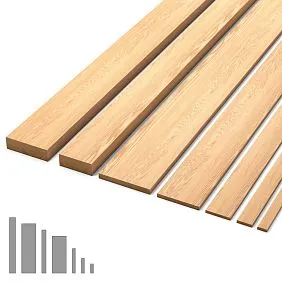
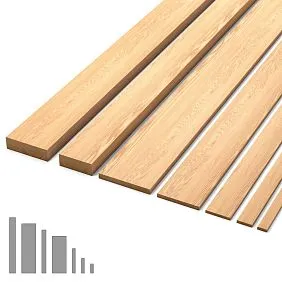


The trend for wooden slats on the wall — why this decor became popular
Before talking about how to install slats, it's worth answering the question: why did this technique become so in demand in the first place? Not 'it's beautiful' — that's not an answer. There are many beautiful solutions in interiors. Why specifically slats?




Three reasons for the trend's durability
The first reason — naturalness in the age of synthetics. The last decade has been marked by market saturation with imitations: vinyl 'planks', laminate 'under wood', PVC panels with a 'natural texture' print. This stream of imitations has generated a counter-wave: a demand for genuine wood that can be touched and felt. Solid wood slats are an honest answer to this demand. There is no print, no lamination, no plastic here. The texture is real, the smell is real, the tactile sensation is real.
The second reason — geometric expressiveness at minimal cost. A slatted wall is one of the most 'impactful per ruble invested' design techniques. Several linear metersof decorative slats, applied to one wall, radically change the perception of the entire room. There's no need to redo the ceiling, change the floors, or buy new furniture — one accent wall reboots the entire interior.
The third reason — stylistic versatility. A wooden slatted wall is organic in Scandinavian style and Japanese minimalism, in neoclassicism and modern loft, in a children's room and an office meeting room. The wood species, spacing, finish, and orientation of the slats change — and the same technique yields fundamentally different results. This is a rare case where 'one idea — an infinite number of versions'.
Our factory also produces:


Where did wooden slats as decor come from
Slatted walls are not an invention of the 21st century. In Japanese architecture, vertical slats (shingi) have been used to divide space for hundreds of years. In Scandinavian interiors, horizontal boards and slats are a traditional way of finishing the walls of log houses. In British mansions, slatted panels are a classic of the Victorian era.
The modern trend synthesized all these traditions in a new context: an urban apartment, minimalist furniture, white walls — and an accent wall of wooden slats as the only 'living' element of the interior. This contrast creates the visual effect.
Get Consultation
Vertical slats — rhythm, height, spacing between slats
Verticalwooden planks on the wall— a classic of the genre. A rhythmic vertical pattern has two undeniable advantages that make it the first choice for most rooms.
Visual effect of verticals
Vertical lines on a wall direct the gaze upward — towards the ceiling. This is an optical technique that works unfailingly: a room with vertical slats is perceived as taller than it actually is. In apartments with ceilings of 2,600–2,700 mm, this is an invaluable property.
The effect is enhanced if the slats run from floor to ceiling — without breaks, without horizontal 'crossings'. The gaze 'slides' from the baseboard to the cornice along rhythmic verticals, and this continuous movement creates a sense of height.
A similar principle works in clothing: a vertical stripe 'elongates' the figure. Vertical slats on a wall 'elongate' the room. This is not a coincidence — these are laws of visual perception that are thousands of years old.
Spacing between vertical slats: calculation
Spacing — the distance between the centers of adjacent slats or the distance between their side edges (gap). This is the key parameter determining the visual effect of a slatted wall.
Equal spacing (gap = slat width): The wall is 50% covered with wood, 50% with gap. A clear, rhythmic, 'striped' effect. Good for modern minimalism and loft.
Narrow gap (gap < slat width): Wood dominates. The wall looks 'rich', warm. Good for a bedroom, living room with dark walls, rooms where a 'cozy' atmosphere is needed.
Wide gap (gap > slat width): The wall background is more visible than the wood. A 'light', airy structure. Good for small rooms and light interiors — the slats 'hint' at structure without overloading the space.
Recommended parameters for vertical slats:
| Batten width | Recommended gap | Effect |
|---|---|---|
| 20 мм | 20–40 mm | Frequent rhythm, "weaving" |
| 30 мм | 30–50 mm | Standard rhythm, universal |
| 40 мм | 40–60 mm | Calm rhythm, monumentality |
| 50–60 mm | 50–80 mm | Wide rhythm, "air" |
How to calculate the number of battens for a wall
Algorithm for calculating vertical battens for a wall of width W:
-
Choose batten width (b) and gap (g).
-
Laying step: s = b + g.
-
Number of battens: n = (W + g) / s.
-
Round the result to a whole number.
-
Check: final gap = (W − n × b) / (n − 1).
Example: wall 3,600 mm, batten 30 mm, gap 40 mm. Step 70 mm. Number of battens: (3600 + 40) / 70 = 52 pieces. Final gap: (3600 − 52 × 30) / 51 = (3600 − 1560) / 51 = 40 mm. Exact match — calculation is correct.
Unequal step: playing with rhythm
Author's interior — not always a uniform grid. Grouping battens — 2–3 pieces tightly together with a wide gap between groups — creates a "syncopated" rhythm. Or: different batten widths in one sequence (30–60–30–60 mm) — a binary rhythm, "breaking" the monotony of equal spacing.
Such solutions require preliminary marking on paper or in an editor — improvisation "by eye" during installation yields unstable results.
Horizontal battens — zoning and visual expansion
Horizontalwooden planks on the wall— a different tool with different tasks. If verticals "pull" space upward, then horizontals "pull" it sideways.
When to choose horizontal battens
A horizontal batten wall is the right choice in several cases:
Narrow room. A corridor 1,200 mm wide with vertical battens "narrows" even more. Horizontal battens "push apart" the walls, making the corridor visually wider.
Low ceiling. Paradoxically, horizontal battens, when properly positioned, do not "lower" the ceiling but "draw" the gaze sideways — the interior is perceived as more spacious despite the low ceiling.
Height zoning. Horizontal battens on part of the wall (e.g., up to a height of 1,000–1,200 mm — "panel zone") create a clear division: a wooden zone near the floor and a clean wall above. This is an analogue of the classicwooden panel with moldings, only in a laconic modern execution.
Scandinavian and minimalist style. Horizontal battens are a "signature" of northern design. Combined with white walls and light floors, they create that very "Scandinavian air".
Horizontal battens in combination with baseboard
With horizontal batten installation, the bottom batten in the row "meets" the baseboard at the floor. Important: this meeting must be intentional. Three options:
Battens start from the top edge of the baseboard.Wooden baseboardThe baseboard serves as the "base" from which the battens "grow". The baseboard and battens should be of the same wood species and finish — it's a unified system.
Battens go down to the floor (no baseboard on top). The bottommost batten itself acts as the "baseboard". Suitable for interiors without a baseboard or with a recessed, hidden-mount baseboard.
Battens are placed only in the upper zone of the wall. The lower part of the wall is clean, the baseboard is standard. The upper zone (e.g., from 1,400 mm to the ceiling) features horizontal battens. An interesting technique for accentuating the upper part of the room.
Combination of vertical and horizontal battens
A 'grid' of intersecting vertical and horizontal battens is a separate decorative technique. Important here: the first layer (closer to the wall) is the supporting frame, the second layer (closer to the observer) is the visible decorative row. The thickness of the first layer is 20–25 mm, the second is 15–20 mm. The final wall 'relief' is 35–45 mm from the wall surface.
A lattice batten wall is a complex solution requiring precise marking, but it provides a unique three-dimensional effect that cannot be achieved by any other means.
Accent wall behind a bed or sofa — calculation and installation
An accent wall is the only wall in a room decorated differently from the other three. A wooden batten accent wall is one of the most spectacular and popular solutions for bedrooms and living rooms.
Wall behind the bed in the bedroom
The wall behind the bed headboard is the 'focal point' of the bedroom. It is what a person sees upon entering the room. It creates a 'frame' for the bed and sets the tone for the entire bedroom interior.
wooden planks on the wallIn the bedroom behind the bed — a solution combining the tactile warmth of wood (especially important in the bedroom — a place of rest and recovery) with the visual expressiveness of a rhythmic pattern.
Parameters of a batten wall behind a bed:
-
Width: typically, from wall to wall (full width of the room) or the width of the bed plus 400–600 mm on each side
-
Height: from floor to ceiling (maximum effect) or from floor level to 1,800–2,000 mm (medium accent)
-
Batten orientation: vertical — a classic for bedrooms (visual 'canopy' over the bed)
-
Wood species: oak in a natural tone, dark oak, whitewashed oak — depending on the overall color palette of the bedroom
A dark batten wall behind a white bed — contrast creating a cozy 'cocoon'. A light whitewashed batten wall behind a dark bed — Scandinavian lightness. Natural oak behind linen textiles — an 'organic' bedroom without a pronounced stylistic statement.
Wall behind the sofa in the living room
A batten wall in the living room behind the sofa — the 'backrest' of the living area, its architectural background. Unlike in the bedroom, where the wall creates an intimate atmosphere, in the living room, a batten wall is a social accent: it is visible to guests, it 'represents' the living room.
Parameters of a batten wall in the living room:
-
Width: the entire wall or the width of the sofa + 300–500 mm
-
Height: from floor to ceiling — most convincing
-
Batten orientation: both vertical and horizontal — depends on ceiling height and wall width
-
Connection with wooden elements: battens should be coordinated with, which covers the technological gap. The top edge may be detailed with a cornice or left open.anddoor casings— a single wood species and finish
Material calculation for an accent wall
Step-by-step calculation:
-
Determine the wall area (width × height). Example: 3,800 × 2,700 mm = 10.26 m².
-
Select batten parameters: width 30 mm, gap 40 mm.
-
Calculate the number of battens: (3800 + 40) / (30 + 40) = 3840 / 70 = 54.8 → 55 battens.
-
Length of each batten: 2,700 mm (floor to ceiling).
-
Linear meters: 55 × 2.7 = 148.5 lm.
-
Margin 10–15%: 148.5 × 1.12 = 166.3 linear meters.
The margin accounts for end waste during precise cutting and possible replacements of defective pieces. Natural wood slats are a living material, and 3–5% of a batch may have hidden defects only revealed during cutting.
Wall preparation
Key condition for a quality slat wall: a flat surface. A slat wall does not hide wall unevenness—on the contrary, slats installed on an uneven wall highlight every deviation. Surface variation under the slats: no more than 3 mm over 2 meters.
For greater variation—level with plaster or install slats on battens (wooden 20×40 mm strapping battens, leveled).
Methods of wall attachment: adhesive, anchors, mounting tape
Installing wooden slats on a wall is a task with multiple solutions. The choice of method depends on wall material, slat weight, and requirements for structure removability.
First method: mounting adhesive
Installing wooden slats on a wall with adhesive is a fast, clean, and—with the right adhesive choice—very reliable method.
When suitable:
-
Flat wall (drywall, plastered brickwork)
-
Slats up to 60 mm wide and 20 mm thick (light slats)
-
No future removal required
-
Room without significant humidity fluctuations
Which adhesive to use:
Acrylic mounting adhesive (flexible): the best choice for wooden slats. Provides flexible bonding—compensates for wood micro-movements due to humidity changes. Does not warp slats during drying.
Polyurethane mounting adhesive (foam): reliable fastening, but expands upon drying—may warp thin slats. Use cautiously for slats < 15 mm thick.
Liquid nails based on neoprene: rigid bond, not recommended for wood—slat movement may tear out fragments of the wall base.
Adhesive installation technique:
-
Mark the axis of each slat on the wall.
-
Apply adhesive to the back surface of the slat in a serpentine pattern—application spacing 200–250 mm.
-
Place the slat against the wall according to markings, press for 30–60 seconds.
-
Secure with painter's tape or mounting clamps for 24 hours.
-
Remove tape after adhesive cures.
Second method: anchors and screws
Anchor fastening is a reliable method for heavy slats (width > 60 mm, oak slats) and for walls with uneven surfaces.
Fastening pattern:
-
Fastening point spacing: 400–500 mm along slat length
-
First and last point offset from slat end: 80–100 mm
-
Hole diameter in slat: 3.5–4 mm (for 3.5×40 mm screw)
-
Anchoring depth into wall: 40–50 mm (into concrete/brick), 30–35 mm (into aerated concrete/drywall)
Hidden fastening: to preserve a clean visible surface of the slat, angled fastening is used (a screw is driven at a 45° angle through the side edge of the slat into the wall) or a cleat fastening (similar to installation).wooden baseboards).
If fastening is done through with a visible head—the head is countersunk into the body of the batten and covered with a wooden plug or wood putty matching the wood species.
Third method: double-sided mounting tape.
VHB (Very High Bond) mounting tape — an acrylic foam tape with strong adhesion on both sides. The holding capacity of VHB series tapes is up to 20–30 kg/m² (depends on the surface).
When suitable:
-
Very lightweight thin slats (thickness 10–15 mm, width 20–40 mm).
-
Smooth wall (painted drywall, tile, glass).
-
Requires a perfectly clean visible surface without any traces of fastening.
-
Temporary or removable structure (VHB tape is removed from glass with a special solution).
Limitations: for heavy oak slats and long vertical slats (> 1,800 mm) — insufficient reliability. VHB tape is a supplement to the main adhesive, but not an independent fastening for full-wall-height slats.
Fourth method: installation on guides.
For walls with surface irregularities or to create a ventilation gap behind the slats (relevant for exterior and damp walls) — installation on guides.
Scheme: horizontal guide slats 20×40 mm are attached to the wall with anchors spaced 400–500 mm vertically, set strictly level. Decorative slats are attached vertically to the guides — with finishing nails or screws through the guide from the outside.
This method is the only one that allows achieving a level slatted wall on an uneven base. The difference between 'level' and 'following a curved wall' in slat decor is visually critical.
Hybrid installation: adhesive + anchor.
Optimal method for most interior applications: the slat is attached with mounting adhesive (ensures uniform adhesion along the entire length) + 1–2 anchors at the endpoints (guarantee reliability during long-term use).
The adhesive works immediately — holds the slat during fixation. Anchors — long-term guarantee. Together — professional installation that won't require rework in 3–5 years.
Painting and tinting slats — uniform color or contrast.
CoatingDecorative wooden planks— not a technical issue, but a design one. It is the finish that determines the final visual result.
Natural oil: texture without masking.
Oil-wax on wooden slats — a solution for those who choose 'honest' wood: visible texture, open pores, 'living' surface. Oak under oil reveals its full character: medullary rays, large vessel pores, contrast between earlywood and latewood.
Tinted oil allows choosing the color temperature while preserving the texture:
-
Natural oil — warm honey-golden tone.
-
'Grey oak' oil — cool modern tone.
-
'Dark oak' / 'tobacco' oil — rich brown.
-
White oil — ash-white with visible texture.
Coating wooden products with oil.— is applied before installation — it's easier to treat all edges of the slat, including ends and the back side.
White slats: Scandinavian classic.
White wooden slats on a wall — one of the most popular options. White color 'mutes' the wood texture and brings geometry to the forefront — the rhythm of lines.
Technology: water-based acrylic paint, matte finish. Mandatory priming of coniferous species with a shellac sealer (otherwise resin will 'bleed through' the white paint after a year). For oak slats, shellac primer is also recommended — oak tannins can cause yellowing through white acrylic paint.
White battens on a white wall — a monochrome solution where the relief is perceived only through shadows. The effect is delicate, 'intellectual.' White battens on a dark wall (graphite, dark green, dark blue) — a bright contrast, an expressive accent.
Tinted battens: harmonizing with the interior
Tinting battens to match parquet or furniture — a systematic approach. If the living room has oak parquet in a 'coffee' tone and a sofa with wooden legs in the same tone — a batten wall in a similar 'coffee oak' tone creates a sense of a unified material concept.
This principle — one wood species, one tone for all wooden interior elements — is used inSTAVROS complete solutions, where battens, baseboards, moldings, and door casings are made from a single batch of oak with a unified finish.
Two-tone batten walls
A non-standard but very effective technique: some battens in one tone, others in another. Options:
Alternating tones: batten 'natural oak' / batten 'whitewashed oak' every other. A binary color rhythm over a binary wood/gap rhythm — a complex but rich texture.
Ombre (gradient): battens on the left are dark, gradually lightening toward the right edge. Technically challenging, visually — unique.
Accent in the center: the central 3–5 battens in a different tone, the rest — neutral. Highlighting the 'center' of the wall — like backlighting behind a TV, but with wood.
Applying finish before or after installation
Both options are applicable, each with its own advantages:
Before installation (recommended for oil): all edges of the batten are treated evenly. The ends and backside receive coating — full protection. Disadvantage: during installation, the ends will inevitably be damaged (when cutting) — restoration is required.
After installation (recommended for paint): the coating covers both the gaps between battens and the wall in the gap — a unified tone for the background and battens (or intentionally contrasting). Disadvantage: harder to treat the back surface and ends.
Hybrid: main coating — before installation, final layer — after. Optimal for a quality result.
Battens on the wall in different interior styles — five solutions
Instead of a photo selection — detailed, evocative descriptions of five stylistic solutions. Each is a complete designer image with specific parameters.
Scandinavian bedroom
Wall: behind the headboard of the bed, width 3,200 mm, floor to ceiling 2,600 mm.
Battens: ash or birch, width 30 mm, gap 40 mm, vertical orientation. Finish: white oil — ash-white tone with visible texture.
Wall background: white (RAL 9016) — battens in the same tone almost blend with the background, visible only through relief and shadows.
Adjacent:white wooden skirting board60 mm, same wood species, same finish. White door casings.
Effect: airiness, lightness. Wood is present tactilely but 'doesn’t shout' — delicate Scandinavian decor.
Japanese minimalism in the living room
Wall: side wall of the living room, width 4,000 mm, height 2,700 mm.
Battens: oak, square cross-section 20×20 mm, gap 60 mm, vertical. Finish: dark oil 'wenge' — almost black tone with barely visible texture.
Wall background: deep dark gray — battens 'dissolve' into the background, forming a subtle 'hatched' pattern.
Adjacent:dark oak moldingsaround the perimeter of the wall. Baseboard 80 mm in the tone of the battens.
Effect: meditative depth. The wall "breathes" — space is discernible behind the slats. Strictness and tranquility.
English classic living room
Wall: wall behind the sofa, width 3,800 mm, height 3,000 mm.
Slats: quarter-sawn oak, width 60 mm, gap 20 mm, horizontally — lower wall zone up to a height of 1,200 mm. Above — a clean wall in "dark green" tone.
Slat finish: "tobacco" oil — warm brown tone.
Transition: the horizontal slatted zone is topped witha wooden separator moldingwith a shaped profile.baseboard 100 mmmade of oak to match the slats.door casingswith a shaped profile.
Effect: London club library. Dark wood + dark green = "club" atmosphere, seriousness, dignity.
Modern loft
Wall: end wall in a studio living room, width 5,000 mm, height 3,200 mm.
Slats: larch, width 40 mm, gap 40 mm, vertically. Unfinished — brushed surface with light charring and treatment with linseed oil.
Wall background: industrial gray — exposed concrete or RAL 7039 paint.
Adjacent:larch skirting boardor brushed oak. Metal parts of the fixtures — matte black steel.
Effect: industrial aesthetic, warmed by the wood. Contrast of concrete and larch — an interior with character and without excessive "coziness".
Children's room
Wall: wall behind a house-style bed, width 2,400 mm, height 2,400 mm.
Slats: pine or birch, width 20 mm, gap 30 mm, vertically. Finish: acrylic paint, color — pale powder (RAL 3015) or mint (RAL 6019).
Wall background: white. Colored slats on a white background — a bright, but not aggressive accent.
Transition: white 50 mm skirting board. The slats do not reach the floor — they start from the top edge of the skirting board.
Effect: playfulness, lightness, "childlike" quality without overload. The slats create a feeling of a "house" — a safe, cozy space.
Care for wooden strips on the wall
After installation, a slatted wall requires minimal but regular maintenance.
Annual cleaning: soft brush or vacuum with a delicate surface attachment. Dust in the gaps between slats is inevitable. Wet cleaning — microfiber cloth, slightly dampened with water and neutral detergent. Do not pour water into the gaps.
Oil finish renewal: every 3–5 years — light sanding with P320 along the grain and application of a fresh coat of oil. For this, the slats do not need to be removed — the work is done in place.
Acrylic paint renewal: every 5–7 years — light sanding with P220 and application of a new coat of paint with a brush or short-nap roller (3–5 mm).
Humidity control: maintaining 45–55% RH is a key condition for the durability of all wooden elements: slats,baseboards, moldingandcasings.
FAQ — answers to popular questions
Do the slats need to be removed from the wall during renovation?
Depends on the mounting method. Slats on clips — removable without damage. Slats on adhesive + dowels — removable with effort, with possible adhesive residue on the wall. If a decor change is planned in 5–7 years — consider a clip-on or removable mounting method during installation.
Can wooden boards be used in a bathroom?
With caveats. A bathroom with good ventilation and no direct water contact on the slats — application is possible under the condition: oil finish with high wax content (water repellency), installation on a ventilation gap (20×20 mm guide slats), regular finish renewal. The best wood species for a bathroom — larch or thermally modified wood.
How to attach vertical battens to drywall?
Drywall is a non-load-bearing base. For battens weighing up to 5 kg per linear meter — use mounting adhesive + plastic butterfly anchors in a staggered pattern with a 400 mm spacing. For heavy battens — attachment to the drywall's metal frame via anchors is required.
Is installing battens on a wall difficult to do yourself?
No, it's one of the few types of finishing that is truly doable on your own with minimal skills. The key points: precise marking (laser level), quality materials, and correct choice of fastening. The first batten — strictly level, the rest — aligned to it.
What is the thickness of a standard decorative batten?
Standard thickness for decorative wall battens: 15–20 mm. Thinner ones (10–12 mm) — risk of deformation with humidity changes. Thicker ones (25–30 mm) — significantly increase the 'depth' of the battened wall, which may or may not be appropriate depending on the concept.
About the company STAVROS
A wooden batten wall is always a story about choice. About choosing not just a finishing material for your home, but the character of the space. Rhythm. Warmth. Authenticity.
STAVROS — a Russian manufacturer of architectural decor from solid natural oak and beech.STAVROS decorative slatsare manufactured with a cross-section tolerance of ±0.2 mm, final sanding with P320 grit, and moisture content of 8–10% — material ready for installation and application of any final coating.
The STAVROS catalog features a complete system of wooden wall decor:decorative battens, Moldings and cornices, baseboards and moldings, door casings, Furniture legsanddecorative handlesOne wood species — oak. One production standard. One system for an interior where all details speak the same language.
STAVROS: wood where character is legible.


