Article Contents:
- Philosophy of plank wall paneling: why it works
- Accent wall as a compositional center
- Play of light and shadow: dynamic painting
- Materials science: wood species and treatment selection
- Oak: nobility and durability
- Ash: dynamic texture
- Beech: uniformity and formability
- Pine: economical naturalness
- Geometry and proportions: mathematics of beauty
- Slat thickness and width
- Spacing between slats: rhythm of space
- Installation height: floor-to-ceiling or fragmentary
- Color and finish: from natural to experimental
- Natural wood with oil: material honesty
- Toning: texture plus color
- Painting: integration into the palette
- Installation: professional quality technology
- Surface preparation: perfect plane
- Marking: precision to the millimeter
- Fastening: reliability and invisibility
- Final treatment: perfection finishing
- Application in various rooms: where and how
- Living room: compositional core
- Bedroom: headboard as art object
- Entryway: First Impression
- Office: concentration and status
- Bathroom: wood in humid environment
- Combinations and experiments: complicating composition
- Different cross-sections and rhythms
- Diagonals and complex angles
- Integration of lighting and functional elements
- Combination with other materials
- Maintenance and Operation: Preserving Beauty
- Regular Cleaning
- Recoating
- Cost and budgeting: investment in aesthetics
- Material costs
- Specialists' work
- Frequently Asked Questions
- What type of wood is best for a slatted wall?
- Can planks be installed by oneself?
- How to care for wooden slats?
- Are slats suitable for a small room?
- What is the optimal spacing between slats?
- Is a frame needed or can slats be attached directly to the wall?
- Can planks be used in wet areas?
- How much do wooden slats cost?
- Can slats be painted in another color?
- Where to buy quality wooden slats?
- Conclusion

What should a modern interior be like to evoke emotions? How to turn an ordinary room into a space with character, depth, and its own voice? The answer lies not in expensive furniture or complex lighting, but in details that create structure, rhythm, tactility. And among these detailswooden slats on the wall accenthold a leading position in design solutions for 2026. This is not just a decorative element — it is a tool for architectural space modeling, a way to manage visual flows, a method for creating a third dimension on a flat wall surface.
An accent wall made of vertical or horizontal slats transforms the perception of the entire room. It becomes the compositional center that draws the eye, around which all other furnishings are arranged. At the same time, the slatted structure possesses an amazing property — it is expressive enough to dominate the space, but not so massive as to overwhelm or overload. Air circulates between the slats, light creates a play of shadows, the eye glides along rhythmic lines — dynamics, movement, life emerge.


Philosophy of plank wall paneling: why it works
The slatted structure appeals to deep archetypes of human perception. Rhythm — the repetition of elements at equal or systematically changing intervals — is one of the fundamental principles of information organization. Our brain loves rhythm; it orders chaos, creates predictability, and calms. Vertical lines pull the gaze upward, creating a sense of height, aspiration, growth. Horizontal lines expand space, stabilize, ground.
But it's not just about geometry.Buy oak wooden planks for wallsis also valuable because wood is a material with its own energy. Even in the form of thin slats, wood retains its organic warmth, texture, and subtle aroma. This is a counterbalance to the cold geometry of modern interiors, a balance between technological sophistication and naturalness.




Accent wall as a compositional center
Any space needs hierarchy. Not everything can be equally important — the gaze will get confused, attention will scatter, and a sense of chaos will arise. An accent wall establishes a dominant, saying: 'Look here. This is the center. This is where the space begins.' And the slatted structure handles this task perfectly — it is expressive enough but doesn't shout, doesn't oppress, doesn't compete with the people in the room.
In the living room, the accent wall is often the wall behind the sofa or behind the TV. In the bedroom — the wall at the head of the bed. In the study — behind the desk. In the hallway — the first wall seen upon entering. The choice of location is not random — it is always a functionally significant zone that is logical to highlight and emphasize.
Our factory also produces:


Play of light and shadow: dynamic painting
A flat painted wall is static. It is the same in the morning and evening, under sunlight and artificial light. A slatted structure is a living surface. Each slat casts a shadow on the wall behind it, creating a light gradient on its own surface. The angle of illumination changes throughout the day—and so does the character of the shadows, the depth of the gaps, the contrast of the entire composition.
Directional lighting enhances the effect. A lamp installed at an angle to the side of the slatted wall creates long, dramatic shadows. Light from above — short horizontal stripes. Hidden backlighting behind the slats turns the wall into a glowing object, almost mystical, floating in space.
The thickness of the slats determines the depth of the shadows. Thin slats of ten to fifteen millimeters create a delicate relief, light hatching. Thick slats of forty to fifty millimeters form deep, contrasting shadows, creating a sense of powerful architectural relief. The choice depends on the desired effect and the scale of the room.
Get Consultation
Materials science: choice of wood species and treatment
Wooden plankfor a wall can be made from various wood species, and each has its own character, its own visual and performance properties.
Oak: nobility and durability
Oak — the choice for premium-class interiors, where not only aesthetics matter but also status, durability, and respectability. Oak wood has an expressive, contrasting texture with clearly distinguishable annual rings, large pores, and light medullary rays. The color varies from light golden (young oak) to rich brown (mature oak) and almost black (bog oak).
The density of oak, seven hundred to eight hundred kilograms per cubic meter, ensures high mechanical strength. Oak slats do not deform, do not sag, and maintain their geometry for decades. The high tannin content (tannic substances) provides natural resistance to biological impacts — fungi, mold, insects.
From an aesthetic point of view, oak is universal. In its natural form with oil, it fits perfectly into Scandinavian style, eco-interiors, and modern classics. Tinted in gray shades — into industrial lofts, minimalism. Painted white — into Provence, shabby chic, Scandinavian white aesthetic.
Ash: dynamic texture
Ash is similar to oak in physical characteristics — high density, strength, elasticity. But the texture is different — more contrasting, with pronounced wavy annual rings. On a radial cut, ash displays a beautiful wavy pattern reminiscent of moiré silk. On a tangential cut — expressive arches that create visual movement.
The color of ash is lighter than oak — from creamy white to light brown with a gray or olive undertone. This neutrality allows ash to be easily tinted into any shades — from bleached to wenge. Tinting into gray and graphite colors is especially popular — on the contrasting texture of ash, this creates a modern industrial effect.
Wooden Planks for Wallsmade of ash — the choice for dynamic modern interiors where the expressiveness of the material and its visual activity are valued. Ash slats themselves become a decorative accent thanks to their texture.
Beech: uniformity and formability
Beech is a wood with a fine-pored, uniform structure and a neutral pinkish hue. The grain is subtle—there are no contrasting annual rings, large pores, or bright patterns. This makes beech an ideal material for applications requiring a smooth surface without distracting details, or when painting is planned.
Beech battens are easily stained and painted in any color. Thanks to their uniform structure, paint applies evenly, without streaks or uneven tones. This is important for interiors where battens need to be painted a specific color from the RAL palette to precisely match the overall color scheme.
Another unique property of beech is its formability. After steaming, beech wood becomes pliable, allowing for the creation of curved elements with a bending radius from four hundred millimeters. This opens up possibilities for creating complex-shaped batten structures—semi-circular walls, arched openings, wave-like compositions.
Pine: Economical Naturalness
Pine is a budget-friendly option for projects with limited budgets or for interiors where a deliberately natural, unpolished aesthetic is appropriate. The soft, light wood with characteristic resin ducts and knots has a distinct coniferous aroma that many find pleasant and relaxing.
Pine's density is lower than that of hardwoods—about five hundred kilograms per cubic meter. This means lower mechanical strength and a greater tendency to dent and scratch. But for wall battens that are not subjected to mechanical loads, this is not critical.
Pine battens are good for cottage interiors, country style, eco-aesthetics, where natural simplicity is valued. They are also suitable for children's rooms, where the naturalness of materials is especially important, and the low price allows for large-scale projects.
Geometry and Proportions: The Mathematics of Beauty
Creating an accent wall with battens is not just about mounting slats on a wall. It is architectural design in miniature, where proportions, rhythm, and relationships are important.
Thickness and Width of Battens
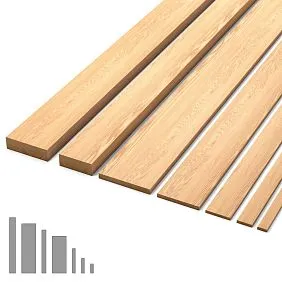
The cross-section of battens determines the character of the entire composition. Thin battens of ten by twenty millimeters create a light graphic, almost lace-like structure. They are delicate, non-dominant, and suitable for small spaces where it's important not to overload the area. The optimal installation spacing is fifty to seventy millimeters.
Medium battens of twenty by forty millimeters are the most versatile option. They are expressive enough to create a noticeable accent but not massive. Suitable for most interiors—from Scandinavian minimalism to modern classic. Installation spacing is eighty to one hundred twenty millimeters.
Thick battens of thirty by fifty or forty by sixty millimeters are for spacious rooms with high ceilings, where monumentality and expressive relief are needed. They create deep shadows, powerful verticals, and architectural weight. Installation spacing can be larger—one hundred fifty to two hundred millimeters, or conversely, battens can be mounted close together, creating an almost solid surface with narrow light gaps.
Spacing Between Battens: The Rhythm of Space
The distance between battens is no less important than their size. A frequent rhythm—battens spaced thirty to fifty millimeters apart—creates a dense, almost textile-like structure. The wall behind the battens is hardly visible, and the composition is perceived as a single surface.
A medium rhythm—seventy to one hundred millimeters—balances the slats and gaps. The structure is clearly readable, the play of light and shadow is expressive, yet the background wall is visible through the battens, allowing for color contrast play.
A wide rhythm—one hundred fifty to two hundred fifty millimeters—creates a sparse structure where each batten is perceived individually. This is a more minimalist approach, suitable for interiors where lightness and airiness are important, where battens should not dominate but merely hint at structure.
An interesting effect is achieved with a variable rhythm—alternating different intervals according to a specific pattern or randomly. This creates visual complexity, makes the composition more interesting for prolonged contemplation, and prevents the eye from getting bored.
Installation Height: From Floor to Ceiling or Fragmentary
The classic option—battens run from floor to ceiling, creating a continuous vertical structure. This maximally elongates the space, emphasizes height, and creates a sense of upward aspiration. Works well in rooms with ceilings from two meters seventy centimeters.
Fragmentary installation—battens occupy not the entire wall height but a part of it. For example, a strip one hundred twenty to one hundred fifty centimeters high, positioned at eye level. Or the lower third of the wall, creating an effect of tall panels. This is a less radical solution, suitable for conservative interiors or when an accent is needed without excessive drama.
Horizontal battens visually expand the space, making the wall appear wider. This can be useful in narrow areas—hallways, elongated rooms. Horizontal lines also create a sense of stability, calm, and groundedness—unlike the dynamic vertical.
Color and Finish: From Naturalness to Experiment
How to finish the battens? Leave them natural, emphasizing the natural beauty of the wood? Paint them to integrate into the interior's color scheme? Stain them in unusual shades to create a unique effect?
Natural Wood Under Oil: Honesty of Material
Clear oil is the perfect coating for battens when it's important to preserve the tactile feel and visual warmth of the wood. Oil penetrates the wood, strengthens the surface layer, protects against moisture and dirt, but does not create a surface film. The wood remains 'breathable,' pleasant to the touch, and non-reflective.
The color and grain of the wood under oil are revealed to their fullest. Oak acquires a golden warmth, ash a silvery coolness, beech a soft pink hue. Oil slightly darkens the wood, makes the grain more contrasting, and emphasizes the fiber pattern.
For interiors focused on eco-friendliness, naturalness, connection with nature—Scandinavian style, eco-minimalism, Japanese aesthetics—battens under oil are ideal. They become not just decor, but an embodiment of the philosophy of naturalness, simplicity, and honesty of material.
Staining: Texture Plus Color
Stains and tinting oils allow you to change the color of the wood while preserving the visibility of the grain. This is a compromise between natural wood and paint—you get the desired color, but the material remains recognizable, its natural structure visible.
Traditional tinting shades — walnut, wenge, rosewood, teak — mimic valuable exotic wood species. Oak or ash slats tinted to resemble wenge look like products made from African wood, but are significantly cheaper and more eco-friendly.
Modern trends include tinting in gray, graphite, and even black shades. Gray wood is the hallmark of industrial and minimalist interiors. The contrasting texture of ash or oak in gray creates the effect of aged, weathered wood, adding depth, history, and character to the interior.
Bold experiments involve tinting in unconventional colors: blue, green, burgundy. Against the natural wood grain, these colors look not artificial but organic, like natural variations. Such solutions are for avant-garde interiors, art spaces, and commercial projects where uniqueness is important.
Painting: Integration into the Palette
Full painting conceals the wood grain but allows precise integration of the slats into the interior's color scheme. White slats on white walls create a subtle play of white shades and relief. Black slats provide dramatic contrast, graphic appeal, and modernity. Colored slats add accent, emotion, and individuality.
High-quality painting of wooden slats requires preparation. The surface is sanded, primed, and then two to three coats of paint are applied with intermediate sanding. The result is a perfectly smooth matte surface with no visible brush or roller marks.
Water-based acrylic paints are the optimal choice. They are eco-friendly, odorless, dry quickly, and form a durable, wear-resistant coating. Matte finishes are preferable to glossy ones—they create a noble, velvety surface, do not glare, and look visually more expensive.
Installation: Professional Quality Technology
The beauty of a slatted wall is ninety percent determined by the quality of installation. Crooked lines, uneven spacing, visible fasteners—all of these ruin the effect even when expensive materials are used.
Base Preparation: Perfect Flatness
Slats are attached either directly to the wall or to a frame. In the first case, the wall must be perfectly flat. Any bumps, depressions, or deviations from vertical will become apparent after installing the slats—they will not hide defects but emphasize them.
Flatness is checked using a long straightedge or laser level. The permissible deviation is no more than two millimeters over two meters. If the wall is uneven, it is leveled with plaster, putty, or covered with drywall.
For frame installation, horizontal guides made of 40x40 mm wooden battens or metal profiles are attached to the wall. The spacing of the guides is 40–60 centimeters. The frame is set strictly level and flat—this is the foundation on which the geometry of the entire structure depends.
Marking: Precision to the Millimeter
Before starting installation, precise marking is performed. The position of the first and last slat is determined, and the number of slats and the spacing between them are calculated. If the spacing must be constant, it is calculated based on the wall width, slat width, and their quantity.
Formula: spacing = (wall width - (number of slats × slat width)) / (number of slats - 1)
For example, a wall three meters wide (three thousand millimeters), slats forty millimeters wide, and twenty-five slats need to be installed. Spacing = (three thousand - (twenty-five × forty)) / (twenty-five - 1) = (three thousand - one thousand) / twenty-four = eighty-three and three-tenths millimeters.
On the wall or frame, the centers or edges of each slat are marked with a pencil. A long level or laser plane builder is used to ensure all marks are strictly vertical. Marking accuracy is critical—an error of one to two millimeters per slat accumulates and can amount to several centimeters by the end of the wall.
Fastening: Reliability and Invisibility
Slats are attached to the base or frame using adhesive, mechanical fasteners, or a combination of both. For lightweight, thin slats, construction adhesive (liquid nails, polyurethane adhesive) is sufficient. The adhesive is applied in strips to the back of the slat, the slat is pressed against the wall, aligned with the markings, and fixed with temporary supports or painter's tape until the adhesive sets.
For thicker and heavier slats, additional mechanical fastening is required. Headless finishing nails or thin screws are used, which are driven into the slat at a slight angle and countersunk into the wood. The fastener locations are filled with putty, sanded, and then the slats are painted or oiled—making the fasteners invisible.
An alternative is hidden fastening using clips (special metal brackets) or a tongue-and-groove system. Clips are attached to the frame, and the slats snap into them without through fasteners. The tongue-and-groove system involves each slat having a groove on one side and a tongue on the other; they interlock with each other, and only every third to fifth slat is attached to the frame.
Finishing: Perfecting the Details
After installing all slats, geometry is checked, ends are sanded (if slats were trimmed to height), and fastener locations are filled with putty. If slats were installed unfinished, oil, stain, or paint is now applied. If slats were pre-finished, only final sanding and a protective coat in areas of hand contact may be required.
The lower ends of the slats, adjacent to the floor, are often covered with a baseboard. The upper ends at the ceiling can be left open (if the cut is neat), covered with a ceiling molding, or a decorative strip. The side edges of the slat composition are finished either with decreasing slat spacing (the last slat fits tightly into the corner or edge) or with a finishing strip of contrasting color or greater width.
Application in Various Rooms: Where and How
interior wall decorWooden slat decor is universal, but each type of room has its own nuances and optimal solutions.
Living Room: Compositional Core
In the living room, an accent slatted wall is most often placed behind the sofa or in the TV area. These are logical compositional focal points where the attention of people in the room is directed. The slats create a background that does not compete with the screen image but structures the space around it.
Vertical slats behind the sofa visually raise the ceiling, creating a sense of height and airiness. If the living room has a fireplace or faux fireplace, slatted cladding around the portal emphasizes its significance and creates an architectural frame.
An interesting solution is a slatted partition for zoning an open floor plan. Such a partition does not block light and air but visually separates the living area from the dining or kitchen area. Through the gaps between the slats, the spaces remain connected, yet each retains its own identity.
Bedroom: Headboard as an Art Object
The wall behind the bed headboard is a classic spot for an accent. Slatted wall paneling here serves several functions: it visually highlights the sleeping area, creates a vertical composition that balances the horizontal line of the bed, and adds the tactile and visual warmth of natural wood.
For bedrooms, light wood species and non-aggressive rhythms are preferable. Slats made of light oak, beech, or pine with a natural oil finish create a calm, relaxing atmosphere. A medium or wide spacing is used — there's no need to overload the space where a person rests.
A functional addition is the integration of hidden lighting behind the slats. An LED strip installed between the slats and the wall creates a soft, diffused glow that can serve as a night light. Additionally, sconces, power outlets, and USB charging ports can be built into the gaps between the slats — they remain hidden, not disrupting the visual integrity of the composition.
Entryway: first impression
The hallway is the first room seen upon entering a home. Here, an accent wall sets the tone and forms the first impression of the interior style. Slatted wall paneling in hallways is often combined with functional elements: coat hooks, a mirror, a shoe rack.
Due to the limited area of hallways, the slatted composition here is usually fragmentary — not the entire wall, but a section of it. Vertical slats visually raise low ceilings in standard apartments, which is especially relevant for narrow hallways where a feeling of cramped space needs to be compensated for.
A practical point is the choice of wood species and finish. The hallway is a high-traffic area; walls here can get splashed or touched with dirty clothing. It's better to choose hardwoods (oak, ash) with a protective varnish or oil finish that is easy to clean and resistant to stains.
Office: Concentration and Status
In a home office or study, a slatted wall behind the desk creates a background for video conferences, emphasizes status, and forms a business-like atmosphere. Vertical lines are associated with growth, aspiration, ambition — suitable symbolism for a workspace.
The color scheme here depends on the nature of the work. For creative professions — bright, unconventional shades, experimental rhythms. For serious business — restrained tones, classic proportions, noble wood species in their natural state.
Acoustic effect — an added bonus. A slatted structure with an air gap between the slats and the wall partially absorbs sound and reduces reverberation. For video conferences, podcast recording, or playing music, this improves acoustic comfort.
Bathroom: Wood in a Wet Environment
Can wooden slats be used in a bathroom? Yes, provided conditions are met: good ventilation, quality hydrophobic treatment, and the choice of moisture-resistant species. Oak and larch have natural resistance to moisture due to resinous substances in their structure.
In bathrooms, slats are placed in areas not subject to direct contact with water — the wall opposite the bathtub or shower, the area near the sink (with splash protection from glass). The finish is special oil for wet rooms or yacht varnish, creating a waterproof film.
Aesthetically, wood in the bathroom creates a spa-like atmosphere, associations with a sauna, eco-friendliness, and warmth. This contrasts with cold ceramics and plumbing, making the space cozier and more lived-in.
Combinations and Experiments: Complicating the Composition
A basic slatted wall is already a self-sufficient solution. But for those seeking greater complexity, expressiveness, and uniqueness, there are many options for complicating the composition.
Different Profiles and Rhythms
Instead of identical slats, planks of different widths are used, arranged according to a specific pattern or randomly. For example, alternating thin and thick slats creates a visual rhythm resembling a barcode. Or grouping slats — three thin, one thick, again three thin.
Variable spacing — the distances between slats change. You can create a density gradient: slats are closer together in the center of the wall, thinning out towards the edges. Or a wave-like rhythm: density changes sinusoidally across the width of the wall.
Diagonals and Complex Angles
Who said slats must be strictly vertical? Diagonal placement at an angle of thirty, forty-five, or sixty degrees creates dynamism, non-triviality, and visual movement. Such a solution requires more complex installation — each slat is cut at an angle on both ends, and spacing calculation becomes more complicated.
Herringbone, chevron — slats are arranged at an angle, forming a V-shaped pattern. A classic parquet motif transferred to a vertical surface. This is very decorative but labor-intensive to execute.
Integration of Lighting and Functional Elements
Hidden lighting — an LED strip installed between the slats and the wall turns the slatted wall into a glowing object. Light breaking through the gaps creates a magical effect, especially impressive in the evening.
Spot lighting — small light fixtures installed in the gaps between slats at different heights. They create light accents, enhance the play of shadows, and add another dimension to the composition.
Functional elements — shelves, hooks, holders, power outlets — are integrated into the slatted structure. A shelf suspended between slats appears to float. Coat hooks peeking out from the gaps are functional and visually do not disrupt the integrity of the composition.
Combination with Other Materials
Wood combines beautifully with other materials. Slats against a concrete wall — a contrast of warm and cold, natural and industrial, characteristic of lofts. Slats against a brick wall — a combination of two natural textures, creating surface richness.
Mirror inserts between slats visually double the space, creating an infinity of reflections. Metal strips of brass or black steel, alternating with wooden ones, add an industrial or Art Deco accent.
Textile panels, wallpaper, painted sections between slats turn the wall into a multi-layered composition. The slats serve as frames, structuring the heterogeneous elements.
Care and Maintenance: Preserving Beauty
Wooden slats on the wall do not require complex maintenance, but minimal attention is necessary to preserve their original appearance.
Regular cleaning
Dust settles on the horizontal surfaces of the slats and accumulates in the gaps. Regular dry cleaning with a vacuum cleaner using a soft brush or wiping with a microfiber cloth removes dust without scratching the finish. Frequency: once every one to two weeks depending on the dustiness of the room.
Wet cleaning with a well-wrung cloth without excess water is possible for slats with varnish or oil finish. Do not use aggressive detergents, abrasives, or solvents. Mild soap or special wood care products are the maximum allowed.
Recoating
Oil finish requires periodic renewal every three to five years depending on the intensity of use and conditions. The procedure is simple: light sanding with fine abrasive, dust removal, application of a fresh coat of oil. This takes several hours but fully restores the protective and aesthetic properties of the finish.
Varnish finish lasts longer: seven to ten years without renewal. When the varnish begins to dull or develop micro-scratches, it is renewed: sanding, application of a new coat of varnish. Or complete restoration: removal of old varnish by sanding, application of primer and several coats of new varnish.
Painted slats are the most low-maintenance. High-quality paint lasts ten to fifteen years. If necessary, the slats can be repainted in a different color, completely changing the character of the interior without dismantling the structure.
Cost and Budgeting: Investment in Aesthetics
How much does it cost to create an accent slatted wall? The range is wide—from quite affordable solutions to the premium segment. The cost depends on the material, dimensions, complexity of installation, and finish.
Material Costs
Pine slats are the most budget-friendly option. Price from one hundred fifty to three hundred rubles per linear meter depending on the cross-section. For a wall three by two meters with a slat spacing of one hundred millimeters, about sixty meters of slats are required. Total material cost: nine to eighteen thousand rubles.
Beech slats are in the mid-price segment. From four hundred to seven hundred rubles per meter. The same wall: twenty-four to forty-two thousand rubles for the material.
Oak or ash slats are premium. From seven hundred to one thousand two hundred rubles per meter. The wall: forty-two to seventy-two thousand.
To the cost of the slats, add consumables: frame (if used), fasteners, adhesive, finishes. This is another five to ten thousand depending on the chosen technology.
Specialist Labor
Installation of a slatted wall requires precision and skills. The cost of professional installation is from one thousand to three thousand rubles per square meter depending on complexity. Simple vertical layout is cheaper; diagonals and complex patterns are more expensive.
For a six-square-meter wall, the work will cost six to eighteen thousand rubles. Total project cost from pine slats with simple installation: fifteen to twenty-four thousand; up to oak slats with complex installation: eighty to ninety thousand.
Self-installation saves on labor but requires tools (miter saw, level, screwdriver), time, and readiness for mistakes. For a first experience, it is better to choose a small wall and a simple layout.
Frequently asked questions
Which wood species is best for a slatted wall?
For premium interiors with durability of thirty to fifty years: oak or ash. For the mid-segment with a good price-quality ratio: beech. For budget projects or country interiors: pine. The choice also depends on the desired texture: oak and ash are expressive, beech is neutral.
Can planks be installed by oneself?
Yes, with precision, patience, and a minimal set of tools. Key points: even base, precise marking, careful fastening. For a first experience, choose a small wall and a simple vertical layout.
How to care for wooden slats?
Regular dry cleaning with a vacuum cleaner or microfiber cloth. Periodic wet wiping with a slightly wrung cloth. Renewal of oil finish every three to five years. Avoid excess moisture, abrasives, aggressive chemicals.
Are slats suitable for a small room?
Yes, but choose thin slats with a non-dense rhythm, painted in light tones or the color of the walls. This creates a delicate structure without overloading the space. Vertical slats visually raise the ceiling.
What is the optimal spacing between slats?
Universal option: eighty to one hundred twenty millimeters for slats with a cross-section of twenty by forty millimeters. For thinner slats, the spacing is reduced to fifty to seventy millimeters; for thicker slats, it is increased to one hundred fifty to two hundred.
Is a frame needed or can slats be attached directly to the wall?
If the wall is perfectly even, you can glue the slats directly onto it. If there are irregularities, level differences, or a need to hide utilities, use a frame. The frame also creates a ventilation gap, which is beneficial for wooden slats.
Can boards be used in humid areas?
Yes, outside areas of direct contact with water, with good ventilation and quality hydrophobic treatment. Choose moisture-resistant species (oak, larch) with a finish of special oil for wet rooms or yacht varnish.
How much do wooden slats cost?
Pine: from one hundred fifty rubles per linear meter. Beech: from four hundred rubles. Oak and ash: from seven hundred rubles. The price depends on the cross-section, length, and quality of processing.
Can louvers be painted in another color?
Yes, painted slats can be easily repainted. Natural oiled slats can be tinted or painted after light sanding. Varnished slats require removal of the old varnish before new finishing.
Where to buy quality wooden slats?
Choose specialized manufacturers with experience in solid wood, a wide range of species and sizes, and the possibility of custom manufacturing. Pay attention to wood drying quality (should be eight to twelve percent moisture content), geometric precision, and surface treatment quality.
Conclusion
Wooden wall slats are a tool for creating space with character, depth, and emotional impact. An accent slat wall transforms interior perception, creates a compositional center, and adds a third dimension to a flat surface. The play of light and shadow, the rhythm of verticals or horizontals, the tactile warmth of natural wood—all create an atmosphere that cannot be replicated by other means.
In 2026,Wooden Planks for Wallsremain at the top of design trends. Their versatility allows slat finishing to fit into any style—from Scandinavian minimalism to industrial loft, from modern classic to eco-aesthetics. The ability to experiment with species, colors, rhythms, and material combinations makes each project unique.
Creating an accent slat wall is an investment that pays off with durability, aesthetic pleasure, and increased interior value. High-quality wooden slats made from hardwoods, with proper installation and minimal care, last for decades while preserving their original beauty. The possibility of restoration, repainting, and coating renewal allows adapting the interior to changing tastes without dismantling the structure.
STAVROS has specialized for over twenty years in producing high-quality solid wood moldings from noble wood species. Over these years, STAVROS has become one of the leading suppliers of materials for professional designers and demanding clients who value quality, reliability, and eco-friendliness.
STAVROS offers a wide selection ofbuy wooden wall slatswhich come in various cross-sections—from delicate ten by twenty millimeters to monumental forty by sixty. Species include oak, ash, beech, pine, larch—each with its own characteristics and aesthetics. Slats can be supplied in natural form, tinted, or painted in any RAL palette colors.
All STAVROS products are made from wood that has undergone proper kiln drying to a moisture content of eight to twelve percent. This guarantees geometric stability, absence of deformations and cracks during operation. Processing on high-precision CNC equipment ensures perfect dimensions, straightness, and surface cleanliness.
STAVROS offers not only standard products but also custom manufacturing according to individual drawings. If you need slats with non-standard cross-sections, specific lengths, certain profiles, or radius elements—STAVROS specialists will bring your idea to life. Minimum order quantities for custom production, flexible approach, and consultative support at all project stages.
In addition to slats, the STAVROS catalog features a full range of molding products: moldings, baseboards, cornices, door frames, balustrades, stair elements. This allows completing the entire project from a single source, ensuring stylistic unity of all interior elements. Also available areRound wooden balustershandrails, rods, decorative railings—for those seeking non-standard solutions.
Choosing STAVROS means choosing a partner who understands the value of natural materials, respects the traditions of woodworking craftsmanship, and follows modern design trends. STAVROS is a guarantee of quality tested by time and thousands of completed projects. It is the confidence that your interior will be not only beautiful but also durable, eco-friendly, and compliant with the highest standards.
Create the accent wall of your dreams with STAVROS materials—and let your interior gain depth, character, and unique individuality that will delight you and your loved ones for many years.