





































Article Contents:
- What are wooden wall panels and why has the slatted format become the leader
- Why slatted panels are the most practical format for modern interiors
- Visual rhythm and architectural depth
- Space management: height, width, zoning
- Accent wall without visual overload
- What types of wooden panels exist by construction
- Rigid panels
- Flexible panels
- Interior slats as a separate format
- Material comparison: paintable MDF or solid oak
- When it's better to choose MDF
- When to choose oak array
- Brief comparison in one block
- Where to use wooden panels: complete room-by-room overview
- Living Room
- Bedroom
- Entry Hall
- TV Area
- Ceiling
- Columns, arches, niches
- Furniture fronts
- How to choose size and format of wooden panels
- Slat width and spacing
- Panel height
- Fine and coarse rhythm
- When ready-made panel is needed vs. separate slat
- What to choose: ready-made slatted panel or separate interior slats
- Interior styles and slatted panels: where they work best
- Jatoba
- Minimalism
- Modern style and contemporary
- Organic and eco-style
- Commercial interiors: restaurant, office, showroom, hotel
- Installing Wooden Slat Panels: What You Need to Know
- Foundation Preparation
- Material acclimatization
- Dry fitting
- Adhesive and fixing scheme
- Joining and edge processing
- Painting, tinting, varnish
- Common mistakes when choosing wooden panels
- Which solutions suit different tasks
- For an apartment with modern renovation
- For a private house with organic design
- For a cafe or restaurant
- For an office or meeting room
- For a showroom or conceptual space
- For a furniture project
- For curved surfaces
- Wooden panels and acoustics: an unexpected bonus
- Ecology and material safety
- FAQ: Answers to the Most Popular Questions
- About the Company STAVROS
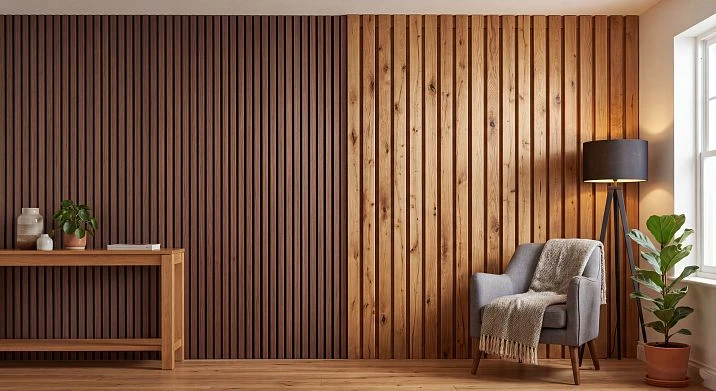
Imagine: you walk into a room — and the first thing you notice is the wall. Not the furniture, not the lighting, not the decor. It is the wall that sets the tone for the entire space, defines the mood, and forms the first impression. Wooden wall panels today are not just a finishing material. They are an architectural solution capable of radically changing the perception of a room: making it deeper, warmer, more expressive. And among all the format diversity, slatted panels hold a special place — thanks to their rhythm, chiaroscuro, and that special liveliness that cannot be imitated by either wallpaper or paint.
This article is written for those who want to make an informed choice: to understand the difference between MDF and solid oak, to understand formats and constructions, to competently select panels for a specific room and task. No fluff — only specifics, examples, comparisons, and practical advice from a specialist.
What are wooden wall panels and why the slatted format has taken the lead
The term 'wooden panels' encompasses several completely different products. Some understand this phrase as smooth veneered sheets, others as solid boards for cladding, and still others as decorative elements with relief. And all of these are indeed wooden panels. But there is a huge difference between them in terms of construction, visual effect, and application area.
Slatted panels are a separate, clearly defined format. Their foundation is the principle of parallel rhythm: vertical or horizontal slats, placed at a specific interval, create a play of light and shadow, turning the wall from a flat surface into a three-dimensional composition. It is precisely this effect — the main advantage of the slatted format over any smooth solutions.
Why have slatted wall panels become one of the most requested formats in interior design today? The answer is simple: they work on multiple levels simultaneously. Visually — they create depth and dynamism. Architecturally — they accentuate a zone or structure space. Practically — they are easy to install, hold paint well, and are compatible with various materials. And when combined with the right material — MDF for painting or solid oak — they become a full-fledged designer tool.
The broad search term 'wooden panels' covers too heterogeneous an audience: some are looking for MDF sheets for furniture, others for sauna boards, others for veneered panels for offices. If you are reading this article in search of specifically wall solutions with pronounced texture and architectural character — you needRafter panels, and the further conversation will be precisely about them.


Why slatted panels are the most practical format for modern interiors
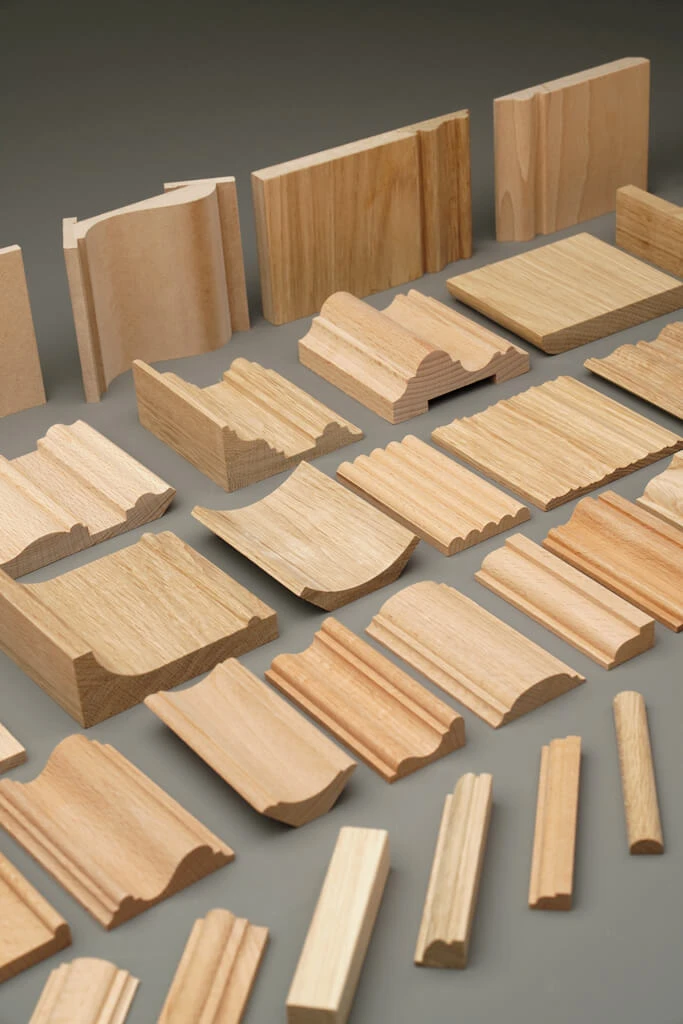
Our factory also produces:






Visual rhythm and architectural depth
A slatted wall is not just decor. It's working with space at an architectural level. Each slat creates a thin strip of light and a slightly darker shadow next to it. When there are twenty, thirty, fifty such strips — they form a visual rhythm that the eye perceives as movement, volume, depth. The wall ceases to be a flat surface and becomes part of the design.
This effect cannot be achieved with a painted drywall slab or even expensive wallpaper. Only physical relief, only real volume gives that play of light and shadow that makes a space come alive.
Get Consultation
Space management: height, width, zoning
Vertical slats visually stretch a room upward. This is not theory, it's optics: the eye follows the direction of lines, and if they go from bottom to top, the ceiling appears higher. This is precisely why wooden slatted panels with vertical orientation are so popular in apartments with standard ceiling heights.
Horizontal slats, on the contrary, expand space — especially in long narrow corridors or hallways. Changing the orientation of the slats is not just a stylistic technique, but a way to work with the geometry of a room.
Zoning is another strong point of slat panels. An accent wall made of slats instantly highlights a zone: the TV area in the living room, the headboard in the bedroom, a workspace, or a dining set. At the same time, the space remains open—there is no partition, no wall, but the zone is clearly defined.
Accent wall without visual overload
Slat panels can accentuate without shouting. The right color and slat width will create an expressive accent wall that won't overwhelm the rest of the space. This is especially important in modern interiors—minimalism, Japandi, Scandinavian—where every element should contribute to overall harmony, not compete for attention.
What types of wooden panels are there by construction?
Before choosing a specific model, you need to decide on a basic question: do you need a ready-made panel or a separate interior slat? This is a fundamental choice that affects both installation and the final result.
Rigid panels
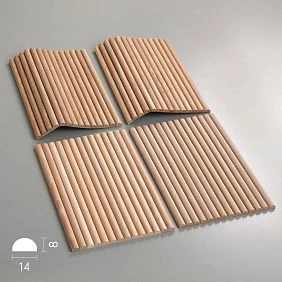
A rigid slat panel is a finished product with fixed geometry: specific dimensions, specific slat spacing, specific width. You get an assembled structure where the slats are already fixed to a supporting base at the required interval. Installing such a panel is faster, and the geometry is always precise.
Rigid panels are the optimal choice for straight walls, TV zones, bed headboards, hallways, and any surfaces with even geometry. Installation speed, predictable results, and a clear visual rhythm are the main advantages of this format.
In the assortmentslatted wall panelsRigid solutions are represented by panels PAN-001 and PAN-002: both are available in formats 1010 × 8 × 950 mm and 1010 × 8 × 2700 mm, allowing you to cover both separate zones and a full-height wall. For those who want to assess the geometry and scale of the slats in person, a sample OPAN-001 measuring 196 × 8 × 310 mm is provided.
Flexible panels
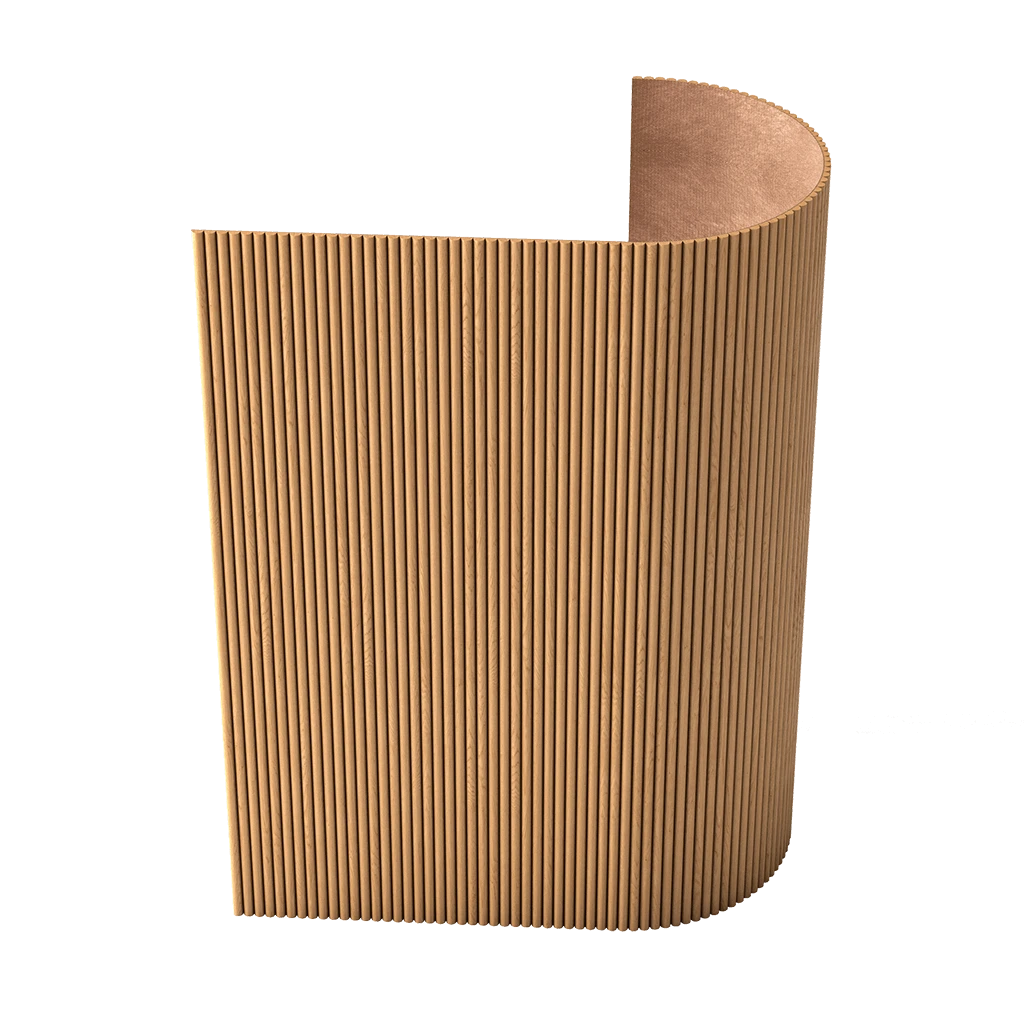
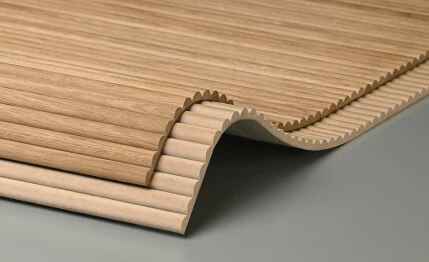
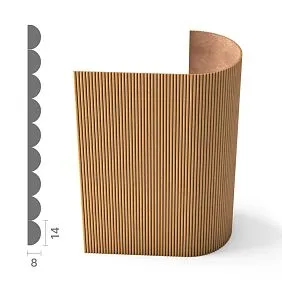
Flexible slatted panels solve problems that rigid formats cannot handle: columns, arches, niches with rounded corners, radius walls. The base of such panels is sufficiently elastic to wrap around curved surfaces without tears or deformations.
This is a fundamental advantage for design projects with non-standard architecture. If your space has at least one radius surface—a column, an arched opening, a rounded corner—it is precisely the flexibledecorative slatted panelthat will create a seamless covering without joints or rhythm disruption.
Interior slats as a separate format
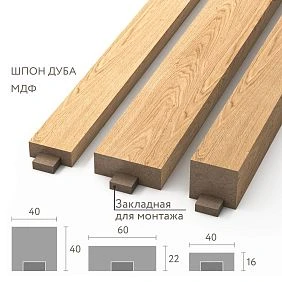
An interior slat is a standalone product that is installed piece by piece directly onto a wall or base. Unlike a ready-made panel, here you set the spacing, orientation, and layout pattern yourself.
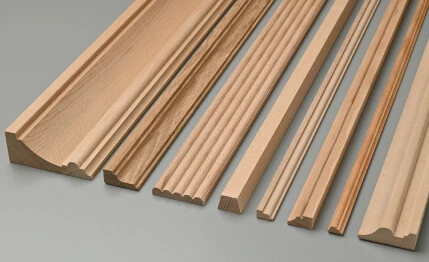
The RK-002 interior slat is available in several cross-sections, with a length of 2750 mm. This format is indispensable where complete geometric freedom is needed: non-standard slat spacing, mixed horizontal-vertical layouts, finishing furniture fronts in a unified style with the walls. Additionally, individual slats are more convenient when working on ceilings—especially where a non-standard mounting scheme is required.
Material comparison: MDF for painting or solid oak
This is one of the most frequent questions when choosing wooden panels. MDF and solid oak are two fundamentally different materials with different characteristics, different appearances, and different application scenarios. Neither is inherently better: each solves its own tasks better than the other.
When is it better to choose MDF
MDF—medium-density fiberboard—has long ceased to be a second-rate material. In modern slatted panel production, it is a full-fledged competitor to solid wood where precise geometry, a uniform surface, and the ability to paint in any color are required.
The primed panel for painting PAN-002 is a classic example of such a solution. The surface is already prepared for paint application: primer is applied evenly, pores are sealed, and the surface structure is uniform. You choose any color from the RAL or NCS palette—and get panels that perfectly match the walls, furniture, or decor.
Choose MDF panels if:
-
You need precise color control, matching wall or furniture hues
-
The project involves painting different zones in multiple colors
-
Priority is a perfectly smooth surface for enamel
-
The interior is modern, minimalist, or Scandinavian-style
-
The budget requires a reasonable balance of quality and cost
-
You need paintable panels with the option to change color in the future
MDF has no natural pores, knots, or texture variation—this is its advantage where predictability is needed. In design contexts where a monochrome accent wall or a background wall for bold decor is important, paintable MDF panels are the optimal solution.
When it's better to choose solid oak
Solid oak is a different story. It's a living material with character: each plank has its own texture, grain pattern, and tonal variations. Two oak panels will never be identical—and that's precisely their value.
Oak plank paneling creates what is called the 'natural wood effect': warmth, organic feel, tactile appeal. It's not an imitation, not veneer over MDF—it's solid wood with real structure. The surface can be finished with oil, wax, stain, or varnish—each option reveals the grain in its own way.
ChooseSolid oak panels, if:
-
You need a living natural texture, not a uniform painted surface.
-
The project involves finishing with oil, wax, or wood stain.
-
The interior is oriented toward Japandi, organic style, Wabi-sabi, Scandinavian naturalism.
-
Material durability is important: oak is one of the hardest European wood species.
-
The space is premium housing, a showroom, restaurant, hotel, where the status of the finish matters.
-
You need to create a solid wood effect in the finish—not an imitation, but real wood.
Oak develops a noble patina over time—this is what is called a 'living material.' It doesn't age poorly; it ages beautifully.
Brief comparison in one block
| Parameter | MDF for painting | Solid oak |
|---|---|---|
| Surface | Uniform, smooth | Natural texture |
| Color | Any RAL / NCS | Tinting, oil, varnish |
| Weight | Lighter | Heavier |
| Durability | High with proper care | Very High |
| Style | Minimalism, Modern | Organic, japanandi, classic |
| Budget | Optimal | Premium |
Where to use wooden panels: a complete overview by rooms
Living Room
Living room — the main space of the apartment, where slatted panels work most expressively. An accent wall behind the TV, decoratedwith wooden slatted panels, instantly structures the zone and gives the interior a finished look. The rhythm of the slats creates depth that a flat painted wall lacks.
For the living room, full-height vertical slats are excellent — they elongate the space. If the ceilings are high, you can play with a wider spacing of slats — this adds airiness. With low ceilings, narrow slats with minimal spacing will create an illusion of height.
Bedroom
Wooden panels in the bedroom create a sense of coziness and intimacy. The wall behind the headboard is a classic area for a slatted panel: it highlights the sleeping area, creates a visual focus, and literally 'hugs' the person with the warmth of natural material.
For the bedroom, solid oak panels with oil treatment or soft tinting work especially well. Such a surface is associated with warmth and calmness—exactly what is needed for rest.
Entryway
The hallway is a small space that sets the first impression of the entire apartment. Properly selected wooden wall panels can turn a narrow, dark corridor into an expressive entrance to the home.
Horizontal slats in the hallway visually expand the space. Dark tinting with good lighting creates a depth effect. And if the hallway has a niche or a sliding wardrobe—slatted fronts in a unified style with the wall finish will create a cohesive design effect.
TV area
A TV zone with a slatted panel is perhaps the most popular application in residential interiors over the past five years. The panel serves simultaneously as a background for the screen, a space accent, and an element that hides wires and equipment in a single plane.
For the TV zone, both rigid PAN-001 panels with clear geometry and more flexible solutions from individual RK-002 slats with custom layouts are suitable. The choice depends on the size of the zone, ceiling height, and desired style.
Ceiling
Wooden slatted panels on the ceiling—a bold but very effective solution. The horizontal plane of the ceiling with vertical or diagonal slats gains volume and dynamism. This works especially well in spaces with high ceilings—restaurants, showrooms, living rooms with ceilings from 3 meters.
For ceiling mounting, it is important to correctly select the fastening system and plan the lighting in advance. Lighting between the slats is one of the most beautiful effects in slatted interiors.
Columns, arches, niches
Here, flexible slatted panels are indispensable. A column wrapped in a slatted panel ceases to be an architectural 'inconvenience' and becomes an accent element. An arched opening with slatted finishing becomes a frame that emphasizes the transition between zones.
Niche walls are a separate topic. Slatted finishing of the niche back wall creates depth and transforms a functional storage area into a decorative element. For such tasks, flexible panels from the assortmentSTAVROS slatted panels— are the perfect solution.
Furniture facades
One of the most interesting applications of slatted panels is furniture fronts. When wall finishing and the fronts of cabinets or chests are executed in a unified slatted style, the space achieves architectural integrity. The boundary between furniture and wall blurs—and this creates that very designer effect of 'built-in architecture'.
For fronts, both rigid panels (PAN-001) and individual interior slats with custom layouts work well. It's important to maintain a uniform pitch and material—then the wall and furniture will be perceived as a single whole.
How to choose the size and format of wooden panels
Panel size is not just a technical specification. It's a design decision that directly influences the visual result.
Slat Width and Spacing
Narrow slats with a frequent pitch give a dense, rich rhythm—such a wall appears more 'dark', saturated, detailed. Wide slats with a larger pitch mean air, lightness, transparency. The first option works in large rooms with high ceilings. The second—in small rooms where it's important not to overload the space.
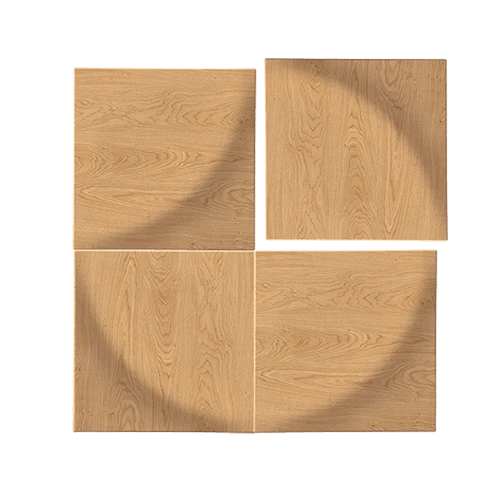
Sample OPAN-001 (196 × 8 × 310 mm) allows you to assess the rhythm and proportions in person—this is precisely why ordering a sample before a major project is a professional standard.
Panel height
Panels PAN-001 and PAN-002 are produced in two height formats: 950 mm and 2700 mm. The first format is for partial wall finishing, creating a paneled zone at a certain height (a classic technique—panels on one-third or half of the wall). The second is for full-height finishing, when you need to cover the wall from floor to ceiling.
The choice of height depends on the ceiling height and the design intent. In rooms with ceilings of 2.7–2.8 m, a 2700 mm panel gives a monolithic vertical without horizontal joints.
Fine and coarse rhythm
Fine rhythm (narrow slats) — detail, richness, dynamism. Coarse rhythm (wide slats with large gaps) — calmness, airiness, monumentality. For residential interiors, fine and medium rhythm is often chosen — it creates coziness. For commercial spaces — restaurants, offices, showrooms — coarse rhythm provides the necessary scale.
When to choose a ready-made panel and when — an individual slat
A ready-made panel is about speed and precision. If you need to quickly cover a straight wall with a clear rhythm — choose a ready-made panel. The individual interior slat RK-002 is needed where standard geometry doesn't work: non-standard spacing, mixed orientation, complex junction with another material, a ceiling with a non-standard structure, or a furniture facade of a non-standard size.
What to choose: a ready-made slatted panel or individual interior slats
This choice is made not on the principle of 'better-worse', but based on the task. Let's examine both options in detail.
Ready-made slatted panel (PAN-001, PAN-002):
-
Installs quickly — geometry is already set
-
Guarantees uniform slat spacing without manual marking
-
Suitable for large flat surfaces
-
Joints between panels are minimal with proper installation
-
Ideal for TV areas, headboards, full-height walls
Separate interior rail (RK-002, length 2750 mm):
-
Complete freedom in spacing, orientation, and pattern
-
Indispensable for non-standard surfaces
-
Allows creating unique layouts
-
More convenient for ceiling installation and in complex areas
-
Perfect for furniture fronts with non-standard dimensions
Both formats are available in the categoryof wooden slatted panelsand can be used within a single project — for example, ready-made panels on the wall and individual slats on the ceiling in the same style.
Interior styles and slatted panels: where they work best
Japandi
Japanese-Scandinavian hybrid — one of the most organic contexts for wooden slatted panels. What matters here: natural material, restrained color palette, pronounced texture. Oak with oil treatment is the ideal choice. Neutral gray-beige tones, minimal details, maximum textural quality.
Minimalism
In a minimalist interior, slatted panels are one of the few permissible decorative elements. They add texture without disrupting the purity of the space. MDF for painting in the same tone as the walls creates a monochrome effect with subtle relief — exactly what minimalism needs.
Modern style and contemporary
Contrast works well here: a dark slatted wall against a light interior. MDF panels in graphite or anthracite tones provide the necessary expressiveness without pretensions to luxury.
Organic and eco-style
Natural oak, oil finish, warm tones — this is the language of organic interior. Solid oak slatted panels here are not just decor, but an ideological statement: living material, eco-friendliness, honest texture without imitations.
Commercial interiors: restaurant, office, showroom, hotel
In commercial spaces, wooden wall panels carry a dual load: functional and image-related. Slatted panels visually elevate the status of the premises, creating a professional, thoughtful appearance. A hotel with slatted walls in the lobby is no longer just a hotel, it's a design object. A restaurant with warm wooden finishes is a coziness that guests feel physically.
Installing wooden slat panels: what's important to know
Foundation Preparation
The base must be level, dry, and sturdy. Permissible deviations — within 2–3 mm over 2 meters. If the wall has significant unevenness — it should be pre-leveled with plaster or drywall. Base moisture is a critical parameter for wooden panels: if installed on a damp wall, the material may warp or darken.
Material acclimatization
Wooden panels — especially solid wood — require acclimatization: 48–72 hours in the room where installation will take place. This allows the material to adapt to humidity and temperature, preventing subsequent deformation.
Dry fitting
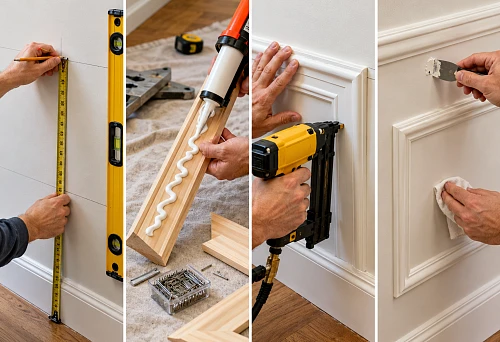
Before final installation, always perform a dry fitting: lay out the panels on the wall without fixing them, check the rhythm, joints, and pattern alignment. This saves time and material.
Adhesive and fastening scheme
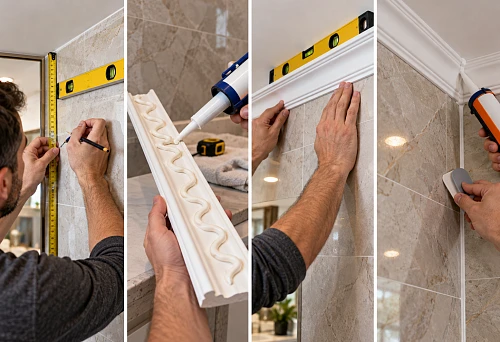
Installation of slatted panels is done using special structural adhesive (wood mounting adhesive or MS-polymer) combined with mechanical fasteners. Adhesive alone without dowels is a risk: when drying and expanding, a heavy panel may detach. Dowels alone without adhesive provide poor sound insulation and vibration. The combination delivers a reliable and quiet result.
Joining and end treatment
Joints between panels must be strictly vertical or horizontal. Ends are covered with moldings matching the panel color or left open — if the panel design allows for a clean open cut. Corner joints are resolved with corner molding or a special corner element.
Painting, tinting, varnish
If panels are MDF for painting — final painting is done after installation. This allows sealing minor joints and creating a monolithic surface. For oak panels, final finishing is done before or after installation depending on the technology.
Common mistakes when choosing wooden panels
This is not a theoretical list — these are real mistakes that are repeated over and over in projects of various scales.
-
Choosing based on photos without in-person evaluation. A photograph doesn't convey texture, tactility, or the real color. Order a sample — OPAN-001 was created specifically for this.
-
Confusing MDF and oak. These aren't just different materials — they represent different finishing philosophies. Decide on the concept before choosing a specific model.
-
Ignoring the rhythm of slats. Large slats in a small room create heaviness. Small ones in a large hall get lost. Scale matters.
-
Not accounting for ceiling height. A 950 mm panel on a 2700 mm high wall will leave a strip above it that needs to be covered with something. Plan ahead.
-
Unrelated wall and furniture. If the interior has furniture with slatted fronts, their style must match the wall panels — otherwise, there will be visual dissonance.
-
Installation on a damp or uneven base. This is the most costly mistake: deformations and delamination after installation.
-
Lack of material acclimatization. Especially critical for solid oak in rooms with unstable humidity.
-
Unaccounted-for future finishing. MDF for painting needs to be painted after installation. Oak — processed according to technology. If this stage isn't planned in advance, the result can be unpredictable.
-
Wall and ceiling in different rhythms. If you're planning a slatted ceiling and slatted walls, the slat spacing must be coordinated. Otherwise, the intersection will create visual chaos.
Which solutions are suitable for different tasks
For an apartment with modern renovation
MDF panels for painting (PAN-002) in a neutral color. Accent wall in the living room, slatted area behind the headboard in the bedroom, slatted fronts of the built-in wardrobe in the hallway — all in a single color, unified geometry. Clean modern style without overload.
For a private house with organic design
Solid oak with oil treatment. Vertical slats in the living room, horizontal layout in the library or study, slatted ceiling on the veranda. Warm natural tones, lively texture, durable material.
For a cafe or restaurant
Oak panels tinted to dark walnut or mid-brown — a classic of restaurant interiors. Slatted accents above the bar counter, zoning of seating areas with tall slatted panel partitions. Warmth, coziness, a 'tasty' visual.
For an office or meeting room
MDF for painting in corporate colors, exact RAL color. Strict vertical layout, even geometry, professional appearance without excessive decorativeness.
For a showroom or conceptual space
Everything is possible here: a combination of oak and painted MDF, non-standard layout angles, mixed horizontal-vertical patterns. The RK-002 interior slat in a custom layout is the perfect tool for creating a unique space.
For a furniture project
Solid wood or MDF panels for slatted facades — in the same material and rhythm as the wall panels. This solution transforms standard furniture into an architectural element of the interior.
For curved surfaces
Flexible slatted panels — without alternative. Columns, arches, rounded niches. The material wraps around the surface without distorting the pattern.
Wooden panels and acoustics: an unexpected bonus
A topic often overlooked when choosing finishes is the acoustic effect of slatted panels. Slats with gaps partially absorb sound waves and reduce echo. This is especially noticeable in rooms with hard floors and high ceilings — precisely where acoustics become a problem.
Slatted panels are not a professional acoustic tool, but their contribution to the comfort of a space is quite tangible. Combined with soft furniture and textiles, they create a comfortable sound environment without special acoustic solutions.
Ecology and material safety
For home use, it's important to know: what glue is used in MDF production, what coatings are applied to oak. High-quality MDF of class E1 or E0 has minimal formaldehyde content and is safe for living spaces. Oak panels with natural oil or wax coating are an environmentally friendly product without synthetic solvents.
When choosing wooden panels, it's worth clarifying with the manufacturer: the emission class of MDF and the type of coating. This is not a formality, but a matter of health for everyone who lives or works in the space.
FAQ: answers to the most popular questions
What is better to choose: wooden panels or slatted panels?
Slatted panels are a type of wooden panels. When people say 'wooden wall panels,' they refer to a broad class of products. Slatted panels within this class are the most relevant format for modern interiors: they create volume, rhythm, and chiaroscuro, which smooth panels lack.
Are slatted panels suitable for an apartment?
Yes, and this is one of the main applications. TV area, bedroom, hallway, living room—slatted panels fit organically into any residential interior. The key is to correctly choose the scale of the slats and the material to match the apartment's style.
What is better for painting: MDF or solid wood?
For painting in an exact color—MDF. It has a uniform surface without pores or texture variation, and holds paint well. Solid oak is better revealed under transparent coatings: oil, wax, tinting, varnish.
How do oak panels differ from MDF?
Oak is natural solid wood with a living texture, high hardness, and durability. MDF is an industrial material with a uniform structure, ideal for painting. These are fundamentally different materials with different application scenarios.
Can slatted panels be used on the ceiling?
Yes. Slatted panels on the ceiling are a popular designer solution, especially in high spaces. It is important to plan the mounting system and lighting elements in advance.
Are panels suitable for TV areas and bedrooms?
Absolutely. The TV area and the headboard of the bed are classic zones for slatted panels in a residential interior. Panels create an accent, structure the area, and add warmth.
Can panels be installed on furniture fronts?
Yes. Slatted furniture fronts in the same material and rhythm as wall panels are one of the strongest design techniques for creating a unified space.
What to choose for a curved wall or column?
Flexible slatted panels are specifically designed for such tasks. They wrap around curved surfaces without distorting the pattern.
Are samples needed before ordering?
Yes, and it's a professional standard. The OPAN-001 sample allows you to evaluate the actual color, texture, scale of the slats, and surface quality before making a decision on a large order.
How to choose the color of panels to match the interior?
For MDF — order a sample and paint it in the desired color before making a decision. For oak — evaluate several tinting and oil options on a small fragment. The color on the screen and in a real interior can differ significantly.
How long will wooden slatted panels last?
With proper installation and care — decades. MDF in residential spaces lasts 15–20+ years, provided it is protected from mechanical damage and moisture. Solid oak, when treated with oil or varnish — significantly longer, practically without a lifespan limit.
How to care for oak panels?
Panels with oil treatment are refreshed with a thin layer of oil every 1–2 years — this takes no more than an hour for a standard wall. Panels with a lacquer coating require minimal care: wet cleaning without aggressive agents.
About the company STAVROS
If you are looking for wooden wall panels with guaranteed material quality and precise geometry — take a look at the STAVROS range. The company specializes in solid wood products and slatted panels for residential and commercial interiors: paintable MDF, solid oak, rigid and flexible structures, individual interior slats.
The catalog features ready-made solutions — panels PAN-001 and PAN-002, sample OPAN-001 for preliminary evaluation, interior slat RK-002 for custom projects. The range covers tasks from wall finishing in apartments to designing commercial spaces and furniture fronts.
STAVROS slatted panels— precise geometry, natural materials, and a well-thought-out format that works in any interior.