
























Article Contents:
- What Are Furniture Rosettes and Why Are They Needed in Furniture Decor
- What Wooden Furniture Rosettes Can Be Bought in Moscow
- Central Furniture Rosettes: Accent in One Point
- Corner and Symmetrical Rosettes: System Elements
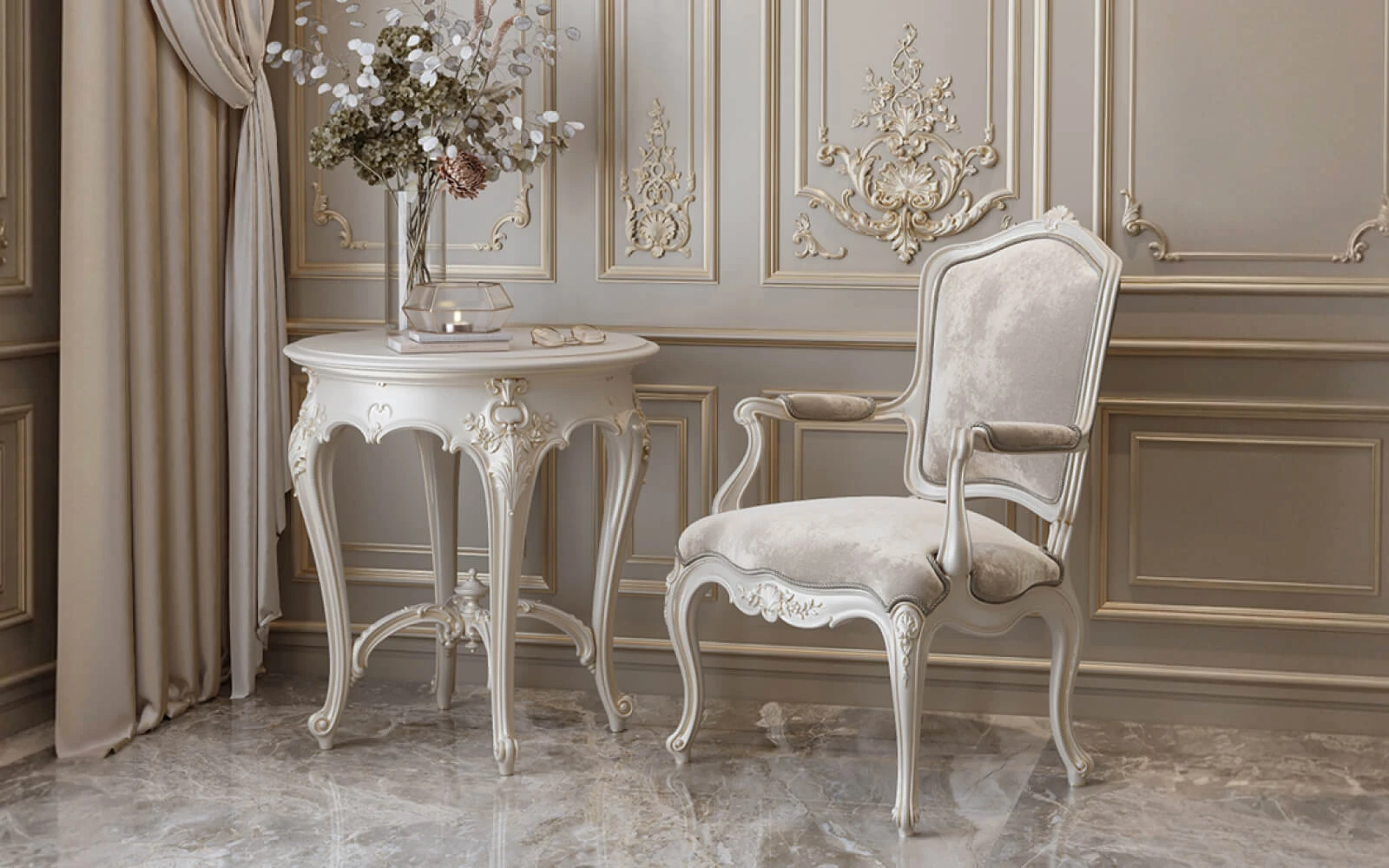
- Carved Rosettes for Classic Furniture
- Decorative Rosettes for Facades and Interior Panels
- What Furniture Are Wooden Furniture Rosettes Suitable For
- For Cabinets: Focus for Each Door
- For dressers: vertical rhythm
- For nightstands: one precise element
- For kitchen fronts: for dense coating
- For buffets and display cases: representative scale
- For restoring classic furniture
- How furniture rosettes differ from overlays and other decorative elements
- How to choose a furniture rosette: 7 key criteria
- By size: proportion as law
- By shape: contour defines character
- By style: ornament reads instantly
- By purpose: position is primary
- By degree of decorativeness
- Material: wood, species, preparation for finishing
- Combination with other elements
- Which materials are best for wooden furniture rosettes
- Why wood is the only right choice
- When to choose for enamel
- When to choose for tinting
- How to combine furniture rosettes with other decor
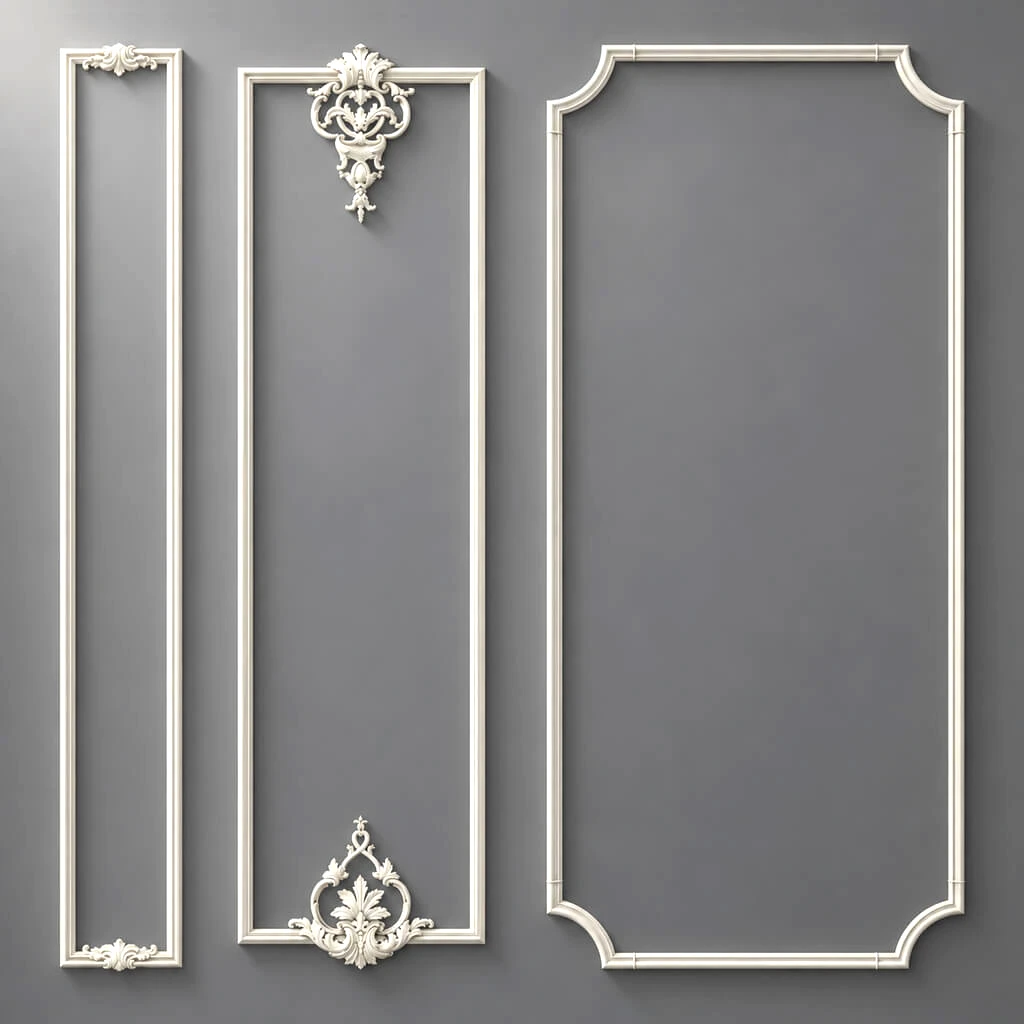
- Rosette and molding frame: a classic pair
- Rosette and corner overlays: accent and support
- Rosette and cornice: horizontal and point
- Rosette and capitals: vertical and point
- Three maximum: the rule of quantity
- Common mistakes when choosing wooden furniture rosettes
- Too large rosette
- Socket too small
- Style mismatch
- Mixing ornamental motifs
- Purchase without a plan
- Confusion with product type
- Where to buy wooden furniture sockets in Moscow
- STAVROS catalog: selection with filters
- Pickup and delivery
- Showroom in Moscow: live contact with the detail
- Order and consultation
- Who are wooden furniture sockets especially suitable for
- For private buyers
- For interior designers
- For furniture workshops and manufacturers
- For restorers
- FAQ: answers to common questions
- What is a wooden furniture socket?
- Where are wooden furniture sockets used?
- How does a furniture socket differ from an overlay?
- Which furniture rosettes are suitable for facades?
- How to choose the size of a furniture rosette?
- Which furniture styles best combine with carved rosettes?
- Can furniture rosettes be used in restoration?
- Where to buy wooden furniture rosettes in Moscow?
- How to combine furniture rosettes with moldings and cornices?
- Can a single rosette be used without a molding frame?
- Conclusion
There are decorative elements that work on the principle of a point. Not a line, not a frame—specifically a point. One detail in the right place—and the facade gains a center, a focus, a semantic core. In furniture decor, this role is played by the rosette.
Buying wooden furniture rosettes in Moscow is a specific task. But between 'buying' and 'buying correctly'—there is a fundamental difference. The right size, the right shape, the right ornament, the right style, the right material. All about this—in a detailed article.
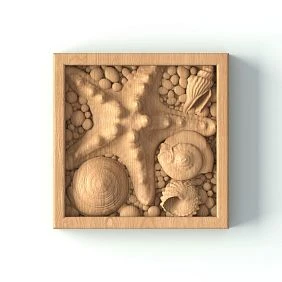
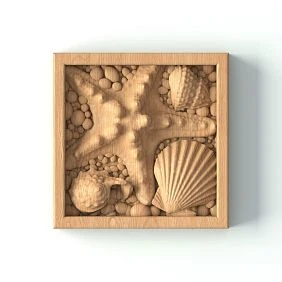
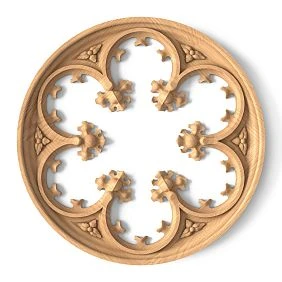
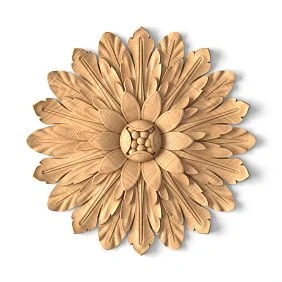
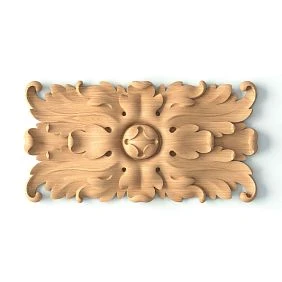
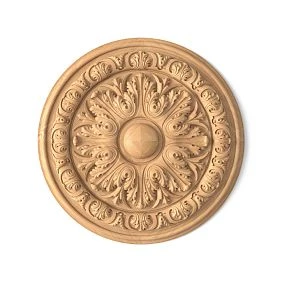
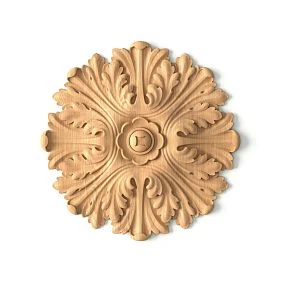
What are furniture rosettes and why are they needed in furniture decor
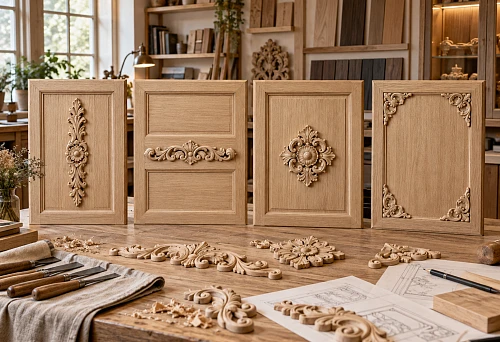
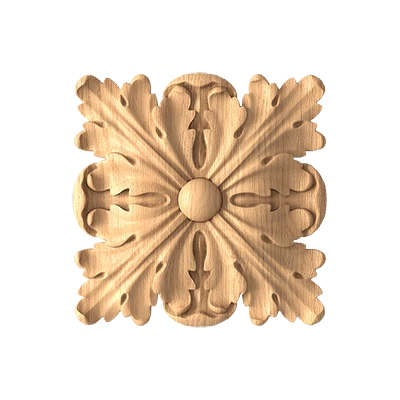
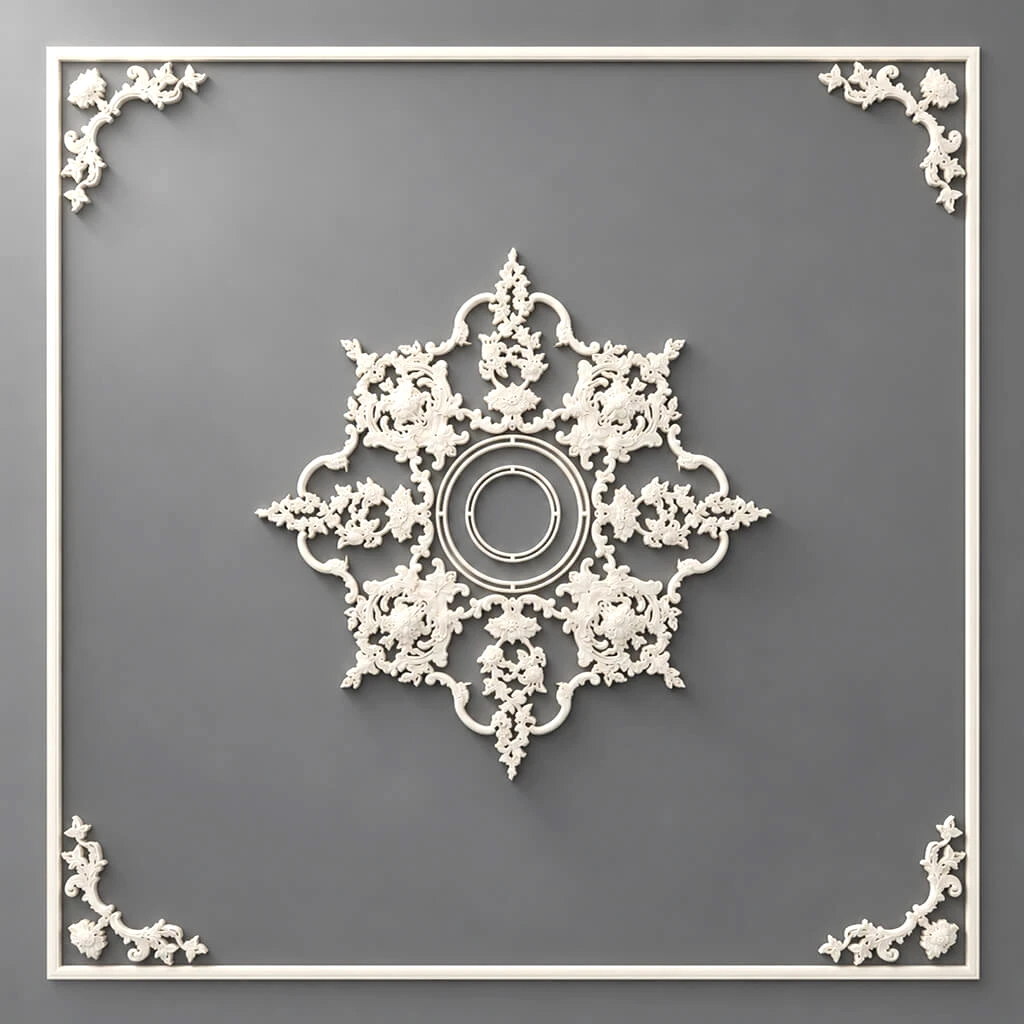
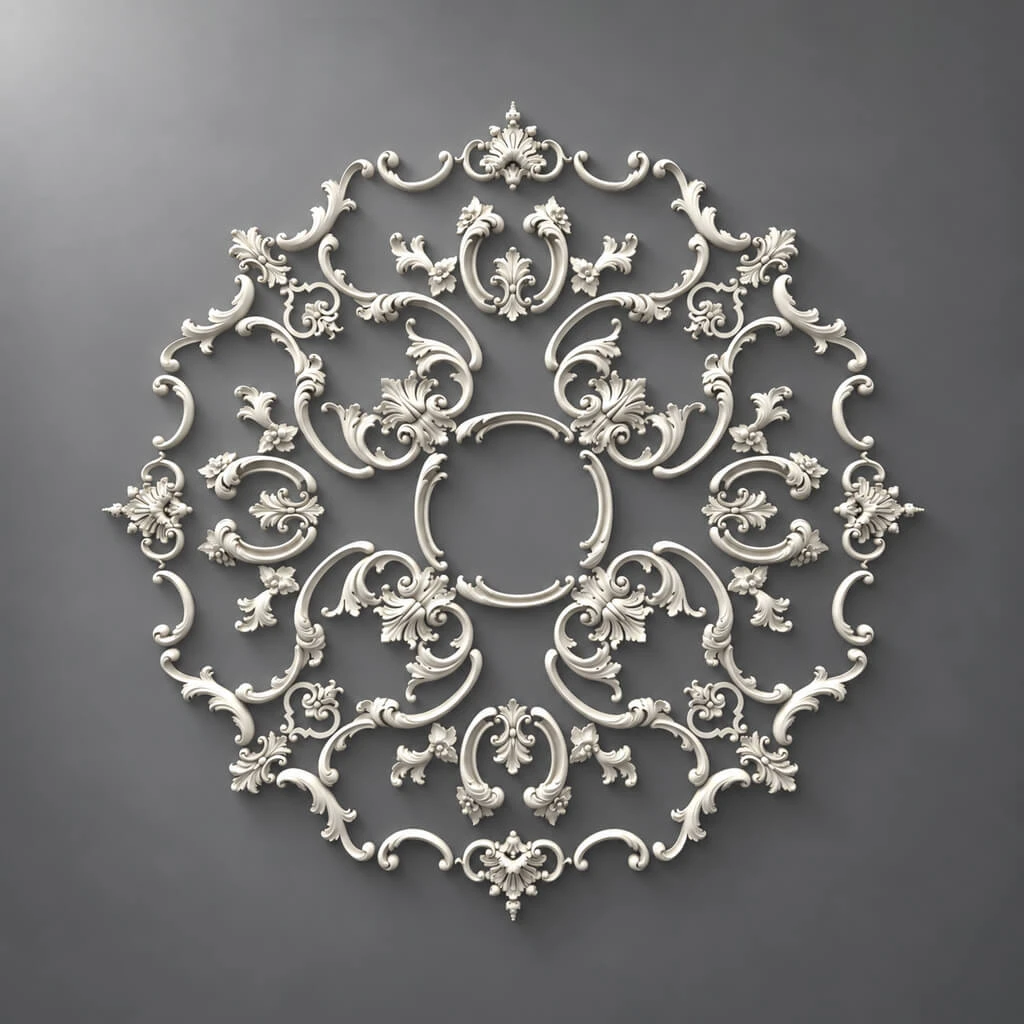
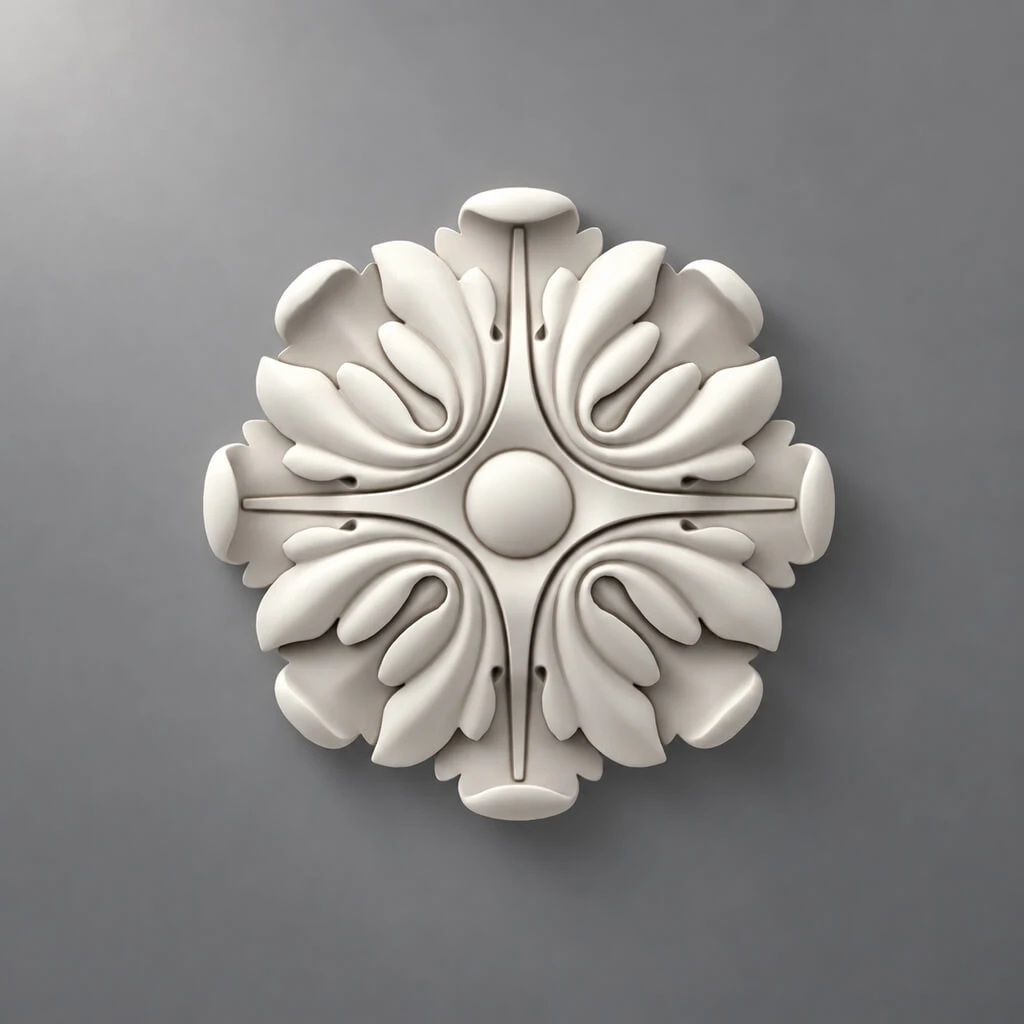
A furniture rosette is a decorative three-dimensional element with a symmetrical pattern, installed on the surface of a furniture facade as a central or accent decorative feature. Most often, it is round, oval, or square in shape with a radially spreading relief pattern.
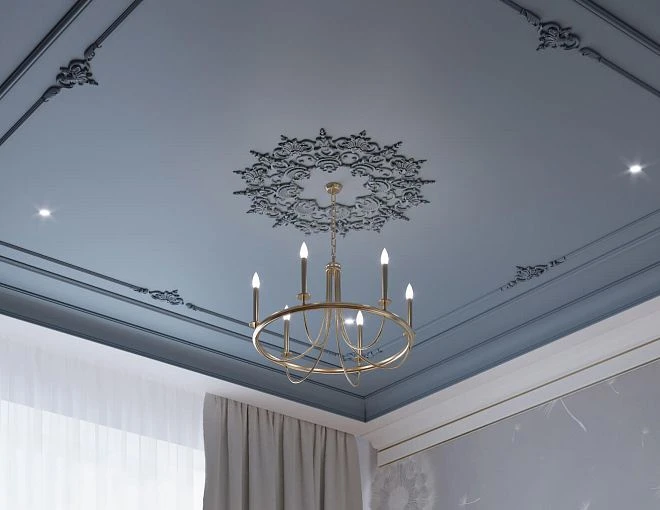
It's important to clarify one point that causes confusion right away. A furniture rosette is not the same as a ceiling plaster rosette for mounting a chandelier. These are different products with different purposes. Wooden furniture rosettes are intended exclusively for decorating furniture: facades, doors, panels, drawers, decorative inserts. They are made from solid oak or beech, have precise dimensions calculated for furniture scale, and are adapted for finishing with furniture varnishes and enamels.
Why are wooden rosettes used in classical and decorative facades? Because the symmetrical pattern of a rosette is one of the oldest decorative motifs in history. It is present in ancient architecture, in furniture from the Renaissance, Baroque, Classicism, and Empire periods. It is perceived as 'correct,' 'complete,' 'finished'—at the level of cultural memory.
In furniture decor, a rosette serves several specific functions:
-
Anchors the center of the facade—organizes the perception of the door panel around a single point
-
Creates a visual focus—draws and holds the eye
-
Sets the scale of the pattern—one element defines the 'level of decorativeness' of the entire system
-
Connects the furniture with the interior style—a floral rosette says 'classic,' a geometric one says 'neoclassical'
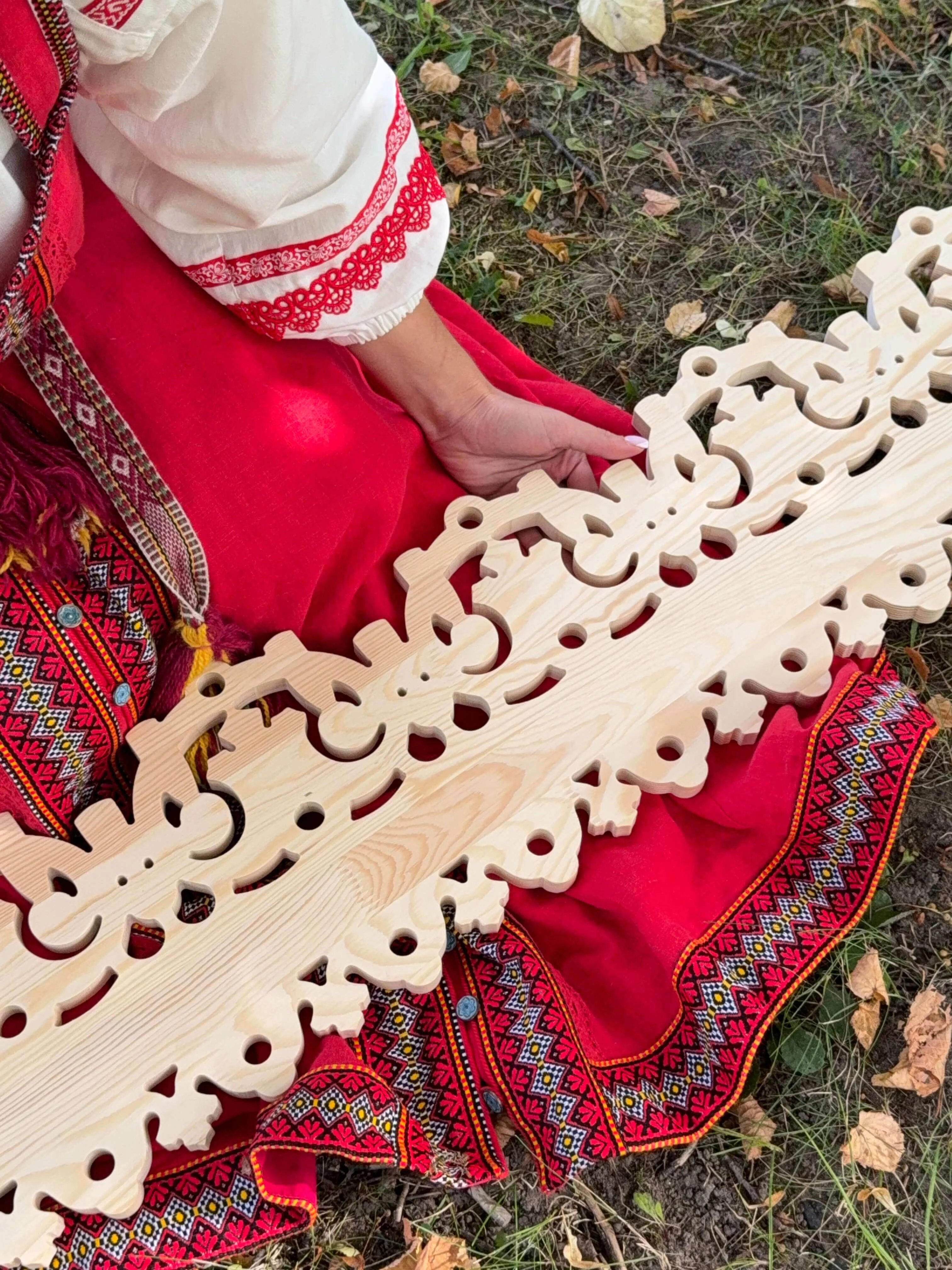
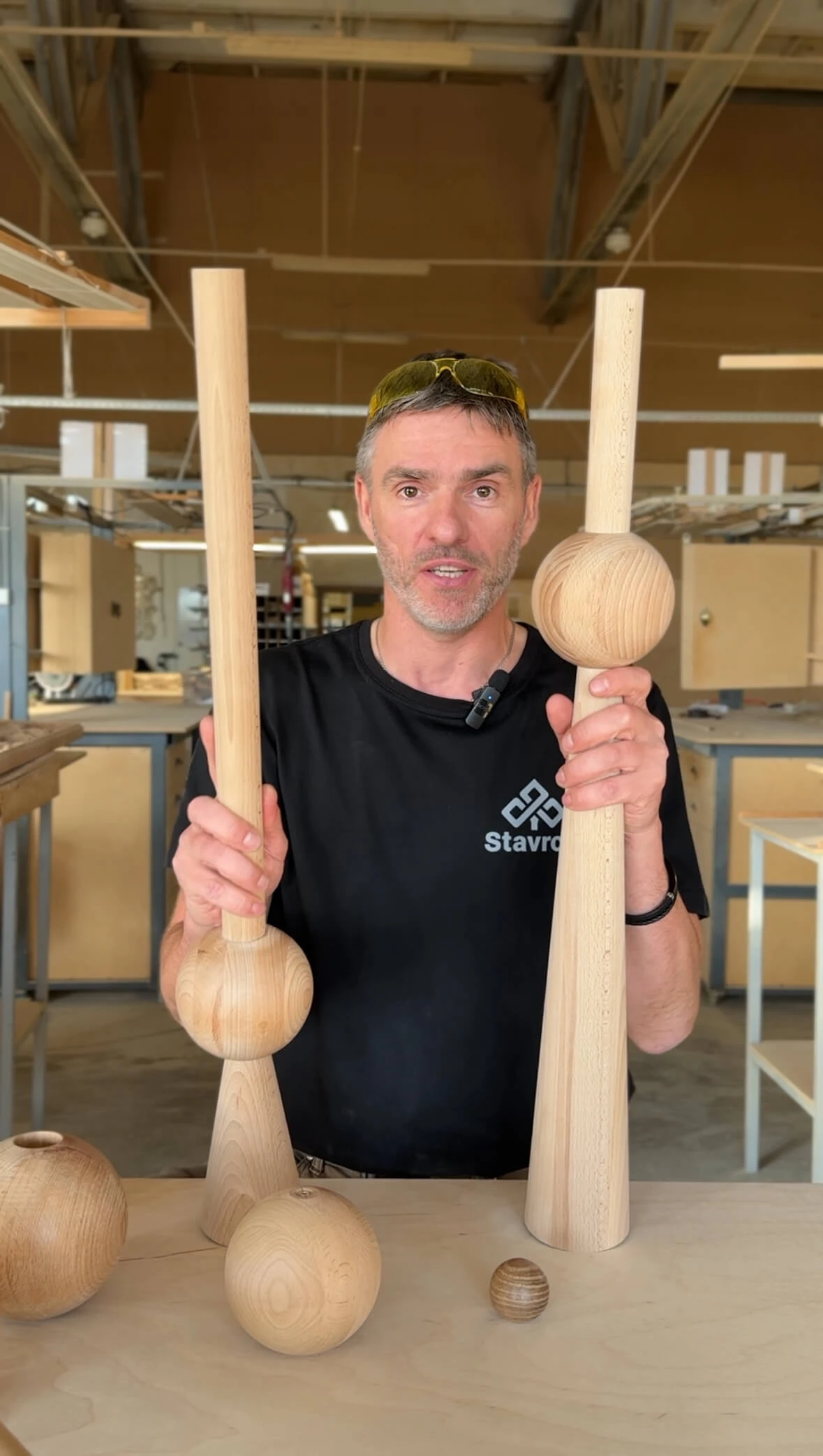
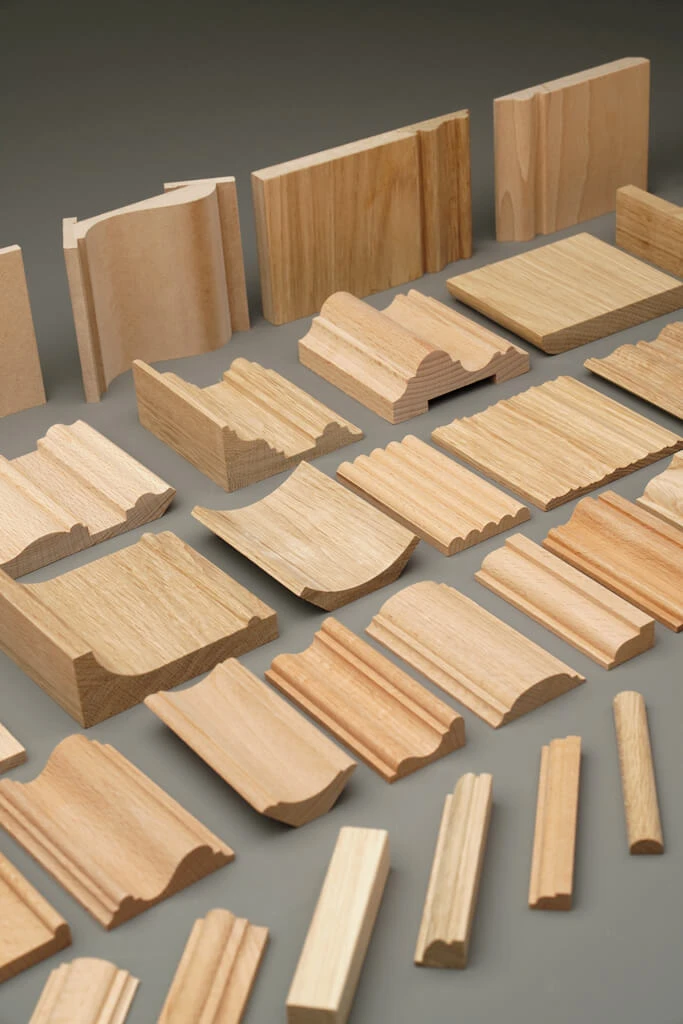
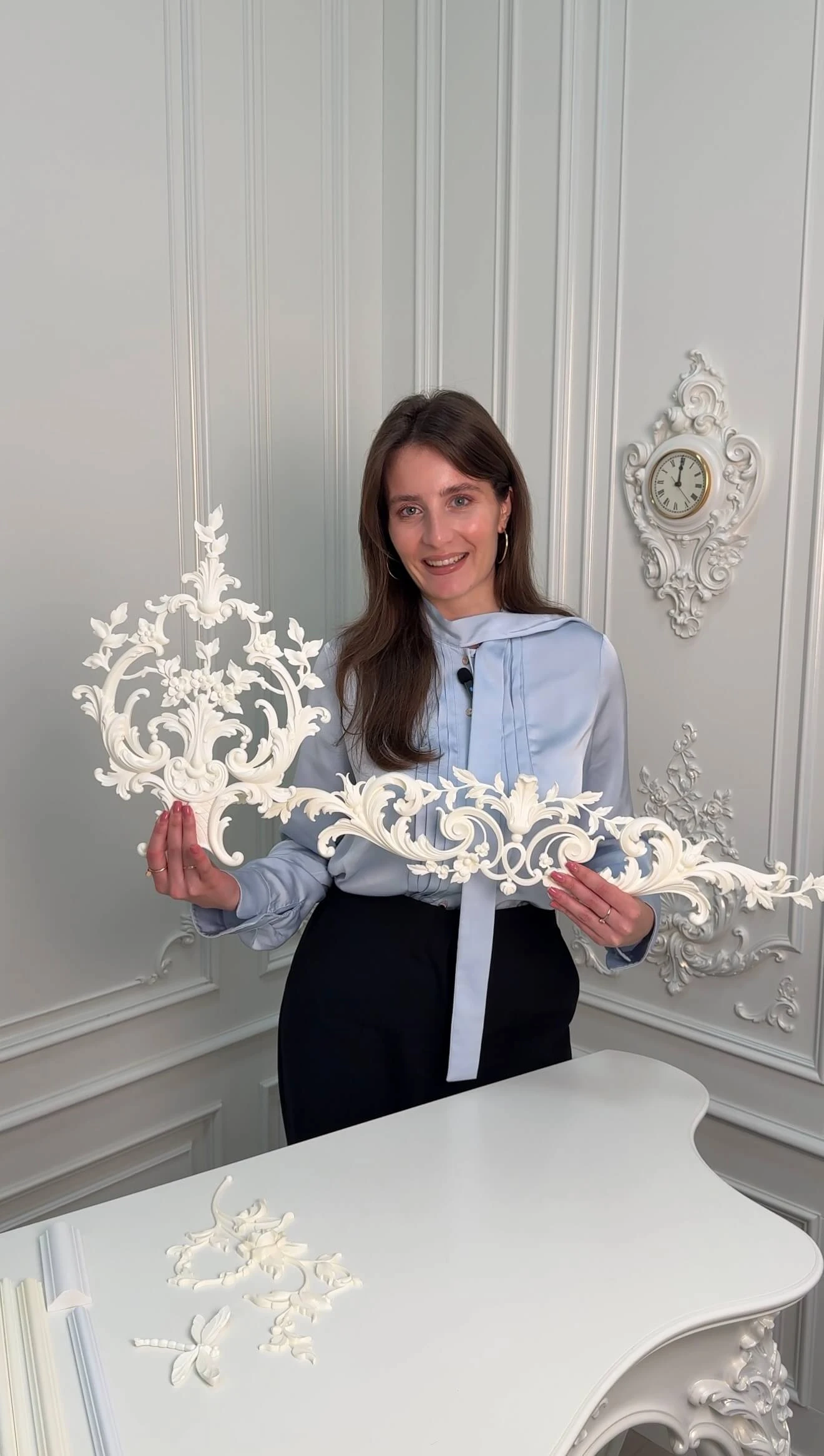
What wooden furniture rosettes can be purchased in Moscow
Our factory also produces:
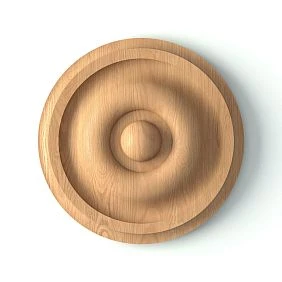
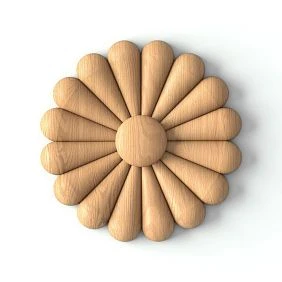
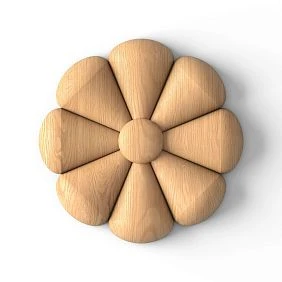
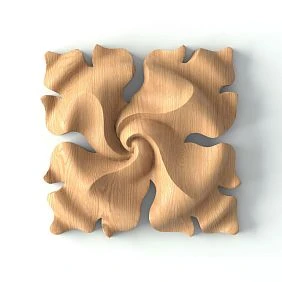
Central furniture rosettes: an accent at a single point
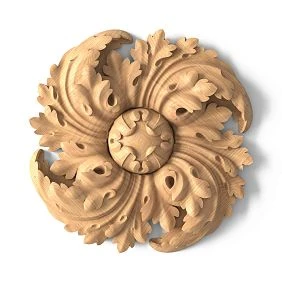
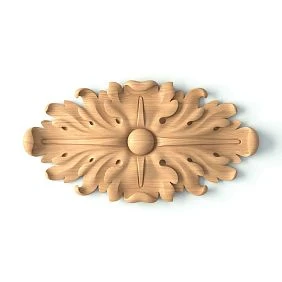
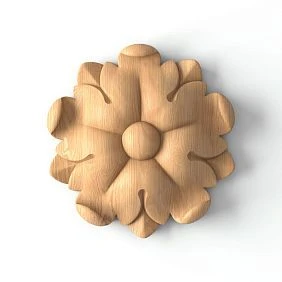
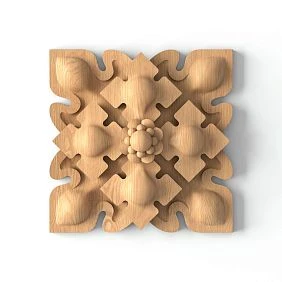
Central rosettes are the most common type. These are symmetrical products designed for installation strictly in the center of a furniture front or decorative panel. They can be round, square, diamond-shaped, octagonal — the shape of the outer contour determines how well the element fits into the geometry of a specific front.
inin the STAVROS decorative rosettes catalogfeatures a wide range of central furniture rosettes made of solid oak and beech. The size range spans from small 5–8 cm for cabinets and drawers to large 18–25 cm for executive cabinet fronts.
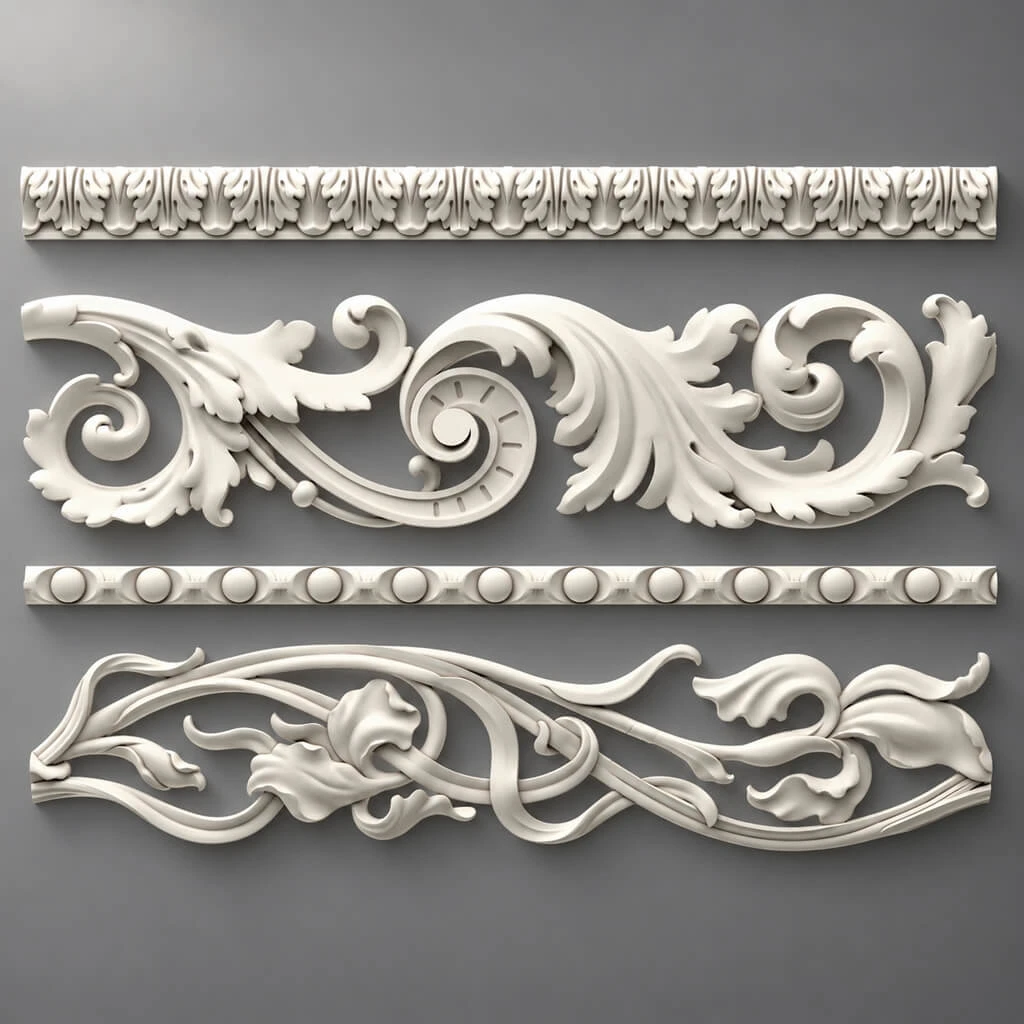
Ornamental motifs: petal rosettes with leaf ornamentation, floral rosettes with acanthus petals, geometric rosettes with meander contour, mixed motifs with plant and geometric elements.
Get Consultation
Corner and symmetrical rosettes: system elements
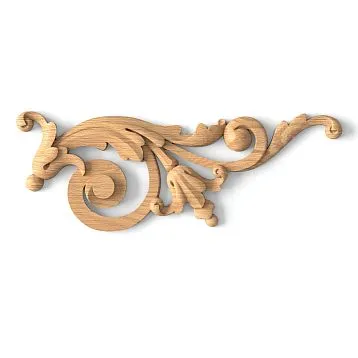
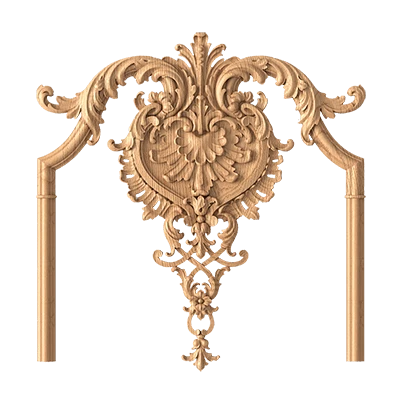
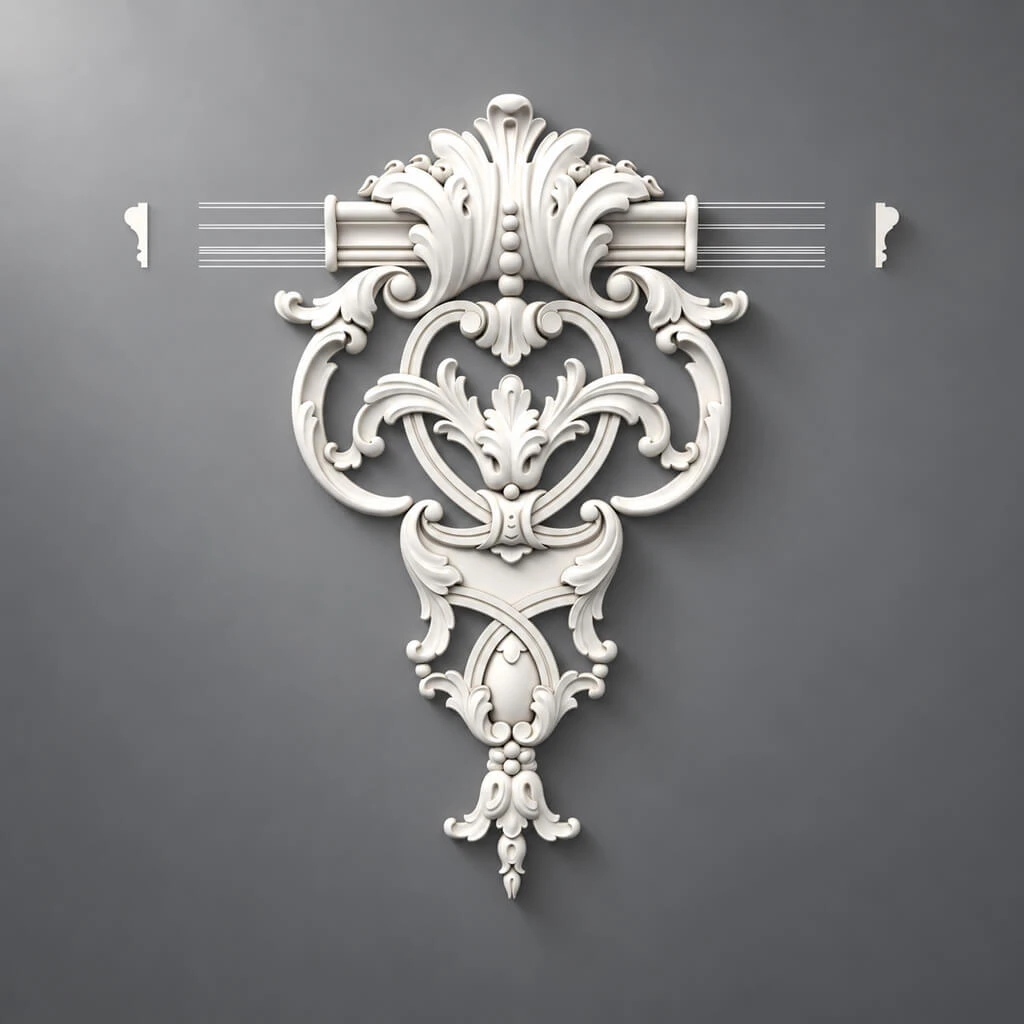
Corner decorative rosettes are special products with an L-shaped or beveled contour for placement in corner positions of molding frame systems. They cover the joint angle of two molding profiles and add an ornamental accent to the corner points of a door.
Symmetrical paired rosettes are mirrored versions of a single product. The right and left are installed symmetrically relative to the central axis of the front — creating a sense of rhythm and order when decorating wide planes.
Carved rosettes for classic furniture
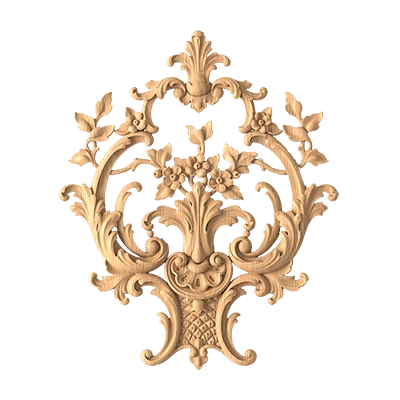
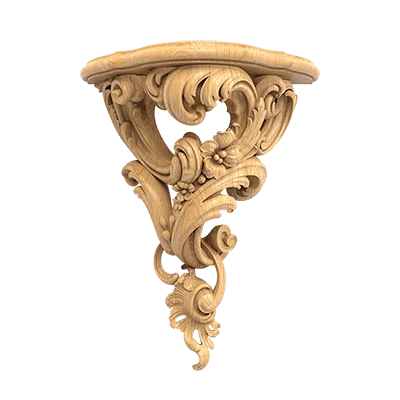
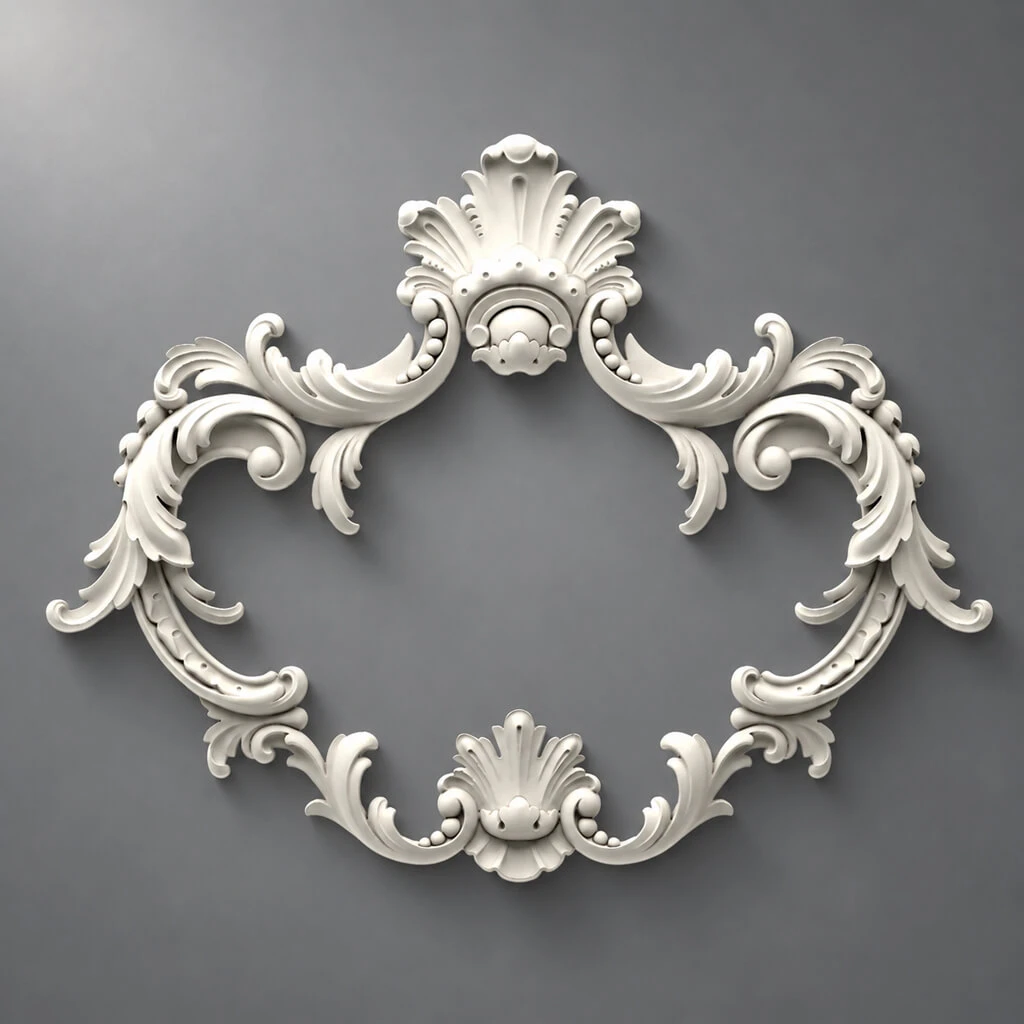
Carved furniture rosettes with deep ornamentation — elements for rich classic, baroque, and empire styles. Relief depth from 10 to 25 mm, detailed elaboration of each petal, ornamental motif, and transitional element. These are products of the 'Prestige' category — with additional manual sanding of hard-to-reach areas.
It is precisely such rosettes that are used in buffets, display cabinets, library furniture, and office cabinets — where furniture aspires to an architectural level and requires appropriate decoration.
Decorative rosettes for facades and interior panels
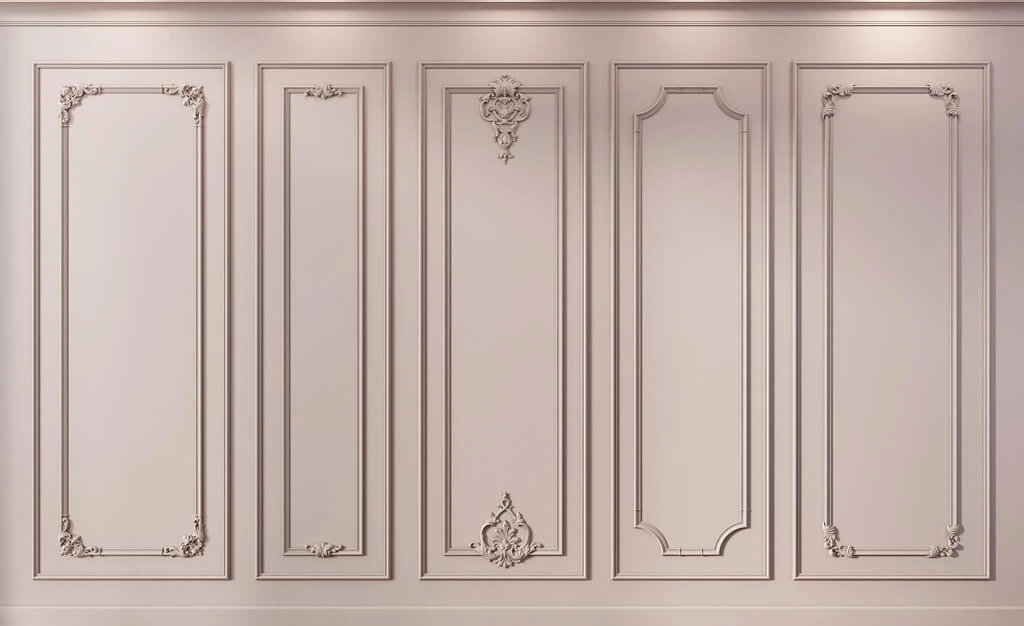
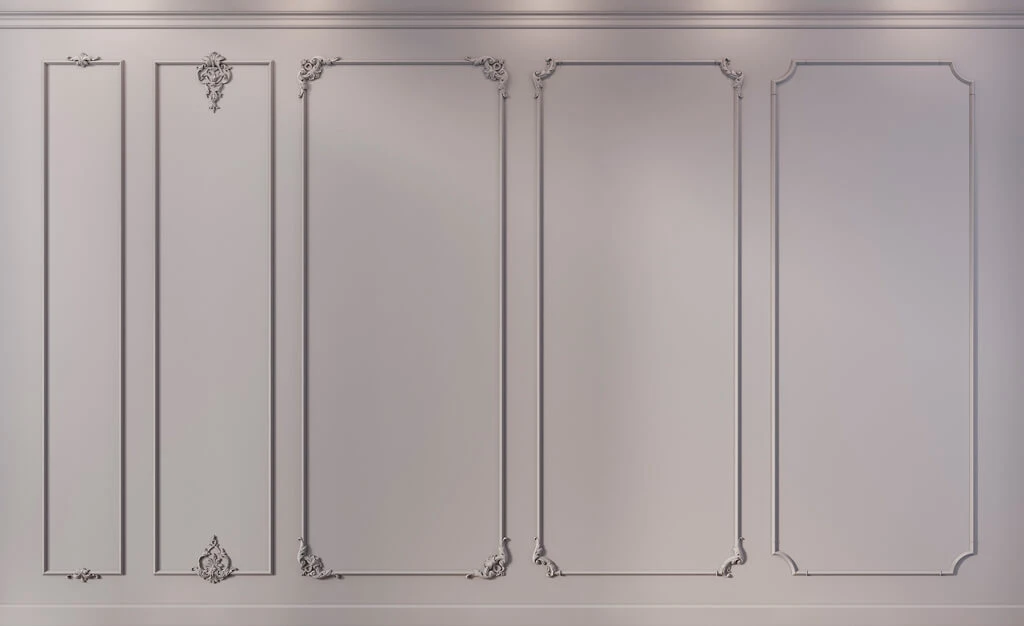
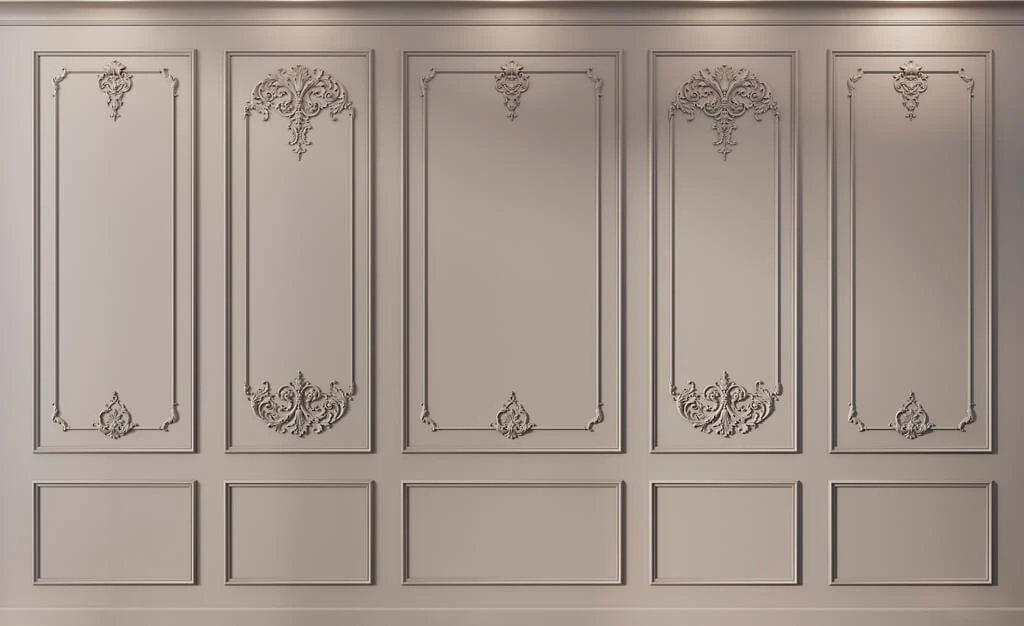
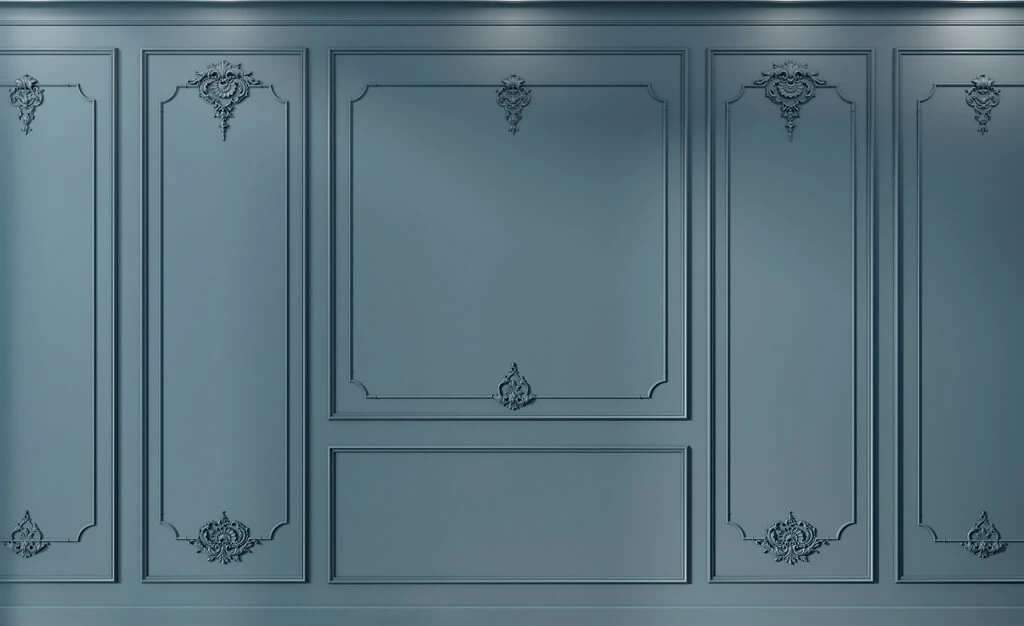
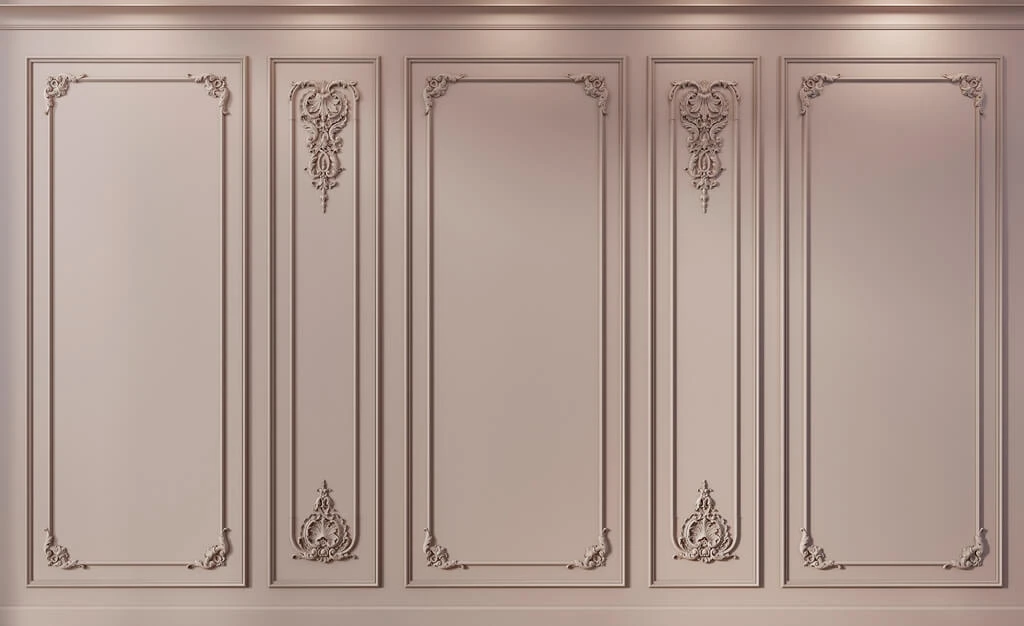
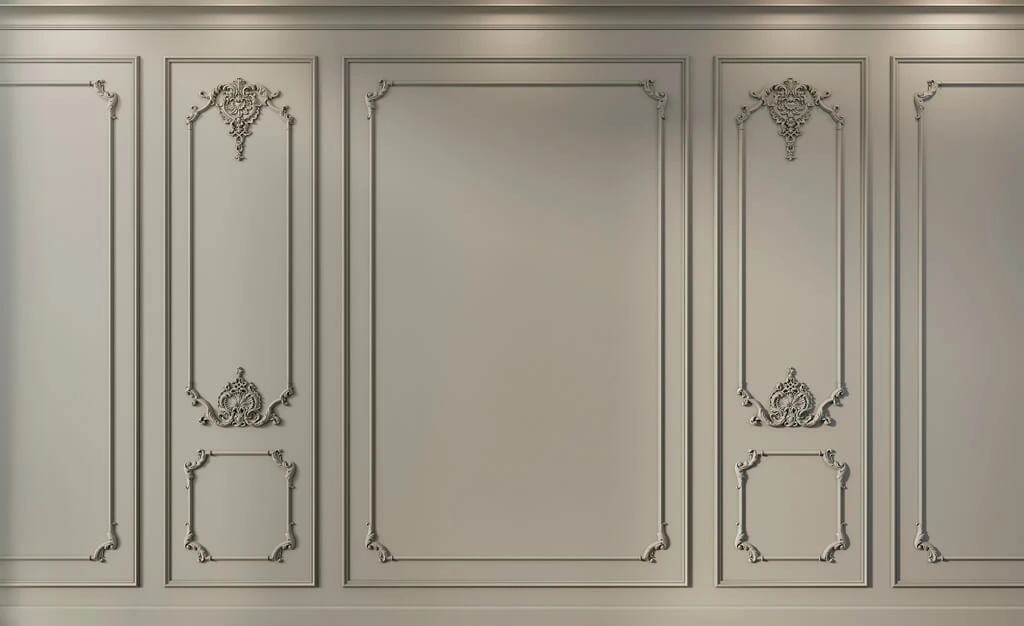
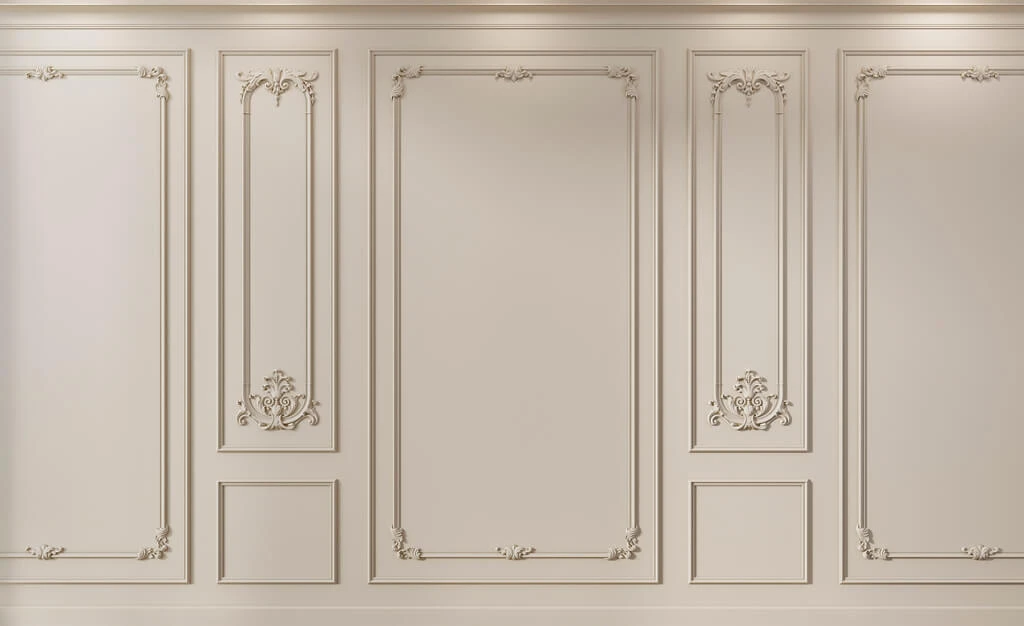
Not only furniture requires decorative wooden rosettes. Wall panels with molding cellular structure, decorative niches, door leaves — all these surfaces use the same range of products.
This expands the possibility of creating a unified decorative system: rosettes on furniture facades and rosettes on wall panels from the same series — a single ornamental language for the entire space.
For which furniture are wooden furniture rosettes suitable
For cabinets: a focal point for each door
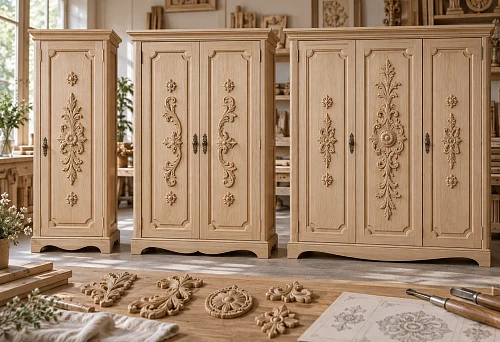
The cabinet is the main platform for furniture rosettes. Tall doors, wide planes, significant facade area — here the rosette works to its full potential.
Minimum scheme: one wooden rosette in the center of each cabinet door. Simple but effective. A homogeneous plane gets a focal point, the eye finds a point.
Extended scheme: rosette in the center + molding frame around the perimeter of the door + corner elements at the intersections of the frame. This is a full-fledged classical system — the door turns into an architectural panel.
For tall cabinet doors with different sections: rosette in the upper section + horizontal molding belt + rosette or horizontal overlay in the lower section. Visually, each section gets its own center.
For dressers: rhythm along the vertical
A chest of drawers is a horizontal stack of drawers. The wooden rosette here works on the principle of vertical rhythm: the same rosette on each drawer, strictly centered.
A critically important rule: one model, one size, one position on each drawer. Any deviation breaks the rhythm—and instead of order, randomness arises.
For small chest drawers (width 35–50 cm): rosettes 6–10 cm. For wide drawers: 8–14 cm. The proportion—the central element occupies 20–30% of the drawer width.
For cabinets: one precise element
Bedside table, TV stand, console table in the hallway. Small items with small fronts. The principle of delicacy works here: a small carved rosette in the center of the door. One element. One accent. Coordinated in ornament with the adjacent large furniture.
A cabinet does not require saturated decor—it requires a precise gesture. One correctly chosen wooden rosette works better than three poorly chosen ones.
For kitchen fronts: for dense coating
The kitchen is a special environment. Wooden furniture rosettes are used here provided the material is properly prepared and reliably coated with waterproof varnish.
For kitchen fronts, it is recommended:
-
a beech blank 'for enamel'—for dense, waterproof painting;
-
Standard quality — sufficient before multi-layer coating;
-
Compact sockets 6–9 cm — proportionate to kitchen fronts.
A socket on each central front of the kitchen set + molding frames + decorative cornice — a classic kitchen system that radically changes the appearance of the set.
For buffets and display cabinets: representative scale
Buffet and display cabinet — large items with high decorative potential. A large carved wooden socket in the center of each section, pilasters on the sides with capitals, a carved cornice on top — this is high-level architectural furniture decor.
For a display cabinet with glass doors: the socket is attached to the upper part of the door or in the center of the lower section. The glass itself is a 'window' to the contents; the socket creates a decorative frame for this window.
For restoring classic furniture
Restoration requires maximum accuracy in selection. It is necessary to find a socket whose ornament matches the original, the size corresponds to the lost element, and the material behaves identically to the original wood under the finish.
Only solid oak or beech satisfies all these requirements simultaneously. The STAVROS range features historical ornamental motifs characteristic of 18th–19th century furniture — petal, floral, geometric rosettes of classical styles.
How a furniture socket differs from an overlay and other decorative elements
This is an important question: part of the audience uses the words 'socket' and 'overlay' interchangeably. This is not the case.
| Element | Shape | Position | Ornament | Function |
|---|---|---|---|---|
| Rosette | Round, oval, square with symmetry | Strictly centered | Radially symmetric | Focal center of the facade |
| Overlay | Any: vertical, horizontal, complex | Center, corner, side, horizontal belt | Any: floral, geometric, narrative | Accent or structural element |
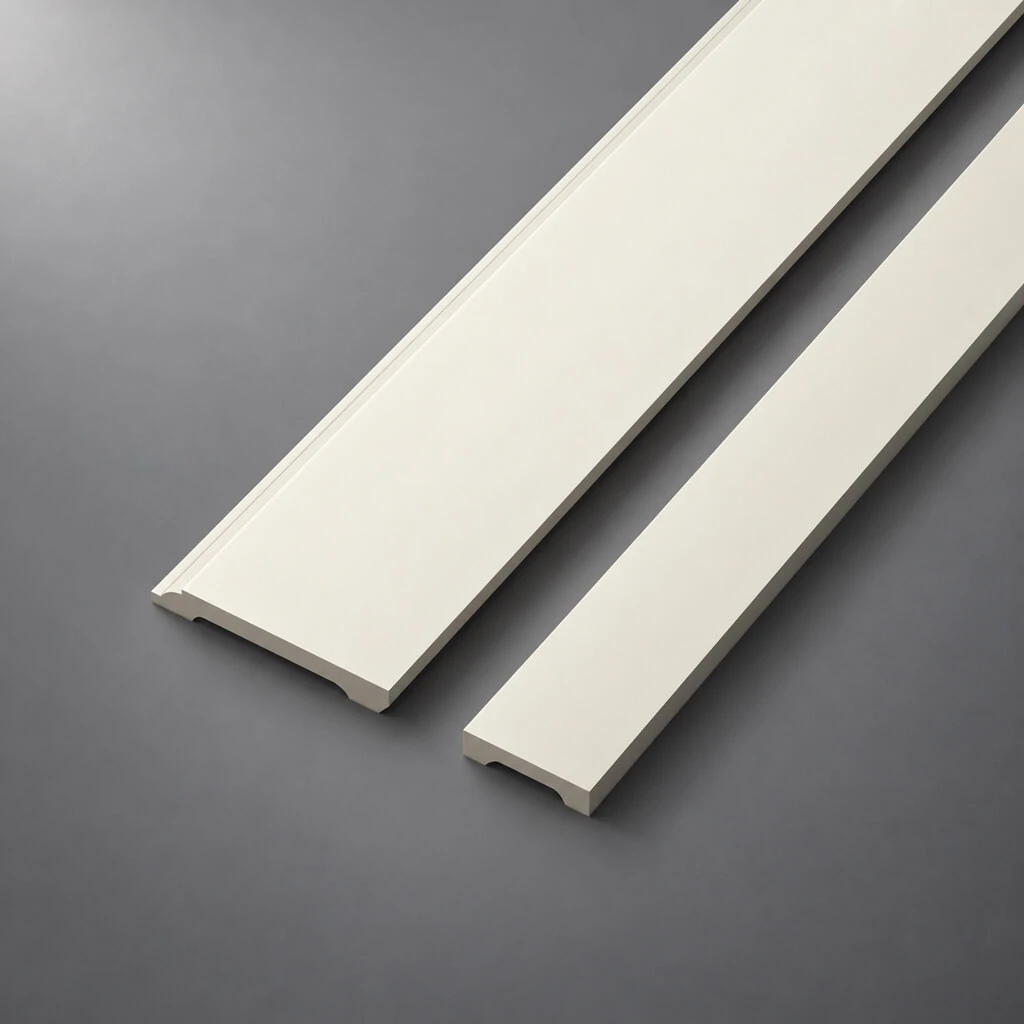
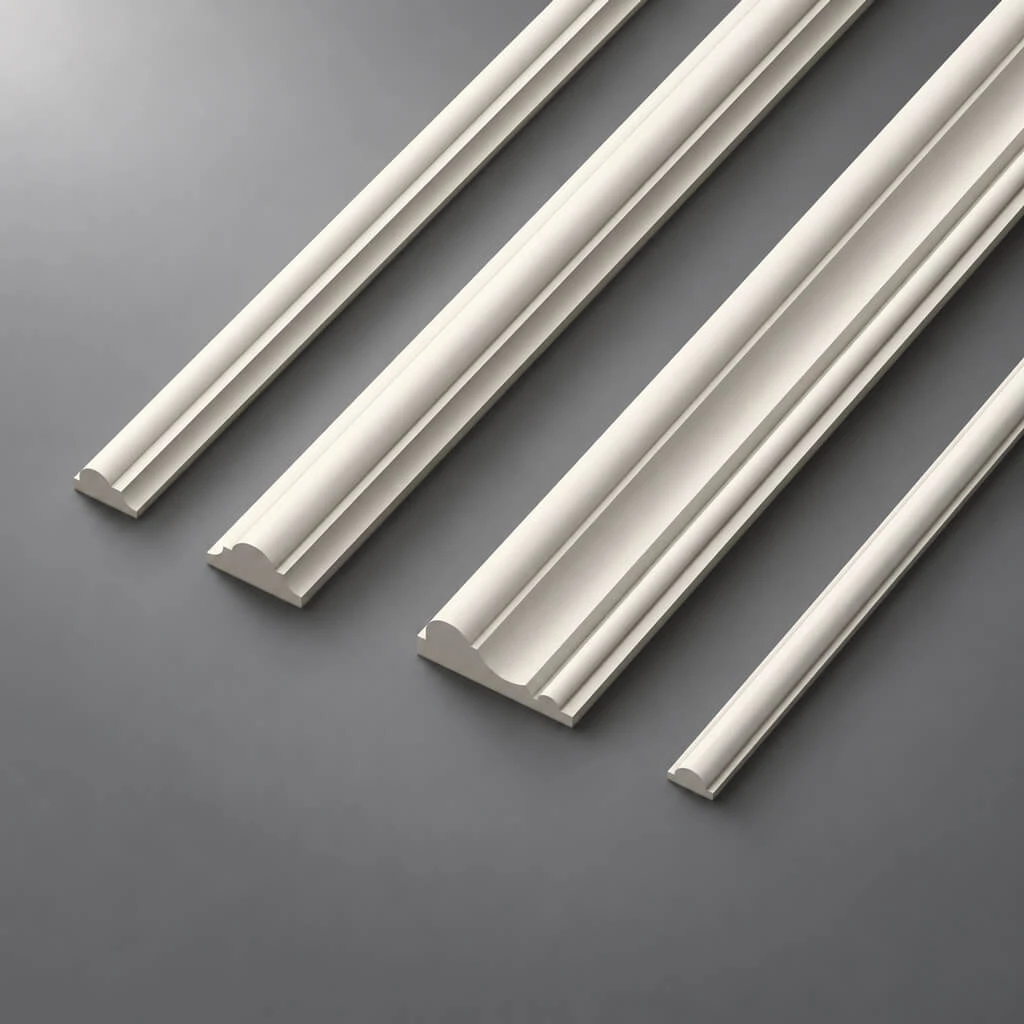
| Molding | Linear profile | Door perimeter, horizontal belts | Profiled, can be ornamental | Facade structure, frame |
| Cornice | Horizontal linear profile | Top of cabinet, set | Profiled or carved | Top completion of the body |
| Capital | Top completion of vertical | Top of pilaster or column | Ionic, Doric, Corinthian | Completion of a vertical element |
When to choose a rosette: when you need one clear central accent with radial symmetry. A rosette is the ideal choice for facades without a complex decorative system but requiring an expressive focal point.
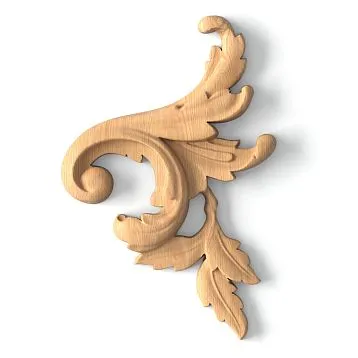
When to choose an overlay instead of a rosette: when you need a vertical or horizontal element, asymmetrical ornament, asymmetrical shape, or complex figured silhouette.
Rosettes and overlays can work together — but with clear role separation. The rosette is the main accent. Overlays are supporting corner or symmetrical elements.
How to choose a furniture rosette: 7 main criteria
By size: proportion as law
Size is the most critical parameter. A furniture rosette should occupy 20–30% of the facade width. Violating the proportion is immediately noticeable.
Table of approximate sizes:
| Facade width | Recommended rosette size |
|---|---|
| 20–30 cm | 4–8 cm |
| 35–50 cm | 7–13 cm |
| 55–70 cm | 11–18 cm |
| 75–90 cm | 15–22 cm |
| 90 cm and more | 18–25 cm or composite system |
Rule: a socket that looks 'right' on a computer screen is not necessarily correct for a specific facade. Always measure the facade before choosing.
By shape: contour defines character
The shape of the rosette's outer contour defines its 'voice':
-
Round — the most versatile, neutral, classic. Suitable for most styles.
-
Oval — soft, slightly elongated. For Rococo, Provence, soft classicism.
-
Square — strict, geometrically precise. For Empire style, strict neoclassicism.
-
Octagonal — a transitional shape, combining strictness and softness.
-
Complex carved — with a figured, irregular contour. For Baroque, rich decorative classicism.
By style: the ornament is instantly recognizable.
The ornamental motif of the rosette is immediately read as belonging to a certain style. A mismatch between the style of the rosette and the style of the furniture creates conflict.
-
Baroque — lush floral rosettes with petals, acanthus, garlands. Deep relief.
-
Rococo — light, asymmetrical motifs, subtle relief, airiness.
-
Empire — strict geometric or acanthus rosettes, clear silhouette, symmetry
-
Neoclassicism — moderate floral or petal motifs, restraint
-
Classic — wide range: from simple petal to complex ornamental
By purpose: position is primary
Where exactly the rosette is installed:
-
Center of the facade — main accent, most noticeable position. Requires the most expressive model
-
Corner of the molding frame — finishing element, less large
-
Center of the drawer — proportionate, modest element
-
Decorative insert in the panel — accent point in the wall or door system
Position determines scale. Scale narrows the model selection.
By degree of decorativeness
Three saturation levels:
-
Restrained — flat relief 3–5 mm, simple motif. For modern classics, minimalist solutions
-
Expressive — relief 6–12 mm, elaborated ornament. For neoclassics, medium saturation classics
-
Accent — deep relief 12–25 mm, detailed carving. For baroque, empire style, representative interiors
By material: wood, species, preparation for finishing
STAVROS wooden furniture rosettes — exclusively solid oak and beech chamber-dried, moisture 8 ± 2%. Detailed material description — on the pageMaterials and Quality.
Oak — dense, with pronounced texture. For tinting while preserving wood grain, dark interiors, study furniture.
Beech — uniform, fine-textured. For dense enamel painting, neoclassics, Provence, white classics.
Enamel blank — without selecting lamellas by color and texture. All differences are hidden under dense coating. More affordable in price.
Tinting blank — lamellas selected by color and texture. For transparent or semi-transparent finishing while preserving wood texture.
"Standard" — machine sanding, optimal for primer and dense painting.
"Prestige" — machine + hand sanding, for premium finish.
Regarding combination with other elements
A rosette does not work alone, but in a system. Before choosing, determine what it will be combined with: molding, cornice, corner overlays, handles. All these elements must belong to the same ornamental family — or, at a minimum, the same level of decorativeness.
In the STAVROS catalog, each series includes compatible products — rosettes, overlays, moldings of one stylistic solution. Choosing from one series eliminates the error of incompatible parts.
What materials are best for wooden furniture rosettes
Why wood is the only right choice
The market offers polyurethane and MDF rosettes. They are cheaper. But natural wood has fundamental advantages that cannot be compensated by price.
Uniform tone with furniture. When the rosette and the facade are the same material, paint and varnish lay without a visible seam. Two different materials under one coating give a visible boundary after several years due to different thermal expansion.
Restorability. A wooden rosette, if damaged, is sanded, repainted, patinated. A polyurethane one is replaced entirely.
Depth of relief. Only solid wood holds the sharp edges of carved ornament for decades without degradation. MDF crumbles on thin elements, polyurethane does not provide the same clarity of undercut.
Living texture. The wood grain is an irreproducible natural pattern. It is what makes a wooden rosette a valuable piece, not just a decorative detail.
When to choose for enamel
Blank "for enamel" — if:
-
the furniture is painted in a solid color;
-
a more affordable price is important;
-
priming is planned before the final coating.
When to choose for tinting.
Blank "for tinting" — if:
-
the furniture is coated with a transparent or semi-transparent composition;
-
the natural wood grain is important;
-
the interior is designed in natural wood tones.
STAVROS recommendation: when finishing "for tinting," use a tinting composition, not a clear varnish — for a uniform color across the entire surface, despite the natural tonal differences between the lamellas.
How to combine furniture rosettes with other decor
Rosette and molding frame: a classic pair
A molding frame around the perimeter of the door + a wooden rosette in the center is a time-tested scheme. The frame organizes the facade space, the rosette anchors its center. Without the frame, the rosette 'floats' in empty space. Without the rosette, the frame looks incomplete.
Compatibility rule: frame and rosette from the same series. If the molding has a floral ornament — the rosette with the same motif. If the molding is smooth — the rosette can be carved, but its level of decorativeness should not sharply contrast.
Rosette and corner overlays: accent and support
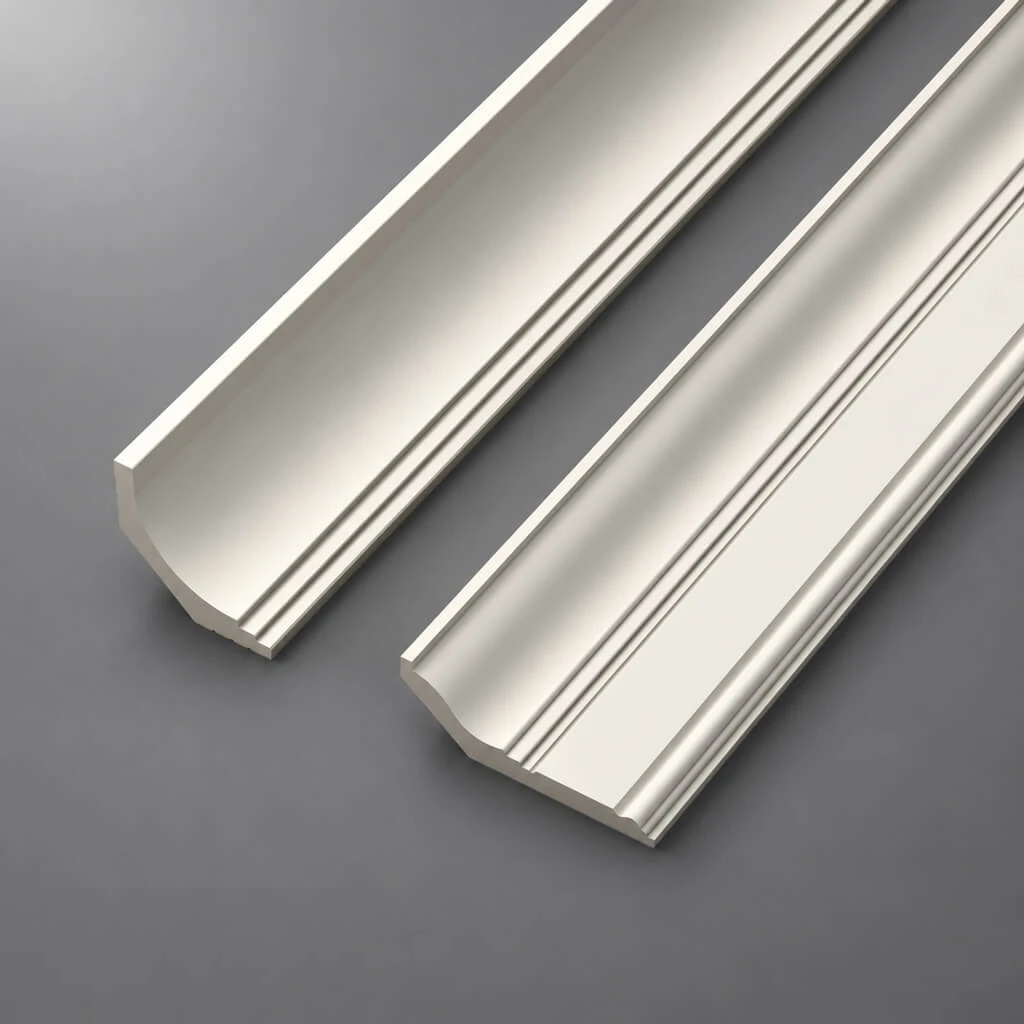
Rosette in the center + fourCorner capsat the intersections of the molding frame — an extended classical scheme. The rosette here is the main accent, the corner overlays are supporting elements. The size of the corner overlays should be smaller than the rosette: they do not compete, they frame.
Rosette and cornice: horizontal and point
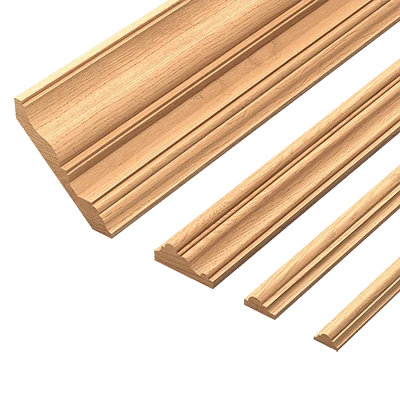
Decorativecarved cornicefinishes the cabinet from above. The rosette anchors the center of each door. These are two different scales: the cornice is a horizontal rhythm across the entire width of the cabinet, the rosette is a point accent. They do not compete.
Coordination: if the cornice is richly carved — the rosettes are restrained. If the cornice is a smooth profiled one — the rosettes can be accent. Balance the overall decorative 'weight' of the system.
Rosette and capitals: vertical and point
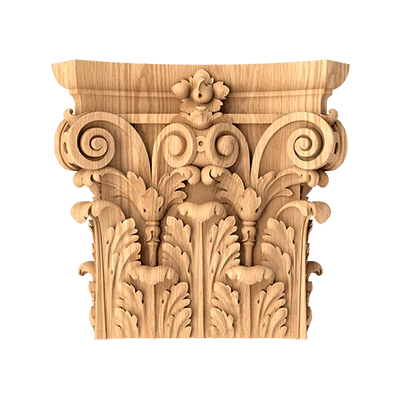
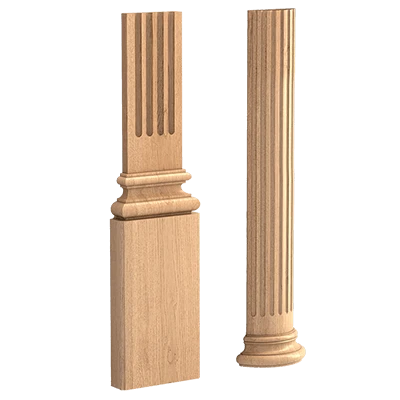
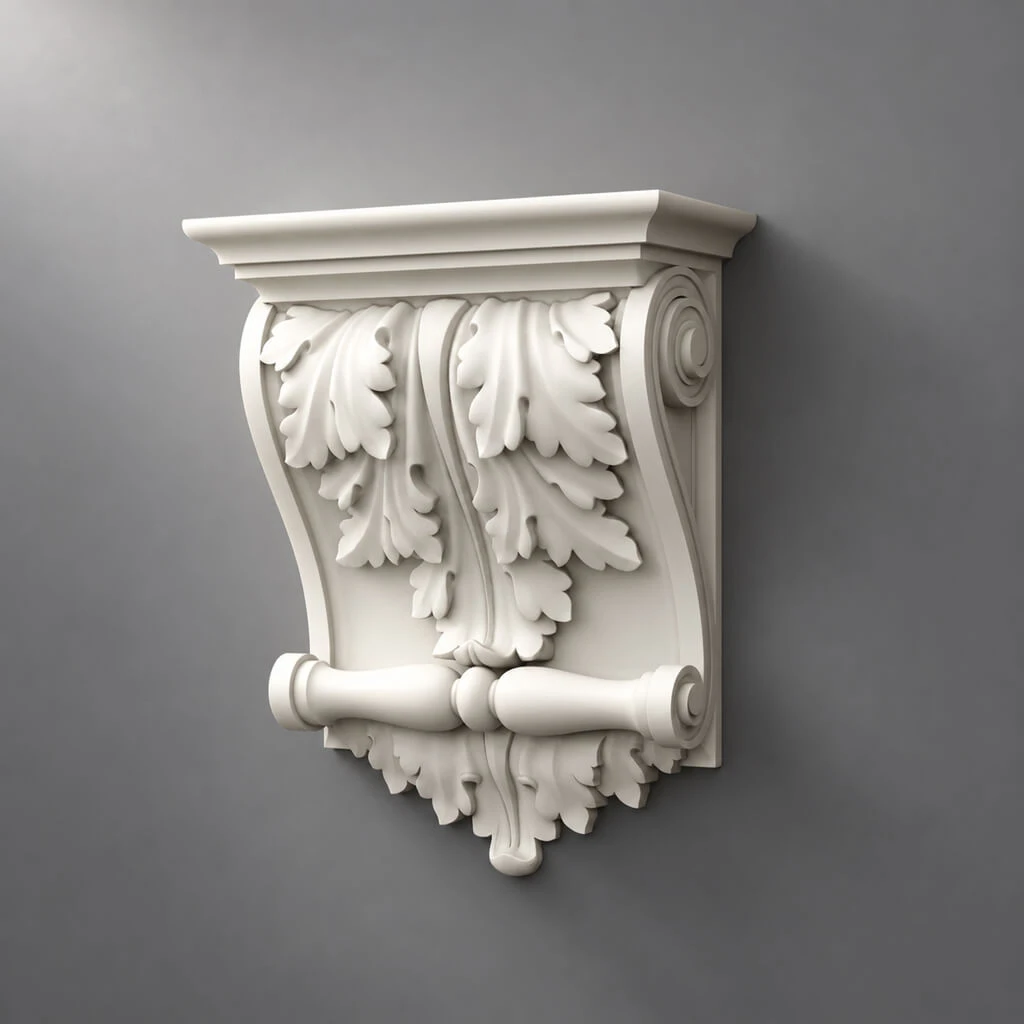
CapitalsOn pilasters + rosettes on facades — a system where the capital sets the vertical rhythm, and the rosette provides the horizontal accent. The ornamental motif of the capital and rosette must belong to the same style — otherwise the system falls apart into unrelated fragments.
Three maximum: the rule of quantity
Three types of decorative elements on one piece of furniture — the optimum for most classical solutions. Molding frame + rosette + corner elements. Adding a fourth and fifth type requires separate justification by the scale of the item.
Common mistakes when choosing wooden furniture rosettes
Too large rosette
A rosette that occupies more than 30% of the facade width overwhelms the plane — it is not an accent, it dominates. The eye 'stumbles' over the decoration instead of freely reading the image. Always check the proportion before ordering.
Too small rosette
The opposite mistake. A small rosette on a large door gets lost — it becomes an unnoticeable detail that fails to perform its function as a focal center. Wide facades need proportionate, legible elements.
Style mismatch
A lush Baroque rosette with floral ornament on a facade in the style of modern classicism — a style conflict. Carved decoration enhances the existing style of the furniture but does not create a new one.
Mixing ornamental motifs
A floral rosette and geometric corner overlays — two different ornamental languages on one facade. They do not create richness — they create visual tension. One motif across the entire piece.
Purchase without a plan
A rosette bought today, molding—a month later from a different series, corner elements—even later and completely incompatible. Result: a set of parts without common logic. The correct approach: first design the entire decorative facade system, then order everything necessary as a kit.
Confusion with product type
Ordering a 'rosette' from a photo without verification—and receiving a ceiling plaster rosette for mounting a chandelier, not a furniture one. Always clarify: it's about a decorative wooden furniture rosette made of solid wood for facades.
Where to buy wooden furniture rosettes in Moscow
STAVROS catalog: selection with filters
Catalog of wooden furniture rosettes STAVROS— full range of products made of solid oak and beech with detailed filtering:
-
By rosette shape (round, oval, square, complex)
-
By ornamental motif
-
By collection
-
By availability in Moscow
Next to the sockets in the catalog are compatible overlays, moldings, and cornices from the same series. This allows you to immediately select a complete decorative system, not just isolated individual parts.
Pickup and delivery
If available at the Moscow warehouse, self-pickup is available. Order conditions, payment, delivery options — on the page "Payment and Delivery". Delivery — throughout Russia.
Showroom in Moscow: live contact with the detail
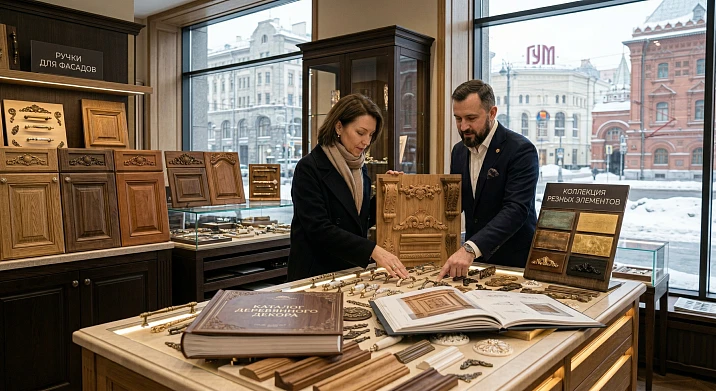
Wooden furniture sockets need to be seen in person. A photograph does not convey the tactility of the relief, the depth of the ornament, the warmth of the material. At the Moscow STAVROS showroom you can:
-
Assess the actual scale of the products
-
Compare the quality of 'Standard' and 'Prestige'
-
Place the socket against samples of your furniture
-
Get a consultation on selection for a specific project
Showroom address: Volokolamskoye Highway, 3. Contacts and working hours — on the page "Contacts. Moscow".
Order and Consultation
Orders are placed through the online store or via the toll-free phone number 8-800-555-46-75. Minimum order — one item. A specialist helps select furniture rosettes for a specific facade, calculate the quantity, choose the type of blank and level of processing.
Who are wooden furniture rosettes especially suitable for?
For private buyers
Want to update a cabinet without replacing it? One correctly selecteda decorative element for furniturefundamentally changes the look of the item — without renovation, without the cost of new furniture. Minimum order of one item.
For interior designers
For projects where furniture decor and wall panel decor must form a unified system, the STAVROS assortment allows selecting rosettes, overlays, moldings, and cornices from a single collection. A unified ornamental language for the space — from one source.
For furniture workshops and manufacturers
Wooden furniture rosettes made from solid natural wood are a professional component for furniture manufacturers. Wide assortment, stable availability in the Moscow warehouse, possibility of wholesale orders. Furniture with carved oak rosettes is a different price segment and positioning.
For restorers
Only solid natural wood allows reproducing a lost wooden rosette so that it matches the original in behavior under finish. Historical ornamental motifs in the STAVROS catalog — acanthus, petal, floral — ensure precise matching when restoring antique furniture.
FAQ: answers to frequently asked questions
What is a wooden furniture rosette?
It is a decorative three-dimensional element made from solid wood with a symmetrical ornament — predominantly round, oval, or square in shape. Installed on the surfaces of furniture facades as a central or accent decorative element. Not to be confused with ceiling rosettes for molding.
Where are wooden furniture rosettes used?
On cabinet fronts, dresser drawers, cabinet doors, kitchen fronts, in buffets and display cases, on decorative wall panels and door leaves. Also used in the restoration of antique classic furniture.
How does a furniture rosette differ from an overlay?
A rosette is a radially symmetrical element for a central position, predominantly round or symmetrical in shape. An overlay is a broader concept: any shape (vertical, horizontal, complex), any ornament, any position on the facade. A rosette and an overlay can work together — with a clear delineation of roles.
Which furniture rosettes are suitable for facades?
For the center of the door — central round or symmetrical rosettes. For corner positions of the frame system — corner rosettes. For wide facades — large rosettes or paired symmetrical ones. All elements are from the same collection.
How to choose the size of a furniture rosette?
The central element should occupy 20–30% of the facade width. Measure the door width, multiply by 0.25 — you get the approximate optimal size. Specify the size based on the actual facade, not a photograph.
Which furniture styles best combine with carved rosettes?
Baroque, Rococo, Empire, Neoclassical, Classic — the entire range of classical styles. Modern classic — provided that restrained, flat options without deep carving are chosen. Minimalist styles and high-tech — not suitable.
Can furniture rosettes be used in restoration?
Perfectly suitable. Only solid wood behaves under finishing identically to the original wooden parts of antique furniture. The STAVROS catalog features historical motifs characteristic of classic 18th–19th century furniture.
Where to buy wooden furniture rosettes in Moscow?
At STAVROS — a manufacturer with CNC production and hand finishing. Catalog with full range, warehouse in Moscow with pickup, showroom at Volokolamskoe shosse, 3. Free phone: 8-800-555-46-75. Order from one item.
How to combine furniture rosettes with moldings and cornices?
All elements are from the same series. Molding frame + rosette in the center — a classic basic pair. Cornice + rosettes — horizontal rhythm and point accents that work at different scales and do not compete with each other. The level of decorativeness of all elements should be coordinated.
Can one rosette be used without a molding frame?
Yes. A rosette on a clean facade plane is an independent solution. Especially appropriate for small cabinet doors, dresser drawers, kitchen fronts in modern classic style. The frame enhances the effect but is not mandatory.
Conclusion
Buy wooden furniture rosettes in Moscow— means adding the most valuable thing to your furniture: a focal point. One element in the right place, of the right size, with the right ornament — and the furniture gains what cannot be achieved by any other means: completeness.
STAVROS — manufacturer of wooden furniture decor. Rosettes,applique, Moldings, Crown Molding, Capitals— a complete system of solid oak and beech furniture decor. Blanks for enamel and tinting. Standard and Prestige. Orders from one item. Showroom: Volokolamskoye Highway, 3, Moscow. Phone: 8-800-555-46-75 (free).
STAVROS — when one detail completes the look.