Article Contents:
- Grip philosophy: why every edge matters
- Types of grip and their impact on construction
- Geometry and standards: the language of millimeters
- Position calculation: the mathematics of beauty
- Material matters: why exactly wood?
- Ecology and safety: what you need to know
- Finish: protection and aesthetics in one bottle
- Color and staining: individuality in details
- Durability: what affects service life
- Impact of Operating Conditions
- Installation and mounting: secrets of professionals
- Common Mistakes and How to Avoid Them
- Care and maintenance: extending the life of wood
- Restoration and renewal
- Styling and design: how to choose the shape
- Size matters: proportions and balance
- Combination with Other Interior Elements
- Economics of choice: price and value
- Wholesale purchases and custom orders
- Production Technologies: From Sketch to Finished Product
- Quality control: what to check
- Psychology of perception: why wood calms us
- Trends and prospects: where design is heading
- Frequently asked questions: answering doubts
- In conclusion: a choice that matters

Can furniture be considered complete without handles? Unlikely. It’s the very detail that creates the first tactile contact with interior furniture. It’s through it that we feel the character of the furniture, its temperature, texture, style.Wooden furniture handleNot just a functional element, but a point of contact between human and space, where form meets comfort, and aesthetics meet practicality. We’ll discuss how this small but incredibly important component affects our daily lives, what ergonomic principles underlie its creation, what finishes protect the wood, and why wood remains the unrivaled material for those who value genuine quality.


Grip philosophy: why every edge matters
When you open a dresser or cabinet drawer, you rarely think about how precisely the handle 'fits' your palm. Yet it’s precisely this moment that determines whether interaction with furniture is comfortable or irritating. Ergonomics of grip is the science of how an object’s shape corresponds to hand anatomy, force distribution, and natural finger movements. ProperWooden furniture handletakes into account palm width, finger thickness, grip angle, and even the force a person applies when opening a facade.
Imagine a D-shaped handle. Its silhouette follows the natural curve of the hand, allowing it to be gripped with the whole palm or with three to four fingers. The setback from the facade surface here is critical: if less than 38 millimeters, fingers will press against the door, causing discomfort. Optimal depth is 38 to 50 millimeters for full hand grip and 22 to 30 millimeters for light finger grip. These are not just numbers from a reference book, but the result of years of research into how humans interact with household items.
But shape is only part of the story. The wood’s texture, its thermal response, tactile softness — all of this affects sensations. A metal handle may feel cold in winter and scorching hot in summer. Plastic appears lifeless and artificial. Wood, however, always feels pleasant to the touch, it 'breathes,' adapts to ambient temperature, and creates a sense of warmth and coziness. That’s whyFurniture Handlesmade from solid beech or oak become the choice of those who value not only appearance but also the quality of daily interaction with interior design.




Types of grip and their impact on construction
There are several basic types of grip, each requiring a specific handle configuration. Full palm grip is used for opening heavy cabinet doors or pulling out deep drawers. Here, a D-shaped handle 128 to 192 millimeters long with sufficient setback from the facade is needed, so the hand can rest comfortably. Three-finger grip — typical for small drawers and light facades — requires more compact dimensions, 64 to 96 millimeters. Two-finger grip (index and thumb) suits miniature doors and pull-out elements, where button-style or small overlay handles are used.
made from hardwoods that retain their shape under load and do not deform even under intensive use.Furniture HandlesGeometry and standards: the language of millimeters
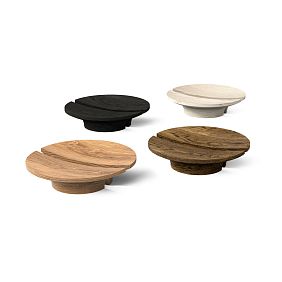
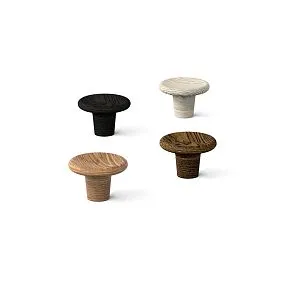
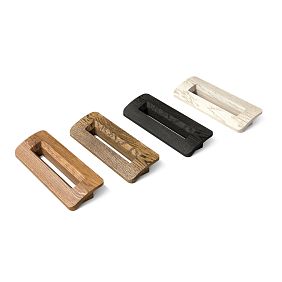
Our factory also produces:



Geometry and standards: the language of millimeters
The world of furniture hardware speaks the language of precise dimensions. The center-to-center distance — the distance between the centers of two mounting holes — must conform to strict standards. Modern furniture manufacturing is built on a modular system, where the base step is 32 millimeters. This is not a random number, but the result of production process optimization, allowing standardization of carcass, facade, and hardware marking.
Standard center-to-center distances for wooden handles start at the minimum value of 32 millimeters — this size is for very narrow facades, children's furniture, and small drawers. The next step is 64 millimeters, suitable for small drawers and narrow facades 150–200 millimeters wide. The 96-millimeter size is considered standard for kitchen drawers and facades 250–400 millimeters wide. The universal and most common center-to-center distance is 128 millimeters, ideal for facades from 400 to 600 millimeters.
For wider doors, sizes of 160, 192, 224, and 256 millimeters are used. Rail handles designed for very wide facades may have center-to-center distances of 320, 352, 416, and even 512 millimeters. This system allows easy replacement of hardware without drilling new holes: if the new handle has the same center-to-center distance, it will fit in place of the old one without additional work.
Get Consultation
Position calculation: the mathematics of beauty
Correct facade marking is an art requiring precision. For horizontal handle placement (standard for doors), the holes are aligned on a single horizontal line. For lower cabinets, the height from the bottom edge of the facade is usually 50–70 millimeters, allowing convenient opening from top to bottom. For upper cabinets, the holes are placed 50–70 millimeters from the top edge to facilitate pulling from bottom to top.
The formula for calculating the position of the first hole from the side edge of the facade is simple and elegant: X = (Facade width − Center-to-center distance) / 2. Example: facade width 450 millimeters, center-to-center distance 128 millimeters. X = (450 − 128) / 2 = 161 millimeters. The first hole is placed 161 millimeters from the left edge, the second — 128 millimeters to the right, i.e., 161 millimeters from the right edge. Symmetry is the foundation of harmony.
Vertical placement is used for tall, narrow doors, where the holes are positioned one above the other. The center-to-center distance in this case is measured vertically, and the horizontal position is determined either at the center of the facade width or offset toward the edge, depending on hinge placement and door opening direction. This configuration is often found in tall panel cabinets, whereFurniture Handlesbecome a visual accent, emphasizing vertical lines.
Material matters: why exactly wood
In the age of synthetic materials and composites, wood remains the unrivaled choice for those who value authenticity. Each species has its own character, texture, and history. Beech — a hard, dense wood with a fine grain structure, resistant to mechanical damage and ideal for milling complex shapes. Oak — a symbol of strength and durability, with a distinctive texture and noble tone that deepens over time. Ash — a resilient and elastic wood, combining strength with lightness, ideal for minimalist forms.
The choice of species is determined not only by aesthetic preferences but also by functional requirements. For kitchen facades, where handles are subjected to intensive use, hardwoods such as oak or beech are preferred. For bedrooms and living rooms, where the emphasis is on aesthetics, lighter and softer species such as ash or maple can be chosen. In any case,Wooden furniture handlesolid wood will always surpass in durability and tactile qualities any product made from particleboard, MDF, or veneered materials.
Ecological and safety: what to know
Natural wood is not only beauty, but also safety. Unlike plastic or composite handles, wooden ones do not emit toxic substances, do not cause allergies, and do not accumulate static electricity. This is especially important for children's rooms, kitchens, and bedrooms, where we spend most of our time. Wood possesses natural antibacterial properties: some species, such as oak, contain tannins that inhibit the proliferation of microorganisms.
Moreover, the production of wooden handles is a process with a minimal carbon footprint, especially if the wood comes from forests managed under certified sustainable practices. ChoosingFurniture Handlessolid wood, you make a conscious choice in favor of ecology, supporting the principles of circular economy and responsible consumption.
Coating: Protection and Aesthetics in One Bottle
Even the strongest wood requires protection. A wooden handle's coating is not merely a decorative layer, but a comprehensive system ensuring longevity, moisture resistance, resistance to contamination, and mechanical damage. There are several main types of coatings, each with its own advantages and application specifics.
Varnish coating — a classic choice for those who wish to preserve the natural color and texture of wood. Varnish highlights the natural wood grain pattern, making it more expressive and deep, creates a smooth surface pleasant to the touch, and protects the wood from moisture, contamination, and ultraviolet rays. Modern acrylic varnishes have high wear resistance, do not yellow over time, and are safe for health. Matte varnish coating is especially popular in Scandinavian and minimalist interiors, where naturalness and restraint are valued.
Oil coating — a choice for those who prefer deeper penetration of the protective composition into the wood structure. Oil does not form a film on the surface, but impregnates the fibers, highlighting the texture and giving the wood a silky, slightly matte sheen. Such handles are pleasant to the touch, “warm” and alive, but require periodic renewal of the oil layer — approximately once a year under intensive use. Oil is ideal for eco-style interiors, where maximum material naturalness is important.
Wax coating — a traditional method used for centuries. Wax creates a soft, velvety sheen, highlights the richness of wood tones, and has a pleasant light aroma. However, wax coating is less resistant to moisture and contamination than varnish or oil, so it is recommended for furniture in living rooms and bedrooms, not on kitchens or in bathrooms. Wax requires regular care and renewal, but the result is worth the effort: handles acquire a unique depth of color and an irreplaceable patina of time.
Combined coating — a modern approach combining the advantages of different methods. For example, oil impregnation with a final matte acrylic varnish layer provides maximum protection while preserving the natural appearance of the wood. Such a coating makeswooden furniture handlemoisture-resistant, wear-resistant, and pleasant to the touch, combining the best of both worlds.
Color and toning: individuality in details
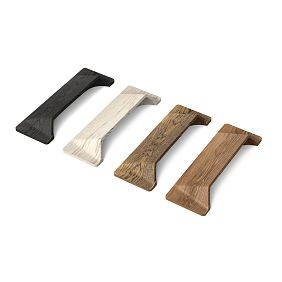
Coating is not only protection, but also an opportunity to change the color of the wood, adapting it to the interior style. Stains and toning oils allow you to achieve shades from light honey to deep chocolate, from silvered oak to charcoal veneer. At the same time, the wood texture remains visible, preserving its natural beauty. Pigmented varnishes and enamels create a dense colored coating that completely hides the wood structure, but opens up limitless possibilities for color experiments: from pastel shades to bright accent colors.
The choice of handle color is determined by the overall interior concept. In classic interiors, natural wood tones are preferred — golden oak, warm walnut, reddish cherry. In Scandinavian and minimalist spaces, light tones are popular — bleached oak, ash, light beech. Modern industrial interiors allow bolder solutions: black, graphite, even colored handles that become a bright accent on neutral facades.Furniture HandlesWooden handles with individual toning allow you to create a unique interior reflecting your personality and style.
Durability: What Affects Service Life
A high-quality wooden handle, with proper care, can serve for decades, preserving its shape, functionality, and aesthetic appeal. Durability is determined by several factors: wood species selection, processing quality, coating type, and operating conditions.
Hardness of the wood species — the first criterion of durability. Hardwoods such as oak, beech, and ash have high fiber density and resistance to mechanical damage. They do not deform under load, do not crack with temperature and humidity fluctuations, and retain their shape clearly even after long-term use. Softwoods, such as pine or spruce, are less suitable for heavily used furniture, as they easily develop dents and scratches.
Processing quality — the second key factor. Modern manufacturing methods, such as 3D milling, allow creating handles with ideal geometry, free of chips, burrs, and irregularities. Precision processing is especially important for mounting points: screw holes must be strictly perpendicular to the handle’s plane and have the correct diameter to ensure a secure connection with the facade. Quality sanding and polishing create a smooth surface on which the coating adheres more strongly and evenly.
Mounting — often underestimated aspect of durability. Even the highest-quality handle will not last long if the mounting is unreliable. For wooden handles, stainless steel or brass screws are used, which do not rust or deform. Screw length must match facade thickness and thread hole depth in the handle. Proper tightening torque ensures tight fit without risk of wood splitting. In some constructions, additional elements — bushings, washers, gaskets — are used to distribute load and protect both the handle and the facade from damage.
Influence of Operating Conditions
Even the strongestWooden furniture handleneeds proper operating conditions. Main enemies of wood — sharp humidity and temperature fluctuations, direct sunlight, aggressive cleaning agents. In rooms with normal humidity (40–60%) and stable temperature (18–24°C), wooden handles retain their properties for decades. In high-humidity environments (bathrooms, kitchens), it is important to choose handles with enhanced water-resistant coating and regularly check mounting condition.
Direct sunlight causes wood bleaching and drying, so furniture with wooden handles should be placed away from windows or use UV-protective curtains. Aggressive cleaning agents containing abrasives, solvents, or chlorine may damage the coating, so for maintenance, it is recommended to use gentle compositions — special wood polishes, oils, or simply a soft damp cloth.
Installation and Mounting: Secrets of Professionals
Correct installation of a wooden handle is the key to its durability and functionality. The process may seem simple, but requires precision and attention to detail. First stage — marking holes. Use a template or measuring tool to accurately determine hole center positions. Remember the calculation formula mentioned earlier and check symmetry: distance from facade edges to holes should be equal.
Second stage — drilling. Choose a drill bit 0.5 mm wider than screw diameter to ensure easy installation without risk of facade cracking. Use painter’s tape on the back of the facade to prevent chipping when the drill exits. Drill strictly perpendicular to the facade plane, avoiding any tilt. For thick facades (20 mm and above), use a drill with speed adjustment, starting at low RPM.
Third stage — handle installation. Insert screws into handle holes, thread them through facade holes, and begin tightening. Do not tighten immediately to full torque: first, pre-tighten both screws, ensure the handle is level, and then tighten them alternately, controlling torque. Excessive force may crack the wood or deform the threads. Correctly installedWooden furniture handlefits tightly against the facade, has no play, and looks perfectly symmetrical.
Typical mistakes and how to avoid them
First mistake — inaccurate marking. Even a few millimeters deviation results in a handle appearing skewed. Use precise measuring tools and templates, especially if installing multiple handles on one facade or adjacent facades where asymmetry will be particularly noticeable.
Second mistake — drilling at an angle. If the hole is not perpendicular to the facade plane, the screw enters at an angle, creating stress in the mounting and wood. Over time, this leads to handle loosening and hole deformation. Use guides or special drill jigs to ensure perpendicularity.
Third mistake — over-tightening screws. Wood is a material with defined plasticity, and excessive force may cause micro-cracks that over time lead to mounting failure. Use a torque screwdriver or drill with torque adjustment if installing many handles.
Fourth mistake — using unsuitable screws. Screws must match facade thickness and thread hole depth in the handle. Too short screws will not provide secure mounting; too long screws may protrude from the back of the facade or hit the furniture body wall. Quality handle manufacturers usually include appropriate fasteners, but if replacing screws, ensure they meet requirements.
Care and Maintenance: Extending Wood’s Lifespan
Wooden handles require no complex care, but regular attention helps preserve their beauty and functionality for decades. Main rule — gentleness. Avoid abrasive sponges, aggressive cleaning agents, excessive moisture. For daily cleaning, simply wipe handles with a soft dry or slightly damp microfiber cloth.
Every few months (depending on usage intensity), more thorough cleaning is recommended. For handles with lacquer finish, use furniture polish or special wax — which not only clean but also create an additional protective layer. For handles with oil finish, use specialized wood compositions — oil-wax or hard wax oil. Apply a small amount to a soft cloth, spread a thin even layer over the handle surface, and leave for 15–20 minutes to absorb. Wipe off excess with a dry cloth, polish to a soft sheen.
Pay special attention to mounting points. Periodically check if the handle has loosened, and tighten screws if necessary. If you notice cracks, chips, or other damage, do not delay repair: minor defects are easily fixed early on, but over time may lead to serious problems.
Restoration and renewal
Even if a wooden handle has lost its original appearance, it is not a reason to discard it. Wood is a material easily amenable to restoration. Scratches and scuffs can be removed with light sanding using fine-grit sandpaper (220–320 grit), followed by reapplying the finish. For lacquered handles, apply a thin layer of matte lacquer using a brush or spray. For oiled handles, apply fresh oil, let it absorb, and polish.
If you wish to change the handle’s color, you can use stains or tinting oils. First, remove the old finish by sanding, then apply stain in several thin layers until desired shade is achieved, let dry, and then apply protective lacquer or oil. This approach allows adaptingFurniture Handlesto a changed interior without needing to purchase new ones.
Stylistic and Design: How to Choose Shape
Handle shape is not only an aesthetic issue but also a functional one. Different interior styles require different solutions, and the right shape enhances the overall impression of the space. Classic interiors lean toward rounded, smooth shapes with carving and decorative elements. Handle-eyes with decorative overlays, button-shaped handles resembling sockets, curved lines imitating historical samples — all are characteristic of classic, baroque, and empire styles.
Scandinavian style prefers minimalism and functionality. Here, simple geometric shapes — straight handles, cylindrical handles, minimalist overlays without decoration — are appropriate. Light-colored woods — ash, white oak, light beech — fit perfectly into Scandinavian color palette.Furniture HandlesIn this style, handles should be as inconspicuous as possible, blending into the overall composition, yet still convenient and reliable.
Modern and minimalist interiors allow bolder solutions: asymmetrical shapes, unusual cross-sections, contrasting material combinations. A wooden handle can be enhanced with metal inserts, leather elements, or even integrated lighting. Industrial style combines wood with metal and concrete, creating rugged, deliberately rough shapes where material texture, natural defects, and irregularities are visible.
Size matters: proportions and balance
The correct handle size is determined not only by functional requirements but also by visual proportions. A too small handle on a large facade looks ridiculous, disappears, and creates an impression of incompleteness. A too large handle on a small facade appears bulky and disrupts the balance. Golden rule: the handle length should be approximately one-third of the facade width, but not less than 96 millimeters for comfortable grip.
Handle thickness is also important. A too thin handle (less than 10 millimeters in diameter) is uncomfortable to grip and may appear fragile. A too thick handle (more than 30 millimeters) does not fit in the palm and looks bulky. Optimal thickness for brackets is 12–20 millimeters, for cylindrical handles — 18–25 millimeters. These dimensions ensure comfortable grip and visual harmony.
A wooden handle does not exist in a vacuum — it is part of a complex composition including facades, countertops,
Combination with other interior elements
, lighting. Harmonious combination of all these components creates a unified interior image, where every detail is in its place.Furniture legs, decorative elementsLighting. Harmonious combination of all these components creates a unified interior image, where every detail is in its place.
— overlays, sockets, moldings — should match handles in style and material. If handles have carved decoration, carved overlays on facades or panels are appropriate. If handles are minimalist and smooth, the decoration should be equally restrained. General rule: the more complex the handle shape, the simpler the other elements should be, and vice versa.
Buy decorative elementsLighting plays an important role in the perception of wooden handles. Warm light (2700–3000 K) highlights golden and honey tones of wood, creating a cozy atmosphere. Cool light (4000–5000 K) makes the texture more contrasting, reveals relief details, suits modern interiors. Directional lighting (spotlights, track lights) creates play of light and shadow on carved surfaces, transforming a simple handle into a sculptural object.
Lighting plays an important role in perceiving wooden handles. Warm light (2700–3000 K) highlights golden and honey tones of wood, creating a cozy atmosphere. Cool light (4000–5000 K) makes the texture more contrasting, reveals relief details, and suits modern interiors. Directional lighting (spotlights, track lights) creates play of light and shadow on carved surfaces, transforming a simple handle into a sculptural object.
Economics of choice: price and value
The cost of a wooden handle varies widely — from several hundred to several thousand rubles per piece. What determines the price and is it worth paying extra for expensive models? First factor — wood species. Exotic species (wenge, teak, rosewood) are more expensive than local ones (oak, beech, ash). Second factor — processing complexity. Carved, shaped handles require more time and skill than simple geometric forms. Third factor — finish. Multi-layer lacquer systems or special waxes with hard resin cost more than simple impregnation.
But price is not the only criterion. More important is value — the ratio of quality, durability, and aesthetics to cost. An inexpensive handle made of softwood with poor finish will last one or two years, then require replacement. An expensiveWooden furniture handlemade of hardwood with professional processing will last decades, maintaining functionality and appearance. In the long run, a quality handle proves more economical, not to mention the pleasure you get from daily interaction with a beautiful and comfortable object.
Wholesale purchases and custom orders
If you are furnishing a large space — kitchen, wardrobe, library — it makes sense to consider wholesale purchases. Many manufacturers offer discounts for purchasing a certain quantity of handles, significantly reducing the overall project cost. Moreover, wholesale purchase guarantees that all handles will be from the same batch, with identical shade and texture, which is important for creating a unified look.
Creating a quality wooden handle is a complex process combining traditional craftsmanship and modern technologies. It all begins with selecting wood. The material must be carefully dried to a moisture content of 8–10% to avoid deformation during use. Defects are rejected at the visual inspection stage: cracks, rot, large knots make the blank unsuitable.
Production technologies: from sketch to finished product
Next stage — cutting. Blanks of required size are cut from the block, taking into account processing allowances. Grain direction matters: for long handles, the grain should run lengthwise, ensuring maximum strength. Then comes milling — the process of shaping the blank. Modern CNC machines allow creating complex three-dimensional shapes with precision down to tenths of a millimeter, unattainable with manual processing.
After milling, sanding follows — a multi-stage process starting with coarse abrasives (grit 80–120) to remove milling marks and ending with fine abrasives (grit 220–320) to create a perfectly smooth surface. Quality sanding is the foundation of long-lasting finish: on poorly sanded surfaces, lacquer or oil settles unevenly, forming runs and gaps.
Then the finish is applied — one or several layers, depending on material type and protection requirements. Between layers, intermediate sanding is performed to remove raised fibers and minor irregularities. The final layer is polished to the desired gloss level — matte, satin, or glossy. The last stage — drilling holes for fasteners and installing threaded inserts, if specified by the design.
Then a coating is applied — one or several layers, depending on the material type and protection requirements. Between layers, intermediate sanding is performed to remove raised fibers and minor irregularities. The final layer is polished to the desired gloss level — matte, satin, or glossy. The last step is drilling holes for fasteners and installing threaded inserts, if specified by the design.
Quality control: what to check
A quality manufacturer conducts multi-stage control at each stage. Geometry is checked: all dimensions must match the drawing with tolerance no more than 0.5 millimeters. Surface quality is checked: no chips, cracks, scratches, or finish runs are allowed. Fastening strength is checked: threaded holes must withstand multiple screwing and unscrewing cycles without damaging the threads.
A reliable manufacturer provides warranty on their products, confirming confidence in quality.Furniture HandlesWooden blocks from reputable brands undergo testing for wear resistance, moisture resistance, and temperature stability, ensuring long service life under real operating conditions.
There is something deeply human in our love for wood. Studies show that contact with natural materials reduces stress levels, improves mood, and enhances concentration. Wood connects us with nature, reminding us of forests, mountains, open spaces. Even small wooden elements in interior — such as handles — create a sense of coziness and safety.
Tactile experience plays a key role here. Touching a warm, slightly rough wooden surface activates receptors in the skin, sending signals to the brain associated with comfort and calm. This works on a subconscious level: we don’t think about it, but every time we open a cabinet with wooden handles, we receive a microdose of positive emotions.
Visual perception of wood also matters. Unique grain patterns, variations in shades, play of light on textured surfaces — all this creates visual richness that never gets boring, unlike monotonous artificial materials.
and hardware form a unified interior image, where every detail contributes to the overall atmosphere.Wooden wall decorand hardware form a cohesive interior image, where every detail contributes to the overall atmosphere.
Trends and prospects: where is design heading
Modern furniture hardware design is at the intersection of tradition and innovation. On one hand, there is growing interest in artisanal techniques, handcrafted work, and unique small-batch items. On the other hand, technologies are advancing, enabling the creation of forms previously impossible. This synthesis gives rise to new solutions where precision machining combines with the naturalness of the material.
One key trend is eco-friendliness. Consumers increasingly choose products made from renewable resources, with minimal carbon footprint, from manufacturers adhering to sustainable development principles. Wooden handles from certified forests, with natural water-based finishes, have become the norm rather than an exception.
The second trend is customization. People want unique interiors that reflect their personality. The ability to choose the wood species, shape, color, and finish makeswooden furniture handlenot just a functional element, but a means of self-expression. Manufacturers offering flexible solutions and custom orders gain a competitive advantage.
The third trend is technology integration. Handles with built-in opening sensors, lighting, even wireless smartphone charging already exist. Wood combines beautifully with electronics, creating items where natural and technological elements harmoniously complement each other.
Frequently Asked Questions: Answering Doubts
How to choose the right handle size for a specific cabinet door?
The handle length should be approximately one-third of the door width, but not less than 96 millimeters for comfortable grip. For a 450-millimeter wide door, the optimal handle length is 128–160 millimeters. Also check the center-to-center distance: it should be a multiple of 32 millimeters and match the standard cabinet body marking.
Which wood species is best for kitchen handles?
For kitchens, hardwoods with dense grain structure — oak, beech, ash — are recommended. They are resistant to moisture, mechanical damage, and can withstand intensive use. Always choose handles with moisture-resistant finish — multi-layer lacquer or hard-wax oil.
Can wooden handles be installed by oneself?
Yes, installation does not require special skills, but accurate marking is crucial. Use a template or measuring tool to determine the position of holes, drill strictly perpendicular to the door surface, and do not overtighten screws. If unsure, consult professionals.
How to care for wooden handles?
Wipe them with a soft dry or slightly damp cloth. Every few months, use polish for lacquered handles or oil for oiled ones. Avoid abrasives, aggressive cleaning agents, and excessive moisture. Periodically check the fasteners and tighten screws as needed.
Why are wooden handles more expensive than plastic or metal ones?
Natural wood is a material requiring careful processing, drying, and multi-stage finishing. Producing wooden handles is more labor-intensive than stamping metal or molding plastic. But you pay not only for the material, but also for eco-friendliness, durability, aesthetics, and tactile comfort. In the long run, qualityFurniture Handlesmade of wood is more economical, as they do not require frequent replacement.
Can wooden handles be painted?
Yes, wood easily accepts painting. First, remove the old finish by sanding, apply primer (if using enamel), then paint in several thin layers. After drying, apply a protective lacquer. You can also use stains or tinting oils to change the color while preserving the texture.
What is the most universal center-to-center distance?
128 millimeters is the most common size, suitable for most kitchen and furniture doors ranging from 400 to 600 millimeters wide. If unsure, choose this size: it ensures comfortable grip and fits standard modular systems.
Do wooden handles need additional treatment after purchase?
Quality handles from reliable manufacturers come pre-treated with protective finish and do not require additional treatment. If you purchase unfinished blanks or wish to change the tone, apply stain, oil, or lacquer according to the manufacturer’s instructions.
Can wooden handles darken over time?
Some species, especially oak, naturally darken under exposure to ultraviolet light and oxygen. This is a normal process that gives wood a noble patina. If you wish to preserve the original tone, use lacquer with UV filter and place furniture away from direct sunlight.
Are wooden handles suitable for bathrooms?
Yes, provided they have a quality moisture-resistant finish — choose handles with multi-layer lacquer or special oil that prevents moisture absorption. Ensure good ventilation in the room to avoid prolonged exposure to high humidity. Regularly inspect the finish and renew it as needed.
In conclusion: a choice that matters
Choosingwooden furniture handleBy choosing, you opt for quality, eco-friendliness, aesthetics, and longevity. This is not just hardware, but a point of contact with furniture — an element that shapes your daily interaction with space. Properly selected handles highlight interior style, ensure comfortable use, and serve for decades, preserving both functionality and beauty.
When you open a cabinet door or pull out a drawer, you feel the warmth of wood, its natural texture, its living energy. This sensation is impossible to get from plastic or cold metal. Wood turns a house into a home, transforming furniture from a set of functional items into a living, breathing space where it’s pleasant to be.
STAVROS offers a wide range of furniture handles made from solid hardwoods, manufactured using modern technologies with high-precision equipment and eco-friendly finishes. Each handle undergoes multi-stage quality control, ensuring perfect geometry, flawless finish, and long service life. In the STAVROS catalog, you’ll find models suitable for any interior style — from classic to minimalism, from Scandinavian simplicity to industrial ruggedness.
Choosing STAVROS means choosing quality proven over time, reliability confirmed by thousands of satisfied customers, and beauty that never goes out of style. STAVROS wooden handles are an investment in comfort, style, and longevity of your interior — a decision you won’t regret.