Article Contents:
- Wooden profile: sculpture on a plane
- What is a profile from a geometric perspective
- Wood species: choosing between aesthetics and functionality
- Buy wooden profile: criteria for professional selection
- Size range: from miniature beads to massive cornices
- Profile complexity: from simple to carved
- Finishing: protection and aesthetics
- Shaped wooden profile: engineering of complex forms
- Milling technology: from manual to CNC
- Bent profiles: when a line becomes an arc
- Round beech handrails: an alternative to oak
- Beech handrail: properties and features
- Mounting beech handrails: features of working with the material
- Round oak handrail: the standard of prestige and durability
- Oak handrail: texture and patina of time
- Installation of oak handrails: nuances of working with hard wood
- Carved wooden balusters: art in every element
- Types of carving on balusters
- Manufacturing wooden balusters: from blank to masterpiece
- Harmony of profiles and handrails: a system of connections
- Unity of wood species and finish
- Profile rhyme
- Carved theme
- Contrast of scales
- Installation of decorative profile: professional tricks
- Marking: Precision — the Politeness of Kings
- Angle cutting: the art of joining
- Fastening: glue plus mechanics
- Application in interior styles
- Classicism: Symmetry and Proportions
- Baroque: Luxury and Dynamism
- Modernism: fluidity and asymmetry
- Scandinavian minimalism: simplicity and light
- Loft: industrial aesthetics
- Frequently Asked Questions and Detailed Answers
- Can different wood species be combined in one interior?
- Which profile to choose for a small apartment?
- Is it necessary to treat the ends of the profile?
- How to care for carved balusters?
- How long does an oak profile last?
- Can wooden profiles be installed in damp rooms?
- How to determine profile quality when purchasing?
- Conclusion: Mastery in Details

Why does one interior feel like a collection of random elements, while another feels like a unified organism where every detail is in its place? The secret lies in the coordination of lines, profiles, and textures.Wooden decorative profilesets the rhythm for walls and ceilings, forms frames and panels, masks joints.Round oak handrailbecomes a natural extension of the hand when ascending the stairs—smooth, warm, reliable. When wall profiles echo balusters, and the handrail repeats the geometry of moldings, a visual and tactile harmony is born, which you feel but cannot always explain in words.
Let's get to the point: what is a wooden decorative profile, what forms does it take, what is the purpose of this play of convexities and concavities. HowRound oak handrailties the staircase structure together. WhyCarved wooden balustersrequire special craftsmanship. And how to combine these elements into a composition worthy of admiration not only at the moment of finishing the renovation but also after twenty years of use.




Wooden Profile: Sculpture on a Plane
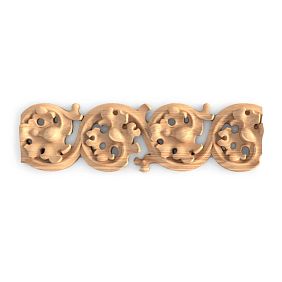
A flat wall covered with paint or wallpaper is a neutral background.Profile made of woodinstalled vertically or horizontally, transforms the background into a structured space. Lines appear, dividing the plane into zones. Relief appears—the profile casts a shadow, creates a play of light throughout the day. The wall gains character.




What is a profile from a geometric perspective
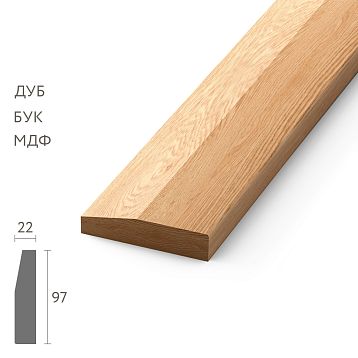
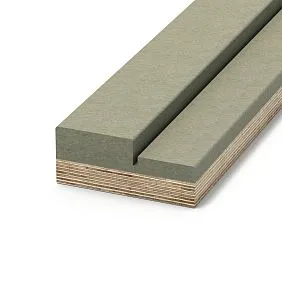
A profile is a strip with a shaped cross-section. If you take the simplest rectangular-section block measuring 20×40 millimeters, that is also a profile, just the simplest one. The interest begins when roundings, chamfers, beads, and coves are applied to the edges. The cross-section becomes more complex, and the profile becomes shaped, molded.
Classical nomenclature of profile elements:
Bead—a convex cylindrical element with a radius of 3-8 millimeters, running along the entire length of the strip. Creates a distinct shadow, emphasizes volume.
Cove—a concave element, as if 'cut out' from the solid. Forms a smooth transition from one plane to another, softens corners.
Ogee—a combination of convex and concave elements forming a wavy profile. Complex, decorative, characteristic of classical interiors.
Ovolo—an S-shaped bend of the profile, combining convex and concave parts. Visually dynamic, creates a sense of movement.
Rebate—a rectangular protrusion or recess used for joining elements (e.g., in door frames).
Simple profiles (one or two elements) are easy to install, inexpensive, and suitable for modern minimalist interiors. Complex profiles (three to five elements) require high-precision processing, are more expensive, and are characteristic of classic, Baroque, and Empire styles.
Our factory also produces:


Wood Species: Choosing Between Aesthetics and Functionality
The choice of wood species for a profile is determined by several factors: appearance (texture, color), physical properties (hardness, stability), and cost.
Oak. Hardness 3.7-4.0 on the Brinell scale, density 700-750 kg/m³. Texture is expressive, with clear annual rings and medullary rays (especially on radial cut). Color ranges from light golden (young oak) to dark brown (stained oak). Oak profile lasts 50-70 years, is easily restored, darkens and becomes more refined with age. Disadvantage—high price (30-50% more expensive than beech).
Beech. Hardness 3.6-3.8, density 650-680 kg/m³. Structure is uniform, fine-pored, with a pinkish hue. Beech sands perfectly to a silky smoothness, takes stains excellently (the texture does not show through under paint, resulting in an even tone). Formability is high—after steaming at 100-110°C, beech bends with a minimum radius of 400 millimeters, allowing for curved profiles for arches and bay windows. Disadvantage—hygroscopicity: with humidity fluctuations exceeding ±10%, deformations are possible. Service life is 30-40 years in a stable climate.
Ash. Hardness comparable to oak (3.5-3.8), texture is contrasting—bright annual rings on a light background. Ash is elastic, holds nails and screws well (does not split), suitable for profiles under mechanical stress. Color is lighter than oak, valued in Scandinavian and modern interiors. Price is close to oak.
Pine. Soft (hardness 1.6-2.0), lightweight (450-500 kg/m³), affordable. Suitable for budget projects, country houses, saunas. Texture with pronounced resin ducts, yellowish-pink color. Disadvantages: softness (scratches easily), resinousness (resin can seep out for years), relative lack of durability (20-30 years). With quality treatment with antiseptics and fire retardants, pine serves reliably.
Larch. Denser than pine (550-650 kg/m³), harder (2.6-3.0), contains gum that repels insects and fungus. Does not rot even in damp conditions. Color reddish-brown, silvers over time (especially outdoors). Larch is a compromise between the affordability of pine and the prestige of oak. Service life 30-50 years.
Get Consultation
Buying wooden molding: criteria for professional selection
When making a decisionto buy wooden molding, it's important to consider not only the wood species, but also dimensions, profile complexity, finish, and manufacturing technology.
Size range: from miniature beads to massive cornices
Profile width (face surface size) varies from 15 to 200 millimeters:
Narrow profiles 15-30 millimeters. Used for framing small elements (pictures, mirrors, furniture fronts), creating delicate lines on walls. Suitable for small spaces where wide profiles would overwhelm the area.
Medium profiles 40-80 millimeters. Universal, used for panel systems (boiserie), framing door and window openings, creating decorative wall compositions. Optimal for most interiors.
Wide profiles 90-150 millimeters. Architectural details for spacious rooms with high ceilings — columns, pilasters, fireplace portals. Create monumentality, suitable for classic palace interiors.
Massive cornices 160-200 millimeters. Ceiling cornices for representative halls. Often decorated with carving, combined with stucco.
Profile thickness (relief depth) is usually 10-25 millimeters. Thin profiles (10-12 millimeters) barely protrude from the wall, creating graphic lines. Thick profiles (20-25 millimeters) form pronounced relief, casting deep shadows.
Profile complexity: from simple to carved
Simple profile (one-two elements: rounding or bevel). Cost is minimal, processing on standard milling machines, suitable for minimalism, Scandinavian style, contemporary.
Figural profile (three-four elements: beads, coves, ogees). Mid-price category, requires setting up milling equipment for the specific profile. Characteristic of neoclassicism, Art Nouveau, Art Deco.
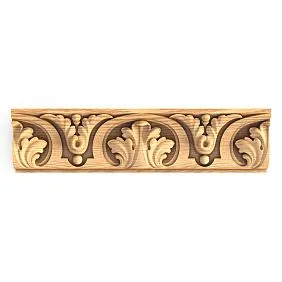
Carved profile (relief ornament on top of a figural cross-section). High cost, manufactured on CNC milling machines or by hand. Used in classic, Baroque, palace interiors. Carving depth 3-10 millimeters, motifs: plant scrolls (acanthus, grapevine), geometric meanders, architectural elements (dentils, eggs).
Coating: protection and aesthetics
Profiles can be sold unfinished (raw, sanded) or with a finished surface treatment.
Unfinished. 20-30% cheaper, requires on-site finishing. Allows choosing any color and finish type for the specific interior.
Varnished. Coated with 2-3 layers of polyurethane or acrylic varnish. Ready for installation. Gloss level: glossy (bright shine, emphasizes texture but shows scratches), semi-matte (noble subdued sheen), matte (natural look, hides minor defects).
Oil-wax. Impregnated with oil with added wax, surface is natural, pleasant to the touch. Oil emphasizes texture, doesn't create a film. Requires renewal every 3-5 years, but easily restored.
Painted with enamel. Coated with opaque paint (often white, gray, pastel tones), texture is hidden. Suitable for Provence, Scandinavian style, shabby chic. Enamel can be glossy, semi-matte, matte.
Tinted. Treated with stain (changes color while preserving texture) and coated with varnish. Allows imitating valuable wood species: light beech can be tinted 'to look like walnut' or 'to look like wenge'.
Wooden shaped profile: engineering of complex forms
Wooden shaped profile— a term denoting profiles with complex cross-sections containing curvilinear elements. Manufacturing requires special equipment and high operator skill.
Milling technology: from manual to CNC
Manual milling. The operator guides the workpiece along a rotating cutter, forming the profile. Requires experience, result depends on skill. Used for one-off items, exclusives. Productivity is low (5-10 linear meters per shift), but unique profiles are possible.
Four-sided planers. Process the workpiece from four sides in one pass, forming a complex profile. Productivity is high (100-200 linear meters per shift), accuracy ±0.1 millimeters. Suitable for serial production of standard profiles.
CNC milling machines. Programmable equipment performing milling along a set path. Allows creating profiles of any complexity, including carving, three-dimensional elements. Productivity is medium (30-50 linear meters per shift for complex profiles), accuracy is high (±0.05 millimeters). Optimal for custom orders with high quality requirements.
Bent Profiles: When a Line Becomes an Arc
Straight profiles are easy to manufacture and install. However, in architecture, there are arched openings, bay windows, and round columns that require curved profiles. The technology for manufacturing bent profiles:
Steaming and Bending. A beech (less commonly ash) blank is steamed at 100-110°C for 2-4 hours. The fibers become pliable. The blank is bent on a special template, clamped, and dried for 5-7 days. After drying, the shape is fixed. The minimum bending radius is 400-600 millimeters for beech, 800-1000 for oak. The method is labor-intensive but yields natural bent wood without glue joints.
Gluing Lamellae. Thin lamellae (3-5 millimeters thick) are glued together on a template of the required radius. This results in a bent-glued profile of any radius (down to 200 millimeters). Strength is high, geometric stability is excellent. The drawback is visible glue layers on the ends (though not noticeable on the face surface).
Cutting from Solid Wood. For radii over 1000 millimeters, an arc can be cut from a wide board and then profiled. The method is costly (high material waste) but yields a solid wood profile without glue joints or steam treatment.
Round Beech Handrails: An Alternative to Oak
Round beech handrails— a popular choice for stairs in private homes and mid-price public buildings. Beech is 25-35% cheaper than oak, while having comparable hardness and wear resistance.
Beech Handrail: Properties and Features
Beech wood is uniform, without pronounced grain (unlike oak with its distinct rings). After sanding with P240-320 grit abrasive, the surface becomes perfectly smooth and silky. The hand glides easily along a beech handrail without catching on fibers. This is important for heavily used stairs.
The color of beech is pinkish, neutral. It does not dominate the interior, easily combines with various shades of walls, floors, and furniture. A beech handrail can be left natural (under oil or clear varnish) or stained to any shade—from light honey to dark chocolate.
The formability of beech allows creating bent sections of the handrail (turns, roundings at the beginning and end of the stairs) without joining elements. This improves safety (no protruding joints) and aesthetics (a continuous line).
The drawback of beech is its sensitivity to humidity. When wood moisture increases from 10% to 15%, linear dimensions increase by 0.3-0.5% across the grain. For a handrail with a diameter of 50 millimeters, this means an increase in diameter of 0.15-0.25 millimeters—not noticeable, but with sharp humidity fluctuations (more than ±15%), deformations are possible. Therefore, beech handrails are recommended for rooms with a stable climate (air conditioning or constant heating).
Fastening a Beech Handrail: Features of Working with the Material
Beech is dense, hard, and requires pre-drilling for dowels and screws. The drill diameter for an 8-millimeter dowel is exactly 8.0 millimeters, without clearance. Beech does not shrink (unlike pine), so the dowel must fit tightly, with slight force.
When screwing in screws without pre-drilling, beech can split along the grain. It is essential to drill a hole with a diameter of 0.7-0.8 times the screw diameter. For example, for a 5-millimeter screw—a 3.5-4.0 millimeter hole.
Gluing beech elements (joining handrail sections, attaching to balusters with dowels) is done with polyurethane glue or carpenter's PVA. Press (clamp) holding time is at least 4 hours for PVA, 2 hours for polyurethane. Full strength is achieved after 24 hours.
Round Oak Handrail: The Benchmark of Prestige and Durability
Round oak handrail— the pinnacle of stair element hierarchy. Oak is 10-15% stronger than beech, wear resistance is 20-30% higher, durability is 50-70 years compared to 30-40 for beech. Oak grain is expressive, especially on radial cuts where medullary rays are visible—a characteristic feature of the species.
Oak Handrail: Grain and Patina of Time
Young oak (tree age 80-120 years) has a light golden hue with yellowish and greenish nuances. Over time (10-20 years of use in an interior), oak darkens, acquiring a honey-brown tone. This process is called patination—tannins oxidize, and the color deepens. Patina does not spoil the wood but ennobles it, giving it a noble appearance.
Bog oak (aged in water for 50-300 years) has a dark gray, almost black color with a purple sheen. Density increases by 20-30%, hardness by 30-40%. Bog oak is an exclusive, expensive material used in premium projects.
Thermally treated oak (processed at 180-220°C in a steam environment) acquires a chocolate-brown color throughout its thickness (not surface staining, but a structural change). Hygroscopicity decreases by 40-50%, making thermo-oak ideal for humid rooms.
Installation of an Oak Handrail: Nuances of Working with Hard Wood
Oak is 5-10% harder than beech, requiring higher-quality tools. Drills and cutters must be carbide-tipped (carbide-tipped for metal is not suitable—they dull quickly). Drilling speed is lower than for beech: 800-1000 rpm versus 1200-1500 for beech.
The abrasiveness of oak is high (due to silica content). Sanding discs and belts wear out 30-40% faster than when working with beech. For final sanding of an oak handrail, P180-P240 grit abrasive is used (for beech, P240-320 is sufficient).
Gluing oak elements requires longer holding time: at least 6 hours under press for PVA, 3 hours for polyurethane glue. Oak is dense, and glue is absorbed more slowly than in beech.
Carved Wooden Balusters: Art in Every Element
Carved wooden balustersturn a staircase into a work of art. While turned balusters are created on a lathe (repeating cylindrical elements: balls, discs, vases), carved balusters are made by milling or hand carving and can have any shape.
Types of Carving on Balusters
Bas-relief Carving. The ornament protrudes above the background by 3-8 millimeters. Motifs: plant scrolls, geometric patterns, stylized flowers. The background can be smooth (matte or polished) or textured (punched). Bas-relief carving is characteristic of classicism, art nouveau, and Russian style.
Openwork (pierced) carving. The background is completely removed, the pattern is held by thin bridges. The baluster becomes light, airy, visually weightless. High complexity, requires manual labor or a 4-5-axis CNC milling machine. Used in exclusive projects, cost is 3-5 times higher than turned balusters.
Three-dimensional (sculptural) carving. The baluster is a three-dimensional sculpture: figures of people, animals, mythological creatures. Manufacturing is exclusively manual, timeframe 5-15 days per baluster. Used in unique premium projects (palaces, mansions, museums).
Combined carving. Combination of turning and carving: the base of the baluster is turned (with balls and cylinders), carving (leaves, flowers) is applied to separate sections. Optimal balance of cost and decorativeness, suitable for classical interiors in the mid-price segment.
Manufacturing wooden balusters: from blank to masterpiece
Detailed technologyManufacturing balusters from woodincludes several stages.
Selection and preparation of wood. Blanks must be free of knots, cracks, cross-grain. Moisture content 8-10% (over-dried wood is brittle, damp wood fuzzes during carving). Cross-section of the blank is 10-15% larger than the final size of the baluster (allowance for processing).
Rough processing. The blank is turned on a lathe to a cylindrical shape of the required diameter (usually 40-60 millimeters). Defects are removed, the surface is leveled.
Turning or milling of main elements. Balls, discs, cylinders are formed (if the baluster is turned) or the basic shape (if carved). Turning tools (for lathe) or milling cutters (for milling machine) are used.
Applying carving. Manually with chisels and knives or on a CNC milling machine according to a set program. Carving depth 3-10 millimeters, detailing depends on the complexity of the pattern.
Sanding. Sequentially with abrasives P80-P120-P180-P240. Carved areas are sanded manually with special shaped blocks (for access into recesses). Final sanding P320-P400 creates a silky surface.
Final finishing. Varnishing (2-3 coats), oil-wax, painting or staining. Carved balusters are often antiqued (dark paint is applied into the recesses of the carving, creating an aged effect).
Harmony of profiles and handrails: a system of connections
How to link decorative wall profiles with staircase handrails and balusters? Here are several proven strategies.
Unity of wood species and finish
The simplest way is to use one wood species for all elements, treated with the same coating. For example, everything made of oak, stained with 'dark walnut' stain, coated with semi-matt varnish. Wall profiles in the corridor, handrail, balusters, staircase treads — all in the same shade, with the same texture. The eye moves through the space, finding a familiar texture everywhere. This creates integrity, calmness, harmony.
Profile rhyme
If wall profiles have certain elements (a bead with a diameter of 8 millimeters, a cove with a radius of 6 millimeters), you can order balusters with the same elements. Or make the handrail not just round, but with a decorative bead at the base (at the junction with the balusters). This profile rhyme creates a visual connection, demonstrating thoughtful design.
Carved theme
If profiles are decorated with a carved pattern (for example, a plant motif — grape leaves), you can order carved balusters with the same motif. Repeating the theme connects different zones of the interior. It's important not to overdo it: 2-3 carved balusters per flight of stairs are enough (at key points — beginning, middle, end), the rest are simple turned ones. Otherwise, an excess of carving will create visual overload.
Contrast of scales
A bold technique: wall profiles are narrow, delicate (20-30 millimeters), while the handrail and balusters are massive, expressive (handrail diameter 60 millimeters, balusters 70 millimeters). The walls serve as a neutral background, the staircase as a powerful accent. Suitable for spacious halls where the staircase is the compositional center.
Installation of decorative profile: professional tricks
The quality of installation determines the final result no less than the quality of the profile itself.
Marking: precision is the courtesy of kings
Before installing profiles, marking must be done. For horizontal profiles, a laser level or water level (tube with water) is used. The slightest deviation from horizontal (1-2 millimeters per meter) will be noticeable to the eye.
Vertical profiles are marked with a plumb line or laser level in vertical mode. For complex compositions (panel systems with many horizontal and vertical elements), a scaled sketch is made, transferred to the wall with a pencil.
Cutting corners: the art of joining
Corners are cut at 45 degrees on a miter saw. For profiles with complex cross-sections, it is important that the cutting plane passes exactly at 45 degrees to all elements of the profile (beads, coves). Otherwise, the elements will not match when joined.
After cutting, the ends are checked on a joining template (two profile offcuts are joined at 90 degrees). If there are gaps — the ends are finish-sanded manually on a block with P180-240 abrasive.
Fastening: glue plus mechanical
The optimal method is a combined approach: the profile is coated with polyurethane adhesive (a thin bead along the flanges) and additionally secured with finishing nails (with small heads) or screws. Fastener spacing is 300-400 millimeters.
The adhesive sets in 15-20 minutes, reaching full strength in 24 hours. Mechanical fasteners hold the profile in place while the adhesive sets. Once dry, the fasteners can even be removed (if screws were used), and the holes filled with putty—the adhesive will already hold the profile securely.
For profiles longer than 3 meters, it is recommended to leave a 2-3 millimeter expansion gap (for wood expansion with increased humidity). The gap is concealed with wood-colored sealant.
Application in interior styles
Classicism: symmetry and proportions
Classical interiors are built on the canons of ancient Greek and Roman architecture: symmetry, clear proportions, noble materials. Profiles are shaped, with beads and coves, width 60-100 millimeters. Handrails are round, 50 millimeters in diameter, made of oak. Balusters are turned, alternating spheres, disks, and vases (the classical triad). Color—natural oak (medium tones) or white (painted enamel). Finish—semi-matte varnish.
Baroque: Luxury and Dynamism
Baroque loves opulence, abundant decoration, curvilinear forms. Profiles are wide (80-150 millimeters), carved, with plant motifs (acanthus, laurel, grapevines). Handrails can be shaped (not just round, but with decorative elements). Balusters are carved, with three-dimensional details. Color—dark oak or gilding on a red bole (underlay for gold). Finish—semi-gloss varnish, emphasizing the shine.
Modern: fluidity and asymmetry
Art Nouveau rejects straight lines in favor of smooth curves imitating natural forms (plant stems, waves). Profiles are curvilinear, bent, asymmetrical. Handrails can be oval or smoothly changing in cross-section. Balusters are flat, carved, with plant motifs (irises, lilies). Color—natural wood with oil, emphasizing the grain. Finish—matte.
Scandinavian minimalism: simplicity and light
Scandinavia values conciseness, functionality, light tones. Profiles are simple, rectangular in cross-section with lightly rounded edges, width 20-40 millimeters. Handrails are round, 50 millimeters in diameter, made of light wood (pine, birch, ash) with oil finish. Balusters are square 40x40 millimeters, painted with white matte enamel. Overall tone—light, airy, with a predominance of white and natural wood.
Loft: industrial aesthetics
Loft combines industrial materials (metal, concrete, brick) with wood. Profiles are simple or absent (walls may be undecorated—brick, concrete). Handrails are round, made of dark wood (fumed oak, thermowood ash) with oil finish, no gloss. Balusters can be metal (pipes, rods) or wooden with a square cross-section, deliberately rough, preserving traces of processing.
Frequently asked questions and detailed answers
Can different wood species be combined in one interior?
Yes, but with caution. Light beech harmonizes with dark oak, creating contrast. Ash pairs well with larch. It's important that the shades do not clash. It is recommended to make samples, test the combination under different lighting (daylight, artificial light in the evening). Use the same finish (oil or varnish) for all wood species—this unifies them.
Which profile to choose for a small apartment?
Narrow, simple, light. Width 20-30 millimeters, cross-section with a slight rounding or chamfer, color—white or light natural wood. Wide and carved profiles overload small spaces, visually making them appear smaller.
Is it necessary to treat the ends of the profile?
Absolutely. The ends (cross-cut grain) absorb moisture intensely. An unprotected end can swell and crack. After cutting, the ends are sanded with P240 abrasive and coated with the same finish as the main surface (varnish, oil), in 2-3 coats.
How to care for carved balusters?
Dry cleaning with a soft brush or vacuum with a brush attachment once a week. Dust accumulates in the recesses of carvings and is removed with a soft-bristled brush. Wet cleaning is allowed with a well-wrung cloth. Every six months, you can apply wood polish (restores shine on varnished surfaces) or renew the oil finish.
How long does an oak profile last?
With proper care, 50-70 years. Oak only improves with age—darkens, acquires a noble patina. Multiple restorations are possible: sanding, refinishing. Essentially, the service life is limited only by mechanical damage (chips, deep dents), which can be repaired.
Can wooden profiles be installed in damp rooms?
Yes, provided there is protective treatment. The best wood species for damp rooms are larch, oak, thermally modified wood. Finish—water-resistant polyurethane varnish in 3-4 coats or special oil for damp rooms. Good ventilation is essential.
How to determine profile quality when purchasing?
Check the geometry: the profile should be straight, without warping (place it against a flat plane). Inspect the surface: no knots, cracks, dents. Run your hand over it: smoothness should be uniform, without rough spots. Check moisture content with a moisture meter: norm is 8-12%. Smell it: there should be no chemical odor (poor-quality finish) or smell of rot.
Conclusion: Mastery in the Details
Decorative profiles form the lines of an interior, create structure, conceal technical joints. A round handrail ensures safety on stairs and lasts for decades. Carved balusters transform a utilitarian structure into a work of art. These elements may seem secondary until you see an interior where they are masterfully selected.
The manufacturing company STAVROS produces decorative wooden profiles, round handrails, and carved balusters according to European quality standards from select oak, beech, and ash. Kiln-dried to 8-12% moisture content, processed on German four-sided planers with ±0.1 millimeter precision, multi-stage sanding, professional finishing (varnish, oil, enamel)—each stage is controlled so the product serves for generations.
STAVROS offers over 40 standard profiles (width 15-200 millimeters, simple and shaped), round handrails 50 millimeters in diameter up to 6 meters long (solid or finger-jointed), turned and carved balusters 900 millimeters high. Custom manufacturing from individual drawings is possible: exclusive profiles, bent elements, custom carving. Minimum order for custom projects—from 50 linear meters (profiles) or 50 pieces (balusters).
Manufacturer's warranty—5 years against manufacturing defects, provided operating conditions are met. Free consultations on wood species, profile selection, and installation methods. Delivery across Russia. Production lead times: standard items 3-5 business days, custom orders 10-21 days depending on complexity.
By choosing STAVROS products, you invest in beauty that doesn't tire, in quality that doesn't disappoint, in durability proven over decades. Natural wood, professional processing, attention to every detail—this is what turns a house into a space worthy of your life.