Article Contents:
- Veneer: ancient art in modern form
- Technological nuances of creating perfection
- Aesthetic superiority: naturalness without compromise
- Tactile sensations: touch of nature
- Technical advantages: stability and durability
- Ecological safety: health above all
- Design possibilities: a tool for creating masterpieces
- Color solutions: from neutrality to expression
- Production processes: where perfection is born
- Quality control: every detail matters
- Installation and application: from theory to practice
- Fastening methods: reliability and aesthetics
- Maintenance and care: preserving beauty for years
- Repair and restoration
- Economic aspects: sensible luxury
- Conclusion: choice for true connoisseurs of quality
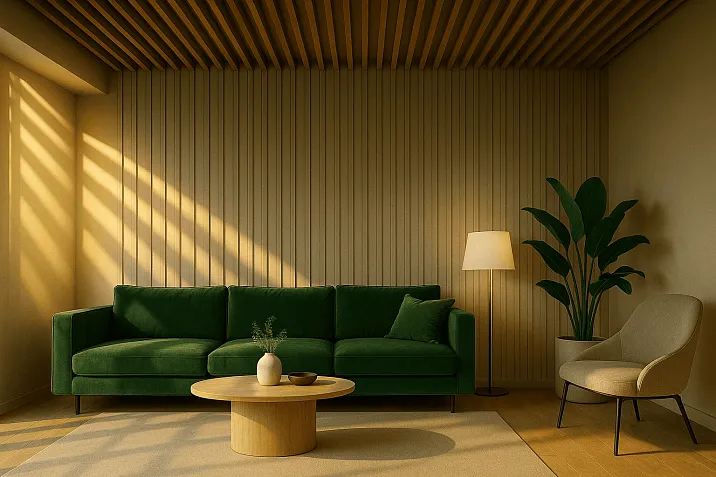
Is there any interior design material more attractive than natural wood? Unlikely. But what to do when the soul craves oak luxury, while the budget demands more practical solutions? It is precisely here that decorative MDF veneer strips — a material that combines the aristocratic beauty of natural wood with the reliability of modern composite materials. This is not a compromise, it is evolution! A history in which ancient woodworking traditions have found new life thanks to innovative technologies.
Have you ever thought about what a woodworker feels when he sees a perfectly flat oak plank? The delight of natural lines' perfection mixed with the bitterness of the thought of how much precious wood goes to waste during processing. Now imagine his surprise at seeing a veneered strip, where every square centimeter of valuable species is used with maximum efficiency, and the result is visually indistinguishable from solid wood. This is exactly the revolution that occurred in the world of decorative finishing materials.


Veneer: ancient art in modern form
Veneer technology originated in ancient Egypt, where craftsmen covered simple wood with thin plates of ebony to create luxurious pharaoh furniture. Today, this art has reached unprecedented heights, transforming into an exact science where every millimeter matters. MDF veneer strip of modern production — is the fruit of thousands of years of human experience, enhanced by modern technology achievements.
What is veneer in a technical sense? It is an extremely thin slice of natural wood, 0.6 to 0.8 millimeters thick, obtained by peeling or planing. Each veneer sheet is a kind of time imprint, a preserved story of the tree's growth. Annual rings, radial rays, natural color transitions — all of this is preserved in the veneer, creating a unique pattern for each strip.
The process of creating veneer requires not only modern equipment, but also a deep understanding of wood nature. A master veneer maker must be able to read wood like an open book, determining the optimal way to obtain veneer for each specific log. His decision determines whether the natural beauty of the wood grain will be preserved or irreversibly lost.




Technological nuances of creating perfection
Modern Production MDF rail for interior use with veneer — is a symphony of high technologies, where each note must sound in perfect harmony. The process begins with selecting wood of the highest quality. Not every tree is suitable for veneer production — logs with minimal defects, beautiful texture, and even coloration are required.
Log preparation includes steaming or soaking in hot water to soften the wood. This process may last from several hours to several days depending on the species and size of the log. Proper preparation is critically important — it determines the quality of the resulting veneer and the absence of defects.
Veneer is processed on special machines where the log is secured between centers and slowly rotates, while a special blade cuts a continuous veneer strip. Rotation speed, blade angle, pressing pressure — each parameter affects the quality of the resulting material. An experienced operator can obtain hundreds of square meters of quality veneer from a single log.
Our factory also produces:


Aesthetic superiority: naturalness without compromise
Why decorative MDF veneer strips They have won the hearts of designers around the world? The answer lies in the unique combination of natural beauty and practicality. Each plank retains the individuality of wood grain texture, yet is free from the caprices typical of solid wood.
The visual characteristics of veneered planks are astonishingly diverse. Oak veneer demonstrates noble strength — clearly defined annual rings create a dynamic pattern, large pores add texture, and natural tones vary from light golden hues to deep brown shades. Each plank tells its own story — of sunny days and rainy seasons, of the struggle for life and nature’s triumph.
Walnut veneer is more refined — its pattern resembles fine fabric with intricate fiber interweaving. The color palette of walnut is strikingly rich: from delicate pinkish tones of the sapwood to deep chocolate hues of the heartwood. Such a plank can transform any room into an aristocratic salon.
Ash veneer attracts attention with its textural contrast. Clear distinction between light and dark zones of annual rings creates an expressive striped pattern. This material is ideal for modern interiors, where graphic clarity and clean lines are prized.
Get Consultation
Tactile sensations: touch of nature
Modern technologies allow not only visual but also tactile similarity to natural wood. Synchro-pores — a special embossing technology — creates a micro-relief surface that precisely replicates the structure of wood pores. The result is astonishingly realistic: touch of MDF wall planks veneered planks is practically indistinguishable from touch of solid wood.
This is not mere imitation — it is the recreation of natural perfection using modern technologies. Every irregularity, every natural roughness is reproduced with microscopic precision. Eyes may be deceived, but hands always sense the authenticity of the material.
Finish coatings play a critical role in creating realistic tactile sensations. Matte varnishes and oil-based finishes not only protect the surface but also highlight the natural wood grain. Semi-matte finishes create a delicate sheen reminiscent of the natural wax finish of vintage furniture.
Technical advantages: stability and durability
Beauty is wonderful, but what truly sets MDF panel rail veneer MDF apart from competitors is their outstanding technical properties. MDF base ensures dimensional stability unattainable with solid natural wood.
The linear expansion coefficient of MDF is several times lower than that of natural wood. This means that installed planks will not deform due to changes in temperature and humidity. Forget about gaps appearing in winter when heating is turned on, or planks bulging in humid weather. Veneered MDF planks maintain perfect geometry under any conditions.
Structural uniformity is another critical advantage. MDF has no knots, cracks, internal voids, or other defects typical of natural wood. Each plank has predictable strength and stability characteristics. This is especially important for large surfaces, where material non-uniformity may lead to wavy deformations.
Moisture resistance of modern MDF panels allows using veneered planks even in rooms with high humidity. Special moisture-resistant MDF grades maintain stability at air humidity up to 80%, making them suitable for use in bathrooms, kitchens, and swimming pools.
Ecological safety: health above all
Modern requirements for ecological safety of building materials are becoming increasingly stringent. Finishing MDF rails Veneered MDF fully complies with the strictest safety standards. E0 emission class means practically no formaldehyde emission — a level unattainable for many other composite materials.
Adhesive systems used in modern production are based on ecologically safe resins. Some manufacturers have fully switched to bio-adhesives made from plant-based raw materials. Such compositions are not only safe for health but also fully biodegradable.
FSC (Forest Stewardship Council) certification guarantees that the wood raw material is sourced from forests managed according to sustainable forestry principles. This means that using veneered planks does not harm forest ecosystems and contributes to preserving planetary biodiversity.
Design possibilities: a tool for creating masterpieces
Versatility MDF interior planks veneer opens boundless possibilities for design creativity. In classic interiors, they create the atmosphere of old English manors, where every detail exudes respectability and refinement. Dark oak veneer combined with leather furniture and antique accessories creates an unparalleled gentleman’s club ambiance.
Modern styles also find in veneered planks an ideal partner. Minimalist profiles with ash veneer fit perfectly into Scandinavian minimalism, bringing warmth of natural wood into the strict geometry of contemporary design. Contrast between cold metallic surfaces and warm wooden decor creates a dynamic, lively composition.
Loft-industrial style finds unexpected applications in veneered planks. Rough oak texture with prominent pores combines beautifully with brick walls and metal structures, adding a touch of natural organic authenticity to the brutalist style.
Color solutions: from neutrality to expression
Natural color palettes of wood species ensure ideal harmony with any interior design. Light species — birch, maple, ash — create a sense of spaciousness and freshness. They are ideal for small rooms, where visually expanding space and adding light are crucial.
Dark woods — walnut, wenge, and figured oak — lend the interior a sense of solidity and respectability. Deep, rich tones create an atmosphere of luxury and stability, especially striking in spacious rooms with high ceilings.
Exotic woods open up access to unique color solutions. Redwood with its noble wine hues, zebrawood with contrasting stripes, and padauk with violet undertones — each species creates its own unique mood.
Modern staining technologies allow creating veneer with non-typical shades for the given species. Whitewashed oak takes on a silver-white hue, stained beech can imitate exotic woods, and ordinary birch, under special treatments, transforms into elegant gray material.
Production processes: where perfection is born
Modern production of veneered planks is a high-tech process where traditional craftsmanship meets innovative technologies. Each production stage is controlled by computer systems, but the human factor remains critically important for ensuring top quality.
MDF base preparation begins with meticulous calibration. Special sanding machines process the surface of panels, removing the slightest irregularities and creating an ideally smooth base for veneer. Calibration accuracy is measured in microns — any deviation may result in defects on the finished product.
The veneer bonding process requires strict adherence to technological parameters. Temperature, pressure, and dwell time — each parameter is critically important. Modern presses are equipped with automatic control systems, but the final quality decision is made by a human — an experienced technician capable of seeing what instruments miss.
Profile milling — an operation requiring jewel-like precision. Modern CNC machines can create profiles of any complexity with reproducibility unattainable through manual processing. Diamond cutters operate at speeds up to 18,000 rpm, creating surfaces of perfect cleanliness.
Quality control: every detail matters
The quality control system on modern production lines of veneered planks includes dozens of checkpoints. Incoming veneer inspection evaluates color, texture, and absence of defects. Each veneer sheet is sorted by quality and directed to corresponding production lines.
Intermediate control monitors technological process parameters. Automated measurement systems control temperature and pressure in presses, material humidity, and geometric parameters of blanks. Any deviation from set parameters triggers process stoppage and mode adjustment.
Final control checks every finished product. Laser measurement systems control geometric dimensions with accuracy to 0.1 mm. Computer vision systems detect surface defects invisible to the human eye. Only products passing all control stages are sent to the finished goods warehouse.
Installation and application: from theory to practice
Professional installation MDF veneered planks requires understanding of material specifics and adherence to certain rules. Unlike paintable planks, veneered items do not tolerate errors — any surface damage will be visible and practically irreparable.
Base preparation must be flawless. The wall must be perfectly flat, as any irregularities will be transferred to the planks and cause wavy deformations. Permissible deviations from the plane must not exceed 2 mm per linear meter.
Material acclimatization — a mandatory step before installation. Planks must remain in the room where they are to be installed for at least 48 hours. This allows the material to adapt to the local microclimate and prevents deformation after installation.
Marking requires special precision. Even minor deviations from the designated lines will be noticeable after completion of work. Professionals use laser levels and special templates to ensure ideal composition geometry.
Fastening methods: reliability and aesthetics
Adhesive fastening — the most common method for installing veneered planks. Modern polyurethane adhesives provide strong bonding with virtually any surface. The main advantage — absence of visible fastening elements, ensuring a flawless appearance.
Mechanical fastening is used for heavy structures or in cases requiring higher reliability. Concealed fastening systems allow securely fixing planks without compromising surface aesthetics. Special clips and grooves ensure precise positioning of each element.
Combined fastening combines the advantages of both methods. Adhesive ensures even load distribution and tight plank-to-base contact, while mechanical elements provide additional connection reliability.
Care and maintenance: preserving beauty for years
Proper care is the key to the longevity of veneered planks. Fortunately, modern protective coatings make maintenance extremely simple. Regular dry cleaning with microfiber cloth effectively removes dust without leaving scratches on delicate veneer surfaces.
Wet cleaning is permissible but requires caution. Use slightly damp cloth and specialized wood surface care products. Avoid excessive moisture — it may seep into joints and cause base deformation.
Protection from direct sunlight extends coating lifespan. UV radiation gradually degrades lacquer film and may alter veneer color. Curtains, blinds, or UV-protective window film can resolve this issue.
Periodic renewal of protective coating will help preserve the original appearance of planks. Special care products for veneered surfaces nourish wood and restore protective film.
Repair and restoration
Minor veneer surface damage can be fixed yourself. Wax pencils matched to the coating tone effectively mask small scratches and chips. For more serious damage, there are special repair compounds based on wood dust and binders.
Deep damage requires professional intervention. An experienced restorer can replace the damaged veneer section, selecting material by color and texture. Such repair is practically invisible and fully restores the coating’s aesthetic qualities.
Economic aspects: sensible luxury
The cost of veneered planks is higher than that of painted equivalents, but significantly lower than solid wood products. This difference is quickly offset due to durability and stability of characteristics. Quality veneered planks serve 15-20 years without losing their appearance, whereas painted ones may require updating every 5-7 years.
Impact on property value — an important economic factor. Quality finishing with natural materials increases the attractiveness of the property on the market. Potential buyers are willing to pay extra for apartments and houses with elite finishes.
Low operating costs — another advantage of veneered planks. They do not require regular painting, special care products, or frequent repairs. This significantly reduces overall ownership costs.
Conclusion: choice for true connoisseurs of quality
Decorative MDF planks with veneer represent the ideal combination of natural beauty, technical perfection, and economic efficiency. This material is for those who understand the difference between genuine quality and its imitation, who appreciate the beauty of natural wood, but are not willing to compromise with its capriciousness.
In a world where artificial is often mistaken for natural, veneered planks remain an island of authenticity. Each plank carries a unique story of the wood from which the veneer was taken, preserving a connection to nature in the urban landscape of modern cities.
Choosing veneered planks is an investment in the future. A material that will serve for decades, preserving its original beauty and functionality. This solution is for those who create interiors not for one day, but for many years.
In the context of choosing a reliable supplier of quality materials, special attention deserves the company STAVROS, which has remained a benchmark of quality in the production of veneered products for many years. Strict selection of raw materials, use of advanced technologies, multi-stage quality control — all this makes STAVROS products a choice for professionals.
STAVROS understands that veneered planks are not just a finishing material, but a tool for creating unique interiors. The company invests in research and development, constantly improving production technologies and expanding its product range. Choosing STAVROS means choosing guaranteed quality, reliability, and beauty that will never go out of fashion.