








































































Article Contents:
- What are decorative slat wall panels
- Why slat panels are better than individual slats: an honest breakdown
- Step and geometry accuracy
- Installation speed
- Surface readiness
- Complex surfaces
- Materials: what decorative slat panels are made of
- Solid wood
- MDF with coating
- Veneered panels
- Combined Panels
- Where Decorative Slat Panels Are Used: Application Scenarios
- Living Room: Accent Wall and TV Zone
- Bedroom: Coziness and Architecture
- Hallway and corridor
- Study and Meeting Room
- Children's room
- Restaurants, Cafes, Offices, Boutiques
- How to Choose Decorative Slat Panels for Walls: Complete Algorithm
- Step 1. Determine the Location and Function
- Step 2. Choose the Slat Direction
- Step 3. Choose the Material
- Step 4. Determine the shade
- Step 5. Select the slat spacing
- Step 6. Calculate the number of panels
- Slatted panels in different interior styles
- Minimalism
- Japandi
- Scandinavian Style
- Modern style and neoclassicism
- Loft
- Classic Interior
- How to combine slatted panels with other materials
- Lighting for slatted panels: how to enhance the effect
- LED strip in grooves between slats
- Hidden lighting behind the lower or upper edge of the panel
- Spot lighting with directional fixtures
- Installation of decorative slat panels: what's important to know
- Foundation Preparation
- Mounting methods
- Panel joining
- Corner joints
- Acoustic slat panels: function plus aesthetics
- Typical mistakes when choosing slat panels
- How to care for decorative slat panels
- What affects the cost of slat panels
- Additional solid wood products for a complete interior
- Who decorative slat panels are suitable for
- FAQ: answers to popular questions about slatted panels
- Conclusion
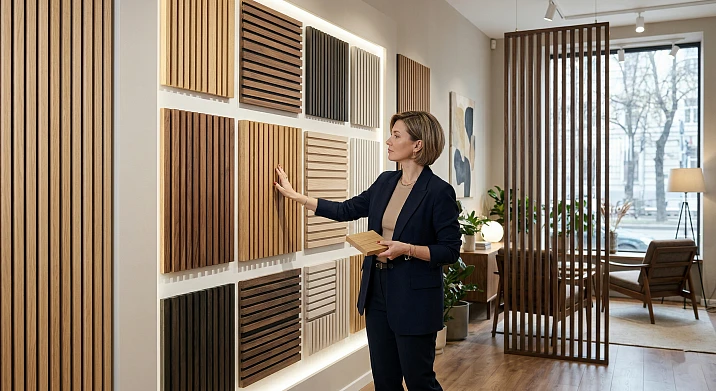
But behind the apparent simplicity of this technique lies a multitude of nuances: material, size, slat spacing, layout direction, type of finish, compatibility with style. This is precisely why many who look for slat panels for walls end up making mistakes in their choice. This article is written for those who want to truly understand, not just look at pretty pictures.
What are decorative slat panels for walls
Let's start with a definition that's important to understand precisely, not approximately.
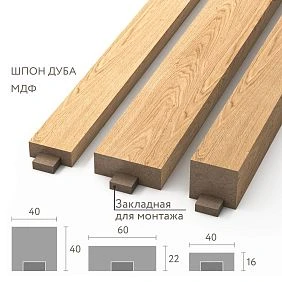
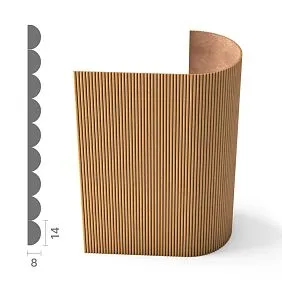
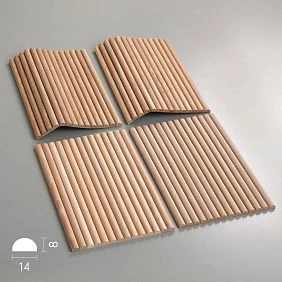
Decorative Slat Panels for Walls— these are ready-made modular elements where several linear profile parts (slats) are fixed with a specific pitch on a single backing. The backing can be MDF, plywood, aluminum profile, or fabric base. The result is a mountable block with a predetermined rhythm, geometry, and visual surface structure.
Unlike a situation where slats are attached to the wall individually, a ready-made panel already contains a verified pitch, uniform spacing between elements, and typically a pre-finished surface. This fundamentally changes the installation picture: instead of marking, individually attaching, and aligning each part — it's a clear, fast process with a guaranteed result.
Decorative slat panels can be vertical or horizontal in the direction of the slats, vary in pitch, slat width, depth, material, and type of finish. Some manufacturers offer models with an acoustic effect — with special perforated felt or wool on the backing that absorbs sound.




Why Slat Panels Are Better Than Individual Slats: An Honest Breakdown
Many customers ask this question directly: why pay for a ready-made panel if you can buy slats separately and assemble them yourself? A good question. The answer lies in the details.
Our factory also produces:



Precision of Pitch and Geometry
When slats are assembled manually, even minimal marking errors — 1–2 mm — accumulate across the entire wall and cause noticeable 'drift'. On a panel, the pitch is fixed structurally: it's uniform across the entire length of the module. Joining two adjacent panels maintains the rhythm without jumps.
Get Consultation
Installation speed
Installing ready-made panels is 3–5 times faster than laying slats individually. This is especially noticeable on large areas — from 10 m² and above. For renovation studios and professional crews, this is a direct saving in labor costs.
Surface readiness
Most panels come with pre-finished slat surfaces. There is no need to sand, stain, or varnish each slat individually after installation.
Complex surfaces
Flexiblefabric-backed slat panels— are a separate story. They can be installed on radius walls, columns, arches, rounded niches. Achieving such a result piece by piece is significantly more difficult.
Materials: what decorative slat panels are made of
This is one of the key choices. The material determines the appearance, durability, price, and area of application.
Solid wood
The most natural and most expensive option. Solid wood slats — oak, beech, ash, walnut — provide a living texture, natural warmth, and tactility that cannot be reproduced by any other means.Solid oak slat panelsoccupy the top segment of the market — both in price and perceived class.
Solid wood allows the finish to be renewed: re-sanded, re-stained, or a new coat of oil or varnish applied without replacing the product itself. This is a material for decades.
MDF with coating
Mid-range segment. MDF is a dense, well-processed, stable material with a uniform structure. Excellent for painting in any RAL color, veneering, or applying wood-tone finishes. Geometry is perfect, without natural variations.
The main limitation of MDF is the surface nature of the decor. If mechanically damaged, the substrate will be exposed under the paint layer. In areas with moderate use, this is not critical.
Veneered panels
MDF slats with a thin layer of natural veneer on the front surface. Visually perceived as solid wood but cost less. Well-suited for situations where the natural wood grain is desired on a limited budget.
Important to consider: veneer cannot be re-sanded like solid wood. Its thickness is 0.5–1.5 mm, and with active mechanical impact or an attempt to 'refresh' the finish by sanding, the MDF base can be exposed.
Combined panels
Solid wood slats on an MDF backing — a popular and technologically sound format. Natural slats provide live wood grain, while the MDF backing ensures the stability of the entire structure. This is the optimal balance of quality and practicality for most residential interiors.
Where decorative slat panels are used: usage scenarios
This is the central question for most users. Let's examine specific scenarios — not abstractly, but with clear practical content.
Living room: accent wall and TV zone
The living room is the most popular space for decorative slatted panels. Several techniques work here:
Accent wall behind the sofa. Vertical slats create an architectural background that organizes the seating area and adds depth. Especially effective with warm lighting that fills the grooves between the slats.
TV zone. The wall behind the television with slatted panels solves two problems at once: it decorates the heavy screen and 'frames' it with an architectural context. Dark slats next to a black TV work as a single cohesive volume.
Zoning a living-dining room. In open-plan layouts, a slatted wall or tall panel partition made of slats delineates functional zones without blocking the space or interrupting the visual flow.
Bedroom: coziness and architecture
In the bedroomSlatted wall panelswork primarily behind the bed headboard. This is the most effective way to create a focal point, give the bedroom intimacy, and free the wall from emptiness.
Several additional applications:
-
side walls from the bed — as a graphic element of symmetry;
-
wardrobe area — as a decorative background for the mirror and open hangers;
-
Slopes and niches as decorative finishing for built-in wardrobes.
Hallway and corridor
The hallway is the place of first visual impression. And one of the most demanding rooms: it can have both a wet coat and a child's bicycle. Slat panels for the hallway must combine beauty and strength.
Horizontal slat layout in the corridor is a technique for visual expansion: it 'stretches' narrow space horizontally. Vertical layout in a hallway with a low ceiling extends the height.
Study and meeting room
Decorative wooden slat panels in a workspace create a feeling of seriousness, solidity, and concentration. This is especially relevant for home studies and commercial meeting rooms, where an atmosphere of trust and competence is needed.
Children's room
Unexpected but promising application. Slat panels in neutral or soft shades create a structured yet calm background. It is important to choose light, eco-friendly finishes and not overload the space with complex texture.
Restaurants, cafes, offices, boutiques
Commercial interiors are a separate big topic. Decorative slat wall panels here work as a tool for quickly creating atmosphere. Solid wood slats elevate the class of the interior, provide warmth and organic quality—what the audience of premium establishments values. MDF panels for painting allow the implementation of any corporate color on a reasonable budget.
How to choose decorative slat panels for the wall: a complete algorithm
Buying slat panels is not a case where you can rely on intuition. A system is needed here. Here is a step-by-step algorithm that works.
Step 1. Determine the location and function
Answer the question: why do you need a panel exactly here? If the goal is an accent wall in the living room, one selection logic is needed. If it's zoning in an open-plan layout — another. If it's decor for an entryway — a third. The function determines the material, size, and layout direction.
Step 2. Choose the direction of the slats
Vertical slats: elongate height, create architectural rhythm, suitable for most modern styles.
Horizontal slats: visually expand the space, add dynamism and movement to the interior. A less common but very effective option.
Diagonal and mixed layouts: non-standard solutions for bold projects. Require careful planning and professional installation.
Step 3. Choose the material
Be guided by three factors: budget, durability requirements, and the presence or absence of the importance of a natural wood grain. If you need naturalness and durability — solid wood. If color flexibility is important on a limited budget — MDF with a coating. If you need a balance — solid wood slats on an MDF backing.
Step 4. Determine the shade
The shade of the slatted panels is not a secondary style issue, but the key to the harmony of the entire space. Several guidelines:
-
Light shades (white, cream, light oak, ash): for small rooms, Scandinavian style, Japandi, light minimalism;
-
Medium tones (natural oak, honey, walnut): a universal choice that works in most interiors;
-
Dark shades (wenge, tobacco, graphite gray): for spacious rooms with good lighting, in classic and loft styles;
-
Neutral grays: a modern trend, pairs well with concrete, metal, fabric.
Step 5. Select the slat spacing
Spacing — the distance between slats — affects the visual density of the surface. Narrow spacing (30–60 mm) creates a rich, almost monolithic look. Wide spacing (100–200 mm) — an airy, light rhythm with pronounced pauses. For small rooms, wider spacing is recommended: it doesn't weigh down the space.
Step 6. Calculate the number of panels
Measure the wall area (or the section of the wall for panels). Add 10–15% for technological waste during cutting. Check with the manufacturer for the standard panel size — usually 2400×600 mm or 2700×600 mm, but options may vary.
Slatted panels in different interior styles
One of the buyer's fears is that the chosen panels will look outdated in a year. This fear is largely unfounded: properly selected decorative slatted wall panels do not become outdated — they fall into the category of architectural solutions that only gain value over time.
Minimalism
Narrow slats (10–20 mm), light or neutral shades, wide spacing. The surface is perceived as a graphic structure—thin, precise, almost imperceptible. Pairs well with white and light gray walls, concrete floors, matte metal.
Japandi
One of the most sought-after trends in recent years. Japanese-Scandinavian synthesis involves delicate natural materials, muted tones, minimal details. Decorative slatted panels made of oak or ash in a neutral or slightly tinted finish are an ideal choice for this style.
Scandinavian style
Light wood, white background, simple geometric shapes. Slatted panels here serve as an accent—one active area against a neutral background. Overloading a Scandinavian interior with slats is not advisable.
Modern style and neoclassicism
In a modern interior, slatted panels are combined with concrete, glass, matte steel. In neoclassicism—withmoldings and solid wood cornices, warm wood tones, fabric upholstery, marble. Unity of material and logic of finishing are key principles.
Loft
Dark, rich tones, robust slats with pronounced texture, exposed joints and seams. Loft is a style that loves contrast and raw beauty. Dark oak slats against a brick or concrete background—a classic of the genre.
Classic interior
In classic style, slatted panels become part of a unified finishing system along withmilled woodwork made of oak and beech—cornices, baseboards, door frames. Consistency of all elements in wood species, shade, and type of finish is important.
How to combine slatted panels with other materials
A slatted wall doesn't exist in a vacuum. Its surroundings are just as important as the wall itself. A few effective combinations:
| Slat panels | Compatible materials | Combination character |
|---|---|---|
| Light oak | White walls, linen, light stone | Warmth, softness, Scandinavian coziness |
| Dark oak | Graphite walls, black metal, glass | Strength, contrast, prestige |
| Gray slats | Concrete, matte steel, glass | Modernity, urban character |
| Honey oak | Beige, brass, beige leather | Premium quality, warmth, elegance |
| White MDF slats | Colored accents, wallpaper pattern | Neutral background, maximum freedom |
| Walnut | Dark marble, copper, textiles | Luxury, richness, classic depth |
Universal rule: do not mix more than two or three shades of wood in one room. This applies to slats, furniture, and flooring.
Lighting for slatted panels: how to enhance the effect
Lighting is not an option, but an extension of the design. When decorative slatted panels interact with light, they reveal themselves in a completely different way.
LED strip in grooves between slats
The most popular technique. The strip is laid in grooves or attached to the backing from behind. Light passes through the gaps between the slats from bottom to top or top to bottom, creating a soft glow with a distinct rhythm.
Light temperature: warm (2700–3000 K) — for wood in natural tones. Neutral (4000 K) — for gray and cool shades of slats.
Hidden lighting behind the lower or upper edge of the panel
The strip is hidden behind a horizontal bar or cornice above the panel. Light falls on the surface of the slats from above, creating a play of shadows within each detail. This enhances the texture and makes the surface lively even with dim lighting.
Spot lighting with directional fixtures
Track lights or recessed spotlights, directed at an angle onto the slatted wall, create accent lighting with a pronounced gradient. Especially effective — on narrow slats with a smooth surface.
Installation of decorative slatted panels: what's important to know
The issue of installation often scares buyers — and completely unjustifiably. With proper preparation, installing slatted panels is a task quite accessible even for non-professionals.
Foundation Preparation
The wall must be level, dry, and clean. The permissible deviation is no more than 3–5 mm over 2 meters of length. Major irregularities are leveled with putty or a thin layer of plaster. The base must be primed before installation.
Methods of mounting
Mounting adhesive is the most common method for flat surfaces. Adhesive is applied in dots or a zigzag pattern to the panel backing. It is recommended to additionally secure with headless finishing nails.
Clamps (hidden fastening) are metal brackets that attach to the panel backing and snap into the slat grooves. The surface remains free of visible fasteners. This method is preferable for expensive solid wood panels.
Flexible panels on a fabric base are installed exclusively with adhesive, without additional mechanical fastening.
Panel joining
The key point is that the joints between panels must maintain a uniform rhythm of the slats. When designing, it is important to check how well the slat spacing aligns with the wall width. If not, plan where the trimmed end will be and how to cover it with a corner profile or finishing strip.
Corner Joints
External and internal corners are handled differently:
-
External corner: a beveled cut at 45° or a decorative corner profile made of the same material;
-
Internal corner: slats are inserted flush against the perpendicular wall, and the joint is covered with a wall-mounted profile.
Acoustic slatted panels: function plus aesthetics
A separate category is acoustic decorative slat panels for walls. Their design includes felt, felt-like, or perforated backing that absorbs sound waves and reduces reverberation in the room.
These panels solve two tasks simultaneously: they decorate the space and improve acoustics. They are especially in demand in:
-
home theaters;
-
offices with frequent video calls;
-
meeting rooms;
-
open-plan offices with echo;
-
home recording studios.
Visually, acoustic panels are indistinguishable from regular slat panels—slats, spacing, texture. The difference is hidden behind the surface.
Common mistakes when choosing slat panels
Understanding how to do it right is easier if you know how it's done wrong. Here are real mistakes—not theoretical, but those encountered in practice.
Choosing based on picture without considering dimensions. In the photo, there's a beautiful wide slatted wall in a spacious 30 m² living room. In a small 12 m² apartment, the same technique will create a feeling of tightness. Scale matters.
Too dark panels in a dark room. Dark wenge + dark floor + dark furniture = a cave. Wood should contrast with the surroundings or at least be proportionate to them.
Ignoring lighting. Without lighting, a slatted panel is just texture. With lighting, it's architecture. Plan the lighting at the design stage, not after installation.
Inconsistent shades. Slats of one shade, floor of another, furniture of a third. An interior without color logic looks chaotic.
Overdoing the quantity. Slatted panels on all four walls, ceiling, and furniture—this isn't design, it's a forest warehouse. One accent, one main surface—that's enough.
Incorrect material choice for the application area. MDF panels in a bathroom or hallway with high humidity without moisture-resistant coating—risk of deformation in six months. Choose a coating suitable for the operating conditions.
Buying without a sample. Color on screen and color in hand are different things. Request a sample, look at it under the actual lighting of the room where you'll install it.
How to care for decorative slatted panels
Rule one and main: care depends on the coating, not just the material.
Panels with oil coating require delicate handling. Dry wiping with a soft cloth or brush. Wet cleaning—minimally damp cloth, without aggressive agents. Every 2–3 years—renew the oil layer: surface is dusted, treated with a thin layer of oil-wax, polished after drying.
Panels with a lacquered finish are more practical. Damp cleaning (without excess water) is allowed, and neutral cleaning agents can be used. For scratches—local restoration: sanding (P320–P400), dust removal, and applying a new layer of lacquer.
MDF panels with a painted surface are the easiest to care for. Regular damp wiping with a neutral agent. Avoid abrasive sponges.
Humidity mode in the room. Wooden panels, like any natural wood products, are sensitive to sharp humidity fluctuations. Recommended range: 45–65% relative humidity, temperature 18–24°C. When heating is turned on during the off-season, using a humidifier is recommended.
What affects the cost of slatted panels
The price difference between a 'cheap' and an 'expensive' panel is always a specific list of parameters, not just a brand or marketing.
Material of the slats. Solid oak is more expensive than MDF. Veneered slats are an intermediate option. Exotic species (walnut, teak, ebony) are the highest price level.
Type of backing. MDF is standard. Aluminum system is more expensive but lighter and more precise. Fabric base for flexible panels is a separate category.
Wood grade. Slats without knots, with tone and texture matching, are more expensive. Blanks 'for enamel' without pattern requirements are more affordable.
Pitch and width of slats. Thinner slats require precise processing—this affects the price. Non-standard pitch on individual order is more expensive than standard.
Type of finish. Clear oil is one price. Tinting to a specific shade is higher. Custom color for the project is the maximum cost.
Order volume. A print run order of 50–100 m² is always cheaper than a retail purchase of several panels.
Additional solid wood products for a complete interior
Slatted panels are one element in a broader system of wooden interior decor. For a space to look complete, the consistency of all details is important.
To oak or beech slatted panels, the following are organically added:
-
Solid wood moldings, cornices, and baseboards— for finishing wall perimeters and transitions between surfaces. A uniform wood species and finish type on all elements is a sign of a professionally designed interior.
-
Decorative solid oak battens— for local accents, additional elements, non-standard wall sections where ready-made panel modules are not applicable.
This approach — a unified material environment from wall to cornice — distinguishes a designer's work from the haphazard combination of disparate materials.
Who decorative slatted panels are suitable for
To be honest — practically anyone who values structured space and natural materials. But several audience portraits are worth outlining separately.
Apartment owners in new buildings. White walls and minimal architecture are the standard finish in new homes. Slat panels are the fastest way to create character where there is none initially.
Families with children. Durable, repairable solid wood panels are a sensible investment. No need to worry that the panel will 'go out of fashion' in a year or become unusable from the first impact of a toy car.
Designers and architects. Professionals know: a slatted wall is a tool with a predictable result. When applied correctly, it always works — in renderings and in reality.
Commercial clients. Restaurants, hotels, showrooms, coworking spaces — decorative slat panels create an atmosphere faster and cheaper than a large-scale renovation. And the result is instantly understood by the audience.
FAQ: answers to popular questions about slatted panels
What are decorative slat wall panels?
A ready-made modular finishing element: several slats fixed on a single backing with a specified spacing. Mounted on the wall as a whole, it ensures an even surface rhythm without piece-by-piece marking.
How is a slat panel better than slats assembled manually?
In geometric precision, installation speed, and surface readiness. A finished panel guarantees consistent spacing across the entire area and eliminates accumulating marking errors.
Which panel material is better: solid wood or MDF?
It depends on the task. Solid wood — for natural texture, durability, and repairability. MDF — for color flexibility and a limited budget. Combined panels (solid wood slats + MDF backing) — the optimal balance.
Are slatted panels suitable for a small room?
Yes, with the right choice. Light shades, vertical layout, wide spacing between slats — all of this visually expands and elongates a small space.
How to calculate the number of panels?
Measure the area of the wall section. Add 10–15% for trimming. Find out the standard panel size from the manufacturer and divide the area by the unit panel.
Can slat panels be installed independently?
Yes, if the base is level and dry. Rigid panels are mounted with adhesive and finishing nails. Flexible ones — only with adhesive. It's important to check the levelness of the base in advance and plan the layout scheme.
How to choose the color of slatted panels?
Consider the floor, furniture, and overall tone of the interior. Rule: no more than two to three wood shades in one space. For small rooms — lighter, for large ones — freedom of choice.
Can lighting be installed inside slatted panels?
Yes. LED strip is placed in the grooves between the slats or mounted behind the underlay. Warm light (2700–3000 K) highlights warm wood tones. Neutral (4000 K) — for cool gray panels.
How to care for slatted panels with an oil finish?
Dry or slightly damp wiping, neutral cleaning agents. Renew the oil layer every 2–3 years. Local removal of scratches without replacing the entire panel.
How long will wooden slat panels last?
With proper care and normal humidity levels — 20–40 years or more. Solid wood allows for multiple surface restorations without replacing elements.
Conclusion
Decorative slat panels for walls are not just a trendy technique. They are an architectural tool that, when applied skillfully, works in any interior, any space, and any price segment. The key is understanding the selection logic: material for the task, shade for the surroundings, direction for the space.
Slats create rhythm. Rhythm creates structure. Structure creates atmosphere. And atmosphere is what people pursue interior design for in the first place.
If you are looking for a reliable manufacturer with proven quality and a wide range — pay attention to STAVROS. Over 20 years in the wooden interior decor market, working on projects of national importance, thousands of completed private and commercial projects across Russia. Two quality levels — Standard and Prestige — allow finding a solution for any task and budget. Each product undergoes multi-stage production control: incoming wood inspection, humidity control, sanding, geometric control of the finished part.
Decorative slat panels made of solid oak and MDFfrom STAVROS — is a specific choice with a predictable result. Shipping from a single panel, Contact us to confirm shipping to your destination., possibility to order samples.