Article Contents:
- Psychology of narrow spaces: why the corridor feels oppressive
- Tasks of decorative finishing
- Color as an expansion tool
- Light palette: classic expansion
- Horizontal division: play of contrasts
- Accent wall: focus of attention
- Finishing materials: practicality and beauty
- Panels: protection and decoration
- Paint: universality and simplicity
- Wallpaper: variety of textures
- Decorative plaster: texture and individuality
- Moldings and decorative elements
- Horizontal moldings: lines of expansion
- Molding panels: classic elegance
- Moldings: volumetric decoration
- Lath systems: modern graphics
- Vertical laths: raising the ceiling
- Horizontal laths: expanding walls
- Diagonal laths: space dynamics
- Mirrors: magic of reflections
- Large mirror: doubling the space
- Mirror panels: decorative reflection
- Mirror tiles: mosaic of reflections
- Lighting: light expands
- Multi-level lighting
- Accent Lighting
- Color Temperature of Light
- Functional zones of the corridor
- Entrance zone: first impression
- Gallery zone: art on the walls
- Transit zone: movement without obstacles
- Stylistic solutions
- Classic Hallway
- Minimalist Hallway
- Scandinavian Hallway
- Loft Hallway
- Practical Tips for Installation
- Surface Preparation
- Panel Installation
- Molding Installation
- Budget and Premium Solutions
- Budget Finishing
- Mid-range segment
- Premium Finishing
- Mistakes to Avoid
- Dark Colors in a Narrow Hallway
- Vertical Wallpaper Pattern in a Low Hallway
- Excessive Decoration
- Insufficient Lighting
- Glossy Surfaces on Uneven Walls
- Conclusion: Hallway as Art
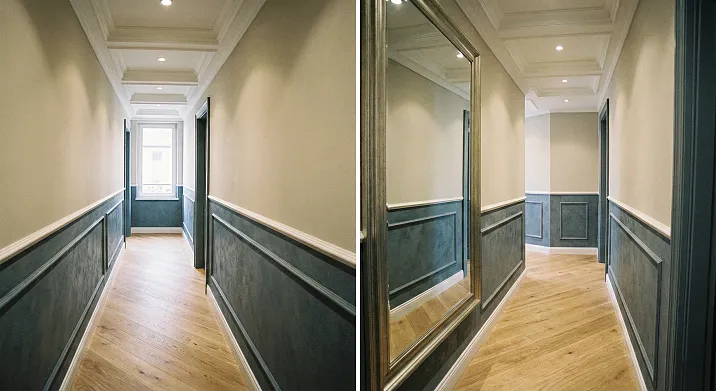
Hallway. The most underestimated, ignored, and neglected space in the house. All efforts, budgets, and design ideas go to the living room, bedroom, kitchen. What about the hallway? It gets whatever is left — leftover wallpaper, cheap linoleum, bare bulb. But think about this: it’s the hallway that welcomes you every day, it’s the one that forms the first impression for guests. Why do we treat it this way? Entryway finishing deserves no less attention than grand rooms. Moreover, it requires special skill, because turning a narrow tunnel into an elegant passage is harder than decorating a spacious living room.
Decorating a narrow hallway — it’s the art of illusion. Here, optical laws, psychology of perception, play of light and shadow work. ProperDecorative corridor wall finishingcan visually double the width, raise the ceiling, fill the space with air. Incorrect — it turns an already cramped room into a claustrophobic trap. The stakes are high, mistakes are costly.
Panels for hallway, moldings, rails, mirrors, lighting — the designer’s arsenal is extensive. But merely knowing about the existence of tools is not enough. One must understand how they work, when to apply them, how to combine them. The hallway is a chess game, where every move is calculated, every element serves a purpose. The goal is one: to create a sense of spaciousness where there is none physically.


Psychology of Narrow Spaces: Why the Hallway Feels Constricting
Humans are creatures evolved on open savanna spaces. Narrow gorges, tight crevices meant danger, the possibility of ambush by predators. Instinct demands visibility, space for maneuvering. A narrow hallway activates ancient fears, creates discomfort on a subconscious level.
A long hallway with doors on both sides resembles a tunnel. The gaze hits the far wall, finding no resting point. This tires the eyes, creates psychological tension. One wants to quickly pass through and escape into the open space of the room.
A dark hallway intensifies negative feelings. Absence of natural light makes the space oppressive. Shadows in the corners create an illusion of even greater confinement. The brain interprets darkness as danger, requiring attention and caution.




Tasks of Decorative Finishing
Internal wall finishingof the hallway solves a complex set of tasks. The first — visual expansion of space. Using optical illusions, correct colors, reflective surfaces creates a sense of greater volume.
The second task — creating visual pauses. A monotonous long hallway tires the eye. Decorative elements break the space into segments, giving the eye points of rest. This makes the path psychologically shorter.
The third — filling with light.decorative wall finishingmust work with light, reflect it, enhance it. A bright space is perceived as more spacious.
The fourth — practicality. The hallway is a high-traffic zone. Walls here are exposed to dirt and mechanical impacts. Finishing must be durable, easy to clean, and repairable.
Our factory also produces:


Color as a tool for expansion
Get Consultation
Light palette: classic expansion
White — the king of space expansion. White walls reflect maximum light, making the hallway brighter and visually wider. But pure white can feel cold, clinical. Choose warm white shades — milk, cream, white with a slight beige undertone.
Beige — the universal choice for a hallway. Warm, cozy, it creates a welcoming atmosphere. Beige pairs well with wooden elements, which are often present in entryways — doors, furniture, baseboards.
Light gray — a modern alternative to beige. Cool gray suits minimalist interiors. Warm gray with a slight brown undertone creates elegant neutrality.
Horizontal division: play of contrasts
Two-tone solution visually changes proportions. Dark lower section and light upper section — a classic approach. The bottom third of the wall is painted dark or covered with panels. The upper two-thirds remain light. This solves two tasks at once: practicality (dark lower section hides dirt) and visual expansion (light upper section lifts the ceiling).
The height of the division is critical. Too low a division (50–70 cm) makes the hallway low and cramped. Too high (above 120 cm) overwhelms with dark color. Optimal height — 90–100 cm. This is roughly one-third of the height of a standard 2.7-meter ceiling.
Decorative wall panels wall finishingIdeal for the lower zone. They create a noble texture, protect the wall, and are easy to clean. Boiserie in the hallway — practicality in elegant packaging.
Accent wall: focus of attention
One bright wall at the end of the hallway creates a focal point. The gaze is drawn to the color spot, diverting attention from the narrowness of the space. This can be a rich blue, emerald green, or terracotta.
An accent wall visually brings the space closer. If you paint the far wall in a bright color, the hallway will appear shorter. This is useful for overly long hallways where proportions need adjustment.
Wallpaper on the far wall creates an illusion of depth. Landscapes, roads receding into the distance, open spaces — such images trick the brain, creating the sensation of space continuing beyond the wall.
Materials for finishing: practicality and beauty
Panels: protection and decoration
Wall panels — the optimal solution for a hallway. They protect the wall from damage, are easy to install, and create a noble texture.Internal wooden wall finishesIdeal for natural wood or MDF.
MDF panels combine affordability and quality. They imitate wood, stone, fabric. The laminated surface is easily cleaned with a damp cloth. Scratches and wear, inevitable in hallways, are less noticeable on panels than on paint.
Wooden panels create a warm, welcoming atmosphere.Wooden wall claddingNatural, eco-friendly, and durable. Light woods — ash, maple — visually expand the hallway. Dark woods — walnut, wenge — require spacious halls.
PVC panels — budget option. They are moisture-resistant, easy to install, and available in a wide variety. The downside — plastic look. Unsuitable for premium interiors, but a worthy solution for budget renovations.
Paint: universality and simplicity
Painting — the most common finishing method. Paint allows you to create any color, is easy to refresh, and is inexpensive. For hallways, choose washable paints — latex or acrylic.
Matte paint hides minor wall imperfections. It doesn’t reflect light, creating a calm, noble surface. The downside — difficult to clean. Matte surfaces absorb dirt.
Semi-gloss paint — a compromise between matte and glossy. It reflects some light but doesn’t create glare. Easier to clean than matte. Optimal choice for hallways.
Glossy paint reflects maximum light, visually expanding the space. But it highlights every wall imperfection, requiring a perfectly smooth surface. Suitable for modern interiors with smooth walls.
Wallpaper: variety of textures
Vinyl wallpaper is durable and washable. It withstands wet cleaning, doesn’t fade, and lasts for years. For hallways, choose wallpaper on a non-woven base — stronger than paper-based wallpaper.
Textile wallpaper creates a luxurious atmosphere. But it absorbs odors, collects dust, and is hard to clean. Not the best choice for hallways in apartments. In spacious halls of private homes, where walls are protected by panels at the bottom, it may be worth the risk.
Paintable wallpaper allows color change freedom. Tired of the shade after a couple of years? Repaint. The textured surface of paintable wallpaper creates a subtle relief, adding visual interest.
Decorative plaster: texture and individuality
Texture plaster creates a unique surface. Each wall is unique — the craftsman forms the relief by hand.Relief wall finishingadds visual interest, diverting attention from the narrowness of the corridor.
Venetian plaster imitates marble. The glossy surface reflects light, visually expanding the space. This is an expensive solution requiring professional application, but the result is impressive.
"Termite", "sheepskin", "fur" — textured plasters with pronounced relief. They hide wall imperfections, create an interesting texture. Durable, easy to clean, long-lasting.
Moldings and decorative elements
Horizontal moldings: lines of expansion
Horizontal lines visually expand the space.Wall finishing with moldingscreates these lines elegantly and functionally. A molding at a height of 90-100 cm divides the wall, creating a classic composition.
A molding at the junction of the wall and ceiling visually raises the ceiling. A white molding on a white ceiling creates a clear boundary, structuring the space. This is a classic technique that works reliably.
Several horizontal moldings create rhythm. Three to four parallel moldings spaced 15-20 cm apart create a graphic composition. This is a modern interpretation of classic decor.
Molding panels: classic elegance
Rectangular frames made of moldings on corridor walls create a classic look.Wall cladding optionsSuitable for spacious halls where there are free wall areas.
Contrasting finishes are placed within the frames. Classic patterned wallpaper, contrasting paint, textile panels. Frames create a multi-level composition, visually complicating the space.
Symmetry is critical. Panels must be of the same size, placed at the same height, with equal spacing. Asymmetry in classic decor looks like an error.
Cornice: volumetric decor
Sculptural decorationsIn a corridor, they should be restrained. Excessive decor overloads a narrow space. A few elegant elements are sufficient.
Consoles under shelves create a classic accent.Sculptural wall decorationIn the form of a console, it supports a shelf for keys, creating functional decor.
Corner elements frame doorways. They transform ordinary doors into portals, adding architectural expressiveness. This is appropriate for classic interiors.
Slatted systems: modern graphics
Vertical slats: raise the ceiling
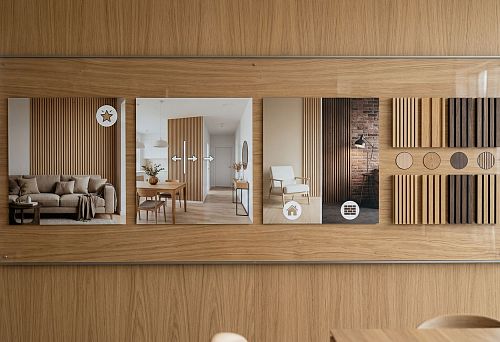
Vertical lines visually raise the ceiling.Plank wall claddingWith vertical slats, the corridor appears higher. The gaze moves upward, creating a sense of greater volume.
Racks for internal wall claddingThey are mounted from floor to ceiling. Continuous verticals are most effective. Short slats that do not reach the ceiling have a weaker effect.
Thickness and spacing affect perception. Thin slats with narrow gaps create a dense, detailed relief. Thick slats with wide gaps — a graphic, minimalist effect.
Horizontal slats: expand walls
wall finishing with lathsIn the horizontal direction, they expand a narrow corridor. Horizontal lines draw the gaze along the wall, creating an illusion of greater width.
Installation height is important. Slats at eye level (160-170 cm) are most effective. They fall within the center of the visual field, maximally affecting perception.
Combining with backlighting enhances the effect. An LED strip between slats creates light lines, visually pushing the walls apart. At night, such a corridor looks futuristic.
Diagonal rails: space dynamics
Diagonal lines create movement. Rails installed at a 45-degree angle break monotony and add dynamism. This is a bold modern solution.
Diagonal pattern requires precise installation. An error in angle or unevenness will be obvious. This is a job for a professional with experience.
Decorative wall panelingDiagonal placement is suitable for short corridors, where you need to create visual interest and distract from the lack of length.
Mirrors: magic of reflections
Large mirror: doubling the space
A mirror covering the entire wall doubles the visual width of the corridor. Physically, the corridor remains narrow, but perception changes radically. The brain sees the reflection and interprets it as an extension of space.
Mirror placement is critical. On a long wall, a mirror doubles the corridor's width — maximum effect. On an end wall, a mirror doubles the length — useful for short corridors.
Safety is important. A mirror in a corridor is at risk of being hit. Use tempered glass or apply protective film to the mirror. In case of breakage, it will hold the shards.
Mirror panels: decorative reflection
Several mirror panels create a decorative composition. Mirrors in frames, rhythmically arranged along the wall, combine functionality and beauty.Decorative wall finishingUsing mirrors — a classic approach.
Mirror frames should match the style. A classic interior requires molding frames. Modern interiors — minimalist metal frames or frames altogether absent.
Rhythm of placement creates visual interest. Three mirrors at equal distances create a symmetrical composition. Mirrors of different sizes, placed asymmetrically — a modern, dynamic look.
Mirror tiles: mosaic of reflections
Mirror tiles create an interesting effect. Many small mirrors break up the reflection, creating a shimmering surface. Less dramatic than a large mirror, but visually expands the space.
Installing mirror tiles requires a flat base. Any unevenness will be visible in the reflection. Professional installation guarantees the result.
Combining mirror and regular tiles creates a pattern. Chessboard layout, stripes, geometric patterns — design possibilities are extensive.
Lighting: light expands
Multi-level lighting
One ceiling lamp — the worst solution for a corridor. It creates harsh shadows, doesn't illuminate corners, and makes the space flat. Multi-level lighting includes ceiling, wall, and floor light sources.
Ceiling fixtures create general lighting. For a narrow corridor, linear fixtures that create a strip of light along the ceiling are suitable. Recessed lights arranged in a line provide a similar effect.
Wall sconces illuminate walls, highlighting the texture of finishes. Light directed upward visually raises the ceiling. Light directed downward creates a cozy atmosphere.
Floor lighting — a modern solution. LED strip along the baseboard creates a light path serving as a guide in the dark. It is both practical and beautiful.
Accent lighting
Light fixtures directed at decorative elements create focal points.Wall Finishing Elements— paintings, niches, decorative panels — stand out with light, attracting attention.
Lighting for paintings creates a gallery atmosphere. The corridor transforms into a home gallery, where each artwork is professionally lit.
Lighting for niches creates depth. Light from within the niche creates an illusion of more space, as if there were another room behind the wall.
Color temperature of light
Warm light (2700-3000K) creates a cozy atmosphere. It suits classic interiors, making the space welcoming. Warm light visually reduces space, which may be problematic in a narrow corridor.
Neutral white (4000K) — a universal choice. It doesn't distort colors, creates a comfortable environment, and doesn't visually reduce space. The optimal choice for a corridor.
Cool light (5000-6000K) visually expands the space. It is associated with daylight, making the room brighter. Suitable for modern interiors, minimalism.
Functional zones of the hallway
Entrance zone: first impression
The entrance zone requires special attention. Here, shoes are removed, clothes are hung, bags are placed.Wall cladding in an apartmentThe entrance zone should be as practical as possible.
Panels up to 120-150 cm protect the wall from dirt. Spills from wet clothes and dirt from shoes do not reach the upper part of the wall. Panels are easy to clean and retain their appearance for years.
Hooks for clothes are integrated into panels. This is both functional and aesthetically pleasing. Separate hanging hooks look like a temporary solution. Integrated hooks look like a thought-out design.
A mirror in the entrance zone is functionally necessary. Checking one's appearance before leaving is a basic need. A mirror above a console or on the wall creates a convenient zone.
Gallery zone: art on the walls
The long wall of the hallway is an ideal place for a gallery. Photographs, paintings, posters transform a transit space into a place where one wants to linger.Wall finishing samplesWith gallery mounting, the possibilities are demonstrated.
Symmetrical mounting creates a classic order. Paintings of the same size in identical frames, arranged in a single line — strict, elegant, proven over centuries.
Asymmetrical mounting creates a modern dynamism. Paintings of different sizes, different frames, free placement — this requires a designer's touch, but the result is individual.
Lighting above paintings turns the hallway into a real gallery. Small fixtures above each painting create a professional exhibition.
Transit zone: movement without obstacles
The main part of the hallway is transit. Here, freedom of movement is important.Interior wall finishing in an apartmentIt should not protrude, creating obstacles.
Built-in cabinets save space. If the hallway allows, built-in wardrobe cabinets solve storage problems without taking width. Mirrored cabinet doors double the visual width.
Niche in walls create places for decoration without occupying space. A vase, figurine, books in a niche do not protrude beyond the wall plane, do not interfere with movement.
Stylistic solutions
Classic hallway
Classic requires symmetry, proportions, noble materials.Decorative wall panels wall finishingBoiserie — the hallmark of a classic hall. Light panels made of wood or MDF create the base.
Wall finishing with moldingsIt completes the composition. Molding at the junction of panels and the upper part of the wall, ceiling cornice create architectural expressiveness.
The color palette is restrained. White, beige, light gray — background. Dark wood panels create contrast. Gold accents in mirror frames, fixtures add luxury.
Minimalist hallway
Minimalism rejects excess. Every element is functional.Wall finishing photoMinimalist hallways show smooth, monochromatic surfaces.
Single-color paint — classic of minimalism. Perfectly aligned walls, matte neutral paint create a calm background. Decoration is minimal or absent.
Plank wall claddingIt is natural in minimalism. Strict geometry, monochromatic paint, absence of unnecessary details correspond to the philosophy of the style.
Scandinavian Corridor
Scandinavian style cultivates light, simplicity, functionality.Interior Wall Finishes PhotoScandinavian interiors demonstrate white walls, wooden accents, minimal decor.
White dominates. Walls, ceiling, doors — everything is white. This maximizes the reflection of precious northern light.Wooden wall claddingLight-colored wood adds warmth.
Functionality comes first. Hooks, shelves, mirrors — everything necessary, nothing extra. Clean lines and simple forms create an orderly space.
Loft corridor
Loft celebrates industrial aesthetics. Brickwork, concrete, metal create a rugged atmosphere.Wall finishing in a houseLoft style uses rough materials.
An exposed brick wall — symbol of loft. Red brick creates texture, color, character. If real brickwork is unavailable, use imitation — brick-patterned tiles.
Industrial lighting complements the look. Lamps in the style of industrial lamps, exposed bulbs, metal shades create an authentic atmosphere.
Practical installation tips
Surface preparation
The quality of finishing depends 70% on preparation.wall finishing materialsRequire a smooth, clean, strong base. Cutting corners on preparation will lead to problems.
Removing old finishes is the first step. Wallpaper, paint, and plaster that is peeling off must all be removed. Tap the wall — a dull sound indicates voids beneath the plaster.
Leveling is critical for some finishes. Painting requires perfectly flat walls — every bump will be visible. Panels are more forgiving of unevenness, but rough defects must be corrected.
Sealing is mandatory. Primer strengthens the surface, improves adhesion, reduces material consumption. Don't skimp on primer — it's a quality guarantee.
Panel installation
Panels are installed with adhesive or a frame. Adhesive installation is simpler but requires flat walls. Frame installation is more complex but hides unevenness and creates an air gap.
Marking before installation is mandatory. Mark the installation level and joint locations. Panels must be installed strictly horizontally — any tilt will be obvious.
Joints between panels are filled with sealant or covered with trim. Neat joints indicate professional work. Uneven gaps or inconsistent seam widths reveal amateurism.
Molding installation
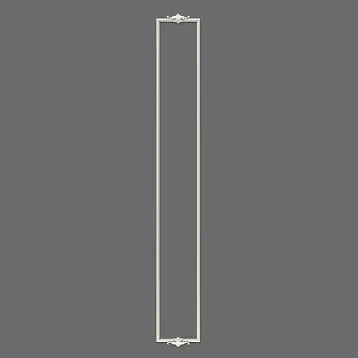
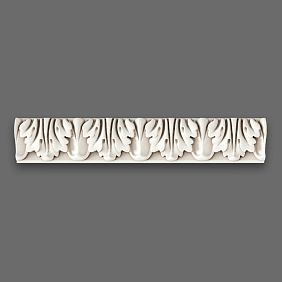
Plaster ornament for walls and ceilingsPolyurethane panels are mounted with special adhesive. Apply adhesive to the back, press against the wall, hold for a minute. The adhesive sets quickly.
Cutting moldings requires precision. For corner joints, a 45-degree cut is needed. A miter saw or miter box provides accurate cuts. Inaccuracy in degrees creates a gap at the joint.
Joints are filled with acrylic sealant. Smooth the seam with a wet finger — you’ll get an invisible connection. Quality joints are half the success.
Budget and premium solutions
Budget finishing
Painting is the most accessible solution. Quality paint, roller, brush — minimal investment. The result depends on preparation and careful execution.Wall finishing in a private houseBudget does not mean poor quality.
PVC panels combine affordability and practicality. They are cheaper than wood and MDF, easy to install, and durable. Choose quality panels — cheap ones look cheap.
Paintable wallpaper is a compromise between price and quality. It hides minor wall imperfections, creates a subtle texture, and costs reasonably. Repainting refreshes the interior.
Mid-Range Segment
MDF panels with laminate finish look substantial. The wood or stone imitation is high quality and hard to distinguish.Decorative wall finishing priceavailable to most in this segment.
Decorative plaster creates a unique surface. Venetian plaster and textured finishes cost more than paint, but the result is exclusive. Every wall is unique.
Polyurethane wall claddingwith moldings and cornices adds classic elegance. Polyurethane is more affordable than plaster, looks identical, and lasts for decades.
Premium finishing
Natural wood of valuable species — the pinnacle of quality.Wooden wall claddingfrom walnut, oak, exotic species creates a luxurious atmosphere. The cost is high, but the result is eternal.
Handmade plaster moldings — exclusivity. Each element is unique, crafted by a master.Plaster wall finishing— choice for connoisseurs of authenticity.
Natural stone creates monumentality. Marble, granite, travertine turn a hallway into a gallery. The cost is extraordinary, but the impression is unforgettable.
Mistakes to avoid
Dark colors in a narrow hallway
Dark walls narrow the space. In a narrow hallway, this is a catastrophe. Dark blue, black, dark gray consume space, making the hallway a tunnel. Avoid dark colors if the hallway is already narrow.
Exception — a short, wide hallway. Here, a dark end wall visually brings the space closer, correcting proportions. But side walls must remain light.
Vertical wallpaper pattern in a low hallway
Vertical stripes on wallpaper raise the ceiling. Sounds good? But in a hallway with low ceilings, this emphasizes the crampedness. The hallway appears even narrower. Choose horizontal patterns or solid finishes.
Excessive decoration
Hallway — transitional space. Excessive decoration creates visual noise, hinders movement. Statuettes on shelves, numerous paintings, complex draperies — all this overloads.Wall finishing photos in apartmentsshows: better less, but better.
Insufficient lighting
One light bulb on the ceiling — a failure. The hallway remains dark, corners in shadow, space seems cramped. Invest in lighting — it is critical for a hallway.
Glossy surfaces on uneven walls
Glossy paint, mirror tiles highlight every imperfection. If walls are not perfectly flat, gloss will reveal all flaws. Use matte or semi-gloss finishes that conceal imperfections.
Conclusion: hallway as art
Decorative corridor wall finishing— the pinnacle of design. Turn a deficiency into an asset, create beauty in limited space, make a cramped hallway appear spacious — this requires skill, knowledge, and a sense of proportion.
Do not regard the hallway as secondary space. It is the first thing you see upon returning home. It is the last thing guests remember. The hallway sets the tone for the perception of the entire house. Investments in its finishing pay off in daily comfort and pride in your home.
Modern materials and technologies make quality finishing accessible. No more need for palace budgets. Polyurethane moldings cost as much as premium wallpaper. MDF panels are accessible to the middle class. Even budget paint, when applied correctly, creates a worthy result.
Company STAVROS — your reliable partner in creating the ideal hallway. For over twenty years, we have offered materials of the highest quality for decorative finishing. Our assortment includes everything needed to transform any space.
Sculptural decorationsSTAVROS from premium polyurethane transforms an ordinary hallway into an elegant hall. Moldings, cornices, consoles, pilasters — each element is crafted with jewel-like precision. The material’s lightness simplifies installation — even a non-professional can handle it. Moisture resistance guarantees longevity under any conditions.
Decorative wall panelsSTAVROS — premium boiserie for creating classic interiors. Made from natural wood or high-quality MDF, they create a noble atmosphere, protect walls, and serve for decades. Numerous designs allow selecting a solution for any style.
rafter walls for wallsSTAVROS from natural wood creates modern interiors. Ideal geometry, premium wood, ability to paint in any color. STAVROS’s paneling — quality proven by thousands of projects.
Moldings made of polyurethaneSTAVROS is available in dozens of variations. From simple to complex, from narrow to wide — there’s a solution for any project. All elements combine harmoniously to create balanced compositions.
STAVROS’s own production guarantees stable supply and quality control. Each element undergoes multi-stage inspection. We do not allow defects, do not sell second-grade products. Only perfect products reach the customer.
Delivery across Russia makes STAVROS accessible in any region. Moscow, Saint Petersburg, Vladivostok — geography is not a limitation. Reliable packaging ensures preservation during transport. Logistics partners deliver on time.
The STAVROS showroom in Moscow presents the full range. Come, see, and touch materials in person. Experience the quality, detail, and feel the difference between mass production and premium class. Our consultants will help you choose optimal solutions, compose layouts, and calculate material quantities.
The STAVROS online catalog is constantly updated. New arrivals, popular items, exclusive collections — everything is available on the website. Convenient search system, detailed descriptions, high-quality photos help you choose what you need.
STAVROS technical support advises at every stage. Unsure about your choice? Call us. Don’t know how to install? We’ll provide instructions. Questions arise during the process? We’re here. Your success is our goal.
STAVROS is not just a store. It’s a community of professionals and enthusiasts creating beauty. Designers, builders, homeowners — thousands of people trust us. Join satisfied STAVROS clients.
Transform your hallway. Turn a narrow tunnel into an elegant passage. Create a memorable first impression. With STAVROS materials, this is realistic, accessible, and reliable. Your ideal hallway begins here!