Article Contents:
- Polyurethane on the facade: why this is the solution of the future
- Temperature stability: from frost to heat
- Moisture resistance: a barrier against water
- UV stability: protection from the sun
- Bio-resistance: against mold and beetles
- Anatomy of window decoration: elements and their functions
- Casing: perimeter framing
- Pediments: protection and accent
- Window sill cornices: finishing the lower border
- Brackets: support and volume
- Comprehensive facade decor: beyond windows
- Crowning cornices: finishing the building
- Interfloor cornices: horizontal division
- Pilasters: vertical division
- Columns: three-dimensional verticals
- Rustication: Imitation of Stone Masonry
- Balustrades: balcony and terrace railings
- Stylistics of facade decor: from classic to minimalism
- Classical style: symmetry and order
- Baroque: Opulence and Dynamism
- Ceiling Molding: Framing the Upper Surface
- Minimalism: conciseness and geometry
- Modern classic: balance of tradition and conciseness
- Installation of facade decor: technology of durability
- Base preparation: key to reliability
- Adhesive compounds: what to use
- Mechanical fasteners: additional fixation
- Element joining: invisible seams
- Painting: protection and aesthetics
- Frequently Asked Questions
- Can polyurethane decor be installed in winter?
- Does polyurethane decor withstand hail?
- How to clean facade decor from contamination?
- Does polyurethane decor need protection from birds?
- How to repair a damaged decor element?
- Can decor be painted the same color as the wall?
- Does the orientation of the facade affect the choice of decor?
- How to combine polyurethane decor with a ventilated facade?
- Conclusion: Architecture as Art of Details

A window is not just an opening in a wall. It is the eye of the house, which looks out at the world and allows the world to see what is inside. An unframed window is like an eye without eyelashes, without eyebrows—functional but lacking expressiveness.Facade window decoration from polyurethaneIt transforms a technical opening into an architectural accent that shapes the building's appearance, its character, its style. Casings framing the opening around the perimeter. Hoods protecting from rain and creating horizontal accents. Window sills finishing the lower boundary of the window. Brackets supporting the hoods and adding volume. All of this is a system of elements that not only decorates but architecturally organizes the facade, creates rhythm, proportions, scale.Outdoor facade decoration using polyurethaneIt includes not only window decor but also cornices encircling the building around the perimeter, pilasters and columns dividing the facade vertically, rustication creating a stonework effect, balustrades framing balconies and terraces. Polyurethane solved a problem that had limited facade decor for centuries: weight and fragility. A plaster casing weighs 15-20 kg, requires reinforced fastening, cracks from frost, deteriorates from moisture. A polyurethane equivalent weighs 1.5-2 kg, adheres like regular molding, withstands any weather for decades. How to choose the right decor for a facade? How to combine elements so the building looks harmonious? How to install so the decor lasts not years, but decades? Let's dive into the details.


Polyurethane on the facade: why this is the solution of the future
Facade decoration for exterior polyurethane claddingIt displaces traditional materials not only due to lightness but also a complex of performance characteristics critical for exterior application.




Temperature stability: from frost to heat
The facade is subjected to extreme temperature loads. Winter frosts down to -40°C in northern regions, summer heat up to +60°C on the surface of a dark wall under direct sunlight, daily fluctuations of up to 30-40°C in spring and autumn. Traditional materials react to such fluctuations with deformations. Plaster cracks when moisture freezes in its pores. Wood swells with humidity and shrinks with dryness, leading to warping, cracking, and detachment from the base. Concrete is relatively stable but heavy and expensive to produce in complex shapes.
Polyurethane maintains geometry in a range from -60°C to +80°C. The coefficient of linear expansion is minimal—0.00007 per 1°C, meaning a change in size of a decorative element 1 meter long of only 0.07 mm with a temperature change of 10 degrees. Such a change is imperceptible and does not create stress in the fastening. The material does not become brittle in the cold or soften in the heat, maintaining strength and elasticity year-round.
Our factory also produces:




Moisture resistance: a barrier against water
Moisture is the main enemy of facade materials. Rain, snow, condensation, capillary rise of moisture from the ground—all this creates constant dampness. Plaster absorbs water like a sponge, with water absorption reaching 30-40% by mass. Swollen plaster loses strength, deforms, and when water freezes in its pores, it deteriorates from within. Wood absorbs moisture along the fibers, swells, then dries—cycles of swelling and drying lead to cracking.
Polyurethane does not absorb water—water absorption is less than 1% even during prolonged immersion. The closed-cell structure of the material (if using foamed polyurethane) or monolithic structure (dense polyurethane) does not allow water to penetrate inside. Polyurethane decor can be installed in the wettest zones—under downspouts, on lower floors where capillary wall moisture is high, in coastal areas with salty fog.
Get Consultation
UV stability: protection from the sun
Ultraviolet radiation destroys polymers, causing photodegradation—breaking molecular chains, loss of strength, brittleness, yellowing, fading. Ordinary polymers (polystyrene, unprofiled polyurethane) degrade under UV exposure in 2-3 years. Facade polyurethane contains UV stabilizers—additives that absorb ultraviolet light and prevent degradation. Modern stabilizers (based on benzotriazoles, benzophenones, HALS systems) provide protection for 20-30 years even when installed on southern facades where solar exposure is maximum.
Painting with facade acrylic paint with UV-resistant pigments additionally protects the material. Light colors (white, cream, light gray) reflect up to 80% of solar radiation, reducing heating of the decor and extending its service life.
Biostability: against mold and beetles
The facade is an environment favorable for biodeterioration. Moisture, organic matter (dust, pollen), variable temperatures create conditions for mold, fungi, and lichen growth. Wood is affected by wood-boring beetles, fungi causing rot. Plaster, absorbing moisture, becomes covered with mold, turns black. Polyurethane is a synthetic inert material, not a nutrient medium for microorganisms and insects. It does not rot, does not become covered with mold, is not affected by beetles.Polyurethane architectural decorationIt maintains surface cleanliness for decades even in damp, shady areas where other materials quickly turn black.
Anatomy of window decor: elements and their functions
What does it includeFacade window decoration from polyurethane? The window framing system consists of several key elements, each with a function and an aesthetic role.
Casings: perimeter framing
A casing is a vertical or horizontal strip framing the window around the perimeter. Side casings are installed vertically on the left and right sides of the window. The lower casing (window sill cornice) runs under the window. The upper casing can be replaced by a hood or pediment.
The width of the casing is chosen depending on the window size and building scale. For small windows 80-100 cm wide—casings 8-12 cm wide. For standard windows 120-150 cm wide—casings 12-18 cm wide. For large panoramic windows 200-300 cm wide—casings 20-30 cm wide. A casing too narrow for a large window will get lost, look disproportionate. A casing too wide for a small window will overwhelm the opening.
The casing profile determines the style. A simple flat casing (rectangular strip)—for minimalist modern facades. A casing with a chamfer (beveled edge)—for neoclassical, transitional styles. A casing with a bead (rounded convexity along the length)—for classical facades. A casing with ornamentation (floral scrolls, geometric patterns)—for historical styles, Baroque, Art Nouveau.
Casing function: visual framing that highlights the window on the wall, creates contrast, makes the opening noticeable. Masking the joint between the window frame and the wall—the casing overlaps the mounting seam, protects it from drafts, moisture. Architectural division of the facade—vertical and horizontal lines of casings create rhythm, structure the wall plane.
Hoods: protection and accent
A hood is a horizontal decorative cornice located above the window. It protrudes from the wall plane by 5-15 cm, creating a canopy that diverts rainwater from the window. Water flows down the wall, reaches the hood, flows off its protruding edge at a distance of 5-15 cm from the window, not hitting the glass and frame.
Sandrik forms are diverse. A straight horizontal sandrik is a simple strip projecting above the window. Suitable for strict modern facades, minimalism, neoclassicism. An arched sandrik is a strip with a curved lower edge, following the arch or creating a soft curvilinear line. Suitable for romantic styles, Art Nouveau, Mediterranean architecture. A triangular pediment is a sandrik in the shape of a triangle with a base resting on brackets or side architraves, and a vertex raised above the center of the window. A classic element that gives the window solemnity and grandeur. Used in order architecture, neoclassicism, Empire style.
Complex multi-tiered sandriks combine horizontal cornices of different widths, arranged in steps, with decorative elements — dentils (teeth), modillions (brackets), floral ornaments. Such sandriks are characteristic of Baroque, Rococo, Eclecticism.
The size of the sandrik is proportional to the window. The width of the sandrik (length of the horizontal strip) should be 10-20% greater than the width of the window together with the side architraves. A window with architraves has a total width of 160 cm — the sandrik should be 176-192 cm (160×1.1 = 176, 160×1.2 = 192). The projection of the sandrik from the wall plane (depth of the canopy) for standard windows is 8-12 cm, for large windows — 12-18 cm, for grand pediments — 18-25 cm.
Sill cornices: finishing the lower boundary
A sill cornice is a horizontal strip running under the window, finishing its lower boundary. It projects from the wall plane by 3-8 cm, creating a visual sill (not functional, on which nothing is placed, but decorative). Function: finishing the composition (the window gets clear upper and lower boundaries, becomes a complete rectangle), diverting water flowing down the glass and frame away from the wall (water drips from the projecting edge of the cornice, not falling on the wall under the window).
The width of the sill cornice corresponds to the width of the sandrik (for compositional symmetry) or is slightly less (if the sandrik is large, pedimented, the sill cornice can be more modest). The profile is simple — a rectangular strip with a chamfer or a bead, without complex ornamentation (the decorative accent is on the sandrik, the sill cornice is a secondary element).
Brackets: support and volume
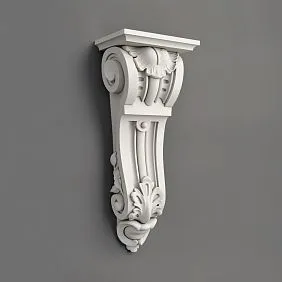
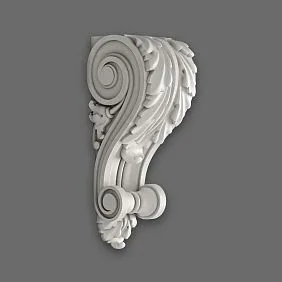
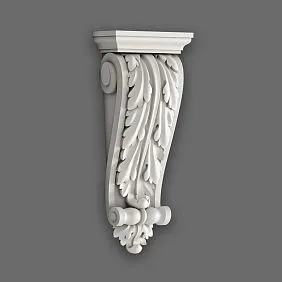
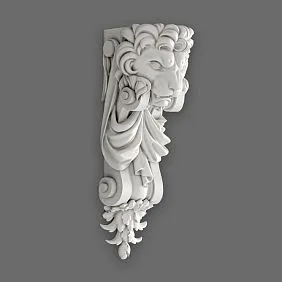
Brackets are vertical or diagonal decorative elements that visually 'support' the sandrik. They are installed under the edges of the sandrik (one bracket on each side) or under a pediment-type sandrik (two brackets on the sides of the triangle). Brackets do not perform a real load-bearing function (the sandrik is held by adhesive and dowels), but create a visual logic of the structure — the bracket 'props up' the projecting cornice, which is perceived as natural, architecturally plausible.
Bracket sizes range from 10×15 cm (height×width) for small windows to 30×40 cm for large windows with massive sandriks. Shape: simple rectangular or triangular for strict styles, S-shaped curved for Baroque, carved with floral motifs for Art Nouveau, geometric with profiled edges for Art Deco.
Comprehensive facade decor: beyond windows
Outdoor facade decoration using polyurethaneis not limited to window surrounds. A full-fledged architectural concept includes elements that organize the entire facade.
Crowning cornices: finishing the building
A crowning cornice is a horizontal profiled element encircling the building around the perimeter at the level of the transition from the wall to the roof. It finishes the vertical composition of the facade, creates a visual boundary between the walls and the roof. Without a cornice, the building looks unfinished — the wall ends abruptly, the roof begins sharply, without a transition.
The width of the crowning cornice (its vertical dimension from the lower edge to the upper) is chosen depending on the height of the building. For single-story buildings 3-4 m high — cornices 20-35 cm wide. For two-story buildings 6-7 m high — cornices 35-50 cm wide. For three-story buildings 9-10 m high — cornices 50-80 cm wide. The taller the building, the larger the cornice should be to be readable from a distance, not lost against the wall background.
The profile of the crowning cornice includes several elements: the supporting part (lower), adjacent to the wall, creating a transition from vertical to horizontal; the middle part with ornamentation (beads, grooves, dentils, modillions); the projecting part (upper), the canopy, finishing the cornice and creating the maximum projection from the wall plane.
The projection of the cornice (distance from the wall to the edge of the canopy) for standard buildings is 15-30 cm, for monumental ones — 30-50 cm, for historical reconstructions — 50-80 cm. A large projection creates a deep shadow under the cornice, which enhances expressiveness, but requires reliable fastening (combination of adhesive and mechanical fasteners).
Interfloor cornices: horizontal articulation
An interfloor cornice (string course) is a horizontal band encircling the building at the level of the floor slab between stories. It visually divides the facade into tiers, creates a horizontal rhythm, emphasizes the number of stories. Without interfloor cornices, a multi-story facade looks monotonous — a continuous vertical plane with windows. Cornices structure this plane.
The width of the interfloor cornice is less than that of the crowning one (it does not finish the building, but only separates the floors). For two-story buildings — 12-20 cm, for three-story buildings — 15-25 cm. The profile is simpler than the crowning one — usually one or two beads or grooves, without complex ornamentation. The projection is minimal — 3-8 cm (the cornice should not interfere with window opening, hanging air conditioners).
The interfloor cornice is installed either at the level of the upper boundary of the lower-story windows (first-floor windows end, the cornice runs along their top line, above which second-floor windows begin), or at the level of the lower boundary of the upper-story windows (second-floor windows begin, the cornice runs below them).
Pilasters: vertical articulation
A pilaster is a vertical flat projection imitating a column, but adjoining the wall. A polyurethane pilaster consists of three parts: base (lower, widened part, transition from wall to shaft), shaft (central vertical part, smooth or with flutes — vertical grooves), capital (upper, widened part with ornamentation — Ionic with volutes, Corinthian with acanthus leaves, Doric simple).
The height of the pilaster equals the height of the tier it articulates. For a single-story building 3.5 m high, the pilaster has a height of 3.0-3.2 m (from the plinth to the crowning cornice). For a two-story building, the pilaster can run the full height of the facade (6.5-7.0 m) or only within one tier (3.0-3.5 m, a separate pilaster on the first floor, a separate one on the second).
The width of the pilaster (its projection from the wall) for residential buildings is 12-20 cm, for public monumental buildings — 25-40 cm. The thickness (cross-sectional dimension parallel to the wall) for standard pilasters is 15-25 cm, for massive ones — 30-50 cm.
Pilaster placement: at building corners (one pilaster in each corner, visually marking the facade boundary), on either side of the entrance (two pilasters frame the doorway, turning the entrance into a portal), at equal intervals along the facade length (create rhythm, divide the facade into sections — e.g., a facade 12 m long is divided by four pilasters with a 3 m interval into three sections, each section with one window).
Columns: three-dimensional verticals
A column is a three-dimensional cylindrical element, unlike a flat pilaster. Polyurethane columns are hollow (a shell of polyurethane 10-20 mm thick, empty inside or filled with lightweight material), which reduces weight. Column diameter for residential buildings is 20-35 cm, for public ones — 35-60 cm. Height is like pilasters — within one tier or the full height of the facade.
Columns are installed not flush with the wall, but set back 20-50 cm from the wall, forming a portico (a covered gallery where the roof rests on columns). A portico in front of the entrance creates a grand entrance area, protects the entrance from rain. A portico along the facade creates a covered veranda, gallery.
The load-bearing capacity of polyurethane columns is limited (the material is not intended for load-bearing structures). The real load-bearing structure (metal or wooden post) is installed inside the polyurethane shell, which performs only a decorative function. Or the column bears no load at all — the roof rests on hidden posts, the column stands nearby for decoration.
Rustication: imitation of stone masonry
Rustication — horizontal or vertical strips imitating joints between stone blocks. They create a pattern on a smooth wall reminiscent of masonry made of large stones. Horizontal rustication runs in rows across the entire facade at intervals of 30-50 cm (imitation of stone rows 30-50 cm high). Vertical rustication divides the wall into rectangular sections 50-100 cm wide (imitation of stone blocks).
Corner rustication — rustication is installed only at building corners, creating corner 'stones' (quoins) sized 30×50 cm or 40×60 cm. The central part of the facade is smooth, the corners are rusticated — an effect of strength, solidity. Plinth rustication — rustication at the plinth level (lower part of the wall 50-80 cm high) imitates a stone foundation. Above, rustication is absent, the wall is smooth or plastered.
Rustication thickness (its projection from the wall plane or recess) for simulating stone masonry is 1-3 cm. The profile can be rectangular (flat strip), beveled (a 45° chamfer creating shadow), or rounded (a bead).
Balustrades: railings for balconies and terraces.
A balustrade is a railing consisting of balusters (vertical decorative posts) and a handrail (a horizontal rail resting on the balusters). Polyurethane balustrades are installed on balconies, terraces, staircases, and porches. The height of a balustrade according to building codes is at least 90 cm (for safety), typically 90-110 cm. The distance between balusters is no more than 15 cm (to prevent a child from squeezing through).
Baluster shapes are diverse: classic with a vase-like swelling in the center, smooth cylindrical, square with profiled edges, carved with floral motifs. Baluster height is 70-90 cm (from base to handrail), diameter or side of a square is 8-12 cm.
Handrail (rail) — a horizontal rail 8-12 cm wide, 4-6 cm high, profiled (rounded upper surface for a comfortable hand grip). The handrail rests on balusters, connecting to them with glue and dowels.
Stylistics of facade decor: from classic to minimalism.
Polyurethane architectural decorationreproduces any style, from historical to ultra-modern.
Classical style: symmetry and order.
Classicism (Neoclassicism) is based on the ancient order system. The facade is symmetrical relative to the central axis (entrance). Windows are strictly aligned above each other, forming vertical rows. The crowning cornice is wide (40-60 cm) with dentils (teeth) and modillions (brackets). Windows are framed by architraves 12-18 cm wide with a simple profile (bead + groove), with straight horizontal or triangular pedimented pediments over central windows. Pilasters with Ionic or Corinthian capitals divide the facade into three parts (risalits) — the central part (entrance) and two side parts. Color: white decor on a cream, beige, light yellow wall background.
Baroque: opulence and dynamism
Baroque is characterized by an abundance of decor, complex curvilinear forms, and multi-tiered composition. The crowning cornice is large (50-80 cm) with a complex profile, including several rows of ornament — dentils, modillions, acanthus leaves. Windows are framed by architraves with rich ornamentation — plant scrolls, cartouches (shields with monograms). Pediments are arched, curvilinear, often with a broken pediment (a triangle broken in the center, with a vase or sculpture in the break). Brackets are S-shaped, carved. Pilasters with Corinthian capitals, shafts with fluting. Color: gilded elements (gold paint on protruding parts of the ornament) on a white or pastel background.
Modern: natural forms and asymmetry
Art Nouveau (Art Nouveau) rejects strict symmetry, using natural motifs — stylized flowers (irises, poppies, lilies), dragonflies, wavy lines. Architraves are asymmetrical, with flowing ornaments transitioning from the vertical part to the horizontal. Pediments are curvilinear, often in the shape of a wave or an arch with overhanging plant elements. Pilasters may be replaced by stylized plant stems. The crowning cornice is of medium width (30-50 cm) with plant ornamentation. Color: natural palette — green, brown, terracotta, with white or cream decor.
Minimalism: conciseness and geometry.
A minimalist facade uses decor sparingly. Architraves are narrow (6-10 cm), flat, without ornament, creating a clear geometric frame around the window. Pediments are absent or minimal — a thin horizontal strip 5-8 cm wide without projection. The crowning cornice is narrow (15-25 cm) with a simple profile (one chamfer or bead). Pilasters are absent or replaced by flat vertical strips 8-12 cm wide without capitals or bases. Color: monochrome scheme — decor in the wall color (white on white, gray on gray), revealed only by relief and chiaroscuro. Or a contrasting scheme — black decor on a white wall, white on dark gray.
Modern classic: a balance of tradition and conciseness.
Modern classic simplifies classical forms, preserving proportions and symmetry, but removing excessive ornamentation. Architraves are 10-15 cm wide with a simple profile (chamfer or one bead). Pediments are straight horizontal, 15-25 cm wide, without ornament. The crowning cornice is 30-45 cm wide with minimal relief (two or three beads without dentils). Pilasters with simplified capitals (Ionic volutes stylized, large, without small details). Color: light palette — white, cream, light gray decor on white or beige walls.
Installation of facade decor: technology for durability.
How to properly installOutdoor facade decoration using polyurethaneso that it lasts for decades?
Preparing the base: key to reliability
Facade decor is glued to the wall; the strength of the bond depends on the quality of the substrate. The substrate must be strong (not crumbling, not peeling), level (deviations no more than 5 mm per meter of length), clean (free of dust, dirt, efflorescence), and dry (moisture content no more than 8%).
Preparation of a new facade: if the facade is newly built, plastered, but not painted — a deep-penetration primer is necessary. The primer strengthens the plaster surface, reduces water absorption, and improves adhesive adhesion. It is applied with a roller or brush in one or two coats with intermediate drying of 3-4 hours. After complete drying (12-24 hours), decor can be installed.
Preparation of an old painted facade: if the facade is painted with old paint, an adhesion test is needed. Stick a strip of masking tape to the wall, press it, and rip it off sharply. If pieces of paint remain on the tape — adhesion is poor, the paint is peeling. Cleaning is necessary (removing peeling areas with a putty knife or brush) and priming. If the tape comes off clean — adhesion is good, decor can be installed over the paint.
Adhesive compositions: what to use.
Special adhesives resistant to moisture, frost, and UV are used for facade decor. Polyurethane mounting adhesive (one-component, in 310 ml cartridges for a gun) is the most common. It sets through a reaction with air moisture, setting time 15-30 minutes, full polymerization 24 hours. Bond strength is high, the adhesive is elastic, compensating for thermal expansion. Working temperature from +5°C to +35°C.
Acrylic mounting adhesive (one-component, water-based) is an alternative to polyurethane. More environmentally friendly (does not contain isocyanates), but less moisture-resistant. Used for decor that will be painted with facade paint after installation (the paint additionally protects the adhesive joint from moisture). Setting time 10-20 minutes, full polymerization 12-24 hours.
Epoxy two-component adhesive (two components are mixed — resin and hardener) — maximum strength, absolute moisture resistance, but expensive and difficult to work with. Used for decor with high load (large cornices, columns) or in extreme conditions (coastal areas with salt fog).
Mechanical fasteners: additional fixation.
Light elements (architraves, narrow moldings, overlays) are attached with adhesive only. Heavy and large elements (crowning cornices, pilasters, columns, large pediments) require additional mechanical fastening. Dowels (plastic expansion or metal anchor) with a diameter of 6-10 mm, length 60-120 mm are used (depending on the thickness of the decor and substrate).
Technology of combined fastening: the decor is placed against the wall, fastener locations are marked (interval 40-60 cm), holes are drilled through the decor into the wall (drill diameter 1 mm larger than the dowel diameter), dowels are inserted, adhesive is applied to the back of the decor, the decor is pressed against the wall, dowels are tightened (the dowel head is countersunk into the decor by 2-3 mm), the recess is filled with acrylic putty, after drying it is sanded and painted over.
Joining elements: invisible seams.
Long cornices, architraves are assembled from planks 2 m long (standard length of linear products). Joints are made butt-to-butt (end to end) at a right angle (for horizontal elements) or at a 45° angle (for corner connections). Ends are cut with a fine-toothed saw or a miter saw (ensures a perfectly even cut without chips).
Joint preparation: ends are cleaned with fine sandpaper (burrs are removed), coated with adhesive, joined, the seam is pressed, excess adhesive is removed. After adhesive polymerization (24 hours), the seam is filled with acrylic facade putty, sanded, and painted. A properly executed joint is invisible even up close.
Painting: protection and aesthetics
After installation, the molding is painted with facade acrylic paint. Painting serves two functions: aesthetic (color matching the design project) and protective (the paint additionally protects the polyurethane from UV, moisture, and contamination).
Painting technology: the molding is primed with acrylic facade primer (if it was not primed by the manufacturer), drying time 4-6 hours. It is painted with facade acrylic paint using a brush (to paint the relief) in two to three coats with intermediate drying of 6-8 hours. The first coat is the base, covering the primer but may show through. The second coat is the main one, creating an even coverage. The third coat (optional) is the finish coat, for maximum color density.
Paint color: light colors (white, cream, beige, light gray) reflect solar radiation, reduce heating of the molding, and extend its service life. Dark colors (black, dark gray, brown) absorb radiation; the molding heats up to +70-80°C on southern facades — this is acceptable but reduces service life to 15-20 years instead of 30-40 for light colors.
Frequently asked questions
Can polyurethane decor be installed in winter?
Yes, but with limitations. Most adhesives work at temperatures not lower than +5°C. For winter installation, frost-resistant polyurethane adhesives are used, maintaining elasticity and adhesion at temperatures down to -10°C. The substrate must be dry (moisture freezes, turns into ice, adhesion is zero). Installation is performed in dry weather without precipitation. After installation, the molding is covered with film for 48 hours to protect it from snow and ensure normal adhesive polymerization.
Does polyurethane molding withstand hail?
Yes, polyurethane is impact-resistant. Hail with a diameter of 10-15 mm (most common) does not leave dents or chips on polyurethane with a density of 250-350 kg/m³. Hail with a diameter of 20-30 mm (rare, extreme) may leave dents on thin elements with a thickness of 5-8 mm but will not destroy the molding. For comparison: gypsum molding crumbles from hail with a diameter of 5-10 mm.
How to clean facade molding from contamination?
Polyurethane is smooth and does not absorb dirt. Dust and soot are washed off with water from a hose or a high-pressure washer (pressure no more than 100 bar, distance from the nozzle to the molding at least 30 cm to avoid damaging the paint). Greasy contamination (in areas near kitchen ventilation outlets) is removed with a soapy solution (liquid soap or dishwashing detergent diluted in water 1:10), applied with a sponge, followed by rinsing with clean water. Stubborn contamination (mold on shaded areas) is removed with a chlorine bleach solution (1:5 with water), applied with a brush for 10-15 minutes, then rinsed off.
Is protection of polyurethane molding from birds needed?
In some cases, yes. Birds (pigeons, sparrows) may perch on protruding molding elements (wide cornices, pediments, column capitals), leaving droppings that stain the surface and spoil the aesthetics. Protection: installation of anti-perching spikes (plastic or metal strips with protruding spikes 5-10 cm high, attached to the top plane of the cornice, pediment), application of a special repellent gel (applied to the surface, creates a sticky layer unpleasant for birds' feet, repels without harm).
How to repair a damaged molding element?
Small chips and scratches are filled with acrylic putty for exterior work, after drying they are sanded with fine sandpaper, and painted with facade paint in the color of the molding. Major damage (cracks longer than 10 cm, broken-off fragments) require replacement of the element. The damaged element is dismantled (removed from adhesive and dowels), and a new one is installed using standard technology. The advantage of polyurethane is easy dismantling and availability of replacement without large-scale work.
Can the molding be painted the same color as the wall?
Yes, monochrome painting (molding the same color as the wall) is a popular solution for minimalist facades. The molding is revealed only by its relief and light-shadow, creating a delicate volumetric effect. For this, the wall and molding are painted with the same paint of the same color in the same number of coats. Important: the paint must be facade acrylic, resistant to UV and moisture.
Does the orientation of the facade affect the choice of molding?
Yes, southern facades receive maximum solar radiation, the molding heats up more. Light colors (white, cream) are recommended, reflecting 70-80% of radiation. Northern facades receive less sun but more moisture (dry worse after rain). Painting with biocide additives (against mold) and protection of protruding elements with pediments (so that water does not stagnate) are recommended. Western and eastern facades are universal, any solutions are suitable.
How to combine polyurethane molding with a ventilated facade?
A ventilated facade (cladding on a frame with an air gap) requires special mounting of the molding. The molding is mounted not on the cladding (porcelain stoneware, panels), but on embedded elements of the frame or on additional support battens secured to the frame. Adhesive is used minimally (only for final fixation), the main load is on mechanical fasteners (dowels, anchors). The ventilation gap under the molding is preserved (for air circulation).
Conclusion: architecture as the art of details
Facade window decoration from polyurethaneand comprehensive exterior wall design transform a standard building into an architectural work, where proportions, rhythm, scale are thought out, where each window is not just a technical opening but a framed element of the composition, where the facade is not a featureless plane but a structured system of horizontals and verticals, divisions and accents.
Polyurethane as a material has solved all historical problems of facade molding — the weight of gypsum, the fragility of stone, the high cost of wood, the short lifespan of polystyrene foam. Lightweight, durable, moisture-resistant, frost-resistant, UV-stable, bio-resistant, long-lasting — polyurethane provides a service life of 30-50 years even in harsh climatic conditions. A variety of forms — from strict minimalist strips to lush Baroque ornaments — allows the implementation of any stylistic concept.
A systematic approach to facade molding considers all elements: window surrounds (architraves, pediments, window sills, brackets), cornices (crowning, interfloor), vertical divisions (pilasters, columns), imitations (rustication, balustrades). All elements are selected in a unified style, with coordinated proportions, forming a harmonious system where there is nothing superfluous, where every detail is in its place.
Installation of facade molding requires care and adherence to technology: substrate preparation, correct choice of adhesive, combined fastening for large elements, careful joining, quality painting. Properly installed molding serves for decades without maintenance, requiring only periodic washing from dust.
Company STAVROS — the largest Russian manufacturer ofArchitectural decoration from polyurethanewith a 24-year history and a reputation as a market leader. Full-cycle production at own facilities, use of European raw materials (polyurethane from BASF, Bayer, Huntsman), high-precision casting equipment, multi-level quality control — all this ensures world-class products at affordable prices.
The STAVROS assortment for facade molding includes over 800 items: architraves from 8 to 30 cm wide in dozens of profiles (smooth, with chamfer, with bead, ornamented), pediments from 80 cm to 3 m long straight, arched, triangular, multi-tiered, window sills of all sizes, brackets from simple rectangular to carved Baroque, crowning cornices from 20 to 80 cm wide in simple and complex profiles, interfloor cornice strips from 12 to 30 cm wide, pilasters from 150 to 300 cm high with Ionic, Corinthian, Doric capitals, columns from 20 to 60 cm in diameter hollow, lightweight, rustication horizontal and vertical from 1 to 5 cm thick, balustrades with balusters of various shapes and railings.
STAVROS production technologies guarantee material density of 250-350 kg/m³ (maximum strength and durability), relief clarity up to 0.1 mm (detailing of the smallest ornamental elements), geometric accuracy (deviation no more than 0.5 mm per meter of length), moisture resistance (water absorption less than 0.5%), frost resistance (withstands over 200 freeze-thaw cycles without deformation), UV stability (service life outdoors 30-40 years without loss of properties).
The STAVROS stock program ensures availability of popular items for immediate shipment. An order placed today is shipped tomorrow. Delivery to Moscow and the Moscow region — by courier 1-2 days, to St. Petersburg and the Leningrad region — by courier 2-3 days, to Russian regions — by transport companies 3-10 days depending on distance.
Professional, multi-layer packaging: elements are wrapped in bubble wrap, placed in rigid cardboard boxes, voids are filled with cushioning material, boxes are marked "Fragile, Top". The percentage of damage during transportation is less than 0.2% — the result of a well-developed packaging system.
STAVROS consulting support is available at all stages: architects and designers will develop a facade decoration concept considering the building's architectural style, regional specifics, and budget. They will create a 3D visualization to show how the building will look with the decor. Technical specialists will calculate the number of elements, select adhesive and fasteners, and provide detailed installation recommendations. The STAVROS website features video installation guides for facade decor, a gallery of completed projects (over 500 facades across Russia), and a material calculation calculator.
Custom manufacturing is available for exclusive architectural projects. Need a casing with a unique pattern? Reproduction of a historical element for monument restoration? Non-standard column size? STAVROS will create a master model (sculptor's hand molding or 3D printing), produce a silicone mold, and cast the product. Minimum order from 20 elements, production time 8-12 weeks, cost from 8000 rubles per element depending on complexity.
Choosing %s, such as the carved rosette R-033, you are not just purchasing a decorative element — you are bringing a piece of history, craftsmanship, and art into your home. Stavros guarantees that every purchase will delight you and your loved ones for many years. Decorate your home today by selecting from our catalog exceptional rosettes that will become a pride of your interior.Facade decoration for exterior polyurethane claddingChoosing STAVROS means choosing quality tested by time and thousands of projects, the widest assortment for any style and budget, professional support from concept to installation, and the reliability of a market leader with a 24-year history. You create facades where architecture is thought through to the smallest detail, where every window is framed, every wall is structured, where a building gains character, style, and individuality. STAVROS is your partner in creating architecture that inspires. Quality visible from afar. Beauty that doesn't age. Reliability proven over decades.