






































Article Contents:
- Why an Interior Designer Needs Architectural Decor
- Why Polyurethane Decor is Convenient for Design Projects
- Lightness as an Advantage in Work
- Geometric precision
- Moisture Resistance and Expanding the Scope of Application
- Working with Different Styles
- Which Decorative Elements Designers Use Most Often
- Moldings
- Cornices
- Baseboards
- Ceiling Rosettes
- Wall Decor
- Ceiling decor
- How to Choose Decor to Match the Project Style
- For Modern Interiors
- For neoclassical style
- For classic interiors
- For commercial spaces
- For restrained minimalist solutions
- How to choose decor for the room's purpose
- Living Room
- Bedroom
- Entry Hall
- Office
- Commercial interior
- How to avoid overloading the interior with decorative elements
- How to assemble a unified decorative system
- Walls and ceiling in a unified logic
- Moldings, cornices, and baseboards as a single ensemble
- Frames, panels, and niches
- Transitions between rooms
- Common mistakes when choosing decor for a design project
- Decor for walls and ceilings: detailed breakdown
- Walls: From Frames to Accent Zones
- Ceilings: Levels of Complexity
- Decorative Elements by Project Type: From Apartment to Showroom
- For Apartments
- For Country Houses
- For Salon, Showroom, Office
- For a Project with a Limited Budget
- For projects focused on wow-effect
- How a Designer Works with Decorative Semantics in a Project
- Polyurethane Molding: When Appropriate and How It Works
- Where to Look for Polyurethane Decor for a Project
- FAQ: Answers to Popular Questions



Why an Interior Designer Needs Architectural Decor
There is a difference between a beautifully furnished room and a well-structured interior. In the first case, the space is filled—furniture is arranged, fabrics are selected, lighting works. But something is missing: there is no depth, no rhythm, no sense of completion. This is where architectural decor comes into play—not as an embellishment on top of a finished solution, but as a tool that gives structure to the space.
An interior designer does not work with beauty detached from logic. They work with proportions, transitions, accents, and scale. When a wall has no architectural elements—no molding, no frame, no profile—it is perceived as a flat background, not as part of a cohesive composition. Add a molding panel or run a horizontal cornice under the ceiling, and the space immediately begins to 'read' differently: scale appears, a layer appears, a sense of architectural thought behind the project emerges.
Decorative elements are not an addition to the interior. They are its framework. Moldings divide the wall into zones, creating a rhythm of verticals and horizontals. Cornices emphasize the transition from wall to ceiling—one of the most important visual connections in an interior. Baseboards finish the bottom of the space and link the floor with the wall finish. Ceiling rosettes form the center of the ceiling plane. Each element carries not only a decorative but also a structural function.
This is precisely why professionaldecor for interior designersis not about luxury or wealth. It is about a system, about architectural logic, and about the ability to structure space so that it is perceived as a whole.
Architectural decor works especially well in three zones:
-
Walls—molding frames, decorative panels, horizontal profiles that divide the surface into zones;
-
Ceilings—perimeter cornices, rosettes, borders, accent moldings;
-
Transition zones—baseboards, corner profiles, niches, arched openings, door and window frame moldings.
In each of these points, a well-chosen element either enhances the interior solution or destroys it. A designer who works with architectural decor consciously always wins over one who adds it at the last moment.




Why polyurethane decor is convenient for design projects
When a designer chooses a material for architectural decor, they evaluate not only aesthetics but also practical aspects: weight, installation complexity, geometric accuracy, resistance to room conditions, and paintability. Based on the combination of these parameters,polyurethane decor for interiorspolyurethane holds a very strong position—and this is not a marketing claim but a quite measurable reality.
Our factory also produces:


Lightness as an advantage in work
Polyurethane is a lightweight material. This is not just convenient for installation: it is fundamentally important for complex ceiling solutions, for decorating walls with non-standard load-bearing capacity, and for projects where the weight of the decor matters. Heavy plaster molding requires serious surface preparation and additional fasteners. Polyurethane products are mounted much more easily—with adhesive and additional point fasteners where needed, the element holds securely.
Get Consultation
Geometric accuracy
One of the main risks when working with decorative elements is geometric inconsistency. A bent cornice, molding with an imprecise profile, a rosette with broken symmetry—all of this is immediately visible and ruins the impression of the interior. Polyurethane products are manufactured using injection molding, which ensures consistently precise geometry along the entire length and in every relief detail. The designer gets exactly the element they saw in the catalog.
Moisture resistance and expanded application area
Bathrooms, kitchens, rooms with pools, commercial spaces with unstable microclimates—all these are areas where traditional plaster molding behaves unpredictably. Polyurethane is inherently moisture-resistant, making it suitable for high-humidity environments without additional treatment.
Working with different styles
This is precisely where polyurethane decor particularly excels for professional projects: the range covers both rich classical relief with ornaments and garlands, as well as laconic modern profiles with minimal detailing. One material—completely different stylistic solutions. For a designer managing several parallel projects in different styles, this is fundamentally important.
View the entire rangemoldings from polyurethanewith breakdown by category and application in the STAVROS catalog — groups are already structured for specific tasks: walls, ceilings, moldings, cornices, baseboards, rosettes, stucco.
Which decorative elements do designers use most often
Before moving on to the selection question, it is important to clearly understand which elements make up a designer's working arsenal when working with architectural decor. Each of them has its own logic of application, its role in the space, and its limitations.
Moldings are linear profiles used to create framed compositions, zone walls, and frame openings. They come in various widths (from 20 to 150 mm) and relief complexity — from smooth to richly decorated.
Molding is a linear profile used for dividing surfaces. Its task: to divide a wall into zones, highlight a frame, create a horizontal or vertical rhythm. In interiors, moldings work as 'syntax' — they organize space, place accents, and set the scale.
Moldings are used:
-
for creating wall panels and frames;
-
for highlighting niches and mirror zones;
-
for marking the boundary between different textures or colors;
-
for decorating door and window openings.
The width, depth of relief, and profile shape of molding directly affect the perception of space. Wide and deep molding makes a wall richer and heavier—it works well in high-ceilinged rooms with a classic design. Thin and flat molding is for modern interiors where a concise accent without overload is needed.
Crown mouldings
A cornice is one of the most important elements for decorating the ceiling transition. It forms the line where the wall 'meets' the ceiling, and it is this line that largely determines the feeling of height and completeness of the space.
A well-chosenpolyurethane ceiling decorin the form of a cornice:
-
visually 'raises' the ceiling with the correct profile;
-
hides irregularities in the transition between the wall and the ceiling plane;
-
creates the possibility for hidden lighting (when using cornices with a light niche);
-
sets the character of the interior—from solemn to restrained.
A cornice without the correct scale either gets lost against the wall or 'presses' the space. Therefore, when choosing a cornice profile, the designer always correlates the height of the room, the overall scale of the finish, and the nature of the stylistic solution.
Baseboards
The baseboard is the lower horizontal line of the interior. It may seem like a small element, but it is precisely what completes the entire vertical solution of the wall and connects it to the floor. In an interior without a baseboard or with a baseboard of the 'wrong' scale, a sense of incompleteness is felt—the eye cannot find the point where the vertical line concludes.
For a design project, it is important to:
-
correlate the height of the baseboard with the ceiling height and the overall scale of the decor;
-
choose the profile shape of the baseboard in accordance with the style (curved, stepped, straight);
-
if there are moldings and cornices, select a baseboard from the same collection or one with a similar pattern to avoid disrupting the unity of the system.
Ceiling Rosettes
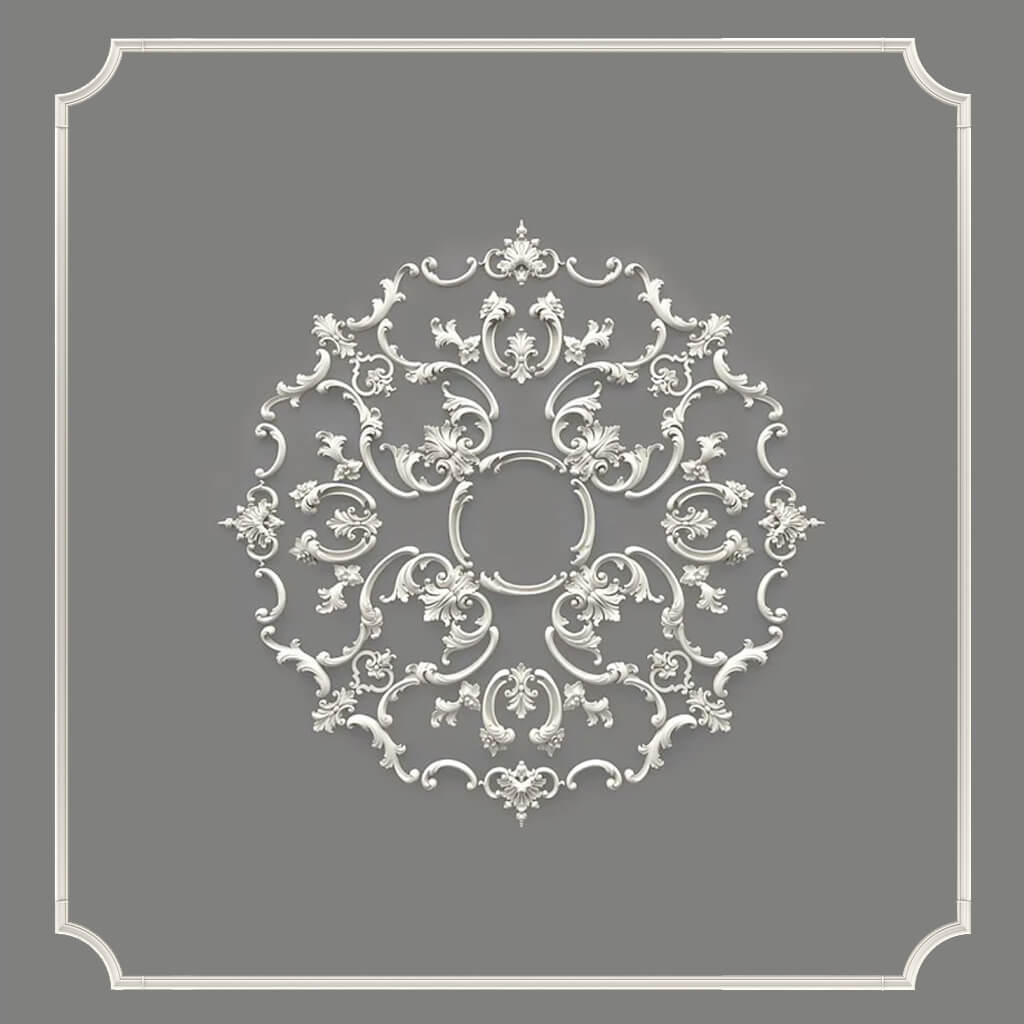
A ceiling rosette is the central element of the ceiling plane, traditionally installed under a chandelier or light fixture. In modern interiors, it does not necessarily carry a functional load but always creates a visual focal point on the ceiling.
For designers, a ceiling rosette is a way to:
-
anchor the point of light in the space;
-
create an accent node on the ceiling;
-
add an ornamental element where the cornice and moldings work with the perimeter.
Wall decor
Wall-mountedPolyurethane wall decor— a broad category that includes ornamental overlays, medallions, corner elements, frames, decorative panels, pilasters, and niche inserts. All of these are tools for creating expressive accent zones and giving a flat wall volume and layering.
In projects that require additional visual weight — for example, in a bedroom with an accent headboard, in a living room with a TV wall, or in a hallway with a mirror niche — wall decor works as a structural element, not just an ornament.
Ceiling decor
Ceiling decor is not just cornices and rosettes. In complex classical and neoclassical projects, the ceiling receives a full-fledged solution: moldings, borders, coffers, medallions, corner inserts. Each of these elements requires thoughtful selection and precise scaling to the specific room.
How to choose decor to match the project style
One of the most frequent questions a designer faces when choosing architectural decor is how not to make a mistake with the style. A decorative element should not just be beautiful in itself: it must organically exist within the stylistic solution that the project builds.
For a modern interior
Modern interior is about clean lines, restraint, functionality. Architectural decor here does not disappear but becomes geometric and concise. Moldings with minimal profile, straight cornices without ornaments, flat baseboards with a sharp edge — all of this works to create a sense of precision and control over space.
At the same time, decor in a modern interior should not 'shout.' It should clarify, structure, add depth — not drawing attention to itself, but directing the eye where the designer needs it.
For neoclassical style
Neoclassicism is a style in which classical forms are reinterpreted towards greater lightness and contemporary relevance. Here, decorative elements can already be more expressive: moldings with soft relief, cornices with a small ornamental band, ceiling rosettes with a delicate pattern.
The selection principle for neoclassicism: the form is classical, the scale is moderate. The decor should be read as a hint at tradition, not as its literal reproduction.
For a classic interior
In classic style, decor can be rich and multi-layered. Here, cornices with ornamental bands, ceiling rosettes with elaborate patterns, moldings with antique profiles, and wall panels with decorative medallions are appropriate. Polyurethane stucco for classic projects is a tool for creating atmosphere that works through detailing and ornamental richness.
It's important to remember: in classic style, decor is systematic. You cannot install a rich cornice and simplify the baseboard to a basic profile—this creates a sense of incompleteness. The system must be coordinated at all levels.
For commercial spaces
Restaurants, hotels, showrooms, and representative-class offices are spaces where architectural decor performs an important image function. Here, stylistic accuracy is not as crucial as expressiveness and scale.
Polyurethane moldings, cornices, and baseboardsIn commercial interiors, decor elements are often used on a larger scale than in residential projects—because spaces are larger, room heights are greater, and the task of making an impression is explicit.
For restrained minimalist solutions
Minimalism does not mean abandoning decor. It means abandoning the superfluous. One horizontal molding dividing a wall into two parts with different textures—that is minimalist decor. A straight baseboard of significant height with clear geometry—that is also minimalist decor. The main principle: every element must be justified, and it must do something specific to the space.
How to choose decor for a room's purpose
Style is just one of the criteria. The function of the room is no less important. A designer choosing decor always works in two coordinates simultaneously: 'what style is this' and 'what kind of room is this'.
Living Room
The main room in a residential interior, where decor works to its maximum potential. Here, the following are appropriate: a cornice around the perimeter, wall molding panels, a ceiling rosette for the main light fixture, decorative accents on the TV wall or in the fireplace area.
The living room is a place where the designer can 'allow' the decor to be noticeable. The main thing is to build it into a system, not to assemble disparate elements.
Bedroom
The bedroom requires a more restrained approach. The accent is the headboard: a molding frame or decorative panel behind the bed, possibly a ceiling accent above the rest area. A cornice around the perimeter is appropriate, but a thinner profile than in the living room is preferable.
In the bedroom, decor should create a sense of coziness and tranquility, not theatrical opulence. The principle is softness, symmetry, moderation.
Entryway
The hallway is the first thing a guest sees. Here, architectural decor works to create a first impression. A cornice under the ceiling, molding on the walls, decorative elements above the mirror or door opening—all this creates a sense of a well-thought-out interior from the first meters.
The hallway is especially important in projects where a 'wow effect' is needed upon entry. A well-chosenPolyurethane Interior Decorationhere gives a quick visual result.
Office
The study is a space that should convey status and intellect. Vertical molding panels, which create a sense of library structure, a cornice with a simple classical profile, and a baseboard of significant height work well here.
Decor in the study should be masculine and clear—without excessive ornamentation, but with a distinct architectural character.
Commercial interior
In restaurants, hotels, boutiques, and showrooms, decor is part of branding. It creates an atmosphere that is memorable and brings customers back. In a commercial project, a designer should not just select decor 'to match the style,' but build a visual narrative with it—creating a sense of a place with character and history.
How to avoid overloading an interior with decorative elements
This is one of the most practical questions every designer works with. Decor is a powerful tool that is easy to apply excessively. And then, instead of architectural expressiveness, you get visual noise.
A few rules that really work in practice:
When molding alone is enough. If the room is low (up to 2.7 m) and the style is restrained — neither a cornice nor a rosette is needed. A horizontal molding at 2/3 of the wall height is sufficient. This creates rhythm without overload.
When only a cornice is needed. In rooms with high ceilings (from 3 m), a perimeter cornice is often self-sufficient — it finishes the wall and defines the character of the space without additional elements on the wall itself. The walls remain 'clean,' and the interior is not overloaded.
When one accent node is enough. In small rooms, bedrooms, minimalist projects — it's often better to make one clear decorative accent (for example, a molding frame behind the bed or a rosette above the table) and not add anything beyond that. A single accent works stronger than several disjointed ones.
How to combine active relief and calm planes. If a cornice with rich ornamentation is chosen — the walls are better left cleaner. If the wall receives molding division — the cornice should be more modest. Two 'loud' elements at the same time — that's conflict, not dialogue.
How to assemble a unified decorative system
The most professional result in working with architectural decor is achieved not when each element is beautiful on its own, but when all elements together form a unified system.
Walls and ceiling in one logic
The profile of the cornice should echo the profile of the molding on the wall. They don't have to be identical, but they should belong to the same visual language. The depth of relief, the character of curves, the 'heaviness' or 'lightness' of the form — all this should be coordinated between the horizontal lines of the ceiling and the vertical or framing elements of the walls.
Moldings, cornices, and baseboards as a unified ensemble
Three horizontal interior lines—the cornice at the top, the molding in the middle of the wall, and the baseboard at the bottom—should form a unified ensemble. If they match in the 'mood' of the profile, the interior is perceived as a cohesive architectural object. If they diverge, it creates a feeling that the elements are sourced from different places.
Frames, panels, and niches
Molding frames on walls work well when they create a logical rhythm—equal intervals, coordinated proportions. Frames of different sizes and chaotic placement create anxiety, not rhythm.
Transitions between rooms
A frequently overlooked point: the decor in adjacent rooms should be coordinated. The baseboard in the hallway and the baseboard in the living room don't have to be identical, but they shouldn't create a stylistic break during the transition. A designer builds not separate rooms, but the interior as a unified space.
Common mistakes when choosing decor for a design project
Design experience is largely built on mistakes—one's own and others'. Below are the most common ones, which even experienced professionals encounter.
Overly complex relief in a small room. A rich ornamental cornice or deep molding in a 12–14 sq. m room 'compresses' the space and creates a feeling of claustrophobia. For small rooms, light, thin profiles with minimal depth are needed.
Disproportionate elements. A 5 cm high baseboard in a room with a 3.5 m ceiling and a 20 cm cornice is a lack of proportion. Always correlate the height and scale of each element with the proportions of the space.
Mixing incompatible forms. A Baroque cornice with garlands and minimalist straight-line moldings—this is a conflict of forms that won't work in any interior. The style must be coordinated.
Lack of logic between walls and ceiling. If the ceiling has no decoration while the walls feature rich molding panels, a sense of incompleteness arises: the walls appear 'finished,' but the ceiling hasn't 'grown' to their level. Either decorate both levels with a cohesive logic or focus on just one.
Choosing decor without tying it to the room's function. A common mistake is selecting decor based on a picture rather than the task at hand. An element that looks good in a photo may not work in a specific space due to scale, the room's function, or a mismatch in style.
Wall and ceiling decor: a detailed breakdown
The two largest 'canvases' in an interior—the wall and ceiling—require separate attention. They occupy the greatest visual area and determine how the space as a whole is perceived.
Walls: from frames to accent zones
Working with wall decor is, first and foremost, about working with rhythm. Vertical pilasters divide a long wall into equal sections and create a sense of architectural order. Molding frames are a softer tool: they outline panels but don't impose strict vertical division.
For accent zones—such as a fireplace wall, headboard area, or TV zone—more complex decorative solutions are used: frames with corner rosettes, ornamental overlays, or a combination of molding with a decorative element at the center of the panel.
Polyurethane wall decorThe STAVROS catalog is structured precisely for such tasks—it includes both simple profiles for minimalist solutions and complex ornamental elements for classic and formal interiors.
Ceilings: levels of complexity
Ceiling decor can be:
-
Minimum: one cornice around the perimeter;
-
Medium: a cornice and a central rosette;
-
Complex: cornice, border, coffered structure, corner inserts, central medallion.
The complexity level is chosen based on style, room height, and function. For a classic living room with a high ceiling, a complex ceiling solution will be appropriate and organic. For a modern bedroom with a 2.7 m ceiling, it will be excessive.
An important professional technique: the border on the ceiling does not necessarily have to be right against the wall. A 10–20 cm offset creates additional rhythm and a sense of layering, and also opens up the possibility for hidden lighting in the resulting niche.
Decorative elements by project type: from apartment to showroom
For apartments
In a residential project, the designer usually works within a limited height range — ceilings from 2.6 to 3 m. Here, the scale of the decor is crucial: moderate, proportionate, not 'crushing' the space.
Optimal solutions for an apartment:
-
cornice with a profile of 6–10 cm without deep relief;
-
moldings 2–5 cm wide for creating framed panels;
-
baseboard 8–12 cm high;
-
accent ceiling rosette with a diameter proportionate to the room.
For a country house
A country house typically offers more spatial freedom: high ceilings, large areas, the ability to work on a larger scale. Here, decor can be significantly richer without the risk of overload.
For living rooms in country houses, the following work well: wide cornices with ornamental bands, large ceiling rosettes, wall panels with full-height vertical moldings, decorative consoles and brackets.
For a salon, showroom, office
Commercial spaces are a special topic. Here, decor should work for the brand and the atmosphere. For a jewelry showroom — light neoclassicism with delicate decor, creating a sense of value. For a restaurant — a more emotional solution, possibly with rich Baroque or classical decor. For a representative-class office — strict academicism with an emphasis on proportions.
Decorative elements for an interior projectat STAVROS cover this entire range — from concise profiles for modern commercial interiors to rich ornamental solutions for classical and formal spaces.
For a project with a limited budget
A budget project is no reason to abandon architectural decor. It's a reason to place accents more wisely. One well-thought-out decorative technique is better than several mediocre ones.
Most budget-friendly yet effective solutions:
-
molding frames behind the headboard in the bedroom (minimum material, maximum effect);
-
cornice along the perimeter of one accent wall in the living room;
-
a significantly high baseboard instead of the usual minimal one — it's inexpensive but immediately gives the room a different level.
For a project focused on the wow effect
When the task is to create a sense of luxury and theatricality, decor becomes the main tool. Here, multi-tiered ceiling solutions, rich cornices with ornaments, wall panels with deep relief, decorative consoles, brackets, and medallions work.
The wow effect is achieved not by the quantity of elements, but by their precise scale and correct placement in the space.
How a designer works with the semantics of decor in a project
A professional designer sees an interior not as a set of separate solutions, but as a cohesive visual narrative. In this narrative, decor plays the role of 'punctuation marks' — it sets pauses, accents, transitions.
When molding is placed at a height of 1.2 m from the floor — it creates a visual 'horizon,' dividing the wall into a heavier lower part and a lighter upper part. This is a classic technique that works in any style. When a cornice runs along the ceiling perimeter — it 'closes' the space from above, creating a sense of completeness and coziness.
Working with decor is working with sensations. Not with the beauty of individual elements, but with what emerges when they are assembled together and coordinated with furniture, color, and light.
That is why the selectionof polyurethane decor for interiorsalways begins not with choosing a specific molding or cornice, but with understanding the project's task—style, space, scale, function.
Polyurethane molding: when it is appropriate and how it works
Molding is decor with a history. For centuries, it has been a sign of architectural quality and status. TodayPolyurethane molding for interiorallows using all this visual potential without the limitations imposed by traditional plaster.
Polyurethane molding is organic in:
-
Classical projects—where ornamental decor is part of the stylistic program;
-
Neoclassical—where molding adds 'academicism' without fully immersing in a historical style;
-
Eclectic—where mixing forms and eras is a principle, and molding becomes one of the expressive layers;
-
In commercial interiors—hotels, restaurants, banks, theaters—where stucco creates the atmosphere of a significant place.
An important professional point: stucco should not be 'everywhere.' It works when there is a clear logic to its distribution throughout the space. A ceiling border and rosette are a system. Scattered ornaments across the entire ceiling without logic is chaos.
Where to look for polyurethane decor for a project
When the task is defined, the style is determined, and the scale is calculated—all that remains is to find the right assortment. For this, STAVROS has built a complete product structure by element types:
-
moldings;
-
cornices;
-
baseboards;
-
ceiling rosettes;
-
wall decor;
-
ceiling decor;
-
polyurethane moldings;
-
brackets, capitals, rosettes, trim.
Everything is structured around real design tasks, categorized by application type. A designer can use the catalog as a professional selection tool—choosing elements for a specific project, a particular style, or a given budget.
Full catalogwall and ceiling decor made of polyurethaneis available on the STAVROS website—with photos, dimensions, and categorization. You can also get consultation on selection for a specific project here.
FAQ: Answers to popular questions
What decor do interior designers use most often?
In practice, moldings for creating framed panels, cornices for decorating ceiling transitions, and baseboards are most in demand. In classical and neoclassical projects, ceiling rosettes and ornamental wall elements are added to these.
Why is polyurethane decor suitable for design projects?
Polyurethane combines lightness, precise geometry, moisture resistance, and a wide range of forms from classical to modern. Installation is simple, the surface takes paint well, and the products retain their shape through temperature and humidity fluctuations.
What to choose for walls: moldings or ready-made decorative elements?
Moldings — for creating linear rhythm, frames, and articulation. Ready-made decorative elements (overlays, medallions, ornaments) — for accent zones where additional visual weight is needed.
When is a cornice needed in an interior, and when can you do without it?
A cornice is needed when it is necessary to complete the vertical solution of a wall, conceal irregularities in the transition to the ceiling, or create the possibility for hidden lighting. It can be omitted in minimalist interiors with clean planes or in small rooms with low ceilings.
How to choose decor for a modern interior?
For a modern interior, choose moldings and cornices with a straight or minimally curved profile, without ornaments. The key principle is the conciseness of form with clear geometry.
Is polyurethane stucco suitable for commercial premises?
Yes, polyurethane stucco is widely used in restaurants, hotels, stores, and representative offices. The material is resistant to mechanical damage and humidity, which is important for public spaces.
Can polyurethane decor be used in rooms with humidity?
Yes. Polyurethane is moisture-resistant, making it applicable in bathrooms, toilets, kitchens, and other rooms with high humidity.
How not to overload the interior with decorative elements?
Consider the scale of the room and ceiling height. The smaller the space, the thinner and more concise the profiles should be. Avoid combining an ornate cornice and complex wall panels in a small room. The principle is one 'loud' element with the others in supporting roles.
What pairs best together: moldings, baseboards, or cornices?
Optimally, all three elements should be from the same collection or have profiles of a similar character. The cornice forms the top line, the molding the middle, and the baseboard the bottom. Together they create an architectural 'frame' for the interior.
Where can I view the range of polyurethane decor for a project?
In the STAVROS catalog — the full rangeof polyurethane moldings, cornices, and baseboardscategorized with photos and dimensions for professional project selection.