
































































Article Contents:
- Why white in finishing is more complicated than it seems
- Anatomy of white: what types of white exist and why it matters
- Cool white — warm white
- Degree of gloss
- Three 'white systems' for interiors
- Where white slatted panels work best
- Living room with insufficient natural light
- Bedroom: monochrome tranquility
- Children's room: white as a neutral backdrop for vibrant content
- Hallway: the first impression in white
- Study: white and concentration
- How ceiling molding makes a white interior expressive, not empty
- Three architectural roles of white molding
- What molding works in a white interior
- Play of light, shadow, and texture in a white interior
- Daylight in a white space with slats
- Artificial light: three scenarios
- Texture in white: why the same tone is not the same surface
- Combination of white slatted panels and moldings with other materials
- Wood in white interiors: warmth as contrast
- Brass and matte gold: an architectural touch of luxury
- Natural stone: marble and travertine
- Textiles: texture and softness
- Black as a point contrast
- Technical parameters: white MDF slats for walls
- MDF type: standard vs moisture-resistant
- Type of finish
- Geometry: tolerance is not an abstraction
- Dimensions for white slatted systems
- Technical parameters: polyurethane ceiling molding
- Quality PU: criteria
- Cornice for white interior: size chart
- Painting molding white — technology
- Schemes "white interior with slats and molding" for different rooms
- Scheme 1: "Scandinavian minimalism" — bedroom
- Scheme 2: "Warm white with brass" — living room
- Scheme 3: "White neoclassicism" — hall with high ceiling (3.0+ m)
- Scheme 4: "Children's room in white" — neutral base
- Main mistakes of white interiors with slatted panels and molding
- Mistake 1: Mixing cool and warm white
- Mistake 2: Different levels of sheen on different elements
- Mistake 3: Cornice without primer 'peels off'
- Mistake 4: White slats without accent lighting
- Mistake 5: Too wide a gap in white slats
- Mistake 6: Missing bottom finishing element
- Mistake 7: Outlet 'not to scale'
- FAQ: white slatted panels and ceiling molding
- About the Company STAVROS

A white interior is not just a color scheme. It's a philosophy. And like any philosophy, it easily turns into a caricature of itself: instead of thoughtful minimalism — hospital sterility; instead of air and light — emptiness without character. White that is 'nothing'.
Between these two states lies an abyss. And it is in this abyss that the main question of a white interior lives: how to make a light space expressive, not just light?
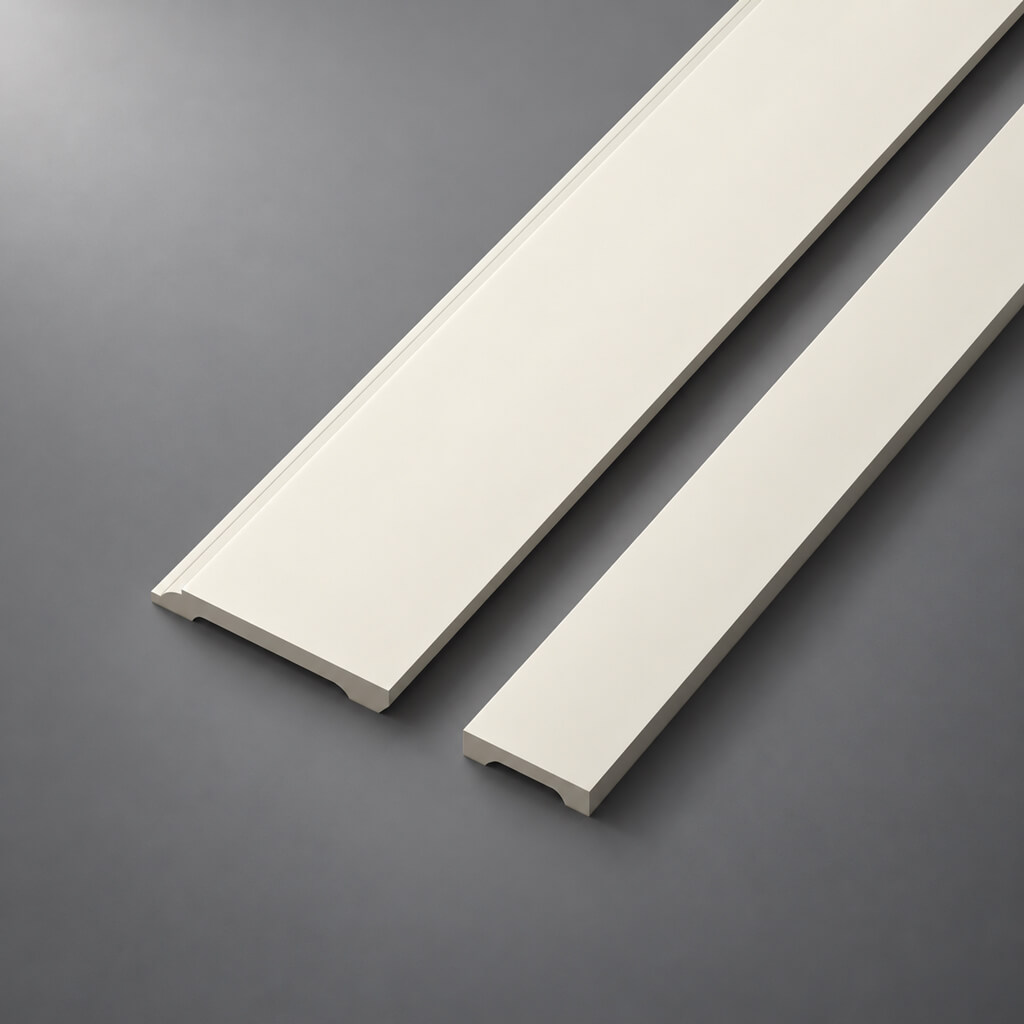
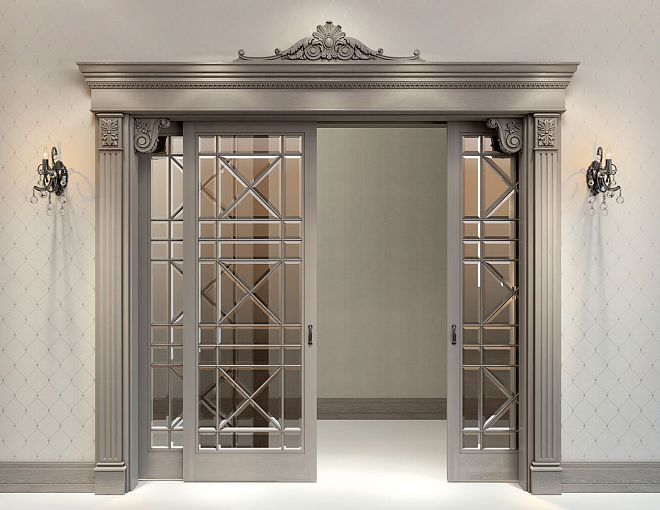
A white slatted wall panel is not a neutral background. It is an architectural surface with rhythm, depth, and chiaroscuro. Polyurethane ceiling molding is not a 'top' decoration. It is a system that organizes the ceiling plane, connects it with the walls, and endows the interior with scale. Together, they create a bright space with something to read, something for the eye to linger on, something to feel tactilely.
This is precisely what the article is dedicated to—how white becomes expressive.





Why white in finishing is more complex than it seems
Ask any experienced designer this question—and they will smile. Because they know: a white interior is one of the most demanding.
A dark space forgives inaccuracies. Deep blue or anthracite conceals unevenness, masks details, and holds the gaze on itself, not letting it wander to the minutiae. White exposes everything. An uneven seam, a careless molding joint, a geometric imperfection in a slat—in a white space, this is visible.
But this is only a technical complexity. There is a deeper one.
White without relief is emptiness. A smooth white wall, a white ceiling, a white floor—this is not an interior, it is a room in a state awaiting renovation. The color white does not carry character within itself—it reveals character through form, relief, and shadow.
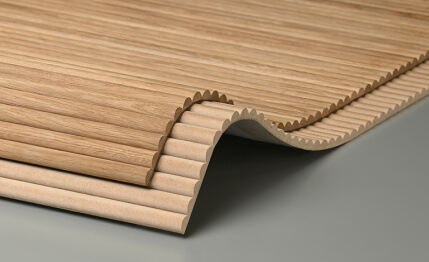
Exactly thereforewhite slatted wall panel—is a fundamentally different solution than a white painted wall. Slats create relief. Relief in white creates shadows—subtle, delicate, changing with the lighting. The wall ceases to be a plane—it becomes a surface with rhythm.
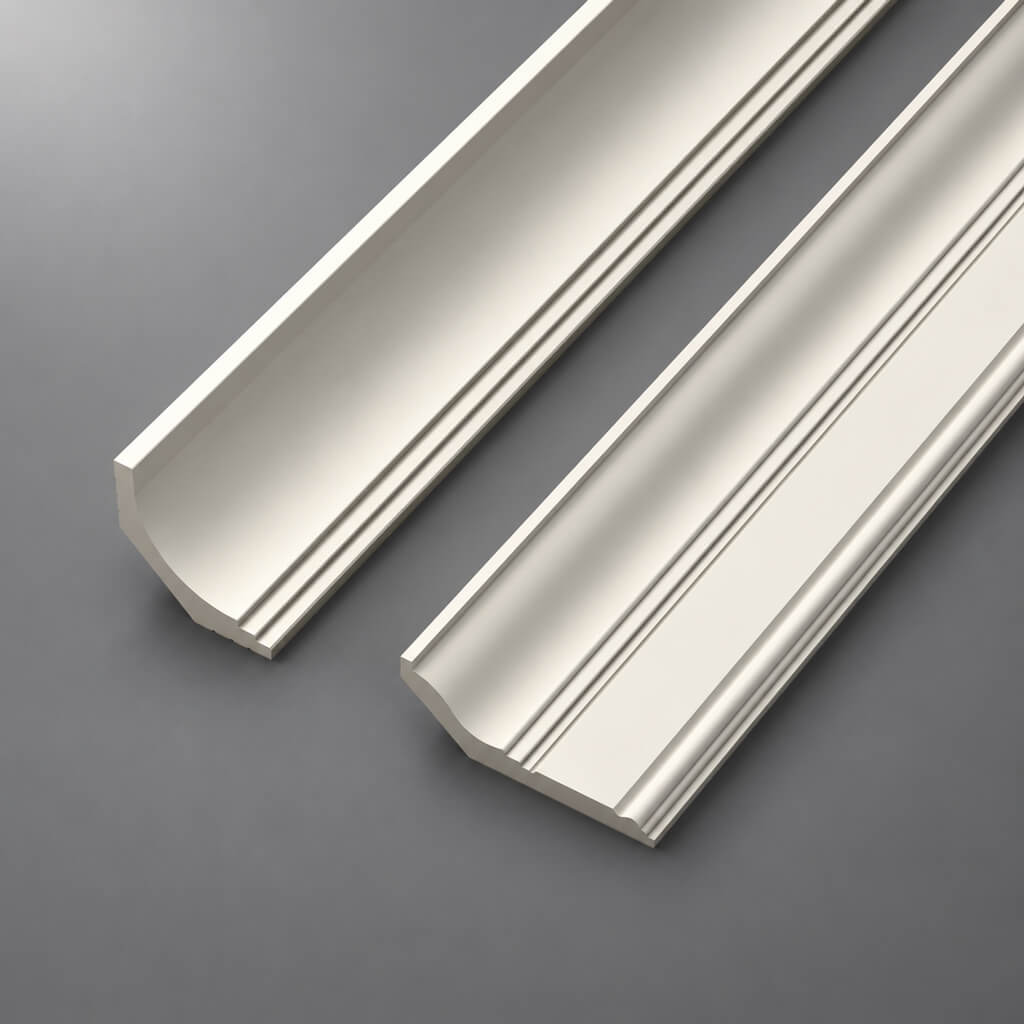
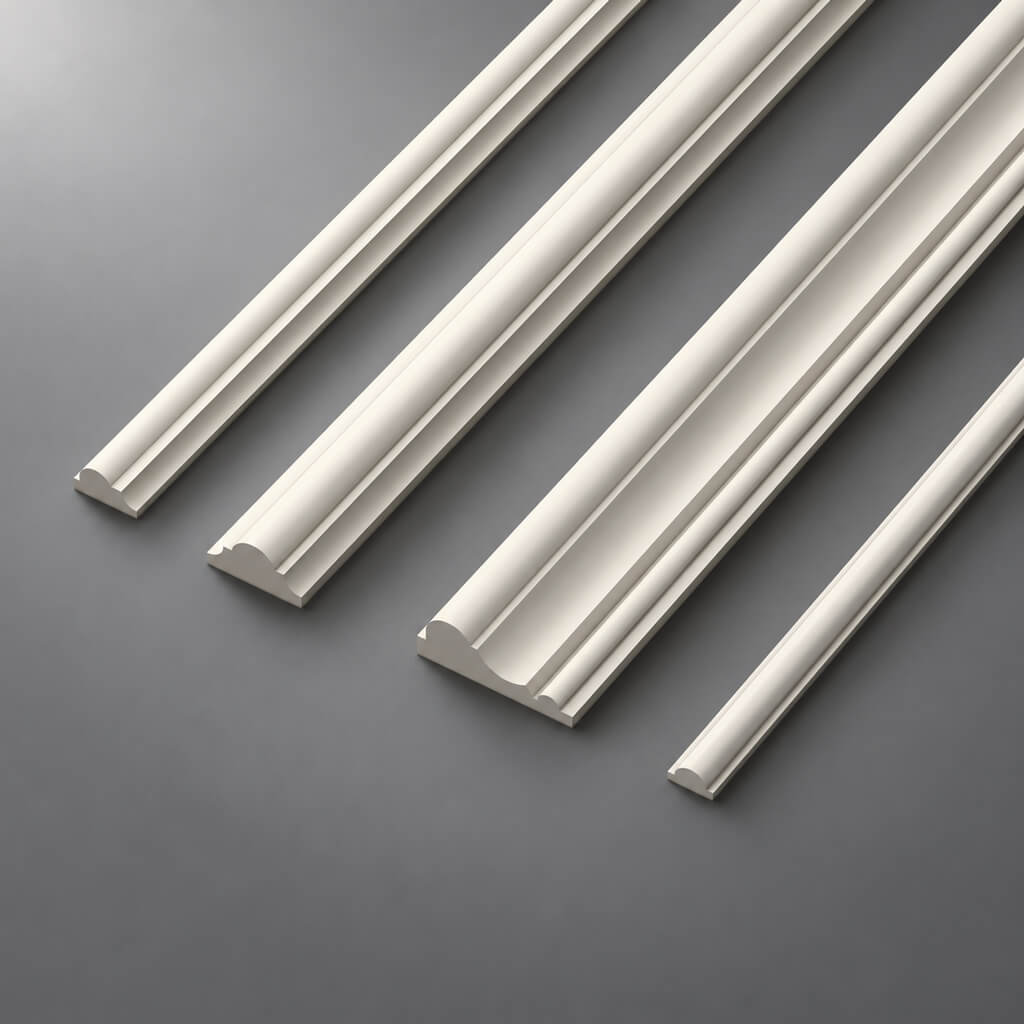
The same is done byPolyurethane Ceiling Moldings: cornice, rosette, moldings on the ceiling—all white, all in a common 'field,' but each element casts its own shadow, its own relief trace. The ceiling ceases to be the 'fifth smooth forgotten element' and becomes part of the architecture.
White in skilled hands is not an absence, but a presence of form.




The Anatomy of White: What Kinds of White Exist and Why It Matters
Before discussing how to use white slatted panels and moldings, it's necessary to understand white itself. It's not one color—it's a family, within which conflict is just as possible as between blue and green.
Our factory also produces:





Cool White — Warm White
Cool white contains blue and gray shades: RAL 9016 (pure white), RAL 9003 (signal white), NCS S 0502-B (cool neutral). It is associated with modernity, minimalism, and technological feel.
Warm white contains yellow, beige, cream shades: RAL 9010 (pure white with a warm tint), RAL 9001 (creamy white), NCS S 0804-Y20R (warm neutral). It is associated with coziness, naturalness, and classic interiors.
The main rule: all white elements in one space must belong to the same 'temperature' family. A coolwhite slatted panelnext to a warm white cornice is a visible clash of tones that looks like a mistake.
Get Consultation
Degree of Gloss
Glossy white — reflects light, reads as 'expensive' and modern, but merciless to scratches.
Satin white — soft sheen, a compromise: visually cleaner than matte, but more practical than glossy.
Matte white — absorbs light, velvety effect, hides minor scratches. Most popular for white slatted structures.
Forwhite slatted wall panelmatte or satin finish is recommended: matte emphasizes shadows in gaps, makes the relief more pronounced.
For ceiling molding: the same level of sheen as the ceiling. If the ceiling is matte — molding is matte. If satin — molding is satin. Mismatch in sheen between molding and ceiling is one of the most common installer mistakes.
Three 'white systems' for interiors
| System | Tone of slats | Stucco tone | Wall tone | Mood |
|---|---|---|---|---|
| Pure white | RAL 9003 | RAL 9003 | RAL 9003–9016 | Clinically clean, modern |
| Warm white | RAL 9010 | RAL 9010 | RAL 9001 | Cozy, natural |
| Monochrome with an accent | RAL 9003 | RAL 9003 | RAL 9003 + accent wood tone | Modern with a warm accent |
Where white slatted panels work best
white slatted paneldoes not work equally well in all rooms. There are spaces where this solution shines to its full potential, and situations where it gets lost.
Living room with insufficient natural light
Paradox: white slats are especially good precisely in rooms with few windows or northern orientation. Why? Because the matte white surface with relief softly diffuses even scarce daylight—the wall 'glows' from within, rather than 'absorbing' rays. A smooth white wall in these conditions looks flat and lifeless. A white slatted wall—voluminous and lively.
Bedroom: monochrome tranquility
Bedroom — a space where white works to its full potential.White wall slat panelBehind the headboard, combined with a white cornice and white walls, it creates a 'safe' monochrome environment where the brain receives no color signals—only texture and light. This is quality visual calm.
The effect is enhanced when illuminated by sconces from the sides of the bed: side lighting creates shadows in the gaps of the slatted wall—at 10 PM, it's dark outside, and the slats 'come alive'.
Children's room: white as a neutral background for bright content
In a children's room, a space with white walls follows the gallery principle: a neutral background against which toys, drawings, and textiles stand out with maximum brightness. A white slatted wall adds texture to the neutrality. But most importantly: the children's room grows with the child, and a white interior 'accepts' any new color that appears in the space.
Hallway: first impression in white
A white slatted wall in the hallway is unexpected. In a space traditionally finished 'practically' (tiles, durable wallpaper), white slats create a feeling that you are entering a consciously designed home. Not just renovated—but thoughtfully planned.
Requirement: MR class (moisture-resistant) MDF with two-component coating. A hallway with an entrance door is a humidity zone. Standard MDF risks swelling here.
Study: white and concentration
A white study is a non-trivial solution. Traditionally, studies are made dark: dark wood, deep tones. But a white study is a space where thought is not 'weighed down' by a dark setting. A white slatted wall behind the workspace + a white cornice + accents like wooden shelves or brass lamps—and this is an interior where thinking happens.
How ceiling molding makes a white interior not empty, but expressive
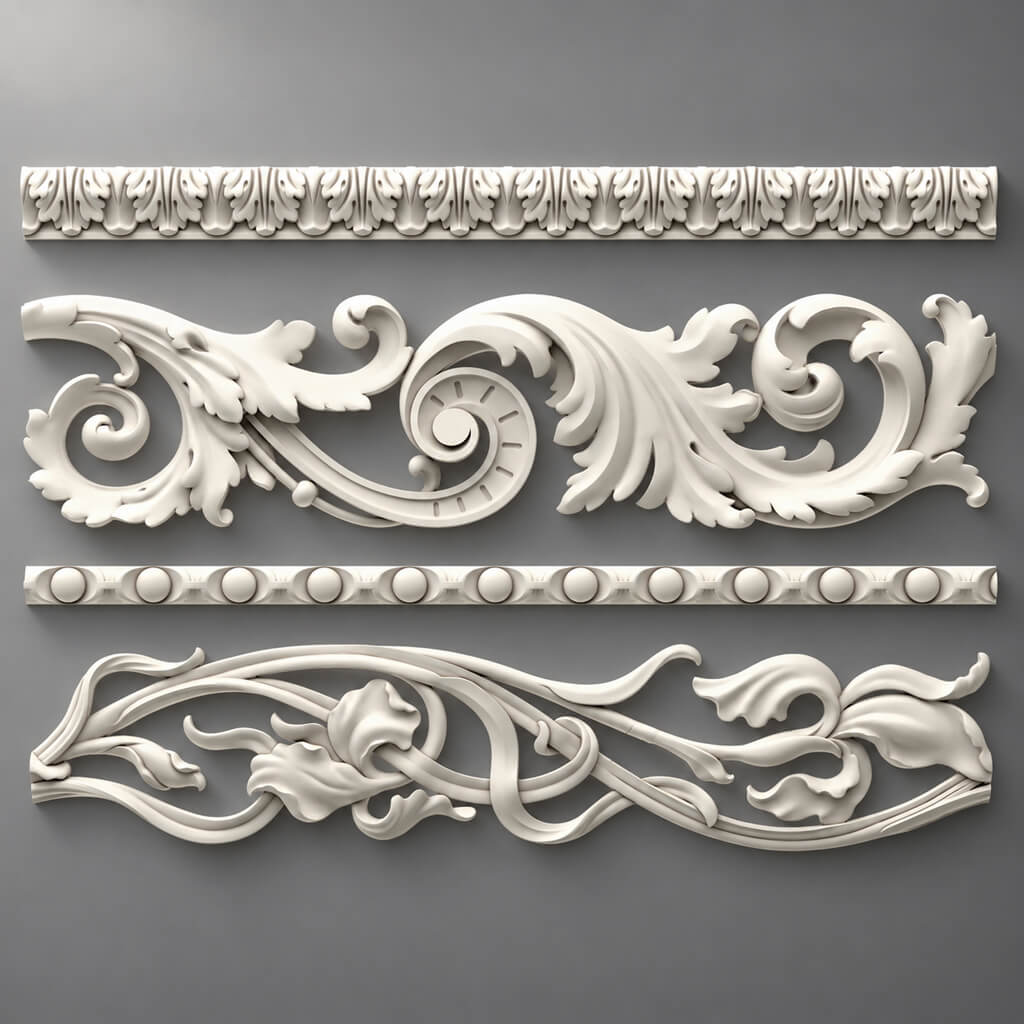
Let's return to the main question: what saves white from emptiness? Relief. AndPolyurethane Ceiling Moldings— this is relief in the most 'forgotten' plane of the apartment.
The ceiling occupies a huge area. In an 18 m² room, the ceiling is 18 square meters of visual space. If this ceiling is a perfectly smooth white plane, it simply does not exist in perception: the gaze does not 'read' it, it slips past. The space loses its upper architectural boundary.
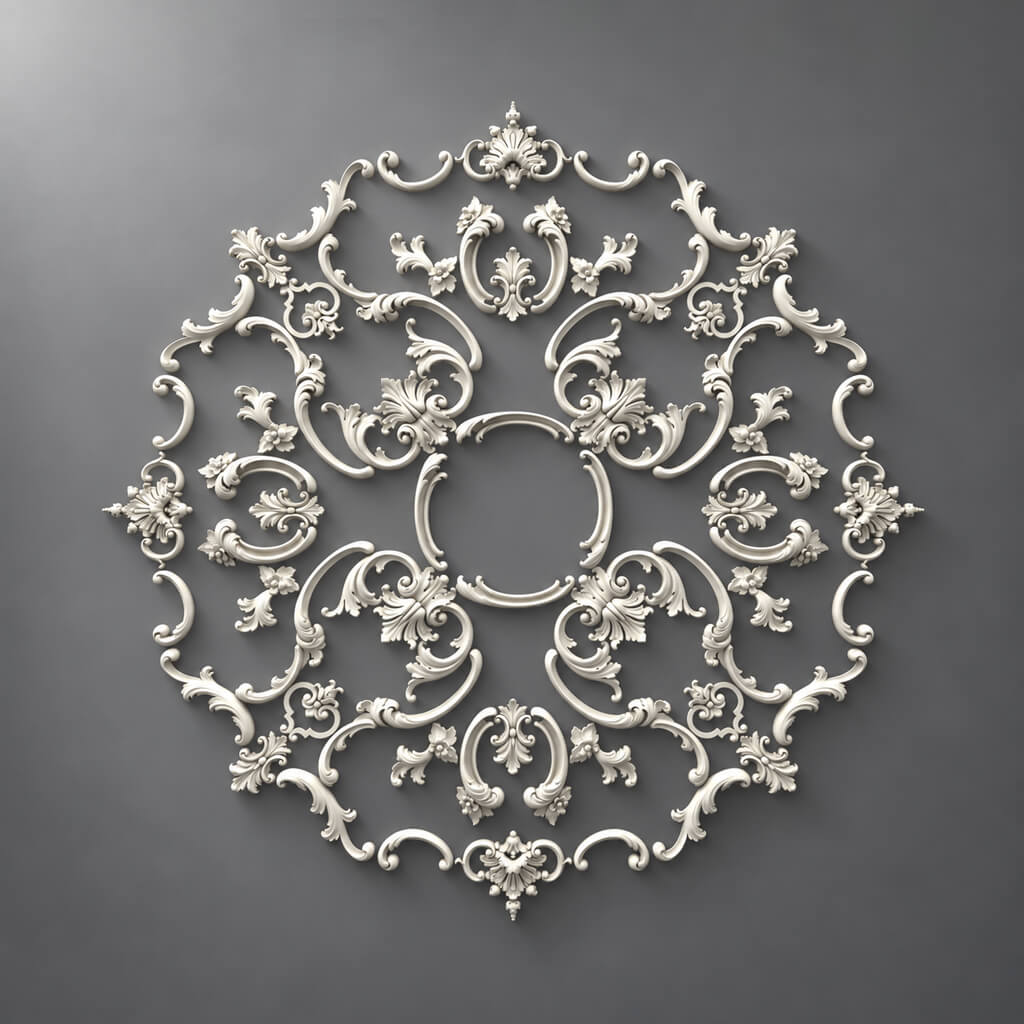
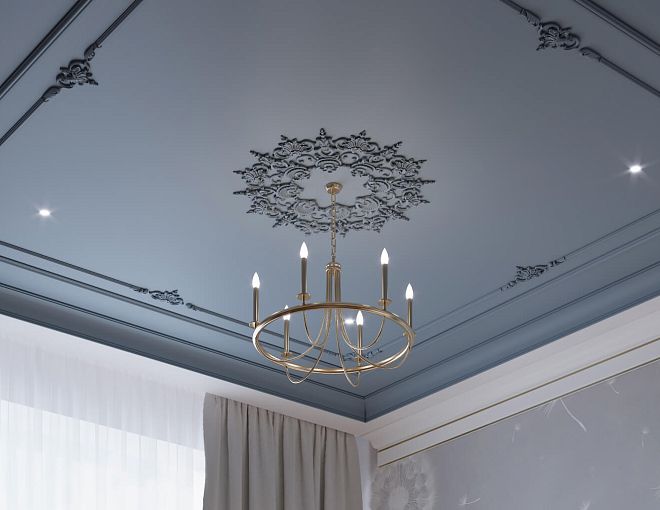
Ceiling moldingin a white interior works precisely as 'creating a ceiling': the cornice separates it from the walls, the rosette organizes around the center, moldings break it into zones. The ceiling begins to exist.
Three architectural roles of white molding
Role 1: Creating scale. The ceiling cornice is a horizontal 'belt' by which the eye instantly determines the height of the room. Without a cornice, the wall and ceiling merge—the height of the room is 'lost.' With a cornice—it is clearly readable.
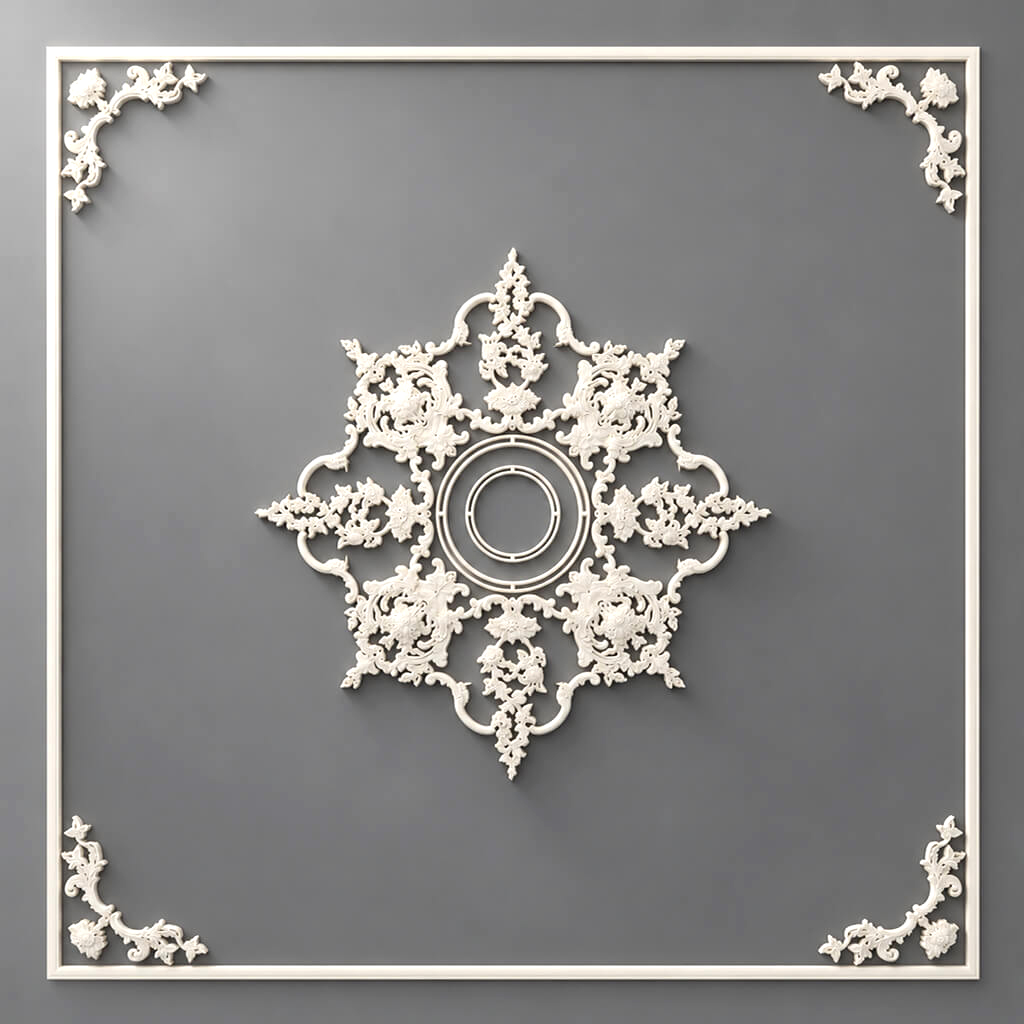
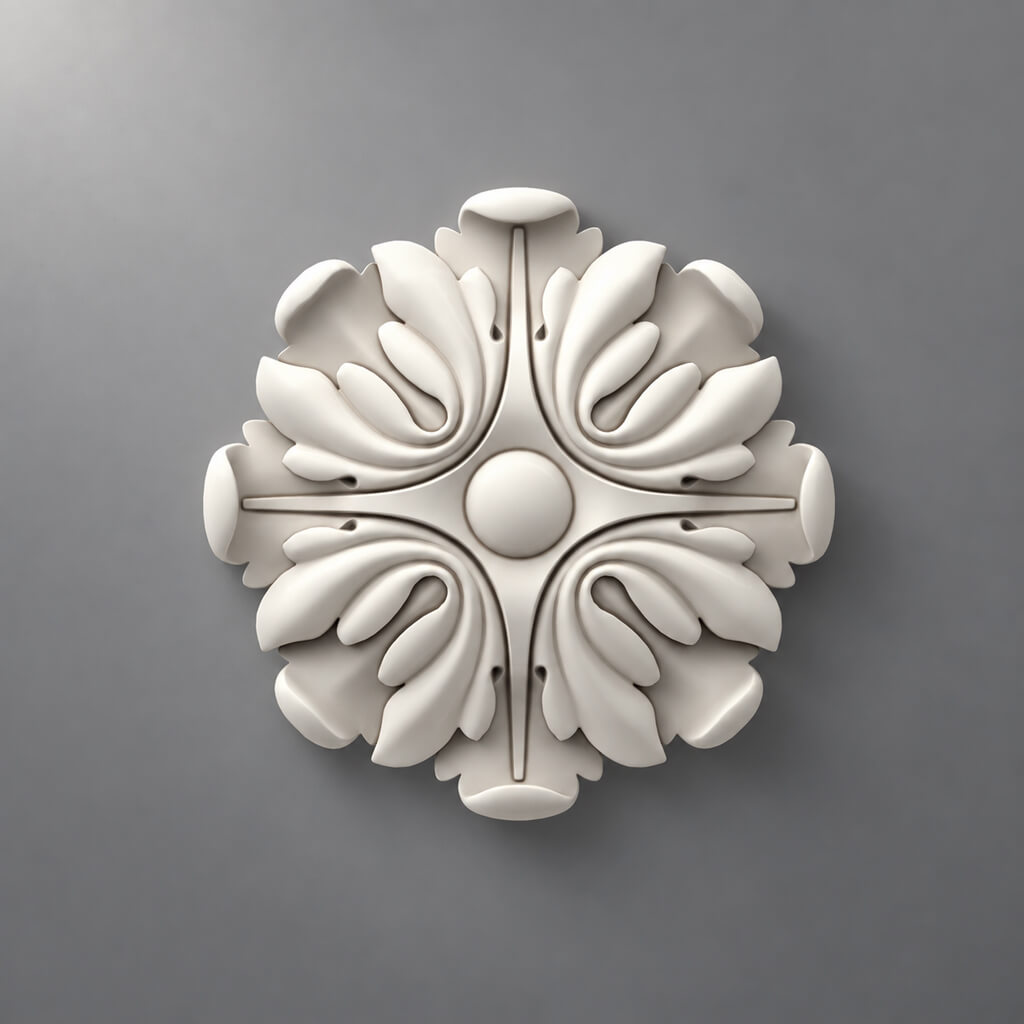
Role 2: Creating a center. The ceiling rosette is a focal point on the ceiling. The gaze, rising to the ceiling, finds a point and returns. The space gains an 'axis.'
Role 3: Creating a hierarchy of zones. Moldings on the ceiling break it into zones—a 'coffer' marks the living area in an open plan, separating it from the kitchen or dining area. Without physical separation—architectural zoning.
What molding works in a white interior
The answer depends on the style:
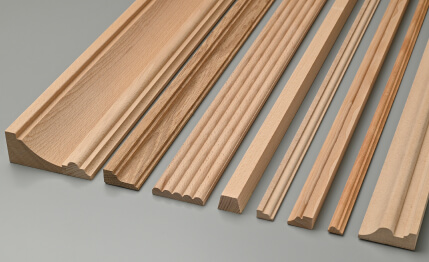
Minimalism and modern classic: smooth cornice 50–80 mm without ornament. Rosette 180–280 mm with geometric or minimal relief. No acanthus, no complex profiles.Decorative stuccoIn this case, it's pure geometry.
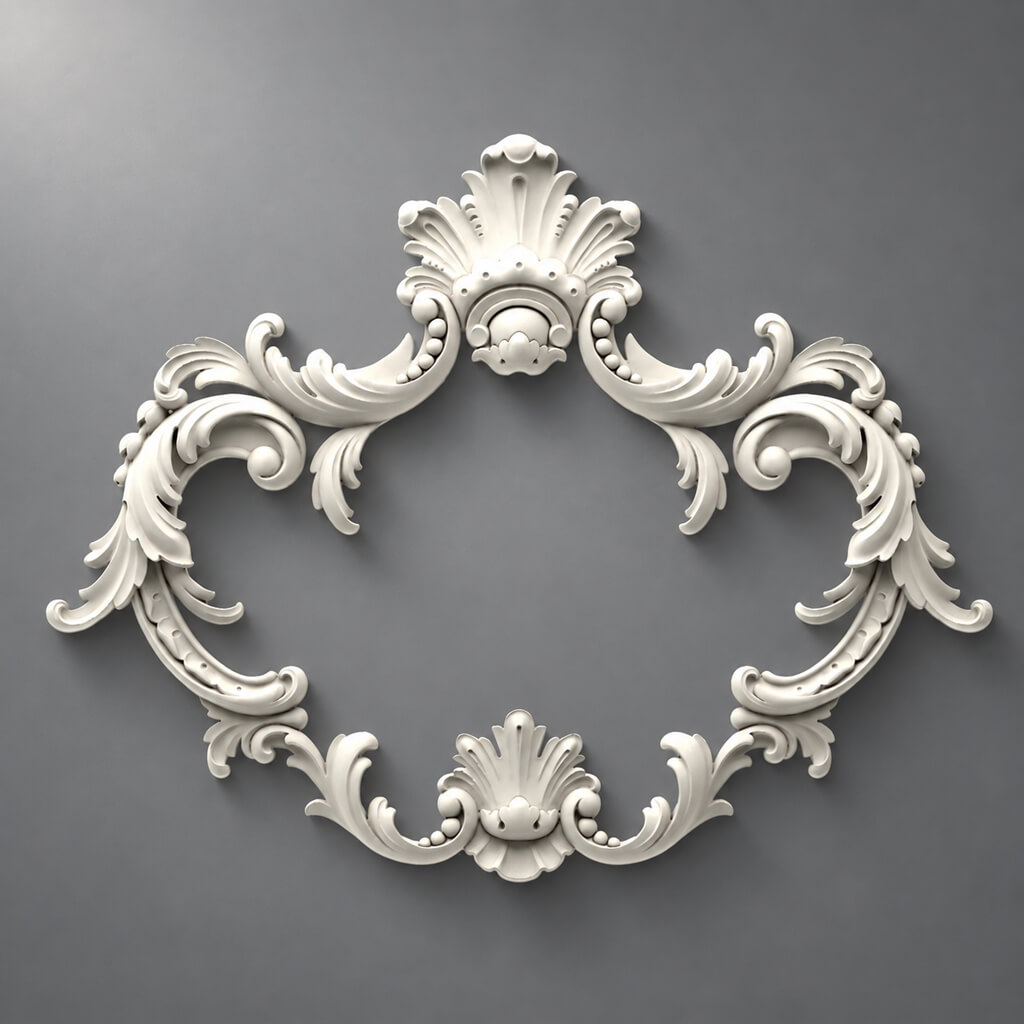
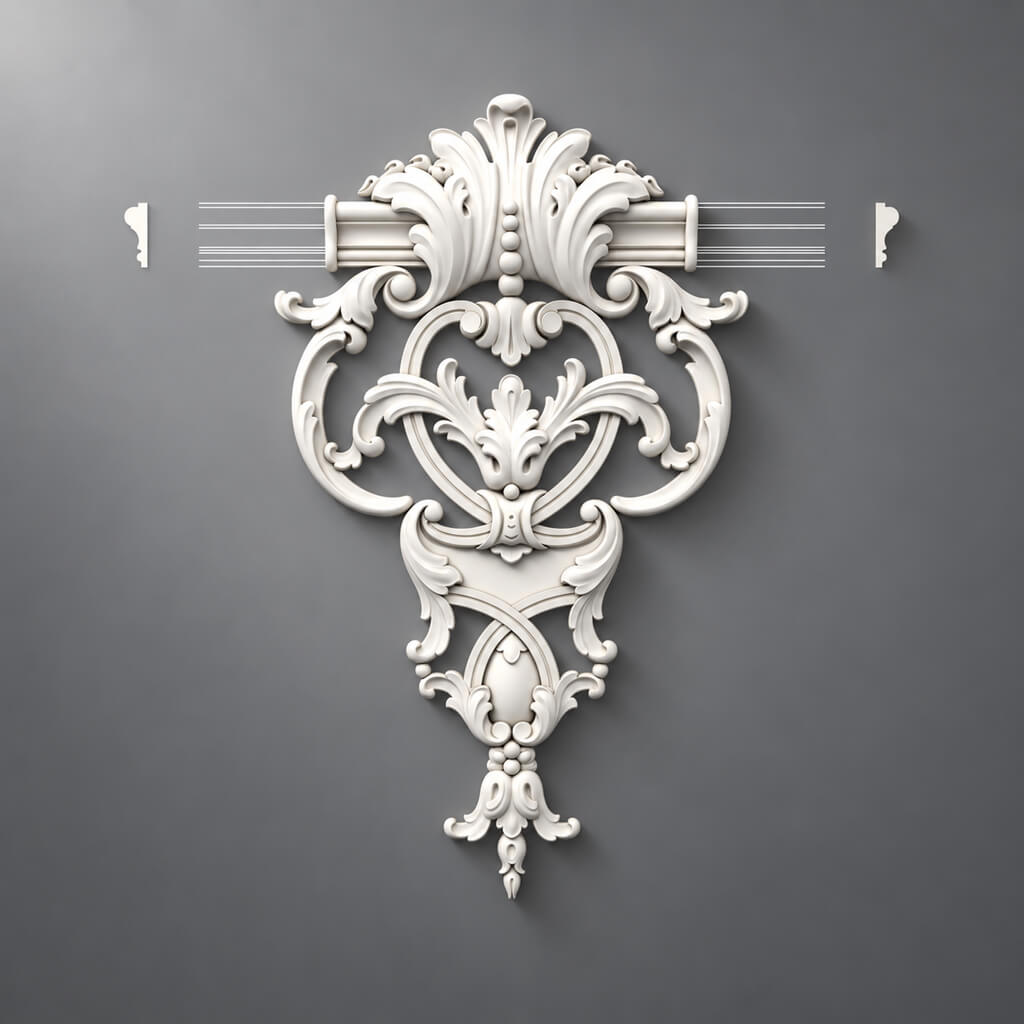
Neoclassicism: cornice 80–120 mm with a classic profile — ovolo, fillet, cyma. Rosette 300–450 mm with ornament (leaves, egg-and-dart, ionic). Molded coffers.
Scandinavian style: only smooth cornice 45–60 mm. No other elements. Laconicism as a principle.
Art Deco: geometric cornice with rectangular shelves. Molded frames on the ceiling in the form of rectangles. Rosette with geometric ornament.
Play of light, shadow, and texture in a white interior
A white interior is work with light. Without understanding how light interacts with a white surface, it is impossible to create an expressive white space.
Daylight in a white space with slats
Natural light falling at an angle to a slatted wall creates subtle vertical shadows behind each slat. Morning sun from the east — one type of shadows. Daytime diffused light — another. Evening lighting — a third.
A white slatted wall in daylight is a living, changing surface. Not a static picture, but kinetic architecture.
Enhancing the effect: beveled or chamfered slats. A side cut of the slat at a 15–30° angle creates an additional plane — the shadow becomes more pronounced, the relief deeper.
Artificial light: three scenarios
Scenario 1: Accent light at a 30–40° angle. Spotlights or track lights directed at the slatted wall at an angle. Each slat casts a thin shadow — the wall becomes 'woven,' the relief is maximized. Color temperature: 2700–3000 K for warm white, 3000–4000 K for cool.
Scenario 2: Indirect light behind a cornice. LED strip on the rear shelf of the ceilingpolyurethane decor: light is directed towards the ceiling. The ceiling glows evenly, without a visible source. Moldings are silhouetted in soft backlight. For a white interior: the effect of a 'floating' ceiling.
Scenario 3: Integrated light in the slatted structure. LED strip on the load-bearing profile near the top edge of the structure. Light filters through the gaps or is directed towards the ceiling. White slats in oblique light — an abstraction: lines and the space between them.
Texture in white: why the same tone is not the same surface
In a white monochrome space, texture becomes the only 'language' of distinction. MDF with 2K matte coating, polyurethane cornice with matte paint, drywall ceiling with matte whitewash — three fundamentally different textures with the same tone.
MDF: perfectly smooth, technically 'cool' to the touch. Polyurethane: slightly resilient, fine-porous texture upon close inspection. Drywall with paint: slightly grainy.
This difference in textures within a unified tone creates richness in white space. This is 'complex whiteness'—what distinguishes a professionally designed interior from one simply 'painted all white'.
Combination of white slatted panels and molding with other materials
A white interior with slatted panels and molding is the foundation. The accents that 'activate' this foundation are materials introduced in a targeted and deliberate manner.
Wood in a white interior: warmth as contrast
This is the most organic combination. White slats + wooden shelves, wooden floor, wooden furniture. Wood 'responds' to white with warm contrast—not color contrast, but temperature contrast.
Principle: wood should be of one species (or very close tones). A chaotic mix of oak, pine, birch, and walnut in a white interior is a 'firewood shed,' not a natural accent.
The most expressive combination: white slats + oak parquet in 'natural' or 'honey' tone + an unfinished wooden dining table.
Brass and matte gold: an architectural note of luxury
White + brass is one of the most 'foolproof' designer techniques. Brass lighting fixtures, door handles, plumbing accents. In a white space with slatted panels and white molding, even a single brass pendant light over the dining table changes everything: the space stops being 'cold-minimalist' and becomes warm and elegant.
Important nuance: matte brass is preferable to polished. Polished brass 'reflects' everything around—in a white space, this can create 'mirror spots.' Matte absorbs light—nobly and calmly.
Natural stone: marble and travertine
White marble with gray veins + white slatted panels — monochrome luxury. Marble carries a natural pattern that 'enlivens' a white space differently than wood: not with warmth, but with pattern complexity.
Travertine — a more 'earthy' stone with warm tones — in a white interior acts as a link between cold whiteness and warm wood. An excellent choice for windowsills, countertops, fireplace cladding.
Textiles: texture and softness
Linen, cotton, waffle fabric, jute — natural textiles in white or neutral tones. Dense curtains matching the wall color 'dissolve' the window opening, making the wall continuous. A soft sofa covering matching the slats — the sofa 'fits' into the architecture.
Textiles in a contrasting color (deep blue, dark green) — this is an accent that 'activates' the white space. Two sofa cushions are enough.
Black as a point contrast
One or two black elements in a white interior — this is not a violation of the concept, but its completion. A black mirror frame, black coffee table legs, a black light fixture. A white space 'needs' a black point just as a white page needs text.
Don't overdo it: three black elements are 'three points' organizing the gaze. Ten black elements are chaos.
Technical parameters: white MDF slats for the wall
Let's move on to specific technical parameters. Because 'white slatted panel' is not a single product, but an entire family with fundamental differences.
MDF Type: Standard vs. Moisture-Resistant
For a white slatted wall in dry living areas (living room, bedroom, study): E1 MDF, standard class. For the hallway, kitchen dining area: MR E1 MDF (moisture-resistant, green edge when cut).
Type of finish
Two-component polyurethane varnish (2K): hardness 2H on the pencil scale. Resistant to scratches, household chemicals, moisture. The only choice for white panels in the hallway and children's room.
Water-dispersed acrylic enamel: softer, eco-friendly (solvent-free). For the bedroom and children's room — the optimal choice for eco-friendliness. Hardness HB–B — requires careful handling in high-traffic areas.
MDF for painting: primed without a topcoat. Painted on-site to an exact RAL shade. The only way to achieve a perfect color match between slats, moldings, and walls.
Painted MDF plank panels— detailed breakdown of the technology: which primer, which paint, how to achieve the perfect shade.
Geometry: Tolerance is not an abstraction
White slats 'forgive' geometric inaccuracies less than dark ones. On a dark wall, an uneven 2–3 mm gap is hard to notice. On a white one — it's immediately visible because the shadows in the gaps are sharp and the rhythm uniformity is instantly perceived.
Requirement for white slatted constructions: slat width tolerance ±0.1–0.2 mm (CNC milling). Geometric precision is not an advantage, but a mandatory requirement.
Sizes for white slat systems
| Parameter | For minimalism | For modern classic | For neoclassicism |
|---|---|---|---|
| Slat width (mm) | 35–45 | 45–60 | 55–80 |
| Gap (mm) | 10–12 | 12–16 | 14–18 |
| Slat thickness (mm) | 16–18 | 18–20 | 18–22 |
| Coating type | Matte acrylic | 2K matte | 2K satin |
Technical parameters: polyurethane ceiling molding
Polyurethane Ceiling MoldingsIn a white interior, this is an element that has special requirements. In a white space, every defect is visible.
Quality PU: criteria
-
Density: 300–450 kg/m³. Check — does not deform when pressed with a finger.
-
Relief: sharp, clear edges of the ornament. Blurriness is a sign of a worn-out mold.
-
Geometry of the back side: fits flush to the joint without gaps.
-
Length: 2.0 m standard. Joints on one side of the room should align in height.
-
Tone: factory white, ready for painting.
Cornice for white interior: size chart
| Ceiling Height | Style | Cornice height (mm) | Profile type |
|---|---|---|---|
| 2.5 m | Minimalism | 40–52 | smooth |
| 2.7 m | Scandinavian | 50–60 | smooth |
| 2.7 m | Modern Classic | 65–80 | Profile without ornament |
| 2.8–3.0 m | Neoclassical | 80–110 | Classic with profile |
| 3.0–3.5 m | Expanded neoclassicism | 100–145 | Ornamental |
Painting stucco white — technology
-
Degreasing (isopropyl alcohol, not solvents)
-
PU primer thin layer — curing 2–4 hours
-
First layer of acrylic paint — curing 2–3 hours
-
Second layer of acrylic paint — finish
Paint type: acrylic water-based or acrylic enamel. Not alkyd — alkyd on polyurethane "does not adhere" properly.
Schemes "white interior with battens and stucco" for different rooms
Scheme 1: "Scandinavian Minimalism" — Bedroom
Slatted wall behind the headboard: 40 mm slats, 10 mm gap, matte white (RAL 9003). Height from floor to ceiling.
Cornice around the perimeter: 50 mm, smooth, same tone. No sockets — minimalism.
Ceiling: white matte. Walls: same RAL 9003. Floor: natural oak.
Textiles: linen duvet cover in ecru tone. One wooden bedside table.
Lighting: wall sconce with matte shade, color temperature 2700 K.
Result: a white space where only the texture of the wooden floor and the relief of the slatted wall live. Absolute tranquility.
Scheme 2: "Warm White with Brass" — Living Room
Slatted wall behind the sofa: 50 mm slats with chamfer, 13 mm gap, warm white RAL 9010. MDF with 2K coating, matte.
Support system: metal profile, LED strip along the top edge (3000 K).
Cornice: 80 mm warm white RAL 9010, smooth profile. Around the entire perimeter.
Socket: 260 mm, geometric, RAL 9010. For a suspended brass light fixture.
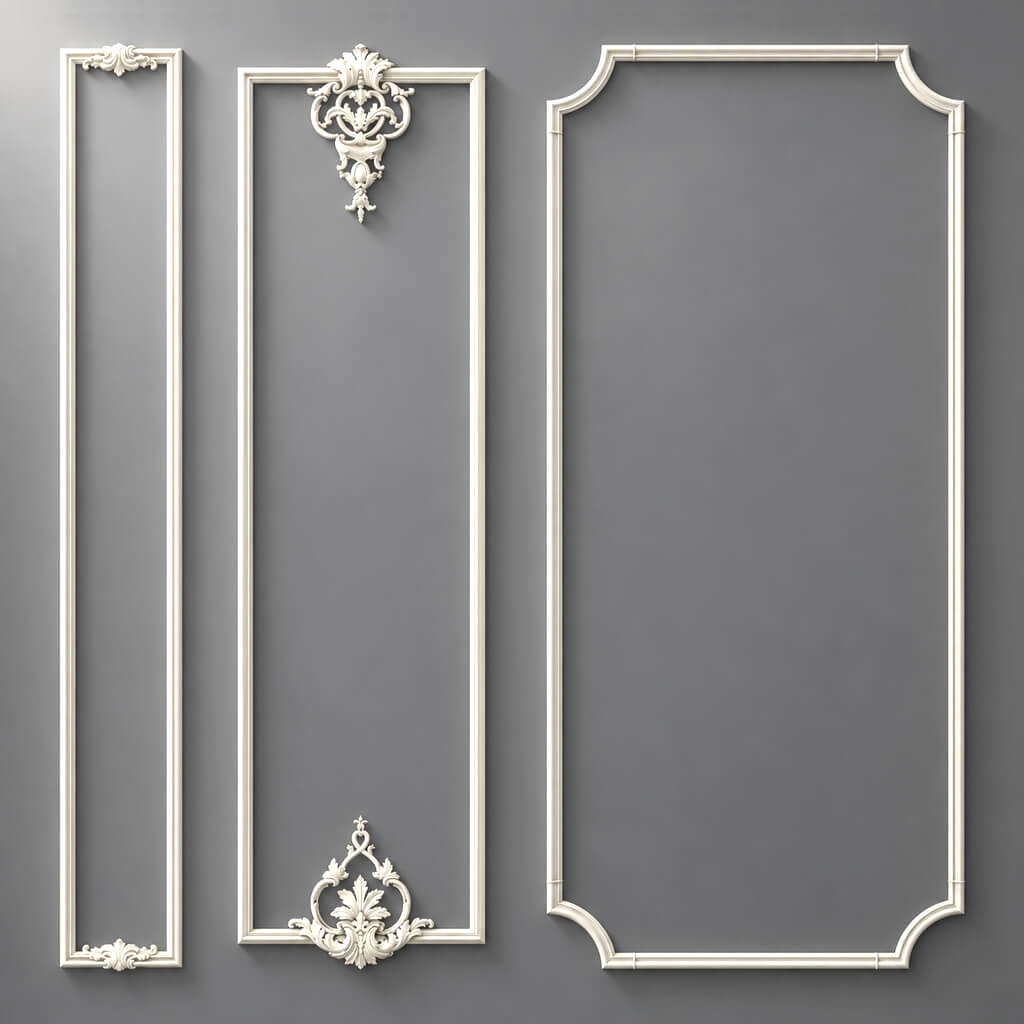
Molding frames on adjacent walls: 28 mm profile, same tone. Two frames symmetrically.
Floor: 'honey' oak, 120 mm board width.
Brass details: handles, floor lamp, mirror frame in the hallway.
Result: a warm white space that 'breathes'—relief without color, only light and form.
Scheme 3: 'White Neoclassicism'—hall with a high ceiling (3.0+ m).
Lower slatted zone: 60 mm slats, 15 mm gap, warm white, height 1.5–1.6 m. Horizontal molding along the top edge.
Above the molding: wall in 'ivory' tone RAL 9001. Molding rectangular frames in the same tone.
Cornice: 110 mm, classic profile with a shelf and a cavetto.
Socket: 380 mm, with ornament.
Floor: black and white marble tile or Calacatta marble.
Result: white neoclassicism, where 'St. Petersburg meets modernity'.
Scheme 4: 'Children's room in white' — neutral base
Slatted accent wall (behind the bed or play area): slats 40 mm, gap 10 mm, white E0 MDF with water-dispersed acrylic.
Cornice: 45 mm, smooth, white. Around the perimeter.
No sockets, moldings, or overlays.
Walls: white or pastel neutral.
Floor: light parquet or carpet in a neutral tone.
Result: a clean background where the child is the main color accent.
Main mistakes in white interiors with slatted panels and moldings
Let's gather the most common mistakes — those that cause a white interior to 'not work out'.
Mistake 1: Mixing cool and warm white
Cool slats RAL 9003 + warm molding RAL 9010 + ceiling in neutral RAL 9001 — three different whites in one space. These are not 'nuances' — this is a visible conflict of tones. Solution: paint all elements with one batch of the same composition.
Mistake 2: Different levels of sheen on different elements
Matte slats + satin cornice + glossy ceiling. In a white space, the difference in sheen 'screams'. All white surfaces should be in a unified sheen system.
Mistake 3: Cornice without primer 'peels off'
White acrylic paint on unprimed polyurethane peels off after 12–18 months in the form of 'bubbles'. Mandatory priming with PU primer — no exceptions.
Mistake 4: White slats without accent lighting
A white slatted wall without accent lighting is a flat surface. The whole point of a white slatted structure is in the shadows. Without directional light, there are no shadows. Rule: for each slatted structure, plan accent lighting at an angle of 30–40°.
Error 5: Too wide a gap in the white slats
A wide gap in the white slats exposes the load-bearing system (metal profile) behind the structure. In a white interior, a black cavity behind the slat is an undesirable contrast. Solution: paint the load-bearing profile white or use a white load-bearing system. Maximum gap without a 'drop' behind the structure: 18 mm with a slat depth of 20 mm.
Error 6: Missing bottom finishing element
A slatted wall construction without a baseboard at the bottom is an unfinished solution. Baseboard: either wooden to match the floor, or a white MDF profile matching the slats.
Error 7: Out-of-scale rosette
A 500 mm diameter rosette on a 2.7 m ceiling is monumental and excessive. A 100 mm rosette on a 3.2 m ceiling is simply not visible. Proportionality is not 'more decor = more beautiful'.
FAQ: white slatted panels and ceiling molding
Should the slats and cornice be painted with the same product?
Ideally, yes. If from different manufacturers, ensure the shade matches on the color chart: one RAL, one level of sheen, one type of paint (acrylic over acrylic).
How to clean a white slatted wall?
Soft damp sponge, neutral pH. Non-abrasive cleaners, no solvents. Two-component 2K coating is resistant to mild detergents. Water-dispersed acrylic — only dry or slightly damp wiping.
Can IWhite slatted wall panelCan it be repainted to a different color later?
Yes, if the coating is 2K or paintable. Sanding P180–P220, degreasing, primer for the new shade, painting. Water-dispersed acrylic coating can be repainted without sanding.
Ceiling moldingDoes it hold without additional fasteners, just with adhesive?
For a cornice weighing up to 400 g/m and length up to 2.0 m on a horizontal section — special adhesive is sufficient with proper preparation (ceiling primer + pressure until full curing). On the ceiling for elements heavier than 400 g/m — additional fastening with dowels every 600–800 mm.
White slats in a child's room — safe?
When using MDF class E0 and water-dispersed acrylic coating without solvents — absolutely safe. Class E0 is regulated to ≤3 mg/100 g formaldehyde — 2.5 times stricter than E1.
Is acclimatization needed for white MDF slats?
Yes, 24–48 hours at room temperature. MDF is a hygroscopic material; it expands with sudden temperature changes. Installation without acclimatization in winter risks warping.
How to create a 'floating ceiling' effect with white molding?
LED strip on the back of the cornice (directed towards the ceiling) + matte ceiling. The cornice 'disappears' in a soft luminous halo, the ceiling glows without a visible source.
About the company STAVROS
White interiors are about precision. Not about simplicity — about precision. Precise tone, precise geometry, precise coating, precise installation. A deviation in any of these parameters — and white turns from an architectural solution into an unfinished renovation.
STAVROS is a Russian manufacturer for whom precision is not a slogan, but a production standard. CNC milling of slats with a tolerance of ±0.1 mm. Painting in a factory paint booth with viscosity and coating thickness control. Polyurethane elements, cast in silicone molds with micron precision of relief. Emission class E1, declaration of conformity for each item.
For light interiors with white slatted panels and molded decor in the STAVROS catalog:
-
white slatted wall panel— all aspects of the white slatted concept
-
Painted MDF plank panels— technology of the perfect white tone
-
Polyurethane Ceiling Moldings— full range: moldings, overlays, trims
-
Ceiling molding— types, installation, selection for a white interior
-
Decorative stucco— rosettes, overlays, pilasters
-
Polyurethane Decor— moldings, cornices, baseboards for white space
White tone samples — upon request. Free consultation on selecting tone, proportions, and layouts for a specific project. STAVROS — because a white interior deserves flawless execution.