Article Contents:
- Anatomy of a Baluster: What Lies Behind a Simple Form
- Structural Elements and Their Functions
- Distance Between Balusters: More Than Just Aesthetics
- Types of Balusters: Turned, Milled, Carved
- Turned Balusters: Symmetry and Classic Style
- Milled Balusters: Geometry and Modernity
- Carved Balusters: Art and Uniqueness
- Turned and Carved Balusters: Synthesis of Technologies
- Materials for Balusters: Oak, Beech, Ash, Pine
- Oak: The Benchmark of Strength and Longevity
- Beech: Optimal Balance of Characteristics
- Ash: Strength and Elasticity
- Spruce: Accessibility and Practicality
- Stair Components: System of Elements
- Handrails and Balusters: Inseparable Connection
- Support Posts: The Structural Power Base
- Baluster Shoes and Handrail Planks
- Baluster Styles: From Classic to Modern
- Classical Styles: Baroque, Empire, Classicism
- Modern: Natural Lines and Asymmetry
- Modern Styles: Minimalism, Loft, Scandinavian
- Baluster Installation and Fastening: Professional Secrets
- Preparation for installation
- Ways to mount balusters
- Handrail Installation and Final Assembly
- Where to Buy Quality Balusters: Supplier Selection Criteria
- Manufacturer or Middleman
- Product Quality: What to Look For
- Price and Reasonable Savings
- Frequently Asked Questions About Stair Balusters
- Conclusion: choose quality with STAVROS

Have you ever wondered what transforms a staircase from a utilitarian structure into an architectural masterpiece?balusters— is precisely the element that forms the visual and functional essence of a flight of stairs. These vertical posts between the steps and the handrail create rhythm, define style, and ensure safety. Seems simple? In reality,Balusters for staircaserepresent a complex system of engineering calculations, artistic decisions, material selection, and manufacturing technologies.
The modern market offers hundreds of models—from strict classics to avant-garde designer pieces. How not to get lost in this diversity? How to choose exactly thoseWooden balustersthat will perfectly fit into the interior, last for decades, be safe, and yet aesthetically perfect? Let's break it down in detail, professionally, and without fluff.




Anatomy of a Baluster: What Lies Behind a Simple Form




Structural Elements and Their Functions
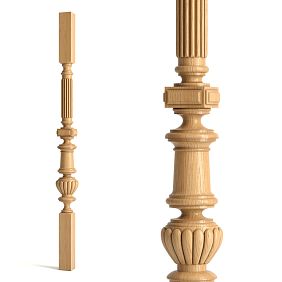
Wooden balusterconsists of several functional zones. The base — the lower part with an increased diameter of 60-80 mm — provides stability and an area for attachment to the tread or sub-baluster rail. It is through the base that the main load is transferred to the staircase structure.
The body of the baluster — the central decorative part with a height of 700-850 mm — creates the visual image. Here, the craftsman realizes the artistic concept: turned elements alternate with smooth sections, carved patterns create a play of light and shadow, and geometric shapes form a rhythmic structure. The body works in bending under horizontal loads — for example, when a person leans on the railing.
The neck — the upper part with a diameter of 40-50 mm — connects to the handrail. It can be cylindrical for attachment into a handrail bracket or have a special platform for direct fixation to the underside of the handrail. The strength of the neck is critical — it is here that stress concentrates under lateral loads.
The overall height of the baluster is standardized — 900 mm from the tread to the top of the handrail according to building codes. This ensures safety and convenience of using the staircase. The height of the baluster itself varies from 700 to 850 mm depending on the tread thickness, presence of a sub-baluster rail, and handrail height.
Our factory also produces:


Distance Between Balusters: Not Just Aesthetics
The installation spacing of balusters is regulated by safety requirements. The maximum distance between the axes of adjacent balusters is 150 mm. This prevents children from slipping between the posts. In practice, a spacing of 100-120 mm is used for residential buildings, and 80-100 mm for public buildings with higher requirements.
The number of balusters per tread depends on the width of the flight. A narrow staircase 800-900 mm wide accommodates one or two balusters per tread. A wide flight of 1200-1500 mm requires two or three balusters to maintain a safe spacing. The more balusters, the stiffer the railing structure, but the higher the cost and labor intensity of manufacturing.
Visually, frequent baluster spacing creates a dense, substantial railing — characteristic of classic interiors. Wide spacing creates lightness, airiness — organic in modern minimalist spaces. The intermediate option — two balusters per tread — is universal and suits most styles.
Get Consultation
Types of Balusters: Turned, Milled, Carved
Turned Balusters: Symmetry and Classic
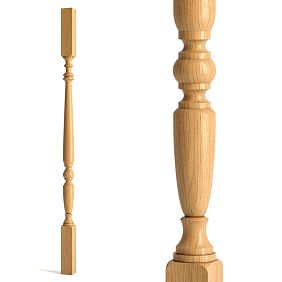
Turned balusters are manufactured on lathes by rotating a workpiece and removing material with cutters. The technology allows creating axisymmetric forms — cylinders, cones, spheres, and their combinations. A turned baluster is recognizable by the rhythmic alternation of thickenings and waists.
A typical turned baluster includes several elements. A bead — a cylindrical section of constant diameter 40-60 mm. A bobbin — a spherical element with a diameter of 50-70 mm. A ring — a toroidal thickening. A waist — a section of reduced diameter 30-40 mm, separating more massive elements. By combining these forms, hundreds of variations are created.
Advantages of turned balusters — manufacturability of production and versatility. Turning is faster than carving, which reduces cost. Turned forms are organic in classic, neoclassical, Scandinavian, and country interiors. Symmetry is perceived as order, stability, harmony.
The manufacturing precision of turned balusters is high — modern CNC machines ensure dimensional deviations of no more than 0.3-0.5 mm. All balusters in a batch are identical, which is critical for creating a uniform visual rhythm. Manual turning provides variation — each baluster is unique in its nuances, but requires high skill of the craftsman.
Milled Balusters: Geometry and Modernity
Milling creates balusters of rectangular, polygonal, or complex curvilinear cross-section. The technology uses a rotating cutter that removes material, forming flat faces, grooves, and profiles. Milled balusters differ from turned ones in the absence of axial symmetry.
Popular types of milled balusters — square cross-section 50×50 or 60×60 mm with chamfers or profiled edges. Hexagonal and octagonal balusters create a faceted relief. Flat balusters with a thickness of 30-40 mm and a width of 80-120 mm resemble vertical slats. They are lighter and cheaper than turned ones, suitable for terraces, verandas, balconies.
Milling allows creating through slots, forming openwork balusters. Geometric slots — diamonds, circles, ovals — add decorativeness without weighing down the form. Plant motifs — leaves, flowers — are cut with a milling cutter, creating silhouette carving.
Stylistically, milled balusters are more modern. Clear edges, geometricity, minimalism of decor correspond to the spirit of modern, loft, high-tech styles. Flat balusters with slots are organic in Scandinavian style, country, eco-direction. Square balusters are universal — depending on the finish, they fit into both classic and contemporary styles.
Carved Balusters: Art and Uniqueness
Wood carving turns a baluster into a sculpture. Carved balusters are created manually or using CNC milling machines with complex three-dimensional programs. The carving depth reaches 10-20 mm, creating expressive relief.
The typology of carved balusters is extensive. Plant carving — acanthus leaves, grapevines, oak branches — is characteristic of classicism and baroque. Geometric carving — braids, rosettes, meanders — is inherent in archaic styles and modern. Sculptural carving — figures of people, animals, mythological creatures — creates unique authorial balusters.
Carved balusters require high-quality wood without defects. Knots, cracks, and grain irregularities are unacceptable — they disrupt the integrity of the carving. Carving emphasizes the wood texture — annual rings, medullary rays become part of the artistic image.
The cost of carved balusters is 2-4 times higher than turned ones due to labor intensity. Manual carving of one baluster takes 4-8 hours depending on complexity. Machine carving on CNC machines speeds up the process but requires expensive equipment and programming. Carved balusters are a choice for exclusive interiors where the budget is not limited.
Turned-and-Carved Balusters: Synthesis of Technologies
Turned-and-carved balusters combine a symmetrical turned base with carved decorative elements. The body of the baluster is turned on a lathe, creating a rhythmic structure of beads, bobbins, and rings. Then, carving — plant ornament, geometric pattern, inscriptions — is applied to the smooth sections.
The advantage of this type is the balance of manufacturability and artistry. Turning is fast and precise, ensuring batch uniformity. Carving adds uniqueness and expressiveness. The cost of turned-and-carved balusters occupies an intermediate position between turned and fully carved ones.
Turned-and-carved balusters are stylistically universal. Restrained carving on a turned base suits neoclassicism. Abundant carving covering the entire surface is organic in baroque and rococo. Geometric carving on simple turned forms is characteristic of modern and ethnic styles.
Materials for balusters: oak, beech, ash, pine
Oak: the standard of strength and durability
Oak is the king among wood species for making balusters. A density of 700-800 kg/m³ provides exceptional mechanical strength. An oak baluster withstands significant bending and impact loads without deformation or failure. A Brinell hardness of 3.7-4.0 makes oak resistant to abrasion. Over decades of use, oak balusters practically do not change their geometry.
Oak's texture, with its pronounced annual rings and medullary rays, creates a rich decorative pattern. Each baluster is unique thanks to the wood's natural grain. The color palette of oak is diverse—from light golden to dark brown. Over time, oak darkens, acquiring a noble patina.
Oak contains tannins, which provide natural protection against rot, fungi, and insects. Oak balusters do not require aggressive chemical treatment. Oak's hygroscopicity is low—the wood reacts weakly to changes in air humidity, minimizing deformations.
Processing oak requires professional equipment and skills. High density makes cutting, turning, and milling difficult. Cutters and milling bits wear out faster when working with oak. But the result justifies the effort—oak balusters retain the clarity of their forms, and carved details do not blur over time.
The cost of oak balusters is higher than that of other species. Simple turned oak balusters cost 1000-2500 rubles per piece. Carved oak balusters reach 3000-6000 rubles. For a set of 40-60 balusters for a staircase, this is a significant expense item. But the investment pays off in durability and prestige.
Beech: the optimal balance of characteristics
Beech ranks second in popularity after oak. A density of 650-700 kg/m³ provides high strength with less weight. Beech balusters are 10-15% lighter than oak ones, which simplifies transportation and installation. At the same time, the strength characteristics are sufficient for any staircase structures.
Beech's Brinell hardness of 3.8-4.2 is even higher than oak's. The wear resistance of beech balusters is excellent—an abrasion coefficient of 0.10 mm compared to 0.20 mm for pine. Over 20 years of use, a beech baluster wears down by 2 mm at contact points, while a pine one wears down by 4 mm. The difference is visually noticeable.
Beech's texture is uniform, fine-pored, without a pronounced pattern. This creates a calm, matte surface. For carved balusters, beech is optimal—the carving turns out clear, and details do not blend together. Beech's natural color is a light pinkish hue, adding warmth. Beech takes staining excellently, allowing for any shade from white to dark brown.
Beech possesses a unique ability to bend after steaming. Curvilinear balusters, bent handrails are created from beech with a minimal bending radius. This plasticity expands design possibilities.
Beech's drawback is its high hygroscopicity. Without protective treatment, beech balusters absorb moisture, swell, and warp. Impregnation with antiseptics and a final coating with varnish or oil are mandatory. If the processing technology is followed, beech balusters last for decades.
The cost of beech balusters is 20-30% lower than oak ones. Simple turned balusters cost 700-1500 rubles. Carved beech balusters cost 1500-3000 rubles. Beech is the optimal choice for those who want quality balusters without overpaying for the oak brand.
Ash: strength and elasticity
Ash is close to oak in hardness—density 700 kg/m³, Brinell hardness 3.8-4.2. But ash is more elastic than oak—it better withstands impact loads and does not splinter. Ash balusters withstand lateral impacts without forming cracks. This is important for staircases in homes with children, where mechanical impacts are possible.
Ash's texture is expressive—contrasting annual rings, wavy lines, shade transitions. Each ash baluster is individual thanks to the natural grain. Ash's color is lighter than oak's—white-yellow, cream. This allows ash to be used in light interiors without staining.
Ash processes well—it turns, mills, and sands. Carving on ash turns out clear, with sharp edges. Ash takes staining excellently—from light to dark. Stains emphasize the contrasting texture, creating a dramatic effect.
Ash's drawback is its tendency to rot in high humidity. Ash balusters require protective treatment with antiseptics. With proper treatment, ash lasts for decades.
The cost of ash balusters is comparable to beech or slightly higher. Turned balusters cost 800-1800 rubles, carved ones 1800-3500 rubles. Ash is the choice for light interiors where expressive texture and high strength are important.
Spruce: Accessibility and Practicality
Pine is the most affordable wood species for making balusters. A density of 400-500 kg/m³ makes pine easy to process and transport. Brinell hardness of 1.5-2.5—significantly lower than that of hardwoods.
Pine's softness simplifies turning, milling, and carving. Cutters and milling bits wear out slower when working with pine. Complex profiles are created faster. This reduces production costs. Simple turned pine balusters cost 300-800 rubles per piece.
Pine's texture is characterized by contrasting annual rings and resin ducts. Natural pine without staining has a warm yellow-pink color. Pine stains easily, taking on any shades. Pine's resinousness provides natural protection against moisture and biological damage.
Pine's drawbacks for balusters are significant. Low hardness makes pine vulnerable to impacts and scratches. Dents and chips quickly appear on pine balusters. Wear resistance is low—abrasion is twice as fast as beech. Pine is prone to warping with humidity fluctuations.
Pine balusters are recommended for secondary staircases—to the attic, basement, or porch. For main staircases in living spaces, it is better to choose hardwoods. If the budget is limited, pine is an acceptable option with the understanding that the service life will be shorter.
Staircase components: a system of elements
Handrails and balusters: an inseparable connection
Handrails and balustersform the staircase railing. 'Handrail' is a general term for the entire railing system, including balusters, handrails, and newel posts. Balusters are the vertical posts, handrails are the horizontal element for hand support.
The handrail is attached to the top ends of the balusters in one of several ways. Attachment via a handrail bracket—a wooden strip with a cross-section of 30×50 mm, which is fixed to the ends of the balusters with screws. The handrail is then attached to the bracket from below. This method ensures structural rigidity and hides the fasteners.
Direct attachment of the handrail to the balusters with screws is used less frequently. Screws are driven through the handrail into the ends of the balusters at an angle. The screw heads are countersunk and filled. This method is simpler but less reliable—over time, the fastenings loosen.
The height of the handrail from the step is standardized—900 mm for residential buildings, 850-1200 mm for public buildings. A round handrail diameter of 50-60 mm is optimal for hand grip. An oval handrail with a cross-section of 50×70 mm is more comfortable than a round one. A rectangular handrail of 60×80 mm is characteristic of modern interiors.
The material of the handrail should match the balusters. Oak balusters require an oak handrail. Mixing species is acceptable if the shades match—for example, light ash and whitewashed oak. A contrasting combination—a dark handrail with light balusters or vice versa—creates a visual effect.
Support posts: the structural load-bearing foundation
Support posts are powerful vertical elements with cross-sections of 100×100, 120×120, 150×150 mm, installed at the beginning, end, and turns of a staircase. The posts bear the main load from the railing and handrail. The post height is 1200-1500 mm from the floor to the top of the finial.
Structurally, a post consists of a base, body, capital, and finial. The base — the lower part 200-300 mm high — is attached to the floor or stair structure. Fastening is done with anchor bolts 12-16 mm in diameter or threaded studs. The body of the post — the central part — can be square in cross-section, turned, or carved.
The capital — the upper decorative part of the post, 100-150 mm high — creates a transition to the finial. The capital is often decorated with carvings that repeat the baluster decor. The finial — the final element at the top of the post — can be spherical, conical, or carved. The finial, 80-120 mm high, completes the post composition.
Posts should be made from the same wood species as the balusters and handrails. Oak posts with oak balusters create integrity. The staining of posts and balusters must match. Differences in shade disrupt the harmony of the staircase.
Baluster rails and handrail support strips
A baluster rail is a horizontal strip with a cross-section of 50×70 mm, to which the lower ends of balusters are attached. The baluster rail is mounted to the stringer or carriage of the staircase. Balusters are attached to the baluster rail with screws or dowels with glue. This method simplifies installation — first, a railing section is assembled on the floor, then the finished section is installed on the staircase.
The baluster rail allows balusters to be installed at an angle corresponding to the slope of the staircase. The lower ends of the balusters are cut at the required angle. Balusters are fixed to the baluster rail perpendicular to its surface. After installation, the balusters are strictly vertical.
The handrail support strip is attached to the upper ends of the balusters similarly. The strip with a cross-section of 30×50 mm is fixed with two screws per baluster. The handrail is then attached to the strip from below with hidden screws or glue. The handrail support strip distributes the load from the handrail evenly across all balusters.
An alternative to baluster rails is direct attachment of balusters to the steps. This method is more labor-intensive but visually cleaner — the baluster rail is not visible. Holes are drilled in the step for dowels or threaded studs. The baluster is fixed with glue and mechanical fasteners.
Baluster styles: from classic to modern
Classical styles: Baroque, Empire, Classicism
Classical balusters are characterized by symmetry, proportionality, and rich decor. Baroque balusters are lush, with abundant carving and large elements. Acanthus leaves, grape clusters, putti, and shells cover the surface. The form is dynamic, with pronounced thickenings and constrictions.
Empire-style balusters are monumental. The base is massive, the body includes columns with fluting, capitals with Ionic or Corinthian motifs. The carving is stricter than Baroque — laurel wreaths, military attributes, Egyptian motifs. Colors are dark — walnut, mahogany, or contrasting — white with gilding.
Classicism in balusters is restraint and proportion. The form is clear, with a distinct division into base, body, and neck. Decor is minimal — perhaps a few rings or beads. Carving is geometric — meanders, egg-and-dart, bead-and-reel. Color is natural or with light staining.
Classical balusters require high ceilings and spacious rooms. In standard apartments, lush Baroque looks out of place. Restrained Classicism adapts more easily.
Art Nouveau: Natural Lines and Asymmetry
Modernist balusters reject classical symmetry. Forms are asymmetrical, smooth, flowing. Straight lines are replaced by curves that mimic natural forms — plant stems, waves, flames. The baluster's cross-section changes unpredictably along its height.
Art Nouveau ornamentation features stylized flowers, leaves, insects. Irises, lilies, dragonflies, butterflies are depicted not naturalistically, but in a generalized, decorative manner. Lines flow into one another, creating a continuous pattern. Carving is deep, relief, with strong interplay of light and shadow.
Art Nouveau requires special craftsmanship. The forms are complex, non-trivial, and difficult to execute. Turning is insufficient — hand carving or programming complex trajectories for CNC machines is required. The result is unique — a staircase with Art Nouveau balusters resembles no other.
Art Nouveau colors are natural — wood tones from light to dark, sometimes with greenish or purple undertones. Varnish is glossy, emphasizing texture and carving. Art Nouveau is organic in early 20th-century interiors, in country houses with custom architecture.
Contemporary styles: Minimalism, Loft, Scandinavian
Contemporary balusters lean towards simplicity of form. Minimalist balusters are rectangular or square in cross-section without decor. The surface is smooth, sanded, sometimes brushed to emphasize texture. Color is neutral — light wood, gray, white.
Loft-style balusters combine wood with metal. Metal rods of square or round cross-section alternate with wooden posts. The wood is rough, unfinished, with visible tool marks. Color is dark — graphite, anthracite, or natural with oil.
Scandinavian style prefers light wood — whitewashed oak, ash, pine. Balusters are simple, often turned with minimal decor. A few rings or beads, no more. The surface is matte, coated with oil or wax. The combination of wooden balusters with white painted handrails and posts is characteristic of Scandinavian style.
Country and rustic styles use roughly processed wood. Balusters are irregular in shape, preserving the natural curves of branches. The surface is brushed, emphasizing texture. Color is natural or with light staining. Country balusters are organic in wooden houses, saunas, verandas.
Baluster installation and fastening: professional secrets
Pre-installation preparation
Baluster installation begins with marking. The number of balusters is calculated based on the flight length and a safe spacing of 100-150 mm. Installation points are marked on the stringer or steps. A laser level is used to ensure accuracy.
If balusters are installed on steps, holes are drilled for fasteners. The hole diameter depends on the fastener type. For a 10 mm dowel, a 10 mm hole is drilled 30-40 mm deep. For an M8 threaded stud — an 8 mm hole 50-60 mm deep. Drilling must be strictly vertical — deviation will cause the baluster to tilt.
The lower and upper ends of balusters are cut at an angle corresponding to the staircase slope. The angle is measured with a protractor or calculated by the formula: tan(α) = H/L, where H is the flight rise height, L is the horizontal projection. A typical angle is 30-35 degrees. Ends are cut with a miter saw at the required angle.
Ways to Mount Balusters
Fastening with dowels is a traditional joinery method. A wooden dowel 10-12 mm in diameter and 50-60 mm long is glued into the hole in the step halfway. PVA wood glue or polyurethane provides strength. A corresponding hole is drilled in the baluster's lower end. The baluster is placed over the protruding part of the dowel with glue. It is clamped until the glue dries for 2-4 hours.
Fastening with threaded studs is the most reliable method. A metal stud 8-12 mm in diameter and 100-120 mm long is screwed into the step halfway. An axial hole is drilled in the baluster, 1-2 mm larger than the stud diameter. The baluster is screwed onto the stud. Epoxy glue is additionally used to seal the connection.
Angled screw fastening is the fastest method. 80-90 mm long screws are driven through the base of the baluster into the tread at a 30-45 degree angle. Two screws per baluster from opposite sides. The screw entry points are filled with putty and sanded. This method is less reliable — the fastenings may loosen over time.
Fastening via a sub-baluster rail is the most technological method. Balusters are attached to a wooden plank on a horizontal surface. The ends are cut at an angle, glue is applied, and the balusters are secured with screws. The completed railing section is installed onto the staircase as a whole unit. The sub-baluster rail is attached to the stringer or treads with screws every 300-400 mm.
Handrail installation and final assembly
After installing all balusters, their vertical alignment is checked using a level or plumb line. Inclined balusters are adjusted before the glue hardens. A handrail support strip is attached to the top ends of the balusters. Two 50-60 mm long screws per baluster.
The handrail is placed on the support strip and fastened from below with countersunk head screws. Screws are driven through the strip into the handrail at 250-300 mm intervals. The screw heads are sunk flush. Alternatively, the handrail can be glued to the strip with polyurethane glue without screws.
The joints between the handrail and the newel posts are treated with particular care. The ends of the handrail and posts are miter-cut at an angle for a tight fit. The connection uses glue and hidden screws. Gaps are filled with tinted wood putty.
Final finishing — sanding all visible joints, touch-up painting of fastener points, applying a finish coating to unprotected areas. Varnish or oil evens out the color and protects the wood. The railing is ready for use 24-48 hours after installation is complete.
Where to buy quality balusters: supplier selection criteria
Manufacturer or intermediary
buy balustersYou can buy from the manufacturer or through intermediaries. The manufacturer offers lower prices, a wide range, and the possibility of custom orders. An intermediary is convenient due to local availability, but the markup can reach 30-50%.
Signs of a reliable manufacturer. Own production base with descriptions of equipment and technologies. Detailed catalogs with technical specifications of products. Product samples in a showroom for quality assessment. Reviews from real customers with photos of completed projects.
Questions to ask the supplier. What wood are the balusters made from, what is the material's moisture content. What equipment is used for processing — manual, semi-automatic, CNC machines. What finish coating is applied — oil, wax, varnish, its manufacturer and characteristics. What guarantees are provided for the products.
Product quality: what to look for
Wood moisture content is critical. Balusters with moisture content above 12% will shrink and warp after installation. Moisture content can be checked with a moisture meter — a professional supplier will not refuse. An alternative is to weigh the baluster and compare it with the calculated weight of dry wood.
Processing quality is assessed visually and tactilely. The surface should be smooth without burrs, chips, or dents. Carved elements are clear, without blurred edges. The ends of the balusters are even, perpendicular to the axis. Staining is uniform without spots.
Baluster geometry is checked with measurements. The height of all balusters in a batch should match with an accuracy of ±1 mm. The base and neck diameter are the same for all specimens. Deviation from vertical (curvature) is no more than 2 mm over a length of 900 mm. Batch uniformity is critical for a consistent visual rhythm.
The finish coating must be of high quality. Oil or varnish is evenly distributed over the surface. No drips, runs, or missed spots. The coating protects the wood from moisture and dirt. A poor-quality coating will have to be redone after purchase.
Price and reasonable savings
The price range for balusters is wide. Simple turned pine balusters: 300-800 rubles. Turned beech balusters: 700-1500 rubles. Turned oak balusters: 1000-2500 rubles. Carved beech balusters: 1500-3000 rubles, carved oak balusters: 3000-6000 rubles.
For a set for a staircase with 40-60 balusters, the cost will be. Pine — 15,000-30,000 rubles. Beech — 30,000-60,000 rubles. Oak — 50,000-120,000 rubles. To this, add the cost of newel posts, handrails, and fasteners.
Reasonable savings are possible without loss of quality. Choosing beech instead of oak saves 20-30% with comparable characteristics. Turned balusters instead of carved ones reduce the cost by 2-3 times. Self-installation instead of hiring professionals saves 30,000-50,000 rubles.
Unreasonable savings will lead to problems. Buying wet balusters with 15-20% moisture content will cause warping. Balusters made from softwood for a heavily used staircase will require replacement in 5-7 years. Poor-quality installation will create a wobbly railing, dangerous for use.
Frequently asked questions about staircase balusters
What distance should be between balusters?
The maximum distance between the axes of adjacent balusters is 150 mm according to building codes. In practice, a spacing of 100-120 mm is used for residential houses. This ensures safety and visual density of the railing.
How many balusters are needed per step?
It depends on the width of the flight. A narrow staircase 800-900 mm accommodates one or two balusters per tread. A wide one 1200-1500 mm requires two or three balusters. It is important to maintain a safe spacing between balusters.
Which wood species is best for balusters?
Oak is the benchmark for strength and durability, but expensive. Beech is the optimal balance of characteristics and price. Ash is for light interiors with expressive grain. Pine is a budget option for secondary staircases.
Can balusters be installed by oneself?
Yes, if you have the tools and woodworking skills. Requires a drill, screwdriver, miter saw, level, clamps. It is important to follow the fastening technology and check vertical alignment. Beginners are advised to start with simple fastening methods.
How to care for wooden balusters?
Weekly dry wiping with a soft cloth removes dust. Wet cleaning no more than once a month. Avoid aggressive cleaning agents. Renew the oil finish or polish with wax every 2-3 years. Varnished balusters do not require finish renewal for years.
How much does a set of balusters for a staircase cost?
For a standard staircase with 12-15 steps, 40-60 balusters are required. A pine set costs 15,000-30,000 rubles. Beech sets cost 30,000-60,000 rubles. Oak sets cost 50,000-120,000 rubles. Carved balusters increase the cost by 1.5-2 times.
What is the difference between turned and carved balusters?
Turned balusters are manufactured on lathes by rotating the workpiece, creating symmetrical shapes. Carved balusters are cut by hand or on CNC milling machines, creating complex relief patterns. Turned balusters are cheaper and more technologically efficient. Carved balusters are more unique and expressive, but 2-3 times more expensive.
Conclusion: choose quality with STAVROS
Balusters determine the safety, functionality, and aesthetics of a staircase. The correct choice of material, type of processing, and installation method transforms a staircase into an architectural work that lasts for decades. Saving on material quality or workmanship will lead to problems—deformation, loosening, and the need for repairs.
Company STAVROS has been producing for over twenty yearsstaircase componentsmade from solid valuable wood species. The 6,000 m² production base in St. Petersburg is equipped with modern equipment. CNC lathes and milling machines ensure manufacturing precision. Experienced carvers create unique carved elements.
The STAVROS assortment includes hundreds of baluster models. Turned balusters in classic and modern shapes. Carved balusters with floral and geometric ornaments. Milled balusters with square and polygonal cross-sections. Flat balusters for terraces and verandas. All products are made from selected oak, beech, and ash wood with a moisture content of 8-12%.
STAVROS offers a complete set of staircase elements. Balusters, support posts, handrails, sub-balusters, and fastening elements. All products are compatible with each other—same wood species, matching toning, unified style. The ability to purchase a set from a single supplier guarantees the integrity of the staircase.
Custom production allows ordering balusters based on client sketches. Non-standard sizes, unique profiles, and custom carving. A minimum order of 10 pieces makes custom orders accessible. Production time is 2-4 weeks depending on complexity.
The quality of STAVROS products is confirmed by certificates and warranties. Balusters come with a 12-month warranty. The wood undergoes moisture control and defect inspection. Final coating with professional compounds from well-known manufacturers. Reliable packaging that prevents damage during transportation.
STAVROS logistics ensures delivery throughout Russia. Shipping from one piece. Cooperation with transport companies guarantees cargo safety. Possibility of self-pickup from the warehouse in St. Petersburg.
Consultation support helps clients make their choice. STAVROS specialists are knowledgeable about styles, wood species, and installation technologies. They will suggest the optimal type of balusters for a specific staircase, calculate the required quantity, and assist with selecting related elements.
Choosing STAVROS means choosing reliability, quality, and an individual approach. Products made from natural wood, created with respect for the material and traditions of carpentry craftsmanship. Balusters that will last for decades, maintaining strength and beauty. Create your dream staircase with STAVROS.