Article Contents:
- The nature of molding: when wood becomes a frame
- The historical role of wooden molding
- How wooden molding surpasses alternatives
- Molding profiles: from classic to avant-garde
- Round molding: a universal element of wooden decor
- Fifty millimeters in diameter: the standard of functionality
- Where fifty-millimeter round molding is used
- Beech round molding: the golden mean
- Molding production: from block to masterpiece
- Wood selection and drying
- Profile milling
- Sanding and finishing
- Mounting molding frames: precision corners and joint strength
- Tools and preparation
- Cutting and assembling corners
- Finishing and object installation
- Using molding in interiors: more than just frames
- Molding as an architectural element
- Combining molding and round molding
- Choosing and purchasing molding: quality criteria
- Moisture and Stability
- Quality of processing
- Matching style and object
- Frequently asked questions about molding and round molding
- Can molding be used to frame large mirrors?
- How does a molding profile differ from regular molding?
- How long does wooden molding last?
- Can molding be painted independently?
- Where to buy quality fifty-millimeter round molding?
- What diameter molding to choose for a stair railing?
- Can different wood species be combined in one interior?
- Is it necessary to treat wooden molding with protective compounds?
- How to care for picture frames?
- How much does custom picture frame making cost?
- Conclusion: STAVROS — a guarantee of quality wooden decor
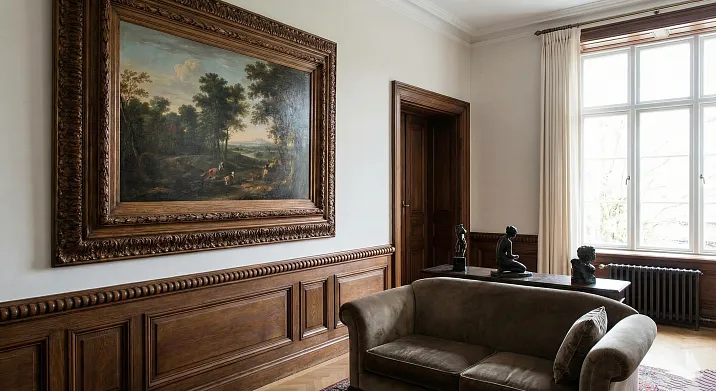
Have you ever wondered why the same painting looks modest in a simple frame, but turns into a work of art in an elegant framing? It's all about the molding — that very element that creates a transition between the artwork and the surrounding space.Wooden moldingnot only holds the canvas or photograph — it creates a visual pause, concentrates the viewer's attention, adds depth to the image. And in combination with50 mm round wooden moldingin the interior, it becomes possible to create an integrated wooden system — from frames on walls to stair handrails, from decorative cornices to support posts.
Many confuse the concepts of 'molding' and 'picture frame', not understanding the fundamental difference. Molding is a flat decorative element that is attached to one surface (wall or ceiling), creating relief, framing, zoning of space. A picture frame, however, has a specific profile with a deep groove or slot designed to fix another element — canvas, mirror, glass. Moreover, picture frames are used to create frames that exist independently of walls, whereas molding is always part of the room's architecture.




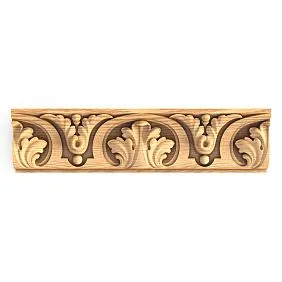
The nature of molding: when wood becomes a frame




The historical role of wooden molding
Molding as a form of artistic framing appeared during the Renaissance, when painting on canvas became a mass phenomenon. Before that, paintings were painted on wooden boards, which themselves served as frames. With the advent of canvas, the need arose for a frame that would stretch the fabric, protect the edges, and create a decorative frame. The first frames were made of wood — an accessible, technological, noble material.
Wooden moldingwas made by European craftsmen from oak, walnut, linden. Profiles were carved by hand with chisels and cutters, decorated with gilding, inlay, carving. A picture frame sometimes cost more than the painting itself — it emphasized the owner's status, created solemnity, turned an ordinary canvas into a treasure. Over time, technologies simplified, milling machines appeared that cut profiles in series, but the essence remained the same: wooden molding is nobility, classic, durability.
Our factory also produces:




Why wooden molding surpasses alternatives
The modern market offers moldings from different materials: plastic (polystyrene), aluminum, MDF with coating, plaster. Why thenbuy wooden moldingdo art connoisseurs and interior designers prefer?
The first reason — tactility and visual warmth. Wood has a unique texture that cannot be fully imitated. Even under a layer of paint or gilding, wood fibers create a micro-relief that is captured by the eye and gives the frame depth. Plastic looks flat, cold, artificial, no matter how well it is cast.
The second reason — strength and repairability. Wood is stronger than plastic, does not break from point impacts, does not deform from temperature fluctuations. If the molding is damaged — chip, scratch, dent — the wood can be sanded, puttied, repainted. Plastic molding after a chip will remain damaged forever — synthetic material does not recover.
The third reason — eco-friendliness and prestige. In the era of conscious consumption, natural materials are valued more and more. Wood breathes, does not emit toxic substances, is biodegradable.Carved Wooden Moldingin the interior is immediately read as an element of high quality, status. Plastic, no matter how high-quality it is, is always associated with mass production and economy.
Get Consultation
Molding profiles: from classic to avant-garde
The profile of the molding determines its character and area of application. Classic molding has a complex multi-stage profile with alternating convexities and concavities — beads, coves, chamfers, grooves. The width of such a profile can reach eighty — one hundred twenty millimeters, the depth of relief — twenty — thirty millimeters. Such molding is suitable for framing paintings in classic interiors, large mirrors, formal portraits.
Modern molding has a laconic profile — one or two geometric elements, clean lines, minimal relief. Width thirty — sixty millimeters, the profile can be rectangular with a chamfer, beveled at an angle, with one cove. Such molding is suitable for graphics, photography, posters, modern painting, minimalist interiors.
Decorative wooden moldingcan also have extravagant forms — asymmetrical profiles, torn edges, deliberately rough processing. Such moldings are used for framing contemporary art, collages, art objects, where the frame itself becomes part of the artistic statement.
Round molding: a universal element of wooden decor
Fifty millimeter diameter: a standard of functionality
Round balustrade 50 mmoccupies a special place in the line of wooden cylindrical profiles. This diameter is not accidental — it is optimally suited for an adult's hand to grasp. Ergonomists have established that the comfortable diameter of a stair handrail is forty-five — fifty-five millimeters. With a smaller diameter, the hand does not get reliable support, with a larger one — it is inconvenient to grasp.
But the scope of application of fifty-millimeter molding extends far beyond stair handrails. This is a universal profile that is used as decorative curtain cornices, support posts for shelves, vertical fence posts, cylindrical balusters, small-diameter decorative columns.
The round shape offers several advantages over the rectangular one. Firstly, the absence of sharp corners makes the molding safe—there is no risk of injury from a protruding edge. Secondly, the uniform distribution of material around the circumference ensures maximum strength with minimal wood consumption. Thirdly, round molding is easier to process on lathes, results in less waste, and is less prone to cracking.
Where is fifty-millimeter round molding used?
Stair handrails are the primary area of application.Round wooden baluster 50 mmIt is installed on the top of the balustrade, providing a secure grip when ascending and descending. The handrail runs along the entire flight of stairs, attached to posts (balusters or newel posts) via special brackets or mortised into them. For curved sections of the staircase, the molding can be bent (after steaming for pliable species like beech) or replaced with radius elements.
Wall-mounted handrails are another functional area. In long corridors, on ramps for people with disabilities, and along walls in bathrooms, horizontal handrails with a diameter of fifty millimeters are installed. They are mounted on brackets at a height of eight hundred fifty to nine hundred millimeters from the floor, provide reliable support, and can withstand a vertical load of up to one hundred twenty kilograms.
Decorative curtain rods are a visual application. Fifty-millimeter round molding is used as the load-bearing element of a curtain rod in classic and country-style interiors. It supports the weight of heavy drapes (up to fifteen to twenty kilograms for a three-meter length), does not sag, and creates a solid, substantial appearance. The molding is mounted on brackets spaced eight hundred to one thousand millimeters apart, with the ends finished with decorative finials.
Support posts and columns are a structural application. Round posts with a diameter of fifty millimeters are used as vertical supports for floating shelves (the shelf is hung on posts passing through holes in its ends), as the frame for lightweight partitions (posts form the skeleton, with infill such as glass, fabric, or slats), and as small-diameter decorative columns in niches, openings, and bay windows.
Round beech molding: the golden mean
Round beech balustrade— a popular choice due to the optimal balance of hardness, price, and appearance. Beech has a density of six hundred fifty to seven hundred fifty kilograms per cubic meter, which is close to oak, but its cost is thirty to fifty percent lower.
Beech has a fine-pored, uniform texture without contrasting annual rings. Its color is pinkish-beige, warm, and neutral. Beech molding does not distract with its texture, creating a calm background. At the same time, beech is hard enough not to scratch from everyday use or dent from point loads.
A feature of beech is its ability to bend after steaming. If a radius handrail for a spiral staircase or a curved curtain rod for a bay window is needed, beech molding is steamed at a temperature of one hundred to one hundred ten degrees, bent on a template of the required radius, and fixed until completely dry. The minimum bending radius is eight to ten times the thickness of the workpiece; that is, for a diameter of fifty millimeters, it is four hundred to five hundred millimeters.
A drawback of beech is its sensitivity to humidity. With fluctuations in relative air humidity of more than ten to fifteen percent, beech molding can warp or crack. Therefore, beech handrails and curtain rods are not recommended for damp rooms (bathrooms, open verandas). For living rooms with a stable microclimate (temperature eighteen to twenty-four degrees, humidity forty-five to sixty-five percent), beech is ideal.
Picture frame molding production: from blank to masterpiece
Wood selection and drying
Quality molding begins with the correct choice of raw material. Hardwood species are used for picture frame profiles—oak, beech, ash, walnut, linden. Linden, despite its softness, is popular for carved molding—it cuts easily, does not splinter, and yields a clean surface after carving.
Wood is selected according to strict criteria: absence of knots larger than three millimeters in diameter, straightness of grain, uniformity of color. For molding that will be coated with clear varnish, beautiful grain is important. For molding intended for opaque paint or gilding, grain is secondary, but the structure must be uniform, without cracks or resin pockets.
Wood drying is a critically important stage. Freshly sawn wood has a moisture content of sixty to eighty percent. With natural air drying, it reduces to twenty to twenty-five percent over a year. For molding, this is insufficient—a moisture content of eight to twelve percent is needed, corresponding to the humidity of living spaces. This moisture level is achieved through kiln drying.
A drying kiln is a sealed chamber where wood is dried under controlled temperature (forty to sixty degrees) and humidity. The process takes two to four weeks depending on the species and thickness of the material. Proper drying ensures the geometric stability of the molding—it does not shrink after installation, crack, or warp.
Profile milling
After drying, the wood is sawn into blanks of the required cross-section. For molding eighty millimeters wide and thirty millimeters thick, a blank of approximately ninety by forty millimeters is needed (with allowance for processing). The blanks are planed on four-sided planers, achieving precise dimensions and smooth surfaces.
Then comes the key stage—profile milling. The blank is fed into a milling machine, where rotating cutters remove material according to a given contour. Simple profiles (rectangle with a bevel) are milled in one pass. Complex profiles (multi-stepped, with sharp transitions) require several passes with different cutters.
Milling accuracy determines the quality of the molding. The tolerance for profile width and thickness should not exceed plus or minus zero point five millimeters. If the tolerance is greater, the molding will have varying widths along its length, frames will turn out crooked, and corner joints will not align. Modern CNC machines provide accuracy up to plus or minus zero point one millimeter, guaranteeing perfect geometry.
Polishing and finishing
After milling, the molding surface has fine marks from the cutters and roughness on the profile ends. Sanding eliminates these defects, creating a perfectly smooth surface for finishing. Sanding is performed with abrasive belts ranging from eighty grit (coarse sanding) to two hundred forty grit (finish sanding).
Wide-belt sanding machines sand the flat surfaces of the molding automatically, with consistent quality. Complex profiles with recesses, grooves, and carvings are sanded manually with special sanding sponges that match the profile shape. Manual sanding takes longer and is more expensive but is indispensable for carved molding, where every detail of the relief must be perfectly smooth.
After sanding, the molding is ready for finishing. Finishing options are varied: natural wood under varnish or oil (emphasizes the grain), painting with opaque enamel (hides the grain, creates a uniform color), patination (artificial aging with darkening in the profile recesses), gilding (applying a thin layer of gold leaf or gold paint), silvering, or staining with dyes in any color from light beige to black.
Picture frame assembly: precision corners and strong joints
Tools and preparation
Creating a picture frame requires precision, care, and the right tools. The main tool is a miter saw (a miter box with a saw or an electric miter saw) capable of cutting at a forty-five-degree angle. Cutting accuracy is critical—a deviation of even half a degree will lead to a gap in the corner joint, ruining the entire appearance of the frame.
Additional tools include: a protractor (for checking cut angle accuracy), clamps (for fixing frame parts during gluing), a stapler or pneumatic nail gun with finish nails (for mechanical corner fastening), a sander or sandpaper (for cleaning joints), wood filler (for filling minor defects).
Before starting work, measure the object to be framed—a painting, mirror, or photograph. Add a clearance of two to four millimeters around the perimeter to the object's dimensions (so the object fits freely into the frame), then add double the width of the molding (the outer frame size). For example, a painting three hundred by four hundred millimeters, molding width fifty millimeters: inner frame size three hundred four by four hundred four millimeters, outer frame size four hundred four by five hundred four millimeters.
Mitering and Assembly of Corners
The molding profile is cut into four strips: two short ones (according to the frame width) and two long ones (according to the frame height). Each strip is mitered at a forty-five-degree angle on both ends, with the angles oriented mirroring each other. This is the most critical operation — the slightest inaccuracy in angle or length will cause the frame corners not to align.
Professional framers use special machines for mitering molding — guillotines with clamping stops that guarantee precision. For home crafting, a quality miter saw with a laser guide and stops is suitable. Important: the molding is placed in the machine with the face side up, the flat side (which will be against the wall or backing) against the stop. The cut line must pass exactly through the profile corner, without cutting off excess or leaving an undercut.
After mitering, the corners are dry-fitted (without glue) for checking. If the joint is tight, without gaps — it can be glued. If there is a gap — the cut angle needs adjustment. Wood glue PVA is applied to the mitered ends (in a thin, even layer), the strips are joined, and tightly pressed together. The corner is secured with a clamp or a special corner clamp for one to two hours (the glue setting time).
Additionally, the corner is reinforced with mechanical fasteners — finishing nails or staples. Nails are driven from both sides of the corner at an angle, passing through one strip into the end of the other. The nail heads are countersunk two to three millimeters below the molding surface, the holes are filled with wood filler, and after drying, sanded flush.
Final Finishing and Object Installation
After assembling all four corners, the frame is checked for geometry. The frame diagonals must be equal (measured with a tape measure from corner to opposite corner). If the diagonals differ by more than two millimeters — the frame is skewed and needs to be disassembled and reassembled with correction.
The corner joints after gluing may have micro-cracks, small gaps, traces of squeezed-out glue. All of this is eliminated by sanding and filling. Filler is chosen to match the wood color (for varnished molding) or universal white (for painted molding). After sanding, the frame is ready for final finishing — varnishing, painting, patination.
The object (painting, photograph, mirror) is attached to the frame from the back. For a canvas, a wooden stretcher is used, which is inserted into the depth of the molding profile and secured with small nails or metal staples. For photographs and graphics, acrylic glass (in front, protects the image) and thick cardboard (in back, provides rigidity) are used. All of this is assembled in layers: acrylic glass — image — cardboard, secured in the frame with metal
clamps or sealed with self-adhesive tape.
Hangers are attached to the back of the frame — metal loops or a cable from which the frame will hang on the wall. For frames weighing up to three kilograms, two screw eyes inserted into the top frame strip are sufficient. For heavy frames (five to ten kilograms), a steel cable is used, stretched between two loops at a distance of one-third of the frame width from the corners.
Application of Molding in Interior Design: More Than Just Frames
Molding as an Architectural Element
Molding profiles are used not only for framing paintings and mirrors. In classic interiors, molding is used as architectural decor — framing panels, ceiling cornices, door and window casings.Carved Wooden Moldingwith rich relief transforms an ordinary wall into a work of art, creating depth, interplay of light and shadow, and a historical atmosphere.
Ceiling molding (sometimes called a frieze or cornice) is installed around the perimeter of a room at the junction of the wall and ceiling. Unlike a simple ceiling skirting board, molding has a complex profile with pronounced relief, which is emphasized by directed lighting. The width of ceiling molding can reach one hundred fifty to two hundred millimeters, making it a dominant element in the upper part of the room.
Wall panels are framed with molding to create coffers — rectangular recesses that break the wall plane into sections. Molding is mounted vertically and horizontally, forming a grid. Inside each coffer, contrasting paint, wallpaper, or fabric can be used. Such decoration is typical for classic studies, libraries, and formal living rooms.
Combining Molding and Round Molding
A design technique that creates a visual connection between different interior elements — using the same wood species and the same finish for molding and round molding. For example, oak molding with dark staining frames paintings and mirrors on the walls, and oakRound trim 50 mmwith the same finish is used as a curtain rod and stair handrail. Unity of material and color creates interior integrity, where everything matches and complements each other.
Another option is a contrasting combination. Light beech molding frames modern graphics on the walls, while dark oak round molding is used for support posts and decorative columns. The contrast of light and dark creates dynamism, visually divides the space into zones, and emphasizes architectural elements.
in loft interiorsbuy wooden moldingmakes sense with deliberately rough treatment — preserving saw marks, irregularities, natural cracks. Such molding combines with round molding treated in the same style — with visible wood fibers, contrasting texture, with matte oil instead of glossy varnish. Industrial aesthetics demand material honesty, and wooden molding works exactly that way — showing its nature, not hiding behind artificial coatings.
Selection and Purchase of Molding: Quality Criteria
Moisture and stability
Like any wooden product, molding critically depends on humidity. Molding dried to eight to twelve percent is stable at room temperature and humidity of forty-five to sixty percent. If the molding is under-dried (fifteen to twenty percent humidity), it will dry out after installation, frame corners will separate, gaps will appear, and paint will crack.
When purchasing molding, ask the seller about the humidity. A serious manufacturer has a moisture meter and can measure the humidity in front of you. If the seller refuses or says "everything is fine" without specifying numbers — this is a reason to be cautious. Buying molding of unknown humidity is risking the quality of future frames.
Store molding in a dry room, horizontally, on a flat surface. Do not leave molding outdoors, even under a canopy — it will quickly absorb atmospheric moisture. Do not store in damp rooms (basement, unheated garage) — the wood humidity will rise to twenty to thirty percent, and the molding will become unstable.
Surface finish quality
The molding surface should be perfectly smooth, without scratches, fuzz, or chips on the profile edges. Run your hand along the molding — there should be no roughness, snags, or unevenness. Look at the profile from the side, against the light — all lines should be clear, transitions smooth, without steps or dips.
Molding geometry is checked by measuring the width and thickness at several points along the strip length. The variation should not exceed plus or minus zero point five millimeters. If the molding has variable width (eighty millimeters at the beginning, seventy-eight at the end), frames made from such molding will be crooked, and corner joints will not align.
Color and texture should be uniform along the entire strip length and from strip to strip within the same batch. If buying several meters of molding for one project, ensure all strips are from the same batch — different batches may differ in shade, texture intensity, which will be noticeable after frame assembly.
Compliance with Style and Object
The choice of frame profile depends on what will be framed and the interior style. Classical painting (portraits, landscapes, still lifes in an academic manner) requires a wide frame (seventy to one hundred twenty millimeters) with complex relief, painted in dark noble tones (dark walnut, mahogany, burgundy with gilding).
Modern painting (abstraction, expressionism, conceptual art) requires a minimalist frame — narrow (thirty to fifty millimeters), with a simple profile, painted in neutral colors (white, black, gray, natural wood under matte varnish).
Photography (especially black and white) looks good in a thin frame of a contrasting color — a black frame for light photos, white or silver for dark ones. Frame width is thirty to forty millimeters, profile is flat or with a single bevel.
Graphics (drawings, engravings, etchings) are traditionally framed with a thin frame and a mat (a wide cardboard border between the image and the frame). The mat creates airy space around the graphic, the frame merely holds the structure. Frame width is twenty to forty millimeters, color is chosen to match the mat or contrast with it.
Mirrors require a sturdy frame, as glass is heavy. Frame width should be at least fifty to seventy millimeters, the profile can be anything — from classical with gilding to ultra-modern with asymmetry. It is important that the mirror's attachments to the frame are reliable — metal brackets or high-strength adhesive compound.
Frequently asked questions about picture frames and round molding
Can picture frames be used for framing large mirrors?
Yes, but a frame of increased strength is needed — wide (seventy to one hundred millimeters), made of hardwood (oak, beech), with reinforced corner joints. Large mirrors (one meter by one and a half and more) are heavy — ten to fifteen kilograms. A regular frame may not withstand such weight, the corners may come apart. Professional framers reinforce corners with metal brackets, embed them on the back side of the frame, and additionally fasten them with staples.
What is the difference between a picture frame profile and regular molding?
A picture frame profile has a special groove (rabbet, rebate) for fixing the object — canvas, glass, backing. Molding is a flat profile without grooves, which is attached to a surface (wall, ceiling) as a decorative element. A picture frame exists independently (as a frame), molding is always part of the architecture (trim, panel, cornice).
How long does a wooden picture frame last?
With proper manufacturing (kiln drying, quality wood, precise processing) and proper storage (dry room, stable humidity), a wooden picture frame lasts for decades. Frame frames made of oak and walnut, manufactured in the nineteenth century, are still in museums and private collections, maintaining their shape and strength. A modern frame with proper care will last thirty to fifty years without replacement.
Can I paint a picture frame myself?
Yes, if you have skills in working with paint and tools. The frame must be sanded before painting (220-240 grit abrasive), dusted, and primed with acrylic primer. Then apply paint (acrylic enamel) in two to three coats with intermediate drying and light sanding. For complex effects (patina, gilding, crackle), it is better to consult a professional — these techniques require experience and special materials.
Where to buy quality round molding fifty millimeters?
Round molding is produced by specialized woodworking enterprises that have lathe equipment. It is better to buy directly from the manufacturer or in construction hypermarkets where products from trusted brands are presented. Pay attention to straightness (roll the rod on a flat surface — it should roll without wobbling), uniformity of diameter (measure with a caliper at several points), smoothness of the surface (without scratches, chips, tears).
What diameter of molding to choose for a stair handrail?
For adults, a diameter of forty-five to fifty-five millimeters is optimal. A diameter of fifty millimeters is the standard, suitable in most cases. For children's stairs, a smaller diameter can be used — thirty-five to forty millimeters, so that a child's hand can fully grasp the handrail. For outdoor stairs and ramps, where the handrail is subjected to high loads, a diameter of fifty-five to sixty millimeters is used.
Can different wood species be combined in one interior?
Yes, but carefully. Different species have different textures and colors, their combination requires a sense of proportion. A successful combination: light beech or ash (frame, slats) with dark oak or walnut (handrails, support posts). The contrast of light and dark creates visual dynamics. An unsuccessful combination: oak and pine — too different in density, texture, material status, looks heterogeneous.
Is it necessary to treat a wooden picture frame with protective compounds?
If the frame is used indoors, a varnish or oil finish is sufficient. It protects the wood from moisture, dirt, ultraviolet light, and gives a finished look. For frames in damp rooms (bathroom, kitchen), additional treatment with moisture-proof impregnations before applying the final coating is recommended. For outdoor use (gazebos, verandas), special yacht varnishes or facade paints resistant to atmospheric influences are needed.
How to care for picture frames?
Dry wiping with a soft cloth once a week. Wet cleaning — with a well-wrung cloth once a month, without aggressive detergents. Avoid getting a large amount of water on the frame, especially on untreated ends. Renew the protective coating once a year or two — for varnished frames, light polishing with wax; for oiled frames, reapplication of a thin layer of oil. If scratches appear — local sanding and touch-up painting.
How much does it cost to make a custom picture frame?
The cost consists of the price of the molding (from two hundred rubles per meter for simple pine frame to two thousand rubles per meter for carved oak with gilding), the cost of labor (cutting, assembly, finishing — from five hundred rubles for a simple configuration frame to three thousand for a complex shape with many corners), the cost of additional materials (acrylic glass, backing, fasteners — from two hundred to one thousand rubles). On average, a frame measuring fifty by seventy centimeters from a mid-price category frame will cost one and a half to three thousand rubles.
Conclusion: STAVROS — a guarantee of quality wooden decor
Production of qualitywooden picture framesandround moldingrequires not only modern equipment but also a deep understanding of wood properties, years of experience, and a commitment to quality. The company STAVROS — one of the leading Russian manufacturers of wooden interior products — offers the widest range of picture frame profiles, round and shaped molding, made from selected solid oak, beech, ash.
The STAVROS production facility in St. Petersburg is equipped with the latest generation of European woodworking machinery. Drying chambers ensure stable wood moisture content of eight to twelve percent. CNC four-sided planers guarantee geometric accuracy to within plus or minus zero point one millimeters. Wide-belt sanders create a perfectly smooth surface without scratches. Lathes produce round moldings with diameters ranging from twenty to one hundred and fifty millimeters with impeccable straightness.
The STAVROS catalog features over two hundred profiles of millwork products: from simple rectangular strips to exquisite carved moldings, from floor skirting boards to ceiling cornices, from door architraves to furniture overlays. Each profile is available in several finishing options: natural wood under varnish, enamel painting in any RAL color, patination, staining with wood stains. Custom orders are accepted for batches of fifty linear meters — the company will manufacture a unique profile according to your drawing while maintaining all technological standards.
When you purchase STAVROS products, you receive not just millwork, but a system of wooden elements that harmoniously combine with each other in terms of wood species, color, and style. Identical processing of moldings and round profiles, trims and architraves creates visual unity in the interior, where each element complements the others, forming a holistic image. Professional designers and architects choose STAVROS for its predictable quality, wide range, and flexibility in handling custom orders.
The STAVROS stock program allows for the shipment of standard profiles on the day of request. Delivery is carried out to St. Petersburg, Moscow, and all regions of Russia. Millwork is packaged in stretch film, placed on pallets, and transported by covered vehicles — this guarantees the preservation of products from production to your site.
By choosing STAVROS, you choose the traditions of Russian woodworking craftsmanship combined with modern technologies. Every strip of molding, every rod of round profile undergoes multi-stage quality control — from incoming raw material inspection to final inspection of finished products. This guarantees that only top-grade items, which will last for decades while preserving their original appearance and geometry, will enter your interior.
STAVROS is more than just a millwork supplier. It is a partner in creating the interior of your dreams, where every detail is thought out, every element is of high quality, every line is perfect. Contact the company's specialists for consultation on profile selection, calculation of the required material quantity, and recommendations for installation and finishing. STAVROS — your guide to the world of natural wood, nobility, and durability.