












































































Article Contents:
- What Creates the 'Museum' Feeling: Baget Thickness, Proportions, Light
- Baget Thickness — Visual Weight and Significance
- Proportions — Golden Ratio and Architectural Harmony
- Light — As in an Art Gallery
- Classical Profiled Baseboard as an Essential Partner to the Baget Frame
- Baseboard Profile — Complexity and Expressiveness
- Baseboard Height — Monumentality and Solidity
- Baseboard material — only solid wood
- Baseboard Color and Finish
- Technique: Mirrors in Baget Frames on a Wall with Panels and a Pronounced Baseboard
- Wall Panels — An Architectural Frame for the Mirror
- Symmetry or Asymmetry — A Matter of Style
- Color Combinations — Panels, Baseboard, Frame
- Colors: Warm Gold, Ivory, Complex Beige Shades
- Warm Gold — Classic Luxury
- Ivory — Complex Beige with History
- Complex Beige Shades — Taupe, Greige, Crème Brûlée
- Dark Accents — Emerald, Sapphire, Bordeaux
- For Which Rooms the 'Museum' Approach is Appropriate: Living Room, Library, Formal Hallway
- Living Room — The Formal Space of the Home
- Library or Study — A Space of Intellect
- Formal Hallway or Foyer — The First Impression
- Dining Room — The Celebration of a Meal
- Bedroom — Intimate Luxury
- How Not to Cross the Line Between Solidity and Ostentation
- Rule of Three — No More Than Three Decorative Levels
- Gilding — An Accent, Not a Fill
- Carving — Fine and High-Quality, Not Coarse and Excessive
- Color Restraint — Complex Shades Instead of Bright Ones
- Proportions — no more than the room can handle
- Materials and technologies: how to achieve museum quality
- Solid wood — the foundation of foundations
- Carving — manual or high-quality milling
- Finishing — multi-layered, complex, high-quality
- Hardware and fasteners — reliable and invisible
- Practical tips for creating a museum-style interior at home
- Start with one room
- Hire a professional for design
- Invest in quality materials
- Don't rush with decor
- Regularly care for the wood
- Frequently Asked Questions
- Conclusion

Have you ever wondered why everything in museums looks so solemn, so precise, so monumental? It's not just about the masterpieces on the walls. It's about the architecture of the space, the details that create an atmosphere of significance. High ceilings, yes — but not only. Thick picture frame moldings around paintings and mirrors, massive profiled baseboards, expressive cornices, complex wall panels. All of this works together to create the feeling that you are not just in a room, but in a space of culture, history, eternal values. And this atmosphere can be recreated at home — if you understand how it worksMirror in a baguette framein combination with classicwooden baseboard.


What creates the 'museum' feeling: frame thickness, proportions, light
The museum effect is not about room size. A small living room in an apartment can look museum-like, while a huge hall can look shabby if the details aren't worked out. So what creates this feeling?




Frame thickness — visual weight and significance
The first thing that catches your eye in a museum is the thickness of the frames. A thin frame 2–3 cm wide doesn't create a sense of significance. But a picture frame molding 8–15 cm wide is a different story. It has weight, it has volume, it declares: what is framed by me is important.
Classical picture frame molding for a mirror— is not a flat plank, but a complex profile with bevels, recesses, carved elements. The cross-section of a classical picture frame molding resembles a trough — the outer edge is higher than the inner one, creating a perspective effect, visually deepening the mirror. Light falls on the molding, creates shadows in the recesses, emphasizes the relief — and the frame becomes three-dimensional, architectural, alive.
The thickness of the molding should correspond to the size of the mirror. For a mirror sized 80×100 cm, a molding 8–10 cm wide is suitable. For a mirror 120×150 cm — a molding 12–15 cm wide. If the frame is too thin for a large mirror, the composition will be unbalanced. If too thick for a small one — the mirror will get lost in the frame.
Our factory also produces:


Proportions — the golden ratio and architectural harmony
The museum effect is built on proportions. The height of the baseboard, the width of the molding, the size of the mirror, the distance from the mirror to the ceiling and floor — all of this must be precise.
Classical rule: the height of the baseboard is approximately 1/10–1/12 of the wall height. If the ceiling height is 3 meters, the baseboard should be 20–25 cm. If 2.7 meters — 15–20 cm. The baseboard creates the foundation, the visual base on which the entire composition rests.
A mirror in a picture frame is placed on the wall so that its center is at eye level — approximately 150–160 cm from the floor. If hung higher — the mirror will float, losing connection with the baseboard. If lower — it will seem crushed.
The distance from the top edge of the mirror frame to the ceiling (or to the ceiling cornice) should be no less than 30–50 cm. This gives air, doesn't create a feeling of tightness. The mirror should breathe, not press against the ceiling.
Get Consultation
Light — as in an art gallery
In museums, paintings and mirrors are illuminated with directional light — spotlights, sconces, built-in lighting. Light falls from above at a 30–45 degree angle, evenly illuminating the surface, emphasizing the relief of the frame, creating soft shadows.
In a home interior, it's the same. A mirror in a molding should be illuminated. You can use wall sconces on the sides — symmetrically, at the same height. You can install a directional spot above the mirror. You can create built-in lighting in the molding — an LED strip hidden behind the frame profile.
Important: the light should be warm (2700–3000K), not cold. Cold light destroys the museum atmosphere, makes the space office-like, lifeless.
Classical profiled baseboard as a mandatory partner for the picture frame
Picture frame molding and baseboard are a pair that work together. You cannot pair a luxurious frame with gilding and carving with a simple, flat, plastic baseboard. This would ruin the composition and create visual dissonance.
Baseboard profile — complexity and expressiveness
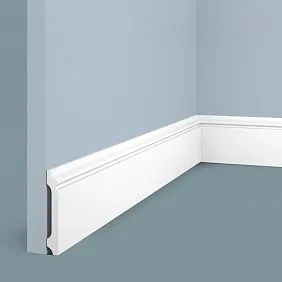
A classic baseboard is not a rectangular plank. It is a complex profile with multiple bevels, relief, and a play of light and shadow.Wooden baseboards of a classic profilehave convexities and concavities that create volume.
The baseboard profile should echo the profile of the picture frame molding. If the frame has a classic concave profile with carved acanthus leaves, the baseboard should also be carved — with floral motifs, festoons, and relief. If the frame is laconic, with a simple molding profile, the baseboard can be simpler — with two or three bevels, without carving.
Important: the baseboard and molding should not be identical — that would create monotony. But they should be coordinated in terms of complexity, scale, and style.
Baseboard height — monumentality and solidity
A narrow baseboard 6–7 cm high will not create a museum-like effect. Height is needed.Wide wooden baseboards 15–20 cm highare the foundation of a classic interior, where monumentality and solemnity are important.
A tall baseboard visually raises the ceiling, creates a vertical line, and makes the room more formal. It protects walls from mechanical damage, conceals floor irregularities, and serves as the base for the entire architectural composition.
In museums, baseboards often reach a height of 25–30 cm. This is not by chance: a tall baseboard sets the scale and makes the space significant. In a home interior, such height is possible if ceilings are 3 meters or higher. With a standard height of 2.7 meters, 15–18 cm is optimal.
Baseboard material — only solid wood
Plastic wood-look baseboard is taboo in a museum-style interior. Even a high-quality imitation will not deceive an eye accustomed to natural materials. The baseboard should be made of solid oak, beech, walnut — the same wood species as the picture frame molding of the mirror.
Solid wood has texture, tactile pleasantness, and the ability to reflect light in a special way. Plastic is dead, flat, cold. Wood is alive, warm, noble.
Baseboard color and finish
In a museum-style interior, a baseboard can be painted white, ivory, or a complex beige. Or it can be finished with a tint that emphasizes the wood grain — honey oak, walnut, dark wenge. Or it can have gilding, patina, decorative painting — if the interior is Baroque or Empire style.
Important: the baseboard and picture frame molding should be in a unified color scheme. If the frame is gold, the baseboard can be white with gold accents. If the frame is natural oak, the baseboard should also be oak. If the frame is dark with patina, the baseboard should follow the same theme.
Technique: mirrors in frames on a wall with panels and a pronounced baseboard
One of the classic museum techniques is placing mirrors on a wall decorated with wall panels (boiserie). This creates a multi-level composition where each element enhances the other.
Wall panels — an architectural frame for the mirror
Wall panels are created from moldings— wooden overlays that are attached to the wall, forming frames, panels, and vertical and horizontal divisions. The classic scheme: the wall is divided into several rectangular sections by moldings 5–8 cm wide. Inside the sections — a painted wall, wallpaper with a delicate pattern, or fabric upholstery.
A mirror in a picture frame is placed inside one of these sections — centered or asymmetrically. The molding creates an outer frame, the mirror's frame creates an inner one. Double framing enhances the mirror's significance, making it the focal point of the composition.
Below — a tall profiled baseboard that finishes the wall, creating a base for the panels. Above — a ceiling cornice that finishes the wall at the ceiling. The mirror finds itself in an architectural context, surrounded by elements that emphasize its status.
Symmetry or asymmetry — a matter of style
A museum composition can be strictly symmetrical: two identical mirrors on either side of a fireplace, console, or door. Molded panels of the same size, baseboard running along the entire perimeter without breaks. This is classic symmetry, characteristic of Baroque, Classicism, and Empire styles.
But asymmetry is also possible — a contemporary interpretation of classicism. One large mirror is offset from the center of the wall. Molded panels are of different sizes but follow a unified rhythm. The baseboard remains unchanged — it anchors the composition, preventing asymmetry from turning into chaos.
Color combinations — panels, baseboard, frame
If the wall inside the panels is painted ivory (a complex beige with a warm undertone), the moldings can be white, the baseboard — white with gilding, the mirror frame — gold with carving. This creates a warm, solemn palette.
If the wall is dark green (emerald, malachite), moldings and baseboards are white or cream, and the mirror frame is gold or white with gilding. The contrast of dark and light, green and gold is a classic combination used in palace interiors.
If the wall is graphite or black (a bold modern option), moldings are white, baseboards are white, and the mirror frame is white or silver. The black-and-white contrast creates graphic quality, severity, and expressiveness.
Colors: warm gold, ivory, complex beige shades
Museum interiors are built on noble, complex colors. Not bright, not loud, but deep, multi-layered, requiring careful observation.
Warm gold is a classic of luxury
Gilding is a symbol of museum space. Gold picture frames, gold mirror frames, gold accents on baseboards and cornices. But it's important to understand: gold comes in different types.
Cold gold (with a greenish or gray undertone) looks cheap, fake. Warm gold (with a honey, reddish undertone) is noble, expensive. Museums use red gold, old gold, tarnished gold with patina.
A mirror frame with gilding must be executed with quality. Gilding can be real (gold leaf or imitation gold leaf) or imitation (gold paint). It's important that the gold is applied to relief carving, emphasizing volume and creating interplay of light and shadow.
A baseboard with gold accents is light gilding on the protruding parts of the profile, on carved elements. Not solid gold painting, but delicate highlighting of details.
Ivory is a complex beige with history
Ivory (elephant ivory color) is not just beige. It's a complex shade with a warm undertone, a slight yellowness, a sense of time. Ivory is never bright—it's muted, soft, noble.
Walls painted in ivory create an ideal backdrop for mirrors in gold frames, for dark furniture, for paintings. Ivory reflects light, makes a room bright but not cold. It's the color of museum halls, palace drawing rooms, libraries.
A baseboard in ivory color (wooden, painted, or MDF with quality enamel) creates a soft horizontal line, not contrasting with the walls but not merging with them either.
Complex beige shades: taupe, greige, crème brûlée
Modern classic uses complex beige shades that can't be described with a single word. Taupe (gray-beige with a brown undertone), greige (gray-beige with a gray undertone), crème brûlée (beige with a caramel undertone)—these colors create a refined, calm palette.
Such shades work as a backdrop for mirrors in frames made of natural wood—oak, walnut, stained beech. They don't draw attention to themselves but create volume, depth, and layering.
A baseboard matching the wall color (taupe, greige) creates a monochrome composition where contrast is created not by color but by relief, light, and texture.
Dark accents: emerald, sapphire, burgundy
If you want to add drama, use dark saturated colors—emerald, sapphire, burgundy. One wall painted in a deep color becomes a backdrop for a mirror in a gold frame. The remaining walls are light (ivory, cream). The baseboard around the entire perimeter is white or cream, creating a unified line.
Dark color in a museum interior is not gloominess but solemnity. It requires sufficient lighting, quality materials, and precise proportions.
For which rooms is the 'museum' approach appropriate: living room, library, formal hallway
The museum style is not suitable for all rooms in a house. It's appropriate where representativeness, solemnity, and status are important.
Living room—the formal space of the house
The living room is a place for receiving guests, hosting family celebrations, and gathering in the evenings. Here, the museum approach works flawlessly. A mirror in a luxurious frame over a fireplace or console, high baseboards around the perimeter, wall panels, ceiling cornice—all this creates the atmosphere of a palace drawing room.
In the living room, there can be several mirrors in frames—symmetrically placed, in a unified style. Lighting—a chandelier with crystal pendants, wall sconces, floor lamps with fabric shades.
Furniture—classic: sofas with carved legs, armchairs with velvet or jacquard upholstery, a coffee table made of solid wood with a marble top.
Library or study—a space of intellect
The library is a room where the museum approach is natural. Bookshelves from floor to ceiling, a mirror in a strict wooden frame between shelves, a high baseboard made of dark oak, ceiling cornice, plaster rosettes.
The color palette of the library is dark, noble: dark green, burgundy, dark blue, chocolate. Baseboard—made of dark wood or painted to match the shelves. Mirror frame—made of the same wood as the shelves.
Lighting—a desk lamp with a green shade, a floor lamp with directed light, built-in lighting in the shelves.
The formal corridor or hall — the first impression
The formal corridor (or hall) in a private house or spacious apartment is the perfect place for a museum-like approach. It's the first thing a guest sees upon entering the home. It's important to make an impression here.
A mirror in a gold baguette frame on the wall opposite the entrance, a solid wood console under the mirror, a high white baseboard with gilding, a ceiling cornice, a chandelier with crystal pendants — the classic composition of a formal hall.
Floor — marble, porcelain stoneware mimicking marble, or parquet with a geometric pattern. Walls — light-colored, with molding panels. Everything creates a sense of solemnity, status, and culture.
Dining room — the celebration of a meal
A dining room in a classic style is another space where a museum-like approach is appropriate. A mirror in a baguette frame on the wall opposite the window (to reflect light), a high baseboard, a ceiling cornice, a chandelier above the dining table.
A mirror in the dining room visually expands the space, multiplies light, and creates a festive feeling. The mirror frame can be gold, white with gilding, or made of natural wood — depending on the overall style of the dining room.
Bedroom — intimate luxury
The bedroom is a more intimate space where the museum-like approach should be softer, more delicate. A mirror in a baguette frame above a dressing table or chest of drawers, a baseboard not too high (12–15 cm), calm colors (ivory, taupe, powder).
In the bedroom, the museum style should not be cold or formal. Softness, coziness, and warmth are important. The mirror frame can be carved, but not too ornate. The baseboard — expressive, but not monumental.
How not to cross the line between solidity and ostentation
The museum style requires a sense of proportion. It's easy to overdo it with gilding, carving, stucco — and the interior will become not museum-like, but theatrical, pompous, ostentatious. How to find the balance?
The rule of three — no more than three decorative levels
If a wall has molding panels, a baguette mirror frame, and a high carved baseboard — that's already three decorative levels. Adding ceiling stucco, rosettes, pilasters — that's overkill. The space will become overloaded, heavy.
Choose three main decorative elements and develop them. The rest is background, support, but not the dominant.
Gilding — an accent, not a fill
Gilding should highlight details, not cover everything solidly. Gold carving on a mirror frame — yes. Gold accents on a baseboard — yes. A completely gold wall — no.
Gilding works on contrast. If surrounded by light, calm surfaces (ivory, white, cream), gold glows, attracts attention. If there's too much gold, it loses significance, becomes background.
Carving — fine and high-quality, not coarse and excessive
Carving on a baguette frame and baseboard should be fine, detailed, and well-executed. Coarse carving, sloppy, with sharp edges — that's not museum style, but an imitation.
Better a simple frame with a high-quality profile than a carved but poorly executed one. The wood should be sanded, the carving — clear, the recesses — neat.
Color restraint — complex shades instead of bright ones
A museum interior does not tolerate acidic, bright, garish colors. No bright pink, lime green, orange. Only complex, muted, noble shades.
If you want color, choose deep, saturated tones — emerald, sapphire, burgundy, chocolate. They create drama, but not vulgarity.
Proportions — not more than the room can handle
A high 25 cm baseboard in a room with a 2.5 m ceiling — a mistake. It will seem huge, out of place, visually eating up the wall height. Proportions must correspond to the scale of the room.
For standard ceilings (2.5–2.7 m) — baseboard 12–15 cm. For high ceilings (3–3.5 m) — 18–22 cm. For very high ceilings (4 m and above) — 25–30 cm.
The same with a baguette frame. A large mirror in a wide frame (15 cm) on a small wall will overwhelm the space. The frame size should be proportional to the size of the mirror and the wall.
Materials and technologies: how to achieve museum quality
The museum effect is impossible without quality materials and professional execution.
Solid wood — the foundation of foundations
Solid oak or beech wooden baseboards, picture frames made from the same wood — this is the foundation. Solid wood has texture, weight, tactility, scent. It is alive.
MDF with high-quality finishing (enamel, veneer) is a compromise acceptable for baseboards and moldings if the budget is limited. But a mirror frame must be made of solid wood — it is an element at eye level that one can approach, examine, and touch.
Carving — hand-carved or high-quality milling
Traditional carving is done by hand by a master carver. It takes time, is expensive, but the result is unique, alive, with character. Hand carving has a slight imperfection that makes it valuable.
Modern carving is done on CNC machines using three-dimensional milling. It is faster, more affordable, but requires quality equipment and subsequent manual finishing.Carved frame from the classic collection, made using this technology, can be indistinguishable from handcrafted work.
Finishing — multi-layered, complex, high-quality
Finishing wood in a museum style is not just one coat of paint. It involves primer, sanding, applying the base tone, sanding, applying patina (artificial aging), sanding, gilding (if needed), and protective varnish or wax.
Patination — a technique that creates an effect of age. Dark patina is applied in the recesses of the carving to emphasize the relief and create depth. On the raised parts — light gilding or simply polishing. The result is a frame or baseboard that looks as if it is a hundred years old, yet perfectly preserved.
Hardware and fasteners — reliable and invisible
A mirror in a heavy picture frame requires reliable mounting. Metal hinges screwed into the frame and anchors or dowels in the wall are used. It is important that the fasteners are hidden and do not spoil the appearance.
Baseboards are attached with screws (for solid wood) or with adhesive (for lightweight MDF baseboards). Screws are covered with decorative caps or filled and painted to match.
Practical tips for creating a museum-style interior at home
Start with one room
Do not try to make the entire house museum-like. Choose one room — a living room, library, or hallway — and work it out thoroughly. This will be your formal space, the calling card of the house.
Hire a professional for design
A museum interior requires knowledge of proportions, architecture, and art history. A designer will help choose the correct baseboard and picture frame profiles, calculate the dimensions of molding panels, and select colors.
Invest in quality materials
Saving on materials will ruin the museum effect. It is better to do less but with solid wood than more with cheap plastic.
Do not rush with decor
A museum interior is created slowly. First, the architectural foundation — baseboards, cornices, panels. Then — mirrors, furniture. Then — textiles, accessories, lighting. Each element is added thoughtfully, with pauses for evaluation.
Regularly care for the wood
Wooden baseboards and frames require care. Wipe them with a dry, soft cloth, and renew the wax or oil coating once a year. This preserves the wood, extends its lifespan, and maintains its noble appearance.
Frequently asked questions
What is the minimum ceiling height needed for a museum style?
Optimally from 2.7 m and above. With a height of 2.5 m, a museum style is possible, but baseboards and picture frames should be more modest in size.
Can a museum effect be created in a small room?
Yes, but with caveats. Use light colors, one accent (a framed mirror), and avoid overloading with decor.
Which baseboard to choose — oak or MDF?
For a museum interior — only solid oak or beech. MDF is acceptable if the budget is limited and the finish is high-quality.
How much does a mirror in a handmade frame cost?
From 30,000 to 200,000 rubles and above — depending on size, carving complexity, and wood species.
Is gilding necessary in a museum interior?
Not mandatory, but desirable as an accent. You can manage with natural wood and patina.
How to care for a gilded frame?
Wipe with a dry, soft cloth; do not use water or chemicals. Gilding is fragile and requires delicate handling.
Can museum style be combined with modern furniture?
Yes, this is called eclecticism. But it requires refined taste and an understanding of balance.
Where to buy quality wooden skirting boards and picture frames?
From specialized companies dealing with wooden decor. It's important to choose manufacturers with experience and a portfolio.
How long does it take to create a museum interior?
From 3–4 months (if using ready-made elements) to a year (if making a custom order with carving and finishing).
Is it necessary to do museum style in all rooms?
No. One or two formal rooms are enough. The others can be simpler, cozier, more modern.
Conclusion
The museum effect in a home interior is not about the size of the space or a huge budget. It's about attention to detail, respect for architectural proportions, and the quality of materials. A mirror in a noble frame, a classic profiled skirting board made of solid wood, thoughtful lighting, carefully chosen colors — these are the elements that create an atmosphere of solemnity, significance, and culture.
Museum style is not for everyone. It requires discipline, maintaining order, and a willingness to live in a space where every detail matters. But for those who value classicism, who understand the language of architecture, who want their home to be not just a place to live but a space of culture — the museum approach provides the tools to create an interior that does not age, does not become tiresome, and remains relevant for decades.
The line between solidity and ostentation is thin. It's easy to cross — just overdo the gilding, carving, or stucco. But if you maintain balance, remember proportions, and choose quality over quantity — the museum interior becomes a space where you want to be, where it's pleasant to return, and which you can be proud of.
For over twenty years, the company STAVROS has been creating elements of classic interiors from natural wood, understanding that museum quality is not achieved by chance but through systematic work at every stage of production. From wood selection to final finishing — every process is controlled, verified, and perfected.Wooden skirting boardsSTAVROS products are made from select solid oak and beech with a moisture content of 8–10%, guaranteeing no deformation or cracking over decades of use. The range includes over thirty classic profiles with heights from 60 to 250 mm, allowing for solutions for rooms of any height and style.Picture frames for mirrorsSTAVROS frames are created using 3D milling followed by manual refinement of carved elements, ensuring detail clarity and the individuality of each piece. The collections include classic Baroque frames with rich carving and gilding, restrained Neoclassical models, and laconic modern frames — over fifty options in total for any interior task. STAVROS offers not only standard solutions but also custom design possibilities: development of unique skirting and frame profiles, creation of frames to custom sizes, selection of tinting and finishing to match a specific interior. In-house full-cycle production allows for quality control at all stages and guarantees product consistency. STAVROS showrooms in Moscow and St. Petersburg provide an opportunity to see the products in person, assess the wood texture, carving complexity, and finish quality. Consultants will help select elements, coordinate them with each other, and calculate the required quantity. Delivery across Russia and CIS countries, professional installation, warranty, and post-warranty service — STAVROS takes responsibility for the result. By creating an interior with STAVROS products, you receive not just wooden elements, but the foundation of a space that will delight generations, preserving beauty, nobility, and museum-quality craftsmanship.


