Article Contents:
- Anatomy of Damage: Why Painted Walls Don't Withstand Real Life
- Two-Level Protection: The Philosophy of Baseboards and Panels as an Engineering Solution
- Baseboard as the First Line of Defense: Height, Material, Profile
- Bottom Row of Panels: Materials, Constructions, Height of the Protective Zone
- Practical Advantages: From Protection to Acoustics
- Visual Aesthetics: From Classic to Modern
- System Installation: Sequence and Nuances
- Ownership Economics: Initial Costs vs. Long-Term Benefits
- Scenarios for Different Rooms: Where Protection is Critical
- STAVROS: System Solutions for Durable Wall Protection

A freshly painted wall looks flawlessly smooth until the first touch. After a few months of use, the picture changes radically: shoe marks in the hallway, vacuum cleaner scratches along all walls, scuffs from chair backs in the dining room, greasy stains from hands near light switches, paint chips in corners from moving furniture. A painted wall without additional protection is a visual idyll that lasts weeks, at most months, and then turns into a chronic source of irritation and the need for constant cosmetic repairs. Professional designers and experienced homeowners have long understood a fundamental truth: the lower third of the wall, from the floor to a meter high, is the zone of maximum mechanical loads, requiring not decorative but functional finishing. A system of a high wooden baseboard combined with protective panels solves the problem comprehensively: it creates a physical barrier against damage, forms a visually clean zone that is easy to wash and not afraid of impacts, while simultaneously adding architectural depth and classic elegance to the interior. This is not a decorative whim, but a rational engineering solution that pays off by protecting the base finish and reducing interior maintenance costs.

Anatomy of Damage: Why Painted Walls Don't Withstand Real Life
Paint as a finish coating has many advantages — a wide color palette, relative ease of application, the ability to create a perfectly smooth surface. However, paint has a fundamental drawback — it is a thin film a few tenths of a millimeter thick, applied to plaster or drywall. This film does not have sufficient mechanical strength to withstand the real loads of a living space. A vacuum cleaner impact during cleaning leaves a dent in the plaster, visible through the paint. A scratch from a sharp object cuts through the paint layer to the base, exposing light primer or gray plaster. A mark from dirty shoes is absorbed into the micropores of the paint, and it is impossible to wash it off completely even with aggressive detergents. Grease splashes in the kitchen penetrate the coating structure, creating indelible stains.
Damage statistics are distributed extremely unevenly along the height of the wall. The zone from the floor to a height of thirty centimeters is the territory of shoe marks, especially in rainy weather in the hallway. Wet shoes touch the wall when changing shoes, leaving dirty imprints. Children playing on the floor lean their hands against the walls, leaving marks. Pets rub against walls, leaving hair and skin oil secretions. The zone from thirty to seventy centimeters is the territory of the vacuum cleaner, mop, and cleaning bucket. Modern robot vacuum cleaners are eight to ten centimeters high, but their bumpers regularly contact walls, leaving scuffs. A traditional vacuum cleaner with a rigid tube scratches walls with every cleaning. The zone from seventy to one hundred twenty centimeters is the height of chair backs, tables, and dressers. Furniture pushed against the wall constantly contacts it, creating scuffs. During rearrangement, impacts and scratches occur.
The psychology of perceiving damaged walls exacerbates the problem. The human eye is tuned to notice defects on uniform surfaces. A small scratch on a perfectly painted white wall attracts attention like a black dot on a white sheet. Each new defect reduces the overall impression of the interior, creates a feeling of neglect and carelessness, even if the other ninety-nine percent of the surface is flawless. The owner either begins to ignore the problem, resigning themselves to visual imperfection, or enters an endless cycle of touch-ups and local repairs, which rarely give an ideal result — the touched-up spot usually differs in tone from the surrounding surface, creating a new defect instead of eliminating the old one.
The economics of painted walls looks attractive only in the short term. The cost of painting a square meter of wall with professional materials ranges from three hundred to eight hundred rubles depending on the quality of the paint and the complexity of preparation. This seems affordable. However, after three to five years of use in high-load zones, the paint requires renewal. A complete repainting of the room is again preparation, priming, two to three coats of paint, temporarily clearing the space of furniture. If cosmetic repairs are carried out every five years, over twenty years of home ownership you will pay four times for painting the same walls. A protection system of baseboards and panels requires larger initial investments but lasts thirty to fifty years without the need for replacement, and the wall area above the panels remains clean and does not require frequent updates.




Two-Level Protection: The Philosophy of Baseboards and Panels as an Engineering Solution
The concept of two-level protection is based on understanding the nature of threats to different height zones of the wall. The first level — the baseboard — protects the very lowest critical zone from the floor to a height of seven to fifteen centimeters. This is the territory of direct contact with the floor, where dust accumulates, water splashes occur during wet cleaning, and impacts from furniture legs happen during rearrangement.Wooden baseboardIt creates a strong barrier of solid oak or ash wood with a density of seven hundred kilograms per cubic meter, which is not afraid of moisture with proper treatment, withstands impacts without chips and deformations, and is easily washed with any household products. The second level — panels with a height from the top of the baseboard to a conditional boundary of seventy to one hundred twenty centimeters from the floor — protects the middle zone from vacuum cleaner scratches, contact with furniture, touches from hands and pets.
The material logic of the system lies in placing the most durable material in the zone of maximum loads. The lower part of the wall receives cladding made of solid wood or high-density MDF with a durable protective coating — polyurethane varnish or hard oil. These materials withstand multiple washing cycles, impacts, scratches, while preserving their appearance. The upper part of the wall, located above one hundred twenty centimeters, is practically not subjected to mechanical impacts — splashes don't reach there, the vacuum cleaner doesn't reach, furniture doesn't touch. This zone can be painted or wallpapered, and the coating will last decades without damage because it is protected by distance from threat sources.
The visual boundary between the protected lower zone and the decorative upper one creates an architectural division of the wall, turning it from a homogeneous plane into a structured composition. The horizontal line of the upper edge of the panels at a height of about a meter divides the wall into two parts with different functions and characters. The lower part is utilitarian, durable, in dark practical tones. The upper part is decorative, lighter, visually expanding the space. This division corresponds to the classic architectural principle — a heavy base at the bottom, a light superstructure at the top — which makes the space visually stable and harmonious.
The psychological effect of the system lies in relieving anxiety about the preservation of the finish. When the entire wall is painted, every movement of furniture, every cleaning, every child's touch is accompanied by internal tension — 'just don't scratch, don't stain.' This creates chronic background anxiety, turns the house into a museum where caution must be observed. Walls protected with panels relieve this tension — you can freely move chairs, vacuum vigorously, allow children to play near walls without fear of irreversible consequences. The house becomes a space for living, not for guarding.
Our factory also produces:


Baseboard as the First Line of Defense: Height, Material, Profile
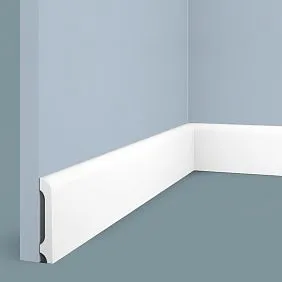
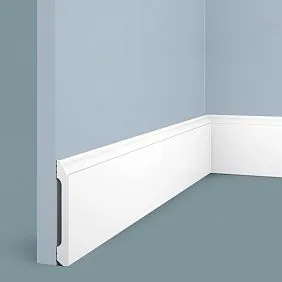
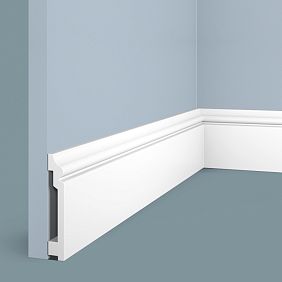
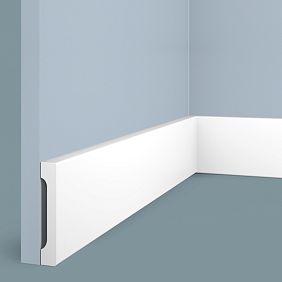
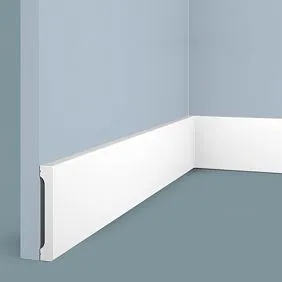
The height of the baseboard directly determines the level of protection and the visual character of the interior. Minimalist baseboards with a height of fifty to seventy millimeters create a delicate boundary between the floor and the wall, protecting the very lowest zone from direct contact with the floor and accidental splashes during cleaning. Such height is appropriate in modern interiors with low ceilings, where a massive baseboard would visually weigh down the space. However, the protective function of a minimal baseboard is limited — it only closes the junction of the floor to the wall, leaving the wall above vulnerable. Medium baseboards with a height of eighty to one hundred millimeters are a universal solution for most living spaces. They create a visually noticeable architectural detail, protect the wall to a height sufficient to repel most accidental contacts, and harmoniously combine with standard ceilings of two fifty to two seventy centimeters.Wide Wooden Skirting BoardA baseboard with a height of one hundred twenty to one hundred eighty millimeters belongs to the category of high or even monumental elements. Such a baseboard creates a powerful visual base, protects the wall to a significant height, and is suitable for rooms with high ceilings and classic interiors where architectural representativeness is important.
The material of the baseboard determines its durability and performance characteristics. Solid oak represents the standard of strength among wood materials. The density of oak is seven hundred to seven hundred fifty kilograms per cubic meter, the high tannin content makes it resistant to humidity and biological damage, and its hardness allows it to withstand impacts without dents.Oak wooden skirting boardIt serves thirty to fifty years without loss of functional properties, it can be repeatedly restored through sanding and reapplication of coating. Ash has slightly lower density but greater elasticity, making it resistant to impact loads. The light shade of ash is ideal for Scandinavian and modern interiors. Larch surpasses oak in moisture resistance due to its high resin content, making it the optimal choice for wet rooms — bathrooms, toilets, kitchens. High-density MDF with moisture-resistant impregnation and durable varnish coating creates a stable, geometrically perfect alternative to solid wood at a lower cost.
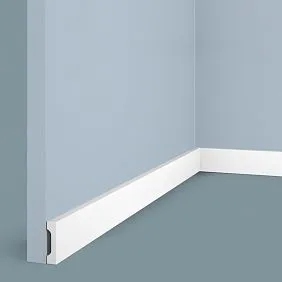
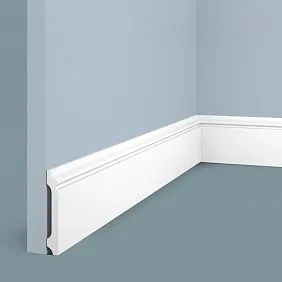
The profile of the baseboard affects ease of cleaning and visual perception. A simple rectangular profile without protrusions and recesses is the most practical from a cleaning standpoint. A smooth surface is easy to wipe with a damp cloth, dust does not accumulate in the relief. Such a profile is characteristic of minimalist and modern interiors. A classic profile with beads, rounds, and chamfers creates a play of light and shadow, adds visual complexity, but requires more thorough cleaning — dust accumulates in the recesses of the relief. A compromise solution is a baseboard with one upper bead of a soft radius, which creates a delicate transition from the vertical of the baseboard to the plane of the wall, visually lightens the mass, while not creating complex dust collectors.
Skirting board attachment is critical for long-term protection durability. Adhesive mounting using polyurethane or MS-polymer adhesive creates a strong, flexible bond that compensates for wood's thermal expansion and withstands decades of use. It's important to use specialized wood adhesives rather than universal construction adhesives—they provide the necessary adhesion and flexibility. Mechanical fastening with screws through the skirting board into the wall offers maximum reliability, especially on uneven walls where adhesive won't ensure full contact. Screws are countersunk, holes are filled with wooden plugs or color-matched acrylic compound, making them invisible. Combined fastening—adhesive along the entire length plus screws at key points—is the optimal solution for most cases.
Get Consultation
Bottom row of panels: materials, constructions, protective zone height
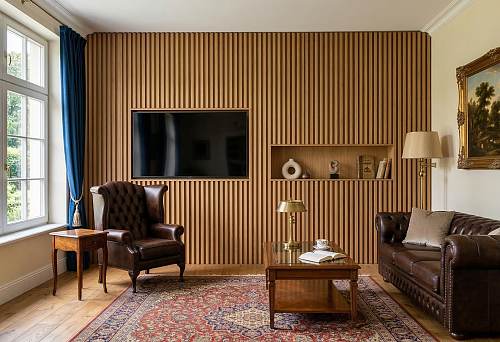
Wooden panels above the skirting board form a second level of protection, covering the wall to a height of seventy to one hundred twenty centimeters depending on interior concept and practical requirements. Paneled wainscoting with raised panels represents a classic solution originating from 17th-18th century palace interiors. A panel consists of a frame—four strips forming a rectangle—and an inserted raised panel—a thin solid wood or veneered MDF board. The raised panel can be flat, creating a strict geometric composition, or profiled with a beveled perimeter, adding volume. A single panel typically measures forty to eighty centimeters in width and equals the full protective zone height vertically. Multiple panels installed flush against each other around the room's perimeter create a regular rhythm of vertical and horizontal lines.
Board-and-batten panels made from individual boards are a more democratic and technological option. Vertical or horizontal boards ten to twenty centimeters wide, one and a half to two centimeters thick are assembled on the wall, forming continuous wooden cladding for the lower zone. Vertical board arrangement creates a graphic structure, visually elongates space upward, characteristic of Scandinavian and contemporary interiors. Horizontal board arrangement forms a banded structure, visually expands the room, associated with ship-lap and nautical style. Boards can be joined tightly with minimal two to three millimeter seams or with pronounced five to eight millimeter gaps, creating shadow lines as a design element.
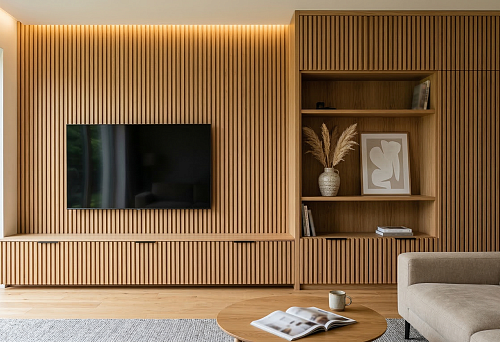
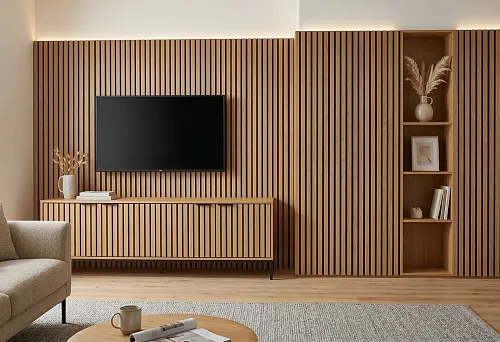
Slatted panels made from narrow strips three to seven centimeters wide with gaps between them create a semi-transparent structure that protects the wall but doesn't completely isolate it. Slats are mounted on hidden battens vertically or horizontally with uniform spacing. Gaps between slats leave the base wall visible, typically painted in a contrasting color. This construction is visually lighter than solid panels, creates dynamic rhythmic patterns, suitable for contemporary interiors. The protective function of slatted panels is partial—they cover the wall where slats make contact but leave gaps vulnerable.
MDF panels with veneer or paint-grade finish are a technological alternative to solid wood. High-density MDF (750-800 kg/m³) is geometrically stable, doesn't warp from moisture, allows milling complex profiles. Veneered with natural oak or ash veneer, MDF is visually indistinguishable from solid wood but cheaper and more technological. Paint-grade MDF after priming and sanding accepts enamel perfectly evenly, creating ceramic-smooth surfaces. This is optimal for monochromatic interiors where panels are painted the same color as the wall above, differing only in texture.
Panel zone height is determined by practical considerations and architectural proportions. Low panels seventy to eighty centimeters high protect only from vacuum cleaners and lower contacts, leaving chair back zones unprotected. This height suits spaces where furniture isn't pushed against walls—corridors, halls. Medium panels ninety to one hundred centimeters high—classic 'chair rail'—cover contact zones with standard-height chair backs, create visually balanced proportions for rooms with 2.5-2.7 meter ceilings. High panels 110-130 centimeters provide maximum protection, suitable for dining rooms with high chairs, rooms with high ceilings, creating monumental architectural atmosphere.
Framing the panel zone from above completes the composition. Wooden molding—a horizontal strip five to ten centimeters wide installed along the panels' top edge—creates a clear boundary, architectural finishing, additional horizontal line. Molding can have simple rectangular profile or classical with beads and coves. If panels are painted wall color, molding is typically made contrasting, emphasizing the boundary. Without molding, panels abut directly against painted wall, creating minimalist contemporary junction.
Practical advantages: from protection to acoustics
Mechanical wall protection—primary and obvious system function. Wooden panels withstand impacts that would leave dents in plastered painted walls. Chair leg impacts, accidental tabletop corner contact during furniture rearrangement, children's bicycle bumps—all these panels absorb without consequences. Scratches on oil-finished wooden surfaces are easily remedied with local sanding and reapplication of oil in ten minutes. Scratches on painted walls require filling, sanding, priming, two-layer painting with laborious color matching.
Moisture protection is especially critical in the kitchen, bathroom, and hallway. Water splashes from dishwashing, condensation in the bathroom, and wet shoes in the hallway—all of this reaches the lower parts of the walls. A painted wall absorbs moisture, the plaster swells, the paint peels, and mold appears. Wooden panels treated with water-resistant oil or varnish are not afraid of splashes—water rolls off the smooth surface without penetrating the structure. Larch and oak contain natural antiseptics that prevent mold development even in high humidity.
Thermal insulation improves through wooden cladding. Wood has low thermal conductivity—approximately ten times lower than concrete or brick. Two-centimeter thick panels plus air gap between panel and wall create additional thermal insulation layer. Walls feel warmer to touch—psychologically important since touching warm wood is more comfortable than cold concrete through thin paint layer. In corner rooms with exterior walls, wooden panels significantly reduce heat loss through lower wall zones where cold bridges often form.
Sound insulation increases thanks to multi-layered structure. Wooden panel, air gap, base wall—this system partially absorbs and disperses sound waves. Medium and high frequencies are especially effectively dampened—voices, dishes, footsteps sounds. Rooms with wooden panels sound less echoey, more intimate compared to rooms with bare painted walls. This is particularly noticeable in rooms with hard floors—parquet, tile—where unpleasant reverberation occurs without sound-absorbing elements.
Concealing utilities becomes possible behind panels. Electrical cables, heating pipes running along lower wall zones are completely hidden behind wooden cladding. This eliminates need for wall chasing—laborious and dusty operation. Cables are routed in conduits along wall surface or within batten space where panels attach. When utility repair or modernization is needed, panels are easily removed providing access, then reinstalled.
System durability is measured in decades. Quality wooden panels from oak or ash with professional varnish finish last thirty to fifty years without replacement. Even under intensive use they only acquire noble patina, becoming visually richer. Painted walls require renewal every five to seven years in medium-load zones, every three to four years in high-load zones. Over thirty years of use, walls with panels involve one installation payment, walls without panels require six to ten cosmetic repair cycles.
Visual aesthetics: from classic to modern
Architectural wall articulation through skirting board and panels creates visual structure transforming flat surfaces into volumetric compositions. Horizontal line of panels' top edge divides wall into two tiers—dark dense bottom and light airy top. This corresponds to fundamental architectural principle—heavy base supports light superstructure—making space visually stable. Vertical articulation through individual panel or board boundaries creates rhythmic structure, organizes space, establishes scale. Human eye needs visual anchors, measurable elements—without them uniform painted walls seem bland and boring.
Color strategy determines interior character. Contrast scheme with dark wooden panels and light upper wall creates classic elegance, visual clarity, traditional respectability. Dark walnut or fumed oak combined with cream or light gray walls forms English study, French dining room, library atmosphere. Tonal scheme with panels and walls in similar shades creates visual unity, expands space, adds modernity. Light ash panels and light gray walls differ only in texture—matte wood versus smooth paint—creating delicate complexity. Monochromatic scheme paints panels same color as wall, leaving difference only in relief—this is contemporary minimalism where form matters more than color.
Wooden panel texture adds tactile dimension. Smoothly sanded panels under glossy varnish create mirror surfaces reflecting light, characteristic of palace interiors. Matte oil preserves wood's natural silkiness, allows feeling texture when touched. Brushed surfaces with mechanically enhanced grain create relief visible from distance and felt when touched. Patinated surfaces with artificial aging add vintage character, history, lived-in space feeling.
Stylistic system versatility allows integration into any interior. Classic requires raised panel wainscoting, moldings with beads, dark noble species—oak, walnut. Neoclassical simplifies forms—simpler profiles, lighter tones, less decorativeness. Scandinavian style uses light species—ash, whitewashed oak, simple vertical boards, minimal processing. Loft combines roughly processed wood with industrial elements—brushed boards, preserved knots, dark oil. Contemporary style operates with geometric purity—paint-grade MDF, monochromatic colors, perfectly smooth surfaces.
System installation: sequence and nuances
Wall preparation begins with condition assessment. For panel mounting on battens, base wall curvature isn't critical—battens are leveled independently of irregularities. For adhesive mounting requires relatively even surface—deviations no more than five millimeters over two meters. Walls must be dry, solid, cleaned of old wallpaper or peeling paint. Deep-penetration primer improves adhesion and strengthens substrate.
Skirting board installation is performed first.wooden baseboardMarked around room perimeter considering corners. Corners are mitered at forty-five degrees for internal joints and external miter joints. Skirting board is attached with adhesive or combined—adhesive plus screws. Horizontal alignment of skirting board's top line is important—it will serve as reference line for panels. Use laser level for control. After installation, seams between skirting boards are filled with color-matched acrylic sealant.
Panel batten installation uses 30x40 mm section battens. Vertical battens are attached to wall with anchors at forty to fifty centimeter intervals. Horizontal battens are installed along top and bottom edges of future panels. Battens are leveled and plumbed, creating perfectly even plane. Air gap forms between battens and base wall where cables, pipes can be routed. If desired, space is filled with sound insulation material—mineral wool—which additionally improves acoustics.
Panel attachment to battens uses screws or clips. Screws are driven through panel face where they'll later be covered by molding or in relief recesses where they're invisible. Holes are filled with wooden plugs. Clips—special metal brackets attached to battens—engage panel grooves creating hidden fastening without visible hardware. Two to three millimeter expansion gaps are left between panels for thermal expansion.
Top molding installation completes panel zone. Molding is attached horizontally along panels' top edge creating architectural framing. Molding can attach to panels or directly to wall above panels. Molding corners are mitered at forty-five degrees and joined. After installation, seams are filled.
Final processing includes sanding filled areas, applying protective coating to panels if supplied unfinished, painting wall above panels. If concept involves painting panels, perform priming, sanding, multi-layer painting with intermediate sanding.
Ownership economics: initial costs versus long-term benefits
Material costs for protection system are significantly higher than for simple painting. Qualitywith a classic profile creates a sense of solidity, reliability.Oak skirting boards cost from one and a half to three thousand rubles per linear meter. Wooden panels range from four to ten thousand rubles per square meter depending on the wood species and finish. Moldings, fasteners, battens, and final coatings add another thirty to forty percent to the cost. Professional installation is priced from two to four thousand rubles per square meter. In total, protecting one room with a floor area of twenty square meters using panels one meter high will cost one hundred fifty to three hundred thousand rubles. Painting the same walls costs thirty to sixty thousand rubles. The difference in initial costs is fivefold.
However, an analysis of long-term costs changes the picture. Painted walls in high-traffic areas require renewal every four to five years. Each renewal costs thirty to fifty thousand rubles for materials and labor. Over thirty years of homeownership, you will renew the paint six times, spending a total of two hundred to three hundred thousand rubles—the same amount as the installation of panels, which during this time will not require replacement, only possible surface renewal through sanding and reapplication of oil or varnish—an operation costing fifteen to twenty thousand rubles.
An additional benefit is the protection of the base wall from damage that requires major repairs. A deep scratch or dent in plaster requires local plastering, costing from five to ten thousand rubles per square meter, considering the complexity of material matching and repainting. One serious damage to a painted wall can cost as much as prevention through panel installation.
The impact on property value is also considered. An apartment with high-quality wooden panels is perceived as more expensive and prestigious compared to simply painted walls. When selling, the difference in appraisal can be two to five percent of the total value, which for an apartment worth ten million gives an additional two hundred to five hundred thousand rubles in value—more than the cost of installing panels.
Scenarios for different rooms: where protection is critical
The hallway is the area of maximum wall load. Here, shoes are taken off and put on, leaving dirty marks on the walls. Bags, umbrellas, and strollers regularly contact the walls. Bicycles and scooters are stored against walls. Without protection, painted hallway walls require renewal annually. Wooden panels made of hardwoods—oak or larch—with a height of one hundred to one hundred twenty centimeters and a durable polyurethane varnish create an impenetrable barrier. Panels are easily cleaned with any means, are not afraid of moisture from wet shoes, and withstand impacts without damage.
The kitchen is exposed to grease, moisture, and high temperatures. Splashes from the stove reach the walls, condensation settles on surfaces, and accidental impacts from dishes leave chips. Painted kitchen walls quickly become covered with an indelible grease film, and paint peels from moisture. Wooden panels with moisture-resistant coating or MDF under durable enamel protect the lower part of the walls. Panels are cleaned with regular kitchen detergents and do not absorb grease thanks to the dense coating. Panel height of seventy to eighty centimeters covers the area of maximum splashes.
The dining room requires wall protection at the level of chair backs. Chairs are regularly moved in and out, their backs contact the walls, leaving scuff marks. A classic panel zone height of ninety to one hundred centimeters completely covers this area. Wooden panels with raised panels made of noble oak or walnut create not only protection but also a formal atmosphere for the dining room.
The children's room is a territory of chaos where walls are put to the test. Children draw on walls, throw toys, lean with dirty hands, and spill drinks. Painted walls in a child's room become ruined within months. Wooden panels seventy to one hundred centimeters high with a washable coating save the situation. Marker stains wash off, scratches are unnoticeable on the wood texture, and impacts do not leave dents.
The bedroom is a room with minimal wall load, but even here panels bring benefits. The bedside area, where hands touch when turning on a lamp, receives protection. Panels create a cozy atmosphere, improve acoustics, and add tactile warmth.
STAVROS: system solutions for durable wall protection
Creating an effective wall protection system requires quality materials, precise manufacturing, and professional installation. The company STAVROS offers a full rangecornices, moldings, and baseboardsof solid noble wood species and high-density MDF. Skirting board collections include profiles of all heights from minimalist fifty millimeters to monumental one hundred eighty, in simple and classic forms. Wooden panels are made from oak, ash, walnut, and larch with various finishing options—from mirror gloss to rough brushing. The possibility of custom manufacturing to the dimensions of a specific room eliminates adjustments and waste. Experience in implementing hundreds of projects guarantees an understanding of practical requirements, where each element works for durability, functionality, and beauty, turning utilitarian wall protection into an architectural solution that serves for decades and adds value to the interior.