Article Contents:
- Trim Products: Meters of Architecture
- Ceiling Cornices: The Upper Boundary
- Wall Moldings: Vertical and Horizontal Lines
- Floor Baseboards: Protection and Completion
- Architraves: framing openings
- Individual Elements: Accents and Focal Points
- Ceiling Rosettes: Center and Framing
- Corbels and Brackets: Visual Support
- Keystones: The Apex of the Arch
- Decorative Overlays: Point Ornamentation
- Architectural Forms: Order Monumentality
- Columns: Verticals of Power
- Pilasters: flat columns
- Capitals and Bases: Separately and in Sets
- Panels and Coffers: Decorative Planes
- Wall Panels: Relief Rectangles
- Ceiling Coffers: Volumetric Cells
- Special Elements: Solutions for Non-Standard Tasks
- Flexible Moldings and Cornices: For Arches and Curves
- Corner Elements: Joining Without Cutting
- Functional Types: Decoration with Utility
- Baseboards with Cable Channels: Hidden Wiring
- Cornices with Lighting: Floating Ceiling
- Frequently Asked Questions About Types of Molding
- What's the Difference Between Cornice, Cove, and Picture Rail?
- Which Element is the Most Popular?
- Can Elements of Different Styles Be Combined?
- How much does one meter of cornice weigh?
- Where to Buy Rare Types of Molding (Coffers, Large Columns)?
- Can polyurethane molding be painted?
- Conclusion: The System That Creates Architecture

You are facing a choice. The interior is almost ready — walls are leveled, ceilings painted, floors laid. But something is missing. The space is functional but faceless. It lacks that architectural expressiveness that turns a box into a home, an office into a headquarters, a restaurant into a place with character. And then you hear the word: molding. But what does that mean in practice? Cornices? Rosettes? Columns? Moldings? Baseboards?Types of polyurethane moldingsare so diverse that it's easy to get confused without systematization. One element is called a cove, the second a cornice, the third a molding — and it's all about the same thing, just different terms.
This article is a complete classification of decorative polyurethane elements. We will categorize all types: linear products (moldings, cornices, baseboards, casings — what comes in meters, installed along perimeters, along lines), piece elements (rosettes, consoles, keystones, overlays — what is sold individually, installed at specific points as accents), architectural forms (columns, pilasters, capitals, bases — full order systems creating monumentality), panels and coffers (large decorative planes for walls and ceilings), special elements (flexible for arches, corner for joining without cutting), functional types (with cable channels, with lighting, with practical function besides decorative). We will analyze each type by parameters: sizes, purpose, where applied, cost, installation method. The goal is to provide a tool for informed choice, when you understand which element is for which task, how elements combine, how to assemble a composition from them, turning the interior into a work of art.

Linear products: meters of architecture
Linear elements are the foundation of a decorative system. Sold by the meter (more precisely, in planks 200-240 cm long), installed along lines (along the ceiling perimeter, along wall contours, along the floor, around doors and windows). Create relief boundaries, frames, transitions between planes.




Ceiling cornices: the upper boundary
Ceiling cornice (also called cove, molding, ceiling baseboard) — a profiled plank installed at the junction of wall and ceiling. Width from 40 to 250 mm (measured diagonally from the lower point of wall contact to the upper point of ceiling contact). Standard plank length 240 cm (some manufacturers produce 200 cm).
Functions: visual separation of ceiling from walls (creates a boundary, fixes the transition), masking of joint defects (gaps, plane irregularities), placement of hidden lighting (LED strip behind the cornice with a gap from the ceiling — light directed upward, ceiling appears floating), architectural proportion (wide cornice 120-200 mm visually lowers room height, narrow 40-70 mm preserves it).
Profile types:
Smooth — without ornament, simple geometry (one or two curves, beads). Width 40-90 mm, weight 0.3-0.7 kg/meter, price 280-580 rub./meter. For modern interiors (minimalism, Scandinavian, contemporary).
Ornamental classical — egg-and-dart (oval beads), dentils (small rectangular teeth), meander (Greek broken line pattern), pearls (bead-and-reel, chain of round beads). Width 70-150 mm, relief 8-20 mm, weight 0.6-1.2 kg/meter, price 480-1050 rub./meter. For neoclassical, classicism.
Ornamental baroque — acanthus leaves (stylized curled leaves), garlands (flowers and ribbons), cartouches (oval frames), volutes (S-shaped scrolls). Width 100-220 mm, relief 15-35 mm, weight 1.0-2.0 kg/meter, price 750-1650 rub./meter. For baroque, rococo, palace interiors.
With cavity for lighting — profile contains a protrusion or is installed with a 50-100 mm gap from the ceiling, LED strip placed in the gap. Width 80-180 mm, price 620-1380 rub./meter. For modern interiors with floating ceiling effect.
Installation: on adhesive (polyurethane or acrylic mounting adhesive, fixed with painter's tape for 24 hours until dry) or on screws (for heavy cornices wider than 150 mm, weight over 1.5 kg/meter). Corners joined at 45° (cut with miter saw or miter box) or ready-made corner elements used.
Our factory also produces:


Wall moldings: vertical and horizontal lines
Wall molding — narrow profiled plank for wall decoration. Width from 20 to 120 mm, thickness 10-25 mm, plank length 200-240 cm.
Functions: framing decorative panels (moldings highlight rectangular or square zones on the wall — inside the panel is painted a contrasting color, wallpapered, covered with fabric), framing doors and windows (molding goes around the opening perimeter — creates a decorative casing), horizontal wall division (molding at height 90-120 cm from floor divides wall into lower and upper parts — lower painted one color, upper another, molding is the boundary), framing mirrors and paintings (molding around perimeter creates a frame).
Profile types:
Simple rectangular — one or two beads or grooves, minimal relief. Width 20-60 mm, price 180-420 rub./meter. Universal.
Figural classical — curves, flutes, egg-and-dart, dentils (like cornices, but narrower). Width 50-100 mm, price 350-780 rub./meter. For classical interiors.
Wide decorative — complex profile with ornament (acanthus, meander, plant motifs). Width 80-120 mm, relief up to 20 mm, price 520-1100 rub./meter. For creating monumental panels.
Installation: on adhesive (wall surface even, adhesive applied in zigzag or dots, molding pressed, fixed with tape for 12-24 hours). Joints straight (end to end) or at 45° (in frame corners).
Get Consultation
Floor baseboards: protection and completion
Floor baseboard — profiled plank at the junction of wall and floor. Height from 40 to 300 mm (standard 60-140 mm, European baseboards 150-300 mm), plank length 200-240 cm.
Functions: masking thermal expansion gap (when laying laminate, parquet, leave 8-15 mm gap around perimeter, baseboard covers it), protection of lower wall part (from kicks, mop, vacuum, furniture), visual boundary (baseboard separates floor from wall, completes flooring), hiding wiring (baseboards with cable channel contain cavity for cables).
Types:
Simple — minimal relief, one or two grooves. Height 50-100 mm, price 250-580 rub./meter. For modern interiors.
Figural — complex profile with curves, beads (imitation of classical wooden baseboards). Height 70-140 mm, price 380-820 rub./meter. For neoclassical.
European high baseboards — baseboards 150-300 mm, creating a powerful vertical boundary. Visually raise the ceiling. Height 150-280 mm, price 680-1650 rub./meter. For modern neoclassical interiors, lofts.
With cable channel — base attached to wall with screws or adhesive, contains cavity for cables, cover snaps on top. Height 60-140 mm, channel cross-section 15×15 to 30×35 mm, price 420-950 rub./meter. For hidden wiring.
Installation: on adhesive (for light baseboards up to 100 mm) or on screws (for high ones and with cable channel). Corners joined at 45° or straight with decorative corner overlays.
Architraves: framing openings
Casing — molding installed around the perimeter of a door or window opening. Width from 40 to 120 mm, thickness 10-30 mm.
Functions: concealing the gap between the door frame and the wall (a 10-30 mm gap remains after door installation, the casing covers it), decorative framing (the door or window is highlighted with a frame, becoming an architectural accent).
Profile types: similar to wall moldings (simple, figured classic, baroque). Price 220-850 rubles per meter.
Installation: with adhesive or finishing nails (thin 20-30 mm nails into the wall through the casing, heads are countersunk and filled with putty). Corners are joined at 45° (upper corners of the opening) or at 90° (if the casing runs only on the sides and top, with no bottom part — the side casings meet the floor straight).
Individual pieces: accents and focal points
Individual pieces are sold by the piece (not by the meter), installed in specific locations as decorative accents. They create focal points, visual support, and compositional finishing touches.
Ceiling rosettes: center and framing
A ceiling rosette is a round, oval, or polygonal element installed on the ceiling (usually in the center of the room under a chandelier). Diameter from 25 to 120 cm (standard 40-70 cm), thickness 15-40 mm, weight from 0.5 to 8 kg.
Functions: framing the chandelier (the rosette creates a decorative background, enhancing the chandelier's visual weight), concealing ceiling defects at the mounting point (stains from an old chandelier, uneven plaster), centering the composition (the rosette marks the geometric center of the room).
Types of ornament:
Smooth with geometric fluting — radial or concentric grooves, minimal relief 5-10 mm. Diameter 30-60 cm, price 650-1800 rubles. For minimalism, Art Deco.
Classical — egg-and-dart, dentils, meander, acanthus leaves in a circular composition. Diameter 40-80 cm, relief 10-25 mm, price 1200-3500 rubles. For neoclassical, classicism.
Baroque — multi-tiered relief, garlands, cartouches, cupids, roses. Diameter 60-120 cm, relief 20-40 mm, weight 3-8 kg, price 2800-7500 rubles. For Baroque, Rococo.
Installation: with adhesive (small rosettes up to 60 cm, weight up to 2 kg) or adhesive + screws (large rosettes 70+ cm, weight over 2 kg — 3-5 screws through the rosette into the ceiling around the circumference, heads are filled with putty and painted). The center of the rosette aligns with the chandelier's suspension point (the wire passes through the central hole of the rosette).
Corbels and brackets: visual support
A corbel (bracket) is a vertical or slanted element that mimics a support (visually supporting a cornice, shelf, or arch). Height from 60 to 300 mm, width 50-200 mm, projection from the wall 30-100 mm.
Functions: visual support for cornices (corbels are installed under the cornice at corners or along the wall at regular intervals — creating the impression that the corbels hold the cornice), arch decoration (corbels on the sides of the arch at the springing level — visually supporting the arc), functional shelves (a corbel under a wooden or glass shelf — actually supports the weight of books, decor).
Types of ornament:
S-shaped volutes — classic form, scroll at top and bottom. Height 80-180 mm, price 580-1500 rubles per piece. For classic style.
Acanthus leaves — stylized curled leaves, baroque lushness. Height 100-250 mm, price 850-2500 rubles. For Baroque.
Geometric rusticated — straight blocks with imitation stone masonry. Height 120-300 mm, price 950-2200 rubles. For loft style, industrial.
Installation: with adhesive + screws (the corbel is heavy, hangs on the wall at an angle — adhesive + 2-3 screws are mandatory). If the corbel is functional (supports a shelf with a load), secure with wall anchors.
Keystones: the top of the arch
A keystone is a decorative element for the top of an arch. Shape: trapezoidal (widening downward), wedge-shaped (triangle), sculptural (mascaron, cartouche, coat of arms). Height 80-250 mm, width 60-200 mm.
Functions: completing the arch (a symbol of strength, historically the final stone holding the arch), decorative accent (draws the eye to the center of the arch), concealing molding joints (if the arch's curve is framed with flexible molding, the keystone covers the joint at the top).
Price: 850-4500 rubles depending on size and complexity.
Installation: with adhesive, for weight over 1.5 kg additional screws.
Decorative overlays: point ornamentation
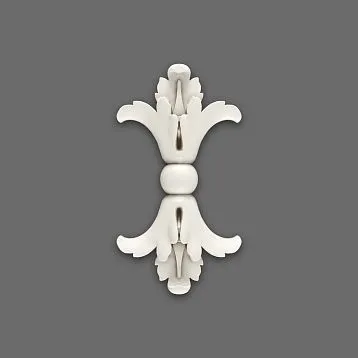
Overlays (appliqués, decors) — small individual pieces for decorating furniture, doors, panels, mirrors. Size from 5×5 cm to 30×40 cm.
Shapes: rosettes (round ornaments 5-15 cm in diameter), corner elements (decorate the corners of molding frames), cartouches (oval frames 10×15 cm), leaves and flowers (stylized, relief 8-20 cm).
Application: overlays are glued onto furniture fronts (cabinets, dressers — transforming IKEA into classic style), onto doors (an overlay in the center of the door panel — an accent), onto the corners of molding frames (instead of mitering moldings at 45° in the corner — a corner overlay, easier installation).
Price: 120-850 rubles per piece.
Installation: with adhesive (small weight 20-150 grams, adhesive holds without screws).
Architectural Forms: Order Monumentality
Architectural forms — full-scale elements of the classical order system (columns, pilasters, capitals, bases). Create monumentality, status, academic rigor.
Columns: verticals of power
Column — a vertical cylindrical element from floor to ceiling. Height from 180 to 400 cm (standard 220-280 cm for ceilings 2.5-3.0 meters), diameter from 15 to 40 cm.
Structure: base (lower part, stands on the floor, widened), shaft (cylindrical middle part, smooth or with flutes — vertical grooves), capital (upper decorated part, visually supporting the entablature or arch).
Orders:
Doric — simplicity, massiveness. Low base (height 8-12 cm), smooth shaft or with 20 wide flutes, strict capital (convex echinus + square abacus slab). Shaft diameter 20-35 cm, height 200-280 cm, price per set (base + shaft + capital) 12000-22000 rubles per column.
Ionic — elegance, slenderness. Tall base with toruses (height 12-18 cm), shaft with 24 narrow flutes, capital with volutes (side scrolls). Shaft diameter 18-30 cm, height 220-300 cm, price 16000-32000 rubles per column.
Corinthian — luxury, opulence. Base as in Ionic, shaft with flutes, capital with two-three tiers of acanthus leaves (complex relief). Diameter 20-35 cm, height 240-320 cm, price 22000-55000 rubles per column.
Application: columns are installed in halls (on either side of the entrance), living rooms (framing the fireplace or sofa area), dining rooms (in corners or on either side of an arched opening). Require high ceilings (minimum 2.7 meters, optimally 3.0+ meters) and spacious rooms (area 30+ m² — in a small room columns are overwhelming).
Installation: base is glued to the floor (adhesive + weight for 24 hours), shaft is placed on the base and attached to the wall with screws (3-5 screws through the shaft into the wall along the height; if the column is round and does not fully contact the wall — screws in the rear part, heads are filled with putty), capital is placed on the shaft (glued + screws).
Pilasters: flat columns
Pilaster — a flat vertical projection on a wall, replicating the structure of a column (base, shaft, capital), but not cylindrical, rather rectangular in cross-section. Width 80-200 mm, height from floor to ceiling or to frieze level.
Advantage over a column: pilaster does not occupy space (projects from the wall by 30-80 mm, a column occupies an area with a diameter of 20-40 cm), cheaper (pilaster is lighter, less material — price 8000-35000 rubles per pair, columns 24000-110000 rubles per pair).
Application: wall decoration (pilasters in room corners, on either side of doors, windows, fireplaces — create vertical divisions, rhythm), portal framing (two pilasters on either side of an arch + cornice on top = portal).
Installation: glued to the wall with its entire back plane (adhesive applied to the entire surface, pilaster pressed, secured with tape for 24 hours). For heights over 2.5 meters, additional screws (3-4 screws along the height).
Capitals and bases: separately and in sets
Capital and base are sold both as part of a column/pilaster set and separately (for creating compositions — e.g., a capital on a wall without a column, as a decorative element, or a base as a pedestal for a sculpture).
Price of individual capitals: Doric 1800-4500 rubles, Ionic 2500-7500 rubles, Corinthian 4500-15000 rubles (depends on size and relief complexity).
Price of bases: 1200-3500 rubles.
Panels and coffers: decorative planes
Panels and coffers — large flat elements with relief ornamentation for decorating walls and ceilings.
Wall panels: relief rectangles
Decorative panel — a rectangular or square element with a relief ornament in the center and framing along the perimeter. Size from 40×60 cm to 120×240 cm, thickness 15-35 mm, weight 1.5-8 kg.
Ornaments: geometric (diamonds, circles, lines), floral (leaves, flowers, garlands), classical (meander, egg-and-dart, rosettes), narrative (bas-reliefs with figures, scenes).
Application: panels are mounted on walls (one large 100×150 cm panel in the center of a wall above a sofa — accent; or several 60×90 cm panels in a row along a wall — rhythm, decorative frieze), on furniture fronts (panel on a cabinet door — turns a smooth door into a paneled one).
Price: 1500-12000 rubles per panel (depends on size and relief complexity).
Installation: with adhesive + screws (panel is heavy, hangs vertically on a wall — adhesive + 4-6 screws around the perimeter, screw heads are countersunk, filled with putty).
Ceiling coffers: volumetric cells
Coffer — a volumetric cell for a ceiling (a recess of square or rectangular shape, framed by profiled beams). Cell size from 60×60 cm to 120×120 cm.
Structure: beams (moldings 80-150 mm wide, forming a grid on the ceiling), panels (flat or relief inserts in the grid cells), rosettes (optionally in the center of each cell — small rosettes 15-30 cm in diameter).
Effect: A coffered ceiling (divided into cells) appears visually taller (cells create perspective and depth) and more monumental (evoking associations with ancient temples and palaces).
Application: Living rooms, studies, libraries in country houses and mansions (minimum ceiling height of 3.0 meters, room area of 30+ m²).
Price for a 30 m² ceiling kit: 45,000-120,000 rubles (depends on cell size, complexity of beam ornamentation, presence of panels and rosettes).
Installation: Beams are glued to the ceiling according to markings (forming a grid), panels are inserted into the cells (glued), rosettes (if present) are glued to the center of the cells.
Special elements: Solutions for non-standard tasks
Flexible moldings and cornices: For arches and curves
Flexible molding is a profiled strip made of elastic polyurethane with a density of 180-250 kg/m³ (compared to 320-380 kg/m³ for rigid ones). It can be bent by hand to a radius from 300 mm (narrow 30-50 mm) to 1000 mm (wide 90-120 mm) without heating.
Application: Framing arched openings (molding along the arch curve), wrapping around columns (molding encircles a round column), decorating curved walls (radius partitions, bay windows).
Price: 30-60% more expensive than rigid ones (flexible molding 80 mm — 520-850 rubles/meter, rigid equivalent 350-580 rubles/meter).
Installation: Bent by hand, glued, fixed with painter's tape or temporary nails for 24 hours (the molding tends to straighten, fixation holds it until the glue dries).
Corner elements: Joining without cutting
A corner element is a ready-made angle for joining cornices or moldings without cutting at 45°. Internal corner (concave 90°) or external (convex 90°). Size matches the cornice/molding (for a 100 mm cornice — corner element 100×100 mm).
Advantage: Simplifies installation (no miter saw or miter box needed, corners are not cut — simply insert the ready-made element between cornice strips).
Disadvantage: Limited assortment (corner elements are produced only for popular cornice models; for exclusive models, you won't find them — you'll have to cut).
Price: 280-720 rubles per pair (internal + external or two internal).
Installation: Cornices are cut straight (90° end), the corner element is glued into the corner, cornices are joined to the corner element with their ends (the joint is filled with sealant).
Functional types: Decorative and practical
Baseboards with cable channels: Concealed wiring
Described above in the section on linear moldings. The base contains a cavity for cables, the cover snaps on. Channel cross-section from 15×15 to 30×35 mm (accommodates from 2-3 to 8-10 cables). Price 420-950 rubles/meter.
Cornices with lighting: Floating ceiling effect
The cornice is installed with a 50-120 mm gap from the ceiling, LED strip is placed in the gap (light directed upward onto the ceiling). The ceiling is illuminated from within, visually detaching from the walls, creating a floating effect.
Types:
Cornices with a shelf (the profile contains a horizontal shelf on which the LED strip is placed). Width 100-180 mm, price 720-1380 rubles/meter.
Cornices without a shelf (installed with a gap, the strip is glued to the wall behind the cornice). Width 80-150 mm, price 620-1050 rubles/meter.
Installation: The cornice is glued to the wall at a distance of 50-100 mm from the ceiling (mark a horizontal line below the ceiling, align the cornice to the line), the LED strip (12V or 220V) is placed in the gap (glued with double-sided tape to the wall or on the cornice shelf), wires are routed to the power supply.
Frequently asked questions about types of molding
What is the difference between a cornice, cove, and batten?
These are synonyms referring to the same element — ceiling skirting (a profiled strip at the wall-ceiling junction). Terms from different traditions: cornice (general construction term), cove (French, from 'galet' — pebble, rounding), batten (French, from 'baguette' — stick, strip). Professionals often use 'cornice', salespeople in showrooms use 'batten' (sounds more refined), builders use 'cove' or 'cornice'.
Which element is the most popular?
Ceiling cornices (installed in 70-80% of interiors with decorative molding — a basic element that transforms a standard ceiling into a decorated one) and floor baseboards (in 90-95% of interiors — a functional necessity plus decoration). Chandelier rosettes are in third place (40-50% of interiors with molding).
Can elements of different styles be combined?
Technically yes, aesthetically — with caution. A classic cornice with Ionic motifs + a Baroque rosette with cupids = eclecticism (can work if the room is large and the styles are balanced in mass). A minimalist smooth cornice + a Baroque rosette = dissonance (incompatible languages). Rule: elements in one room should belong to one style or adjacent ones (Neoclassicism + Classicism = compatible, Minimalism + Baroque = incompatible).
How much does one meter of cornice weigh?
Depends on the width and density of the polyurethane. A smooth 50 mm cornice weighs 0.3-0.5 kg/meter, an ornamental 100 mm cornice 0.7-1.2 kg/meter, a Baroque 200 mm cornice 1.5-2.5 kg/meter. Weight is important for choosing the mounting method (light up to 1 kg/meter — with adhesive, heavy over 1.2 kg/meter — adhesive + screws).
Where to buy rare types of molding (coffers, large columns)?
Local showrooms keep only popular items in stock (cornices, baseboards, rosettes of standard sizes). Rare elements (coffers, columns 3+ meters high, large panels, exclusive ornaments) are ordered directly from manufacturers (delivery 5-10 days, minimum order amount usually 15,000-25,000 rubles).
Can polyurethane molding be painted?
Yes, polyurethane can be painted with acrylic paints of any color. The factory primer is white (ready for painting without preparation). Technique: if a different color is needed — paint with acrylic paint using a roller (smooth areas) and a brush (ornament) in two coats, with a 4-hour interval. If you want gilding, patina, imitation of wood or stone — use special decorative techniques.
Conclusion: a system that creates architecture
Types of polyurethane moldingform a complete system of decorative elements covering all architectural tasks for interiors and facades. Linear products (cornices, moldings, baseboards, architraves) create lines, boundaries, frames — sold by the meter, frame perimeters, divide planes (price 180-1650 rubles/meter, installation with adhesive or screws, corners joined at 45° or with ready-made corner elements). Individual elements (rosettes, consoles, keystones, overlays) create accents, focal points, visual support — installed individually in specific places (price 120-7500 rubles per element, installation with adhesive, heavy ones additionally with screws). Architectural forms (columns, pilasters, capitals, bases) create monumentality, an order system, academicism — full-height verticals from floor to ceiling (price 8000-55000 rubles per set, installation adhesive + screws). Panels and coffers (wall panels, ceiling coffers) create relief planes, volume, perspective (price 1500-12000 rubles per panel, a set of coffers for a ceiling 45000-120000 rubles). Special elements (flexible for arches, corner for simplified installation) solve non-standard tasks. Functional types (with cable channels, with lighting) combine decor and practical utility.
Types of polyurethane moldingdiffer by purpose (ceiling, wall, floor, facade), by form (linear, individual, architectural), by style (smooth minimalist, classic ornamental, Baroque lavish), by function (purely decorative or with practical utility — wiring, lighting). The choice of elements depends on the interior style (minimalism requires smooth thin profiles, classic — ornamental medium-width, Baroque — wide lavish), room size (small rooms are overloaded with wide cornices and large rosettes, large ones require monumental elements for scale), ceiling height (low ceilings 2.4-2.5 m — narrow cornices 40-70 mm, high 3.0+ m — wide 120-200 mm), budget (basic set cornice + baseboard for a 70 m² apartment — 15000-30000 rubles, full decor with columns, panels, coffers for a 300 m² house — 200000-800000 rubles).
Classification of moldinghelps navigate the diversity, understand which element is for which task, how elements combine, how to assemble a composition. Basic set (ceiling cornice + floor baseboard + chandelier rosette) turns a standard room into a decorated one (material cost 8000-18000 rubles for a 20 m² room, DIY installation in 6-10 hours or by a master 4500-8000 rubles). Extended set (cornice + baseboard + rosette + moldings for framing panels + door architraves) creates a classic interior (material cost 18000-45000 rubles for a room, installation 8000-15000 rubles). Full set (cornice with lighting + tall European baseboards + large rosette + moldings + columns or pilasters + panels + coffers on the ceiling) creates a palatial interior (material cost 150000-500000 rubles for a 40-60 m² room, installation 45000-120000 rubles).
The company STAVROS has been manufacturing all types of polyurethane molding since 2002 at its own factory in the Moscow region, using European equipment (injection molding machines Hennecke, Germany) and raw materials (polyurethane compositions BASF, density 320-380 kg/m³ for rigid elements, 200-250 kg/m³ for flexible ones). STAVROS assortment: 1850+ items covering all types of elements (420 ceiling cornice models width from 40 to 250 mm, 380 wall molding models width from 20 to 120 mm, 280 floor baseboard models height from 40 to 300 mm, 160 ceiling rosette models diameter from 25 to 120 cm, 95 column and pilaster sets of all orders height from 180 to 400 cm, 85 console and bracket models height from 60 to 300 mm, 65 keystone models, 140 decorative overlay items, 120 wall panel models size from 40×60 to 120×240 cm, 35 ceiling coffer sets, 45 flexible molding models, corner elements for 180 cornice models).
Quality of STAVROS molding: relief detailing up to 0.3 mm (each acanthus leaf, each Ionic bead, each dentil is reproduced clearly, symmetrically — master models are hand-sculpted by sculptors with academic education, molds are high-precision silicone Wacker Germany), three-layer snow-white primer (thickness 0.15-0.18 mm, acrylic Caparol, applied by robotic sprayers SAMES France, uniformity 100%, ready for painting without sanding), polyurethane density 320-380 kg/m³ (strength, durability 30-50 years, no shrinkage or deformation, frost resistance down to minus 50°C, moisture resistance 100%), precise geometry (stated 100 mm — measure with a caliper, get 99.7-100.3 mm, deviation ±0.3 mm — element joints are perfect without gaps).
Choose STAVROS — choose a complete system of decorative elements, classified, systematized, stylistically coordinated (all elements of one collection share common ornamental motifs — Ionic motifs of the same shape, acanthus leaves of the same pattern, profiles of identical proportions — you assemble a composition, elements combine harmoniously), affordable in price (180-1650 rubles/meter linear, 120-7500 rubles individual, 8000-55000 rubles architectural forms — 2-5 times cheaper than gypsum and wooden analogues), high quality (European polyurethane, detailing 0.3 mm, durability 30-50 years), diverse (1850+ items — you will find elements for any style from minimalism to Baroque, any room from a 12 m² bedroom to a 200 m² banquet hall, any budget from 8000 to 500000 rubles). Your interior deserves an architectural system — STAVROS molding creates it, turning flat walls into relief planes, bare ceilings into coffered vaults, rectangular openings into framed portals, standard rooms into spaces with history, style, character.