












































































Article Contents:
- Classification by constructive features
- Hard set decorations: visual world frame
- Flat hard structures
- Semi-volumetric elements
- Volumetric hard structures
- Soft set decorations: textiles and draperies
- Smooth textile backdrops
- Draped structures
- Painted set decorations
- Classification by Functional Purpose
- Interpreted set decorations
- Background set decorations
- Technical set decorations
- Classification by Manufacturing Materials
- Wood: genre classic
- Solid wood
- MDF and plywood
- Polyurethane and plastics: technologies of the new century
- Polyurethane
- Foamed plastics
- Composite Plastics
- Metals: strength and expressiveness
- Steel
- Aluminum and light alloys
- Fabrics: from canvas to high-tech
- Natural fabrics
- Synthetic fabrics
- Classification by stylistic and historical period
- Historical set decorations
- Antiquity and Classicism
- Middle Ages
- Modern Times
- Modern set decorations
- Minimalism
- Loft and Industrial Style
- Fantastic and stylized set decorations
- Futuristic interiors
- Fantasy Worlds
- Specialized Decorations
- Decorations for Children's Projects
- Decorations for Television Studios
- Decorations for Music Videos and Advertising
- Combined and Transformable Decorations
- Mechanized Decorations
- Projection and LED Decorations
- Modular Systems
- Regional Decoration Specifics
- Hollywood School
- European Tradition
- Russian School
- Trends in Development: Where the Industry is Heading
- Ecological sustainability and development
- Digitalization of design
- Hybrid solutions
- Personalization and uniqueness
- Economic Aspects of Choosing Decorations
- Cost Factors
- Renting vs. Buying
- Investment in quality
- Frequently Asked Questions
- What is the main difference between rigid and soft decorations?
- What materials are most popular for making decorations?
- How do movie decorations differ from theatrical ones?
- Can decorations be used in different projects?
- What role does natural wood play in modern decorations?
- How to choose between ready-made and custom-made decorations?
- What decorations are required for filming in different genres?
- How do technologies change decoration production?
- Are special permits required for using set designs?
- How long do professional decorations last?
- Conclusion: The Art of Creating Illusions
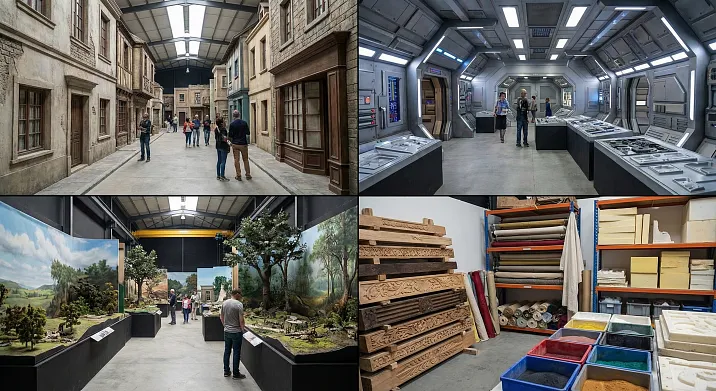
The modern entertainment industry is built on illusions. The camera captures not reality, but a carefully constructed world where every element serves an artistic purpose.Types of Decorations for Cinema and Television ProductsThey impress with variety — from miniature inserts to large pavilion structures, from realistic imitations to fantasy worlds. Understanding this diversity is critically important for anyone involved in creating visual content.
Classifying decorations is a complex task. The same element can belong to different categories depending on the criterion: by material, functional purpose, structural features, or style. Professionals use multiple classification systems, switching between them depending on the context of conversation.
In this article, we will systematize knowledge abouttypes of cinematic set decorationsLet us examine them from different perspectives, analyze the advantages and limitations of each type. This approach will help directors, set designers, and producers make informed decisions during the project planning stage.




Classification by constructive features
The first and most fundamental classification dividesdecorations for televisionand cinema into two major categories: rigid and flexible. This division is determined by the physical properties of the structures and materials.




Rigid decorations: the framework of the visual world
Rigid structures form the basis of the stage space. They have a sturdy frame, can withstand loads, and maintain their shape regardless of external influences. It is precisely the rigidCinema Decorationsthat create the sense of materiality of the world on screen.
Our factory also produces:





Flat rigid structures
Flat elements — walls, panels, partitions, screens. Despite their name, they are rarely absolutely flat. They usually have a small depth, allowing for texture, relief, and decorative details.
Wall panels make up a large part of pavilion decorations. They are assembled from individual panels, allowing for quick changes in space configuration. Standard panel sizes are standardized — usually 2.4 or 3 meters in height, 1.2–2.4 meters in width. This facilitates transportation and storage.
Backdrops and rear panels — a special category of flat decorations. They are placed in the background, creating the illusion of spatial depth. Modern backdrops often combine physical construction with projection, expanding the possibilities for scene transformation.
Get Consultation
Semi-volumetric elements
An intermediate category between flat and volumetric structures. They have a front plane with pronounced relief and minimal depth. Typical examples include imitations of stone masonry, brick walls, and wooden cladding.
semi-volumetricWall Decorationsave pavilion space while maintaining visual credibility. When the camera is positioned frontally, they appear as full three-dimensional objects. Only a side angle reveals the true nature of the structure.
Volumetric rigid structures
Fully three-dimensional elements — staircases, columns, furniture, architectural details. They are interacted with by actors, walked on, leaned against, and used in various ways. Requirements for strength and safety here are maximal.
Architectural elements for filminginclude columns,pilasters, arches, balustrades, railings. These elements are not only functional but also carry a strong aesthetic load. A classical column instantly sets the style of the space, indicates the status of characters, and creates the necessary atmosphere.
Staircases in cinema — a separate story. They are always dramatically rich: chases, love confessions, tragic falls occur on staircases. Therefore, a cinematic staircase must not only be beautiful and appropriate for the era, but also absolutely safe, with thoughtfully designed shooting angles and the possibility of installing safety equipment.
Soft decorations: textiles and draperies
Soft structures are made from fabrics, films, and other flexible materials. They are lighter than rigid ones, easier to transport, and quicker to assemble. Their main advantage is the ability to drape, creating plastic, living forms.
Smooth fabric backdrops
The simplest type — fabric stretched over a frame. Used to create a neutral background for projecting images or as a standalone color element. Chroma key — green or blue background for subsequent computer graphics overlay — is a typical representative of this category.
Fabric cycloramas allow creating an effect of infinite space. The smooth curve of the fabric eliminates the horizon line and blurs the boundary between walls and floor. Such constructions are indispensable for advertising, music video, and specific scenes in feature films.
Draped constructions
Fabric freely falling in folds creates a sense of luxury, softness, and coziness. Draperies are widely used in historical films — tents, canopies, curtains, drapes. They help create the atmosphere of an era, hide modern structural elements, and soften the rigidity of architectural forms.
Fabric selection is critical. Heavy velvets and brocades create solemnity and grandeur. Light silks and chiffons — airiness and romance. Rough canvas and burlap — simplicity and austerity. Professional decorators have extensive fabric sample libraries and understand how each behaves in the frame and interacts with light.
Painted backdrops
Hand-painted or printed fabrics depicting landscapes, architecture, interiors. This is one of the oldest types of theatrical and cinematic backdrops, still relevant today.
Modern printing technologies allow creating photorealistic images on fabric. Wide-format printers print fabrics up to several dozen meters in size. Such backdrops are used when it is necessary to quickly and economically create an illusion of a complex environment.
However, hand-painting on fabric remains in demand. The artist takes into account the lighting conditions on set, distance from the camera, creates the required level of detail and stylization. Such backdrops become artworks in themselves.
Classification by Functional Purpose
Another approach to classification — dividing by the role the backdrops play in the scene. Some elements are actively used by actors, others serve as background, and others perform purely technical functions.
Interactive backdrops
Elements that actors interact with directly. Furniture they sit on. Doors they open. Windows they look out of. Railing they hold onto. This category demands the strictest requirements for durability and safety.
Furniture and interior itemsOften custom-made for filming. Reasons vary: the required style is not available in stores, non-standard sizes are needed, technical specifics of the filming process must be considered. For example, a chair must withstand not only the actor’s weight but also sudden movements and possible impacts during action scenes.
A special category — trick furniture. Chairs that must break upon an actor’s fall (but not injure them), sugar glass windows through which one can jump out, doors capable of repeated forceful opening. Creating such elements requires deep knowledge of materials and construction.
Background backdrops
Elements that create the environment but do not involve direct contact with actors. Walls with hanging pictures, bookshelves far from the action zone, architectural details in the background. Here, lighter constructions and simplified technologies can be used.
However, 'background' does not mean 'secondary'. It is precisely they that create the depth of space, fill it with life, and form the atmosphere. An empty room, even with perfect furniture in the foreground, looks lifeless. Details on the walls, books on shelves, figurines on the fireplace mantel — all of this makes the interior lived-in and real.
Decorations for homeCreated using cinematic technologies, they use exactly this principle. Living space is enriched with decorative elements that have no utilitarian function but create aesthetic content and character of the interior.
Technical backdrops
Elements performing auxiliary functions. Camouflage screens hiding filming equipment. Sound-absorbing panels improving pavilion acoustics. Platforms and stages leveling the floor or creating the required relief.
These structures usually do not appear in the frame, but their role is hard to overestimate. Properly organized technical space in the pavilion is the guarantee of effective work of the entire filming crew. The cameraman must be able to place the camera at any required point. Lighting technicians — install equipment at optimal angles. Sound technicians — eliminate extraneous noise and reflections.
Classification by manufacturing materials
Decorative materialsThey determine not only the appearance, but also the production technology, cost, durability, and processing capabilities. Material selection is always a compromise between many factors.
Wood: the genre’s classic
Natural wood remains a favorite among professionals, despite the emergence of many alternatives. Its popularity is due to many reasons: noble texture, variety of species and textures, excellent workability, eco-friendliness, and unique energy of the material.
Solid wood
Solid wood is used for manufacturing load-bearing structures,carved elements for cinema, furniture. Different species have different properties.
Oak — symbol of strength and durability. Its massive texture with pronounced annual rings creates a sense of solidity. Ideal for backdrops depicting old estates, castles, historical interiors. Difficult to process, requires powerful tools and skilled craftsmen.
Linden — favorite of carvers. Soft, uniform, without pronounced texture, it allows creating delicate details.Lace carving, lace ornaments, miniature elements — all of this is made from linden. Not suitable for load-bearing structures due to low strength.
Spruce — the workhorse of production. Accessible, easy to process, sufficiently strong for most tasks. Used for frames, rough structures, elements that will be fully painted. Resin can be both an advantage (characteristic smell for filming in rustic interiors) and a disadvantage (visible resin spots under paint).
Exotic species — redwood, rosewood, wenge — are used when special luxury and uniqueness are required. Their cost is high, but the visual effect justifies the expense. RecallThe rosewood parlorof the Alexandrovsky Palace — it was precisely the choice of material that determined the character of the interior.
MDF and Plywood
Wood Panels — a compromise between natural solid wood and fully synthetic materials. MDF (medium-density fiberboard) is compressed wood dust with a binder. It results in a uniform material without knots or defects, stable and non-warped.
MDF is ideal for large smooth surfaces — wall panels, doors, countertops. It machines well, allowing for relief patterns. The surface is easy to paint, veneer, or laminate. The downside — it is afraid of moisture; when wet, it swells and deforms.
Plywood — glued sheets of veneer. Strong in bending, relatively lightweight, and affordable. Used for structural elements, backings, and bases for other materials. High-quality birch plywood has a beautiful surface suitable for finishing.
Polyurethane and Plastics: Technologies of the New Century
Polymer materials have revolutionized the decoration industry. They allow creating shapes impossible in wood, are lightweight, moisture-resistant, and durable.
Polyurethane
PolyurethaneMoldingsUsed extensively in interiors and decorations. The material can be poured into molds, enabling mass production of complex elements. Cornices, rosettes, columns, capitals — all are produced from polyurethane quickly and economically.
Especially valuable in film for the material's lightness. A polyurethane column weighs significantly less than a wooden or plaster column of the same size. This simplifies transportation, installation, and reduces requirements for load-bearing structures.
The downside — specific texture. Up close, polyurethane differs from natural materials. Therefore, for close-up shots, wood or hybrid solutions are preferable: a polyurethane base covered with natural veneer.
Foamed Plastics
Polystyrene (expanded polystyrene), polyurethane foam (foam), extruded polystyrene — a whole family of lightweight materials. They can be cut with hot knives, milled, glued, and coated with various compounds.
Foamed plastics are used to create large-volume elements — architectural details, sculptures, reliefs. The material is so light that a single person can lift a structure several meters high. For temporary decorations needed for a few days of filming, this is the optimal solution.
The surface of polystyrene is porous and requires additional treatment. It is coated with reinforcing compounds, spackled, and painted. Properly treated polystyrene can look like stone, metal, or wood — whatever is desired.
Composite plastics
Fiberglass, carbon fiber, various reinforced polymers — materials for special tasks. They combine lightness with high strength, allowing the creation of thin-walled structures of complex shapes.
Used when special strength is required with minimal weight. For example, for decorations subjected to dynamic loads — elements of stunt scenes, structures for action sequences. Or for outdoor shoots, where decorations must withstand wind, rain, and temperature fluctuations.
Metals: Strength and Expressiveness
Metal structures rarely serve as final decorative elements, more often acting as frames for other materials. However, there are exceptions — wrought iron grilles, railings, lamps, where metal serves as an independent aesthetic material.
Steel
Steel profiles — the basis of load-bearing structures. Profiles are welded into wall, platform, and tower frames. Steel provides strength and rigidity with relatively small cross-sections of elements.
For decorative purposes, sheet steel is used, which can be cut, bent, and welded. It is used to create imitations of metal cladding, industrial equipment, and technical elements. Steel is easy to paint and patina, creating effects of rust or polished surfaces.
Aluminum and Lightweight Alloys
Aluminum profile — material for mobile structures. It is three times lighter than steel while maintaining sufficient strength for many applications. Aluminum systems with quick-release connections allow assembling and disassembling decorations in hours.
Theatrical and television studios actively use aluminum trusses, on which lighting equipment is mounted, decorative elements are suspended, and screens are attached. Such systems are universal and can be adapted to different projects.
Fabrics: From Canvas to High-Tech
Textile materials for decorations — a separate universe. Professional suppliers offer hundreds of types of fabric, each with its own properties and characteristics.
Natural fabrics
Cotton canvas — classic for theatrical and cinematic backdrops. It paints well, stretches taut without sagging, and lasts long. Dense canvas is used for painted backdrops, while lightweight canvas is used for drapery.
Linen is valued for its noble texture and natural appearance in the frame. Linen drapery creates a sense of naturalness and eco-friendliness. The downside — strong creasing; linen requires careful ironing or special treatments.
Silk, velvet, brocade — materials for luxurious interiors. They are expensive, but their visual effect is unmatched. The play of light on velvet, the sheen of silk, the richness of brocade patterns — all create an atmosphere of luxury that cannot be imitated by cheap alternatives.
Synthetic Fabrics
Modern chemistry has created fabrics with unique properties. Non-flammable materials are critically important for fire safety. Water-repellent fabrics — for outdoor shoots. Elastic fabrics — for complex drapery.
Synthetic fabrics often surpass natural ones in practicality and durability. They do not fade, do not mildew, and are easy to wash. For projects with limited budgets or short-lived decorations, synthetic materials are the optimal choice.
Classification by style and era
Stage decorations for a performanceThe costumes or sets must correspond to the style of the work and the depicted era. This determines the selection of forms, ornamentation, color palette, and materials.
Historical Decorations
Recreating the past is one of the most complex tasks. It requires deep knowledge of architectural, design, and domestic history. An error in detail may shatter the illusion for an audience familiar with the era.
Antiquity and Classicism
pilasters and columnsOrderly systems with their strict proportions, canonical forms of capitals — Doric, Ionic, Corinthian — all must be reproduced with historical accuracy.
For shooting historical films, archaeological finds, measurements of preserved buildings, treatises by ancient and Renaissance architects are studied. Only in this way can decorations be created that withstand the scrutiny of experts and high-resolution cameras.
The Middle Ages
Castle interiors, church spaces, medieval city houses — each requires its own approach. Gothic pointed arches, Romanesque semicircular vaults, stone masonry, wooden ceiling beams — all these elements create a recognizable atmosphere of the era.
church decorFor historical films, this requires special delicacy. Here, not only forms, but also symbolism and adherence to canons matter. An incorrectly executed religious element may provoke justified criticism from believers and specialists.
The Modern Era
The 17th–19th centuries — the period of flourishing decorative arts. Baroque with its opulence and dynamism, Rococo with its elegance and capricious lines, Classicism with its clarity and harmony, Empire with its imperial grandeur — each style has its own language of forms.
Recreating interiors of these eras requires virtuoso mastery of decorative finishing techniques. Wood carving, stucco, gilding, marquetry, painting — all these techniques must be mastered by artisans working on the sets.
Experienceof interior reconstructionsThe reconstruction of the interiors of the Alexander Palace illustrates the scale of the task. Years of research, studying historical materials, recreating lost technologies — this is the price of historical authenticity.
Modern Decorations
It seems easier to recreate modernity — everything is available, everything can be bought. However, there are also complexities here. Modern style is multifaceted, rapidly changing, and requires a sense of timeliness.
Minimalism
Clean lines, minimal decoration, emphasis on textures and proportions. Creating a convincing minimalist interior is more difficult than it seems. There is no opportunity to hide flaws behind an abundance of details. Every line must be precise, every surface perfectly finished.
Modern trends in interior designTrends influence cinematic sets. Directors and designers follow current magazines, attend design exhibitions, study works of leading architects. Sets must look modern today, not reflect yesterday’s trends.
Loft and industrial style
Brickwork, concrete surfaces, exposed utilities, metal structures. This style is popular in modern cinema, especially in urban dramas and thrillers.
Creating a convincing loft requires a delicate balance. The space must look raw, but not dirty; carelessly, but thoughtfully; industrially, but lived-in. Achieving this balance — is an art.
Fantasy and Styled Decorations
When the action takes place in fictional worlds, artists gain maximum creative freedom. But this freedom requires even greater skill — one must create an internally consistent world with its own logic and aesthetics.
Futuristic Interiors
Fantasy requires inventiveness. What does the future world look like? What materials are used? What forms are current? Artists study concept art, industrial design, architectural projects to create a convincing future.
Modern materials — plastics, composites, LED lighting — allow the embodiment of the most daring fantasies. Smooth, aerodynamic forms, glowing panels, transforming structures create a sense of futurism.
Fantasy Worlds
Dragon castles, elven forests, gnomish underground kingdoms — the fantasy genre requires the creation of completely unique decorations. Here, different eras and styles are often combined, creating an eclectic mix that did not exist in reality but appears organically within the context of the fictional world.
Wood is especially in demand in fantasy decor. Natural materials help create a connection with nature, a sense of antiquity and magic. Carved elements with plant motifs, stylized after Celtic or Scandinavian art, create the desired atmosphere.
Specialized types of decor
Some categories of decor are distinguished as separate types due to their specificity.
Decorations for children's projects
Stage decoration for children's theater requires safe, bright, child-friendly elements. Rounded shapes, vibrant colors, and fairy-tale motifs create a magical atmosphere for young audiences.and children's films have special requirements. Safety is the absolute priority. All corners are rounded, surfaces are smooth, there are no small detachable parts that can be swallowed.
The aesthetics of children's decor are specific. Bright colors, exaggerated forms, fairy-tale elements. The house should look like a house from a child's drawing, the tree like a tree from a fairy tale. This requires stylization, simplification of forms, but not primitivism. Children sense falsity no worse than adults.
Decorations for television studios
decorations for televisiondiffer from film sets. Television shoots are often conducted in the same pavilions for months or years. Decorations must be durable, easy to clean, and withstand prolonged lighting from powerful equipment.
Talk shows, news studios, game shows — each format requires its own approach to decor. A news studio should inspire trust — strict lines, neutral colors, a technological look. An entertainment show can be bright, eccentric, with unconventional solutions.
Decorations for music videos and advertising
Short runtime and specific tasks determine the characteristics of decor for videos and advertising. Here, impression often matters more than realism. Decorations can be openly stylized, conceptual, or symbolic.
Advertising shoots often require creating idealized interiors.Decorations for roomsIn furniture advertising, decor must showcase the product in the best light, creating an aspirational image — an image the viewer wishes to aspire to.
Combined and transformable decorations
Modern technologies blur the boundaries between categories, allowing for hybrid solutions.
Mechanized decorations
Moving elements add dynamism to the scene. Rotating platforms, sliding walls, structures rising from under the stage — all of this creates a wow effect and expands staging possibilities.
Mechanization requires engineering calculations, reliable drives, and safety systems. Moving decor is a source of increased danger, so all mechanisms are tested multiple times and have emergency stop systems.
Projection and LED decorations
Digital technologies are revolutionizing the industry. LED screens displaying dynamic images allow for instant environment changes. Actors perform in front of screens showing any location — from Martian landscapes to historical cities.
The virtual production technology used in the series 'The Mandalorian' demonstrated new possibilities. Giant LED walls surround the set, displaying photorealistic environments. The camera shoots actors against screens, and the images on the screens synchronize with camera movement, creating correct perspective and reflections.
Such technologies do not replace physical decor but complement it. The foreground remains physical — actors interact with real objects. The background and sky are digital. The combination provides maximum flexibility while preserving realism.
Modular systems
Universal constructions that can be quickly reconfigured for different tasks. Wall panels with universal mounting, transformable furniture, architectural elements combinable in various configurations.
The modular approach saves budget and time. Instead of creating unique decor for each scene, a library of modules is used to assemble different configurations. One set of elements can serve as the basis for dozens of different interiors.
Regional decor specifics
Decorations for the stageand screen decor differ not only by type but also by geographical origin. Different countries and regions have their own traditions, approaches, and aesthetic preferences.
Hollywood school
The American industry sets standards for scale. Hollywood decor impresses with its scope — entire cities built for a single film. A tendency toward spectacle, sometimes at the expense of historical accuracy.
Developed infrastructure — huge warehouses with libraries of decor accumulated over decades. Many elements move from film to film, recognizable details to experts.
European tradition
European cinema is often more intimate and character-driven. Sets tend toward realism and historical accuracy. A strong theatrical tradition influences the approach to scenography.
The proximity of historical sites allows for more frequent use of location shooting in real castles, palaces, and historical buildings. Sets complement, rather than fully replace, locations.
Russian School
The domestic tradition of scenography is strong in theater and is gradually recovering in cinema after the failure of the 1990s.Decoration manufacturing for theaterIn Russia, it has always distinguished itself by high craftsmanship and deep understanding of style.
Modern Russian projects increasingly demonstrate world-class production of sets. Reconstruction of historical interiors, work with museum collections, collaboration with top craftsmen create sets that do not fall short of Western equivalents.
Trends in development: where is the industry headed?
Decoration IdeasThey are constantly evolving, reflecting technological and cultural changes.
Ecological Sustainability
The film industry is increasingly aware of ecological responsibility. Sets that are simply discarded after filming are wasteful of resources and pollute the environment. New approaches include:
Use of recycled materials. Reuse of sets in different projects. Modular systems that last for years. Biodegradable materials for disposable elements. Rental instead of purchase — the growing sharing economy is penetrating even set production.
Digitalization of design
3D modeling has become standard. The artist creates a virtual model of the sets, which can be viewed from all angles, place a virtual camera within it, and see how it will look in the frame.
Virtual reality allows the director and artist to "enter" future sets, walk through them, assess scale and proportions. This reveals problems during the design phase, saving time and money on rework.
Hybrid solutions
The future lies in the combination of physical and digital sets. Real elements in the foreground, with which actors interact. Digital extensions in the background. Projections and LED screens to create a dynamic environment.
This approach offers the best of both worlds: the realism of physical sets and the flexibility of digital ones.
Personalization and uniqueness
Trends in interior design 2026They emphasize the importance of uniqueness, rejecting mass-produced solutions. This also affects sets — there is growing appreciation for hand-made elements and individual craftsmanship.
Carved elements for cinemaHand-crafted elements possess a uniqueness that no machine can replicate. And the viewer, even subconsciously, senses this.
Economic aspects of set selection
Artistic goals must align with budgetary realities. Understanding the economics of sets helps make sensible decisions.
Cost factors
The cost of sets is composed of many components.Buy Theater DecorationsReady-made sets are cheaper than ordering custom fabrication. But ready-made solutions rarely fully match the vision.
Materials significantly affect cost. Natural wood is more expensive than MDF, MDF is more expensive than foam. Handmade work is more expensive than machine-made. Time also has a cost — urgent orders cost 30-50% more.
However, cheap is not always advantageous. Low-quality sets may require rework, delay filming, and ultimately cost more. Saving on materials results in loss of visual quality, which will affect the audience's perception of the film.
Rental vs. Purchase
For one-off projects, renting is often more cost-effective than purchasing or manufacturing. Specialized companies exist with extensive libraries of sets, furniture, and props. One can rent ready-made elements and assemble the required composition from them.
For long-term projects — series, multi-episode films — it is justified to create custom sets. They pay for themselves through repeated use.
Investment in quality
Quality sets are an investment in the project's success. The visual component is increasingly important in modern cinema. Audiences accustomed to high-quality imagery notice details and appreciate the thoughtfulness of the environment.
Decorations for filmSets created at a high level contribute to the film's success. They create atmosphere, immerse the viewer in the world of history, and evoke the required emotions. This is not merely background — it is an active participant in the narrative.
Frequently asked questions
What is the main difference between hard and soft sets?
Rigid decorations have a frame structure, retain their shape, are used for creating architectural elements, furniture, and three-dimensional details. Flexible ones are made from fabrics and films, lighter and more mobile, used for backdrops, drapery, and textile finishes. The choice depends on the element's function in the scene and technical filming requirements.
What materials are most popular for making decorations?
Wood (solid and MDF) leads due to its natural texture and workability, polyurethane due to its lightness and ability to be mass-produced, foamed plastics for large, lightweight structures. The choice is determined by budget, deadlines, requirements for strength and visual quality. Often, combinations of materials are used, leveraging the strengths of each.
How do film decorations differ from theatrical ones?
Film decorations require higher detail since cameras can shoot close-ups. They are often more stationary and heavier. Theatrical decorations are designed for viewing from a distance, must be mobile for quick scene changes between acts, and can be more stylized or symbolic. However, the basic principles of creating an image are similar.
Can decorations be used in different projects?
Yes, this is a common and economically justified practice. Universal elements — columns, panels, furniture — are repainted, modified, and recombined for different films. Large studios have extensive decoration warehouses. Specialized companies rent elements to multiple projects.
What is the role of natural wood in modern decorations?
Wood remains popular due to its unique texture, warmth, variety of species and finishes. For close-ups, historical interiors, and elements actors interact with, natural wood is preferred. Modern processing technologies expand possibilities for working with wood, but do not negate the value of master craftsmanship.
How to choose between ready-made and custom-made decorations?
Ready-made decorations are cheaper and faster, suitable for standard tasks and projects with limited budgets. Custom manufacturing is more expensive and time-consuming, but the result fully matches the artistic intent and is unique. For commercially significant projects where visual quality is critical, the second option is preferred.
What decorations are required for shoots in different genres?
Historical films require accurate reproduction of the era based on research. Fantasy and science fiction offer freedom but require creating an internally logical world. Contemporary drama needs current interiors reflecting current trends. Comedies often use grotesque, exaggerated decorations. The genre determines the style and approach to creating the environment.
How do technologies change decoration production?
3D modeling allows visualizing decorations before manufacturing. CNC machines ensure precision and complexity of forms. LED screens replace some physical decorations with digital ones. Virtual reality helps assess space. New materials expand possibilities. However, technologies complement rather than replace the craftsmanship and artistic sense of specialists.
Are special permits required for using decorations?
The main requirement is compliance with fire safety regulations. Materials must have certifications, wooden elements must be treated with fire-retardant compounds. Structures interacting with people must withstand calculated loads and have a safety margin. Special permits are required for shoots in public places, but these concern the shooting process, not the decorations themselves.
How long do professional decorations last?
With proper storage and care, decorations made from quality materials last for decades. Theatrical decorations are used for years in repeated performances. Film decorations after shooting are often sent to warehouses, awaiting future projects. Single-use decorations for specific scenes are dismantled after filming, but quality elements are usually preserved for potential reuse.
Conclusion: the art of creating illusions
Types of Decorations for Cinema and Television ProductsThey impress with diversity. From large pavilion structures to miniature overlays, from historical reconstructions to futuristic fantasies — each type solves its own tasks, requiring specific knowledge and skills.
Understanding decoration classification helps professionals plan projects more effectively, make informed decisions about materials and technologies, and optimize budgets. This knowledge is useful not only for filmmakers but also for those interested in film production and appreciating visual culture.
The modern industry stands at the threshold of major changes. Digital technologies expand possibilities but do not negate the value of physical decorations. The best results are achieved by combining traditional and innovative approaches.
Ecological awareness changes production processes. Reuse, recycling materials, and using sustainable resources have become standard. This does not limit creativity but directs it toward a more responsible path.
Decorations for the hall, Facade Decoration, elements fordecorations furniture— all these categories, originally created for film and theater, find application in residential interiors. The boundaries between professional stage design and interior design are blurring. People want to live in spaces worthy of a movie screen.
Here, companies with expertise in creating top-level decorations come to the rescue. STAVROS is a prime example of such a partner capable of realizing the most ambitious projects.
production of STAVROS possesses unique experience working with historical objects. Participation inreconstruction of the Alexandrovsky Palacedemonstrated the company's ability to work with great attention to detail, recreate lost interiors based on historical sources, and master complex decorative finishing techniques.
STAVROS masters perfectly handle all types of wood processing — from classic hand carving to modern CNC milling. The company createsCarved elements for cinematheatrical sets, architectural elements for the most demanding projects.
STAVROS portfolio includes work with various historical styles and eras.church decorclassic furniture, early 20th-century modern — company specialists deeply understand each style, master techniques characteristic of different periods.
STAVROS production capabilities allow executing projects of any scale. Modern equipment ensures precision and speed of production. But technology does not replace humans — final finishing, sanding, patination are performed manually by experienced craftsmen.
STAVROS works not only with large institutional clients — museums, theaters, film studios. The company is open to private clients, ready to create decorative elements for residential interiors, applying the same quality standards as in large-scale projects.
Individual approach — the principle of STAVROS work. Each project is considered a unique creative task. Company specialists consult clients, help find optimal solutions, propose options the client might not have considered.
Buy stage decorationsor order unique elements for a film, create an interior in the style of a favorite movie or reproduce a historical interior — STAVROS is ready to bring any idea to life in wood.
Quality that withstands high-resolution cameras and the discerning gaze of museum experts. Mastery based on years of experience and continuous refinement. Passion for one’s craft, felt in every item — this is what distinguishes STAVROS.
In a world where visual culture becomes increasingly important, where image quality improves, and audiences become more discerning, companies capable of creating world-class decor acquire special value. STAVROS — exactly such a company, a partner for those unwilling to compromise, who value authenticity and craftsmanship.


