Article Contents:
- The Staircase as an Architectural Dominant in Countryside Spaces
- Balusters — Functional Sculpture in the Structure of a Flight
- Anatomy of a Vertical Support
- Typology of Forms and Stylistic Solutions
- Material as the Foundation of Durability
- Protecting and Decorating Walls Along the Staircase Flight
- Moldings as a Structuring Tool
- Panels and Cladding — A Monumental Approach
- Practical Aspects of Installing Decorative Elements
- Harmony of Staircase Group Components
- Treads and Risers — The Horizontal Foundation
- Baseboards on Stair Landings — Finishing the Line
- Posts and Handrails — Vertical and Horizontal Accents
- Zoning and Light Play: Decorative Slats in Staircase Spaces
- Wooden Slats as a Zoning Tool
- Play of Light and Shadow in Vertical Composition
- Materials and Finishing of Slats for Interior Application
- When a Staircase Becomes a Work of Art
- Wood — A Timeless Material for Staircase Structures
- Tactility and Temperature of the Material
- Acoustics of a Wooden Staircase
- Eco-Friendliness and Atmosphere
- Repairability and durability
- Variability of Finishing
- Frequently Asked Questions About Staircase Space Design
- What is considered the optimal spacing between balusters?
- Are risers needed on a wooden staircase, or can they be omitted?
- How to protect walls along the staircase from dirt and scuffs?
- What finish is best for wooden treads: varnish, oil, or paint?
- Can polyurethane moldings be combined with a wooden staircase?
- How to calculate the number of balusters for a staircase?
- What is considered the standard and comfortable height for handrails?
- Is staircase lighting necessary and how to properly organize it?
- Conclusion: Entrust staircase design to professionals

When you enter a country house with high ceilings, the first thing that catches your eye is the staircase. Not just a path between floors, but a true architectural manifesto that sets the tone for the entire space. This is where the dialogue between structure and aesthetics, between functionality and beauty, begins. The staircase flight is the vertical accent of the interior, its compositional center, around which the entire internal architecture of the house is built.
Why do some staircases evoke admiration while others go unnoticed? It's not just about materials or price. The answer lies in the details. In the precisely calculated proportions of support elements, in the rhythm of decorative accents on the walls, in the unity of all components of the staircase group. When these details work together, they create that very effect which transforms an ordinary structure into a work of art.




The staircase as an architectural dominant of country house space
In classical architecture, the staircase has always held a special place. It's no coincidence that in old mansions and palaces, the grand staircase became the culmination point of the entrance group. Today, this principle works with the same force. The staircase flight in a country house is not just a technical necessity, but an opportunity to create a dramatic effect, to control the gaze and mood of a person entering the space.
Imagine: you open the front door, and a vertical composition unfolds before you — steps rising upward, the elegant rhythm of vertical supports, the play of light on wooden surfaces. This is the first impression that shapes the attitude towards the entire house. And here every element is important: from the material of the treads to the shape of the risers, from the cross-section of the load-bearing posts to the profile of the wall decorative strips.
Modern interior architecture offers two main approaches to staircase space design. The first is minimalist, where the staircase strives for lightness and transparency. Open flights without risers, metal stringers, glass railings. The second is traditional, where the staircase demonstrates all the richness of wooden architecture: massive steps, carved support elements, decorative posts. Both approaches have a right to exist, but it is the classical approach using natural wood that creates that atmosphere of solidity and coziness so valued by country house owners.
What makes a staircase a dominant feature? Scale, certainly. But not only that. The richness of details, the tactility of materials, the structure's ability to interact with light are important. A wooden staircase with properly selected components becomes a living object — it changes throughout the day, reflects morning light, creates deep shadows in the evening, plays with highlights on varnished surfaces.




Balusters — functional sculpture in the structure of the flight
If you think about it, the vertical railing post is an amazing element. On one hand, it performs a purely utilitarian task: serves as a support for handrails, creates a protective barrier, ensures safety when moving on the staircase. On the other hand — it's a true sculpture in miniature, repeated many times, creating the rhythmic pattern of the entire staircase flight. This is why many country house owners preferbuy balustersprofessionals who guarantee the quality and precision of execution of each element.
Our factory also produces:


Anatomy of a vertical support
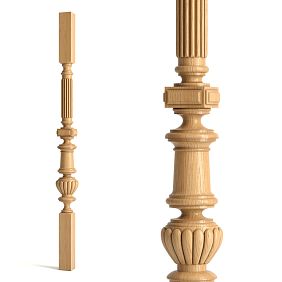
A baluster consists of several zones, each with its own purpose and name. The base — is the lower part that attaches to the step. The central part, or body of the baluster, where the full decorative potential of the form is revealed. And the upper part — the neck, on which the handrail rests. In a classical turned baluster, the central part can include many elements: beads, rings, collars, balls, cones. It is their combination that creates the visual character of the product.
When you face a choice, it's important to understand: the shape of the baluster determines the style of the entire staircase. A simple cylindrical baluster with minimal decor creates a strict, almost minimalist character. A Baroque baluster with many protruding elements, balls and collars — is a statement of classical luxury. A baluster with facets and ribs — a compromise between tradition and modernity.
There are many ways to process wood to create balusters. The most common is turning. A solid wood blank is mounted on a lathe, and the profile is formed with a cutter. This method allows creating round cross-section elements with rich relief. Milling is used to create products with facets, grooves, complex profiles. Hand carving is the most labor-intensive, but also the most expressive method. Carved elements become true works of art, each unique.
Get Consultation
Typology of forms and stylistic solutions
The classification of vertical supports can be endless, but there are several basic types that cover most options. Flat balusters — are elements cut from a board with a profiled contour. They are used less frequently but create an interesting effect in country or Provence stylizations. Turned round balusters — the classic of the genre. They form the basis of most traditional staircases. Square and rectangular balusters — a modern option, often used in minimalist interiors.
Speaking of style, Baroque support elements are distinguished by richness of forms, abundance of decorative details, complex profile. Classical products are more restrained but retain elegance of lines and proportions. Modern variants tend towards simplicity: straight lines, minimal decor, emphasis on wood texture. Scandinavian style implies light wood, simple forms, airiness of construction.
Installation density is another parameter affecting the perception of the staircase. The classic spacing between vertical posts is 12-15 centimeters. This provides sufficient railing strength and creates a rhythmic visual pattern. If elements are installed less frequently, the staircase looks more open but loses in safety, especially if there are children in the house. Frequent installation (8-10 cm) creates the effect of a solid railing, visually weighs down the structure, but is maximally safe.
Material as the basis of durability
The choice of wood species for vertical supports is a choice between aesthetics, strength and budget. Pine — the most affordable option. Soft, easily workable wood, but requires protective coating and is less resistant to mechanical impacts. Pine products are suitable for country houses with moderate use.
Oak — the aristocrat among species. Hard, dense wood with expressive texture. Oak elements are practically eternal, not afraid of moisture and loads, only become more noble over time, acquiring a deep shade. This is the choice for those who value quality and are ready to invest in durability. Many craftsmen recommend buying oak balusters for grand staircases, where not only beauty but also the status of the material is important.
Beech — the golden mean. In hardness close to oak, but more homogeneous in structure, which facilitates turning. Beech posts have a delicate pinkish hue that looks wonderful in interiors with warm color schemes. Ash — an alternative to oak. Durable, with beautiful texture, but lighter. Larch — ideal for damp rooms, contains natural resins that protect wood from rotting.
When it comes to purchasing vertical supports for railings, it's important to pay attention to processing quality. The surface should be perfectly smooth, without chips or tear-outs. Wood moisture content — a critical parameter. Products should be dried to 8-12% moisture content. If moisture is higher, the element may deform after installation, crack, warp. Check geometry: all balusters for the staircase in a batch should be identical in height and profile.
Protection and decoration of walls along the staircase flight
The wall running along the staircase is subjected to constant impact. Hand touches, accidental bumps with bags and objects, abrasion from clothing — all this leaves marks. An unprotected painted or wallpapered wall quickly loses its appearance precisely in the staircase area. But there is a solution that not only protects the surface but also turns a functional necessity into a decorative advantage.
Moldings as a structuring tool
A molding is a profiled strip that is attached to the wall and creates relief. In the context of staircase space, such decorative elements perform several functions simultaneously. First, they protect the wall in areas of greatest contact. Second, they create visual structure, breaking the large wall plane into panels or stripes. Third, they connect the staircase with the overall interior style.
Horizontal profiled strips at a height of 90-120 centimeters from the steps — this is a classic solution. They form a kind of line running along the flight, which visually continues the line of the handrail. This creates compositional integrity. Between two horizontal elements, you can place wallpaper with a different texture or paint the wall a contrasting color — you'll get a decorative panel that runs along the entire staircase.
Vertical decorative battens are used to create a paneled structure. The wall is divided into rectangular sections, each framed by a profile. This solution originates from classical interiors but adapts perfectly to modern spaces if a minimalist profile is chosen. The size of the panels, their proportions, and the spacing between them all require precise calculation. There are proven schemes, so-called decorative element maps, which guarantee a harmonious result.
The material of the profiled battens determines not only the appearance but also the practicality. Wooden elements are classic. They are warm to the touch, easy to install, can be painted any color or varnished to highlight the wood grain. The downside is sensitivity to humidity and the need for regular maintenance. Polymer products are a modern alternative. Lightweight, moisture-resistant, they can imitate molding of any complexity. They can be painted, do not warp or crack. If you are consideringMoldings made of polyurethane, then you will get the perfect solution for rooms with temperature and humidity fluctuations, where polymer elements show their best qualities.
Panels and cladding - a monumental approach
If profiled battens are light decor, then panel cladding is an architectural solution. Wooden wall panels create a sense of solidity, protect the wall to its full height, and radically change the character of the space. The classic option is cladding with tongue-and-groove boards or wooden elements to a height of 120-150 cm. This solution came from English interiors, where the lower part of walls was always clad in wood to protect against dampness and damage.
In the context of a staircase, panel cladding is especially logical. The lower zone of the wall is most vulnerable, and wood here works as armor. At the same time, the wood grain and its warm shade create a cozy atmosphere. An important point is that the boundary between the cladding and the upper part of the wall must be finished with a horizontal profiled element or batten. This creates completeness and visual logic.
An alternative to tongue-and-groove boards is MDF panels with decorative coating. They imitate wood, stone, leather, but are cheaper and easier to install. For staircase walls, this is a compromise option that, with a competent selection of color and texture, gives an excellent result. Modern MDF panels have a protective coating that is easy to clean and scratch-resistant.
There is also a radical solution - to completely clad the walls of the staircase space with wood. From floor to ceiling. This creates the effect of a wooden box, where every element - steps, support posts of the railing, walls - is made of the same material and works in a unified style. This approach requires courage and good taste so that the space does not become oppressive. But the result can be stunning.
Practical aspects of installing decorative elements
Installing profiled battens and panels on walls along a staircase has its own peculiarities. Staircase space often has complex geometry: the wall runs at an angle, following the rise of the steps. This means that all horizontal elements will actually be slanted, repeating the slope of the flight. Layout here is critically important.
Use a laser level to project lines. If installing a horizontal profile along the flight, stretch a cord between the start and end points - it will show the correct angle of inclination. All vertical elements (if creating a paneled structure) must be strictly vertical, check them with a plumb line. Cuts at corners and joints require precision. Use a miter box or a miter saw with angle adjustment.
Choose adhesive for installation depending on the material. For wooden battens, PVA or special wood glue is suitable. For polymer ones - polymer-based adhesive, often included in the kit. Additional fastening with finishing nails or screws increases reliability. Fastener heads are countersunk and filled, becoming invisible after painting.
Painting is the final touch. Wooden profiles can be varnished to preserve the wood grain, or painted the color of the walls to create a unified surface with relief. Polymer elements are always painted. Use water-based acrylic paints - they are odorless, dry quickly, and give an even coating. Two to three coats with intermediate sanding with fine sandpaper - and the result will be perfect.
Harmony of staircase group components
A staircase is a system where each element is connected to the others. Steps, risers, vertical railing supports, posts, handrails, baseboards on landings - all of this must work as a single ensemble. Dissonance in even one component destroys the integrity. How to achieve this harmony?
Steps and risers - the horizontal foundation
A step consists of two parts: the tread - the horizontal surface on which the foot is placed, and the riser - the vertical board that closes the space between treads. The tread determines the comfort of the staircase. Its depth (width in the direction of travel) should be sufficient for the full placement of the foot - optimally 28-32 cm. Less - and the staircase becomes uncomfortable, the foot does not fit completely. More - and the step is disrupted, requiring an intermediate movement.
The thickness of the tread depends on the material and construction of the staircase. For wooden steps resting on stringers or carriages, 40-50 mm of solid wood is sufficient. This ensures strength and minimal deflection. If the steps are cantilevered (hang without visible support), the thickness increases to 60-80 mm, or laminated wood is used, which is stronger than solid wood.
The riser is not a mandatory element, but highly desirable. A staircase without risers is called open. It looks lighter, lets light through, and visually does not clutter the space. But it has disadvantages: less structural rigidity (steps rest only on side elements), psychological discomfort (the space under the staircase is visible), danger for children and pets (a foot can slip between steps).
A closed staircase with risers is free of these drawbacks. The riser connects adjacent steps, increasing the rigidity of the entire structure. The staircase practically does not creak - sounds arise from mutual displacement of parts, and risers fix the steps, eliminating play. Visually, risers give the staircase solidity, completeness, and solidity.
The height of the riser is the height of the step. The optimal range is 15-18 cm. This is a physiologically comfortable height for lifting the leg. Less - and the staircase becomes shallow, taking up more space. More - and the ascent turns into a workout, especially uncomfortable for descending. There is a formula for a comfortable staircase: twice the step height plus the tread depth should equal the average human step (60-64 cm). For example, step height 17 cm, tread depth 30 cm: 17×2 + 30 = 64 cm. Perfect.
The material of steps and risers is most often the same, but combinations are acceptable. Tread of oak, riser of pine - such a combination saves budget without losing quality. It is important that both parts are made of well-dried wood with the same moisture content. A difference in shrinkage will lead to gaps and creaks.
Surface treatment of steps is a matter of safety and durability. Varnish coating protects the wood and gives it shine but can be slippery. Use varnishes with anti-slip additives or matte compositions. Oil-wax coatings give a more natural look, are not slippery, are easy to renew, but require regular maintenance. Paint is an option for budget staircases or stylistic solutions but hides the wood grain.
Baseboards on staircase landings - completing the line
A staircase rarely starts and ends with just steps. Usually, there are landings - horizontal sections between flights or at the beginning and end of the staircase. The landing is essentially a continuation of the floor, and it requires the same finishing as a regular floor in a room. And that means a baseboard is needed.
When the installation of the staircase structure is completed, it is important not to forget about finishing the landings, whereWooden baseboard becomes a logical continuation of the entire composition. If the steps and support posts are made of solid wood, then the baseboard should also be wooden, preferably from the same species and with the same shade. This creates visual unity. On the landing, where steps, floor, and wall meet, such an element performs an important function: it closes the thermal gap between the flooring and the wall, protects the lower part of the wall from dirt, and creates compositional completeness.
The height of the baseboard on a staircase landing usually corresponds to the height of a similar element in the other rooms of the house. Standard is 70-100 mm. But in staircase space, where all elements are more massive, a higher profile can also be used - 120-150 mm. This will create proportionality.
The profile of the baseboard is a matter of style. A classic profile has a rounded top and may include decorative grooves. A modern version is often rectangular, with minimal relief. It is important that the profile relates to the profile of other staircase elements - for example, to the profile of handrails or decorative battens on the wall.
Installation on the landing requires precise corner cutting. At turn points (internal and external corners), a 45-degree miter cut is used. Modern systems often include ready-made corner elements, which simplifies installation. Fastening is possible with adhesive, finishing nails, or hidden clips. The latter option allows for the baseboard to be removed if necessary without damage.
The color scheme can vary. A baseboard matching the floor color is a classic choice, visually extending the horizontal surface. Matching the wall color is a modern technique, making the wall appear to 'flow' onto the floor. Matching the staircase color (treads and support posts) creates unity within the stair group. A contrasting option serves as an accent, highlighting the boundary between planes. For a country house, a solid wood baseboard that harmonizes with all elements of the staircase structure is optimal.
Posts and handrails are vertical and horizontal accents.
Vertical balusters are an important element, but they function between two other key components: posts and handrails. Posts (also called support posts or newel posts) are installed at the beginning and end of a flight of stairs, at turns, and on landings. These are more substantial vertical elements that bear the main load from the handrail and create visual accents.
Posts are typically one and a half to two times thicker than balusters. If a baluster has a diameter of 40-50 mm, a post is 80-120 mm. The height of a post equals the height of a baluster plus the handrail, but visually a post can appear taller due to a finial—a decorative element crowning the post. A finial can be spherical, conical, or shaped. It not only decorates but also serves as a logical completion of the vertical line.
The form of a post often echoes the form of the support posts but is more massive and detailed. If balusters are turned with beads and coves, the posts will also be turned but with larger details. If balusters are square with chamfers, the posts will also be square, possibly with decorative overlays or carvings.
Handrails are the horizontal element on which the hand rests when moving up or down the stairs. Handrail comfort is critically important. The optimal cross-section for a round handrail is 40-50 mm, allowing the hand to comfortably grip it. The installation height for handrails is 90-100 cm from the line of the treads. This is the standard that ensures comfort for most people.
Handrails can be solid (from a single piece of wood, which is only possible on short straight sections) or composite. On turns and curves, bent sections or special corner elements are used. Handrails are attached to balusters and posts from below using screws or with special connectors that remain invisible.
Unity of all components is achieved through thoughtful selection. One wood species, one color palette, a unified style of processing and decoration. If the treads are oak, then the balusters, posts, and handrails should also be oak. If a 'dark walnut' stain is chosen, all elements receive the same finish. This creates an effect of integrity, where the staircase is perceived not as a collection of parts but as a single architectural object.
Zoning and light play: decorative slats in the staircase space.
The space under the stairs is often a forgotten zone. However, with a competent approach, it can become a functional or aesthetic asset to the interior. The height under the stairs gradually decreases from the beginning to the end of the flight. In the highest part under the stairs, you can place a cabinet, shelving, or a workspace. In the middle part—a pantry or wardrobe. But there is another approach—to leave the space open but visually structure it using decorative elements.
Wooden slats as a zoning tool.
A slat is a narrow strip with a rectangular cross-section. In the context of interior design, such elements are used to create lattice or slatted structures. When many slats are attached parallel with a certain spacing, a semi-transparent partition is formed, which zones the space without blocking light and visual connections.
Applied to a staircase, such narrow slats can solve several tasks. If the staircase is open (without risers), they can be used to partially close the space between treads. Vertical elements installed with a small spacing create a visual screen that does not weigh down the structure but makes it more enclosed. This is especially relevant if there is a living area under the stairs and some privacy needs to be created.
The second option is to use such slats to decorate the wall under the stairs. If the space under the flight is open, the wall behind it can be clad with vertical elements spaced 5-10 cm apart. This creates a rhythmic structure that will interact beautifully with light. During the day, when light falls from a window, the slats will create a play of shadows on the floor. In the evening, if hidden lighting is placed between them, an effect of glowing stripes is achieved—very impressive and modern. For such purposes, Wooden plank of various cross-sections is ideal, allowing for the implementation of the boldest design solutions in the staircase space.
Horizontal slats are an alternative approach. They are attached one above the other with uniform spacing, creating a louvered effect. Such a structure works as a visual filter: the space under the stairs is visible but not completely. This creates intrigue, depth, and multi-layered space.
Play of light and shadow in a vertical composition.
Light is a powerful tool in the architecture of staircase space. The staircase is often located in an area where light flows from different sources intersect: windows, overhead lighting, local fixtures. Using slatted structures allows this light to be 'captured' and turned into part of the composition.
Imagine: vertical narrow slats under the stairs, spaced 7 cm apart, 2 cm thick. Light from a window located to the side passes through this lattice and creates a rhythmic pattern of light and dark stripes on the floor and the opposite wall. Throughout the day, this pattern changes: in the morning, the stripes are long and slanted; at noon, short and vertical; in the evening, they stretch out again. A static structure becomes dynamic, alive.
Artificial lighting offers even more possibilities. An LED strip hidden behind the slats (between the elements and the wall) creates an effect of a glowing surface. Light will seep through the gaps, creating a soft, diffused glow. This is an excellent solution for evening ambiance—not too bright but sufficient for orientation and creating a cozy atmosphere.
Spotlights directed at the slatted structure from below or above create a dramatic effect. Beams of light sliding along the slats will emphasize their texture, create deep shadows, and highlight the volume. This is a theatrical technique that turns the staircase into scenography.
Materials and processing of slats for interior application.
Not every slat is suitable for interior decor. Construction-grade strips sold at markets are usually roughly processed, may have knots, chips, and unevenness. For interiors, slats of furniture quality are needed: cleanly planed, without visible defects, made from well-dried wood.
The cross-section is chosen depending on the task. For creating light decorative screens, slats of 20×40 mm or 30×50 mm are suitable. For more substantial structures—40×60 mm or 50×70 mm. The length is determined by the height of the structure. It is convenient to work with elements 2-3 meters long—they are easily transported and installed.
The wood species is chosen based on the interior style and budget. Pine is a budget option, light-colored with a pronounced grain. Oak is a premium choice, dark, dense, noble. Ash is a mid-range option, lighter than oak but with a beautiful pattern. Larch is good for damp rooms, but this is usually not critical in staircase spaces.
Processing before installation is mandatory. Sanding with fine sandpaper removes minor defects and prepares the surface for finishing. The finish can vary: varnish emphasizes the grain and adds shine, oil creates a matte surface and pleasant-to-touch wood, paint hides the grain but allows for any color. For modern interiors, white or gray paint is often used—the slats become graphic elements that do not draw attention to the wood grain.
Installing a slatted structure requires precise marking. If the slats are vertical, horizontal guides (battens) are installed first, to which the elements are attached. The spacing between them is marked in advance, using a template—a batten of the required width that is inserted between the slats during installation. This ensures perfectly uniform spacing. Attachment is done with screws, finishing nails, or adhesive, depending on the construction.
When a staircase becomes a work of art.
What distinguishes an ordinary staircase from one that evokes admiration? Not the price or the complexity of the construction. It's in the details, in their thoughtfulness, in the ability of all elements to work together. A staircase becomes a work of art when each of its parts—from the tread to the floor molding on the landing—carries not only a functional but also an aesthetic load.
Let's recall: the support posts for the railing we have chosen must match the style of the house. If it's a classic interior with moldings and decorative trim, then the balusters will be turned, with rich decoration. If it's modern minimalism, the elements can be straight, square, graphic. But in any case, they must be executed with quality, from good material, with correct proportions.
The walls along the staircase, which we have protected and decorated with profiled strips or panels, create a backdrop for the stair structure. They should not compete with the staircase, but they should not be neutral either. The right color, texture, and relief complement the staircase, emphasize its form, and create context.
The treads, risers, and floor strips on the landings—all are made from the same wood, have a unified finish, and uniform treatment. This creates visual unity. When you ascend such a staircase, you feel it is not an assembled structure of disparate elements, but a holistic object conceived and executed as a single whole.
Narrow strips under the staircase or on the wall, creating a play of light and shadow, add dynamism. A static structure comes to life, begins to interact with light, with the time of day, with the movement of people. This is no longer just a staircase, but a part of the living space that reacts to changes and creates an atmosphere.
Wood is a timeless material for stair structures.
Why does wood remain the primary material for stairs, despite an abundance of alternatives—metal, glass, concrete, composites? The answer lies not only in aesthetics but also in the psychology of spatial perception.
Tactility and temperature of the material
Wood is warm to the touch. When you place your hand on a wooden handrail, you feel not the cold of metal or the inertness of plastic, but a living warmth. This creates psychological comfort, especially important in a private home where the staircase is used barefoot, in home clothes, in a relaxed state. A wooden tread under a bare foot provides a completely different sensation than cold stone or slippery glass.
The texture of wood, its grain pattern, which never repeats, creates visual interest. Even a simple, laconic staircase made of oak with a pronounced texture will not be boring. Each board has its own pattern, its own shades, its own characteristics. This is natural variability that cannot be artificially reproduced.
Acoustics of a wooden staircase
Wood absorbs sound differently than metal or concrete. Footsteps on a wooden staircase are softer, deeper, more noble. It's not the ringing clatter of heels on metal or the echoing boom of a stone staircase. A wooden staircase creates a cozy acoustic environment. Yes, wood can creak, but this is more of a character trait than a flaw. The gentle creaking of an old wooden staircase is part of the charm of a country house.
To minimize creaks, it is important to assemble the staircase correctly. All connections must be tight, without play. Using risers, which tie the treads together, sharply reduces the likelihood of creaks. High-quality wood with the correct moisture content will not deform and will maintain the tightness of the connections.
Eco-friendliness and atmosphere
Wood is a natural material that does not emit harmful substances, breathes, and regulates humidity in the room. A wooden staircase contributes to a healthy microclimate in the home. This is especially important for people with allergies or sensitivity to artificial materials.
But it's not just about physical properties. Wood creates an atmosphere. That very elusive coziness, which is difficult to explain but easy to feel, largely depends on the presence of wood in the interior. A wooden staircase is a central element that sets this tone. This is why experienced designers recommend buying balusters from high-quality solid wood to create a holistic and harmonious composition.
Repairability and longevity
A wooden staircase serves for decades, and with proper care—for centuries. Ancient wooden staircases in historical buildings are the best confirmation of this. But even if wear, scratches, or local damage appear over time, wood can be repaired. A tread can be sanded and refinished with varnish or oil. A damaged support post can be replaced. A handrail can be removed, treated, and reinstalled.
With a metal or concrete staircase, such manipulations are more difficult or impossible. Wood forgives mistakes, allows for changes, and renewal. It is a material that ages beautifully, acquiring a patina of time, depth of color, and nobility.
Variability of treatment
Wood can be stained any color while preserving the grain through tinting compositions, or the grain can be hidden under opaque paint. The natural shade can be left, merely protected with clear varnish or oil. It can be artificially aged to create an effect of long-term use. It can be charred, achieving a deep black color and emphasized texture (shou sugi ban technique).
This flexibility in treatment allows a wooden staircase to fit into any interior style. From rustic country with rough, massive treads of aged oak to refined classicism with turned support posts of bleached ash. From Scandinavian minimalism with simple forms and light wood to industrial loft, where wood is combined with metal elements.
Frequently asked questions about designing stair space
What is considered the optimal spacing between balusters?
The optimal spacing between the vertical supports of a railing depends on several factors: safety, visual perception, and structural requirements. From a safety standpoint, especially if there are children in the home, the spacing should not exceed 12-15 cm—this prevents the possibility of a head fitting between the elements. Visually, a spacing of 12-15 cm creates a sufficiently dense railing that looks reliable but not massive. If the support posts are thin (30-40 mm in diameter), such spacing creates a rhythmic, elegant picture. For more massive elements (50-60 mm), the spacing can be slightly increased to 15-18 cm to avoid visual overload. Structurally, it is important that the posts provide sufficient rigidity for the handrail—when leaning on the handrail, there should be no sagging or feeling of unreliability.
Are risers needed on a wooden staircase, or can they be omitted?
Risers are not a mandatory element, and the choice depends on stylistic preferences and functional requirements. A staircase without risers (an open-tread staircase) looks lighter, more airy, allows more light to pass through, which is especially valuable in small spaces. It creates a sense of modernity and spaciousness. However, an open-tread staircase has drawbacks: less structural rigidity (treads are held only by side supports), psychological discomfort for some people (the space underfoot is visible), a danger for children and pets, and a greater likelihood of creaks. A closed-tread staircase with risers is more rigid, practically does not creak, looks monolithic and solid, and is completely safe. Risers also enclose the space under the staircase, which can be important aesthetically. The choice should be made based on the interior style and family composition.
How to protect the walls along the staircase from soiling and wear?
The walls along a flight of stairs are subjected to constant impact: hand touches, contact with clothing, bags, accidental bumps. Without protection, a painted or wallpapered wall quickly loses its appearance. There are several protection methods. The classic method is installing a horizontal profiled element at a height of 90-120 cm, which takes the main contact. Such a strip can be wooden or polymer, painted to match the wall or in a contrasting color. A more substantial option is paneling the lower part of the wall to a height of 120-150 cm with wooden panels, clapboard, or MDF. This is not only protection but also a decorative element. A modern solution is using washable paints with high abrasion resistance. Such paints can be regularly wiped with a damp cloth without loss of coating quality. A combined approach: washable paint in the contact zone plus decorative elements for visual structure—is the optimal combination of practicality and aesthetics.
What finish is better for wooden treads: varnish, oil, or paint?
Each type of finish has its advantages and limitations. Varnish creates a durable protective film on the wood surface, protects well against moisture and abrasion, adds shine, and emphasizes the grain. Polyurethane varnishes are especially durable and suitable for heavily used staircases. The downside is that a glossy surface can be slippery; matte or semi-matte formulations with anti-slip additives are required. Oil penetrates deep into the wood, does not create a surface film, preserves the natural look and tactility of wood. Oil finishes are not slippery, are easily renewed (just apply a new coat to worn areas), but require regular maintenance—renewal every 1-2 years. Paint completely hides the wood grain but allows for any color. This is a solution for budget staircases made from inexpensive species or for specific stylistic tasks (e.g., a white staircase in a Scandinavian interior). Paint protects wood well, but if damaged, it requires local touch-ups, which may be noticeable. The choice depends on the wood species, interior style, and willingness for regular maintenance.
Can polyurethane moldings be combined with a wooden staircase?
Absolutely, and this is often the optimal solution in terms of practicality and budget. Polymer decorative elements have a number of advantages: they are lighter than wooden ones, are not afraid of humidity and temperature fluctuations, do not crack, do not deform, and are easier to install. After painting to the desired color, they are indistinguishable from wooden ones at a distance. At the same time, they are significantly cheaper. In the context of stair space, where the solid wood staircase itself is in the foreground and wall elements play a supporting role, such a combination is quite justified. It is important to correctly select the profile and paint the polymer strips to match the tone of the main structure or walls. The only limitation is if the entire interior is built on emphasizing natural materials, then polymer elements may feel foreign upon tactile contact. But for most projects, the combination of a wooden staircase and polymer wall decorations is a practical and aesthetically sound solution.
How to calculate the number of balusters for a staircase?
Calculating the number of support posts for a railing depends on the length of the flight of stairs and the desired spacing between elements. The standard formula: the length of the flight is divided by the spacing between baluster centers minus their thickness. For example, a flight length of 3 meters (300 cm), spacing between baluster centers of 15 cm. Number of gaps: 300 / 15 = 20. Therefore, 21 balusters are needed (one more element than gaps, as the end posts are installed at the ends). Note that typically 1-2 balusters are used per tread. When installing one post per tread, it is placed in the center or at the front edge. When installing two, they are placed at the edges of the tread. If the staircase has turns, landings, or winder steps, the calculation becomes more complex—each section is calculated separately. It is recommended to add 2-3 spare elements to the calculated quantity in case of defects during installation or damage. When purchasing, check with the manufacturer about the possibility of purchasing individual elements if the calculation turns out to be inaccurate.
What is considered the standard and comfortable height for railings?
The standard height for staircase handrails is 90 cm from the line of the treads (more precisely, from the front edge of the tread). This standard is established in building codes and has been proven over decades of use—it is convenient for most people with heights ranging from 160 to 190 cm. At this height, the hand naturally rests on the handrail without needing to reach up or bend the arm too much. For taller people (above 190 cm), handrails at a height of 95-100 cm may be more comfortable. For children's staircases or if there are small children in the house, an additional child's handrail is sometimes installed at a height of 50-60 cm. For open terraces, balconies, or staircases with a flight height exceeding 3 meters, safety regulations require a railing height of at least 110 cm. Important: the height is measured not from the floor of the landing, but from the line of the treads, meaning on the flight, it is an inclined line following the angle of the staircase rise. When designing, consider the thickness of the handrail—the top point of the handrail is the calculated railing height.
Is stair lighting necessary and how to organize it correctly?
Stair lighting is not mandatory but is highly recommended, as it enhances safety and creates atmosphere. In the dark, an unlit staircase becomes a risk zone—it's easy to trip or miss the edge of a step. Proper lighting solves this problem and can also be aesthetically expressive. There are several options for organizing light. Built-in lights in the steps—the most impressive solution. LED lights are installed in the risers or the side part of the treads, creating a soft glow that outlines the edge of each step. This is safe and beautiful. Under-rail lighting—LED strips are attached under the handrail, creating a light line running along the flight. Wall lights—a classic option, especially if the staircase runs along a wall. Lights are placed at equal distances (usually every 2-3 steps) at a height of 180-200 cm. Lighting from below decorative slatted structures under the staircase—creates diffused light and a decorative effect. For lighting, it is recommended to use warm white light (2700-3000K), which creates a cozy atmosphere. Cool light is more suitable for modern minimalist interiors. The brightness should be sufficient for orientation but not blinding. A good solution is to install motion sensors or twilight sensors that turn the lighting on automatically.
Conclusion: Entrust the design of your staircase to professionals
A staircase group is a complex multi-component system where every detail affects the overall impression. From choosing the shape of support posts to selecting the profile of floor planks on landings, from the material of the treads to the type of finish—everything matters. A mistake at any stage can disrupt the harmony of the entire composition.
Creating a truly beautiful and functional staircase requires not only an understanding of stylistic principles but also deep knowledge of materials, wood processing technologies, and installation rules. That is why it is better to entrust this task to professionals who have years of experience working with wood and understand all the nuances of staircase architecture.
The company STAVROS has specialized in the production and supply of solid wood products for interiors for over two decades. The range includes all necessary components for creating staircase groups: from classic turned elements to modern minimalist forms, from oak treads to decorative profiled planks in various styles. Each product undergoes strict quality control, is made from properly dried wood, and has precise geometry.
The company's specialists will help select all elements so that they create a unified composition, taking into account the features of your interior and offering optimal solutions for any budget. On the website, you can find not only a wide catalog of ready-made products but also receive consultation on designing staircase spaces, calculating the required amount of materials, and installation technology.
A staircase in a home is an investment for decades. Quality wood, thoughtful design, and professional execution—these are the three components that transform a functional structure into an architectural work of art, pleasing to the eye and serving faithfully for many generations. Wood was, is, and remains a timeless material, one that never goes out of style and always creates the atmosphere of a true home.