Article Contents:
- Why wooden patterns are trending again
- Ecological aspect
- Perception Psychology
- Types of ready-made decorative elements
- Carved moldings and baguettes
- Decorative appliqués
- Wooden rosettes
- Carved brackets
- Wooden Molding
- Materials: choosing correctly
- Oak: Nobility and Eternity
- Beech: beauty and practicality
- Ash: texture and strength
- Linden: the carver's workshop
- Pine: affordability and warmth
- Styles and directions
- Classicism and Empire
- Baroque and Rococo
- Modern and art deco
- Ethnic Styles
- Modern minimalism
- Application in Interior Design
- Wall Decoration
- Ceiling decoration
- Furniture decor
- Door and window openings
- Fireplaces and portals
- Design Possibilities and Stylistic Solutions
- CNC Milling
- Hand Finishing
- Drying and stabilization
- Protective Treatment
- Purchase: what to pay attention to
- Wood Quality
- Clarity of carving
- Surface treatment
- Geometric parameters
- Completeness and packaging
- Installation and mounting
- Foundation Preparation
- Marking and Fitting
- Mounting methods
- Final finishing
- Maintenance and care
- Regular Cleaning
- Recoating
- Humidity control
- Sun protection
- Frequently Asked Questions
- Can ready-made carved elements be painted?
- How to choose the size of elements?
- How much do carved wooden elements cost?
- Can carved elements be used outdoors?
- How to attach carved elements to drywall?
- Are carved elements safe for allergy sufferers?
- Can elements be ordered in custom sizes?
- How to combine elements of different styles?
- Conclusion: investment in beauty and quality

Have you ever wondered how a simple piece of wood transforms into a work of art? How the master's chisel extracts elegant swirls, floral garlands, and geometric compositions from a silent mass, capable of turning the most ordinary interior into a space full of character and individuality?Wooden patterns for saletoday means getting a ready-made solution for creating unique design without long waiting and searching for craftsmen. Modern production has made carved art accessible while preserving the quality, depth, and expressiveness of traditional handcraft.
Wooden carved elements have become an integral part of interior design, allowing for the creation of an atmosphere of warmth, coziness, and nobility in any space. From classic Baroque swirls to strict geometric shapes, from openwork floral compositions to minimalist accents – the variety of ready-made decorative elements is astounding and opens up endless possibilities for creativity. Let's dive into this amazing world where wood becomes the language in which beauty speaks.



Why Wooden Patterns Are Trending Again
In the age of plastic and synthetics, it seemed that natural materials were destined to remain in the past. But life had other plans. The modern person, tired of the cold anonymity of industrial interiors, is increasingly turning to natural materials, among which wood holds a special place.
Why wood? This material possesses unique properties that cannot be artificially reproduced. A living texture, a surface warm to the touch, the ability to breathe and regulate humidity in a room, eco-friendliness – all this makes wood the ideal choice for those who value a healthy lifestyle and comfort. And when the natural qualities of the material are combined with the craftsmanship of carving, creating elegant patterns on the surface, true magic is born.
Buy Wooden PatternsBuying ready-made – is a solution for those who want results here and now, without sacrificing quality. Modern production technologies allow for the creation of elements with perfect pattern repetition accuracy, which is especially important when designing symmetrical compositions or when several identical parts are required.




Ecological aspect
One of the main reasons for the renewed interest in wooden decorative elements is growing environmental awareness. People are beginning to understand that the environment directly affects health and quality of life. Synthetic materials can release toxic substances, especially when heated, accumulate static electricity, and create an unfavorable microclimate.
Wood, however, is a material tested over millennia. It does not release harmful substances; on the contrary, some species, such as cedar or pine, saturate the air with beneficial phytoncides. Wood has natural antibacterial properties, regulates humidity, creating a comfortable atmosphere in a room.
Our factory also produces:


Psychology of Perception
The human brain is evolutionarily tuned to perceive natural forms and materials as safe and comfortable. Wooden surfaces with their unique texture, play of shades, and natural grain of annual rings evoke positive emotions, creating a sense of connection with nature even in an urban environment.
Carved patterns on wood add another dimension – they create a play of light and shadow, attract attention, and become a focal point in the interior. The eye pleasantly glides along the smooth lines of the ornament, tracing the master's intent, discovering new details with each viewing.
Get Consultation
Types of Ready-Made Decorative Elements
The assortment of ready-made carved wooden elements is so wide that it allows for the realization of almost any design idea. Let's consider the main categories of products that can be purchased for interior decoration.
Carved Molding and Bagettes
Carved Trim– these are long decorative elements with a repeating pattern, used for framing mirrors, paintings, wall, ceiling, and furniture trim. Molding can have varying widths, profile depths, and carving complexity.
A classic example is bagettes with floral ornamentation, where winding stems, acanthus leaves, and floral rosettes create a continuous decorative band. Such elements are ideal for interiors in the styles of classicism, Baroque, and Empire. Elegant swirls and symmetrical compositions lend solemnity and nobility to a space.
For modern interiors, molding products with more laconic patterns are produced – geometric lines, stylized floral motifs, abstract forms. SuchWooden Picture Frameperfectly complements minimalist furniture, emphasizing its strictness and elegance.
Molding is made from various types of wood – from affordable pine to noble oak and exotic species. The choice of material affects not only the appearance but also the durability of the product, its resistance to humidity and temperature fluctuations.
Decorative appliqués
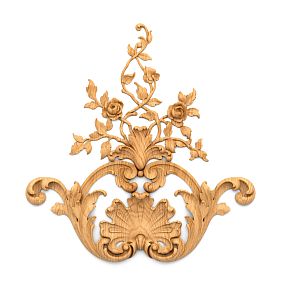
Decorative Inserts– these are individual carved elements that are overlaid onto the main surface of furniture, doors, or walls to create accents. The sizes of overlays vary from small – a few centimeters, to large panels over a meter in size.
Overlays can have the most diverse shapes: oval medallions with floral ornamentation, rectangular panels with geometric patterns, shaped compositions depicting flowers, animals, birds, architectural elements. Overlays with classic motifs are especially popular – acanthus leaves, grape clusters, shells, rosettes.
Applicationcarved appliquésThe scope of application for overlays is practically unlimited. They are used to decorate cabinet fronts, bed headboards, door panels, fireplace portals, and wall panels. Small overlays are used for decorating furniture legs, frame corners, and connecting elements.
An important advantage of overlays is the ability to update the appearance of existing furniture without replacing it. Simply attach the carved elements to the fronts of an old cabinet, and it acquires a completely new, more expensive and refined look.
Wooden Rosettes
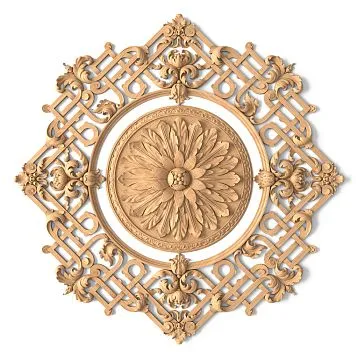
Wooden sockets– these are round or polygonal carved elements, most often used for decorating ceilings, less often – walls and furniture. The classic application of rosettes is framing ceiling lights, chandeliers, where they serve as a decorative base, masking the mounting point and wires.
Rosettes come in various diameters – from miniature 10-15 cm to impressive ones a meter or more. The pattern on rosettes is usually symmetrical, radiating from the center to the edges. These can be petals of a stylized flower, geometric rays, complex interweavings of floral motifs.
In addition to ceilings,carved rosettesare used as central elements of wall panels, for decorating furniture fronts, and door panels. A large rosette can become an independent decorative object, the centerpiece of an interior composition.
Carved Brackets
Wooden bracketscombine decorative and functional roles. These are console elements that serve as supports for shelves, cornices, balconies, bay windows, while being adorned with carvings.
The shape of brackets can be very diverse – from simple triangular to complex figured with swirls, volutes, and floral motifs. A classic bracket has a vertical part attached to the wall, a horizontal part supporting the structure, and a diagonal reinforcing part, which is often decorated with the most elaborate carving.
Carved brackets are widely used in the design of mantel shelves, bookcases, consoles, and bar counters. They give the structure visual lightness, transforming a utilitarian element into a work of art.
Wooden moldings
Wooden moldings– these are narrow decorative strips used for framing wall panels, mirrors, creating framed compositions on walls, and furniture finishing. Unlike trim, moldings typically have a simpler profile but can be decorated with shallow carving or milling.
Moldings allow for structuring wall space by dividing it into separate panels, which is especially effective in rooms with high ceilings. A classic technique is creating rectangular frames from moldings on the wall, inside which wallpaper of a contrasting color or decorative paint is placed.
Wooden moldingsare also used as the upper boundary of wall panels, dividers between different types of finishes, and framing for door and window openings. Their versatility makes moldings indispensable elements of classic interior design.
Materials: Choosing Correctly
The quality and durability of carved wooden elements directly depend on the wood species from which they are made. Each species has its own characteristics, advantages, and optimal areas of application.
Oak: nobility and eternity
Oak – the king among wood species for making decorative elements. Its dense texture, beautiful grain, noble shade from light golden to dark brown make oak an ideal material for carving. Oak products are distinguished by exceptional strength and durability; they are practically not subject to deformation and are resistant to moisture and mechanical damage.
Carving oak requires special skill due to the hardness of the material, but the result justifies the effort – oak patterns retain the clarity of lines for decades, do not wear out, and do not lose their shape. Oak lends itself well to various types of processing – toning, brushing
, patination, which allows creating a variety of visual effects.
The price of oak products is higher than elements made from other species, but this is justified by the quality and prestige of the material. Oak is traditionally associated with solidity, reliability, and high status.
Beech: Beauty and Practicality
Beech – an excellent alternative to oak, combining high quality with a more affordable price. Beech wood has a uniform dense structure, making it ideal for creating elements with fine detailed carving. Small details, thin lines, and complex interweaving of patterns turn out especially clearly on beech.
The color of beech wood varies from light pink to yellowish-red, giving products a warm, pleasant shade. Beech takes well to toning, allowing for a wide palette of colors from almost white to dark chocolate.
An important feature of beech is its hygroscopicity. This species actively reacts to changes in humidity, so beech elements require thorough preliminary drying and stable operating conditions. If these conditions are met, beech products last a very long time, preserving their original appearance.
Ash: Texture and Strength
Ash is close to oak in hardness but has a more pronounced texture with clear annual rings. This creates an interesting visual effect, especially when using transparent or semi-transparent coatings that preserve the natural wood grain.
The color of ash varies from light yellow to olive, with the sapwood (outer layers) being lighter than the heartwood. This play of shades adds special picturesqueness to ash products. The species lends itself well to carving, processing, and toning.
Ash is resistant to impact loads, does not crack, making it a suitable material for elements subjected to mechanical stress – brackets, furniture legs, door overlays.
Linden: The Carver's Workshop
Linden – a traditional material for artistic carving in Russia. Soft, pliable, with a uniform structure, linden allows creating products with jewelry-like detail. The most complex, openwork patterns requiring fine detailing are usually carved from linden.
However, the softness of linden is also its drawback. Products made from this species are less resistant to mechanical damage and require careful handling. Linden is suitable for elements that are not subjected to active impact – ceiling rosettes, wall panels, upper parts of furniture.
The color of linden is light, almost white with a slight creamy tint. Such a neutral base is ideal for any type of finishing – toning, painting, gilding.
Pine: Accessibility and Warmth
Pine – the most accessible species for making decorative elements. Coniferous wood with a characteristic resinous aroma, soft, easily workable. Pine products have a warm golden hue with a pronounced pattern of annual rings and resin canals.
The softness of pine makes carving technological and fast, which reduces the cost of products. However, the same softness means less resistance to damage. Pine elements are more suitable for interior applications where they are protected from harsh impacts.
An important point when working with pine is the presence of resin, which can seep to the surface, especially when the temperature rises. High-quality preliminary processing – deresination – solves this problem.
Styles and Directions
Carved wooden elements are produced in various stylistic solutions, from classic historical styles to modern interpretations. The correct choice of style determines the harmony of the interior.
Classicism and Empire
The classic style is characterized by symmetry, proportionality, and the use of antique motifs. Carved elements in the classic style include acanthus leaves, meanders, palmettes, rosettes, egg-and-dart patterns. Patterns are built according to clear geometric schemes, creating a sense of order and harmony.
Empire style, which evolved from classicism, adds solemnity and monumentality. Military symbols appear here – laurel wreaths, torches, armor, as well as ancient Egyptian motifs – sphinxes, lotuses, pyramids. Empire-style carving is typically more relief-like, expressive, creating strong chiaroscuro contrasts.
Baroque and Rococo
Baroque is a celebration of opulence, an abundance of decoration, complex interweaving of forms. Carved elements of the Baroque style are distinguished by dynamism, asymmetry, and an abundance of scrolls, volutes, and cartouches. Floral motifs are lush, almost sculptural, with deep detailing.
Rococo makes Baroque opulence lighter, more elegant, and playful. Shells (rocaille) appear, from which the style gets its name, as well as asymmetrical interweavings of thin twigs, small flowers, and ribbons. Rococo carving is openwork, lace-like, creating an effect of airiness and lightness.
Modern and Art Deco
Art Nouveau of the late 19th – early 20th centuries brought a new understanding of decoration. Floral motifs become stylized, smooth curved lines and asymmetrical compositions appear. Depictions of irises, lilies, winding stems, as well as female figures with flowing hair are characteristic.
Art Deco of the 1920s-30s contrasts with Art Nouveau through geometricity, clarity of lines, and symmetry. Carved elements in the Art Deco style use zigzags, stepped forms, stylized sun rays, and geometrized floral motifs. The combination of wood with other materials – metal, glass, stone – is often used.
Ethnic styles
Ethnic motifs in wood carving are extremely diverse. The Russian tradition uses solar signs, floral ornaments, geometric patterns, and depictions of birds and animals. Scandinavian carving is more restrained, with clear geometric forms and stylized floral motifs.
Eastern traditions – Chinese, Japanese, Indian – bring their unique elements: dragons, lotuses, hieroglyphs, mandalas. African motifs are characterized by large geometric forms, stylized masks, and abstract patterns.
Modern minimalism
The modern approach to carved elements often follows the path of simplification, stylization, and geometrization of traditional patterns. Minimalist carved elements have clear lines, simple forms, and minimal details. This can be a single smooth line cutting across a surface or a simple geometric pattern with rhythmic repetition.
Such elements fit perfectly into modern interiors, adding individuality without overloading the decor. The principle of 'less is more' works here to its full extent.
Application in interior design
Ready-made carved wooden elements open up endless possibilities for transforming interiors. Let's consider the main directions of their application.
Wall decoration
Walls are the canvas on which the interior composition unfolds.Carved Wooden Elementsallow creating expressive accents on walls, structuring space, adding volume and texture.
A classic technique is creating wall panels using moldings and overlays. The wall is divided into rectangular or square sections framed by moldings, inside which decorative overlays or wallpaper are placed. This solution gives the room solidity, structure, and visually increases the height of the ceilings.
Large carved panels can become the central element of a wall, for example, behind the headboard in a bedroom or above a sofa in a living room. Vertical carved pilasters help zone the space, creating visual boundaries without physical separation.
Ceiling Decor
The ceiling – often the forgotten fifth wall of a room – deserves no less attention.Solid wood productsfor ceilings include rosettes for chandeliers, cornices, coffered constructions, beams with carving.
A ceiling rosette around a chandelier is a simple way to add elegance. Even an ordinary chandelier framed by a beautiful carved rosette looks significantly more impressive. The rosette can be painted to match the ceiling color for a restrained effect or in a contrasting color to create an accent.
Wooden cornices at the junction of walls and ceiling create a smooth transition, visually raise the ceiling, and add completeness to the room. A carved cornice with rich ornamentation turns a simple structural detail into a work of art.
Furniture decor
Furniture is a fertile area for applying carved elements.decorative inlays for furnitureallow turning a simple wardrobe into an antique rarity, and an ordinary chest of drawers into a designer object.
Facades of wardrobes, sideboards, chests of drawers are decorated with overlays in central parts or at corners. Drawers receive carved handles or decorative panels. Furniture legs are adorned with carved elements, turning from simple supports into sculptural details.
Carved decor looks especially impressive on large furniture pieces – wardrobes, beds, tables. A bed headboard with a carved overlay becomes the center of the bedroom, a dining table with carved legs and a frieze becomes the decoration of the dining room.
Door and window openings
Doors and windows are natural focal points in an interior, places of transition between spaces. Their decoration with carved elements emphasizes this role, creates solemnity, and attracts attention.
Door architraves with carving turn a simple opening into a portal. The upper part of the opening can be decorated with a carved overlay or even a small pediment, which is especially effective in interiors with high ceilings.
Window openings also deserve special attention. Carved architraves, window sills with patterns, and upper overlays create a frame for the view from the window, integrating the external space into the interior composition.
Fireplaces and portals
A fireplace portal is a classic place for applying carved decor. The richest, most expressive elements are appropriate here – large overlays with Baroque scrolls, pilasters with capitals, friezes with garlands, cornices with consoles.
Even an electric or bio-fireplace in a beautiful carved frame acquires the impressiveness and significance of a real hearth. A mantelpiece supported by carved brackets becomes a pedestal for decorative objects, family photographs, and works of art.
Production technologies
Modern manufacturing of carved wooden elements combines traditional handcrafting methods with high-tech processes, allowing for an optimal balance of quality, production speed, and cost.
CNC milling
Computer numerical control (CNC) machines have revolutionized the production of carved elements. A computer program controls the movement of the milling cutter, which cuts the most complex patterns with the highest precision based on a given three-dimensional model.
The advantages of CNC technology are obvious: perfect repeatability of elements, the ability to create patterns of any complexity, high production speed, and minimization of material waste. The software allows for visualizing the future product, making adjustments before cutting begins, and optimizing the process.
However, CNC machines do not replace the skill of a carver; they complement it. Automation takes over the routine work of material removal and precise repetition of elements, while the master handles the finishing, giving the product individuality and refining fine details.
Manual Finishing
After being removed from the machine, each product undergoes a stage of manual processing. The master removes minor defects, smooths sharp edges, and refines details that require special attention. This is especially important for elements with fine, openwork carving, where automation cannot always achieve the necessary quality.
Manual sanding is a crucial stage that determines the final quality of the product. The surface must be absolutely smooth, without burrs or roughness, while it is important not to erase the clarity of the carving lines. An experienced master feels the material, understands where more effort is needed and where to act with maximum delicacy.
Drying and Stabilization
High-quality wood drying is the foundation of the durability of carved elements. Freshly cut wood contains a significant amount of moisture, which, when evaporating, causes shrinkage, deformation, and cracking of the material. For carved elements, kiln-dried wood with a residual moisture content of 8-12% is used.
The kiln-drying process takes place in special installations where temperature, humidity, and air circulation are controlled. Gradual, uniform removal of moisture from the wood helps avoid internal stresses that could lead to warping or cracks.
After drying, the wood is stabilized—it is kept in conditions close to operational ones so that the material adapts and takes on its final dimensions. Only after this does the manufacturing of carved elements begin.
Protective treatment
Finished carved elements must undergo protective treatment, which protects the wood from moisture, fungus, insects, and ultraviolet light. Various compositions are used—impregnations, primers, varnishes, oils, waxes—depending on the operating conditions and the desired appearance.
For interior elements, a coating of varnish or oil is usually sufficient, which emphasizes the wood grain, protects the surface from dirt and minor mechanical impacts. Oil coatings create a matte, velvety surface; varnishes create a glossy, more elegant one.
For elements that will be used in conditions of high humidity or outdoors, more serious protection is required—multi-layer antiseptic impregnations, moisture-protective compounds, coatings with UV filters.
Purchase: What to Look For
Having decidedto buy wooden patterns, it is important to pay attention to a number of key points that determine the quality and durability of the products.
Wood quality
The first thing to evaluate is the quality of the source material. The wood should be well-dried, without cracks, knots in critical places, signs of rot, or insect damage. The color should be uniform, without dark spots that may indicate incipient rot.
The presence of small knots is not always a drawback—they can give the product a natural look, emphasizing the authenticity of the material. However, knots should not be located in thin carving elements where they could lead to breakage.
Clarity of Carving
The quality of carving is determined by the clarity of lines, depth and uniformity of material removal, and the absence of chips and burrs. All elements of the pattern should be well-defined, with clean edges and smooth transitions. Symmetrical elements should be truly symmetrical, and repeating details should be identical.
Pay attention to the thin, openwork parts of the carving—they demonstrate the skill of execution. If thin elements are executed carelessly, with uneven edges or insufficient detailing, this is a sign of low quality.
Surface treatment
The surface of the carved element should be smooth, pleasant to the touch, without roughness, burrs, or tool marks. Good sanding is a sign of a serious manufacturer who does not skimp on finishing.
If the product is coated with varnish or oil, the coating should be even, without drips, bubbles, or unpainted areas. A high-quality coating emphasizes the wood grain, making it more expressive, but does not hide it under a thick layer.
Geometric Parameters
It is important to check the geometry of the elements—straightness of long items, flatness of wide panels, accuracy of angles and dimensions. Deformed elements are difficult to install, they may not fit together, creating gaps.
If several identical elements are purchased, make sure they are truly identical in size—this is critical when creating symmetrical compositions.
Completeness and Packaging
When purchasing a set of elements (for example, all parts for framing a door), check the completeness, the presence of all necessary parts, including fasteners if provided. High-quality packaging protects the products from damage during transportation—this is also an indicator of the manufacturer's responsible approach.
Installation and Mounting
Proper installation of carved elements is no less important than their quality. Even the most beautiful product can look unimpressive with careless mounting.
Foundation Preparation
The surface on which the carved elements will be mounted should be level, clean, dry, and sturdy. Uneven areas should be leveled with putty or sanding, dust removed, and primed if necessary.
For heavy elements, reinforcement of the base may be required—installing additional blocks, using more powerful fasteners. It is important to ensure that the wall can support the weight of the decorative elements.
Marking and Fitting
Before final installation, always do marking and fitting. Mark the position of the elements on the wall or furniture, check symmetry, distances, alignment horizontally and vertically. Use a level, tape measure, and pencil.
Complex compositions of several elements are better first assembled on the floor or temporarily fixed with painter's tape to see the overall look and make adjustments if necessary.
Methods of mounting
The choice of fastening method depends on the size and weight of the element, the base material, and operating conditions. Main methods:
-
Adhesive – for lightweight elements on wooden, MDF, or plywood bases. Woodworking PVA, polyurethane, and epoxy adhesives are used.
-
Screws – for medium and heavy elements. Screws are driven from the back or countersunk into the wood and concealed with putty.
-
Combined – adhesive plus headless finish nails, which are virtually invisible after installation.
-
Concealed fasteners – special systems for installing heavy elements where the fastening is completely hidden.
Final finishing
After installation, finishing work may be required – sealing fastening points, touching up or tinting joints, applying an additional protective layer. If elements are installed unfinished (which is sometimes more convenient for subsequent painting to match the interior), full finishing is carried out after installation – priming, painting, varnishing.
Care and Maintenance
With proper care, wooden carved elements last for decades, preserving their original beauty. Care is simple but regular.
Regular cleaning
Dust is the main enemy of carved elements. It accumulates in the recesses of the carving, making the pattern less clear and giving the product an untidy appearance. Regular cleaning with a soft brush or vacuum with an attachment prevents dirt buildup.
For deeper cleaning, a slightly damp cloth or sponge is used, but it is important not to over-wet the wood. After wet cleaning, it is advisable to wipe the surface with a dry cloth.
Recoating
Over time, the protective coating may fade or wear away on the most prominent parts of the carving. Restoring it is simple – the surface is cleaned, lightly sanded with fine sandpaper, and a fresh coat of oil or varnish is applied.
The frequency of renewal depends on operating conditions – on average, once every 3-5 years for interior elements, more often for elements in high-use areas.
Humidity control
Wood is sensitive to humidity. Sharp fluctuations in air humidity can cause deformation and cracking of elements. The optimal humidity for wooden products is 40-60%. Maintaining it is aided by humidifiers in winter when heating dries the air, and dehumidifiers in summer during damp weather.
Do not place wooden elements near heat sources – radiators, fireplaces, heaters. Direct heat overdries the wood, causing cracks.
Sun protection
Direct sunlight causes fading and overdrying of wood. If carved elements are located on the south side with lots of sun, it is advisable to use curtains or blinds for protection during the brightest hours of the day.
Modern varnishes with UV filters significantly slow fading but do not stop it completely.
Frequently asked questions
Can finished carved elements be painted?
Yes, absolutely. Finished elements are usually supplied unpainted or with a basic protective coating, allowing them to be painted any desired color. Before painting, the surface should be lightly sanded for better adhesion, primed, then paint applied in several thin coats.
For wood, water-based acrylic paints, alkyd enamels, and special furniture paints are suitable. Stains and tinting compositions that change the color while preserving the visibility of the wood grain can also be used.
How to choose the size of elements?
The size should correspond to the scale of the room and furniture. In small rooms, large carved elements will look bulky, overwhelming the space. In spacious rooms, on the contrary, small details will get lost.
General rule: ceiling height over 3 meters allows for large elements, standard height of 2.5-2.7 meters – medium sizes, low ceilings up to 2.5 meters require more restrained decor.
How much do wooden carved elements cost?
The price depends on many factors: wood species, size, complexity of carving, manufacturing method. Simple molded products from pine can cost from 200-300 rubles per linear meter, complex carved panels from oak – several thousand rubles per piece.
On average, the budget for decorating a standard room with carved elements ranges from 15-20 thousand rubles when using simple elements to 100-150 thousand and above for rich decor with exclusive products.
Can carved elements be used outdoors?
Yes, but with caveats. For outdoor use, only elements made from weather-resistant species – oak, larch, teak – are suitable, with mandatory high-quality protective treatment. Elements from softwoods, even with coating, quickly deteriorate outdoors.
Outdoor elements require regular maintenance – checking the condition of the coating, renewing it every 1-2 years. It is advisable to place them under canopies that protect from direct rain and snow.
How to attach carved elements to drywall?
Drywall is a weak base that does not hold heavy elements. Light overlays, rosettes can be glued directly to drywall with special adhesive. For medium-weight elements, toggle bolts or molly bolts are used.
Heavy elements should preferably be fastened to a metal frame behind the drywall or to pre-installed wooden blocks provided during the drywall installation stage. If there are no pre-installed blocks, a hole is made in the drywall through which the fastener passes to the load-bearing wall.
Are carved elements safe for allergy sufferers?
Natural wood is hypoallergenic; it does not cause allergic reactions. However, coatings – varnishes, paints – may contain volatile substances that are potentially allergenic. For sensitive individuals, it is recommended to choose products with water-based coatings, eco-friendly oils, and waxes.
Before installation, elements with strong-smelling coatings should be aired out for several days to allow volatile substances to evaporate.
Can elements be ordered in custom sizes?
Most manufacturers offer custom production. You can order elements in non-standard sizes, modify details of an existing design, or create a completely unique pattern based on the customer's sketch.
Custom orders are usually more expensive than standard products and require more time for production – from several weeks to several months depending on complexity. A minimum order quantity is also required, especially for complex items.
How to combine elements of different styles?
Mixing styles is a subtle matter that requires a sense of proportion and taste. The general principle: elements should have something in common – scale, proportions, line character, material. Sharp contrasts can create disharmony.
A safe approach is to choose one dominant style and add small accents of another style. Or use elements of transitional styles that naturally combine features of different directions – for example, Art Nouveau, which unites classical and innovative elements.
Conclusion: Investment in Beauty and Quality
Solutionbuy wooden patterns– is an investment in the beauty, uniqueness, and durability of your interior. Ready-made decorative elements allow you to quickly transform a space, give it individuality, and create an atmosphere that reflects your taste and lifestyle.
Wooden carved products are not just decor. They are a piece of living nature in your home, a source of positive emotions, tactile and visual pleasure. Natural wood creates a healthy microclimate, fills the space with warmth, coziness, and a sense of security and stability.
Modern production makes carved elements accessible while maintaining high quality. CNC milling technologies ensure precision and repeatability, manual finishing adds individuality, and quality materials guarantee durability. The widest assortment allows you to find a solution for any style – from lavish classic to strict minimalism.
Picture frames — a special category of molding products, distinguished by complex profiles and rich decoration. If a molding is a functional element with decorative properties, a picture frame is primarily decorative, although it performs certain functions., carved overlays, moldings, rosettes, brackets – each of these elements can become that very detail that turns an ordinary interior into a memorable one, filled with character and individuality. Don't be afraid to experiment, seek unconventional solutions, and combine various elements. The main thing is to maintain a sense of proportion and follow your taste.
The company STAVROS offers the widest selection of ready-made decorative elements from solid wood for any interior tasks. The catalog features hundreds of models of carved products – fromclassical profiled moldingswith acanthus leaf to modern minimalist solutions. All products are made from quality kiln-dried wood using modern equipment and traditional hand-finishing techniques. The team of experienced craftsmen at STAVROS creates dozens of meters of carved products daily, each undergoing strict quality control. The company offers flexible cooperation terms – the possibility of purchasing both retail and wholesale, delivery throughout Russia and CIS countries, a loyalty program for designers and manufacturers, and production of items according to custom parameters. By contacting STAVROS, you receive not just products, but a comprehensive solution for creating a unique interior, professional consultation from specialists, and a guarantee of quality and durability of the products. Call 8 (800) 555-46-75 or visit the company's website to discover the world of possibilities of wooden decor and start transforming your space today.