Article Contents:
- The Philosophy of Wooden Craftsmanship: Understanding the Material
- Choosing the Species: Character Determines Fate
- Preparation Symphony: The Foundation of a Flawless Result
- Tool Preparation: The Master's Arsenal
- The Art of Marking: Where Mathematics Meets Aesthetics
- Aesthetic Considerations in Marking
- Technological Fastening Methods: From Traditions to Innovations
- Fastening with Threaded Rods: The Golden Standard of Reliability
- Through Bolt Connection: Maximum Strength
- Innovative Fastening Methods
- Locking Connection System 'Swallow's Tail'
- Chemical Anchoring: Technology of the Future
- Fastening on Wooden Shanks: Ecology and Traditions
- Technology of Installing Shanks
- Features of mounting to various bases
- Installation on Wooden Steps
- Fastening to Concrete Bases
- Use of Baluster Supports: Simplification and Reinforcement
- Installation Technology with Baluster Support
- Quality Control and Testing of Joints
- Long-Term Monitoring of Condition
- Final Finishing and Protection of Joints
- Antiseptic Treatment and Protection
- Common Mistakes and Ways to Prevent Them
- Errors in Material Selection and Application
- Innovative solutions and development prospects
- Digital Technologies in Production and Installation
- Economic Aspects and Cost Optimization
- Long-Term Economic Efficiency
- Features of installation under various conditions
- Working in Confined Conditions
- Installation in High Humidity Conditions
- Conclusion: Mastery as the Philosophy of Perfection
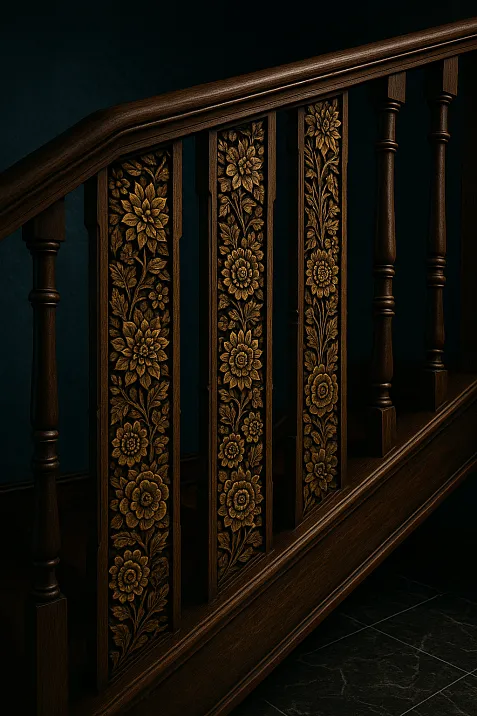
Every staircase tells its own story. Some whisper of modesty and practicality, others loudly proclaim luxury and status. But what truly unites all truly quality staircases? Flawlessly installed wooden balusters — a process that transforms a simple structure into a work of architectural art. After half a century of working with wood, I understand: it is in the details that the soul of the staircase lies, its character and longevity.
Why do some staircase railings serve for centuries, becoming family heirlooms, while others begin to creak and wobble within a few years? The secret lies in understanding that balusters are not merely decorative elements. They are engineering structures that must withstand colossal loads, ensure safety, and at the same time delight the eye with their beauty.
Modern installation of wooden balusters combines centuries-old carpentry traditions with innovative fastening technologies. Each method has its philosophy, advantages, and areas of application. Choosing the right method is an art requiring deep understanding of materials, loads, and aesthetic requirements.


The Philosophy of Wooden Craftsmanship: Understanding the Material
Wood is not just a construction material. It is a living substance that continues to 'breathe' even after processing. Each fiber carries the memory of years of growth, of sun and rain, of winds and frost. When a craftsman takes a wooden baluster in hand, he is not working merely with a blank — he is working with history, with the energy of nature.
Humidity, temperature, mechanical stresses — all of this affects the behavior of wood during operation. Proper installation takes into account these characteristics, anticipates possible changes, and compensates for them in advance. This requires not only technical knowledge but also an intuitive understanding of the material.




Choosing the Species: Character Determines Fate
Different wood species require individual approaches during installation. Oak — the king among species — possesses exceptional strength and stability, but tends to crack if improperly drilled. Its dense structure requires pre-drilling and the use of special drill bits.
Ash combines the strength of oak with a more expressive texture. When installing ash balusters, it is important to consider the direction of the grain — fastening along the grain is significantly stronger than across it. This species holds threaded connections well and practically does not produce splinters when properly processed.
Spruce and larch represent a more accessible segment, but this does not mean compromising on quality. Coniferous species are more workable, simplifying installation, but require special attention to protective treatment. The resinous nature of larch provides natural protection against moisture, making it an ideal choice for rooms with high humidity.
Our factory also produces:


Preparation Symphony: The Foundation of a Flawless Result
Quality installation of wooden balusters begins long before the first hole is drilled. The preparatory stage is the foundation upon which the entire project's success is built. Every detail matters, and every operation affects the final result.
Material acclimatization — the first step toward the longevity of the structure. Balusters must adapt to operating conditions for at least one week. Sudden changes in humidity and temperature can lead to deformations even after installation, negating all the work done.
Quality control includes careful inspection of each baluster for defects. Cracks, knots, and warping can all become causes of problems in the future. The moisture content of the wood should not exceed 12% for internal structures and 15% for external ones.
Get Consultation
Tool Preparation: The Craftsman's Arsenal
Professional installation requires appropriate tools. Each tool must be in perfect condition — a dull drill bit can damage an expensive baluster, an inaccurate level will cause misalignment of the entire structure.
An electric drill with variable speed and a set of high-quality drill bits of various diameters is the foundation of the tool kit. The drill bits must be sharp, properly ground, and suitable for the specific type of wood. For hardwoods, drill bits with a sharper cutting angle are used.
A miter saw provides perfectly straight cuts at any angle. The quality of the cut is critically important for the density of the joints. An uneven end not only worsens the appearance but also reduces the strength of the connection.
A laser level is an indispensable assistant for marking. It allows creating an ideally straight installation line along the entire length of the stair run, which is especially important when working with long spans.
The Art of Marking: Where Mathematics Meets Aesthetics
Correct marking is the foundation of quality installation. Here, mathematical precision must be combined with aesthetic sense. The quality of marking affects not only the appearance of the staircase but also its safety.
Determining the installation line begins with installing the outer support posts. They define the overall geometry of the railing and serve as reference points for all subsequent measurements. A control string or laser line is stretched between the posts — this will be your main reference.
Calculating the baluster spacing requires consideration of many factors. Building codes limit the maximum distance between balusters — the gap should not exceed 120 millimeters to ensure children’s safety. But this is only a technical minimum.
Aesthetic Considerations in Marking
The visual perception of the staircase largely depends on the rhythm of the balusters. Too frequent installation creates a sense of "picket fence," disrupting the lightness of the structure. Too sparse may appear unstable and unsafe.
The optimal spacing is individually selected based on the size of the balusters, the style of the staircase, and the overall interior design. Thin, elegant balusters can be placed more frequently — every 100-110 millimeters. Heavy balusters require larger intervals — 130-150 millimeters.
Marking for landing steps complicates the calculation due to the variable tread width. Here, special skill is required to ensure even visual perception while meeting safety requirements. The balusters must be positioned to create a smooth railing line without sharp angles.
Technological Fastening Methods: From Traditions to Innovations
Threaded bolt mounting: the gold standard of reliability
The threaded bolt method is rightfully considered the standard for mounting balusters. This technology ensures maximum connection strength while preserving the possibility of disassembly for maintenance or repair.
A central hole is drilled through the baluster to a depth of 70-90 millimeters, with a diameter 1-2 millimeters smaller than the bolt. This ensures a tight fit without play. A bolt with a diameter of 8-12 millimeters is installed using a two-component epoxy adhesive.
After polymerization, the epoxy adhesive creates a monolithic connection stronger than the wood itself. The full curing time is 24-48 hours, during which the connection must not be loaded. The protruding bolt portion, 50-60 millimeters long, is inserted into the corresponding hole in the tread.
Through-bolt connection: maximum strength
For particularly critical structures or areas with increased loads, through-bolt mounting is used. A bolt with a diameter of 10-12 millimeters passes through the entire tread thickness and is inserted into the baluster end to a depth of 60-70 millimeters.
The bolt head is pressed into the baluster wood by 4-5 millimeters and covered with a wooden plug made from the same wood species, following the grain direction. On the opposite side of the tread, a wide washer with a diameter of 35-40 millimeters and a nut are installed.
Such a connection can withstand loads many times exceeding the normative values. The only limitation is the need for access to the underside of the tread for installation and periodic maintenance.
Innovative mounting methods
Mortise-and-tenon joint "swallowtail"
The "birdsmouth" type mortise-and-tenon joint represents the pinnacle of carpentry art. A trapezoidal projection with a 15-20 degree angle is milled on the baluster end, and a corresponding groove is cut into the tread. During assembly, the elements engage at an angle, after which the baluster is rotated into its working position.
This technology requires meticulous manufacturing precision — tolerances must not exceed 0.05 millimeters. The result exceeds all expectations: the connection becomes absolutely rigid, requires no additional fasteners, and can withstand tremendous loads.
Manufacturing a mortise-and-tenon joint is possible only on high-precision CNC equipment. Manual manufacturing requires the highest level of craftsmanship and significant time, but the result justifies all the costs.
Chemical anchoring: the technology of the future
Chemical anchors are two-component compositions based on epoxy or polyester resins, which polymerize directly in the hole. The strength of such a connection can be 2-3 times greater than the strength of the material itself.
The technology involves drilling enlarged holes — 16-18 millimeters for 12-millimeter bolts. A chemical compound is injected into the hole using a special gun, and then the threaded bolt is installed. Full polymerization occurs within 4-6 hours at a temperature of 20°C.
Advantages of chemical anchoring include maximum strength, absence of mechanical stress in the wood, the ability to work with damaged areas, and airtight connections. The disadvantage is the high cost of materials and practical impossibility of disassembly.
Fastening with wooden dowels: eco-friendliness and tradition
Wooden dowels are a classic method of connection, proven by centuries of carpentry practice. Dowels are made from hardwoods (oak, beech, ash) and have a cylindrical shape with small longitudinal grooves for excess glue to escape.
The diameter of dowels is usually 10-12 millimeters, and the length is 50-70 millimeters. Coaxial holes to a depth of 30-35 millimeters each are drilled into the baluster end and the tread. The dowel is installed using high-quality PVA wood glue or polyurethane glue.
Dowel installation technology
The accuracy of drilling holes for dowels is critically important for the quality of the connection. Even a 1-millimeter deviation in the axis can cause the baluster to be misaligned or weaken the connection. To ensure accuracy, special dowel guides or bushings are used.
Shanks must fit into holes with a slight interference fit — the force of hand should be sufficient for installation, but without using a hammer. Excessive tightness may cause wood cracking, while excessive looseness leads to weakened joints.
Adhesive is applied to both the shank and the hole in a thin, even layer. Excess adhesive should extrude through grooves on the shank, indicating full gap filling. After assembly, the joint is held under light pressure for 24 hours until the adhesive fully cures.
Features of mounting to different bases
Installation on wooden treads
When attaching balusters to wooden treads, the direction of wood grain and possible seasonal deformations must be considered. Attachment across the grain is less reliable than along the grain, so during marking, the orientation of wood grain in the tread must be taken into account.
The thickness of the tread significantly affects the choice of fastening method. For treads thinner than 40 millimeters, through-fastening may be the only reliable option. For thicker treads, various types of blind joints can be used.
The moisture content of the tread wood must match the moisture content of the balusters, with a tolerance of no more than 2%. A large difference may cause stresses in the joint and weaken it. All wooden elements must be pre-acclimatized under the conditions of use.
Mounting to concrete bases
Mounting balusters on concrete bases requires the use of special anchor systems. Holes of 14–16 mm diameter are drilled into the concrete to a depth of 90–110 mm. Industrial vacuum cleaners must be used to remove concrete dust — dust significantly reduces the strength of the anchor connection.
Chemical anchors for concrete provide exceptional connection strength. The two-component composition is introduced into the hole using a special gun, followed by installation of a threaded rod. Setting time is 2-4 hours depending on ambient temperature.
Mechanical anchors — an alternative for concrete bases. Wedge anchors create a secure connection through mechanical wedging in the hole. Split anchors provide even higher strength but require precise hole dimensions.
Using baluster supports: simplification and reinforcement
A sub-baluster is a horizontal plank with a cross-section of 30×60 or 40×80 mm, which significantly simplifies installation and increases the rigidity of the entire structure. The plank is attached to the stair base and serves as an intermediate element for installing balusters.
The advantage of a sub-baluster is the ability to pre-assemble railing sections on a horizontal surface and then install ready-made blocks. This is especially relevant when working with long spans, complex stair geometry, or in confined conditions.
Installation technology with baluster supports
The sub-baluster is marked according to the baluster placement and fastened to the base using anchor bolts of 10–12 mm diameter or strong screws 120–150 mm long. Grooves 15–20 mm deep are milled into the plank for installing balusters.
Balusters are attached to the sub-baluster using various methods depending on strength and aesthetic requirements. The most common method is attaching screws from below at a 30–40 degree angle. This type of fastening remains hidden and does not compromise the structure’s aesthetics.
After installing all balusters on the sub-baluster, the top handrail support plank is mounted, followed by the decorative handrail. The sub-baluster must be made from the same wood species as the balusters or from a material with similar linear expansion characteristics.
Quality Control and Joint Testing
After completion of installation, each baluster is checked for vertical alignment using a precision level or laser level. The allowable deviation from verticality must not exceed 1 mm per meter of height. All joints are checked for absence of play and fastening strength.
Strength tests are conducted by applying horizontal load to the top of the baluster. The load must equal 150% of the calculated value and must be applied gradually without impacts. Any deformations, creaks, or loosening of fasteners are unacceptable and require immediate correction.
Long-term Monitoring of Condition
Stair railings require periodic inspection of fasteners. Visual inspection is recommended every six months, and technical inspection annually. If loosening of threaded connections is detected, immediate retightening is required.
Special attention should be paid to the condition of wood at connection points. Appearance of cracks, darkening, efflorescence, or other signs of damage require immediate intervention by specialists. Timely detection of problems allows for their resolution with minimal effort.
Final Treatment and Protection of Joints
After mechanical assembly, all joints undergo careful final treatment. Areas where fasteners are installed are sanded with abrasive grit 220–320 until the surface is fully leveled. Wooden plugs covering bolt heads are made from the same wood species, with grain direction properly aligned.
End surfaces of balusters, most vulnerable to moisture, are treated with special end-sealants based on wax or polyurethane. These compounds penetrate wood pores to a depth of 3–5 mm, creating a reliable barrier against moisture ingress.
Antiseptic Treatment and Protection
All wooden elements are treated with deep-penetration antiseptic agents to protect against biological damage. Modern borate-based or organic biocides provide protection for 15–20 years without reapplication.
Metal fastening elements are coated with anti-corrosion compounds. For concealed joints, zinc coatings of at least 12 microns thick or austenitic stainless steel products are used. Exposed metal parts are additionally coated with protective-decorative compounds.
Common Mistakes and Ways to Prevent Them
One of the most common mistakes is inaccurate marking of baluster installation locations. Accumulation of errors leads to uneven gaps, distorted railing geometry, and reduced safety. To prevent this, precise measuring tools must be used, and control measurements must be performed at each stage.
Insufficient drilling depth for fastener holes is another critical error. The depth must be at least 70% of the fastener length to ensure secure fixation. Saving a few millimeters may result in catastrophic consequences.
Errors in Material Selection and Application
Using inappropriate fasteners may lead to joint failure. Metal screws are unsuitable for wood due to different thread pitch and profile shape. Black screws are prone to corrosion and may loosen over time, especially in humid conditions.
Underestimating the importance of pre-drilling in hardwoods often leads to baluster cracking. The pilot hole diameter must be carefully selected for each fastener type and wood species. There are no universal solutions here.
Innovative solutions and development prospects
Modern technologies open new possibilities for installation of wooden balustersHidden fastening systems allow creating joints without visible fasteners, significantly improving the structure’s aesthetics and simplifying maintenance.
Polymer adhesives of the new generation based on modified epoxy resins provide joint strength exceeding the strength of the wood itself. These compositions have high elasticity, allowing them to compensate for thermal deformations without damaging the joint.
Digital technologies in production and installation
CNC machines allow manufacturing balusters with perfect dimensional accuracy and complex profiles. This significantly simplifies installation and improves joint quality. Laser measurement systems provide geometric control accurate to hundredths of a millimeter.
3D modeling and virtual reality allow calculating all installation parameters in advance and identifying potential issues during the design phase. Virtual assembly helps optimize installation technology, minimize material waste, and reduce work time.
Economic Aspects and Cost Optimization
When planning the budget for installing wooden balusters, it is necessary to consider not only material costs but also labor costs for installation, tool and consumable material costs. More expensive fastening systems often pay for themselves through reduced installation time and improved joint quality.
Using standardized elements reduces manufacturing costs and simplifies the installation process. Standardizing fastener dimensions simplifies logistics, reduces the likelihood of ordering errors, and allows creating inventory reserves.
Long-term economic efficiency
Quality installation of wooden balusters is an investment in the long-term operation of the staircase. Cutting costs on fasteners or simplifying technology may lead to significant expenses for repairs and reconstruction in the future. A properly executed joint serves for decades without requiring maintenance.
Using quality materials and professional installation technologies increases property value and creates a positive impression of overall construction quality. A staircase with perfectly installed balusters becomes a hallmark of the house.
Features of installation under various conditions
Working in confined spaces
Installing balusters in already finished rooms requires special care and use of specialized tools. Angle drills and compact impact drivers allow working in limited spaces without damaging surrounding surfaces.
Protective films and cardboard protect finished surfaces from contamination and mechanical damage. Industrial vacuum cleaners with HEPA filters ensure a clean work area and protect respiratory organs from wood dust, which may be carcinogenic.
Installation in high humidity conditions
Staircases in saunas, steam rooms, swimming pools, and other high-humidity areas require special attention to material selection and installation technology. All metal components must have enhanced anti-corrosion coatings or be made from stainless steel materials.
Wood must be pre-treated with deep-penetration moisture-protective compounds. Adhesive joints are made exclusively with water-resistant compounds resistant to steam and condensation. Special attention is paid to ventilation of joints to prevent moisture accumulation.
Conclusion: Mastery as a Philosophy of Perfection
Installing wooden balusters is not merely a technical process, but a true art requiring deep knowledge, years of experience, and a constant pursuit of perfection. After half a century of work in this field, I have realized: every staircase is unique, each project demands an individual approach, and every detail matters for the overall result.
Modern technologies open boundless opportunities for creativity, but the foundation always remains fundamental principles: understanding the material, respect for traditions, striving for quality. Only the combination of deep theoretical knowledge with rich practical experience allows creating staircases that will serve generations.
The path to mastery lies through continuous learning, experimentation, and analysis of mistakes. Each project is an opportunity to discover something new, refine the technology, find a more elegant solution. This is the beauty of our profession — the endless pursuit of the ideal.
Quality installing wooden balusters — it is an investment in safety, beauty, and longevity. Properly executed work becomes a source of pride for the craftsman and joy for the client. The staircase transforms not merely into a functional element, but into a work of art capable of adorning a home for decades.
For many years, the company STAVROS has remained a benchmark of quality in the field of staircase construction. Our specialists are proficient in all modern installation technologies and continuously refine their craftsmanship. We understand that every staircase is not merely a structure, but a part of a family’s life, a witness to important moments, a connecting link between floors of a house and generations of people. Choosing STAVROS means choosing quality proven by time, craftsmanship honed over years, and a guarantee that your staircase will become a true decoration of your home and a source of pride for many years.