Article Contents:
- Why Doors Require Decoration: The Psychology of Space
- First Impression: The Entrance Door as a Business Card
- Interior Doors: Creating Atmosphere Inside
- Visual Correction: How Decor Changes Proportions
- Hiding Defects: The Practical Function of Decor
- Decorative Elements for Doors: Arsenal of Possibilities
- Moldings: Creating Structure
- Decorative Overlays: Central Accents
- Rosettes: Circular Accents
- Panels: Volumetric Panels
- Cornices and Friezes: Finishing Elements
- Door casings: framing the opening
- Materials for Door Decor: Choosing the Base
- Solid wood: nobility and durability
- MDF: Affordable Alternative
- Polyurethane: practicality and versatility
- Combining Materials: Practical Approach
- Door Decoration Styles: From Classic to Modern
- Classicism: Symmetry and Proportions
- Baroque: opulence and drama
- Modern: Smooth Lines and Natural Motifs
- Minimalism: conciseness and purity
- Rustic and Country: Rural Charm
- Decoration Technology: From Idea to Implementation
- Planning the Composition: Creating a Sketch
- Surface Preparation: The Foundation of Quality
- Marking: Precise Placement
- Cutting Elements: Adjusting Sizes
- Installation: Mounting Elements
- Finishing: Color and Protection
- Door Decoration Ideas: Practical Examples
- Simple Interior Door: From Boring to Elegant
- Entrance Door: Creating Representativeness
- Door in a Classic Interior: Harmony with Surroundings
- Door in Loft Style: Industrial Chic
- Door in a Children's Room: Fairy Tale Motifs
- Frequently Asked Questions: Resolving Doubts
- Can a Door Be Decorated Without Removing It from Its Hinges?
- What glue is best to use?
- Should decorative elements be painted before installation?
- How to calculate the amount of material?
- Can a fiberboard door be decorated?
- How long does door decorating take?
- Can the decor be removed if you get tired of it?
- Where to buy quality decorative elements?
- What decor style is the most universal?
- Are special tools needed?
- Conclusion: create doors worthy of your home with STAVROS

You know what distinguishes a home from just a box with rooms? The details. Those very details that most people don't even notice until they're missing. You walk into an apartment—and the first thing you encounter is the door. An ordinary, flat, boring door, like everyone else's. Or is it?Door Decorationcan change not just the appearance of the door leaf—it changes the perception of the entire space, creates a mood even before you cross the room's threshold.
Think about old European houses, Russian mansions, Italian palazzos. What made their doors so memorable? Carvings, overlays, moldings, rosettes—each door told a story, demonstrated craftsmanship, reflected the owners' character. Today we live in an era of mass production, where all doors come off the same assembly line. But this is not a sentence—it's a challenge for those who understand the value of individuality.


Why doors require decoration: the psychology of space
A door is not just a functional element separating rooms. It's a boundary, a transition, a symbol. Entering through a door, we transition from one state to another, from public space to private, from bustle to tranquility. The beauty of a door enhances this transition, makes it conscious, meaningful.




First impression: the entrance door as a business card
The entrance door is the first thing guests see. Before they appreciate the wallpaper, furniture, layout, they see the door. And this door shapes expectations. A simple metal door says: 'Practical people live here, who don't care about beauty.' A door decorated with carved elements, moldings, decorative overlays communicates: 'Aesthetics are valued here, people of taste live here.'
Decorating the entrance door is an investment in reputation. Neighbors will pay attention. Guests will remember. Casual visitors will be surprised. And you, every time you return home, will feel proud that your home stands out from hundreds of faceless apartments around.
Our factory also produces:
Interior doors: creating atmosphere inside
If the entrance door works on external impression, then interior doors shape the internal atmosphere of the home. Imagine a living room with tall doors decorated with classic panels and carved rosettes. Such a room feels more spacious, solid, respectable.
A bedroom with a door featuring elegant overlays with floral motifs becomes not just a place to sleep, but a personal sanctuary, a space for rest and recovery. A study behind a door with geometric moldings gains seriousness, sets a working mood.
Doors create the mood of rooms. By decorating them, you manage the emotional background of the entire home.
Get Consultation
Visual correction: how decor changes proportions
A flat, smooth door visually 'sinks' into the wall, especially if painted the same color. It appears smaller than it actually is. Adding volumetric elements—moldings, overlays—creates relief, play of light and shadow. The door stands out, becomes noticeable, significant.
A narrow door can be visually widened with horizontal elements. A low door can be elongated with vertical strips. A disproportionately large leaf can be broken into sections, creating the illusion of multiple panels. Decor works as an optical illusion, correcting layout flaws.
Hiding defects: the practical function of decor
Old doors often have damage: scratches, dents, veneer chips, cracks. Replacing a door is expensive, and not always advisable if the frame is in good condition. Decorative overlays, moldings, panels cover defects, creating a new surface over the old one.
This is an economically beneficial solution that doesn't require demolition, replacement, or complex repairs. Simply attach decorative elements to the existing leaf—and the door looks like new, and not just new, but designer, exclusive.
Decorative elements for doors: an arsenal of possibilities
The world of furniture and interior decor offers a huge variety of elements for decorating doors. Let's understand what can be used and how it works.
Moldings: creating structure
Wooden moldingsare profiled strips of various cross-sections that are attached to the door surface, forming frames, panels, sections. Molding is the foundation of any decorative composition on a door.
The simplest way to transform a smooth door is to glue moldings in rectangles, imitating classic panels. Two or three frames, symmetrically placed on the leaf, instantly turn a cheap door into an elegant paneled construction.
Moldings come in different profiles. Simple rectangular ones are for minimalist interiors. Shaped ones with curves and roundings are for classic styles. Carved ones with ornamentation are for luxurious styles like Baroque or Rococo.
Molding materials include solid wood (oak, beech, ash), MDF, and polyurethane. Wooden moldings are noble, durable, and can be painted, stained, or varnished. Polyurethane ones are lightweight, moisture-resistant, unaffected by temperature changes, and ideal for bathrooms and entrance doors.
Decorative overlays: central accents
Overlays are flat or three-dimensional elements attached to the door as independent decorative objects. Unlike moldings that form frames, overlays function as accents that draw the eye.
A central overlay with carved ornamentation, placed in the middle of the door panel, creates a compositional center. The eye automatically focuses on it, and the door ceases to be a background, becoming an object of attention.
Overlays can be symmetrical and asymmetrical, floral and geometric, large (300-500 mm) and miniature (50-100 mm). Large ones are used as dominants, small ones as details complementing the composition.
Corner overlays are especially effective—carved elements placed in the corners of molding frames. They add sophistication, completeness, and create a sense of handcrafted work and individual approach.
Rosettes: circular accents
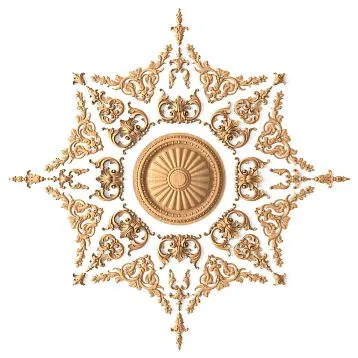
carved rosettes— round or polygonal elements with ornamentation radiating from the center. A rosette is ideal for placement in the center of the door, above or below the door handle, or in the corners of panels.
A rosette creates radial symmetry, attracts attention, and works like a medallion on a dress uniform. A large carved rosette (150-200 mm) becomes the main decoration of the door. Several small rosettes (60-80 mm), arranged symmetrically, create rhythm and structure.
Rosette ornamentation can be floral (stylized flower, acanthus leaves), geometric (rays, polygons), or solar (sun symbol). The choice of ornament depends on the interior style and personal preferences.
Panels: three-dimensional panels
A panel is a recessed or protruding panel that creates relief on the door surface. True panels are a structural feature of the door, formed during manufacturing. However, you can create imitation panels using moldings and overlay panels.
A frame made of molding, inside which a flat or slightly convex panel (made of plywood, MDF, thin solid wood) is placed, creates the illusion of a classic paneled door. The panel can be smooth, textured, carved, or inlaid.
Panels give the door solidity and architectural character. A door with three or four panels looks more expensive and prestigious than a smooth panel, even if made from simple materials.
Cornices and friezes: finishing elements
A door cornice is a horizontal protruding element attached to the top part of the door. It creates completeness, turning the door into an architectural object, a miniature portal.
A frieze is a decorative strip, often with carved ornamentation, placed along the top or bottom edge of the door. A frieze with floral garlands, geometric patterns, or classical ornaments turns a simple door into a work of decorative art.
Cornices and friezes are especially effective on tall doors (2.3-2.7 m), where there is enough space for vertical composition development. They create an impression of height, monumentality, and respectability.
Casing: framing the opening
Architrave is a strip framing the door opening on the room side. It covers the joint between the frame and the wall, but its main function is decorative. A beautiful architrave completes the door's image, connects it with the wall, and creates harmony.
Architraves can be simple (flat strip with minimal profiling) and complex (carved, with ornaments, with capitals and bases imitating columns). The choice of architrave is determined by the style of the door and interior.
Wide architraves (100-150 mm) create solemnity and are suitable for formal rooms. Narrow ones (50-70 mm) are for restrained, minimalist interiors. Carved architraves with floral motifs are ideal for classic styles.
Materials for door decoration: choosing the base
The material affects not only the appearance but also durability, processing possibilities, and the cost of decorative elements.
Solid wood: nobility and strength
Wooden elements made from solid oak, beech, ash—this is tradition, quality, prestige. Solid wood is strong, durable, and beautiful with its natural texture. Wooden decor can be painted any color, stained, or coated with varnish or oil.
Oak is the most prestigious species, with expressive texture, hard, practically eternal. Beech is slightly softer, with delicate pinkish wood, ideal for fine carving. Ash is contrasting, with clear annual rings, strong and elastic.
Wooden decor requires proper treatment—impregnation, priming, coating. But the result is worth it: a door decorated with solid wood elements looks expensive, solid, and respectable. This is the choice for those who value natural materials and classic quality.
MDF: an affordable alternative
MDF is a medium-density fiberboard from which decorative elements are made by milling. MDF is cheaper than solid wood but, with proper treatment, looks just as good.
Advantages of MDF: homogeneous structure without knots and cracks, dimensional stability (does not warp from humidity), possibility of creating complex profiles and fine details. MDF is easily painted with enamels, covered with films, or laminated.
Disadvantages: MDF lacks the natural wood grain texture (though it can be imitated), is less impact-resistant, and may swell under prolonged moisture exposure (therefore not recommended for damp rooms).
MDF decor is a reasonable choice for budget projects where aesthetics are important but solid wood is not an option.
Polyurethane: practicality and versatility
Polyurethane elements are lightweight, moisture-resistant, unaffected by temperature fluctuations, do not rot or warp. Polyurethane can be painted and perfectly imitates wood carving and stucco.
Polyurethane decor is ideal for entrance doors, bathroom doors, balcony doors—anywhere wood might suffer from moisture. It is easily mounted with adhesive and requires no special fasteners.
Visually, high-quality polyurethane is indistinguishable from wood carving, especially after painting. The drawback is the lack of wood's natural tactility, giving a plastic feel to the touch. But for decor that is rarely touched, this is insignificant.
Combining materials: a practical approach
A sensible approach is to combine materials based on their function. Main moldings forming frames can be made from MDF or polyurethane—they bear no load, geometry is key. Central overlays, rosettes, friezes—from solid wood to emphasize their significance and create a quality accent.
Door casings can be made from MDF or solid wood (they are visible, often subject to mechanical impact), while decorative elements on the upper part of the door—from polyurethane (lightness is important there to avoid overloading the structure).
Door decoration styles: from classic to modern
The choice of decorative elements and their arrangement is determined by the interior style.
Classicism: symmetry and proportions
Classical style requires strict symmetry, precise proportions, noble restraint. The door is decorated with two to four rectangular panels arranged symmetrically. Moldings have a simple profile, without excessive ornamentation.
Central overlays (if used) are symmetrical, with classical ornaments: acanthus leaves, meanders, rosettes, palmettes. Color palette is restrained: white, cream, gray, natural wood. Delicate gilding on carved elements is possible.
A classical door is elegance, timeless beauty that does not age or go out of style. It suits living rooms, studies, dining rooms, bedrooms in a classical style.
Baroque: opulence and drama
A Baroque door is an abundance of decor, complex ornaments, multi-layered composition. Moldings with carving, large overlays with scrolls, rocaille, floral garlands. Rosettes are voluminous, expressive, with deep relief.
Baroque colors are saturated: deep blue, emerald, burgundy, black with gold. Gilding is abundant, emphasizing every carved element. A door in Baroque style is theatricality, luxury, a display of wealth and taste.
Such a door requires an appropriate setting: high ceilings, spacious rooms, luxurious furniture. In a small room, a Baroque door will look alien.
Modern: smooth lines and natural motifs
Art Nouveau (Art Nouveau) is a style from the turn of the 19th-20th centuries, drawing inspiration from natural forms. Characterized by smooth, flowing lines, plant motifs, asymmetrical compositions.
A door in Art Nouveau style is decorated with moldings with curved profiles, overlays in the shape of stylized flowers (lilies, irises), leaves, stems. The ornament is organic, devoid of rigid geometry.
Art Nouveau colors: olive, lilac, turquoise, golden, pearl. Finishing often includes patination, creating an effect of noble antiquity. A door in Art Nouveau style is exquisite, refined, suitable for creative, unconventional interiors.
Minimalism: conciseness and purity
A minimalist approach is minimal decor, maximum expressiveness of form. The door is adorned with one or two simple frames made of narrow moldings with a rectangular profile. No carved elements, rosettes, ornaments.
Colors are neutral: white, gray, black, natural light wood. Surface is matte or with a slight satin sheen, no gloss. Handles are hidden or extremely simple.
A minimalist door is purity of lines, geometric clarity, calmness. It suits modern interiors, lofts, Scandinavian styles.
Rustic and country: rural charm
Rural styles value naturalness, simplicity, cozy roughness. The door is decorated with wide planks imitating old barn construction. Moldings are simple, rough, without fine finishing.
Overlays can be in the form of forged elements (or their imitation), decorative bolts, hinges. Colors are natural: brown, gray, aged white. Finishing emphasizes wood texture, cracks, knots—everything that adds authenticity.
A door in rustic style creates an atmosphere of a country house, connection with nature, a sense of peace and stability.
Decoration technology: from idea to implementation
How to practically decorate a wooden door? What stages need to be completed?
Planning the composition: creating a sketch
Start with a sketch. Photograph the door, print the photo or open it in a graphics editor. Draw the intended arrangement of decorative elements over the photograph.
Determine how many panels you want to create (usually 2-4), what size they will be, and how they will be arranged (symmetrically, asymmetrically, in one row, in two). Decide if you need center overlays, corner elements, rosettes.
Maintain proportions. The distance from the edge of the door to the frame should be at least 50-80 mm. The distance between frames, if there are several, is 30-50 mm. The width of the molding is selected depending on the size of the panel: for a 400x600 mm panel, molding with a width of 40-60 mm is suitable.
Surface preparation: the foundation of quality
The door surface must be clean, dry, and degreased. Remove old paint (if it is peeling), fill cracks and dents, and sand with sandpaper.
If the door is painted, lightly treat the surface with fine sandpaper to improve adhesive adhesion. Wipe with a damp cloth and let dry.
Quality preparation is the key to reliable fastening of decorative elements and long-lasting results.
Marking: placement accuracy
Transfer the sketch to the door. Use a tape measure, ruler, square, and pencil. Mark the centers, axes of symmetry, and corners of future frames.
For marking circles (for rosettes), use a compass or template. Check symmetry: measure the distances from the edges of the door to the markings on both sides; they should be the same.
Marking is the most important stage. Mistakes here will lead to a crooked, asymmetrical composition that cannot be corrected.
Cutting elements: adjusting sizes
Moldings purchased in stores usually have a standard length (2000-2500 mm). You need to cut them into pieces of the required length.
Use a miter saw or a miter box with a handsaw. For straight joints, cut at a 90° angle. For corner joints (if forming a frame) — at a 45° angle. The angle must be precise, otherwise the joints will separate.
After cutting, treat the ends with fine sandpaper to remove burrs.
Installation: fastening elements
The main method of attaching decorative elements to a door is adhesive. Use liquid nails, PVA wood glue (for wooden elements on a wooden door), polyurethane glue (universal, suitable for any materials).
Apply glue to the back of the element in a thin layer or in dots (for large elements). Attach to the door according to the markings and press firmly. Secure with painter's tape or clamps (for moldings).
For additional reliability, large elements can be secured with headless finishing nails (they are driven in, countersunk into the wood, and the holes are filled).
Allow the glue to dry completely (usually 24 hours) before further processing.
Finishing: Color and Protection
After installing all elements, the door is ready for finishing. The goal is to combine all elements into a single composition and create a harmonious look.
If the door and decor will be the same color, paint the entire surface with acrylic or alkyd enamel. It is better to paint in several thin layers than in one thick layer.
To emphasize the relief, you can use patination: a base color (light), then patina (dark paint), which is applied and partially wiped off, leaving it in the recesses. This creates an antique effect.
If you want to preserve the natural color of the wood, coat the door with clear varnish (matte, semi-matte, or glossy) or oil.
Door decorating ideas: practical examples
Let's consider specific options for decorating doors for different situations.
Simple interior door: from boring to elegant
Available: a standard smooth fiberboard door painted white.
Solution: create two vertical panels using simple rectangular profile molding 50 mm wide. Place the frames symmetrically, leaving 100 mm from the edges of the door and 80 mm between the frames. Attach a small carved rosette with a diameter of 80 mm to the center of each frame.
Result: the door acquires a classic look, becomes expressive, and visually more expensive. Costs are minimal (molding and rosettes cost 1500-2500 rubles), work time is 3-4 hours.
Entrance door: creating a representative appearance
Available: a metal entrance door with a flat surface.
Solution: cover the door with an MDF panel 6-10 mm thick, creating a base for decoration. Form three horizontal panels: a small top one, a large middle one (in the area of the peephole and lock), and a medium-sized bottom one. Use wide carved molding (70-80 mm). Attach a large carved overlay with a floral ornament to the center of the middle panel.
Result: The entrance door looks like expensive wood, showcasing the owners' status. Medium costs (5000-8000 rubles for materials), work time — 6-8 hours.
Door in a classic interior: harmony with the surroundings
Available: A white interior door in an apartment with a classic interior (ceiling molding, high baseboards).
Solution: Create four panels (two at the top, two at the bottom) using shaped molding with light relief. Attach carved corner overlays with acanthus leaves to the corners of each frame. Paint the door cream color, apply gold patina on the carved elements.
Result: The door fits perfectly into the classic interior, creating a sense of palace luxury. Higher costs (8000-12000 rubles), but the result is impressive.
Door in loft style: industrial chic
Available: An old wooden door with peeling paint.
Solution: Do not restore the door to perfect condition, but instead emphasize its age. Remove peeling paint, lightly sand. Attach wide, rough boards (imitation of a barn door), paint dark gray. Add decorative metal elements: overlay hinges, a bolt, corner plates.
Result: The door becomes an accent in the loft interior, showcasing brutality, industrial style. Low costs (2000-4000 rubles), strong effect.
Door for a children's room: fairy-tale motifs
Available: A smooth door that you want to make interesting for a child.
Solution: Create one large frame in the center of the door. Inside the frame, attach overlays in the form of simple shapes: stars, clouds, moon, sun (can be cut from plywood yourself). Paint the door in bright colors: frame blue, shapes yellow, orange, white.
Result: The door looks cheerful, fairy-tale-like, children like it. Minimal costs, the work can become a joint creative project with the child.
Frequently asked questions: resolving doubts
Can you decorate a door without removing it from its hinges?
Yes, most decorative elements can be mounted on the door without removing it. This is convenient and saves time. However, painting is easier and of higher quality on a removed door laid horizontally.
What adhesive is best to use?
For wooden elements on a wooden door — carpenter's PVA or polyurethane glue. For polyurethane elements on any surface — liquid nails or special glue for polyurethane. For MDF — universal mounting adhesive.
Do decorative elements need to be painted before installation?
It depends on the situation. If the door is already painted and you want contrasting decor, paint the elements separately, then install. If you plan to paint everything one color, install first, paint later.
How to calculate material quantity?
Measure the lengths of all strips on the sketch, sum them up, add 10-15% for trimmings and errors. For molding, the standard strip length is 2000 mm, calculate how many strips are needed. Rosettes and overlays are purchased individually according to the sketch.
Can you decorate a door made of fiberboard (hardboard)?
Yes, fiberboard is perfectly suitable for decorating. The surface is smooth, glue adheres well. The only thing — thin fiberboard may bend, so do not attach overly heavy elements.
How long does it take to decorate a door?
Depends on complexity. A simple option (moldings and a couple of rosettes) — 3-4 hours of work plus drying time for glue and paint. Complex (multi-element composition with patina) — 2-3 days considering all stages.
Can the decor be removed if you get tired of it?
Elements glued with quality adhesive are difficult to remove. You'll have to carefully pry them off, surface damage to the door is possible. Therefore, think through the design in advance. Or use weaker adhesive (double-sided tape), but then the fastening reliability is lower.
Where to buy quality decorative elements?
In specialized interior decor stores, construction hypermarkets, online stores of manufacturers. Pay attention to carving quality, profile clarity, absence of chips and defects.
What decor style is the most universal?
Classic with simple rectangular panels. It suits most interiors, never goes out of style, looks restrained and elegant.
Are special tools needed?
Basic set: tape measure, ruler, square, pencil, handsaw or miter saw, sandpaper, brushes for glue and paint. For precise angled cuts, a miter saw or miter box is desirable. The rest is optional.
Conclusion: create doors worthy of your home with STAVROS
Decorating a wooden door is not just decoration. It is a way to express yourself, demonstrate taste, create a home where every detail is thoughtful and beautiful. Doors are transitions between spaces, and they deserve to be beautiful.
You can hire a designer, pay craftsmen, buy a ready-made expensive door. Or you can take a simple door and turn it into a work of art with your own hands, using affordable decorative elements. The second path is not only more economical but also brings immense satisfaction — you created beauty yourself.
STAVROS is a leading manufacturer of decorative wooden elements for interiors and furniture. For over twenty years, STAVROS has been creating carved overlays, moldings, rosettes, trims, cornices of the highest quality, used by designers, furniture makers, and restorers throughout Russia and abroad.
The STAVROS catalog features a huge assortment of decorative elements for doors.carved appliquéswith classical, baroque, and modern ornaments.Wooden moldingsof various profiles — from simple rectangular to complex shaped.carved rosettesof all sizes and styles. Trim moldings, trims, cornices — everything needed to create exquisite decor.
All STAVROS products are made from selected solid oak and beech — species renowned for strength, durability, and beauty of grain. The wood undergoes proper kiln drying to a moisture content of 8-10%, ensuring dimensional stability and absence of warping.
Carving is performed on modern CNC machines of European production, ensuring micron precision, clarity of lines, and repeatability of geometry. After machine processing, the products are hand-finished by experienced craftsmen, giving them impeccable finish.
STAVROS offers elements for any style. Classical overlays with acanthus leaves and palmettes for traditional interiors. Baroque compositions with scrolls and rocaille for luxurious spaces. Modern laconic profiles for minimalist designs. The author's collection "Summer Garden" with exquisite plant motifs endowed with a modern sound.
In the sectionDoor Decoration Ideason the STAVROS website, dozens of ready-made solutions are presented —examples of door decorationusing various elements, demonstrating how an ordinary panel can be transformed into a work of art. Each project is accompanied by a description of the elements used, making it easy to replicate the design.
STAVROS works with both professionals (designers, furniture factories, construction companies) and private customers who want to decorate their homes themselves. Minimum order — from 1 piece, allowing you to purchase exactly what you need without overpaying for excess.
Purchasing in the STAVROS online store is simple and convenient. Select elements in the catalog, place an order online, or call 8-800-555-46-75 for consultation. The company's specialists will help select elements for your project, calculate the required quantity, and advise on installation and finishing.
Delivery is carried out throughout Russia by transport companies. For residents of Moscow and St. Petersburg, pickup from the company's warehouses is available, allowing you to personally assess the quality of the products before purchase.
STAVROS is a guarantee of quality, tested by time. Thousands of completed projects, tens of thousands of satisfied customers, consistently high production standards. Choosing STAVROS means choosing reliability, beauty, durability.
Transform your doors from faceless openings into objects of admiration. Create an interior where every detail speaks of taste and craftsmanship. Surprise guests, delight yourself, increase the value of your home. All this is possible with STAVROS decorative elements — where the traditions of wood carving meet modern technology, true beauty is born, staying with you for decades!