Article Contents:
- Wooden corner: the invisible guardian of your walls
- Functional triad of the wooden corner
- Construction: equal-shelf and unequal-shelf corners
- Wood species: from pine to oak
- Decorative wooden corner: when protection becomes art
- Carved corner: three-dimensional ornament on the wall edge
- Shaped profile: rounded edges and chamfers
- Combined corners: wood and metal
- Round wooden handrail 50: the gold standard of ergonomics
- Anthropometric justification for the 50-millimeter diameter
- Handrail construction: solid wood or laminated
- Wood species for handrails: hardness and wear resistance requirements
- Round handrails for stairs: a safety system in detail
- Installation height: standards and practice
- Attaching handrail to balusters: dowel joint
- Wall-mounted handrail: bracket mounting
- Wooden stair balusters: vertical graphics of safety
- Height and cross-section of balusters
- Baluster installation spacing: safety first
- Installing balusters on a wooden staircase: fasteners and technology
- Comprehensive approach: corners and handrails in a unified interior system
- Material unity strategy
- Contrast accent strategy
- Profile rhyme
- Wooden corner installation: installation nuances
- Surface Preparation
- Mounting methods
- Corner Trimming
- Final Finishing: Protection and Aesthetics
- Varnishing
- Oil-Wax
- Enamel painting
- Staining with wood stain
- Operation and maintenance: how to extend the life of wooden elements
- Climate requirements
- Regular maintenance
- Local repair
- Application in different styles
- Classic Interior
- Scandinavian Style
- Industrial loft
- Art of installation: installing trims
- Frequently Asked Questions
- Can wooden corners be used in wet areas?
- What handrail diameter to choose for children?
- How long does a wooden corner last?
- Can an already installed lacquered handrail be painted?
- How often should the oil coating of a handrail be renewed?
- Can oak and beech be combined in one staircase?
- Is it necessary to treat the ends of corner guards and handrails?
- Conclusion: Investment in safety and beauty
There are interior details that seem secondary until you face their absence.Wooden corner bracketprotects vulnerable wall edges from chipping, gives finishing touches to the decor, conceals technical joints.round handrails for stairswith a diameter of 50 millimeters provide a confident grip, prevent falls, and last for decades. It seems simple—an angular strip and a cylindrical rod. But it is precisely these elements that separate an interior into 'hastily done' and 'thought out to the smallest detail.' Why are some corners covered with plastic overlays that fade within a year, while others are protected by noble oak that only improves with age? What is the secret of the perfect handrail that the hand instinctively grasps without a second thought?
Let's examine thoroughly: what a wooden corner guard is, why it is needed, which wood species are optimal. How a round handrail with a diameter of 50 millimeters became an ergonomic standard. How to properly installwooden balusters for staircasesso that the structure lasts for generations. And most importantly—how to combine these elements into a unified system where protection, beauty, and durability exist inseparably.



Wooden Corner Guard: The Invisible Guardian of Your Walls
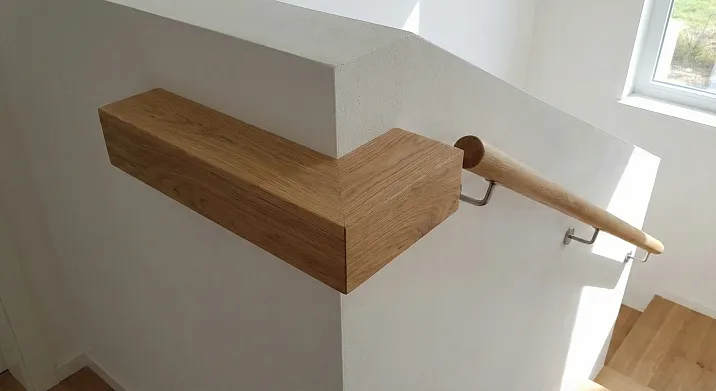
The external corner of a wall is the most vulnerable spot in the finish. Here, two planes meet, forming a sharp edge. Any impact from furniture during rearrangement, careless handling of bulky items, children's play—and the plaster chips, wallpaper tears, paint peels.Wooden cornertakes the impact upon itself, protecting the fragile finish.




Functional Triad of a Wooden Corner Guard
Mechanical Protection. Wood with a hardness of 400-700 units on the Brinell scale (pine, oak) withstands point impacts that would destroy plaster or drywall. The corner guard is fixed with adhesive and mechanical fasteners, creating durable armor for the wall edge. The thickness of the corner guard flanges, 10-25 millimeters, is sufficient to absorb an impact without allowing it to reach the base.
Joint Concealment. The junction of two materials (cladding and plaster, MDF panels and paint, different wallpapers) rarely looks perfect. Even with high-quality craftsmanship, a visible seam remains, especially on an external corner where paper tape or mesh tape cannot be applied.Buy Wooden Anglemeans solving this problem elegantly: the corner guard covers the joint, turning a technical necessity into a decorative element.
Aesthetic Completion. An external corner finished with a wooden corner guard looks crisp and graphic. The clean line of the wood emphasizes the room's geometry, giving the interior structure. This is especially noticeable in wooden houses, where a corner guard made from the same wood species as the walls creates a monolithic perception of space.
Our factory also produces:


Construction: Equal-Flange and Unequal-Flange Corner Guards
The simplest corner guard is an equal-flange one, with two identical sides. A 25×25 millimeter cross-section suits most tasks: wall corners, framing window and door reveals, protecting columns and pilasters. Flanges 25 millimeters wide are enough to cover the risk zone (15-20 millimeters from the corner edge) and provide a safety margin.
For non-standard situations, unequal-flange corner guards are used: one flange is wider than the other. For example, a 30×20 millimeter cross-section. The wide flange (30) covers thick material (15-millimeter cladding + frame), the narrow one (20)—thin plaster on the opposite wall. An unequal-flange corner guard provides a symmetrical visual effect with an asymmetrical construction.
The thickness of the corner guard (profile depth, i.e., the size of the bend at the edge) varies from 8 to 20 millimeters. Thin corner guards (8-10 millimeters) are used for decorative purposes where load is minimal. Thick ones (15-20 millimeters) are installed in high-traffic areas: corridors, stairwells, children's rooms.
Get Consultation
Wood Species: From Pine to Oak
The choice of wood species is determined by budget, interior style, and operating conditions.
Pine. The most affordable species, density 450-500 kg/m³, soft, easy to work with. Suitable for country houses, saunas, rooms with wooden finishes. Pine corner guards absorb protective treatments (antiseptics, fire-bioprotection) well and retain their resinous aroma for a long time. Disadvantage—relative softness: dents from strong impacts remain on pine. Service life 15-25 years.
Larch. Denser than pine (550-650 kg/m³), contains gum that repels insects. Larch does not rot even in high humidity conditions (traditionally used for the bottom logs of log houses, piles). Color is warm, reddish-brown, texture is expressive. Price is 40-60% higher than pine, but durability compensates: 30-50 years.
Oak. The standard of strength and prestige. Density 700-800 kg/m³, high hardness, texture with clear annual rings and medullary rays. Oak corner guards withstand extreme loads, last 50-70 years, darken with age, acquiring a noble hue. Used in classic interiors, country mansions, premium-class projects. Price is high but justified by exceptional properties.
Beech. Density comparable to oak (650-700 kg/m³), structure is uniform, fine-pored, pinkish hue. Beech sands to perfect smoothness excellently, takes paint well (the texture does not show through under paint, resulting in an even tone). Disadvantage—hygroscopicity: in humid rooms without protective coating, beech can warp. With proper conditions, lasts 30-40 years.
Decorative Wooden Corner Guard: When Protection Becomes Art
A simple smooth corner guard serves a utilitarian function.Decorative wooden corner piecetransforms protection into a style element. Carving, shaped profiles, combinations of wood species—all this transforms a modest angular strip into accent decor.
Carved corner: three-dimensional ornament on the wall edge
A relief ornament is applied to the corner surface: floral swirls, geometric meanders, stylized flowers. The carving is done on a CNC milling machine (for serial products) or by hand (for exclusive pieces). A relief depth of 3-8 millimeters creates a play of light and shadow; the corner ceases to be a flat strip and gains volume.
A carved corner is appropriate in classic interiors (Baroque, Empire, Russian estate), where decorative richness is welcomed. In minimalism or Scandinavian style, carving is inappropriate—there, conciseness is valued.
Shaped profile: rounded edges and chamfers
Instead of sharp edges, a corner can have rounded edges (radius 3-5 millimeters) or chamfers (a 45-degree cut to a depth of 2-4 millimeters). Rounding creates softness, tactile pleasantness—such a corner is safe for children, you can run your hand over it without fear of splinters. A chamfer adds graphic quality, strictness, and is characteristic of modern classicism.
Combined corners: wood and metal
In loft or industrial-style interiors, a wooden corner can be combined with metal overlays. A steel strip 5-8 millimeters wide, fixed on the corner edge, enhances strength and adds a rugged look. Black matte metal contrasts with the warm tone of the wood, creating the characteristic loft combination of industrial and natural.
Round wooden handrail 50: the gold standard of ergonomics
A diameter of 50 millimeters forround wooden handrail 50is not accidental. It is the result of decades of ergonomic research, enshrined in the building codes of most countries.
Anthropometric justification for a 50-millimeter diameter
The average circumference of an adult's palm at the grip point (at the base of the fingers) is 180-220 millimeters. With a handrail diameter of 50 millimeters, the circumference is approximately 157 millimeters (π × 50). This means that when gripping, the fingers overlap by 20-60 millimeters, depending on hand size. The grip is reliable, and the hand does not tire even with prolonged contact.
A smaller diameter (40 millimeters) requires greater compression, the hand muscles strain more. For children and people with petite hands, this is acceptable, but for adults, it is tiring. A larger diameter (60 millimeters) makes a full grip difficult, especially for women and the elderly. The fingers do not close completely, the grip is weaker, and the hand may slip during a sudden movement.
A diameter of 50 millimeters is a compromise that satisfies 95% of the adult population. This is precisely why SNiP, DIN, and US building codes recommend this size as optimal.
Handrail construction: solid wood or laminated
round wooden handrail 50 mmis manufactured in two ways.
Solid wood. Turned from a blank with a minimum cross-section of 60×60 millimeters on a lathe. The cross-section shows natural annual rings running along the handrail. Advantages: continuous grain, maximum strength, prestige. Disadvantages: length limitation (up to 3 meters for most species, 4 meters for premium oak), risk of cracking with humidity fluctuations, high cost.
Laminated (glued). Assembled from short lamellae 30-60 centimeters long, glued end-to-end with micro-tenons. The lamellae are pre-dried to 8-10% moisture content, sorted by color and density. Advantages: unlimited length (a handrail of 5-6 meters can be made without joints), geometric stability (multi-directional fibers compensate for internal stresses), uniform color. Disadvantages: visible joints (though barely noticeable with quality tinting), slightly less prestige.
Wood species for handrails: requirements for hardness and wear resistance
A handrail is an element of constant physical contact. Hundreds of hands slide over its surface daily, leaving micro-scratches, indentations, and sweat marks. Softwood (pine, spruce) wears out quickly, losing smoothness. Hardwood species retain their original appearance for decades.
Oak. Brinell hardness 3.7-4.0 kgf/mm². An oak handrail withstands intensive use in public buildings (offices, hotels, museums). The grain is expressive, color ranges from light golden to dark brown (bog oak). Darkens over time, acquiring a noble patina. Service life 50-70 years.
Ash. Hardness comparable to oak (3.5-3.8 kgf/mm²), grain is more contrasting—bright annual rings on a light background. Ash is more elastic than oak, bends well after steaming, ideal for making radius (curved) sections of handrails. Color is lighter than oak, suitable for light-toned interiors.
Beech. Hardness 3.6-3.8 kgf/mm², structure is homogeneous, fine-pored. A beech handrail can be sanded to a silky smoothness, pleasant to the touch. Color is pinkish, neutral, takes stains well. Disadvantage—sensitivity to humidity: in unstable climates (frequent humidity fluctuations over 15%) it may deform. Under stable conditions, it lasts 30-40 years.
Larch. Hardness 2.6-3.0 kgf/mm², less than oak but higher than pine. Resistant to moisture and rot due to gum content. Suitable for damp rooms (indoor pools, winter gardens). Color is reddish-brown, silvers over time.
Round handrails for stairs: a safety system in detail
round handrails for stairsis not an autonomous element, but part of a railing system that includes balusters, support posts, and fasteners. Competent integration of these components ensures safety and durability.
Installation height: standards and practice
Building codes (SP 54.13330.2016) require: the height of a stair railing must be at least 900 millimeters, measured vertically from the front edge of the step to the top of the handrail. For stairs with a height difference of more than 12 meters (e.g., in high-rise buildings)—at least 1100 millimeters.
In practice, in private homes, 900-950 millimeters is most often installed. This is comfortable for adults of average height (165-180 centimeters). For tall people (190+ centimeters), it can be increased to 1000 millimeters, but note: for children and shorter adults, a high handrail is less convenient—the hand has to be raised higher.
If there are small children in the house, an additional lower handrail at a height of 600-700 millimeters is recommended. A child can lean on it while climbing, which is safer than scrambling while holding onto balusters.
Handrail attachment to balusters: dowel joint
The classic method is attachment using wooden dowels with a diameter of 8-10 millimeters. Technology:
-
A hole is drilled at the top of each baluster, 30-40 millimeters deep and 8-10 millimeters in diameter (to match the dowel size). The hole must be strictly vertical (if the baluster is vertical) or perpendicular to the axis of the handrail (if the baluster is slanted, following the staircase angle).
-
Dowels (wooden cylindrical rods) coated with wood glue are inserted into the holes. The dowel should protrude 20-30 millimeters above the baluster.
-
Points for the balusters are marked on the underside of the handrail (the spacing usually matches the baluster spacing—one per step or two per step). Blind holes are drilled, 25-30 millimeters deep, with a diameter slightly larger than the dowel (8.5 millimeters for an 8 mm dowel)—a small gap ensures a proper fit.
-
The handrail is placed onto the dowels, seated with wood glue, and pressed down. For additional rigidity, screws can be driven from below (through the balusters) into the handrail, but the screw heads must be countersunk and filled with putty.
-
After the glue dries (24 hours), the joints are sanded, and the final finish is applied.
Important: all holes must be strictly perpendicular to their respective surfaces. Any deviation will cause the handrail to sit crookedly or skewed.
Wall-mounted handrail: attachment with brackets
If the staircase runs along a wall, a wall-mounted handrail is installed on one side. It is attached to the wall using metal or wooden brackets. The bracket spacing is 600-800 millimeters, with each bracket supporting a load of up to 50-70 kilograms.
Brackets come in the following types:
Chrome-plated metal. Thin, strong, visually light. Suitable for modern interiors.
Bronze or matte black metal. For classic or loft styles.
Carved wooden. Selected to match the handrail tone, creating material unity. Characteristic of classic and country styles.
The distance from the wall to the center of the handrail is 50-70 millimeters. This ensures a comfortable grip: the hand can grasp the handrail without the knuckles touching the wall. A smaller distance is uncomfortable, a larger one weakens the grip.
Wooden balusters for staircases: the vertical graphic of safety
wooden balusters for staircasesThey fill the space between the steps and the handrail, preventing falls. Simultaneously, they shape the staircase's aesthetics: turned balusters with rich relief create a classic look, while simple square-section ones create a minimalist one.
Baluster height and cross-section
The standard baluster height is 900 millimeters (providing a railing height of 900-950 millimeters including the handrail). The cross-section is chosen based on the staircase scale and style:
Round turned, 40-50 millimeters in diameter. A classic option. Turning creates alternating elements: balls, disks, shafts, collars. Suitable for traditional interiors.
Square 40×40 or 50×50 millimeters. Simple, concise. With chamfered edges—for modern classic; without chamfers—for minimalism.
Flat (carved), 30-40 millimeters thick, 80-120 millimeters wide. Carved ornamentation, openwork or relief, is applied to the surface. Visually light, characteristic of Art Nouveau, Provence style.
Baluster installation spacing: safety first
According to regulations, the distance between balusters (clear space, between the surfaces of adjacent balusters) must not exceed 150 millimeters for residential buildings, 100 millimeters for children's institutions. This prevents a child's head from passing between the balusters.
From an aesthetic standpoint, the spacing is chosen for rhythm:
One baluster per step (baluster centered or at the front edge of the step). A classic option, the distance between balusters is approximately equal to the tread width (usually 250-300 millimeters), which complies with regulations.
Two balusters per step (at the edges of the step or with equal spacing). A more frequent rhythm, distance between balusters 120-150 millimeters. Visually creates a dense fill, suitable for wide staircases.
One baluster per two steps. A rare rhythm, distance 500-600 millimeters. Used if the balusters are massive (cross-section 60-80 millimeters) or if horizontal crossbars are installed between them.
Installing balusters on a wooden staircase: fasteners and technology
The attachment method depends on the staircase construction (on stringers, on housed stringers) and the type of balusters.
Dowel fastening. Similar to handrail fastening. A hole 8-10 millimeters in diameter and 30-40 millimeters deep is drilled into the tread. An identical hole is drilled into the bottom end of the baluster. A dowel is inserted with glue, and the baluster is placed on top. Simple, reliable, visually clean (fastener is hidden).
Stud fastening. A metal stud M8 or M10 (metric thread) is screwed halfway into the tread; the protruding part enters a blind hole in the end of the baluster. A nut is screwed onto the thread, countersunk into the wood, and covered from above with a wooden plug. Stronger than dowel fastening, used for heavy balusters or under high loads.
Fastening with screws at an angle. A screw 70-100 millimeters long is screwed through the baluster into the tread at a 30-45 degree angle. A countersink is pre-drilled under the screw head so that the head sinks. After tightening, the hole is filled, sanded, and painted. The method is simple but less aesthetic (even a filled fastener point may be noticeable).
Cutting balusters to match the staircase angle. If the staircase is inclined (usually at a 30-40 degree angle) and the handrail runs parallel to the angle of inclination, the balusters need to be cut at the top and bottom to this angle. Otherwise, the top end of the baluster will not align with the handrail, and the bottom end will not align with the tread. Cutting is performed on a miter saw by setting the required angle.
Detailed instructions oninstalling balusters on a wooden staircasewill help avoid mistakes and ensure the durability of the structure.
Comprehensive approach: corner guards and handrails in a unified interior system
It may seem that wooden corner guards on walls and handrails on stairs are elements of different zones, unrelated to each other. But thoughtful design finds a connection.
Strategy of material unity
Use the same wood species for corner guards and handrails, and treat them with the same finish. For example, everything made of oak, stained with 'dark walnut' stain, coated with matte oil. Corner guards protect the external corners of hallway walls; the handrail and balusters of the staircase are made from the same oak with the same staining. The eye moves from the wall to the staircase, finding familiar texture and color everywhere. This creates a sense of integrity and thoughtful design.
Strategy of contrasting accents
A bolder option: corner guards and walls are painted in a light neutral color (white, light gray), while the handrail, balusters, and staircase elements are natural wood with oil. Light walls visually expand the space, creating a neutral background, and the warm oak staircase elements become an accent, attracting the eye.
Profile rhyme
If corner guards have a shaped profile (rounded edges, chamfers), you can select balusters with similar elements. For example, corner guards with a 5-millimeter radius rounding, balusters with similarly rounded edges. Or corner guards with a 45-degree chamfer, square-section balusters with chamfers at the same angle. This profile rhyme creates a visual connection.
Wooden corner guard installation: installation nuances
The beauty and durability of a corner guard depend not only on the quality of the product but also on the skill of installation.
Surface preparation
The corner guard is installed on a flat, clean, dry base. If the wall is wallpapered, ensure the wallpaper is firmly attached (not peeling, not bubbling). If the wall is painted, degrease the surface with alcohol or mineral spirits. If plastered, check the strength of the plaster (tap it—a dull sound indicates delamination).
Methods of mounting
Adhesive. The corner guard is glued with polyurethane adhesive, liquid nails, or mounting foam. Advantages: no visible fasteners, speed. Disadvantages: difficulty of removal, requires a flat surface. Technique: apply adhesive in a thin bead along the flanges of the corner guard (stepping back 3-5 millimeters from the edges so the adhesive does not squeeze out), press to the wall corner, secure with painter's tape for 24 hours.
Mechanical. The corner guard is screwed with finishing nails (with a small head) or screws. Advantages: reliability, possibility of removal. Disadvantages: visible heads (need to be filled, painted). Technique: mark fastener locations with a spacing of 300-400 millimeters, pre-drill with a thin drill bit (1 millimeter smaller in diameter than the nail/screw) through the corner guard into the wall, drive nails or screw screws, countersink heads 1-2 millimeters, fill holes, sand, paint or varnish.
Combined. Apply adhesive and additionally secure with nails/screws. After the adhesive sets (after 24 hours), the fasteners can even be removed and the holes filled. The adhesive will hold the corner guard, and the fasteners served as temporary fixation during drying.
Trimming Corners
During installation, corner guards are joined at a 90-degree angle (external or internal corner of the room). Ends are cut at a 45-degree angle on a miter saw. Precision is critical: a gap of even 0.5 millimeters on an external corner will be noticeable. Internal corners are less critical—a small gap is filled with sealant.
After cutting, the ends are sanded with fine abrasive (P240-320), removing burrs. Ends can be primed or coated with the same composition as the face surface to prevent moisture absorption.
Final finishing: protection and aesthetics
Wooden corner guards and handrails can be purchased unfinished (raw, only sanded) or with a finish (varnish, oil, paint). The choice depends on operating conditions and style.
Varnishing
Polyurethane varnish creates a durable film that protects wood from moisture, dirt, and mechanical damage. Gloss level: glossy (bright shine, emphasizes texture but shows scratches), semi-matte (subtle noble shine, optimal for classic), matte (no shine, natural look, hides minor defects).
Application: 2-3 coats with intermediate drying of 12-24 hours and sanding with P320-400 abrasive. The final coat is not sanded.
Oil-wax
Oil compositions (linseed oil, tung oil, with added wax) penetrate the wood, emphasize texture, create a matte surface pleasant to the touch. Oil does not form a film; the wood 'breathes'. Disadvantage: less protection compared to varnish, requires periodic renewal (every 2-3 years depending on intensity of use).
Application: 2 coats with an interval of 6-12 hours. Excess oil is wiped off with a cloth 15-20 minutes after application.
Painting with enamel
For Scandinavian style, Provence, shabby chic, painting wooden elements with enamel (often white, gray, pastel tones) is characteristic. The wood grain is hidden, resulting in an even matte or semi-matte tone.
Application: primer (1 coat), enamel (2 coats) with intermediate drying and sanding.
Toning with stain
Stain changes the color of the wood without hiding the grain. Light beech can be tinted 'to walnut' or 'to oak', pine 'to mahogany'. Stain is applied before varnishing: stain (1-2 coats), drying, varnish (2-3 coats).
Operation and care: how to extend the life of wooden elements
With proper care, wooden corner guards and handrails last for decades, maintaining their original appearance.
Climate Requirements
Optimal conditions: temperature 18-24°C, relative humidity 45-65%. Sharp humidity fluctuations (more than ±15% over a short period) can cause warping and cracking. Transitional periods when heating is turned on/off are especially critical.
Regular Maintenance
Dry wiping with a soft cloth or vacuuming with a soft brush once a week. Wet cleaning is allowed with a well-wrung cloth (without excessive wetting), without abrasive agents.
For varnished surfaces, wood polishes can be applied every six months (restores shine). For oiled finishes — oil renewal every 2-3 years.
Local repair
Minor scratches on a varnished surface are removed by polishing with an abrasive paste. Deep scratches — by sanding followed by varnish application. Dents in softwoods (pine) can be 'pulled out' with steam: wet a cloth, place it on the dent, and iron with a hot iron. Steam expands the wood, leveling the dent. After drying, sand and coat.
Cracks are filled with wood putty followed by tinting to match the color of the base material.
Application in different styles
Classic interior
Classic style loves richness of detail, symmetry, and natural materials. Corner guards — with shaped profiles or carvings, made of oak or beech. Handrails are round, 50 millimeters in diameter, made of oak; balusters are turned with alternating elements (spheres, disks, vases). Color — natural oak (medium or dark tones) or white (painted enamel). Finish — semi-matte varnish.
Scandinavian style
Scandinavian style values simplicity, light tones, and functionality. Corner guards — simple, square cross-section, painted with white matte enamel. Handrails are round, made of light wood (pine, birch) with an oil finish. Balusters are square, 40×40 millimeters, also white. The contrast of white elements and light natural wood creates the characteristic lightness of Scandinavian style.
Industrial Loft
Loft style combines industrial materials (metal, concrete) with natural ones (wood). Corner guards are metal or combined (wood + metal strip). Handrails are round, made of dark wood (fumed oak, thermo-ash) without gloss, with an oil finish. Balusters are metal (pipes, rods) or wooden with a square cross-section, deliberately rough.
Country and Provence
Rustic styles welcome natural wood with a slight patina of age. Corner guards made of pine or larch, preserving the natural texture, with an oil or wax finish. Handrails are round, balusters are turned, possibly painted in pastel tones (blue, lavender, olive) with a distressed effect.
Frequently Asked Questions
Can wooden corner guards be used in damp areas?
Yes, provided there is moisture-protective treatment and good ventilation. Larch and oak are most resistant to moisture due to their density and content of protective substances. Finish — waterproof polyurethane varnish in 3 coats or special oil for damp areas.
What handrail diameter to choose for children?
For young children (3-7 years old), a diameter of 40 millimeters is optimal — a small palm can grip it better. An additional child's handrail can be installed at a height of 600-700 millimeters parallel to the main (adult) handrail at a height of 900 millimeters.
How long does a wooden corner guard last?
Service life depends on the wood species and conditions. Pine — 15-25 years, beech — 30-40 years, oak — 50-70 years. With quality care (regular treatment with protective compounds, local repairs), it can be extended by 20-30%.
Can an already installed varnished handrail be painted?
Yes, but it will require removing the old varnish (by sanding or stripping), priming, and painting with enamel in 2 coats. The process is labor-intensive, but the result is worth it if you want to change the interior style.
How often should the oil finish on a handrail be renewed?
In a private home with average use intensity — every 2-3 years. In public buildings (offices, shops) — annually. Signs that renewal is needed: surface dullness, roughness to the touch.
Can oak and beech be combined on one staircase?
Yes, with the right color solution. Light beech for balusters, dark stained oak for the handrail. Or vice versa. It is important that the shades harmonize, not conflict. It is recommended to make samples and test the combination before purchasing the entire batch.
Do the ends of corner guards and handrails need to be treated?
Absolutely. Wood ends (cross-section of fibers) intensively absorb moisture. An unprotected end can swell and crack. After cutting, the ends are sanded and coated with the same compound as the main surface (varnish, oil), possibly in 2-3 coats for reliability.
Conclusion: Investment in safety and beauty
A wooden corner guard protects wall corners from damage and gives the interior a finished look. A round handrail with a diameter of 50 millimeters provides a secure grip and prevents falls on stairs. Balusters fill the space, create a railing, and define the style. These elements seem secondary until you encounter their absence or poor quality.
STAVROS company produces wooden corner guards, handrails, and balusters from selected oak, ash, and beech according to European quality standards. Chamber drying to 8-12% moisture content, precise processing on German machines with a tolerance of ±0.1 millimeters, thorough sanding, professional finishing (varnish, oil, enamel) — each production stage is controlled so that the product lasts for decades.
STAVROS offers standard sizes (corner guards 25×25, 30×30, handrails 50 millimeters in diameter up to 6 meters long, balusters 900 millimeters high) and custom manufacturing according to individual drawings (non-standard cross-sections, carved elements, radius bends). Minimum order for custom orders — from 50 linear meters (for corner guards and handrails) or from 50 pieces (for balusters).
Manufacturer's warranty — 5 years against manufacturing defects (cracks, warping, coating delamination under proper operating conditions). Free consultations on wood species selection, sizes, and fastening methods. Delivery across Russia, production — 3-5 business days for standard items, 10-21 days for custom orders.
By choosing STAVROS products, you are investing not just in protective strips and railings, but in the safety of loved ones, the beauty of your home, and peace of mind for decades to come. Natural wood, professional processing, attention to detail — this is what turns functional elements into objects worthy of admiration.