Article Contents:
- Geometry of Corner Joints: Internal and External Corners
- Internal Corner: Hidden Geometry
- External Corner: Open Visibility
- Tools for Cutting Corners: From Budget to Professional
- Miter Box: Affordable Solution for the Home Craftsman
- Miter Saw: Professional Precision
- Angle Finder: Tool for Measuring the Actual Angle
- Jigsaw with Fine Teeth: Universal Assistant
- Step-by-Step Technology for Cutting at 45 Degrees
- Step 1: Measuring the Actual Room Angle
- Step 2: Calculating the Cutting Angle
- Step 3: Placing the Skirting Board in the Miter Box or on the Miter Saw
- Step 4: Precise Cut with a Fine-Toothed Saw
- Step 5: Dry-Fitting the Joint
- Step 6: Adjusting with Sandpaper or a Rasp
- Joining Corners Without Gaps: Finishing Operations
- On-Site Trimming Technique
- Using Wood Glue to Secure the Joint
- Filling Micro-Gaps with Sealant
- Filling Joints with Wood-Colored Putty
- Decorative Corners: An Alternative to Filigree Cutting
- Construction of Decorative Corners
- Advantages of Using Decorative Corners
- Attaching Decorative Corners
- Where to Buy Ready-Made Decorative Corners
- Common Mistakes When Working with Wooden Skirting Board Corners
- Mistake 1: Cutting by Eye Without Measuring the Angle
- Mistake 2: Using a Dull Tool
- Error 3: Incorrect orientation of the baseboard in the miter box
- Error 4: Lack of trial fitting
- Error 5: Haste and inattention
- Frequently Asked Questions
- Can a wooden baseboard be joined in a corner without a 45° miter cut?
- What to do if the room corner is not 90°, but 85° or 95°?
- How to fill a gap in the corner if the miter cut turned out inaccurate?
- Should the corner joint of the baseboard be glued?
- Which tool is better for home baseboard installation — a miter box or a miter saw?
- How to miter a baseboard with a very complex relief profile?
- Conclusion: Mastery in Details

Corners are where the installer's skill is revealed. Straight sections of baseboard are installed simply: place, nail, glue. ButWooden floor baseboard cornerrequires precision, understanding of geometry, the right tool, and patience. A gap in the corner even 1 mm wide catches the eye, ruining the impression of a quality renovation. A perfect corner joint — two baseboard planks join so tightly that the boundary between them is barely discernible, the profile relief continues seamlessly, as if the baseboard was originally a single piece bent at the corner. How to achieve such a result? Which tool to use? How to miter a baseboard if the room corner is not exactly 90°, but 88° or 92°? What to do if the miter cut turned out inaccurate? Are there ready-made solutions that eliminate the need for jewelry-precise mitering? We delve into the technology of corner joining for wooden baseboard — from measuring the actual room angle to the final sealing of micro-gaps.
Why are corners more difficult than straight sections? Geometry demands precision. When joining two planks at a 90° angle, each is mitered at 45° — the slightest error (a deviation of 0.5-1°) creates a noticeable gap. In a straight butt joint (where two planks join end-to-end in a straight line), a cutting angle deviation of 1-2° is unnoticeable — the planes fit tightly. In a corner joint, the deviation is multiplied by two (two planks, each with an error, result in a doubled gap). Real room corners are rarely exactly 90° — builders allow deviations of ±2-3°, which is unnoticeable for walls but critical for corner baseboard joints. A wooden baseboard with a profiled surface (beads, grooves, roundings) complicates the task — the profile must transition continuously from one plank to the other, any misalignment disrupts the pattern. Let's break it down step by step.


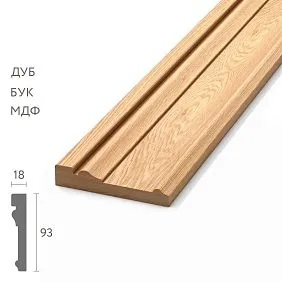

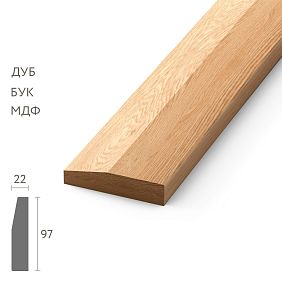


Geometry of corner joints: internal and external corners
There are two types of corners: internal (formed by two walls converging into the room — a standard situation in any room) and external (formed by walls diverging outward — columns, protrusions, bay windows, niches). The miter cut for each type is performed differently.




Internal corner: hidden geometry
An internal corner is visually less noticeable than an external one, as it is recessed. The gaze slides past it, not focusing. But a gap in an internal corner is still visible upon close inspection, creating an impression of carelessness.
Miter geometry for an internal corner: the left baseboard plank is mitered so that the top part (adjacent to the wall) is longer than the bottom part (adjacent to the floor), the cut runs from right to left at a 45° angle (when viewing the plank end from above). The right plank is mitered mirror-image: the top part is shorter than the bottom, the cut runs from left to right at a 45° angle. When joining the two planks in the corner, their cuts fit tightly together, forming a joint.
Important point: the baseboard in the miter box (or on the miter saw) must be positioned with the correct side. The bottom edge of the baseboard (the one adjacent to the floor) should lie on the base of the miter box/saw. The top edge (the one adjacent to the wall) should be pressed against the side wall of the miter box or the saw fence. If you confuse the orientation — you'll cut mirror-image, and the joint won't align.
Our factory also produces:

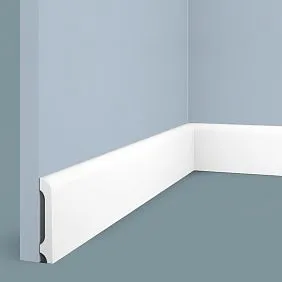
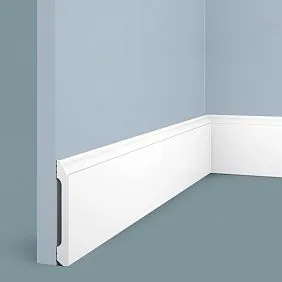
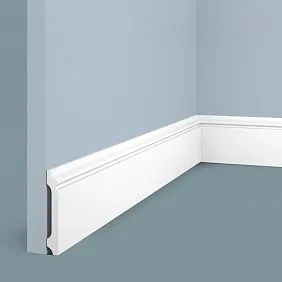
External corner: open visibility
An external corner protrudes into the room space, is well visible from different viewpoints. Any inaccuracy in the miter cut on an external corner is immediately noticeable. Precision requirements are higher than for an internal corner.
Miter geometry for an external corner is opposite to internal: the left plank is mitered so that the bottom part (adjacent to the floor) is longer than the top part (adjacent to the wall), the cut runs from left to right at a 45° angle. The right plank is mitered mirror-image: the bottom part is shorter than the top, the cut runs from right to left at a 45° angle. When joined, the planks form a protruding corner.
Problem with external corners: with an inaccurate miter cut, the gap is not just visible — it gapes, as it is in the foreground. The slightest deviation from 45° (e.g., 44.5° or 45.5°) creates a gap at the top or bottom edge, which widens from the corner in both directions. Solution: use decorative corner caps (ready-made elements covering the external corner without the need for mitering) or perform the miter cut with maximum precision using professional tools.
Get Consultation
Tools for mitering corners: from budget to professional
The quality of a corner joint directly depends on the tool used for the miter cut. Let's consider options from simplest to professional.
Miter box: an affordable solution for the home craftsman
A miter box is a U-shaped device (plastic, wooden, metal) with slots for fixed angles: 90° (straight cut), 45° left, 45° right. The baseboard is placed in the miter box tray, pressed against the side wall, a handsaw is inserted into the slot of the desired angle, and the cut is made.
Advantages of a miter box: low price (plastic miter box costs 300-600 rubles, wooden 800-1500 rubles), ease of use (intuitive principle, no setup required), compactness (takes up little space, can be stored in a tool box).Wooden baseboard miter boxallows for mitering with acceptable quality for undemanding projects.
Disadvantages of a miter box: fixed angles (cannot miter at 44° or 46° if the actual room angle is not 90°), cutting inaccuracy (miter box slots are 1-2 mm wide, the handsaw wobbles in the slot, a cutting deviation of 0.5-1° is inevitable), cut quality depends on the handsaw (a dull handsaw with coarse teeth gives a ragged cut with burrs), slot wear (after repeated use, slots widen, accuracy decreases).
How to improve work with a miter box: use a fine-tooth saw (18-24 teeth per inch, gives a clean cut without chips), press the baseboard against the wall of the miter box as tightly as possible (eliminate the slightest play), guide the saw smoothly without jerking (sudden movements deflect the blade from the slot), after cutting, sand the end with fine sandpaper (P180-P220, removes burrs, evens out the plane).
Miter saw: professional precision
A miter saw (mitre saw, compound miter saw) is a power tool with a circular saw blade mounted on a rotating base. The base rotates left and right, allowing the cutting angle to be set from 0° to 45-50° in each direction with an accuracy of up to 0.1°. The saw blade is lowered from top to bottom by a lever, making the cut.
Advantages of a miter saw: adjustable cutting angle (any angle can be set — 43°, 44.5°, 45°, 46° depending on the actual room angle), high precision (the blade is rigidly fixed, does not deflect, the cut is even with a deviation of no more than 0.1-0.2°), clean cut (a fine-tooth blade for finish cutting with 60-80 teeth gives a perfectly smooth end without chips or burrs), speed (a cut takes 3-5 seconds versus 30-60 seconds with a handsaw).
Disadvantages of a miter saw: high price (budget models from 8000-12000 rubles, professional ones from 25000-50000 rubles), size and weight (the saw weighs 10-20 kg, requires a stationary workplace or a sturdy table), need for electricity (does not work on a site without power), noise (the circular saw creates a high noise level of 90-100 dB, requires headphones).
Wooden Skirting Board 45Degrees are cut with a miter saw in seconds with perfect precision. If you are installing baseboards throughout an apartment or house (perimeter 40-80 linear meters, 16-32 corners), purchasing or renting a miter saw is justified — the time savings and quality of joints pay for the costs.
Angle finder: a tool for measuring the actual angle
Actual room angles are rarely exactly 90°. Concrete and brick walls are built with a tolerance of ±2-3°, wooden houses and log cabins settle over time, changing the geometry. An angle finder allows you to measure the actual angle between walls to adjust the cutting angle.
Types of angle finders: mechanical protractor (two rulers connected by a hinge, with a scale of 0-180° on the hinge, the rulers are applied to the walls, the scale shows the angle), digital angle finder (an electronic device with a display showing the angle with an accuracy of 0.1°, memory for saving measurements, display backlight), laser angle finder (projects laser beams along the walls, measures the angle between the beams, high accuracy ±0.2°, convenient for hard-to-reach places).
How to use an angle finder: apply the rulers/beams of the angle finder to both walls at the location of the baseboard corner (at floor level, as the wall geometry may change with height — the angle at the bottom is 88°, at the top 90°), take the reading (e.g., 88°), divide the angle in half (88° ÷ 2 = 44°), set the miter saw to 44° (instead of the standard 45°), cut both planks at 44°, join them in the corner — the joint will be tight without a gap.
Jigsaw with fine teeth: a versatile helper
A jigsaw is a tool for curved and straight cuts in wood, plastic, and metal. It is rarely used for cutting baseboard at an angle (a miter saw and miter box are preferable), but it is possible as a backup option if no other tools are available.
How to cut baseboard with a jigsaw: mark the cut line on the baseboard with a pencil and a square (a 45° angle is marked using a special 45-90° square or protractor), secure the baseboard to a workbench or table with clamps (the baseboard should not move during cutting), guide the jigsaw exactly along the cut line smoothly without jerking (the jigsaw blade is thin and easily deviates from the line, requiring a steady hand), after cutting, sand the end with sandpaper (a jigsaw gives a less clean cut than a miter saw, requiring additional processing).
Advantages of a jigsaw: versatility (one tool for different tasks — not only cutting baseboard, but also cutting boards, plywood, pipes), mobility (compact, works on battery or mains power), affordable price (budget models from 2000-3000 rubles). Disadvantages: difficulty in maintaining a straight cut at an angle (requires experience, steady hand), less clean cut (compared to a miter saw), low speed (cutting one corner takes 2-3 minutes versus 10-20 seconds on a miter saw).
Step-by-step technology for cutting at a 45-degree angle
How to Cut Wooden BaseboardCorrect? A sequence of actions proven by the experience of thousands of installers.
Step 1: Measuring the actual room angle
Do not assume the angle is 90°. Measure the actual angle between the walls at floor level (where the baseboard will be located) with an angle finder. Record the result. If the angle is 90° ±1° — you can use a standard 45° cut. If the angle differs by 2° or more (88°, 92°, 87°) — adjustment is required.
Angles in the same room may differ. Do not assume all four corners are the same. Measure each angle separately, number them (corner #1, #2, #3, #4), record the results. For each angle, calculate its own cutting angle.
Step 2: Calculating the cutting angle
If the actual room angle is α° (measured with an angle finder), then the cutting angle for each of the two baseboard planks is α° ÷ 2. Examples: room angle 90° → cutting angle 90° ÷ 2 = 45°, room angle 88° → cutting angle 88° ÷ 2 = 44°, room angle 92° → cutting angle 92° ÷ 2 = 46°, room angle 87° → cutting angle 87° ÷ 2 = 43.5°.
If using a miter box with fixed angles (only 45°), and the actual room angle differs from 90° — the miter box is not suitable, a miter saw with an adjustable angle or an alternative method (on-site marking, cutting with a jigsaw/handsaw according to the marking) is needed.
Step 3: Placing the baseboard in the miter box or on the miter saw
Correct orientation of the baseboard is critical. The baseboard should be positioned as it will be installed on the wall: the bottom edge (adjacent to the floor) lies on the base of the miter box/saw, the top edge (adjacent to the wall) is pressed against the side wall of the miter box or the saw's fence. The front side of the baseboard (decorative, visible in the interior) faces you.
For an inside corner: the left plank is placed in the miter box so that the 45° slot runs from right to left (when viewed from the front surface), the right plank — the 45° slot runs from left to right. For an outside corner: the orientation is opposite.
Press the baseboard tightly against the wall of the miter box by hand (eliminate the slightest gap, play) or secure it with a clamp (if the miter box has holes for a clamp). On a miter saw, press the baseboard against the fence, secure it with a hold-down (a lever or screw that presses the workpiece to the base).
Step 4: Precise cutting with a fine-tooth saw
If using a miter box and handsaw: insert the handsaw into the slot of the miter box, press the blade against one of the slot walls (to reduce play), guide the saw with smooth, long strokes (short jerks deflect the blade, creating an uneven cut), do not push on the saw (let the teeth cut on their own, pressure causes deflection), slow down at the end of the cut (to avoid chipping the bottom edge of the baseboard).
If using a miter saw: set the required angle on the base scale (e.g., 44° for a room angle of 88°), lock the base with the locking screw, turn on the saw (let the blade reach full speed 4000-5000 rpm), smoothly lower the blade onto the baseboard (without jerking, with a uniform motion), pass completely through the baseboard (until the blade hits the base), raise the blade, turn off the saw, wait for the blade to stop completely, remove the baseboard.
The blade for a miter saw should have fine teeth (60-80 teeth) for finish cutting wood. Blades with coarse teeth (24-40 teeth) give a rough cut with large chips and are not suitable for visible joints. The blade must be sharp (a dull blade tears the wood, creates burn marks on the cut). Blade replacement frequency: after 50-100 linear meters of cutting hard wood (oak, ash) or 150-200 meters of soft wood (pine, linden).
Step 5: Dry-Fit Check
After cutting the two planks (left and right for one corner), check the joint before installation. Place both planks together on a flat surface (on a table, on the floor), aligning the cuts. The joint should be tight across the entire cut plane without gaps.
If there is a gap at the top edge (where the planks meet the wall) — the cutting angle is too acute (less than required), increase it by 0.5-1°. If there is a gap at the bottom edge (where the planks meet the floor) — the cutting angle is too obtuse (greater than required), decrease it by 0.5-1°. If the gap is uniform along the entire height — the angle is correct, but the cut planes are not parallel (possibly, the baseboard moved during cutting or the saw blade is tilted — check the saw settings).
Place
the planks against the actual corner of the room (where they will be installed) without fastening. This allows you to see how the joint will look in place, taking into account wall and floor irregularities. If the joint is tight on the table but there is a gap on the wall — the problem is not with the cut, but with surface irregularities (the wall or floor is not flat, requiring leveling or filling the gap with sealant/putty).
Step 6: Adjustment with Sandpaper or Rasp
If the joint is not perfect (gap up to 0.5 mm), it can be adjusted manually without recutting. Medium-grit sandpaper (P120-P150) is secured to a flat wooden plank (a 50×100 mm block 200-300 mm long) or a special sanding block. The baseboard end is pressed against the sandpaper, and light back-and-forth motions are made (10-20 strokes), removing a thin layer of wood (0.1-0.3 mm), adjusting the cut angle.
Adjustment direction: if the gap is at the top edge — remove wood from the upper part of the end (tilt the baseboard so the upper part of the end presses harder against the sandpaper, perform sanding motions). If the gap is at the bottom edge — remove from the lower part. After adjustment, check the joint again — the gap should decrease or disappear.
A rasp (a wood file with coarse teeth) is used for rougher adjustment (removing a 0.5-1 mm layer of wood in several strokes). The rasp is held with both hands, the baseboard end is secured in a vise or with a clamp, and rasp strokes are made along the end at the required angle. After rasping, the end must be smoothed with fine sandpaper (P180-P220) to remove coarse marks left by the rasp.
Gap-Free Corner Joining: Finishing Operations
Even perfectly cut planks can develop gaps during installation due to wall irregularities, wood shrinkage, or thermal expansion. The goal is to minimize the visibility of gaps.
On-Site Cutting Technique
A method for professionals working with complex profiled baseboards (where the relief must match exactly at the joint). One plank is cut at 45° standardly and mounted on the wall. The second plank is installed without cutting (with a square end), placed against the first plank in the corner. The profile contour of the first plank is traced onto the end of the second with a pencil. The profile is cut out manually along the drawn line with a jigsaw or coping saw (a narrow blade for curved cuts). The second plank is mounted — its cut profile fits tightly against the profile of the first plank, making the joint invisible.
The method is labor-intensive (15-30 minutes per corner instead of 5 minutes for standard cutting) but provides a perfect result on complex profiles and on corners deviating more than 3-5° from 90° (where standard cutting does not work).
Using Wood Glue to Secure the Joint
Before installation, the ends of the cut planks are coated with wood glue (PVA, polyurethane, epoxy — any for wood). The glue is applied in a thin layer with a brush or finger to both cut planes (left and right planks). The planks are mounted on the wall, pressed tightly together in the corner. The glue sets, securing the joint and preventing the planks from separating due to wood shrinkage or temperature changes.
Excess glue that squeezes out of the joint is immediately wiped off with a damp cloth (before the glue dries). If the glue dries — it can only be removed mechanically (scraping with a knife, sanding), which may damage the baseboard surface.
Filling Micro-Gaps with Sealant
If after installation a gap 0.2-0.5 mm wide remains (invisible from 1-2 m away but visible up close), it is filled with acrylic sealant. The sealant color is chosen to match the baseboard: white (for painted white baseboards), clear (for varnished natural baseboards), colored (to match stain tones — walnut, oak, rosewood — sealant manufacturers offer color palettes for wood).
Sealant application technique: the sealant tube is inserted into a caulking gun (mechanical or battery-powered), a narrow tip (2-3 mm hole diameter) is attached to the tube nozzle, the nozzle is inserted into the gap, and a thin bead of sealant is extruded (filling the gap flush with the surface); excess is immediately removed with a damp sponge or rubber spatula (moving along the joint, leaving sealant only in the gap). After 15-30 minutes, the sealant dries slightly, forming an elastic gap filler that compensates for thermal expansion and does not crack.
Filling Joints with Wood-Colored Putty
For gaps 0.5-2 mm wide (more noticeable), wood putty is used. Acrylic putty (water-based, odorless, easy to sand after drying) or epoxy (two-component, more durable but harder to work with) is applied with a metal or rubber spatula. The putty is pressed into the gap with excess (to completely fill the volume) and smoothed flush with the baseboard surface with the spatula. After drying (2-4 hours for acrylic, 12-24 hours for epoxy), the putty is sanded with fine sandpaper P220-P320 (excess is removed, surface is leveled).
The putty color must match the baseboard color. For natural wood: wood putty in oak, pine, walnut colors (manufacturers offer palettes of 10-20 shades). For painted baseboards: putty is tinted with colorant (a few drops of the desired colorant are added to white putty, mixed until uniform, tested on a baseboard scrap — the color should match).
Homemade wood-colored putty: wood dust (generated from sanding or sawing the baseboard) is mixed with PVA glue in a 3:1 volume ratio (three parts dust, one part glue), stirred to a paste-like consistency. Such putty perfectly matches the baseboard color (as it is made from the same wood), fills gaps, and after drying is sanded, becoming practically invisible.
Decorative Corners: An Alternative to Precise Cutting
Ceiling wooden skirting cornerswhich are finished with ready-made decorative elements, eliminating the need for precise cutting. Decorative corners are ready-made parts made of solid wood (oak, beech, ash, pine), replicating the baseboard profile, designed for installation on interior or exterior room corners.
Construction of Decorative Corners
Interior corner — a corner-shaped part (90° or close), featuring the baseboard profile on both sides. The corner is installed in the room corner, with straight baseboard planks with square ends (cut at 90°, not mitered at 45°) adjoining it from both sides. The corner profile smoothly transitions into the baseboard profile, creating a continuous relief line.
Exterior corner — a similar part for exterior corners (columns, protrusions). The shape is protruding, the profile replicates the baseboard profile, installation is similar to the interior corner.
Decorative corner dimensions correspond to baseboard dimensions: if the baseboard height is 100 mm, the corner height is 100 mm; if the baseboard thickness is 18 mm, the corner thickness is 18 mm. The side lengths of the corner (distance from the corner to the edge of the part) are usually 50-80 mm — sufficient to cover the corner and provide overlap with the straight baseboard planks.
Advantages of Using Decorative Corner Pieces
Installation Speed: No need to measure the room's angle, calculate the miter angle, adjust tools, or make test joints. Simply install the corner piece and attach straight planks with square-cut ends to it. Saves 10-15 minutes per corner (with a miter saw) or 20-30 minutes (when using a miter box and handsaw).
No Waste: With a standard 45° miter cut, a triangular piece 100-200 mm long (depending on the baseboard height) is cut off from each plank and discarded. For a room with 8-12 corners, waste amounts to 2-3 linear meters of baseboard. When using corner pieces, planks are only cut at 90° to fit the wall length, resulting in minimal waste (scraps of 10-50 mm that can be used on short sections).
Aesthetics: Decorative corner pieces often feature additional ornamentation—carved elements, rosettes, patterns—that embellish the corner, making it an interior focal point (instead of an inconspicuous technical joint, the corner becomes a decorative detail). Suitable for classic, neoclassical, and Provence-style interiors where finishing detail is valued.
Compensation for Uneven Corners: If a room's corner is not 90°, but 85° or 95° (a significant deviation where a standard miter cut creates a large gap), a decorative corner piece partially compensates for the deviation. The corner piece is installed with a small gap from the wall (2-5 mm on one or both sides), the gap is filled with sealant, and the straight baseboard planks fit tightly against the corner piece. Visually, the corner looks neat, and gaps are concealed.
Mounting Decorative Corner Pieces
Decorative corner pieces are mounted in two ways: with adhesive (polyurethane construction adhesive or liquid nails applied to the back of the corner piece in dots or a zigzag pattern, the piece is pressed into the room corner and held for 30-60 seconds until the adhesive sets) or with finishing nails/screws (the corner piece is placed in the corner, holes 2-3 mm in diameter are drilled through it into the wall, 30-40 mm long finishing nails are driven or thin screws are inserted, the heads are countersunk into the wood, and the indentations are filled with putty and painted).
After installing the corner piece, straight baseboard planks are attached to it from both sides. The plank ends are cut at 90° (a straight cut, done in seconds with a miter box or miter saw), and the planks fit flush against the sides of the corner piece. The joint between the corner piece and the plank may have a minimal gap (0.2-0.5 mm due to imperfect geometry), which is filled with sealant or wood putty matching the color.
Where to Buy Ready-Made Decorative Corner Pieces
Decorative corner pieces for wooden baseboards are not produced for all profiles. Mass production of corner pieces is economically viable only for popular standard profiles (simple coves, simplified classic baseboards with one or two beads). For exclusive, complex profiles, corner pieces are custom-made (hand-carved or milled using a custom template, costing 1500-3000 rubles per piece).
Standard decorative corner pieces can be purchased from the baseboard manufacturer (if they produce a full range of millwork, including corner pieces, casings, and rosettes) or in specialized wood decor stores. The price of a corner piece depends on the wood species, size, and profile complexity: a pine corner piece for a simple 80 mm high baseboard—from 300-500 rubles per piece; an oak corner piece for a classic 120 mm high baseboard—from 800-1500 rubles per piece.
Common Mistakes When Working with Wooden Baseboard Corners
Mistakes made by beginners and even experienced craftsmen that lead to gaps, chips, and ruined material.
Mistake 1: Cutting by Eye Without Measuring the Angle
Assuming the room's corner is exactly 90° without checking with an angle finder—the cause of gaps in 70% of cases. Real room corners are rarely perfect. A deviation of 2-3° (an 88° or 92° angle) with a standard 45° miter cut creates a 1-2 mm gap that is very noticeable. Always measure the actual room angle with an angle finder and calculate the miter angle individually for each corner.
Mistake 2: Using Dull Tools
A dull handsaw tears the wood, leaving a ragged cut with large chips and burrs. A dull miter saw blade creates scorching on the cut (blackening from friction) and also tears fibers. A defective cut cannot be joined tightly—gaps are inevitable. Use sharp tools: a handsaw with fine teeth (18-24 teeth per inch), replace the blade at the first signs of dullness (cutting becomes difficult, requires pressure), replace a miter saw blade after 50-100 meters of cutting hardwoods, sharpen blades (sharpening service costs 300-600 rubles, extends blade life 3-5 times).
Mistake 3: Incorrect Baseboard Orientation in the Miter Box
The baseboard is placed in the miter box with the wrong side facing (the top edge lies on the base instead of the bottom, or vice versa)—the cut becomes mirrored, and the joint won't align. This mistake is especially frustrating—the cut piece of baseboard becomes scrap, requiring a new cut. Before cutting, double-check the orientation: the bottom edge of the baseboard (against the floor) on the miter box/saw base, the top edge (against the wall) pressed against the side wall/fence, the front side (decorative) facing you.
Some baseboards have an asymmetrical profile (one side differs from the other)—for example, the bottom part is straight, the top part is rounded. For such baseboards, orientation is critical—if placed upside down in the miter box, the profiles at the joint won't match.
Mistake 4: Skipping a Test Fit
Cut two planks, immediately started mounting them on the wall, screwed/glued them, and only after installation discovered a gap in the joint. Fixing it is already difficult—the planks are secured, and removal will damage the wall or baseboard. Always perform a dry test fit before installation: place the two cut planks together on a table or floor, check the joint tightness. If there's a gap—adjust with sandpaper or recut. Only after achieving a tight joint proceed with installation.
Mistake 5: Rushing and Inattention
Corner joints require time, attentiveness, and precision. Rushing leads to mistakes: inaccurate cuts (hurrying, sawing with jerks, resulting in a crooked cut), incorrect orientation (not double-checked, placed the baseboard wrong side up), skipping measurement (assumed the angle was standard, didn't measure). Allocate sufficient time for each corner: 5-10 minutes for a professional with a miter saw, 15-20 minutes for a DIYer with a miter box. It's better to spend time on precision than to redo defective work.
Frequently asked questions
Can You Join Wooden Baseboard in a Corner Without a 45° Miter Cut?
Yes, by using decorative corner elements. An inside or outside corner piece is installed in the room corner, and straight baseboard planks with ends cut at 90° (straight cut, no angled miter) are fitted against it. This method is simpler, faster, and doesn't require precise mitering, but corner pieces are not available for all baseboard profiles and cost extra (300-1500 rubles per piece depending on wood species and size).
What to Do If a Room's Corner Is Not 90°, but 85° or 95°?
Measure the actual angle with an angle finder, divide by two, and cut each plank at the resulting angle. For example: room angle 85° → cut angle 85° ÷ 2 = 42.5°; room angle 95° → cut angle 95° ÷ 2 = 47.5°. This requires a miter saw with smooth angle adjustment. A miter box with fixed slots won't work—in this case, use the on-site marking method (place the plank against the wall, mark the cut line at the required angle with a pencil, cut along the mark with a jigsaw or handsaw).
How to Fill a Gap in a Corner If the Cut Was Inaccurate?
A gap up to 0.5 mm wide is filled with acrylic sealant (clear for natural wood, white for painted baseboard, colored to match the stain tone). A gap 0.5-2 mm wide is filled with wood putty matching the baseboard color (pre-tinted or homemade from sawdust and PVA glue). After drying, the putty is sanded with fine sandpaper (P220-P320) and, if necessary, tinted with stain or painted over. Gaps wider than 2 mm are difficult to conceal—it's better to recut the plank.
Should the corner joint of the baseboard be glued?
It is advisable. Wood glue (PVA, polyurethane, epoxy) is applied in a thin layer to both cut surfaces (left and right plank) before installation. The planks are installed, pressed tightly together at the corner. The glue sets, secures the joint, and prevents the planks from separating due to wood shrinkage, temperature changes, or vibrations. A joint without glue may separate over time (a 0.2-0.5 mm gap may appear), while a glued joint remains tight for years.
Which tool is better for DIY baseboard installation — a miter box or a miter saw?
If you are installing baseboard as a one-time job (one apartment, 40-60 linear meters, 12-16 corners) — a miter box and a quality fine-toothed saw are sufficient. The cost of a miter box and saw is 1000-2000 rubles, which pays off by not needing to buy an expensive saw. If you install regularly (multiple projects, a private house with a large perimeter, planning to do trim work professionally) — a miter saw pays off in speed and quality. A budget miter saw costs 8000-12000 rubles, saves time (cutting a corner takes 10-20 seconds vs. 3-5 minutes with a miter box), and provides a more precise and clean cut.
How to cut a baseboard with a very complex relief profile?
Complex profiles (with multiple beads, flutes, carvings) require perfect profile alignment at the joint. A standard 45° cut may cause profile elements to shift by 0.5-1 mm, which is noticeable. Solution method: one plank is cut at 45° standardly and installed. The second plank is placed without cutting, and the contour of the first plank's profile is traced onto the end of the second plank with a pencil. The profile is cut out along the drawn contour using a jigsaw or coping saw. The second plank is installed — its profile exactly replicates the first plank's profile, making the joint invisible. Labor-intensive (15-30 minutes per corner), but the result is perfect.
Conclusion: Mastery in the Details
Wooden floor baseboard corner— a test of the installer's skill. A perfect corner joint without gaps, with a continuous profile transition, and tight-fitting planks creates the impression that the baseboard was installed by a high-level professional. Any gap, profile misalignment, or chip on the cut reveals a novice or rushed work.
The technology for a quality corner joint includes: measuring the room's actual angle with a protractor (do not assume it's 90°), calculating the cut angle individually for each corner (room angle divided by two), correct orientation of the baseboard in the miter box or on the miter saw (bottom edge on the base, top pressed against the fence, front facing you), precise cutting with a sharp, fine-toothed tool (saw with 18-24 teeth per inch, saw blade with 60-80 teeth), dry-fit before installation (checking joint tightness, adjusting with sandpaper if necessary), gluing the ends with wood glue (securing the joint, preventing separation), and sealing micro-gaps with sealant or putty (visually eliminating defects).
An alternative to meticulous cutting is using decorative corner elements. Ready-made solid wood corner pieces are installed in room corners, and straight baseboard planks with square ends (no 45° cut) are fitted against them. The method is simpler, faster (saving 10-15 minutes per corner), eliminates cutting errors, and adds extra aesthetics (corner pieces are often decorated with carvings, ornaments, becoming interior accents). Disadvantages: corner pieces are not available for all baseboard profiles, cost extra (300-1500 rubles per piece), and require ordering in advance (not always in stock in stores).
Tools for cutting — a miter box (budget option for one-time installation, cost 300-1500 rubles, fixed angles 45° and 90°, medium accuracy) or a miter saw (professional tool for regular installation or large projects, cost from 8000 rubles, adjustable angle with accuracy up to 0.1°, fast clean cut, pays off in speed and quality). Additionally: a protractor for measuring actual room angles (mechanical protractor, digital or laser), sandpaper for adjusting ends (P120-P220), sealant or putty for sealing micro-gaps.
Company STAVROS — a Russian manufacturer of wooden trim with a 24-year history, offering a full range of solid wood baseboards made of oak, ash, beech, linden, pine, and ready-made decorative corner elements. Full-cycle in-house production includes: raw material procurement (dried planed boards and beams of first and second grade, moisture 8-12%, no rot, cracks, or loose knots), sizing (longitudinal cutting on multi-saw machines, thickness calibration on planers with ±0.2 mm accuracy), profile milling (four-sided CNC milling machines creating profiles of any complexity from simple rectangular to complex classical), manufacturing decorative elements (corner elements, rosettes, overlays milled according to individual templates or hand-cut for complex profiles), sanding (wide-belt sanding machines with sequential processing using P80-P120-P180-P240 abrasives for a perfectly smooth surface), coating application (priming, tinting, varnishing, painting in climate-controlled paint booths), packaging (shrink wrap, cardboard end caps, protection against transport damage).
STAVROS baseboard range includes over 40 profiles with heights from 60 to 200 mm: simple rectangular (smooth blocks without milling for minimalist interiors), simplified classical (with one or two beads, balancing classic and restraint), complex classical (multi-step profiles with three-four relief elements for traditional interiors), Euro baseboards (tall profiles 100-160 mm for modern spaces). Standard length — 2.4 m and 2.6 m, custom up to 3.0 m. Wood species: oak, ash, beech, linden, pine (natural colors or stained).
STAVROS decorative corner elements: internal corner pieces for interior room corners (90° and similar angles), external corner pieces for columns, protrusions, bay windows, corner rosettes (decorative elements with ornaments for classical interiors, installed in corners instead of simple corner pieces, creating accents). Corner piece sizes correspond to baseboard profiles (height 60-200 mm, thickness 14-22 mm, side length 50-80 mm). Species: oak, ash, beech (for premium interiors), pine, linden (for budget projects). STAVROS decorative corner piece prices: pine/linden corner pieces for simple profiles 80-100 mm high from 300-500 rubles per piece, oak/ash corner pieces for simplified classical profiles 100-120 mm high from 800-1200 rubles per piece, oak corner pieces for complex classical profiles 120-160 mm high from 1500-2500 rubles per piece. Prices are current as of January 2026, including VAT.
STAVROS consultation support: technical specialists will help select baseboard profiles and decorative corner pieces for your project, calculate the required linear meters and number of corner pieces (room perimeter, number of internal and external corners), recommend installation tools (miter box for one-time jobs, miter saw for large projects, protractor for rooms with uneven geometry), provide detailed instructions for cutting corners (how to measure the actual angle, calculate the cut angle, orient the baseboard in the miter box/on the saw, check the joint, seal micro-gaps).
STAVROS delivery across Russia: Moscow and Moscow Region — own transport 1-2 days, St. Petersburg and Leningrad Region — own transport 1-2 days, other regions — transport companies 3-10 days. Professional packaging (shrink wrap, cardboard end caps, horizontal stacking), transport damage rate less than 0.3%. STAVROS warranty 3 years on all solid wood products under proper operating conditions (air humidity 40-70%, temperature +10-30°C, no direct prolonged contact with water). If during the warranty period the baseboard or decorative elements deform, crack, or the coating peels (under proper use) — STAVROS will replace free of charge.
STAVROS custom manufacturing of decorative corner elements: if standard corner pieces do not fit your baseboard profile (exclusive relief, non-standard size, special wood species), production will manufacture corner pieces to order. Process includes: providing a baseboard sample or profile drawing (exact dimensions of all relief elements), developing manufacturing technology for the corner piece (CNC milling or hand carving for particularly complex profiles), manufacturing a test sample (one corner piece for visual assessment and checking profile match with the baseboard), customer approval (adjustments if needed), launching batch production of the required quantity. Custom manufacturing timelines: simple corner pieces 7-10 days from sample approval, complex corner pieces with carving 15-25 days. Minimum batch — from 4 pieces (one set for a room with four corners). Custom manufacturing cost is 40-70% higher than standard catalog corner pieces.
STAVROS training materials: the company's website features detailed video instructions and text guides on baseboard installation, cutting corners, and using decorative elements. Videos demonstrate: how to correctly measure room angles with a protractor, how to set the angle on a miter saw, how to orient the baseboard for internal and external corners, how to make the cut, how to dry-fit the joint, how to adjust the end with sandpaper, how to seal micro-gaps with sealant or putty, how to install decorative corner pieces. Video length 5-15 minutes, Full HD quality, Russian voiceover, close-up demonstration of all critical moments.
STAVROS cooperation with construction and renovation companies: special terms for professionals who install baseboard regularly. Wholesale discounts from 10% on purchases from 150 linear meters, from 15% from 300 linear meters. Free decorative corner pieces with large orders (1 set of corner pieces free for every 50 linear meters of baseboard). Priority manufacturing (reduced production times for urgent orders). On-site technical support (phone consultations, specialist visits if needed to solve complex installation tasks). Payment deferral for regular partners (up to 30 days after shipment with a contract and positive credit history).
STAVROS product samples: before ordering a large batch of baseboard and decorative corner pieces, you can order samples (a 30 cm baseboard section and one corner element of the desired profile) to visually and tactilely assess processing quality, corner piece profile match with the baseboard profile, wood texture and color. Sample cost: baseboard section 150-300 rubles depending on species, decorative corner piece 200-600 rubles. When placing an order over 25000 rubles, the sample cost is refunded (deducted from the order amount). Samples are shipped via Russian Post or courier services within 2-3 days after payment.
STAVROS environmental responsibility: wood is purchased from loggers operating under sustainable forestry principles (logging in permitted areas, forest restoration through planting young trees). Production waste (sawdust, shavings, baseboard and corner piece trimmings) is not disposed of but used rationally: pressed into fuel briquettes, given to farms, composted. Water-based or natural coatings (acrylic paints without solvents, vegetable oils, beeswax), eliminating the release of volatile organic compounds harmful to humans and the environment.
Choosing baseboard and decorative corner elements from STAVROS means choosing mastery in details, where every corner is executed flawlessly, every joint is invisible, every floor or ceiling boundary is designed with respect for the material, geometry, and aesthetics. Corners cease to be an installation problem — they become proof of professionalism, evidence that masters who understand the value of precision, know the technology, and use quality tools and materials worked in your home. A wooden baseboard with perfect corners lasts for decades, does not separate, does not form gaps, retains its original beauty, becomes part of the interior's history, enduring wallpaper changes, wall painting, furniture replacement, but remaining unchanged in its solidity.
STAVROS — your partner in creating impeccable details, where corners are not hidden but demonstrate quality, where every connection is made with jewel-like precision, where natural wood is treated with respect for nature and craftsmanship, where production technology meets centuries-old traditions of joinery. Professional installation begins with the right tool, precise measurement, patient fitting — and ends with corners indistinguishable from factory-made ones, looking like a single piece, as if the baseboard was originally bent at the corner, not assembled from two planks. This mastery is available to anyone willing to spend time learning the technology, acquiring quality material, using the right tools, following step-by-step instructions — or choosing ready-made decorative corner pieces that eliminate cutting complexities, guarantee results, and adorn the interior with additional decorative elements.