












































































Article Contents:
- Philosophy of the corner: from protection to decoration
- Typology of corner elements: classification and purpose
- External corner elements: protection of protrusions
- Internal corner elements: concealment of joints
- Ceiling corner elements: junction of planes
- Facade corner elements: exterior architecture
- Materials for corner elements: from classics to innovations
- Polyurethane: Universality and Practicality
- Wood: The Warmth of Nature
- Gypsum: classical moldings
- Polymer concrete and composites: facade strength
- Corner elements for interiors: function and aesthetics
- Protection of wall corners: practical solution
- Decorative wall partitioning: architectural structure
- Framing of openings and niches: completion of composition
- Ceiling corner elements: completion of verticality
- Ceiling Cornices: Genre Classic
- Coffers and multi-level ceilings: complex geometry
- Hidden lighting: modern solution
- Facade corner elements: architecture from the outside
- Rusticated corners: monumental classicism
- Pilasters and columns: vertical dynamics
- Sundrinks and cornices: horizontal accents
- Installation technologies: from adhesive to mechanical fastening
- Adhesive mounting: for interior elements
- Mechanical fastening: for heavy elements
- Facade mounting: professional approach
- Stylistic solutions: From classic to modern
- Classic corner elements: ornament and proportions
- Neoclassical elements: restraint and elegance
- Minimalist elements: geometry and function
- Conclusion: corners as architectural statements

Corners are architectural critical points where planes converge, materials meet, and stresses concentrate. In construction and design, corners have always been an area of heightened attention — it is here that cracks, chips, and visual defects most often occur.Corner decorative elementsThey transform this architectural necessity into the opportunity to create expressive accents that protect the structure while simultaneously enhancing its appearance, defining the character of the interior and facade.


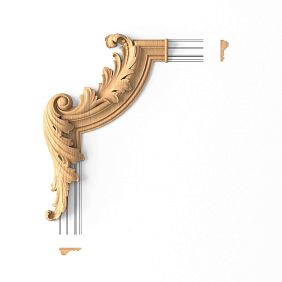
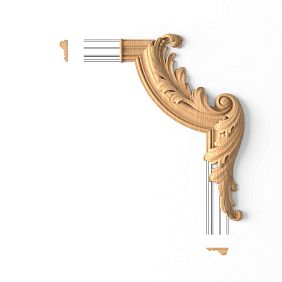


Philosophy of the Angle: From Protection to Decoration
In traditional architecture, building corners were always reinforced and decorated. Rusticated stone corners, wooden overlays, metal angles — these are not merely decoration, but a deliberate necessity to protect the most vulnerable parts of the structure. Over time, the protective function took a back seat, yielding to aesthetics, but in 2026, the understanding returns: beauty and functionality are inseparable.
Corner elements for wallsThey solve several tasks at once. They protect corners from mechanical damage — impacts, scratches, abrasion. They conceal mounting joints and irregularities inevitable when joining planes. They create visual structure, dividing space into zones and emphasizing architectural logic. And finally, they become decorative accents, shaping the style of the interior or facade.
In modern designCorner decorative elementsThey are used not only for external wall corners but also for internal room corners, ceiling junctions, facade details. Production technologies allow creating elements of any complexity — from simple geometric angles to carved compositions with ornamentation.
It is important to understand:Corner finishing element— this is not just a cover, but an integral part of the architectural composition. Properly selected corner elements create rhythm, emphasize proportions, strengthen stylistic concept. Incorrectly chosen ones — destroy harmony, create visual chaos.




Typology of corner elements: classification and purpose
Our factory also produces:

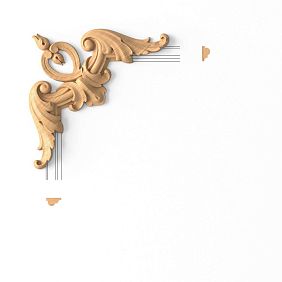


External corner elements: protection of protrusions
External corners are protruding parts of the structure, most susceptible to damage. Anyone who has moved furniture or children’s toys knows how easily a wall corner can be hit.Corner elements for wallsExternal-type elements protect these vulnerable zones while simultaneously decorating them.
External corner elements can be simple — in the form of an L-shaped profile covering the angle from both sides — or complex — with relief, carving, ornamentation. Simple ones suit minimalist interiors, complex ones — classic and decorative styles.Wooden Corner ElementsThey are often used to protect corners in wooden houses, creating material unity.
The width of the flanges of corner elements varies from 2 to 15 centimeters depending on the scale of the room and the degree of protection. Narrow angles of 2–3 cm — minimal protection and decoration. Wide ones of 10–15 cm — full-fledged architectural accents creating expressive wall divisions.— everything must correspond to the chosen era.For corners, they can be profiled, imitating classical moldings.
Get Consultation
Internal corner elements: masking joints
Internal corners are places where two walls meet, often forming gaps, irregularities, level differences.Corner decorative elementsInternal-type elements mask these defects, creating a visually smooth junction.
Internal corner elements have a concave profile filling the angle. They can be simple — in the form of a rounded edge — or decorative — with relief matching the interior style. For classic interiors, profiled internal corners are relevant; for modern interiors — simple rounded edges or sharp joints without decoration.
A special type of internal corner elements — cornices (ceiling moldings) — mask the junction between wall and ceiling. These are horizontal elements, but essentially perform the function of corner elements.Buy polyurethane wall moldingsThey can also be used for internal corners, creating decorative frames for niches and openings.
Ceiling corner elements: junction of planes
Corner Ceiling Element— these are details that decorate the junction between wall and ceiling or the angle between ceiling planes. Ceiling cornices (moldings) — the most common type of ceiling corner elements. They create a smooth transition from the vertical wall to the horizontal ceiling.
Corner element for ceilingThey can be simple — a straight profile without ornament — or complex — with grooves, rosettes, carved decoration. In classic interiors, ceiling cornices are richly decorated; in modern interiors — minimalist.Polyurethane Ceiling MoldingsThey allow creating cornices of any complexity.
For joining cornices at room corners, special corner elements are used — pre-fabricated parts with beveled planes at 45 degrees. This simplifies installation and guarantees perfect profile alignment.polyurethane moldingsThey are often sold in sets — straight sections plus corner elements.
Facade corner elements: exterior architecture
Facade Corner Elements— these are details that decorate building exterior corners, window and door openings, cornices, pediments.Facade Corner ElementsThey transform architectural necessity into a work of art, creating an expressive building silhouette.
Rusticated corners — a classic type of facade decoration imitating stone masonry. Rust is a protruding rectangular block at the building's corner, creating a rhythmic structure. Rusticated corners give the building monumentality, solidity, and classical respectability.decorative polyurethane elementsThey allow creating rustication imitation without using natural stone.
Pilasters at corners — vertical protrusions imitating columns. They divide the facade, create a vertical rhythm, and emphasize the building's height. Corner pilasters are often supplemented with capitals (upper decorative elements) and bases (lower parts).Facade Corner ElementsIn the form of pilasters, they create solemnity, characteristic of classical architecture.
Materials for corner elements: from classics to innovations
Polyurethane: universality and practicality
polyurethane moldings— market leader in corner decorative elements for interiors. Polyurethane is lightweight, strong, moisture-resistant, temperature-resistant, and easily mounted with adhesive.You can buy ready-made stucco matching the Baroque style. Calculate the quantity: linear meters of cornices and moldings, number of rosettes, pilasters, consoles, corner elements. Add a ten to fifteen percent allowance for trimming.Available in a vast assortment — from simple corners to complex carved compositions.
Polyurethane allows reproducing the finest ornament details, creating elements visually indistinguishable from plaster or wooden moldings. Meanwhile, polyurethaneCorner elements for wallsare dozens of times lighter than plaster, require no reinforcement of the base, and are easily cut with a standard saw.
An important advantage of polyurethane — the possibility of coloring.— everything must correspond to the chosen era.can be painted with water-emulsion or acrylic paint in any color, covered with patina, or gilded. This opens up limitless possibilities for creating unique interiors.installing polyurethane moldingAccessible even for non-professionals.
Brings natural aesthetics and warmth into the apartment. Wood regulates humidity, creates a healthy microclimate, and releases beneficial phytoncides (coniferous species).
Wooden Corner Elements— classic, creating an atmosphere of warmth and coziness. Oak, ash, beech, pine — each species has its own texture, density, color. Wooden corners can be smooth, profiled, carved, tinted, or painted.
For wooden houses, log cabins, interiors in country, chalet, or Scandinavian styles, wooden corner elements — a natural choice. They create material unity, emphasize natural aesthetics, and add organic character to the space.wooden corniceOn the ceiling, combined with wooden corner moldings on walls, they form a cohesive system.
Wood requires protection — coatings of varnish, oil, wax, or antiseptics. Without protection, it is vulnerable to moisture, pests, and temperature deformation. Properly treatedWooden Corner Elementslast for decades, gradually acquiring a noble patina.Buy decorative elementsMade from solid wood — an investment in longevity and eco-friendliness.
Gypsum: classical plasterwork
Plaster molding — a traditional material for creating corner decorative elements in classical interiors. Plaster has a unique matte texture that cannot be fully reproduced with synthetic materials.Corner decorative elementsMade of plaster, heavy, require professional installation, but create an atmosphere of authenticity.
Plaster 'breathes', regulating humidity in the room, is eco-friendly, can be painted or gilded. However, it is brittle, afraid of moisture, and unsuitable for rooms with unstable microclimate. For classical interiors in dry rooms, plaster molding — the choice of traditionalists.
Polymer concrete and composites: facade strength
For facades, more durable materials resistant to atmospheric effects are used. Polymer concrete — a composite material based on mineral filler and polymer binder. It is stronger than concrete, lighter than stone, and resistant to frost and moisture.Facade Corner ElementsMade of polymer concrete, they last for decades without changing their appearance.
Glass fiber reinforced concrete (GRC) — concrete reinforced with glass fiber. It allows creating thin-walled, high-strength items. GRC facade molding reproduces details of any complexity — from simple rustication to complex column capitals.Facade Corner ElementsMade of composites — a modern alternative to natural stone.
Expanded polystyrene with protective coating — an economical solution for facade decoration. Lightweight polystyrene elements are covered with a protective layer of reinforced plaster, creating a durable shell. Such elements are suitable for decorating insulated facades.decorative polyurethane elementsFor facades, they must have UV protection.
Corner elements for interiors: function and aesthetics
Protecting wall corners: a practical solution
Walls' corners in residential spaces are constantly subjected to mechanical impacts — furniture bumps, children's play, moving objects.Corner elements for wallsprotect corners from damage, extending the finish's service life.
For hallways, corridors, and children's rooms, reinforced corner elements made of durable materials — wood, metal, rigid plastic — are suitable. They withstand intensive use, are easy to clean, and retain their appearance.Wooden Corner ElementsFor hallways, they can be painted in dark colors that hide dirt.
For living rooms, bedrooms, offices, where mechanical load is lower, more decorative elements — profiled, carved, painted to match wall tones or contrast — are used.Wall moldingAs corner overlays, they add elegance to the interior.
Decorative wall partitioning: architectural structure
Corner decorative elementsUsed not only for protection but also to create architectural structure. Vertical corner pilasters divide long walls into sections, creating rhythm. Horizontal bands of corner elements divide walls vertically, forming tiers.
In classical interiors, wall panel corners are finished with corner rosettes — square or rectangular decorative elements with ornamentation.decorative rose outletsThey mask molding joints, add detail, and create compositional completeness.
For modern interiors, geometric corner elements — metal profiles, contrasting plastic corner pieces, illuminated LED profiles — are relevant. They emphasize line clarity and create a technological look.Corner finishing elementIn modern style, they are maximally minimalist.
Frame for openings and niches: composition completion
Door and window openings, niches, arches are often finished using corner elements.Corner elements for wallsAs surface-mounted corner pieces, they create expressive framing, emphasizing the architecture of the opening.
For arched openings, flexible polyurethane profiles that replicate the arch's curve are used. At corners where the vertical framing transitions into the arch, special corner elements are installed to ensure a smooth transition.Decorative molding for door openingsOften includes corner rosettes.
Wall niches — for TVs, books, decor — are finished with internal corner elements that create neat plane junctions.Buy polyurethane wall moldingsFor framing niches, ready-made corner details can be used.
Ceiling corner elements: vertical completion
Ceiling cornice: genre classic
The ceiling cornice (coving) — the most common typecorner elements for ceilingsIt masks the junction between wall and ceiling, creates visual completeness, and adds height to the room.Polyurethane Ceiling MoldingsAllows creating cornices of any width and complexity.
Cornices can be simple — straight profile without ornament — or complex — multi-tiered compositions with grooves, rosettes, and carving. For minimalist interiors, narrow smooth cornices 3–5 cm wide are suitable. For classical interiors, wide decorated cornices 10–20 cm wide are appropriate.Buy polyurethane wall moldingsAs a cornice — a practical solution.
In room corners, cornices meet at a 45-degree angle. To simplify installation, ready-made corner elements — pre-cut parts that perfectly match straight sections — are used.Corner Ceiling ElementSupplied with the cornice, it guarantees a flawless joint.
Coffers and multi-level ceilings: complex geometry
Coffer ceilings — a system of square or rectangular recesses framed with molding. In coffer corners, special corner elements — rosettes, square decorative overlays with ornamentation — are used.decorative rose outletsThey create richness of detail for coffer ceilings.
Multi-level ceilings with height variations require finishing vertical edges. The corners of these edges — both external and internal — are finished with corner elements that create a neat junction.polyurethane moldingsallows creating elements of complex shapes for multi-level structures.
Hidden lighting: modern solution
In modern interiors, ceiling cornices with hidden LED lighting are popular. An LED strip is mounted behind the cornice, creating a floating ceiling effect.Corner element for ceilingwith a recess for lighting has a special profile.
It is important to ensure continuous lighting at room corners. Corner connectors for LED strips or special corner profiles are used, allowing the strip to smoothly wrap around the corner.installing polyurethane moldingwith lighting requires precise marking and electrical wiring.
Facade corner elements: architecture from the outside
Rusticated corners: monumental classicism
Rusticated corners are an imitation of stone masonry at building corners. A rust is a rectangular protruding block that creates a rhythmic structure.Facade Corner ElementsIn the form of rusts, buildings acquire monumentality, solidity, and classic respectability.
Rusts can be smooth — with flat block surfaces — or textured — imitating rough-hewn stone. Smooth rusts are suitable for neoclassical facades, while textured ones suit castle and medieval styles.Facade Corner ElementsMade from polymer concrete, they reproduce any texture.
The size of rusts is proportional to the scale of the building. For single-story houses — rusts 20–30 cm high. For multi-story buildings — 40–60 cm. Rhythm is important — rusts should be placed at equal intervals, creating a visual structure.decorative polyurethane elementsFor facades, they must have UV protection and frost resistance.
Pilasters and columns: vertical dynamics
Corner pilasters are vertical protrusions at building corners, imitating columns. They divide the facade, create a vertical rhythm, and emphasize the building’s height. Pilasters are often topped with capitals (decorative upper elements) and bases (lower parts).Facade Corner ElementsIn the form of pilasters, they create a sense of grandeur.
Pilasters can be smooth — without ornamentation, fluted — with vertical grooves, or carved — with ornamentation along their entire height. The choice depends on the building’s style. Classicism prefers fluted pilasters with order capitals. Modern architecture favors smooth geometric protrusions without decoration.
Half-columns at corners — a more voluminous variant of pilasters. They create sculptural expressiveness, especially effective under side lighting.Wooden Corner ElementsIn the form of half-columns, they are used in wooden architecture.
Sashings and cornices: horizontal accents
A sashing is a horizontal cornice above a window or door. It protects the opening from precipitation and creates a decorative accent.Facade Corner ElementsIn the form of sashings, special attention must be paid to joints — they must ensure airtightness.
A crowning cornice is a horizontal element at the top of the building, under the roof. It completes the facade, creating a visual finish. The cornice can be simple — a straight profile — or complex — a multi-tiered composition with brackets, modillions, or dentils (tooth-like elements).
At building corners, cornices meet, forming a complex junction. To ensure airtightness and visual continuity, corner elements — specially shaped parts that fit perfectly with straight sections — are used.Corner finishing elementFacade requires a professional approach.
Installation technologies: from adhesive to mechanical fastening
Adhesive mounting: for interior elements
polyurethane moldingsFor interior use, elements are mounted using special adhesive or liquid nails. Adhesive is applied to the back of the element in a zigzag pattern, and the element is pressed against the surface for 30–60 seconds. Modern adhesives set quickly, ensuring secure fixation.
installing polyurethane moldingRequires a flat, clean, primed surface. Any irregularities will become visible after installation. Corner elements are mounted similarly — on adhesive, with careful alignment with straight sections.Corner elements for wallsEasily cut with a saw for fitting.
After installation, joints are filled with acrylic sealant, which is sanded after drying. Then the elements are painted with water-emulsion or acrylic paint.You can buy ready-made stucco matching the Baroque style. Calculate the quantity: linear meters of cornices and moldings, number of rosettes, pilasters, consoles, corner elements. Add a ten to fifteen percent allowance for trimming.Can be already painted or primed for painting.
Mechanical fastening: for heavy elements
Wooden Corner ElementsWooden and gypsum moldings require mechanical fastening — using self-tapping screws, anchors, or nails. Fasteners are driven into the substrate, holes are filled and sanded. For heavy elements, adhesive is additionally used to provide double fixation.
Wooden corner overlays are mounted using finish nails without heads or screws driven at an angle from the inside. This conceals mounting points while preserving aesthetics.Buy decorative elementsWooden elements are better with extra allowance for fitting.
Facade installation: professional approach
Facade Corner ElementsMounted on mechanical fasteners — anchors, screws, metal brackets. Polymer concrete elements are mounted on aluminum or galvanized angles, which are fixed to the wall. Then elements are screwed into the angles through previously drilled holes.
For insulated facades, threaded rods are used, passing through insulation to the load-bearing wall.Facade Corner ElementsMounted onto these rods via metal brackets. It is important to ensure airtightness — all gaps are filled with weather-resistant sealant.
Mounting points are filled with a special compound made of the same material as the elements. After sanding, mounting points become invisible.Corner finishing elementFacade installation requires adherence to technology for longevity.
Stylistic Solutions: From Classic to Modern
Classic corner elements: ornament and proportions
Classic style implies richly decoratedCorner decorative elementswith plant motifs — acanthus leaves, roses, grapevines. Corner rosettes for joining moldings have deep relief, creating play of light and shadow.
For classic interiors, white or cream-colored corner elements on light walls, or gilded on colored backgrounds, are appropriate.decorative rose outletsThey can be additionally adorned with patina.— everything must correspond to the chosen era.In classic style, they create an atmosphere of respectability.
Neoclassical elements: restraint and elegance
Neoclassicism simplifies decoration while preserving architectural logic.Corner elements for wallsHere, profiles are clearly defined without excessive ornamentation. Geometric shapes, minimal relief, noble proportions — these are characteristics of neoclassical elements.
Color palette of neoclassicism — neutral. White, beige, light gray.You can buy ready-made stucco matching the Baroque style. Calculate the quantity: linear meters of cornices and moldings, number of rosettes, pilasters, consoles, corner elements. Add a ten to fifteen percent allowance for trimming.Neoclassical style is simpler than full classicism.Buy moldingsAvailable in coordinated collections.
Minimalist elements: geometry and function
Minimalism uses the simplest corner elements — smooth L-shaped profiles without decoration. Their function is protection and creating clear geometry. Color is often contrasting — black corners on white walls, metallic on concrete.
For modern interiors, recessed corner profiles — elements embedded into plaster, creating perfectly straight angles without visible overlays.Corner finishing elementIn minimalism, they are maximally inconspicuous.
Conclusion: corners as an architectural statement
Corner decorative elementsThese are not just protective overlays, but full-fledged architectural tools for creating expressive interiors and facades.Corner Ceiling Element, Facade Corner Elements, Facade Corner Elements, Wooden Corner Elements, Corner finishing element, Corner elements for walls, Corner element for ceilingAll of this is part of a unified system of architectural decoration.
Modern materials —polyurethane moldings, Wooden cornicesPolymer concrete makes creating expressive corner solutions accessible for any project.Buy polyurethane wall moldingsWith pre-made corner elements — guarantee of perfect alignment.
STAVROS company offers a full range of corner decorative elements —wall overlays, Ceiling Molding, decorative rose outlets, Wooden elements, Moldingsand much more. Elements are presented in coordinated collections for interior and facade use. Experienced consultants will help you select solutions for your project, and delivery throughout Moscow, Saint Petersburg, and all of Russia will make the purchase convenient. Create spaces where even corners become works of art — choose STAVROS!


