












































































Article Contents:
- Polyurethane molding: optimal price-to-quality ratio
- Gypsum molding: prestige and tradition at a high price
- Wooden trim: natural beauty and wide price range
- MDF trim: technological efficiency and affordability
- Installation cost: professionals vs. DIY
- Additional costs: delivery, materials, tools
- Pricing examples for typical projects
- Factors affecting the price
- How to save without compromising quality
- Typical mistakes leading to overspending

Planning a budget for decorative interior finishing requires understanding actual material and labor costs, knowing factors affecting pricing, and being able to distinguish reasonable expenses from excessive markups. The market for molding and trim offers a wide price range — from budget-friendly polyurethane solutions to exclusive handmade gypsum items, from simple baseboards costing a few hundred rubles per meter to carved cornices costing tens of thousands. The cost of ornamental decoration is determined by the material used, profile or ornament complexity, element size, manufacturer brand, region of sale, and purchase volume.
Understanding pricing helps make informed decisions — where savings can be achieved without sacrificing quality, and where cost-cutting may lead to disappointment and additional expenses for redoing work. Molding prices vary from 200 rubles per linear meter for simple polyurethane profiles to 5000 rubles per meter for complex gypsum cornices with rich ornamentation. Installation costs are often comparable to material costs, and sometimes exceed them — professional installation of complex elements requires skill, time, and specialized tools.Trim pricingIncludes not only the price per meter or piece, but also associated costs — delivery, cutting to fit room dimensions, adhesive and fasteners, finishing work.


Polyurethane molding: optimal price-to-quality ratio
Polyurethane dominates the decorative elements market due to its accessibility, variety of forms, and ease of installation. Prices for polyurethane items depend on size, profile complexity, and manufacturer.
Ceiling cornices (baseboards) — the most common category. Simple cornices up to 50 mm high with minimal profiles cost 200–400 rubles per linear meter. These are basic moldings for creating smooth transitions between walls and ceilings in budget projects. Medium-complexity cornices 50–100 mm high with classic profile elements — coves, rolls — cost 400–800 rubles per meter. This is the optimal choice for most residential interiors — sufficient decorative appeal at a reasonable price. Complex cornices 100–200 mm high with rich ornamentation and multi-level profiles cost 800–2000 rubles per meter. Such cornices create a significant visual effect, suitable for high rooms and classic interiors.
Special cornices for hidden lighting with a shelf for LED strips cost 500–1200 rubles per meter depending on size and profile complexity. This is a modern solution creating a floating ceiling effect.
Wall moldings vary in price depending on width and profile. Narrow moldings 20–40 mm wide cost 150–350 rubles per meter. Used for creating thin frames and delicate wall divisions. Medium moldings 40–80 mm wide cost 300–700 rubles per meter. This is the main category for creating classic wall panels. Wide moldings 80–150 mm wide with rich relief cost 700–1500 rubles per meter. Used as horizontal bands or framing large zones.
Flexible moldings for arches and curved surfaces cost 30–50% more than straight equivalents due to special manufacturing technology. A flexible molding 50 mm wide costs approximately 500–800 rubles per meter.
Polyurethane baseboards 60–80 mm high cost 300–600 rubles per meter. Tall baseboards 100–200 mm high cost 600–1200 rubles per meter. Baseboards with cable channels cost 20–30% more than standard ones.
Decorative outlets — items sold individually. Small outlets 300–400 mm in diameter cost 500–1500 rubles each. Medium outlets 500–700 mm in diameter cost 1500–4000 rubles. Large outlets 800–1000 mm and larger with rich ornamentation cost 4000–10000 rubles each.
Decorative appliqués — elements for decorating walls, doors, furniture. Small appliqués 100x200 mm cost 300–800 rubles each. Medium appliqués 200x400 mm cost 800–2000 rubles. Large panels and compositions 500x1000 mm cost 3000–8000 rubles.
Pilasters and half-columns — vertical architectural elements sold as sets (base, shaft, capital) or individual parts. A pilaster set 2000–2500 mm high costs from 8000 to 25000 rubles depending on ornament complexity and size.
Corner elements for cornices and moldings simplify corner joints. Typically cost 200–800 rubles each depending on size and ornament complexity.
Brands influence pricing. European brands (Orac Decor, NMC, Decomaster) cost 30–50% more than Russian and Chinese equivalents with comparable quality. The difference is due to brand, design, sometimes higher-quality raw materials. Russian manufacturers (Perfect, Europlast) offer good price-to-quality ratios — quality is satisfactory, prices are 30–40% lower than European ones. Chinese manufacturers offer the lowest prices, but quality varies — from acceptable to noticeably poor with poor relief detail, uneven edges, and unstable dimensions.




Gypsum molding: prestige and tradition at a high price
Gypsum — a traditional material for molding, offering unparalleled detail, the ability to create custom elements, and the feeling of authenticity in classic interiors. Prices are significantly higher than polyurethane due to labor-intensive production, weight (affects delivery cost), and installation complexity.
Mass-produced gypsum cornices (cast in molds) cost 800–3000 rubles per linear meter depending on height and profile complexity. A simple gypsum cornice 80 mm high costs approximately 800–1200 rubles per meter. A complex cornice 150–200 mm high with rich ornamentation costs 2000–3000 rubles per meter.
Custom-made gypsum cornices according to the client's sketches cost from 5000 rubles per linear meter and more — the price depends on complexity, need for mold creation, and craftsman's skill.
Standard gypsum moldings cost 500-2000 rubles per meter. Custom ones — from 2000 rubles per meter.
Standard gypsum rosettes with diameters of 400-600 millimeters cost 2000-6000 rubles each. Large rosettes with diameters of 800-1200 millimeters cost 6000-15000 rubles. Custom rosettes according to sketches cost from 10000 rubles and may reach 50000-100000 rubles for especially complex pieces.
Gypsum decorative panels, bas-reliefs, and low-reliefs — unique elements, price determined by size and complexity. A small panel 500x700 millimeters of medium complexity costs 15000-30000 rubles. A large panel 1500x2000 millimeters with multi-figure composition may cost 100000-500000 rubles and more.
Gypsum capitals for columns and pilasters cost from 5000 to 50000 rubles each depending on size and order (Doric, Ionic, Corinthian — complexity increases).
The advantage of gypsum is the possibility of restoration, fitting, and adjustments directly on-site. An experienced craftsman can mold a missing fragment or adapt an element to a non-standard size. This justifies the high cost in complex projects, historical interiors, where exact correspondence to the original is required.
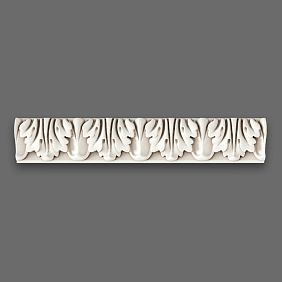
Our factory also produces:


Wood trim: natural beauty and wide price range
Wood — a material with a huge price variation depending on species, processing, and manufacturer.
Spruce skirting boards — the most affordable. Simple planed skirting board 60-80 mm high costs 150-300 rubles per linear meter. Profiled skirting board 80-120 mm high costs 300-600 rubles per meter. Carved spruce skirting board costs from 800 rubles per meter.
Larch skirting boards are 2-3 times more expensive than spruce. Larch skirting board 80 mm high costs 500-800 rubles per meter. High profiled skirting board 120-150 mm high costs 800-1500 rubles per meter.
Oak skirting boards — premium segment. Oak skirting board 80 mm high costs 1200-2000 rubles per meter. High oak skirting board 120-200 mm high costs 2000-4000 rubles per meter. Carved oak skirting board costs from 3000 rubles per meter.
Door casings from spruce cost 200-500 rubles per linear meter (a set for a 5-6 meter door = 1000-3000 rubles). Door casings from oak cost 800-2000 rubles per meter (a set 4000-12000 rubles). Carved door casings from oak or ash cost from 2000 rubles per meter (a set from 10000 rubles).
Wall moldings from wood cost 300-1500 rubles per meter depending on species and profile. Simple spruce molding 50 mm wide costs 300-500 rubles per meter. Profiled oak molding 80 mm wide costs 1000-1500 rubles per meter.
Ceiling cornices made of wood are less common due to weight, but are used in wooden houses and saunas. Spruce cornice 80 mm high costs 500-800 rubles per meter. Larch or oak cornice of similar size costs 1200-2500 rubles per meter.
Wooden false beams — hollow boxes imitating massive beams. Spruce false beam with cross-section 100x100 mm costs 800-1500 rubles per linear meter. Cross-section 150x150 mm — 1500-2500 rubles per meter. False beams from larch or oak cost 2-3 times more. Weathered or brushed false beams cost 30-50% more than standard planed ones.
Amber board (old wood) — exclusive material, price determined by rarity, age, and condition. Amber board 20-30 mm thick costs from 2000 to 8000 rubles per square meter depending on quality, age, and presence of interesting traces of time.
Get Consultation
MDF trim: technological efficiency and accessibility
MDF items for painting or laminated offer a balance between price and quality.
Primed MDF skirting boards 80-100 mm high cost 200-400 rubles per meter. 120-150 mm high — 400-700 rubles per meter. This is the price without paint — primed white surface, ready for painting in any color.
Laminated MDF skirting boards (with film imitating wood) cost 250-600 rubles per meter depending on height and decoration quality.
Primed MDF door casings cost 150-350 rubles per meter. Laminated — 200-500 rubles per meter.
Primed MDF ceiling cornices 80-150 mm high cost 300-800 rubles per meter.
MDF panel strips for painting (ready-made panels with strips on backing) cost 1500-3000 rubles per panel 2700x600 mm (about 1000-2000 rubles per square meter).
Individual MDF strips 40-60 mm wide, 2700 mm long cost 150-350 rubles each.
Installation cost: professionals and DIY installation
Installation of moldings and trim often accounts for 40-80% of material cost, and in some cases exceeds it.
Installation of polyurethane ceiling cornices up to 50 mm high costs 200-350 rubles per linear meter. Cornices 50-100 mm high — 300-500 rubles per meter. Cornices over 100 mm high or with very complex profile — 500-800 rubles per meter. Installation of cornices for hidden lighting with LED strip — 600-1000 rubles per meter.
Installation of wall moldings costs 150-400 rubles per meter depending on width and complexity. Installation of complex panel compositions with numerous corner joints costs more — 400-700 rubles per meter.
Installation of polyurethane or MDF baseboards costs 200-400 rubles per meter. Wooden baseboards — 250-500 rubles per meter (wood requires more careful fitting and mechanical fastening).
Installation of rosettes costs 500-2000 rubles each depending on size and weight. Large heavy rosettes require secure mounting, sometimes additional reinforcement of the ceiling.
The cost of installing decorative moldings ranges from 200-800 rubles per piece depending on size and complexity.
Installation of pilasters and half-columns costs from 3000 to 15000 rubles per set depending on size, weight, and complexity.石膏 elements are more expensive to install due to their weight and fragility.
Installation of gypsum molding is 50-100% more expensive than polyurethane. Gypsum cornices cost 600-1500 rubles per meter of installation. Gypsum rosettes cost 1000-4000 rubles per unit installed. Gypsum is heavy and requires secure mounting with gypsum adhesive and sometimes mechanical fasteners, requiring more skilled labor.
Installation of wooden false beams costs 800-2000 rubles per linear meter depending on size, weight, and ceiling height. Installation requires creating a frame, precise fitting, and sometimes working at height with scaffolding.
Joint sealing and preparation for painting — additional service, usually costing 30-50% of the installation cost. Joints are filled with acrylic sealant or putty, sanded, and prepared for an ideal visual result.
Painting molding costs 100-300 rubles per linear meter (cornices, moldings) or 200-1000 rubles per unit (rosettes, moldings) depending on relief complexity. Painting in one color is cheaper; creating patina, gilding, or multi-color effects costs more — 300-800 rubles per meter or 500-2000 rubles per unit.
DIY installation saves significant money but requires time, care, and basic tools.Polyurethane moldingLightweight, mounted with liquid nails-type adhesive, suitable for DIY installation with a circular saw or miter saw for cutting angles, level, and tape measure. Wooden molding is more complex — requires mechanical fasteners (nails, screws), and hole filling putty. Gypsum molding is not recommended for DIY installation without experience due to weight, fragility, and difficulty working with gypsum adhesive.
Additional expenses: delivery, materials, tools
Total project cost includes not only materials and labor, but also associated expenses.
Delivery depends on volume, weight, and distance. Within the city, delivery usually costs 500-2000 rubles per order for orders below a certain threshold (typically 10000-20000 rubles). For larger orders, delivery is often free. Delivery to the region or other areas is calculated individually and depends on the transport company. Lightweight polyurethane molding is cheaper to deliver. Heavy gypsum molding may cost 2000-5000 rubles or more for delivery of large orders.
Polyurethane mounting adhesive — special mounting adhesives like liquid nails cost 200-400 rubles per tube (310 ml). One tube is sufficient for 4-8 meters of cornice depending on size. For a room with a 18-meter perimeter, you need 3-5 tubes, i.e., 600-2000 rubles for adhesive.
Gypsum adhesive for gypsum molding costs 300-800 rubles per 20-25 kg bag. Consumption depends on element size, usually 3-5 kg per meter of cornice. For a room with an 18-meter perimeter, you need 50-90 kg, i.e., 2-3 bags = 900-2400 rubles.
Acrylic sealant for joint sealing costs 150-300 rubles per 310 ml tube. For a room, you need 2-4 tubes = 300-1200 rubles.
Putty for filling screw holes in wooden molding costs 200-500 rubles per 0.5-1 kg jar. One jar is sufficient for average work volume.
Wall primer before installation costs 300-800 rubles for 5-10 liters. Consumption is 100-200 ml per square meter. For a 20 sq. m. room, you need 2-4 liters.
Paint for molding after installation costs 500-2000 rubles per liter depending on quality. Consumption for smooth cornices is 8-12 sq. m. per liter, for relief elements 6-8 sq. m. per liter. Double the consumption for two layers. For painting cornices in a room with an 18-meter perimeter (cornice height 100 mm = surface width approximately 150 mm including profile = 18 m × 0.15 m = 2.7 sq. m.) you need approximately 0.5-1 liter for two layers = 500-2000 rubles.
Tools for DIY installation — if not available, you will need to buy or rent them. A circular saw costs from 5000 rubles for a basic model to 30000 rubles for a professional one. Alternative — miter saw (300-1000 rubles) and fine-toothed hacksaw (500-1500 rubles). Laser level costs 2000-10000 rubles, bubble level 300-1500 rubles. Caulking gun (sealant) costs 300-1500 rubles. If installation is one-time, it may be cheaper to hire professionals than to buy tools.
Pricing examples of typical projects
Understanding the cost of typical projects helps plan the budget.
Minimal room decoration (18 sq. m., perimeter 18 m, ceiling height 2.7 m): simple 50 mm high polyurethane ceiling cornice + 80 mm high baseboard. Materials: cornice 18 m × 300 rubles = 5400 rubles, baseboard 18 m × 400 rubles = 7200 rubles, adhesive 1500 rubles, sealant 500 rubles. Total materials 14600 rubles. Installation: cornice 18 m × 300 rubles = 5400 rubles, baseboard 18 m × 300 rubles = 5400 rubles, joint sealing 1500 rubles. Total labor 12300 rubles. Total cost including everything approximately 27000 rubles.
Average room decoration: medium-complexity 80 mm high polyurethane cornice + wall moldings to create four panels on one accent wall + 100 mm high baseboard + 500 mm diameter ceiling rosette. Materials: cornice 18 m × 600 rubles = 10800 rubles, panel moldings approximately 30 m × 400 rubles = 12000 rubles, baseboard 18 m × 500 rubles = 9000 rubles, rosette 2500 rubles, adhesive and sealant 3000 rubles. Total materials 37300 rubles. Installation: cornice 5400 rubles, moldings 30 m × 300 rubles = 9000 rubles, baseboard 5400 rubles, rosette 1000 rubles, joint sealing 3000 rubles. Total labor 23800 rubles. Total cost including everything approximately 61000 rubles.
Premium room decoration: 120 mm high ornamental gypsum cornice + gypsum moldings for wall panels on all walls + 120 mm high oak baseboard + large 800 mm diameter gypsum rosette + decorative gypsum moldings in panels. Materials: cornice 18 m × 2000 rubles = 36000 rubles, moldings approximately 70 m × 1200 rubles = 84000 rubles, baseboard 18 m × 1800 rubles = 32400 rubles, rosette 8000 rubles, moldings 8 pcs × 1500 rubles = 12000 rubles, adhesive and materials 8000 rubles. Total materials 180400 rubles. Installation: cornice 18 m × 1000 rubles = 18000 rubles, moldings 70 m × 600 rubles = 42000 rubles, baseboard 18 m × 400 rubles = 7200 rubles, rosette 2500 rubles, moldings 8 pcs × 500 rubles = 4000 rubles, joint sealing and preparation 15000 rubles, painting 25000 rubles. Total labor 113700 rubles. Total cost including everything approximately 294000 rubles.
Factors affecting price
Understanding pricing factors helps optimize expenses.
Material — primary factor. Polyurethane is the most affordable. MDF is slightly more expensive than polyurethane for comparable items. Wood varies by species — from affordable pine to expensive oak. Gypsum is expensive due to labor intensity.
Profile and ornament complexity — the more complex, the more expensive. A simple crown is 3-4 times cheaper than a multi-tiered cornice with ornamentation of the same size. Carved elements are 2-5 times more expensive than smooth ones.
Element size — larger elements cost more per meter or unit due to higher material consumption. A 150 mm high cornice costs 2-3 times more than a 50 mm high cornice of the same complexity.
Manufacturer brand — European brands are 30-50% more expensive. The difference is partly due to quality, partly due to brand and marketing.
Purchase volume — bulk discounts for large volumes. Buying for several rooms at once may give you a 10-20% discount. Some suppliers offer discounts of 5% for orders over 50000 rubles, 10% for orders over 100000 rubles.
Region — prices in Moscow and St. Petersburg are usually 20-30% higher than in regions due to higher costs. Installation work in the capitals is 30-50% more expensive.
Seasonality — during off-season (November–February), demand for repair work is lower, installers may offer discounts of 10-20% to increase workload. In summer and early autumn (May–September), demand is high, prices are maximum, and deadlines are longer.
Object complexity — high ceilings (over 3 meters) increase installation cost by 20-40% due to the need for scaffolding and greater labor intensity. Complex room geometry with numerous angles, niches, and protrusions increases material waste for trimming and labor cost.
How to save without sacrificing quality
Budget optimization is possible with a proper approach.
Choosing polyurethane instead of plaster saves 50-70% with comparable visual results. For most residential interiors, polyurethane is optimal.
Choosing Russian manufacturers instead of European ones saves 30-40% with comparable quality. Russian brands Perfect, Europlast, Decomaster offer decent quality at reasonable prices.
DIY installation of simple elements (cornices, skirting boards, moldings) saves 40-60% of expenses. Polyurethane is easy to install for someone with basic skills.
Accent approach — do not decorate all walls, but focus on the main accent wall or zone. Material and labor savings of 50-70% while preserving visual effect.
Buying on sales and promotions — many suppliers hold seasonal sales and offer discounts on leftover collections. Discounts can reach 20-40%.
Bulk purchase for multiple rooms at once gives 10-20% discounts and saves on delivery.
Avoiding painting — many white polyurethane elements look decent without painting. Savings on paint and labor of 20-30% of project cost.
Combination of materials — expensive elements (plaster, hardwood) on accent zones, budget options (polyurethane, pine) elsewhere. Balance of aesthetics and economy.
Correct planning with precise calculation of required quantities — excess materials (if not returned) = wasted money. Shortage = additional costs for re-purchasing, delivery, possible batch differences. Order exact quantity + 10% reserve.
Typical mistakes leading to overspending
Avoiding mistakes saves money and nerves.
Purchasing without a project and calculations — chaotic buying of liked elements leads to excess of some, shortage of others, mismatched elements to room size. Result — buying unnecessary items, needing to purchase missing ones.
Saving on material quality — buying the cheapest moldings with poor detailing and uneven edges. Result — the interior looks cheap despite having decor, elements deform and detach over time. Repairs cost twice as much.
Saving on installer qualifications — hiring the cheapest workers without experience. Result — crooked lines, visible seams, detached elements. Repairs cost more than hiring professionals initially.
Buying unnecessarily expensive materials — hand-made plaster where polyurethane suffices. Overpayment 3-5 times without real visual benefit in most interiors.
Ignoring additional expenses — forgot about adhesive, sealant, paint, delivery. Result — additional 20-30% to budget.
Incorrect storage of materials before installation — plaster moldings in humid areas, wooden trim exposed to rain outdoors. Result — damaged materials, need to repurchase.
Installing before new home finishes settling — in new construction, buildings settle in the first year, plaster moldings may crack, seams may separate. Better to wait a year or use more flexible polyurethane.
Prices fordecorative wall finishing with moldings and trimIn 2025, decorative wall finishing remains accessible to a wide range of consumers thanks to diverse materials and manufacturers. From budget polyurethane for several hundred rubles per meter to exclusive hand-made plaster for tens of thousands — everyone can find a solution matching their budget and aesthetic requirements. The key is proper planning, understanding real project needs, choosing reliable suppliers and qualified installers. Investing in quality decorative finishing pays off through longevity, visual enjoyment, and increased interior value for decades ahead.


