Article Contents:
- Why Wood Remains Relevant
- Ecological Safety
- Durability and Reliability
- Aesthetic Uniqueness
- Cultural Continuity
- Universality of application
- Resource Renewability
- Wooden Decorative Items in Interior
- Moldings and Cornices
- Baseboards and Door Frames
- Baseboards
- Ceiling Beams
- Wall Panels
- Carved elements
- Carved Gables and Facade Decor
- Traditions of Wooden Architecture
- Symbolism of Ornamentation
- Modern interpretation
- Baseboards and Window Frames
- Cornices and Valances
- Corner and Foundation Elements
- Doorway Framing
- Entrance Portal
- Carved Entrance Decor
- Interior Openings
- Arched Openings
- Doors as Decorative Elements
- Conclusion: Unity of Wood

A house is not merely a set of functional rooms under one roof, but a whole organism where the exterior appearance and interior space exist in inseparable unity.Wooden decorative items for decorating the housebecome the thread that links the exterior and interior, creating a cohesive composition.Carved gable of the houseon the facade corresponds with wooden moldings in the formal living room,Door Frame InstallationThe design of the entrance door continues into the interior openings. Wood, as a material, possesses a unique ability to create a sense of warmth, coziness, and connection to nature — qualities equally important both outside and inside the building. Creating a unified image of the house through wooden decor requires understanding the properties of the material, knowledge of traditional wooden architecture, a sense of style, and measure.


Why wood remains relevant
In the era of high technology, synthetic materials, and digitization of all spheres of life, wood not only does not lose its relevance, but, on the contrary, becomes increasingly sought after. For millennia, wood has served as the primary building and decorative material, and this experience is not diminished by modernity, but finds a new interpretation.




Oak skirting boards are an indispensable element of classic interior styles. In the English style, oak skirting boards with rich carving emphasize the aristocracy and solidity of the space. Dark wood tones harmonize beautifully with traditional materials — natural stone, leather, bronze.
Main argument in favor ofwooden decorative items for decorating the home— their absolute ecological purity. Natural wood does not contain harmful chemicals, does not emit toxic vapors, does not cause allergic reactions. Unlike plastics, which may emit phthalates and other harmful substances, or particleboard with formaldehyde resins, quality wood is safe for health.
Some wood species possess natural antibacterial properties. Cedar releases phytoncides — biologically active substances that suppress the growth of bacteria and fungi. Oak contains tannins, which also have antiseptic properties. Pine fills the air with a pine scent, beneficial for the respiratory system.
Wood is capable of regulating the humidity in a room. When humidity is high, wood absorbs excess moisture; when dry, it releases stored moisture. This creates a healthy microclimate, especially important in living spaces.Wooden decorative items for decorating the houseact as natural climate regulators.
The psychological aspect of ecological safety is also important. Living surrounded by natural materials creates a sense of closeness to nature, which is especially valuable for urban residents disconnected from the natural environment. Wooden decor creates an atmosphere in which a person feels calmer, more harmonious, and healthier.
Our factory also produces:


Durability and reliability
Properly treated and protected wood serves for decades, and in some cases — centuries. Wooden churches of the Russian North, built 300–400 years ago without a single nail, still stand, demonstrating the remarkable durability of the material. Antique wooden furniture from the 18th–19th centuries, after restoration, looks brand new and can serve for another century.
Hardwood species — oak, beech, ash — are characterized by high density (650–750 kg/m³), ensuring strength and resistance to mechanical impacts. Oak elements are especially strong due to the presence of tannins.Carved gable of the houseOak elements withstand extreme weather conditions, preserving the clarity of carving for decades.
Wooden items are restorable. Scratches, chips, minor damage can be removed by sanding and re-treatment. More serious defects are corrected by replacing individual elements without dismantling the entire structure. This makes wood a more economical material in the long term — initial costs are higher than for synthetic materials, but service life is many times longer.
Resistance to loads is another advantage. Wooden floor beams withstand significant weight without deformation.Door Frame InstallationOak solid wood does not deform under constant loads from opening and closing doors, preserving geometry for decades.
Get Consultation
Aesthetic uniqueness
Each wooden item is unique due to the unique grain pattern, natural color variations, and individual texture characteristics. Two elements cut from the same trunk will differ in pattern — nature does not create absolute copies. This makesWooden decorative items for decorating the houseunique works of art, each possessing individuality.
Wood texture is diverse. Oak has a striking large grain with characteristic medullary rays. Ash features contrasting annual rings, creating a dynamic texture. Walnut displays a rich range of tones from light brown to nearly black in a single item. Beech has a fine, uniform texture, ideal for carving small details.
The color variety of wood allows selecting material for any interior color scheme. Light-colored species — birch, maple, ash — create a sense of lightness and airiness. Medium tones — beech, oak — are universal and suitable for most interiors. Dark tones — walnut, wenge, stained oak — add nobility, solidity, and status.
The tactile properties of wood are unique. Warm, slightly rough surface is pleasant to the touch, creating an emotional connection with the material. Upon close inspection, minute pores, color transitions, and natural variations are visible.Door Frame InstallationSolid wood at the level of touch creates tactile comfort unattainable with cold synthetic materials.
Cultural continuity
Wood is a material with deep cultural roots. Wooden architecture is an important part of the cultural heritage of many peoples. Russian log houses with carved door frames, Norwegian stavkirkes, Japanese temples, Swiss chalets — all these architectural traditions are based on wood. Usingwooden decorative items for decorating the homewood connects us with these traditions, creating cultural continuity.
Wood carving is an ancient art dating back thousands of years. Ornaments developed by masters of the past carry symbolic meaning. Plant motifs symbolize fertility and vitality. Geometric patterns — cosmic order and harmony. Zoomorphic elements — connection with nature and protection.Carved gable of the houseWith traditional ornamentation, it becomes a carrier of cultural codes.
Wooden houses are perceived as more 'authentic' and more traditional compared to modern concrete and glass constructions. This creates a sense of rootedness, connection to the earth, ancestors, and history. In the era of globalization and standardization, such rootedness acquires special value.
Universality of Application
Wooden decorative items for decorating the houseWooden elements are universal — suitable for any architectural style, from historical classicism to modern minimalism. In classical interiors, wood is used to create carved moldings, cornices, door frames, and rosettes. In rustic styles — country, Provence, rustic — wooden beams, planks, and roughly processed elements create a distinctive atmosphere.
In modern interiors, wood acts as a warm accent, softening the coldness of concrete, glass, and metal. Wooden panels on accent walls, wooden furniture elements, and wooden decor create a balance between technology and nature. Scandinavian style actively uses light wood to create coziness with minimalist forms.
Wood combines with any materials. With stone, it creates a sense of reliability and monumentality. With metal, it offers a contrast of warm and cold. With glass, it creates a contrast of transparency and materiality. With textiles, it achieves harmony of natural materials. This versatility makes wood indispensable in design.
Renewable resource
Unlike non-renewable resources — oil, metals, certain types of stone — wood is renewable. With proper forest management, felled trees are replaced by new plantings. FSC (Forest Stewardship Council) certification guarantees that the wood comes from responsibly managed forests, where logging is offset by new plantings.
Producing wooden items requires less energy compared to producing plastic, metal, or concrete. Wood's carbon footprint is minimal — growing trees absorb carbon dioxide, and wooden products store bound carbon for decades. This makes wood the most eco-friendly building material in terms of its full life cycle.
At the end of their service life, wooden items can be recycled — ground into chips for producing panels, burned for energy without emitting harmful substances (unlike plastic). Or simply composted, returning to the natural cycle without a trace. This biodegradability makes wood an ideal material from a sustainable development perspective.
Decorative wooden items in interior design
The interior of a home is a space where we spend most of our time, and decorative elements play a critical role in creating the atmosphere.Wooden decorative items for decorating the houseIn interior design, they perform multiple functions — from utilitarian to aesthetic and psychological.
Moldings and cornices
Wooden moldings create architectural structure on flat wall surfaces, dividing them into panels, creating rhythm, proportions, and visual hierarchy. A classic scheme is dividing the wall into three horizontal tiers: the lower tier — panels 90–120 cm high, the middle — the main plane, the upper — the frieze under the ceiling. Each tier is separated by a horizontal molding.
Wooden molding profiles are diverse. Simple rectangular profiles with a slight bevel suit restrained interiors. Complex profiles with grooves, scrolls, and moldings create rich play of light and shadow. Carved moldings with ornamentation transform the wall into a piece of decorative art.
Wooden ceiling cornices create a transition between the wall and the ceiling. The width of the cornice depends on ceiling height — for standard 2.7-meter ceilings, 8–12 cm cornices are optimal; for high ceilings 3 meters and above — 12–20 cm. Wooden cornices can be painted, stained, or varnished to achieve the desired visual effect.
The advantage of wooden moldings over polyurethane ones is the natural beauty of texture, tactile appeal, and prestige of natural material. The disadvantage is higher cost, the need for precise fitting during installation, and susceptibility to humidity fluctuations. For humid rooms, it’s better to choose moisture-resistant species or use polyurethane alternatives.
Baseboards and door casings
Door Frame InstallationMade from natural wood, they create a majestic, presentable appearance. Wooden baseboards can be smooth, profiled, or adorned with carving. Classic profiles include scrolls, moldings, and grooves, creating expressive relief.
Carved baseboards are the pinnacle of carpentry art. Plant motifs — grapevines, acanthus leaves, roses — create lush decoration. Geometric patterns — meanders, braids, and diamonds — create strict order. Figurative elements — volutes, cartouches, and mascarons — add theatrical expressiveness.
A portal with pilasters and a pediment transforms a door opening into an architectural masterpiece. Side pilasters imitate columns with a base, shaft, and capital. The upper pediment can be triangular, arched, or complex in shape. Such an arrangement suits grand entrances, hallways into the living room or dining room.
The width of the baseboard should be proportional to the size of the opening. For a standard 80–90 cm wide opening, an 8–12 cm baseboard is optimal. For wide openings 120–150 cm, the baseboard can be 12–18 cm.Door Frame InstallationCreates a visual frame, highlighting the opening against the wall.
Baseboards
Wooden baseboards serve a practical function — covering the gap between the wall and floor, protecting the lower part of the wall from damage. But they also play an important decorative role, completing the wall composition at the bottom and creating a visual transition to the floor.
The height of the baseboard depends on ceiling height. For standard 2.7-meter ceilings, 8–12 cm baseboards are optimal. For high rooms 3 meters and above, 12–18 cm baseboards can be used. The profile can be simple or complex depending on the interior style.
Wooden baseboards made from the same species as the floor create visual unity. Oak parquet with oak baseboards, beech floor with beech baseboards look like a single composition. Contrasting solutions — dark baseboard on light floor or vice versa — create a graphic effect.
Wide, heavy baseboards 15–20 cm high are characteristic of classical interiors with high ceilings. They emphasize the scale of the room, creating monumentality. Narrow, minimalist baseboards 6–8 cm are suitable for modern minimalist interiors.
Ceiling beams
Exposed wooden beams on the ceiling create a distinctive atmosphere of a country house, chalet, or loft. Massive beams made of timber with a cross-section of 15x20 or 20x25 cm convey a sense of reliability and solidity. Lighter beams 10x15 cm create structure without excessive mass.
Beams can be structural — actually supporting the floor — or decorative — purely visual elements that create an imitation of structure. False beams made of boards assembled into a box shape weigh less than massive beams, are easier to install, but create a similar visual effect.
Beam placement follows rhythm. Parallel beams spaced evenly at 80–120 cm intervals create a regular structure. Beams running in two directions and intersecting form coffers — rectangular cells. Radial beam placement from center to perimeter suits round or octagonal rooms.
Beam color affects perception. Dark beams on a light ceiling create contrast, drawing attention to the structure. Light beams on a dark ceiling — a rarer solution — create an unexpected effect. Beams matching the ceiling color are only visible through relief, creating a restrained structure.
Wall panels
Wooden wall panels create a rich texture, warmth of natural material, and sound insulation. Panels can cover the entire wall from floor to ceiling or only part of it — traditionally, the lower tier is 90-120 centimeters high.
Plank — boards with profiled edges, joined in a tongue-and-groove fashion — create a characteristic rhythmic texture. Vertical planks visually increase the height of the room. Horizontal planks expand the space. Diagonal planks create dynamism.
Panelled walls consist of a frame and inserted panels. The frame creates the structure, while the panels fill the space. Panels can be flat, convex, or concave. Carved panels transform the wall into a work of art.
Modern wooden panels can have various surface treatments. Brushed wood with selected soft fibers creates an expressive relief. Weathered wood with patina — effect of noble antiquity. Charred wood using Japanese yakisugi technique — unique black texture.
Carved elements
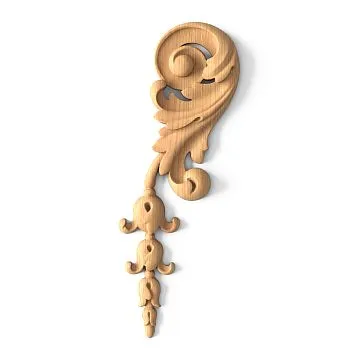
Wooden decorative items for decorating the houseinclude numerous carved elements — rosettes, cartouches, appliqués, brackets. Rosettes are placed on walls, ceilings, and furniture, creating decorative accents. Size varies from small (10–15 cm) to large (50–80 cm).
Brackets — carved elements imitating supporting structures — are placed under shelves, cornices, beams. S-shaped brackets with volutes are characteristic of Baroque. Triangular brackets — for more formal styles. Carved brackets with vegetal motifs — for luxurious interiors.
Appliqués decorate furniture, doors, wall panels. A carved appliqué on a cabinet facade transforms simple furniture into a piece of furniture art. Appliqués on the corners of door panels add elegance. Size is usually small — 5–15 cm.
Capitals — crowning parts of pilasters — have a shape corresponding to the chosen order. Doric capitals are simple with a square abacus. Ionic capitals feature characteristic volutes. Corinthian capitals have lush acanthus leaves. Carved wooden capitals create classical architectural structure.
Carved gables and facade decoration
The facade of a house — is its face, the first thing guests and passersby see.Carved gable of the houseand other facade decoration elements create an architectural style, individuality, and a memorable image.
Traditions of wooden architecture
Carved gables — an important part of Russian wooden architecture tradition. The triangular plane between roof slopes provided ample space for decoration. Carving was executed in various techniques — sunk, pierced, applied — creating different visual effects.
Sunk carving — relief on a solid board — creates play of light and shadow. Vegetal motifs, geometric patterns, zoomorphic elements are cut to a depth of 5–20 mm. Such carving is durable, protected from damage, and long-lasting.
Pierced carving — through holes creating a lace-like effect — appears light, airy, decorative. Requires greater skill, as thin elements easily break. Piercedcarved gables of the housecreate a wooden lace effect.
Applied carving — separate carved elements mounted on a base — allows creating complex multi-level compositions. Elements are carved separately, then mounted on the gable, creating a three-dimensional relief. This technique allows replacing damaged elements without dismantling the entire gable.
Symbolism of ornaments
Traditional ornamentsof the house gablecarry symbolic meaning. Solar signs — circles, rosettes, swastikas — symbolize the sun, source of life and warmth. Placed in the center of the gable, they become protective charms for the house.
Vegetal motifs symbolize fertility, life force, connection with nature. Grapevines with clusters — abundance. Oak leaves — strength, longevity. Roses — beauty, love. Such motifs express a wish for prosperity of the house and its inhabitants.
Zoomorphic elements — birds, horses, lions — have protective significance. A bird on the roof ridge protects against evil forces. Horse heads at the ends of cornices — an ancient symbol associated with the cult of the sun god. Lions at the sides of the entrance — guardians protecting the house.
Geometric patterns — rhombuses, triangles, zigzags — also have symbolic meaning. A rhombus with a point in the center — sown field, symbol of fertility. A triangle — sacred mountain or feminine principle. Zigzag — water, rain, celestial moisture. Understanding symbolism allows creating meaningful compositions.
Modern Interpretation
Moderncarved gables of the houseOften represent a reinterpretation of traditional forms. Preserving general structure and compositional principles, they use simplified, stylized ornaments corresponding to modern aesthetics.
Geometric stylization of traditional motifs creates a link with tradition through a modern visual language. Vegetal elements are simplified into abstract forms. Solar signs transform into geometric compositions of circles and rays. Result — a gable that looks modern yet retains connection to its roots.
Minimalist gables with restrained carving suit modern wooden houses. A few expressive elements instead of full ornamentation. Clean lines, clear geometry, restrained decoration create modern elegance while preserving traditional form.
Combined solutions combine wood with other materials. Wood is complemented by metallic elements creating contrast. Or combined with glass inserted into pierced fretwork, creating an inner glow.Carved gable of the housePierced casings create a wooden lace effect, especially expressive against light walls. Through-holes form complex patterns — floral, geometric, fantastical. Under interior lighting, such casings glow, creating a magical effect.
Casings and window frames
Carved casings on windows are a hallmark of wooden architecture, transforming a utilitarian window into a work of decorative art. The upper part — the lintel — often takes the shape of a crown, kokoshnik, or pediment. The side parts — vertical panels with ornamentation. The lower part — the sash board with carving.
Pierced casings create a wooden lace effect, especially expressive against light walls. Through-holes form complex patterns — floral, geometric, fantastical. Under interior lighting, such casings glow, creating a magical effect.
Modern casings are often simplified compared to historical ones. Simple profiled planks without excessive decoration frame the window, creating completeness without overload. A few carved accents — in the upper corners, in the center of the lintel — are sufficient to create character.
Modern window casings are often simplified compared to historical ones. Minimalist profiled strips without excessive ornamentation frame the window, creating a finished look without overloading. A few carved accents— in the upper corners, at the center of the lintel—are sufficient to create character.
Cornices and friezes
Wooden cornices under the roof eaves protect walls from precipitation and create a decorative finish to the facade. Carved friezes — boards with pierced or applied decoration — are placed along the edge of the eaves, creating a lace-like border.
Chimney caps — boards on the ends of eaves — are often adorned with carving. Traditionally, horse heads were placed at the ends of chimney caps — an ancient protective symbol. Modern chimney caps may have stylized finishes referencing tradition.
Brackets supporting the roof eaves also become objects of decoration. Carved brackets with volutes, floral motifs, geometric patterns transform a utilitarian structure into a decorative element. A row of identical brackets creates a rhythmic facade structure.
Frieze board — a horizontal plank under the cornice — may be adorned with carving, creating a decorative band encircling the house. Repeating ornament — meander, floral garland, geometric pattern — creates a rhythmic composition.
Corner and foundation elements
Corners of wooden houses are traditionally highlighted with decorative elements. Rusticated corners made of protruding beams from the wall plane emphasize structural logic and create visual reinforcement. Carving on the ends of beams adds decorative detail.
Pilasters at corners imitate columns, creating a classical architectural structure. Base, shaft with fluting, capital — a complete order system executed in wood.carved gables of the houseCombined with corner pilasters, they create a cohesive classical composition.
The foundation part of the facade also requires decorative treatment. Carved boards covering the foundation protect against splashes and create a visual base for the house. Carving may be geometric — diamonds, scales — or floral — stylized leaves, vines.
Framing doorways
Door Frame InstallationThe entrance door — a critical element connecting the facade and interior. The entrance door — a point of transition between exterior and interior space — its design must harmoniously link both worlds.
Entrance portal
The main entrance of a private house requires grand treatment. A wooden portal with pilasters and a pediment transforms the entrance into an architectural masterpiece. Side pilasters from ground or foundation level to the pediment create vertical accents, fixing the opening.
The base of the pilaster — an expanded foundation — creates a visual foundation, transitioning from horizontal to vertical. The shaft may be smooth or adorned with fluting — vertical grooves creating a rhythmic texture. The capital — the finishing element — may be a simple geometric or complex carved design with floral motifs.
The pediment above the entrance may be triangular, arched, or broken. A triangular pediment creates a classical monumentality. An arched pediment — a more soft, plastic composition. A broken pediment with a decorative element in the break — baroque theatricality.Door Frame InstallationWith a pediment, it becomes the compositional center of the facade.
The portal size should be proportional to the house size. For a small one-story house, a portal 2.5–3 meters high and 1.5–2 meters wide creates sufficient grandeur without overwhelming scale. For a two-story mansion, the portal may be 3.5–4 meters high, spanning two floors.
Entrance decoration
Door Frame InstallationIt may include carved elements — rosettes, cartouches, floral garlands, heraldic symbols. A rosette above the door in the center of the pediment becomes a compositional focus. A rosette diameter of 30–50 centimeters is proportional to the portal scale.
Side rosettes or cartouches on pilasters add decorative detail. Smaller than the central rosette — 20–30 centimeters. The ornament may repeat the central rosette or vary it, creating visual rhythm.
Floral garlands above the door, draping between pilasters, create baroque opulence. Carved garlands of oak with acorns, grapevines with clusters, laurel wreaths — traditional motifs of classical architecture, executed in wood.
Heraldic elements — coats of arms, monograms, emblems — indicate the house’s owner. A cartouche with initials above the entrance creates personalization. A family coat of arms in the tympanum of the pediment — a prestigious element characteristic of noble estates, which can be reproduced in a modern house.
Interior openings
Door Frame InstallationThe interior of the house should harmonize with the exterior, creating a stylistic unity. Wooden door casings on interior doors may repeat the profile of the entrance door in a simplified form. The same wood species, the same type of finish, but a smaller scale.
Grand entrances - from the hall to the living room, dining room - may have richly ornamented frames with carvings, pilasters, and pediments. Entrances to private zones - bedrooms, offices - have a more restrained design. Technical openings - to storage rooms, bathrooms - have minimal framing or none at all.
The height of interior openings is usually standard - 210-220 centimeters. Width varies - 80-90 centimeters for standard doors, 120-150 centimeters for double doors, up to 2-3 meters for grand entrances without doors. The width of the casing is proportional to the opening width - 8-12 centimeters for standard doors, 12-18 centimeters for wide ones.
Arched openings
Wooden arched openings create a distinctive expressiveness characteristic of classical interiors. A semicircular arch is the most common form. A segmental arch - a truncated circle - creates a more shallow curve. A pointed Gothic arch - sharp - is typical for neo-Gothic stylizations.
Carving on the arch may follow its shape - ornament runs along the arch curve. Or it may create contrast - vertical elements on side posts, horizontal or radial elements on the arch. The keystone at the arch's apex - a traditional accent - can be a carved decorative element in wooden arches.
Wide arched openings 2-3 meters wide create grand portals between grand rooms. A wooden arch of such scale requires structural calculation - the wood must withstand load without sagging. Laminated timber has greater strength than solid wood.
Doors as a decorative element
Wooden door - part of the compositionDoor opening framingA latticed door with carved mullions and panels harmonizes with a carved casing. The number of panels and their proportions must correspond to the overall composition.
The entrance door may be substantial - 60-80 millimeters thick solid oak. Carving on the exterior side corresponds to the casing and pediment carving. The interior side may be smooth or have a more restrained decoration matching the interior.
Glass inserts in doors create transparency and visual connection between rooms. Stained glass with ornament adds decorative appeal. The shape of inserts may be rectangular, round, or arched depending on the style.
Hardware - handles, hinges, locks - should also match the style. Wrought iron handles and hinges in an antique style suit rustic styles. Polished brass - for classic styles. Modern minimalist - for contemporary interpretations.
Conclusion: Unity of Wood
Creating a unified image of the house through the use ofwooden decorative items for decorating the homerequires a systematic approach, where every detail - fromof the house gabletoDoor opening framingto the entire composition.
Wood as a material possesses a unique ability to link exterior and interior due to its versatility, natural beauty, and cultural rootedness. The same wood species, used both outside and inside, creates material unity. Repetition of ornamental motifs in facade decoration and interior elements creates stylistic cohesion.
A professional approach begins with selecting a concept - defining the style, main wood species, type of finish, and degree of decoration. This concept is consistently implemented at all levels - from large elements such as pediments and portals to small details like carved appliqués.
Modern wood processing technologies make it possible to realize complex designs. CNC machines cut intricate ornaments with perfect precision. Modern protective coatings extend the lifespan of wood to 30-50 years even under extreme conditions. Laminated timber has dimensional stability unattainable with solid wood.
The result of proper use of wooden decoration - a house perceived as a unified work of architectural art. Harmony between exterior and interior, stylistic consistency of all elements, natural beauty of the material create a space where one wants to live and be proud of.
Company STAVROS offers a full rangewooden decorative items for decorating the home- from moldings and casings to complex carved compositions. A wide rangeof carved pediments for the houseincludes traditional and modern options. A collection of solutions forDoor opening framingcovers all styles and scales.
STAVROS's own production guarantees material quality, precision of execution, and the possibility of custom orders. Experienced craftsmen work with various wood species - oak, ash, beech - creating items that serve for decades. Professional consultants help develop a decoration concept, select elements, and calculate quantities.
Investments in quality wooden decoration pay off through beauty, longevity, and prestige. A house with thoughtful wooden decoration stands out, is memorable, and increases in value. Create homes where wood unifies exterior and interior into a single work, together with STAVROS - your reliable partner in wooden architecture!