Article Contents:
- Materials and their properties
- Structure and composition of MDF
- Comparison of MDF with other materials
- Ecological Safety
- Processing technologies for MDF
- Dimensional stability and durability
- Moldings and their functions
- Types of moldings and their purpose
- Molding profiles
- Sizes and proportions
- Functionality of moldings
- Molding Installation
- Painting moldings
- Skirting boards as a finishing touch
- Evolution of Baseboards
- Sizes and proportions of baseboards
- Baseboard profiles
- Materials for skirting boards compared
- Installation of MDF skirting boards
- Baseboard Color Solutions
- MDF panels as an accent
- History of panel systems
- Types of panel systems
- Strip sizes and proportions
- Functionality of panel systems
- Installation of panel systems
- Design solutions with panels
- Conclusion
- Frequently Asked Questions

Modern interiors require a systematic approach, where each element is coordinated with the others, creating a harmonious environment. Disjointed details, randomly selected without understanding the overall concept, will never create a sense of completion and professionalism.buy MDF molding for paintingand installMDF skirting board 100 mm for paintingand complete the compositionMDF panels for paintingmeans creating a unified finishing system, where all elements work toward a common result.
Why has MDF become the preferred material for modern interior solutions? The answer lies in its unique combination of properties: dimensional stability, uniform structure, processability, and economic accessibility. Unlike solid wood, which may deform due to changes in humidity, MDF retains its geometry for decades. Unlike plastic, which appears cheap and cold, MDF has a noble matte surface and can be painted in any color.
The concept of complete finishing implies that moldings, skirting boards, and panels are not considered as separate elements, but as parts of a single ensemble. They must be unified by a common material, color scheme, and profile style. This approach creates visual continuity in the interior, where the eye smoothly transitions from one element to another, avoiding dissonances and inconsistencies. Professional designers always plan finishes systematically, understanding that there are no minor details in interior design.
The ability to paint all elements in a single color is a key advantage of paintable systems. This allows creating monochromatic interiors, where structure is defined not by color, but by relief and interplay of light and shadow. Alternatively, it enables using color accents by painting different elements in contrasting shades. The main benefit is complete freedom of choice and the ability to easily change the color scheme simply by repainting elements, without needing to replace them.


Materials and their properties
MDF — medium-density fiberboard — is a composite material obtained by pressing finely dispersed wood particles under high temperature and pressure. Natural lignins present in the wood itself act as binders, making MDF an environmentally safe material.




Structure and composition of MDF
The basis of MDF consists of wood fibers obtained by grinding wood raw material - most often wood processing waste, making MDF production environmentally responsible. The fibers have a size ranging from several millimeters to fractions of a millimeter, ensuring the material's uniform structure. Unlike particleboard, which uses large particles, MDF has a dense, almost monolithic structure.
The density of MDF is 600-800 kilograms per cubic meter, significantly higher than particleboard but lower than solid wood. This density is optimal for interior elements - the material is strong enough to withstand operational loads, yet easily machinable with cutting tools.
The moisture resistance of MDF depends on the type of binder and presence of special additives. Standard MDF withstands brief exposure to moisture, but prolonged contact with water causes swelling. Moisture-resistant MDF, produced with paraffin emulsions, can be used in rooms with high humidity - kitchens, bathrooms.
The MDF surface is perfectly smooth, without knots, resin pockets, or other defects typical of natural wood. This allows for elements with flawless geometry and surface quality. Machining MDF yields clean edges without chips, which is critical for profiled items - moldings and baseboards.
Our factory also produces:


Comparison of MDF with other materials
Solid wood surpasses MDF in prestige, has natural texture and aroma, but is significantly more expensive and more demanding in maintenance. Wooden elements may deform due to humidity changes, crack, require regular care and protective treatments. MDF is stable, does not deform, and requires no special care.
Plastic is cheaper than MDF, completely unaffected by moisture, lightweight and easy to install. However, plastic elements look cheap, have a characteristic gloss that is hard to conceal even with paint. When heated, plastic may deform and emit odors. MDF is more elegant, has a matte surface, and paints better.
Polyurethane is a modern material for moldings and decorative elements. It is lightweight, moisture-resistant, and allows creating complex shapes. Polyurethane elements, after painting, visually indistinguishable from plaster moldings. However, polyurethane is less eco-friendly than MDF and releases toxic gases in case of fire. For basic elements - moldings and baseboards - MDF is often preferable.
Plaster is a traditional material for moldings, noble, eco-friendly, and non-combustible. But plaster is heavy, brittle, moisture-sensitive, difficult to process and install. Plaster elements are expensive and used primarily in exclusive interiors. MDF is more affordable and practical for most projects.
Get Consultation
Oak skirting boards are an indispensable element of classic interior styles. In the English style, oak skirting boards with rich carving emphasize the aristocracy and solidity of the space. Dark wood tones harmonize beautifully with traditional materials — natural stone, leather, bronze.
MDF is often unjustly accused of formaldehyde emissions. Indeed, some types of MDF contain formaldehyde resins as binders. However, modern technologies allow producing MDF of class E1 and even E0, where formaldehyde emissions are minimal and do not exceed natural wood levels. Quality MDF from reliable manufacturers is absolutely safe for health.
The natural origin of MDF components makes it a biodegradable material. Unlike plastic, which takes centuries to decompose, MDF gradually turns into compost. This is important from the standpoint of ecological responsibility and sustainable development.
Using wood processing waste for MDF production reduces pressure on forest resources. Instead of growing trees specifically for decorative elements, secondary raw materials - sawdust, chips, wood shavings - are used. This makes MDF an environmentally responsible choice.
MDF's non-combustibility is inferior to plaster and metal, but superior to plastic. MDF belongs to Group G4 - highly flammable materials. However, applying fire-retardant coatings can reduce flammability. For residential spaces, standard MDF is quite safe when fire safety regulations are followed.
Processing Technologies of MDF
Milling is the primary method for producing profiled items from MDF. Modern CNC milling machines allow creating profiles of any complexity with precision down to tenths of a millimeter. The fine-grained structure of MDF ensures clean cuts without chips or scratches, which is critical for the quality of moldings and baseboards.
Sanding MDF requires using fine-grit abrasives. Coarse sandpaper can tear fibers, creating roughness. Properly sanded MDF surface is perfectly smooth, ready for priming and painting without additional treatment.
Priming is a mandatory stage of preparing MDF for painting. Primer fills the material's pores, creating an evenly absorbent surface, improving paint adhesion. Without priming, paint absorbs unevenly, consumption increases several times, and the finish becomes non-uniform. Specialized primers for MDF ensure ideal surface preparation.
MDF can be painted with various types of paint - acrylic, alkyd, or polyurethane. Water-based acrylic paints are most popular due to their odorless nature, quick drying, and good coverage. For an ideal finish, apply 2-3 coats with intermediate sanding using fine abrasive.
Laminating MDF with film or veneer creates a ready decorative finish, requiring no painting. Laminated MDF can imitate various wood species, have solid color finishes, glossy or matte surfaces. However, paintable elements are more versatile, as they allow changing color as desired.
Dimensional Stability and Durability
The linear expansion coefficient of MDF is significantly lower than that of solid wood. This means MDF elements practically do not change size with temperature and humidity fluctuations. Installed moldings and baseboards do not form gaps at joints, do not detach from walls, and retain their original geometry.
Resistance to deformation is an important advantage of MDF. Long elements - baseboards, moldings - do not warp, sag, or lose straightness. This simplifies installation and guarantees quality results. Wooden elements may twist when screwed, especially with humidity changes.
The service life of quality MDF is 20-30 years under normal operating conditions. This is not a record - solid oak can last centuries - but it is quite sufficient for interior elements. Over this time, interiors are typically updated several times, changing their style, so MDF's durability is quite adequate.
Repairability of MDF elements is good. Minor damage - dents, chips - can easily be filled with wood putty and painted over. Serious damage requires replacing the element, which is not difficult due to standardization of sizes and profiles. The ability to repaint allows updating the appearance without replacing elements.
Moldings and Their Functions
buy MDF molding for painting- means acquiring a universal tool for creating architectural interiors. Moldings are profiled strips used for framing, dividing surfaces, and creating decorative compositions. Their role in interiors is hard to overestimate - it is precisely moldings that transform flat walls into structured architectural spaces.
Types of Moldings and Their Purpose
Ceiling cornices are the most common type of moldings, creating a transition between wall and ceiling. A cornice completes the wall composition, making the room more finished and architectural. Even a simple cornice dramatically changes the perception of the interior. The width of the cornice determines its visual impact - from delicate framing to a powerful architectural accent.
Wall moldings are used to create panels, frames, and decorative compositions on walls. A classic approach is dividing walls into rectangular or square sections using moldings. Within sections, contrasting paint, patterned wallpaper, or decorative plaster can be used. This solution is characteristic of classical interiors but is actively used in modern design as well.
Door and window casings are moldings framing openings. They hide the joint between the wall and frame, creating architectural detailing of the opening. The width and profile of casings determine the visual weight of the framing - from minimalist thin strips to richly profiled elements with carving.
Corner moldings are specialized elements for decorating interior and exterior corners. They eliminate the need for precise 45-degree trimming of standard moldings, creating a ready decorative solution. Corner elements can be simple functional details or richly decorated accents.
Divider moldings are used to create boundaries between different finishing materials — wallpaper and paint, two types of wallpaper, wall panels, and plaster. They create a clear, neat edge while simultaneously serving as a decorative element.
Molding profiles
Simple geometric profiles — rectangular, square, triangular cross-sections — are characteristic of modern minimalist interiors. The absence of complex curves makes such moldings universal and easy to install. After painting to match wall color, they create a subtle relief, structuring space without excessive ornamentation.
Classic profiles consist of several elements — coves, rolls, ovals, and shelves. These elements trace back to classical architecture and have established proportions. A classic profile creates a rich play of light and shadow, lending the interior traditional elegance. The complexity of the profile should match the overall interior style.
Asymmetric profiles have different cross-sections on different sides. Such moldings can be used in a specific orientation, creating a directional visual effect. Asymmetry allows solving specific tasks — for example, creating a hidden niche for lighting or a cable channel for wiring.
Combined profiles combine different elements, creating unique shapes. Manufacturers offer dozens, if not hundreds, of different profiles, from the simplest to intricately complex. Choosing a profile is a matter of style, room proportions, and personal preferences.
Dimensions and Proportions
Molding width — a critical parameter determining its visual impact. Narrow moldings, 2–5 centimeters wide, create a delicate framing, almost imperceptible, yet orderly. They suit small rooms and minimalist interiors where restraint is important.
Medium moldings, 7–12 centimeters wide, are a universal solution for most interiors. They are expressive enough to create an architectural effect, yet do not overwhelm the space. Such moldings suit rooms of standard height 2.5–2.7 meters.
Wide moldings, 15 centimeters and wider, create a powerful architectural effect. They are suitable for spacious rooms with high ceilings, where small details would be lost. Wide moldings visually lower the ceiling, making a high room feel cozier and more intimate.
Profile height — the distance the molding protrudes from the wall — also affects perception. Flat moldings create a delicate relief, while volumetric moldings create a pronounced play of light and shadow. In rooms with side natural lighting, relief moldings are especially effective.
The proportions between profile width and height determine its character. Horizontally elongated moldings create a calm, static effect. Tall profiles with narrow width appear more dynamic and modern. Classic proportions are usually close to 3:1 or 4:1.
Molding functionality
Defect concealment — an important practical function of moldings. Wall irregularities, gaps at junctions of different materials, traces of old finishes — all can be hidden under moldings. This is especially relevant during partial repairs, when you don’t want to disturb the entire finish for a minor defect.
Protection against damage — moldings installed at chair-back height protect walls from abrasion and impacts. Such moldings are called dado or chair rails and are widely used in commercial spaces — restaurants, hotels, offices. They are practical and simultaneously decorative.
Hidden lighting — a modern feature of ceiling moldings. A special profile creates a recess between the molding and the ceiling, where an LED strip is installed. Light directed toward the ceiling creates soft, diffused illumination and a floating ceiling effect, visually increasing room height.
Cable channels — some moldings have internal cavities for laying electrical wires. This allows concealing cables to outlets, switches, and lights without wall cutting. Especially relevant during renovation without structural changes, when adding new electrical outlets is needed.
Space zoning — decorative moldings on walls can visually divide a room into functional zones. Vertical moldings create imaginary boundaries, horizontal moldings emphasize height divisions. Such zoning works in open floor plans, where structure is needed without physical partitions.
Molding installation
Surface preparation is critical for quality installation. Walls must be relatively flat — moldings cannot compensate for significant irregularities. The surface must be clean, dry, and dust-free for good adhesive bonding. Loose old finishes must be removed or reinforced with a deep-penetration primer.
Marking — a crucial stage determining geometric accuracy. Horizontal moldings are marked using a laser or water level. Vertical moldings are checked with a plumb bob. For creating wall panels, carefully calculate section sizes and positions to ensure symmetry and correct proportions.
Molding cutting requires precision, especially for corner trimming. 45-degree joints are made using a miter box or a circular saw. Use a fine-toothed saw to avoid chipping edges. For MDF, metal saws or special reverse-toothed blades are suitable.
MDF moldings are attached using special adhesive — liquid nails, polymer construction adhesive, or MDF glue. Adhesive is applied in dots or zigzag pattern on the back of the molding. The element is pressed against the wall and held for several minutes until initial setting. For heavy moldings, additional mechanical fastening may be used.
Joint sealing — the final step before painting. All joints between elements, corners, and mounting points are filled with acrylic putty or sealant. After drying, the surface is sanded with fine abrasive. The quality of sealing determines the final result — after painting, all defects become visible.
Molding painting
Priming — a mandatory step for preparing MDF for painting. Primer creates an even surface, improves paint adhesion, and reduces paint consumption. For MDF, water-based acrylic primers or specialized wood primers are used. Primer is applied with a brush or roller in one coat.
Paint selection depends on usage conditions and desired effect. For residential spaces, water-based acrylic paints are optimal — they are odorless, dry quickly, and create a durable finish. For humid areas, latex paints with enhanced water resistance are preferable.
Paint gloss level affects molding perception. Matte paints create a noble, restrained surface, hiding minor defects. Glossy paints provide a bright sheen, emphasizing relief, but reveal all irregularities. Semi-gloss paints offer a compromise, combining advantages of both options.
Paint application technique requires care. Moldings with relief profiles are best painted with a brush that penetrates all recesses. Smooth moldings can be painted with a short-pile roller. Spray gun provides perfectly even coverage but requires careful protection of surrounding surfaces from overspray.
Typically, two to three coats are applied. The first coat reveals preparation defects that must be corrected with putty and sanding. The second coat creates the base finish. The third coat ensures perfect coverage and color saturation. Each coat must be fully dry before applying the next.
Baseboards as finishing
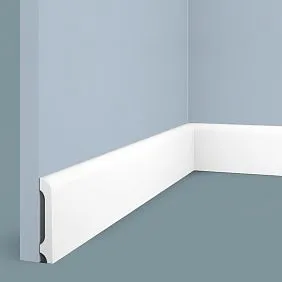
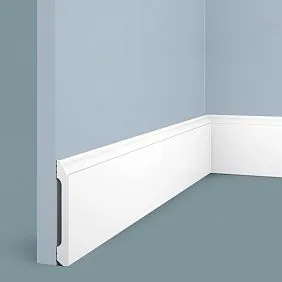
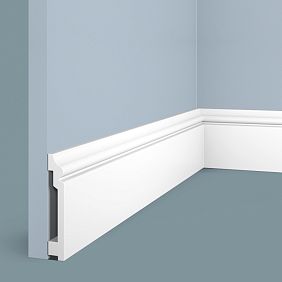
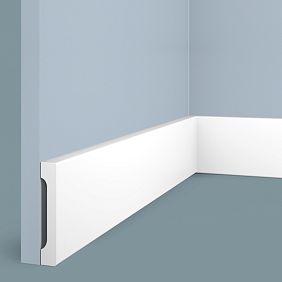
MDF skirting board 100 mm for paintingNot just a strip covering the gap between the wall and floor. It is a finishing interior element that creates the visual base of the room, connects walls with the floor, and protects the lower part of walls from damage. A properly chosen skirting board can significantly improve the perception of the interior, while an incorrect one can spoil even expensive finishes.
Evolution of baseboards
Historically, skirting boards were purely functional elements — they protected the lower part of walls from mechanical damage during cleaning and concealed the inevitable gap between the wall and floor. In peasant houses, these were simple boards nailed to the wall. In urban homes, skirting boards became more decorative, replicating architectural profiles.
Classical architecture turned the skirting board into an important element of the order system. The skirting board was considered a continuation of the column base on the walls of the room. It had a complex profile, often included several tiers — plinth, main body, and decorative cap. High skirting boards 15–20 centimeters were standard in formal rooms.
Modernism of the twentieth century simplified the skirting board to a minimum. Low skirting boards 5–7 centimeters high, almost invisible, performed only a functional role. Some architects even abandoned skirting boards, creating built-in skirting niches or using hidden floor covering fasteners.
The modern approach combines functionality and aesthetics. Skirting boards became more technologically advanced — models with cable channels, hidden fastening systems, and LED-lit skirting boards appeared. At the same time, it remains possible to choose between minimalist and decorative options depending on the interior style.
Dimensions and proportions of baseboards
The height of the skirting board is a key parameter determining its role in the interior. Low skirting boards 40–70 millimeters high are characteristic of modern minimalist interiors. They are almost invisible, do not attract attention, create a sense of lightness and spaciousness. Such skirting boards are suitable for rooms with low ceilings.
Standard skirting boards 80–100 millimeters high — a universal solution for most interiors.MDF skirting board 100 mm for paintingProvides good wall protection, sufficiently expressive, but does not dominate the interior. This height is suitable for rooms with ceilings 2.5–2.7 meters high.
High skirting boards 120–150 millimeters create a more classical, traditional look. They are characteristic of rooms with high ceilings, where low skirting boards would be lost. High skirting boards may include complex profiles imitating classical architecture. They visually reduce wall height, making high rooms more cozy.
Very high skirting boards from 200 millimeters practically represent wall panels. Such elements are characteristic of historical interiors, neoclassicism, and English style. They can be painted in a contrasting color to the walls, creating a clear horizontal division in the interior.
The thickness of the skirting board affects its relief and method of mounting. Thin skirting boards 12–18 millimeters create a delicate relief, are primarily glued. Thick skirting boards 20–30 millimeters are more voluminous, may include cable channels, require more secure mounting. Very thick skirting boards from 40 millimeters create a strong architectural accent.
Baseboard profiles
Rectangular profile — the simplest form, characteristic of minimalism and modern interiors. The skirting board is a simple rectangular-section strip without any curves or ornamentation. After painting to match the wall color, such a skirting board is almost invisible, creating a clean boundary between the wall and floor.
Beveled profile has an inclined front surface, creating a smooth transition from wall to floor. Such a profile visually appears lighter than rectangular, creating a soft play of light. The angle of inclination can vary from shallow to steep, defining the character of the skirting board.
Classic profile includes several elements — lower shelf, main body, upper cap or molding. Such a profile creates a rich play of light and shadow, giving the interior a traditional elegance. The complexity of the profile can vary from simple two- or three-element designs to multi-tiered compositions.
Profile with cable channel has an internal cavity for laying wires. The back wall of the skirting board is removable, allowing easy placement and replacement of cables if necessary. This is a very practical solution for modern homes with many electronic devices.
Profile with lighting creates a niche at the bottom for installing an LED strip. The light is directed downward, illuminating the floor and creating a floating wall effect. Such lighting can serve as a nightlight, create decorative lighting, or visually expand the space.
Skirting Board Materials Comparison
MDF skirting boards combine affordability with a quality surface. They have a perfectly smooth surface without defects, are easily painted in any color, and do not deform under humidity changes. MDF skirting boards are cheaper than wooden ones but more noble than plastic ones. This is the optimal choice for most projects.
Solid wood skirting boards made of oak, beech, or ash are more prestigious and durable than MDF. They have a natural texture, can be restored multiple times, and last for decades. However, wood is more expensive, may deform under humidity, and requires regular maintenance. For premium interiors, wood is preferable.
Plastic skirting boards are the cheapest and most practical. They are completely unaffected by moisture, easy to clean, and simple to install. Plastic skirting boards with cable channels are convenient for laying wires. However, plastic looks cheap, has a characteristic sheen, and is poorly painted. For budget projects, this is an acceptable option.
Polyurethane skirting boards are lightweight, moisture-resistant, and can imitate complex wooden carving profiles. After painting, they visually resemble wood or plaster. Polyurethane is suitable for humid areas and for creating complex decorative forms within a limited budget.
Metal skirting boards made of aluminum or stainless steel are characteristic of commercial interiors, high-tech, and minimalist styles. They are completely non-combustible, hygienic, and durable. Metal creates a cold, industrial look, which is not always suitable for residential spaces.
Installing MDF Skirting Boards
Wall preparation includes removing significant unevenness, cleaning from dust and dirt. The skirting board must fit tightly against the wall along its entire length. If walls are very uneven, flexible skirting boards can be used or the surface can be leveled with spackling.
Material acclimatization — skirting boards must remain in the room for at least 48 hours before installation. This allows the material to adapt to the room’s temperature and humidity, preventing subsequent deformations.
Marking begins with determining the starting point — usually the corner farthest from the entrance. Skirting boards are installed around the perimeter of the room, joints in corners and along the length must be pre-calculated to avoid short cuts in noticeable areas.
Skirting board cutting is done with a miter saw for precise corner cuts or with a jigsaw for straight cuts. Corners are typically mitered at 45 degrees for a neat joint. For inside corners, the contour-cut method can be used, where one skirting board is cut to match the profile of the other.
MDF skirting board installation can be done in several ways. Gluing method — the simplest, the skirting board is glued to the wall using liquid nails or special adhesive. Mechanical fastening — the skirting board is screwed to the wall with self-tapping screws, screw heads are countersunk and spackled. Clip system — special clips are mounted on the wall, and the skirting board clicks into place.
Provides maximum freedom in color choice. The classic option — white skirting board on any background. White is universal, matches any wall and floor colors, creates a clear base line, visually lightens the space.
White skirting boards — a classic solution, creating a clear boundary between wall and floor. White color is universal, matches any wall and floor colors, visually lifts the ceiling, and makes the room brighter. White skirting boards require regular cleaning, as dirt on them is especially noticeable.
Skirting boards in wall color create an effect of continuous surface from floor to ceiling. The wall visually continues downward, increasing the perceived height of the room. This is a modern solution characteristic of minimalist interiors. The skirting board remains functional but does not attract attention.
Baseboards in floor color create the impression of a massive foundation on which the walls stand. This is a more traditional solution, creating stability and solidity. A wooden floor with matching-colored baseboards looks like a single composition.
Contrasting baseboards — dark on light backgrounds or bright colors — become a noticeable design element. They create graphic effects, clearly define room boundaries, and can support color accents of furniture or textiles. This solution requires boldness and good taste.
Baseboards with decorative effects — patina, artificial aging, metalization — create a special atmosphere. Gilded baseboards are characteristic of glamorous interiors. Patinated ones create a vintage look. Metalized ones suit lofts and industrial styles.
MDF strips as accent
MDF grooved panels for painting are popular not only in residential interiors but also in offices, medical centers, and educational institutions. A properly designed grooved system can enhance work productivity and improve overall well-being.A modern trend in interior design that allows creating expressive accent walls, zoning space, and managing the visual geometry of a room. Strips are narrow panels mounted on walls at a specific interval, creating a rhythmic structure and a three-dimensional effect.
History of strip panels
The use of strips in architecture has ancient roots. Wooden strips were used as a base for plaster — lath, onto which clay or lime plaster was applied. Later, strips became a decorative element on their own, especially in Japanese architecture, where lattice structures made of strips created semi-transparent partitions.
Scandinavian design of the 20th century actively used wooden strips to create warm, natural interiors. Vertical strips on walls visually increased the height of small rooms, creating a sense of connection with nature. Unpainted natural wood emphasized eco-friendliness and authenticity.
Modern interpretations of strip panels have expanded their applications. Strips are used not only on walls but also on ceilings, as elements of partitions, and in furniture. Systems with different strip spacing, combinations of strips of different widths, painted and laminated variants have emerged.
The trend for strip panels in the 2020s is linked to the popularity of biophilic design, aiming to bring natural materials and textures into interiors. Strips create a dynamic yet orderly environment, play of light and shadow, depth, and volume. They work equally well in minimalism, Scandinavian style, lofts, and eco-design.
Types of strip systems
Vertical strips — the most popular option, visually increasing room height. Vertical lines draw the eye upward, creating a sense of slenderness and lightness. This orientation suits rooms with low or standard ceilings, narrow corridors, and small rooms.
Horizontal strips create the opposite effect — visually expanding space, making it more stable and calm. Horizontal lines soothe, creating a sense of reliability. This option is good for elongated rooms that need visual expansion, or for creating accent walls behind beds or sofas.
Diagonal strips create dynamism and movement. They are characteristic of modern, experimental interiors where expressiveness and non-standard design are needed. Diagonal lines can run parallel to each other or form complex geometric patterns — such as a Christmas tree, chevron, or grid.
Combined systems combine strips of different orientations, creating complex compositions. For example, the main field may be filled with vertical strips, with a horizontal insert in the center. Or strips may change direction, creating visual zoning on the wall.
Systems with variable spacing create a more complex rhythm, where the distance between strips gradually changes. This creates a sense of perspective, movement, and optical illusion. Such solutions require precise calculation and execution, but the result impresses with its complexity and expressiveness.
Slat dimensions and proportions
Strip width determines visual density and surface character. Narrow strips 20–30 mm wide create a frequent rhythm, visually complex and detailed surface. They are good for creating background walls, not overly accentuated, for small rooms where large elements would overwhelm.
Medium-width strips 40–60 mm — a universal option, creating a balanced rhythm. Such strips are sufficiently expressive but do not dominate the interior. They suit most applications — accent walls, partitions, ceiling installations.
Wide strips from 80 mm create a calmer, rarer rhythm. They are characteristic of minimalist interiors, where restraint and simplicity are important. Wide strips visually appear more substantial, creating a clear graphic structure.
Strip thickness affects relief and play of light and shadow. Thin strips 10–15 mm create a delicate relief, almost graphic effect. Thick strips 20–40 mm form pronounced volume, deep shadows, and a more sculptural surface character.
The spacing between strips — a critical composition parameter. It can equal the strip width, creating a 50/50 rhythm — equal-width light and dark stripes. The spacing may be less than the strip width — strips dominate, gaps are read as accents. Or greater — gaps dominate, strips are perceived as separators.
Functionalities of strip panels
Acoustic correction — an important function of strip panels, especially in rooms with echo and reverberation problems. Strips scatter sound waves, breaking their reflection off flat walls. Gaps between strips can be filled with sound-absorbing material, enhancing the acoustic effect. This is relevant for home theaters, music rooms, and open-plan offices.
Hiding wall defects — a strip panel is mounted on a frame that does not require a perfectly flat wall. Small irregularities, cracks, and traces of old finishes are hidden behind strips. This allows updating the interior without major wall renovation, saving time and money.
Space zoning — strip panels can create visual boundaries between functional zones. For example, in a studio, a strip wall may separate the sleeping area from the living room, maintaining visual continuity and light flow. In a restaurant, strips separate tables, creating privacy without full isolation.
Hiding utilities — behind a strip panel, wires, pipes, and ventilation ducts can be concealed. The frame creates space between the wall and strips, where utilities are placed. When access is needed, strips can be easily removed and reinstalled.
Decorative backlighting — LED strips can be installed between or behind strips, creating an eye-catching backlight. Light filtering through gaps or behind strips creates a dramatic play of light and shadow, making the wall lively and dynamic, especially at night.
Installation of strip systems
Wall preparation for a strip system is less critical than for flat finishing materials. Perfect flatness is not required, as strips are mounted on a frame. However, the wall must be strong enough to support the structure’s weight and free of peeling finishes.
Frame — the foundation of a strip system, determining its strength and longevity. The frame can be wooden — 40x40 or 50x50 mm beams — or metal — gypsum board profiles. A wooden frame is more eco-friendly and easier to work with, while a metal frame is stronger and resistant to moisture.
The framing layout requires precision, especially for vertical studs. Horizontal framing guides must be strictly parallel to the floor and ceiling. A laser level is used for control. The spacing between guides is usually 40-60 centimeters for structural reliability.
Studs can be attached to the frame in various ways. Concealed mounting using clips is the most aesthetic option, as the fasteners are not visible on the front surface. Mounting with screws from the front is simpler but requires subsequent filling of screw heads. Adhesive mounting is possible for lightweight studs on a flat frame.
Finishing includes spackling screw attachment points (if screws are used), sanding, priming, and painting. Studs can be painted before installation, which is more convenient for even coverage, or after installation, allowing for sealing all joints and creating a unified surface.
Design solutions with studs
Accent wall with studs - the most popular application. One wall in a room, usually behind a bed, sofa, or TV, is covered with studs, becoming the compositional center of the interior. Other walls remain smooth, creating a contrast in texture. The color of the stud wall can match other walls or contrast with them.
A ceiling made of studs creates a dynamic upper plane that visually increases the room's height. Studs on the ceiling can run in a direction that visually elongates the space. Recessed spotlights or LED lighting can be installed between the studs, creating interesting lighting effects.
Partial wall covering with studs - only the lower or upper part, or only the central zone - creates a more complex composition. Studs can start from the floor and rise to one-third or half the wall height, creating a panel-like effect. Alternatively, they can descend from the ceiling, visually lifting it.
Studs as zoning elements - a vertical stud structure not reaching the ceiling creates a semi-transparent partition. It visually divides space while maintaining a sense of unity, allowing light and air to pass through. Such partitions are ideal in studios, open-plan offices, and spacious apartments.
Combining studs with other materials creates rich, multi-layered compositions. Studs can be combined with smooth painted walls, wallpaper, decorative plaster, or panels. Contrasting textures make the interior more interesting and expressive.
Conclusion
Complete finishing system includingMDF moldings for painting, MDF skirting boards 100 mm for paintingandMDF grooved panels for painting are popular not only in residential interiors but also in offices, medical centers, and educational institutions. A properly designed grooved system can enhance work productivity and improve overall well-being.The system represents a modern solution for creating harmonious, professionally-looking interiors. Material unity, the ability to paint in any color, and technological installation - all of this makes MDF an ideal choice for most projects.
A systematic approach to finishing means that all elements are designed and selected simultaneously, taking into account their interaction with each other. Moldings create the architectural structure of walls and ceilings, skirting boards complete the composition from below, creating the visual base of the interior, studs add dynamism and modernity, creating accents and zoning. Together, they form a cohesive environment where each element enhances the others.
The advantages of MDF as a material for interior elements are obvious. Dimensional stability ensures longevity without deformation. Uniform structure allows creating profiles of any complexity with clean edges. Ecological safety and safety are confirmed by certificates. Economic accessibility makes quality finishing accessible to a wide range of people.
The ability to paint all elements in a single color or create color combinations offers unlimited possibilities for realizing any design ideas. One can create a monochromatic white interior of classic elegance, or a vibrant colorful space in the pop-art style, or a restrained Scandinavian minimalist gray palette. When changing the interior concept, it is sufficient to repaint the elements without changing them.
Technological installation allows implementing projects in short timeframes. MDF elements are easily cut with standard tools, attached with glue or mechanical fasteners, and do not require special skills. Of course, for an ideal result, it is better to involve professionals, but basic installation can be done independently.
The durability of the system, with proper installation and maintenance, is 20-30 years. This is sufficient considering that interior trends change, and one often wants to refresh the ambiance. In this case, elements can be repainted several times, extending their relevance and adapting them to new color schemes.
Versatility of application - MDF elements are suitable for any interior style. Classic, neoclassic, minimalism, Scandinavian style, loft, eclectic - everywhere one can find applications for moldings, skirting boards, and studs made of MDF. It is important to correctly choose profiles, proportions, and color solutions corresponding to the selected style.
STAVROS company offers a full range of elements for a complete finishing system. Moldings of various profiles - from minimalist to classic, skirting boards of different heights and complexity, studs of various widths and thicknesses - all this allows implementing projects of any complexity. High-quality MDF, precise dimensions, and ideal surface finishing ensure a professional result.
STAVROS products are made from environmentally safe MDF class E1, which does not emit harmful substances. Each element undergoes quality control, geometric checks, and surface condition checks. Primed elements are ready for painting, saving time and ensuring good paint adhesion.
STAVROS specialists' consultation support helps correctly calculate material quantities, choose optimal profiles and sizes, and obtain installation and finishing recommendations. This is especially valuable for those implementing projects independently or working with contractors lacking significant experience.
Choosing an MDF finishing system from STAVROS, you get professional quality, ecological safety, durability, and the ability to realize any design ideas. Your interior will look cohesive, professionally designed, and modern, and the ability to easily update it through repainting will allow maintaining its relevance for many years.
Frequently asked questions
Why is MDF better than solid wood for interior elements?
MDF surpasses solid wood in dimensional stability - it does not deform due to changes in humidity and temperature, does not crack, does not dry out. MDF has a uniform structure without knots and defects, allowing to create profiles with ideal geometry. MDF is significantly cheaper than solid wood of valuable species, yet after painting, it is visually almost indistinguishable. However, solid wood is more prestigious, has natural texture and aroma, and with proper care lasts longer. For most projects, MDF is the optimal choice in terms of price-to-quality ratio.
Can MDF elements be used in humid rooms?
Standard MDF is not recommended for rooms with high humidity - bathrooms, saunas. Prolonged contact with water causes material swelling. However, moisture-resistant MDF with paraffin additives can be used in bathrooms provided it is properly painted with moisture-resistant paints. For kitchens, standard MDF is quite suitable - brief water splashes do not cause damage. An alternative for humid rooms are polyurethane elements, which are completely water-resistant.
How to properly paint MDF elements?
Painting MDF begins with mandatory priming using a special MDF primer or universal acrylic primer. The primer is applied with a brush or roller in one layer and dried according to the manufacturer's instructions. Then paint is applied - acrylic for residential areas, latex for humid areas. The first layer of paint may be uneven - this is normal. After drying, the surface is lightly sanded with fine abrasive and a second layer is applied. For an ideal result, a third layer may be required. It is important to allow each layer to fully dry before applying the next one.
What height of skirting board to choose for a standard apartment?
For an apartment with ceilings 2.5-2.7 meters high, the optimal skirting board height is 80-100 millimeters. Such a skirting board is sufficiently expressive, well protects walls, but does not overload the interior. For smaller rooms, a skirting board of 70-80 millimeters can be chosen; for spacious apartments with ceilings over 3 meters — 120-150 millimeters. Minimalist interiors allow low skirting boards of 50-70 millimeters, while classic interiors require higher ones — from 100 millimeters. It is important to maintain proportions — the skirting board should harmonize with ceiling height, door casing width, and overall room scale.
How to calculate the number of planks for an accent wall?
How much does an MDF finishing system cost for a standard apartment?
How much does an MDF finishing system cost for a standard apartment?
Can MDF elements be combined with wooden ones?
Can MDF elements be combined with wooden ones?
How to care for painted MDF elements?
How to care for painted MDF elements?
Care for painted MDF elements is simple and does not require special products. Regular dry cleaning with a soft cloth or brush removes dust. Wet cleaning is done with a slightly damp sponge without excess water and aggressive chemicals. For removing stains, a mild soap solution or specialized products for painted surfaces can be used. It is important to avoid abrasive sponges and stiff brushes that may scratch the paint. In case of scratches or chips, local repainting is possible. Periodically, every 5-7 years, the coating can be fully repainted to restore the original appearance of the elements.
Is MDF eco-friendly for children's rooms?
High-quality MDF of class E1 or E0 is absolutely safe for children's rooms. Formaldehyde emission from such MDF does not exceed natural wood levels and remains within sanitary norms. When selecting MDF elements for a child's room, always check for certificates confirming emission class. After painting with high-quality water-based acrylic paints, MDF becomes a completely inert material, emitting no substances. The paints should also have safety certificates for use in children's rooms. Properly selected and installed MDF elements create a safe and beautiful environment in the child's room.