












































































Article Contents:
- The Philosophy of Minimalism: Less is More, Thinner is Deeper
- Thin Slats on Walls: Verticals Raise the Ceiling, Horizontals Expand the Space
- Thin Slats on the Ceiling: Rhythm Overhead Governs the Perception of Space
- Play of Light and Shadow: How Thin Slats Become a Light Sculpture
- Minimalist Furniture and Thin Slats: A Dialogue of Simplicity
- Wood Species for Thin Slats: The Light Tones of Minimalism
- Treatment and Finish: Matte vs. Gloss in Minimalism
- Balance of Emptiness and Fullness: How Slats Keep Minimalism from Being Cold
- Installation of Thin Slats: Precision is the Religion of Minimalism
- How Not to Turn Minimalism into Emptiness: Slats as Salvation from Boredom
- Color Temperature and Minimalism: Cold vs. Warm
- Questions and Answers: All About Thin Slats in Minimalism
- STAVROS: Where Minimalism Becomes Reality

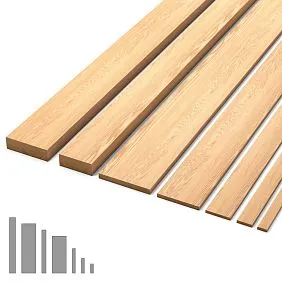
The paradox of an expensive interior lies in its apparent simplicity. The fewer the elements, the higher the demands on the quality of each.Thin wooden lathsThey embody the philosophy of minimalism through rhythm, air, light — three dimensions that transform empty space into an architectural statement. When there is nothing superfluous on the wall, every line becomes significant. When furniture is minimal, every piece must be flawless. Vertical slats with a cross-section of 20×40 mm and a spacing of 80 mm create a texture that does not shout about itself but forms the character of the room — restrained, refined, expensive without ostentatious luxury.
Why does minimalism require thin slats, not massive ones? Because a thick slat of 60×80 mm creates visual weight that disrupts the airiness of the space. A thin slat of 15×30 or 20×40 mm draws lines, not shapes. These lines create rhythm — a regular alternation of wood and emptiness, light and shadow, material and immaterial. Rhythm calms the eye, organizes chaos, creates order without rigidity.Planed wooden stripof light oak or bleached ash on a white wall — this is not decor, it is a structure that holds the space, preventing it from becoming shapeless and cold.



The Philosophy of Minimalism: Less is More, Thinner is Deeper
Minimalism was born from a fatigue of excess. The 20th century, with its Baroque revival, eclecticism, and postmodernism, overloaded interiors with details, colors, and forms. By the middle of the century, architects and designers began seeking purity — a space where one could breathe, think, exist without visual noise. Thus minimalism emerged — not just a style, but a way of thinking where every element is justified by function or beauty, or ideally, both simultaneously.
Simplicity of forms in minimalism does not mean primitiveness. A rectangular solid oak table without carving or decoration can cost more than a Baroque table with gilding — because in minimalism, flaws cannot be hidden behind decor. Every surface is visible, every joint must be flawless, every line must be absolutely straight. This requires the highest precision in manufacturing, material quality, and craftsmanship. Cheap minimalism looks shabby, expensive minimalism looks priceless.
Wooden planks for decorationof walls and ceilings in a minimalist interior serve a dual function. Functional — creating texture on smooth surfaces, structuring space, concealing utilities behind the slat construction. Aesthetic — forming visual rhythm, play of light and shadow, connection between the verticals and horizontals of the room. Thin slats handle both tasks better than thick ones because they create effect without overload, texture without massiveness, structure without oppression.
Air is not emptiness, but the active space between objects. In an overloaded interior, there is no air — every cubic meter is filled with objects, decor, color. In a minimalist interior, air becomes a full participant in the composition. The gaps between slats are not just the absence of wood, they are the presence of light that penetrates between the elements, creates gradients, reveals volume. The thinner the slats and the greater the distance between them, the more air, the easier the space breathes.
Light in minimalism works as a sculptor. It doesn't just illuminate objects; it creates their volume through shadows. Vertical thin slats on a wall under lateral natural lighting turn into a light composition — each slat casts a thin shadow on the wall, these shadows are parallel, creating a rhythm that changes throughout the day as the sun moves. In the morning, shadows are long and soft; at noon, short and sharp; in the evening, they lengthen again, creating a dramatic effect. This is living architecture that needs no additional decor.




Thin Slats on Walls: Verticals Raise the Ceiling, Horizontals Expand the Space
Vertical installationthin wooden stripscreates a visual effect of increasing the room's height. The eye automatically moves from bottom to top along the vertical lines, creating a sensation that the ceiling is higher than it actually is. This is especially important in standard apartments with ceiling heights of 2.5-2.7 meters, where every visual trick that adds height is valuable.
The cross-section of the slat for vertical installation can vary from the thinnest 15×25 mm to medium 25×50 mm. Ultra-thin slats of 15×25 or 20×30 mm create delicate graphics — almost like a pencil drawing on the wall. They are used in small rooms — bedrooms, studies, dressing rooms — where lightness and airiness are important. Medium slats of 20×40 or 25×50 mm create a more pronounced structure, suitable for spacious rooms — living rooms, dining rooms, halls — where the larger scale of elements matches the scale of the space.
The installation spacing determines the texture density. The minimum spacing, equal to the width of the slat — for example, a 20 mm slat, 20 mm gap — creates a regular structure with a wood/emptiness ratio of 50/50. This density is suitable for accent walls, where the slat structure becomes the main decorative element. An increased spacing — 20 mm slat, 60-80 mm gap — creates a more sparse, airy structure, where there is less wood than emptiness. This is a solution for interiors where maximum lightness is important.
Horizontal thin slats visually expand space, especially in narrow rooms — corridors, long living rooms, elongated bedrooms. The eye moves along horizontal lines, creating an illusion of greater width. Horizontal orientation also calms — horizontals are associated with the horizon line, stability, and tranquility. In bedrooms and relaxation areas, horizontal slats create a relaxing atmosphere.
Combining vertical and horizontal slats in one room creates complex geometry but requires caution. Minimalism dislikes excess, so the combination of directions must be justified — for example, vertical slats on an accent wall, horizontal ones on the ceiling, creating a cross rhythm. Intersection at a right angle forms a lattice structure, which is appropriate in minimalism if executed with perfect precision and from a single material.
Mounting thin slats on a frame with a 30-50 mm gap from the wall creates depth, which enhances the play of light and shadow. The slats do not adhere to the wall but float in front of it, creating layering. Light penetrating behind the slats creates a halo, making the structure visually lighter. This technique requires lighting — an LED strip behind the slats, which turns on in the evening, transforming the slatted wall into a light object.
Our factory also produces:


Thin slats on the ceiling: the rhythm overhead controls the perception of space.
The ceiling is a forgotten surface in most interiors. White, smooth, neutral — it simply closes the space from above, not participating in the composition. But in minimalist interiors, the ceiling becomes an active element, especially whenThin wooden lathsappear on it. They create a rhythm that organizes all the space beneath them, dictate the direction of eye movement, hide utilities, and improve acoustics.
Longitudinal slats on the ceiling — along the long axis of the room — visually lengthen the room, creating directionality. This is a solution for narrow spaces that need to be visually stretched even more, emphasizing their linearity. Longitudinal slats also set a movement route in corridors and halls — the eye automatically follows along the slats, psychologically directing a person in the desired direction.
Transverse slats on the ceiling — perpendicular to the long axis — visually expand a narrow room, making its proportions more balanced. In a long corridor, transverse slats create a rhythm that breaks the length into segments, making the space less monotonous. The distance between transverse slats can be regular or variable — accelerating towards the end of the corridor to create a perspective effect.
A slatted ceiling with lighting transforms into a luminous object. LED strips installed between the slats or behind them create soft, diffused lighting without visible fixtures. Light penetrates through the gaps between the slats, creating an alternation of glowing strips and dark slats. Intensity can be adjusted with a dimmer, creating different lighting scenarios — from bright task lighting to intimate evening lighting.
The acoustic effect of a slatted ceiling is significant. The gaps between the slats, behind which acoustic material — mineral wool, acoustic foam — is located, absorb sound, reducing reverberation. This is especially important in rooms with high ceilings and hard surfaces — living rooms with panoramic glazing, studios, meeting rooms — where echo creates discomfort. A slatted ceiling makes acoustics comfortable without using obvious sound-absorbing panels.
Hiding utilities is a practical function of a slatted ceiling. Ventilation ducts, electrical wiring, fire suppression pipes, low-current system cables are concealed in the ceiling space, with access maintained through removable slats. This is an alternative to drywall boxes, which look bulky and disrupt the purity of a minimalist ceiling. Slats create a technological look without industrial roughness.
Get Consultation
Play of light and shadow: how thin slats become a light sculpture.
Light without obstacles is uniform and boring. Light encountering obstacles creates drama. Thin slats are ideal obstacles that do not completely block light but modulate it, creating a rhythmic alternation of illuminated and shaded zones. This transforms a static architectural structure into a dynamic light sculpture that changes throughout the day.
Morning sun low on the horizon, its rays almost parallel to the vertical slats on the eastern wall. Shadows are long, soft, barely noticeable. The wall appears almost smooth, texture minimal. As the sun rises, the angle of light increases, shadows become shorter and sharper. By noon, when the sun is at its zenith, shadows from vertical slats are minimal, but deep shadows appear in the gaps between slats, creating contrasting relief.
Evening sun creates the reverse sequence — shadows lengthen again, but now from the opposite side of the slats. If the left edge of each slat was illuminated in the morning, the right edge is illuminated in the evening. This creates a feeling that the wall has changed, although nothing moved. Such dynamics are impossible on a smooth painted wall — only the relief created by thin slats makes light visible and tangible.
Artificial lighting provides full control over the play of light and shadow. Linear fixtures installed below or above along a slatted wall create directional light that highlights each slat and casts clear shadows. The placement of the fixture determines the character of the shadows — light from below creates a dramatic effect, uncharacteristic of natural lighting, which attracts attention and creates tension. Light from above is more natural, calmer, creating a soft hierarchy of light and shadow.
Hidden lighting behind thin slats turns them into glowing lines. An LED strip installed on the wall behind the slats with a 30-50 mm gap creates a halo of light around each slat. The slats are visible as dark silhouettes against a glowing background — an inversion of the usual perception, where objects are lighter than the background. This effect creates depth, mystery, visual complexity with physical simplicity of construction.
The color temperature of light affects the perception of wooden slats. Warm light 2700-3000K emphasizes the natural warmth of wood, makes light oak or ash golden, cozy, homely. This is a choice for living spaces — bedrooms, living rooms, dining rooms — where a relaxing atmosphere is important. Cold light 4000-5000K makes light wood almost white, creates a sense of sterile cleanliness, technological feel. This is a choice for offices, galleries, commercial spaces, where concentration and background neutrality are important.
Minimalist furniture and thin slats: a dialogue of simplicity.
Modern Furniturein minimalist style — these are clean geometric forms, absence of decorative excesses, perfect execution quality. Tables with thin tops and minimal-thickness legs, chairs with laconic frames, platform beds without headboards or with simple rectangular headboards, shelving from horizontal shelves without visible fasteners. This furniture requires an appropriate environment — walls and ceilings that share its philosophy of simplicity.
Thin slats on walls create texture that does not compete with furniture but complements it. Vertical lines of slats echo the verticals of table and chair legs, creating a visual connection between architecture and furnishings. Horizontal slats on ceilings or walls correspond with the horizontals of countertops, shelves, seats, forming a system of parallel planes that organizes space.
Minimalist furnitureis usually made from light wood species — bleached oak, light ash, birch — or painted in neutral colors — white, gray, beige. Thin slats from the same species or in the same colors create material unity. When a wall is made of bleached oak and a table is made of bleached oak, the boundary between architecture and furniture blurs — they become parts of a single composition, not separate objects in space.
The emptiness between furniture and walls is an important part of minimalist composition. Furniture is not pushed right up against walls but stands away from them, creating an air gap. This gap allows light to circulate around objects, making them visually lighter. Slatted walls enhance this effect — light penetrates not only around furniture but also through the gaps between slats, creating multi-layered lighting.
A console against a slatted wall is a typical composition of a minimalist interior. A console — a narrow table 30-40 cm deep on thin metal legs or wooden supports of minimal cross-section. On the tabletop — one object: a vase, sculpture, lamp. No more. Behind the console — a wall with vertical thin slats. The slats create a background that structures the emptiness around the object on the console, preventing it from getting lost in space. Without slats, the object on the console would seem lonely on an empty wall; with slats, it becomes part of an organized composition.
A dining table in the center of a room under a slatted ceiling receives additional framing. Slats on the ceiling above the table create a visual canopy that psychologically unites people sitting at the table. This is a subtle architectural zoning technique without physical partitions. A linear light fixture installed between the slats directly above the table enhances the effect — the dining area is highlighted by light, the rest of the space remains in half-shadow, creating intimacy.
A bed with a simple headboard against a slatted wall gains architectural significance. The headboard — a rectangular panel of wood or upholstered in fabric — is minimalist in itself and may seem boring. But against a background of rhythmic vertical slats, it becomes a compositional center. The slats create a frame without a physical frame, highlighting the headboard and making it visually weighty. Symmetrical lamps on either side of the bed complement the composition, creating balance.
Wood species for thin slats: light tones of minimalism.
Minimalism prefers light wood species or surfaces painted in light tones. Light wood reflects more light, making a room more spacious and airy. Dark wood absorbs light, creates visual weight, which contradicts the philosophy of lightness and airiness of minimalism. An exception — Scandinavian minimalism, where accents of dark wood are allowed but in limited quantities.
Oak — the king of light lumber. Bleached oak with its grayish-white hue creates cold elegance, characteristic of contemporary minimalism. The texture of oak is expressive even after bleaching — open pores create tactility, medullary rays on a radial cut give a characteristic speckled pattern. The density of oak 700 kg/m³ ensures strength even of thin slats — a cross-section of 15×30 mm of oak does not break during installation, does not deform over time.
Ash is an alternative to oak with a more contrasting texture. Ash's growth rings are more distinct, creating a wavy pattern on the tangential cut. Untreated light ash has a warm creamy-yellow hue that adds warmth to cold minimalist interiors. Ash is slightly less dense than oak—650 kg/m³—but for interior applications, this strength is more than sufficient.
Beech is a mid-range option in terms of price and characteristics. Light beech has a pinkish-beige hue; its texture is fine, uniform, without pronounced growth rings. This makes beech ideal for painting—enamels apply evenly without soaking into large pores. Beech slats under white enamel create a perfectly smooth surface that, in minimalist interiors, is perceived as part of the architecture rather than a decorative overlay.
Pine is a budget choice for paintable slats. Pine's natural color—yellowish-orange—is too warm and rustic for minimalism, but under white or gray enamel, pine looks respectable. Pine's softness—density 500 kg/m³—requires caution when working with thin sections: 15×25 mm pine slats are brittle and chip easily during installation. The minimum cross-section for pine slats is 20×30 mm.
Larch is the choice for high-humidity areas or interiors where durability is important. Larch density is 650-700 kg/m³, with high resin content, making the wood resistant to rot and fungus. Larch's color—reddish-brown—is too dark for classic minimalism, but after bleaching or tinting in gray tones, larch yields an interesting result with a cool hue and expressive texture.
Treatment and finish: matte versus gloss in minimalism
Minimalism is categorical: gloss is excess, matte is truth. Glossy surfaces reflect light, create highlights, attract attention—all of which contradict the philosophy of restraint and calm. Matte surfaces absorb light softly, create no reflections, allow the gaze to glide over them without stopping.Planed wooden strip with a matte finish is the natural choice for a minimalist interior.
Oil finish emphasizes wood grain, creating a matte or semi-matte surface with a slight silky sheen. Oil penetrates the wood without creating a surface film, preserving the tactile quality of the wood. This is important for minimalism—when an interior has few elements, their tactile truth matters. Touching an oiled wooden slat gives a sense of the material, its naturalness, creating a connection with the natural world.
Oil-wax—a combination of natural oil and hard wax—creates a more protected surface with a slight satin sheen. Wax fills the wood pores after oil impregnation, creating smoothness and water-repellent properties. For thin slats in areas of possible hand contact—for example, slatted partitions that might be accidentally brushed against—oil-wax is preferable to pure oil.
Varnish creates a protective film on the wood surface. Matte varnish with 5-10% gloss retains the natural look of the wood, adding minimal sheen. This is a compromise between the naturalness of oil and the durability of varnish. Semi-matte varnish with 30-40% gloss adds a slight silky sheen, acceptable in minimalism if it doesn't become dominant. Glossy varnish with 80-90% sheen is inappropriate in minimalism—it turns wood into plastic, killing naturalness.
Painting with enamels hides wood grain, turning slats into purely geometric elements. White slats on white walls create a monochrome relief where only light and shadow work. Gray slats on gray walls—a more subtle play of shades where slats are slightly darker or lighter than the walls, creating delicate differentiation. Colored slats—black, graphite, beige—create color contrast but require caution to avoid disrupting the monochrome minimalist palette.
Wood bleaching—the process of removing or lightening natural pigments—creates nearly white wood while preserving the grain. Bleached oak has a cool grayish-white hue that fits perfectly into Scandinavian and contemporary minimalism. Bleaching agents based on hydrogen peroxide or oxalic acid penetrate the wood, oxidizing pigments. After bleaching, the wood is neutralized, dried, and coated with oil or varnish for protection and color stabilization.
Balance of emptiness and fullness: how slats keep minimalism from coldness
Pure minimalism without softening elements can be cold, inhuman, clinical. White walls, white ceiling, white floor, minimal furniture—this is more of a gallery than a living space. Wood—a natural material with warm color and tactile texture—softens the coldness, adds humanity, makes minimalism livable.Thin wooden laths is the minimal amount of wood sufficient for softening without violating the purity of style.
Emptiness in minimalism is not absence, but the presence of air, light, possibility. An empty wall is not a boring wall; it's a surface that reflects light, creates a background for furniture, gives the eye a rest. But too much emptiness creates discomfort—humans psychologically need landmarks, structure, texture. Slats create this structure with minimal means—lines on the wall that organize emptiness without filling it.
Fullness—the quantity of objects and details in a space. In a cluttered interior, fullness is excessive; the eye has nowhere to escape from the abundance of items. In a minimalist interior, fullness is minimal, but each object is significant. Slats add visual fullness without adding objects—they create texture, relief, visual interest, remaining part of the architecture rather than separate items.
Balance is achieved when there's enough emptiness for a sense of spaciousness and enough fullness for a sense of coziness. Three walls smooth white, one wall with vertical thin slats of light oak—this is balance. All four walls with slats—excess, the space becomes overloaded with texture. No walls with slats—deficiency, the space may seem empty and cold, especially if furniture is sparse.
Tactility is an important aspect of balance. Minimalism is visually cold—smooth surfaces, hard materials, absence of soft textures. Wood adds tactile warmth—even if slats aren't meant to be touched, their visual texture creates a sense that they can be touched and felt as a natural material. This is psychologically important—humans are natural beings; complete isolation from natural materials causes discomfort.
Acoustics affect the perception of space no less than visual characteristics. Smooth hard surfaces—concrete, glass, tile—reflect sound, creating reverberation, echo, acoustic discomfort. Wood absorbs some sound, especially high frequencies, softening acoustics. Slatted constructions with air gaps and acoustic material behind them significantly improve acoustic comfort, making minimalist space not only beautiful but also pleasant to the ear.
Installation of thin slats: precision is the religion of minimalism
Slat installation in a minimalist interior does not tolerate carelessness. A 2-3 mm vertical deviation over a height of 2.5 meters is noticeable to the naked eye. Uneven spacing between slats catches the eye, disrupting the rhythm. Loose fitting of slats to the battens creates gaps revealed by side lighting. Quality installation requires a laser level, precise marking, careful fastening, and final geometry verification.
Surface preparation begins with leveling walls or ceilings. Slatted construction does not hide base irregularities if slats are thin and mounted on thin battens. Irregularities exceeding 5 mm per meter length create waves in the slat plane, which is unacceptable. Leveling with plaster or drywall creates an ideal base for slat installation.
Marking is done with a laser level, constructing vertical or horizontal lines along which battens are mounted. Batten spacing depends on slat length and thickness—for slats 2.4-2.6 meters long and 15-20 mm thick, batten spacing of 60-80 cm prevents sagging. Battens are fastened to the wall with anchors spaced 40-50 cm apart; each batten element is checked for level or plumb.
Slats are fastened to battens with adhesive and finish nails or hidden fasteners. Adhesive is applied thinly to the back of the slat, the slat is pressed to the batten, aligned with markings, fixed with 1.5×40 mm finish nails with heads countersunk 1-2 mm. Fastening points are filled with wood-colored or enamel-colored filler, sanded flush. Hidden fasteners—a clip system or tongue-and-groove connection—provide a clean surface without visible fastening points.
Spacing between slats is controlled with a template—a wooden or plastic spacer of the required width. The spacer is placed between an already installed slat and the next, ensuring identical gaps along the entire length. This is a simple but effective method guaranteeing structural regularity. For variable spacing, spacers of different widths are used according to the project.
Corner joints—critical points where installation flaws are revealed. Slats meeting at an internal or external corner must join at an exact angle—usually 45° for external corners, butt joint for internal. The cut is made with a miter saw with a laser angle guide. Joints are glued with fast-setting adhesive, tightly clamped until set.
How not to turn minimalism into emptiness: slats as salvation from boredom
The danger of minimalism is sliding into emptiness, where the absence of decor becomes an absence of character. A room with white walls, white ceiling, minimal furniture can be either exquisitely minimalist or simply unfinished, depending on execution quality and the presence of subtle accents. Slats are one such accent that adds visual interest without violating minimalist philosophy.
An accent wall with thin vertical slats in a living room becomes a compositional center. The other three walls are smooth, neutral; against their background, the slatted wall stands out with texture and rhythm. It's logical to place a sofa or bed in front of this wall—the slatted background creates visual support for the furniture, making it compositionally weightier. A TV on a slatted wall integrates into the structure, not looking like a foreign black rectangle.
A slatted ceiling over the dining area creates an architectural highlight of the functional zone. In an open-plan space where the kitchen, dining area, and living room are combined, a slatted ceiling above the table visually separates the dining area without creating physical barriers. A linear light fixture between the slats enhances the effect, illuminating the table and creating intimacy in the evening.
A slatted partition — a semi-transparent wall made of vertical slats with wide gaps — zones the space while maintaining a visual connection between areas. Between the living room and bedroom in a studio apartment, a slatted partition creates a psychological boundary without blocking light or reducing the sense of space. The slats can be made from floor to ceiling or have gaps at the top and bottom for even more airiness.
A slatted bed headboard is an architectural element that replaces a traditional upholstered headboard. Vertical slats from floor to ceiling behind the bed create an expressive backdrop that makes the bedroom area visually significant. The height of the slats exceeds the height of the bed, creating a vertical element that draws the eye upward and makes the ceiling appear higher. Built-in light fixtures between the slats provide soft reading light.
A slatted niche — a recess in the wall filled with horizontal or vertical slats — creates a three-dimensional accent on a smooth wall. The niche can be functional — with shelves between the slats for books or decor — or purely decorative, where the slats create a light sculpture with internal lighting. The size of the niche depends on the scale of the room — from small 60×60 cm to large 2×3 meters.
Color Temperature and Minimalism: Cold vs. Warm
Minimalism is associated with cool tones — white, gray, black, cool beiges. This palette creates a sense of cleanliness, order, and concentration. However, an entirely cool palette can be uncomfortable for a living space, especially in northern regions with a lack of sunlight. Warm accents from natural wood soften the coolness and add coziness.
Whitewashed oak — a cool wood species with a grayish-white hue — enhances a cool palette. Slats made of whitewashed oak against gray walls create a monochrome cool composition suitable for southern rooms with an excess of sunlight. In such conditions, cool tones balance the heat, creating a sense of coolness.
Light ash — a warm wood species with a creamy-yellow hue — adds warmth to a cool palette. Ash slats on white walls create a warm accent that softens the sterility of white. This is a solution for northern rooms with a lack of natural light, where every warm shade is valuable.
Natural oak without staining — a middle option with a neutral beige-brown hue. It is neither warm nor cool, working as a neutral base that adapts to the surrounding palette. In a cool interior, natural oak appears warmer; in a warm interior, it appears cooler. This is a universal choice when the color concept is not yet fully defined.
Stained wood provides full control over the shade. Gray stain turns any wood species cool, with shades ranging from light gray to graphite. Honey stain makes any wood warm, with shades ranging from light golden to amber. The ability to precisely match the color of the slats to the overall interior palette is an advantage of staining over using the natural color.
Contrast solutions — dark slats on a light background or vice versa — create a graphic quality characteristic of Japanese minimalism. Black slats on a white wall — maximum contrast — turn the slats into graphic lines drawing a composition on a white canvas. White slats on a black wall — an inversion — create a dramatic effect suitable for accent zones.
Questions and Answers: All About Thin Slats in Minimalism
What is the minimum slat cross-section suitable for walls?
A minimum cross-section of 15×25 mm is suitable for accent zones and small rooms. For main walls, a cross-section of 20×30 or 20×40 mm is recommended — it creates a more noticeable texture and shadows. Slats thinner than 15 mm become fragile during installation and visually get lost on large surfaces.
What is the optimal spacing between slats for minimalism?
The optimal spacing depends on the slat cross-section. For a 20 mm slat, a spacing of 60-80 mm creates an airy structure characteristic of minimalism. Spacing equal to the slat width — a 20 mm slat with 20 mm spacing — creates a denser texture suitable for accent walls. Spacing over 100 mm makes the structure too sparse; the slats are perceived as separate elements rather than a system.
Is it necessary to coat slats with a protective finish?
Absolutely. Without a finish, wood darkens from UV light, absorbs dirt, can absorb moisture and warp. At minimum — two coats of oil or matte varnish, creating a protective barrier. For rooms with high humidity, polyurethane varnish with increased moisture resistance is recommended.
Can slats be mounted directly on the wall without battens?
Yes, if the wall is perfectly flat. Adhesive mounting gives the thinnest possible construction but requires flawless wall geometry — deviations of more than 2 mm per meter will create waves in the plane of the slats. Battens allow for compensation of wall irregularities and create a ventilated gap, preventing moisture accumulation behind the slats.
Which wood species are best for painting with enamels?
Beech and pine are the best species for painting. The fine-pored structure of beech gives a perfectly smooth surface under enamel. Pine is cheaper but requires high-quality priming to cover resinous areas. Oak and ash with large pores require a pore filler before painting, otherwise the pore texture will show through the enamel.
How to care for thin slats?
Care is minimal — dry or slightly damp cleaning with a soft cloth. Avoid aggressive cleaning agents and excess moisture. Slats with an oil finish require a thin coat of oil renewal every 2-3 years. Varnished slats do not need renewal, but if the varnish is damaged, local restoration is required.
Do slats affect room acoustics?
Yes, positively. A slatted construction with an air gap and acoustic material behind the slats absorbs sound, reducing reverberation. The gaps between slats work as resonant absorbers, particularly effective at mid frequencies. To enhance the acoustic effect, mineral wool or acoustic foam 30-50 mm thick is placed behind the slats.
What is the cost of implementing slatted finishing?
The cost depends on the wood species, slat cross-section, finishing area, and installation complexity. Approximately: pine slats 20×40 mm — from 350 rubles per linear meter, oak — from 1200 rubles, beech — from 800 rubles. Installation with battens — from 1500 rubles per square meter. For a 20 m² room with one 10 m² accent wall, the total turnkey cost is 30-60 thousand rubles depending on materials.
STAVROS: Where Minimalism Becomes Reality
STAVROS is a manufacturing company with its own facilities in St. Petersburg, specializing in the production of premium-quality solid wood millwork.Thin wooden lathsSlats made of oak, ash, beech, pine — are the company's main product, supplied to designers, architects, and construction companies across Russia. Modern European Weinig equipment ensures processing accuracy up to 0.1 mm — critical for minimalist interiors where any geometric deviation is noticeable.
Batten cross-sections range from ultra-thin 15×25 mm to medium 40×60 mm, with lengths of 2.2, 2.4, 2.6, and 3.0 meters. Custom cross-sections can be manufactured according to customer technical specifications with a minimum order volume of 50 linear meters. Wood moisture content of 8±2% after kiln drying guarantees geometric stability — battens will not warp or twist after installation.
Processing includes planing on a four-sided machine, final sanding with P180 abrasive, and coating with oil, wax, or varnish as per customer choice. "Extra" category battens have no visible defects and are suitable for transparent finishes in premium interiors. Category "A" allows for small, sound knots and is ideal for tinted battens. The "for painting" category is manufactured without color matching and is intended for enamel coating.
Modern FurnitureFurniture by STAVROS complements batten wall finishes — tables, consoles, and shelving of simple geometric forms made from the same wood species. This allows for creating interiors where architectural elements and furniture are made from the same material, coated with the same finish, and united by a common minimalist philosophy. A console of bleached oak against a batten wall of bleached oak exemplifies the material unity characteristic of expensive minimalist interiors.
Delivery via our own vehicles within Saint Petersburg and Leningrad Oblast; to other regions via transport companies with packaging in shrink wrap and cardboard corner protectors. Consultative support at all stages — from selecting cross-sections and wood species to recommendations on installation and finishing. Technical documentation with profile drawings is available on the website; samples are sent for quality assessment before a large order.
STAVROS works with designers and architects, providing technical support at the design stage — calculating the required quantity of battens, recommendations on installation spacing, selecting the optimal cross-section for a specific task. The option to manufacture battens with pre-applied finish saves time for installers — battens arrive on-site ready for installation, requiring no final finishing.
STAVROS understands: minimalism is not about economizing on materials, but about a concentration of quality.Wooden planks for decorationProducts by STAVROS are a tool for creating interiors where simplicity of form does not mean simplicity of execution, where every line is precise, every surface is flawless, every element serves the idea of a space filled with light, air, and the natural beauty of wood.


