












































































Article Contents:
- Philosophy of Contrast: Why Light Wood and Black Metal Are the Perfect Pair
- Round Birch Handrails: Beauty Born from Nature
- Black Metal Brackets: Function and Aesthetics
- Technical specifications and safety standards
- Color Solutions and Combinations: From Nuances to Drama
- Stylistic Directions: From Scandi to Neoclassicism
- Furniture Handles: Continuing the Theme
- Decorative Brackets for Shelves: Multifunctionality
- Installing Handrails: Technology and Nuances
- Care and maintenance: preserving beauty for years
- Advantages Over Alternative Solutions
- Real Projects: Inspiration and Examples
- Trends 2026: What Designers Are Saying
- How to Choose Quality Materials
- Company STAVROS: A Reliable Partner in Interior Design
- Frequently Asked Questions
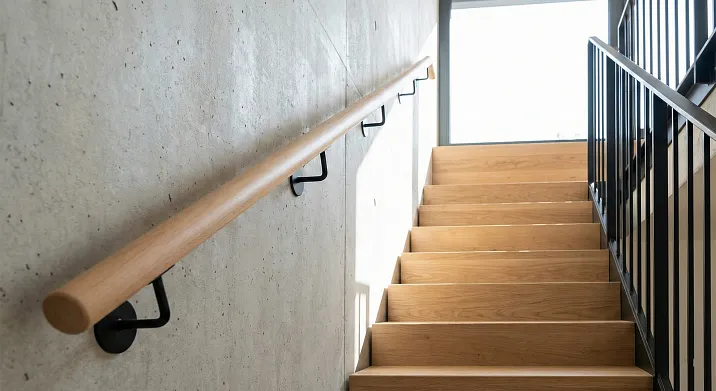
The world of modern interior design is undergoing a remarkable transformation, where the naturalness of materials meets the graphic clarity of forms. In 2026, one of the most striking trends is the combination of light wood with contrasting black details, which turns ordinary functional elements into true works of art. Preciselyround handrails made of beechwhen paired with black metal brackets, embodies this philosophy — they unite the warmth of natural material with the rigor of industrial accents, creating a balance that captivates at first glance.
Imagine a staircase where every detail is thought out to the smallest detail: the smooth surface of the birch handrail, polished to a silky texture, gleams in the rays of natural light, highlighting the noble structure of the wood. And the black metal brackets, like graphic strokes on a light canvas, add depth and expressiveness to the composition. This is not just a staircase — it’s an architectural accent that sets the tone for the entire space. Why birch? Why black metal? And how does this combination win the hearts of designers and homeowners around the world? Let’s dive into the details of this trend that defines the look of modern interiors.



Philosophy of Contrast: Why Light Wood and Black Metal Are the Perfect Pair
Contrast is the foundation of visual perception. When the light tone of birch is juxtaposed with the deep matte black of metal, an effect emerges that simultaneously soothes and stimulates attention. Light wood creates a sense of airiness, expands space, and fills it with warmth. Black details, on the other hand, structure the composition, add clarity to lines, and emphasize architectural logic. This play of opposites — not by chance, but the result of decades of designers’ search to create interiors that are both cozy and contemporary.
In 2026, the trend forlightwood specieshas reached its peak. Birch, with its delicate pink-beige tone and fine-grained texture, has become a favorite material for making handrails and other wooden elements. Unlike oak, which has a darker, more saturated color, birch offers lightness and freshness that fit perfectly into the concept of Scandinavian minimalism, eco-style, and modern neoclassicism. And black metal brackets — this is precisely the addition that transforms the natural beauty of wood into a designer statement.
Why black metal? The answer lies in its universality and expressiveness. The black color does not distract attention, does not compete with the wood’s texture, yet creates a powerful visual anchor. The matte powder coating of black brackets does not reflect light, making them ideal for creating a calm, balanced atmosphere. At the same time, black metal is associated with strength, reliability, industrial chic — qualities that give interiors character and modernity.




Round Birch Handrails: Beauty Born from Nature
Birch is a wood that has been used for centuries in furniture manufacturing and construction due to its unique properties. The density of birch is 650–700 kg/m³, making it sufficiently hard to withstand heavy loads, yet not excessively heavy. Its hardness on the Brinell scale is approximately 3.4–3.8, ensuring resistance to wear and mechanical damage. These characteristics makeround handrails made of beechnot only beautiful but also practical staircase elements.
One of the main advantages of birch is its light, warm tone, which does not yellow over time, unlike some coniferous species. The natural color of birch wood ranges from pale pink to soft beige with a slight peach undertone. This palette fits perfectly into modern interiors where naturalness and restraint are valued. Birch’s fine-grained texture creates a uniform, smooth surface that is pleasant to the touch — a quality especially important for handrails, which are used daily by all family members.
The round handrail with a 50 mm diameter is an ergonomic standard. This diameter allows the palm to naturally grip the handrail, ensuring a secure hold and a sense of safety when ascending or descending stairs. The smooth, polished surface has no sharp edges, making the handrails safe even for children and elderly people. At the same time, the round shape emphasizes the organic nature of the wood, its natural flow, and the softness of its lines.
The process of manufacturing high-qualitybeech handrailsincludes several stages. First, the wood is carefully dried to a moisture content of 8–10%, preventing further deformation and cracking. Then, the blanks are processed on turning lathes, where they are given an ideally round shape. After that, the surface is sanded in several stages — from coarse to final sanding, which makes the wood silky smooth. The final stage — coating with natural oils or waxes, which highlight the texture, protect the wood from moisture and dirt, while preserving the tactile pleasantness of the surface.
Our factory also produces:


Black metal brackets: function and aesthetics
If beech handrails are the soul of the staircase, then metal brackets are its skeleton. Brackets provide secure attachment of the handrail to the wall or balusters, while also serving an important decorative function. In 2026, black brackets are particularly popular,Decorative bracketsblack, which create a striking contrast with the light wood.
Black metal brackets are made of steel or cast iron and coated with powder paint, which ensures resistance to corrosion, scratches, and fading. Matte finish is the most popular solution, as it does not create glare and looks noble and restrained. Bracket sizes vary depending on the staircase construction, but the standard height is 150–200 mm, ensuring sufficient strength while preserving the elegance of the shape.
Bracket design can be minimalist — simple rectangular or angular shapes, or more decorative — with wrought iron elements, geometric patterns, or curved lines. For modern interiors, minimalist shapes are preferred, as they do not overload the space and emphasize clean lines. For classic or eclectic styles, brackets with ornaments are suitable, adding elegance to the interior.
Installing brackets requires precision and professionalism. The distance between brackets is usually 800–1000 mm, ensuring even load distribution and preventing handrail sagging. Mounting is done using anchor bolts with a diameter of 8–10 mm, which securely fix the bracket to concrete, brick, or wooden walls. It is important that all brackets are installed at the same height and strictly vertically — this is achieved using a laser level and marking.
Get Consultation
Technical specifications and safety standards
Consider ceiling height, room size, interior style, and functionality.round beech handrailsWhen installing handrails with metal brackets, it is important to consider not only aesthetic but also technical parameters and safety requirements. According to building codes, the height of the handrail should be 900–950 mm from the stair level. This is the optimal height ensuring comfort and safety for people of different heights. For children’s facilities, an additional handrail at a height of 500–600 mm may be required.
The load-bearing capacity is a critical parameter. A quality beech handrail with a 50 mm diameter withstands a load of up to 150 kg per linear meter when properly installed. Metal brackets must be designed to withstand a load of at least 200 kg each, providing a multiple safety margin. This is especially important for multi-child families, public buildings, and any high-traffic areas.
Load capacity is a critically important parameter. A high-quality wooden handrail with a 50 mm diameter can withstand a load of up to 150 kg per linear meter when properly installed. Metal brackets must be designed to handle a load of at least 200 kg each, providing multiple times the required strength. This is especially important for multi-child families, public buildings, and any areas with high foot traffic.
Coating wood with oil or wax not only highlights the beauty of the texture but also performs a protective function. Natural oils penetrate deeply into the wood structure, protecting it from moisture, dirt, and mechanical damage. At the same time, they do not form a film on the surface, preserving the wood’s ability to “breathe” and pleasant tactile sensations. Wax coatings add an additional layer of protection and give the surface a slight silky sheen.
Color solutions and combinations: from nuances to drama
Combining light beech with black metal is a classic contrast that can be varied depending on the overall interior concept. The natural color of beech without tinting creates a soft, warm atmosphere, ideal for Scandinavian interiors where naturalness and restraint are valued. For a more dramatic effect, beech can be slightly tinted, adding gray or cool tones that enhance the contrast with black brackets.
In interiors with a light color palette — white walls, light floors, minimal decor — beech handrails with black brackets become the main accent, drawing attention. The black color of the metal creates graphic lines that structure the space, giving it clarity and modernity. This solution is especially effective in small rooms, where light tones visually expand the space, while dark accents add depth.
For warmer interiors, where beige, cream, or sandy tones dominate, the combination of light beech and black metal creates a pleasant contrast without excessive sharpness. Here, black does not appear aggressive but rather elegant and restrained. This palette can be complemented byblack furniture handleson cabinets and doors, creating a unified stylistic line throughout the house.
In industrial-style interiors, where brick walls, concrete surfaces, and metal structures are present, light beech handrails soften the harshness of the environment, adding warmth and coziness. Black metal brackets, on the contrary, emphasize the industrial character of the space, harmoniously fitting into the overall concept. This balance between brutality and comfort is what makes loft interiors so appealing.
Stylistic directions: from Scandinavian to neoclassicism
Round beech handrails with black metal brackets — a universal solution that can be adapted to various stylistic directions. Let’s examine how this combination works in different contexts.
Scandinavian style. Here, light wood is the foundation of the foundation. Beech handrails fit perfectly into the concept of Scandinavian minimalism, where naturalness, simplicity of forms, and light color palette are valued. Black brackets add the necessary contrast without disrupting the overall harmony. Minimalist bracket shapes without excessive decoration, matte surface, clean lines — all this emphasizes Scandinavian aesthetics of functionality and beauty.
Loft. In industrial interiors, the combination of wood and metal is almost a mandatory condition. Light beech softens the harshness of the environment, while black metal elements enhance the industrial character. Here, more substantial brackets are appropriate, possibly with elements of raw metal or visible rivets, adding authenticity. The composition can be complemented bydecorative brackets for shelvesof the same black color, creating a unified system of elements.
Modern neoclassicism. This style combines classical proportions with modern materials and forms. Beech handrails can be complemented with brackets featuring elegant curves reminiscent of classical wrought iron, but executed in a modern minimalist style. The black color of the metal adds strictness and elegance, highlighting the nobility of light wood. In such interiors, symmetry and balance are important, so brackets must be placed with perfect precision.
Eco-style. Here, the emphasis on natural materials takes center stage. Untinted beech handrails with the most natural texture, coated with natural oil, embody the philosophy of eco-design. Black metal brackets can be made from recycled metal or have a simple, functional shape. It is important that all elements are environmentally safe and durable.
Furniture handles: continuation of the theme
The idea of combining light wood with black details is not limited only to staircases. A logical continuation is the use ofblack furniture handleson facades of light wood — beech, ash, maple. This creates a stylistic unity throughout the entire interior, when the staircase, furniture, and other elements are linked by a common design concept.
Furniture Handlesblack in color can have various shapes — from simple straight or curved bars to complex geometric forms. Materials — matte black metal, black ceramic, black wood with metal inserts. The main thing is to maintain the overall style and color palette. If the staircase brackets have a matte powder coating, then the furniture handles should also have a similar texture.
Why does this work? Repetition of color and texture motifs creates visual connection between different interior elements. When the eye catches these recurring accents — black brackets on the staircase, black handles on cabinets, black frames on mirrors — there is a sense of thoughtfulness and coherence in the space. This is a sign of professional design, where every detail is in its place.
Decorative brackets for shelves: multifunctionality
If the staircase with beech handrails and black brackets has already become part of the interior, it is logical to continue this theme by usingDecorative brackets for shelvesthe same design. Wall shelves on black metal brackets with light beech wooden tops create functional and beautiful storage elements.
Such shelves can be placed in the hallway next to the staircase, creating a unified composition. Items such as decorative objects, books, plants can be placed on them — everything that emphasizes the style of the home. It is possible to create a system of shelves of different lengths and heights, which will serve as an open shelving unit. Black brackets will ensure secure mounting, while light wood will add warmth and coziness.
In the living room, shelves on black brackets can serve as a base for a home library or a display case for collectibles. In the kitchen — for storing dishes, spices, cookbooks. In the bedroom — for decoration, photos, plants. The universality of this solution lies in the fact that it is both practical and aesthetic, functional and decorative.
Handrail installation: technology and nuances
Correct installationround beech handrailson metal brackets — this is a guarantee of safety and durability of the structure. The process includes several stages, each requiring attention and precision.
Stage 1: Marking. Using a laser level, the height of the handrail installation is determined — standard 900–950 mm from the edge of the step. A horizontal line is drawn along the entire length of the staircase, which will serve as a reference for installing brackets. Then, mounting points for brackets are marked at intervals of 800–1000 mm.
Stage 2: Preparing holes. Holes are drilled in the wall for anchor bolts. For concrete or brick walls, a drill with a 10 mm drill bit is used. The hole depth should be 10–15 mm deeper than the anchor length. In wooden walls, screws of the appropriate diameter can be used.
Stage 3: Installing brackets. Brackets are placed against the wall, aligned with marked points. Anchor bolts are inserted through holes in the brackets and tightened. It is important to check the verticality of the brackets using a level. All brackets must be installed strictly vertically and at the same height.
Stage 4: Installing the handrail. A round beech handrail is inserted into the sockets or grooves of the brackets. Depending on the bracket design, the handrail may be secured with screws from below (hidden mounting) or special wedges. It is important that the handrail fits tightly into the bracket and has no play. At the joints of two handrail sections, connecting couplings are used.
Stage 5: Final finishing. After installation, all fasteners are checked for reliability. If minor scratches or scuffs appear on the handrail surface during installation, they can be removed with light sanding and reapplication of oil. All metal parts are wiped clean of dust and fingerprints.
Care and maintenance: preserving beauty for years
One of the advantages of combining beech and metal is ease of maintenance. Both materials are low-maintenance and require minimal care with proper use.
Care for beech handrails. Regular cleaning with a damp cloth removes dust and surface dirt. It is not recommended to use aggressive cleaning agents or abrasive sponges, which may damage the oil finish. It is recommended to renew the protective coating every quarter by applying a thin layer of natural wood oil. The oil is applied with a soft cloth, rubbed in circular motions, and excess is wiped off. After drying (usually 12–24 hours), the surface regains a refreshed appearance and additional protection.
Seasonal maintenance. It is recommended to conduct a thorough inspection of the entire structure once a year. The reliability of bracket mounting to the wall, absence of handrail play, and condition of the finish are checked. Bolts are tightened as needed, and the wood oil coating is renewed. These are simple measures that ensure the longevity and safety of the staircase for decades.
Seasonal maintenance. It is recommended to conduct a thorough inspection of the entire structure once a year. The reliability of bracket mounting to the wall, absence of handrail play, and condition of the finish are checked. Bolts are tightened as needed, and the wooden surface is re-oiled. These are simple measures that ensure the ladder’s longevity and safety for decades.
Advantages over alternative solutions
Why chooseround handrails made of beechwith black metal brackets, rather than other options? Let’s compare with the most popular alternatives.
Oak handrails. Oak is a noble and strong wood, but it has a darker tone and more pronounced texture. For modern light interiors, oak may appear too heavy. Beech is lighter, softer, and better fits the concept of Scandinavian minimalism. At the same time, beech is only slightly less strong than oak, which is practically imperceptible for everyday use.
Metal handrails. Fully metal handrails made of stainless steel or chrome metal are practical and durable, but feel cold to the touch, especially in winter. Wooden handrails are always warm and pleasant to the hand, which is especially important for daily comfort. Moreover, metal does not create a sense of coziness and home warmth.
Handrails made of PVC or composite materials. Artificial materials are inexpensive and low-maintenance, but cannot compare with natural wood in aesthetics and tactile sensation. Solid beech — this is a living material with a unique texture that ages gracefully, acquiring character. Artificial materials over time look worn and cheap.
Chrome brackets. Chrome shines, which may be appropriate for ultra-modern interiors, but for most homes it is excessive. Matte black brackets are more versatile, restrained, noble. They do not produce glare, do not require frequent polishing, and are resistant to fingerprints.
Real projects: inspiration and examples
Let’s consider several examples of how the combination of light beech handrails and black metal brackets is implemented in real interiors.
Project 1: Townhouse in Scandinavian style. In a two-story townhouse, the staircase to the second floor became the central element of the living room. White walls, light laminate, minimal furniture — typical Scandinavian interior. The staircase is made of light wood with maple steps and beech handrails. Simple geometric black metal brackets create a graphic contrast. Along the wall, shelves made of the same beech are mounted on black brackets — on them are books, plants in white pots, and several decorative items. The entire composition looks light, airy, and modern.
Project 2: Loft apartment in an old building. High ceilings, brick walls, open floor plan — typical urban loft. The metal staircase to the second level is complemented by beech handrails, which soften the industrial rigidity. Massive black brackets with visible rivets emphasize the industrial character of the space. In the kitchen — light wood cabinetry withblack furniture handles, which echo the staircase brackets.
Project 3: Eco-style country house. A large wooden house with panoramic windows, surrounded by forest. The interior is made exclusively of natural materials — wood, stone, textile. The staircase to the second floor — a massive structure with beech handrails and black wrought iron brackets handmade. Simple forms, minimal decor, emphasis on material quality and craftsmanship. The handrails are coated with natural oil containing beeswax, highlighting the eco-friendliness of the project.
Trends 2026: What designers say
According to international design exhibitions and publications in leading architectural journals, the trend of combining light wood with black accents will dominate in 2026. Designers note several reasons for this phenomenon.
First, growing interest in eco-friendly and natural materials. Consumers increasingly value authenticity, durability, and connection to nature. Solid wood embodies these values. Second, the desire for minimalism and functionality. Modern people are tired of excess and chaos; they seek clean lines, order, and calm. Light wood with black accents — this is visual simplicity that does not overload space.
Third, versatility. This combination suits various styles — from Scandinavian to neoclassical, from loft to eco. This allows creating interiors that won’t go out of fashion in a few years, but will remain relevant for decades. Fourth, accessibility. Beech is relatively inexpensive wood, especially compared to exotic species. Powder-coated metal brackets also require minimal investment. This makes the trend accessible to a wide range of consumers.
When choosing quality wooden and metal brackets, it is important to pay attention to several key points.
When purchasinground beech handrailsWhen installing wooden and metal brackets, it is important to pay attention to several key points.
Wood quality. Beech should be grade A — free of knots, cracks, resin pockets. Wood moisture content — no more than 10%, preventing further deformation. The surface should be perfectly smooth, without roughness or burrs. Color — uniform, without dark spots or unnatural tones.
Finish. Natural oils and waxes are preferred, as they highlight the wood texture and preserve its tactile appeal. Lacquered finishes create a film that may crack and peel over time. Oil penetrates deep into the wood, providing long-term protection.
Metal brackets. Pay attention to metal thickness (at least 3 mm for steel), quality of powder coating (even, without streaks or pooling), reliability of fasteners (presence of all necessary holes and threads). Brackets must be rated for appropriate load — at least 150–200 kg per unit.
Geometry. A round handrail must have a perfectly round cross-section along its entire length, without ovality or conicity. Metal brackets must have precise dimensions and angles to ensure proper handrail mounting.
Company STAVROS: a reliable partner in interior design
When selecting quality wooden items for your home, it is important to trust proven manufacturers. Company STAVROS — more than half a century of experience working with solid wood, deep understanding of the material, and modern production technologies. STAVROS offers a full range ofround beech handrails, furniture handles, decorative bracketsand other elements for creating harmonious interiors.
Each STAVROS item undergoes strict quality control at every stage of production — from wood selection to final finishing. The company uses only eco-friendly materials and modern processing technologies, guaranteeing product longevity and safety. STAVROS offers an individual approach to each client: the ability to order items to custom sizes, professional consultations on selection and installation, delivery throughout Russia.
Choosing STAVROS products means choosing quality proven over time, and confidence that your home will be filled with the beauty of natural wood for many years. STAVROS — it is not just a manufacturer, but a partner in creating your dream interior, where every detail is thought out and executed with love for craftsmanship.
Frequently asked questions
Can round beech handrails be painted in another color?
Technically, this is possible, but not recommended. The light natural tone of beech is one of the main advantages of this material. Painting will hide the beautiful wood texture. If you need a dark color, better choose handrails from dark wood (oak, wenge) or use tinting oils that change the tone while preserving the visibility of the texture.
Are beech handrails suitable for outdoor staircases?
For outdoor use, choose wood more resistant to moisture and temperature fluctuations — oak, larch, or exotic species. Beech is hygroscopic and may deform under intense moisture exposure. For indoor spaces with normal humidity, beech is an ideal choice.
What diameter handrail to choose for a child’s staircase?
Standard 50 mm suits children over 5–6 years old. For toddlers, you can install an additional handrail of smaller diameter (35–40 mm) at a height of 500–600 mm. This ensures safety and comfort for children.
How much do round beech handrails with installation cost?
Cost depends on length, wood quality, and region. On average, a linear meter of beech handrail costs from 2000 to 4000 rubles. Metal brackets — from 500 to 1500 rubles per unit. Professional installation — from 3000 to 5000 rubles per 3-meter span. Exact prices should be confirmed with manufacturers and contractors.
Can handrails be installed by oneself?
Yes, if you have basic skills with tools and follow the technology. The main thing — accurate marking, correct drilling of holes, secure bracket mounting. If you lack experience, it is better to entrust the work to professionals to avoid errors that may affect safety.
How often should oil finish be renewed?
At moderate use — every 3–6 months. In high-use areas (e.g., in large families or offices) — every 2–3 months. The process is simple: clean the surface, apply oil in a thin layer, let it absorb, remove excess.
Are black metal brackets safe for children?
Yes, if installed correctly. Brackets should not have sharp angles or protruding elements. All mounting bolts must be recessed or covered with decorative caps. Modern brackets are designed with safety requirements in mind.
Can the letter be combined with metals other than black?
Yes, but black is the most versatile and trending color for 2026. Alternatives include matte bronze, black copper, and graphite metallic. Avoid chrome and polished metals—they create glare and do not harmonize well with natural wood.
How to care for handrails during winter in low humidity?
In winter, when heating is on and the air is dry, wood may lose moisture. It is recommended to use humidifiers to maintain humidity at 40–60%. Apply oil to handrails more frequently—this will prevent wood from drying out and cracking.
What other interior elements can be done in the same style?
Will work wellblack furniture handleson light facades,Decorative brackets for shelves, round balusters from light wooddoor handles, lamps with black shades or bases, mirror and picture frames. The key is to maintain balance and not overload the interior.


