












































































Article Contents:
- When a joint is needed on a straight wall
- Standard plank length and real walls
- Three types of situations requiring joining
- Why think about the joint at all — isn't it always visible?
- Method 1: butt joint of wooden skirting boards (90°)
- What it is and when it is used
- Rules for the butt method: how to make it invisible
- Typical mistakes when butt joining
- Method 2: 45° connection — the most invisible option
- Geometric principle: why 45° works better
- Miter joint technology: step by step
- Angle accuracy: a critically important parameter
- Miter joint on a profiled skirting board: additional complexity
- How to fit planks in length without a gap
- The tool decides everything
- Length fitting method: from corner to joint
- The "copying" method for complex relief
- Putty and filling gaps in the joint: what to use
- Three products and their differences
- Algorithm for choosing filler for the joint
- Rules for applying putty to the joint
- Factory length and spliced skirting board: an alternative to the joint
- What is a spliced skirting board
- When a spliced skirting board solves the wall joint problem
- How to order a skirting board of non-standard length from the manufacturer
- Features of joining wide wooden skirting boards
- Why a wide profile requires special attention at the joint
- Step in the joint: how to eliminate it
- Nuances of joining in a wooden house
- House shrinkage and joint opening
- FAQ: answers to common questions about wooden baseboard joints
- About the Company STAVROS

A wall six meters long. Baseboard strips are two and a half meters each. So, a joint is unavoidable. This is the arithmetic that ninety percent of craftsmen face when installing wooden baseboards. And this is where the questions begin that aren't answered in the store: how to join wooden baseboards so the seam isn't conspicuous? So that in a year it doesn't open up, swell, or form a step?
Wooden baseboard joints— a topic rarely covered in detail, although it's precisely at the joints that the results of the most careful installation fail. A proper joint is practically invisible — it's jewelry work with wood that requires understanding geometry, material behavior, tools, and finishing.
This article provides an exhaustive professional breakdown: from the question 'why is a joint needed at all' to 'how to mask what will still be visible'. Each method — with technological precision, mistakes beginners make, and techniques professionals use. Plus — a section about factory-fused solutions that bypass the joint problem entirely.


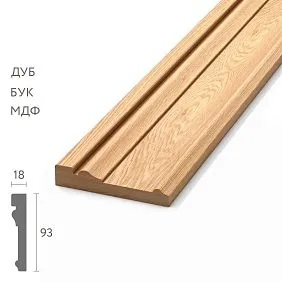


When a joint is needed on a straight wall




Standard strip length and real walls
The standard length of a wooden baseboard strip is 2.5 meters. This is an industrial standard dictated by kiln drying technology, storage, and transportation of long products. Some manufacturers offer 3 meters, rare ones — 4–5 meters on order. But in mass retail: 2.5 m.
The actual length of walls in apartments and houses — from 3 to 8–10 meters. Walls longer than 2.5 meters require at least onejoint of wooden baseboards. This is a standard installation practice, not a mistake. The task is to make the joint unnoticeable.
Our factory also produces:
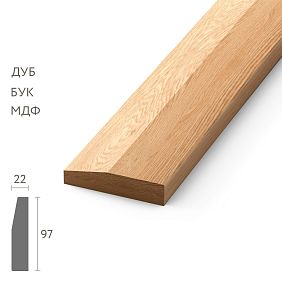

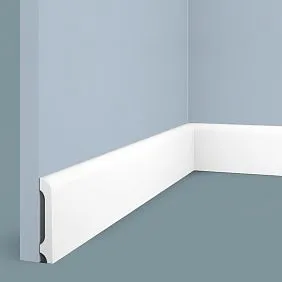
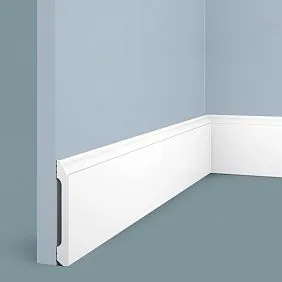
Three types of situations requiring joining
Situation 1: Wall longer than the strip. The most common case. A 4 m wall — needs two strips (2.5 + 1.5 m = 4 m) with one joint. A 7 m wall — three strips with two joints.
Situation 2: Obstacle on the wall. A door jamb, pipes, a built-in cabinet break a straight wall into sections. Each section is a separate baseboard piece. Joining is only unnecessary if each section is less than 2.5 m.
Situation 3: Defect or trimming. When cutting a corner inaccurately, the remaining scrap piece of baseboard can be used on an adjacent wall with an extension — and then a joint with a new strip is needed.
Get Consultation
Why even think about the joint — isn't it always visible?
Many installers will say: 'It will be visible anyway — why bother.' This is a false position. A properly executedjoint of a wooden baseboardwith proper lighting and finish — is practically invisible. An ordinary observer not specifically looking for it won't notice it. That's the goal.
A bad joint — a 'step' between strips in height or plane, a visible gap, a visible glue trace — is a defect that stands out in oblique light, with floor lighting on, and generally under any grazing light beam.
Method 1: butt joint of wooden baseboards (90°)
What it is and when it's used
Joining at a right angle (butt joint, 90°) — the simplest method. The end of one strip is cut exactly at 90°, the end of the other strip — also. The strips are brought end to end, forming a straight line.
This is the fastest method. But it has a fundamental problem: the end gap. Wood changes size along the grain over time (slightly, but noticeably with humidity fluctuations). If both strips 'shrink' by at least 0.5 mm each — the gap in the joint will be 1 mm. That's enough for the joint to become noticeable as a line.
When painted with white enamel — a white joint on a white baseboard: the seam is unnoticeable. With a transparent finish (oil, varnish) — a dark crack between strips on the light texture of oak is very noticeable.
When the butt method is used:
-
The baseboard will be painted with opaque enamel (the joint is covered with paint and putty)
-
The house is 'old', the wood has stabilized, there's no shrinkage
-
Room with constant humidity and temperature (minimal material fluctuations)
-
Installation in budget option, fast
When NOT to use:
-
Transparent coating (oil, varnish): the seam will be visible
-
New wooden house with shrinkage: the joint will open up
-
High-art interior: butt joint is considered a "cheap" solution by professional installers
Rules for the butt joint method: how to make it invisible
If the butt joint method is the chosen option, here's how to minimize its visibility:
Rule 1: Perfect 90° on both ends. A miter saw (or quality miter box) is mandatory. Hand sawing and square - only acceptable with a perfect hand. A deviation of even 0.5° on a 100 mm high baseboard gives a 0.9 mm gap at one of the edges - noticeable.
Rule 2: Joint - above the fastening point. The joint location must be fixed. A nail or screw is driven closer to the end of each plank (10-15 mm from the end), pressing both ends against the wall. If the ends "move" - the joint opens up over time.
Rule 3: Ends - with glue or without. A controversial issue in the professional community. Some craftsmen do not glue the ends: when wood shrinks, the glue joint can cause a "stress" crack worse than just a gap. Others - apply finishing PVA glue to the ends before joining. Compromise: glue on ends is acceptable in a stable (old) house with constant conditions, without glue - in a wooden house with seasonal fluctuations.
Rule 4: Use wood filler, not sealant. After installation, fill the joint with wood filler in a matching tone. Sealant is elastic, which can cause the joint boundary to slightly 'shift' as it dries and may remain visible. Wood filler hardens, can be sanded, and painted—making the joint disappear.
Typical mistakes when butt joining
-
Using a hand saw end cut without a guide: crooked end, uneven seam
-
Installation without fasteners near the end: planks "separate" over time
-
Filling the joint with silicone: silicone cannot be painted and leaves a visible line.
-
"Fitting" with a wooden block: attempting to "tap" the baseboard to the end with hammer blows through a wooden spacer - splits the fiber at the end, ragged seam
Method 2: 45° joint - the most invisible option
Geometric principle: why 45° works better
Joining wooden baseboards at 45°- "mitered" joint or "miter joint" - this is an option where both ends are cut not at 90°, but at 45°. One end - "plus 45°", the other - "minus 45°" - they overlap each other, forming a diagonal seam.
Why does this work better than a straight butt joint?
Firstly: contact area is larger. The cut area at 45° on a 100 mm high plank is 141 mm (hypotenuse of a right triangle). The cut area at 90° is 100 mm. Larger area - more stable seam, holds glue better, less prone to opening.
Secondly: shrinkage gap "hides". If the wood shrinks slightly and a micro-gap appears between planks - with a straight butt joint it forms a vertical dark line crossing the entire profile. With a mitered joint - the gap is diagonal, it is less noticeable in "normal" lighting, "reads" only with a strictly frontal view.
Thirdly: visual logic. A diagonal seam on a baseboard is familiar to the eye, subconsciously perceived as a "corner element", not as a defect. Our eye "doesn't look for" irregularities in a diagonal - it looks for straight vertical lines.
Mitered joint technology: step by step
Step 1: Determine the joint location
Joint location - above the fastening point (nail, screw, dowel). The joint should not be in the place of baseboard "sag" between fastening points. Best location - approximately in the center between two fastening points, each end is attached with its own fastener.
Avoid joints in plain sight: not in the middle of the wall in the area where the main gaze falls. If the wall is 5 m - do not make the joint in the center (2.5 m from the corner): this is exactly the place people look at. Better - offset joint: 1.8 m from the corner and 3.2 m - or behind furniture, behind a doorway.
Step 2: First plank - cut angle +45°
The first plank is placed from the corner. Its far end is cut at a 45° angle so that the long end of the cut is on the front side. When looking at the front plane of the baseboard, the cut slopes 'away from you' towards the continuation of the installation.
Step 3: The second plank — cut angle -45°
The second plank starts from the joint. Its near end is cut at a 45° angle mirrored — the long end of the cut is again on the front side. Both planks form a 'lock' — the end of one overlaps the end of the other.
Step 4: Dry fitting without glue
Place both planks against the wall in their working position — check the seam. With a perfect 45° angle, the seam should be tight along the entire line. If there is a gap at one edge — it means the angle is slightly off from 45°: lightly sand the end with fine P120 sandpaper on a flat surface to eliminate the deviation.
Step 5: Glue on the joint and installation
Before installation: apply a thin layer of wood glue (carpenter's PVA or casein) — on the diagonal surface of one end. Install the first plank, then the second — the diagonal end of the second 'enters' the diagonal end of the first. Press together, immediately wipe away any squeezed-out glue with a damp cloth. Fastening near each end — 10–15 mm from the edge of the plank.
Angle accuracy: a critically important parameter
On a straight wall, the floor angle is 0°. Both planks are horizontal. The joint angle is strictly 45° to the horizontal. Any deviation = a gap.
Source of error: a miter saw with a worn fence or misaligned calibration. Check the saw angle on a scrap piece before cutting the working material. Ideal test: take two pieces of the same baseboard, both cut at 45°, put them together — they should form a perfectly straight line without steps.
Another source of error: the working surface of the miter box. A wooden miter box with deep cuts from years of use — 'guides' the saw inaccurately. A metal miter box or a miter saw with a clamp — is more accurate.
Miter joint on a profiled baseboard: additional complexity
Baseboard with a shaped profile (K-009, K-066 and other tall profilesSTAVROS K-series) — is more difficult to join than a flat one. A shaped profile has several planes, several levels of relief — and each level must align at the joint.
Key rule: both planks must be from the same batch, from the same production run. Baseboard with CNC milling (like STAVROS) — the profile is identical from plank to plank. Baseboard produced on outdated equipment — tolerances up to 0.5 mm, and the joint of two 'different' planks will have a step in the relief.
How to fit planks by length without a gap
The tool decides everything
The correct tool for fitting a wooden baseboard joint:
Miter saw — the optimal tool. Speed, accuracy up to 0.1–0.2°, ability to work with planks up to 100–120 mm high (standard saw) or up to 150–200 mm (sliding miter saw). Blade — finish blade for wood (60–80 teeth): clean cut without fuzz.
Miter box + handsaw — acceptable if no power tools are available. Requirement: saw blade with fine teeth, at least 20 teeth per inch. Coarse teeth give a ragged cut, especially on oak — will require cleaning.
Handsawing freehand — not suitable for a miter joint. The angle cannot be maintained with the required accuracy.
Length fitting method: from corner to joint
Professional plank fitting algorithm:
-
The first plank is cut from the corner (straight cut or 45° miter cut) — the length is intentionally left 'with a margin' of 20–30 mm.
-
The plank is placed against the wall, the joint location is marked with a pencil on the baseboard — exactly above the fastening point.
-
The plank is removed, cut at the mark at the required angle (90° or 45°).
-
The plank is returned to the wall — check that the end fits exactly in the right place, without tension and without a gap to the next wall or obstacle.
-
Installation.
Critically important: do not do steps 1–5 in reverse — do not place the plank at its final length at the joint location and then cut 'from the corner'. This way — more errors.
'Copying' method for complex relief
When joining profiled skirting boards with decorative relief, the 'copying' method helps with minor mismatches between two planks at the joint:
-
After installing the first plank, the end of the second is placed against the end of the first in the working position (with the required overlap or gap)
-
The profile of the first plank is 'copied' onto the second using a thin pencil
-
Refinement along the pencil line with a file or chisel: 'raise' or 'remove' individual relief elements for a perfect match
This is meticulous handwork. Takes 10–20 minutes per joint. But the result is a seam that is practically invisible under transparent coating.
Putty and gap filler for joints: what to use
Three products and their differences
After installation and fastening, even with a perfect joint, a minimal gap remains. It needs to be concealed. For this, there are three types of products:
Wood putty (acrylic or nitrocellulose) – hardens, can be sanded, painted, tinted. Ideal for joints when further painting is planned. Applied with a spatula, excess removed immediately, after drying – sanding with P180–P220. Matched to the wood tone or final color.
Disadvantage: does not hold well with significant wood movement. If the joint is in an actively 'breathing' house, the putty will crack within a year. For such cases – the next option.
Acrylic sealant – elastic, does not harden to brittleness, compensates for movement. Allows painting with acrylic paint after drying (24–48 hours). Not suitable for joints under transparent oil coating – under oil it shows a 'silvering' effect.
Wood wax pencil – for joints under transparent oil or varnish coating. Wax is matched to the wood tone. Fills the joint, avoids the 'gray tile' effect. Not sanded, not painted – only color masking. Less permanent than putty, but can be renewed in a minute.
Algorithm for selecting joint filler
| Skirting board coating | Wood type | Recommended filler |
|---|---|---|
| White enamel | Any | White acrylic putty |
| Colored enamel | Any | Putty matching RAL color |
| Oil / wax | Oak, beech | Wax pencil matching tone |
| Polyurethane varnish | Oak, beech | Wood putty before varnishing |
| In a wooden house (settling) | Any | Acrylic sealant |
Rules for applying putty to a joint
-
Before application – ensure the joint is assembled, the skirting is secured, and the adhesive in the joint is dry
-
A small amount of putty is applied with a finger or narrow spatula across the seam – pressing into the gap
-
Excess is removed immediately with a wet finger or spatula – clean surface without smears
-
Drying time 2–4 hours (acrylic) or 6–8 hours (nitro)
-
After drying – sanding with fine P220 sandpaper across the joint: removing the 'bulge'
-
Primer (if needed) → final painting / varnishing
Factory length and spliced skirting: an alternative to jointing
What is a spliced skirting
A spliced skirting is a product glued together from several short blanks along their length. This is not a defect or a 'cheap' option. It is a deliberate technology that allows obtaining a plank of non-standard length — from 3 to 6 meters — without a single visible seam on the front surface.
In a spliced skirting, the joints of the 'lamellas' are located inside the body of the product, at an angle (FingerJoint — 'finger joint'). The front surface is continuous. After milling and sanding — the connection point is practically indistinguishable on uniform wood species (beech), slightly more noticeable on textured ones (oak) with a transparent finish.
When a spliced skirting solves the wall joint problem
Wall 4–5 m: ordering a 4.5–5 m spliced skirting provides a continuous plank without a single installation joint. Price per linear meter — similar to or slightly higher than standard. Savings: no work on fitting the joint, no puttying, no risk of joint opening.
Transparent finish: if the skirting will be varnished or oiled — a spliced skirting without installation joints provides a perfect continuous surface. Important: visible internal FingerJoint seams on the front surface with an oil finish can sometimes be noticeable — check with the manufacturer for the specific option.
Wide profile: on a wide skirting (K-009, K-018) the installation joint is much more noticeable than on a narrow one. A spliced plank eliminates this risk.
How to order skirting of non-standard length from a manufacturer
Manufacturers of wooden moldings operating at a professional level accept orders for skirting of non-standard length.STAVROS— is one of the few companies offering not only the standard 2.5 m, but also custom manufacturing for a specific project subject to order volume.
Ordering algorithm: measure the lengths of all walls → specify the maximum wall length in the project to the manufacturer → order planks of the required length. Lead time — 2–4 weeks.
Features of joining wide wooden skirting
Why a wide profile requires special attention at the joint
Wide wooden floor skirtingwith a height of 120–150–200 mm — a different story compared to a 60–80 mm profile. The joint on a wide profile:
-
Larger joining area — longer seam line, greater visibility
-
Greater weight of the product — the plank does not 'flex' towards the wall, wall unevenness creates gaps along the entire height of the profile
-
More complex relief — misalignment of shaped elements is more noticeable
Specifically for wide skirting boards (K-009, K-018, K-066, K-104 K-series STAVROS) — the 45° jointing method is the only acceptable solution. A straight joint on a wide profile is a defect in professional execution.
Additional rule for wide skirting: fastening near the end — at least two points (screw from below + screw from above), otherwise the wide plank 'pulls away' from the wall at one edge of the end.
Step in the joint: how to eliminate
A step is when two planks in a joint do not lie in the same plane: one protrudes forward or backward relative to the other. The cause — wall unevenness or different plank thicknesses (manufacturing tolerance).
Elimination:
-
If the step is less than 0.5 mm — sand the joint along the plank with P120, then P180. We level the plane, the boundary disappears
-
If the step is 0.5–1.5 mm — place a thin shim (veneer, cardboard) under the thinner plank in the joint area: we level the plane mechanically
-
If the step is more than 1.5 mm — level the wall or reposition the fastening
Nuances of joining in a wooden house
House shrinkage and joint opening
In a wooden house with walls made of timber or logs — joining wooden skirting boards requires compensation for movement. Rules:
Rule 1: Only miter joint (45°). A butt joint in a wooden house with active shrinkage will open up after one season. A miter joint holds longer with the same wood movement.
Rule 2: Glue in the joint is questionable. In a house with active shrinkage (up to 3-5 years), glue in the joint can cause a 'stress' crack worse than just a gap. Without glue, the joint remains movable but tight due to fasteners near the ends.
Rule 3: Acrylic sealant for masking. After installation, the joint is filled with elastic acrylic sealant. It compensates for movement and doesn't crack. When wood expands and contracts, the sealant 'works' with it.
Rule 4: Joint location - behind furniture or near a doorway. In a wooden house, joints are best placed in 'non-prominent' areas: behind a sofa, cabinet, near a door jamb - where the joint is least noticeable.
FAQ: answers to popular questions about wooden baseboard joints
How to join a wooden baseboard end-to-end so there is no gap?
Perfect 90° on both ends (miter saw), fasteners at each end 10-15 mm from the edge, wood filler to match. When painted, the joint is invisible. With a transparent finish, it's better to use a 45° miter joint.
Why did the wooden baseboard joint open up after six months?
The wood released moisture during heating, shrinking in length. With a butt joint, the gap became visible. Solution: redo with a 45° miter joint + fill with acrylic sealant. Or: acclimate the baseboard before installation for 72 hours in the room's working conditions.
Can a wooden baseboard joint be sealed with silicone?
No. Silicone cannot be painted, and when dry, it leaves a 'gray' stripe on any color. Only acrylic sealant (can be painted with acrylic) or wood filler (can be sanded and painted completely).
How many joints are acceptable on one wall 6 m long?
With a standard length of 2.5 m - minimum 1 joint (planks 2.5 + 2.5 + 1 m) or 2 joints (2.5 + 2.5 + 1 m). Avoid a joint in the middle: arrange planks asymmetrically, place the joint behind furniture or closer to a corner.
Should wooden baseboard joints be filled with putty under oil finish?
Not with putty - acrylic putty under oil 'silvers' and doesn't accept oil. Use a wax crayon to match or an oil-based wood filler (specialized product).
What's better - a joint on the wall or a factory-spliced baseboard of greater length?
For transparent finish and high-art interiors - spliced baseboard longer than 2.5 m: no installation joints, surface is continuous. For painting - a wall joint with proper putty and painting is practically invisible, saves on ordering non-standard lengths.
About the company STAVROS
STAVROS K-series wooden moldingsis manufactured with a geometry tolerance of 0.2 mm per 2.5 meters of length. This is a production standard, critically important specifically for joints: when both planks have the same height with an accuracy of 0.2 mm - there is no step in the joint. When the profile is milled with CNC precision - the relief of two different planks of the same profile matches perfectly.
Over 30 K-series profiles: from K-034 (from 230 rub./lm) to K-104 (from 6,060 rub./lm). Solid beech and oak, chamber-dried 8-10%, sanded P180. For wet rooms -KPU-series polyurethane moldingwith the same classic profiles, absolute moisture resistance, and the ability to paint in any RAL.
Coordinated assortment:K-series casings, KZ-series cornices, Furniture legs, staircase components- everything from one series. Samples: 180 rub. per set. Warehouse in Moscow and St. Petersburg - same-day shipping. Delivery across Russia and CIS. Consultation: 8 (800) 555-46-75.
STAVROS - because an invisible joint starts with the precise geometry of each plank.


