Article Contents:
- Classic: luxury, symmetry, expressive relief
- Profile readability in classic style
- Heights and overhangs for classic interiors
- Line combinations in classic space
- Smooth shadows of classic decor
- Color palette of classic interior
- Texture in classic style
- Neoclassic: classic for modern space
- Profile readability in neoclassic style
- Heights and overhangs for neoclassic interiors
- Line combinations in neoclassic interior
- Balanced shadows of neoclassicism
- Color palette of neoclassicism
- Texture of neoclassic profiles
- Modern: organic lines and natural motifs
- Profile readability in modern style
- Heights and overhangs in modern style
- Line combinations in modern space
- Smooth, flowing shadows of modern style
- Color palette of modern style
- Texture of modern profiles
- Minimalism: geometry, function, silence
- Profile readability in minimalism
- Heights and overhangs in minimalism
- Line combinations in minimalist space
- Broken, sharp shadows of minimalism
- Color palette of minimalism
- Texture of minimalism
- Practical Examples of Profile Selection
- Example 1: Classic Living Room
- Example 2: Neoclassical Bedroom
- Example 3: Apartment in Modern Style
- Example 4: Minimalist Studio
- FAQ: Frequently Asked Questions about Styles and Profiles
- Benefits of Partnering with STAVROS and Hi Wood
- Conclusion
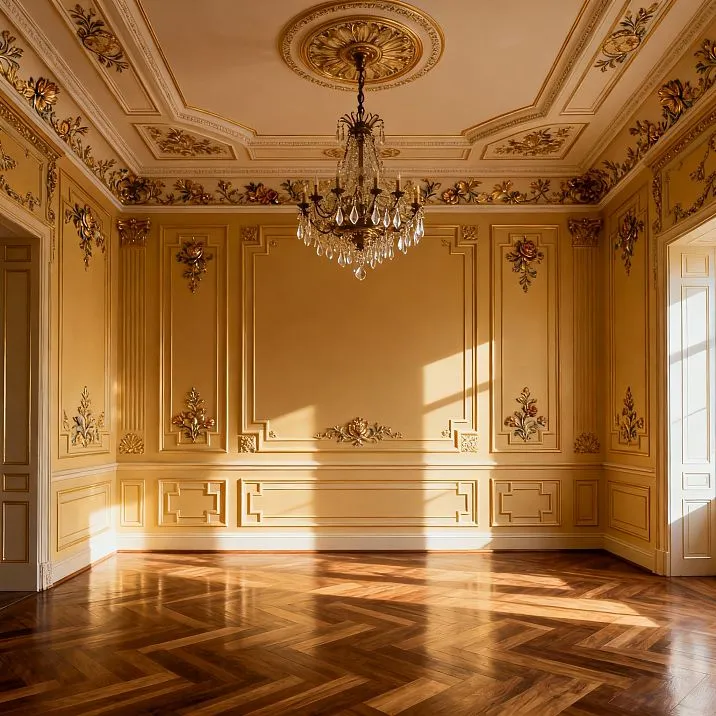
A decorative profile is not just a functional element masking joints. In the hands of a skilled designer, it becomes a powerful tool for expressing the stylistic concept of the interior. The same material — fitopolymer — can look completely different depending on the profile’s shape, size, relief character, and application method. Luxuriousclassic cornice made of fitopolymerwith rich moldings creates an atmosphere of palace grandeur, while a minimalistmodern molding made of fitopolymerstrict geometry emphasizes the modernity and functionality of the space.
STAVROS’s partner, Hi Wood manufacturer, produces decorative profiles for all major stylistic directions: from classic and neoclassic to modern and minimalism. Each collection is carefully developed according to the canons of the corresponding style, ensuring authenticity and visual accuracy of the interior.
In this article, we will thoroughly examine how decorative profiles are read in each style, what heights and overhangs are optimal, how line combinations work, what shadows create the desired atmosphere, what color palette and texture are characteristic of different directions. Residents of Moscow, the Moscow region, Saint Petersburg, and Leningrad region can receive professional consultations from STAVROS specialists on selecting decorative elements tailored to the specific stylistic concept of their interior.


Classic: Luxury, Symmetry, Expressive Relief
Classic style in interior design is the embodiment of the traditions of palace architecture of the 16th-18th centuries, where decorative elements play a key role in creating an atmosphere of luxury and grandeur.




Readability of the profile in classic style
In a classic interior, a decorative profile must be highly noticeable and expressive. It is not a modest element, but a full-fledged architectural detail that attracts attention with its ornate decoration.classic cornice made of fitopolymerIt has a multi-level structure with alternating protrusions and recesses, creating a deep play of light and shadow.
The relief of classic profiles includes traditional motifs: acanthus leaves, Ionic scrolls, rosettes, modillions, egg-shaped ovals, denticles. These elements trace back to ancient architecture and impart nobility and historical depth to the interior.
Important point: in classic style, decoration is not chaotic — it follows strict symmetry and rhythm. Ornaments repeat at equal intervals, creating an orderly structure. Profile readability is achieved through high relief (20–35 mm) and contrasting coloring — usually white against colored walls.
Our factory also produces:


Heights and overhangs for classic interiors
Classic style demands large-scale solutions. Minimum skirting board height — 120 mm, optimal — 140–180 mm. Cornices are even more expressive — 130–200 mm wide. Molding for wall panels — 80–120 mm. These are the maximum sizes in the decorative profile palette, corresponding to the grandeur of the style.
Overhang (projection from the wall) is also significant. Cornices project 80–150 mm, creating a powerful horizontal line under the ceiling. This is not only a decorative effect, but also a functional one — historically, such cornices supported ceiling beams. Modern fitopolymer profiles retain this visual logic, though they serve purely decorative purposes.
Profile thickness (relief height from surface) reaches 25–35 mm. This volume creates expressive shadows, especially under side natural lighting. The profile literally 'detaches' from the wall, becoming a volumetric architectural element.
Get Consultation
Line combinations in classic space
Classic interior is built on the principle of three horizontals: skirting board, horizontal molding at 2/3 wall height, ceiling cornice. These three lines structure the space vertically, creating a layered effect.
Horizontals are complemented by vertical elements: pilasters at corners and center of walls, vertical moldings framing panels. The intersection of horizontals and verticals forms rectangular panels — the basic unit of classic wall composition.
Important principle: all profiles must be from one collection with repeating decorative motifs. Acanthus leaf on cornice corresponds with a simplified version on skirting board, Ionic scroll repeats on moldings. This creates stylistic unity.
Smooth shadows of classic decor
The relief of classic profiles creates a complex system of shadows. Deep recesses between protruding elements produce rich dark shadows, while protruding parts catch light — creating a contrasting light-and-shadow modulation.
The character of shadows is smooth and flowing. Classic ornamentation lacks sharp edges—transitions are rounded, lines are fluid. Light glides over the rounded forms of acanthus leaves, softly fading into recesses between modules. This creates a sense of three-dimensional plasticity characteristic of hand-carved moldings.
Under artificial lighting, it is important to use not only overhead lighting but also side lighting—wall sconces, floor lamps. They highlight the relief of profiles, enlivening the decor through play of highlights and shadows.
Classic interior color palette
Traditional classic palette—white, cream, bone for decorative elements. These light tones contrast with more saturated wall colors: burgundy, emerald, sapphire, gold. This contrast emphasizes the architectural quality of the space.
Alternative approach—gilding. Decorative elements are coated with gold paint or gold leaf, creating a precious effect. This is characteristic of the Empire style—a late version of classicism with imperial grandeur. Hi Wood produces special profiles with complex relief specifically designed for gilding.
Patination is another technique. Gold or silver patina is applied to raised parts of the relief on white profiles. This emphasizes the depth of decoration, creating an effect of noble antiquity.
Texture in classic design
Texture of classic profiles—smooth, polished. After painting and light sanding, the surface should be perfectly flat, without roughness. This highlights the nobility of the material and the purity of lines.
Matte paints are preferable to glossy ones—they provide a soft, noble appearance without the cheap sheen of plastic. Satin paints (with a slight silk-like gloss) are a compromise, combining the elegance of matte surfaces with practicality—such a finish is easier to clean.
Neoclassicism: classicism for modern spaces
Neoclassical style is an adaptation of classical canons to the realities of modern life and typical apartments. The spirit of classicism is preserved, but its material embodiment is simplified and lightened.
Profile readability in neoclassical style
Neoclassical baseboard made of fitopolymerLess decorated than classic. Relief is present but more restrained. Instead of lush acanthus leaves—stylized plant motifs. Instead of complex multi-level structures—two- or three-tiered profiles with clear geometry.
Profile readability in neoclassicism is achieved not through abundance of decoration, but through proper proportions and purity of lines. Profiles have a distinct structure, but ornamentation does not dominate—it complements the form rather than overwhelming it.
Important distinction from classicism: asymmetry and non-standard solutions are permitted. While classicism demands strict symmetry, neoclassicism allows freer composition—for example, an accent wall with molding panels against otherwise smooth walls.
Heights and overhangs for neoclassical interiors
Dimensions are more moderate than in classicism. Baseboards 100–130 mm, cornices 90–130 mm, moldings 60–90 mm. This allows using neoclassicism in apartments with ceilings 2.6–2.8 m without risking overloading the space.
Profile overhangs are also more restrained: cornices project 50–90 mm, which is sufficient to create an architectural effect but does not create a sense of looming. Relief thickness 15–25 mm—profiles are voluminous but not bulky.
These dimensions are universal—they work in both small apartments and spacious rooms, adapting to the scale of the space. This is precisely why neoclassicism is so popular in modern interiors.
Line combinations in neoclassical interiors
Neoclassicism preserves the principle of horizontal zoning, but simplifies it. Baseboards and cornices are mandatory; horizontal moldings on walls are optional—used only with high ceilings (from 3 m) or for special design tasks.
Wall panels made of moldings are applied selectively—on one or two accent walls, not around the entire perimeter as in classicism. This lightens the interior, making it less formal.
Vertical elements are also used sparingly. Instead of pilasters at all corners—perhaps only framing a fireplace or door opening. Emphasis on horizontals; verticals serve as accents, not equal components.
Balanced shadows in neoclassicism
Light and shadow in neoclassicism are less contrasted than in classicism. Relief is not as deep, transitions are smoother—shadows are softer, without sharp contrasts. This creates a calm, balanced atmosphere.
Under artificial lighting, neoclassicism works well with diffused overhead lighting—chandeliers with shades, hidden LED lighting behind cornices. Such lighting does not create harsh shadows, highlighting the profile shapes without excessive drama.
Side lighting (sconces, floor lamps) is used selectively—to highlight specific zones, accent walls with panels. Overall lighting atmosphere is soft and comfortable for daily life.
Neoclassical color palette
Neoclassicism leans toward light neutral tones. White, cream, light gray, beige—basic palette for decorative elements. Walls are often painted in pastel shades: powder, mint, lavender, peach.
Color profiles are allowed - gray, beige, even pastel blue skirting boards and cornices. This is a modern approach that softens the formality of classical forms. It is important to maintain tonal unity - all profiles are of one color or similar shades.
Gilding is used rarely and sparingly - perhaps only on column capitals or central rosettes. Heavy classical gold is replaced by light silver or golden accents.
Texture of neoclassical profiles
Matte or satin texture is preferred. Gloss is undesirable - it cheapens the appearance, making profiles look like plastic. Matte latex paints create a noble velvety surface, emphasizing form without excessive shine.
Decor from phytopolymer for wallsIn neoclassical style, often painted in wall color, standing out only through volume. This creates a monochromatic composition where form is more important than color - a very modern approach.
Modern: organic lines and natural motifs
The modern style (art nouveau) emerged at the turn of the 19th-20th centuries as a contrast to eclecticism and historicism. Its main feature is the rejection of straight lines in favor of smooth, natural forms.
Readability of profiles in modern style
Profiles in the modern style have flowing, wavy lines, imitating plant forms. Instead of classical acanthus leaves - stylized irises, lilies, vines with long curved stems. The ornament is asymmetrical, creating a sense of movement and growth.
Readability is achieved through the contrast between the profile's curved lines and the geometry of space. A smooth cornice curve against a rectangular wall creates visual tension, drawing attention to detail.
Moderate-depth relief (15-20 mm) of modern profiles, but very expressive due to the complexity of lines. Each ornament element is carefully crafted, has an individual shape, and is not a mechanical repetition of a pattern.
Heights and overhangs in modern style
Modern style does not favor massiveness. Profile heights are moderate: skirting boards 90-120 mm, cornices 80-110 mm. It is not the mass, but the expressiveness of the line that matters. A slender, elegant profile with a complex pattern produces a greater impression than a bulky simple one.
Overhangs are also moderate - 40-70 mm for cornices. Profiles should not hang down; they should flow organically from the wall plane, continuing it rather than contrasting with it.
A characteristic feature of modern style is flexible, curved profiles for decorating arches, bay windows, and rounded corners. Straight lines are undesirable - space should "flow", smoothly transitioning from one zone to another.
Line combinations in modern space
Modern style avoids rigid geometry. Instead of rectangular molding panels - oval, elliptical, curved frames. Instead of strict verticals - curved lines that repeat the shape of plant stems.
The principle of asymmetry is more important than symmetry. A decorative element may be shifted from the center of the wall, creating a dynamic composition. Two walls may be decorated differently, without mirror repetition.
Profile combinations are built on repeating ornamental motifs. If irises are depicted on the cornice, the skirting board should have stylized leaves of the same plant. This creates thematic unity despite the variety of forms.
Smooth, flowing shadows of modern style
Lighting in modern style is soft and enveloping. Smooth relief lines create gradient shadows without sharp edges. Light glides over curved surfaces, creating a lively play of highlights.
Artificial lighting should emphasize the fluidity of forms. Ideal are modern-style lamps - with flower-shaped shades, stained-glass pendants. Their soft diffused light harmonizes with the smoothness of decorative profiles.
Hidden LED lighting behind cornices is especially effective in modern style - soft glow that flows along curved profile lines, enhancing the sense of fluidity and intangibility of forms.
Modern color palette
Modern style leans toward natural muted tones: olive, terracotta, smoky purple, ochre, turquoise. Decorative profiles are often painted not white, but in shades harmonizing with walls.
A characteristic technique is patination with green or brown patina, imitating bronze patina. This emphasizes the handcrafted, artistic nature of decoration. Also used is "wood finish" - profiles imitate carved wooden elements.
Gilding in modern style is used, but not bright imperial gold, but muted, matte, like antique gold. Often only individual ornament elements - stamens of flowers, leaf veins - are gilded.
Texture of modern profiles
Texture can be varied. A smooth matte surface emphasizes the purity of lines. But a light texture is also acceptable - imitation of carved wood, metal embossing. This adds a handcrafted, artistic quality to the profiles.
Hi Wood releases special collections in modern style with distinctive plant motifs and smooth lines. They allow recreating the Art Nouveau era atmosphere in a contemporary interior.
Minimalism: geometry, function, silence
Minimalism is the antithesis of classicism. Here, decoration is reduced to a minimum, the form is extremely laconic, and every element is functional. But this does not mean rejecting decorative profiles — they are present, but in a radically simplified form.
Profile readability in minimalism
modern molding made of fitopolymer- a rectangular or trapezoidal strip without decoration. No ornaments, reliefs, complex profiles. Only pure geometry: straight lines, sharp edges, precise angles.
Readability is achieved not through decoration, but through contrast: a light profile on a dark wall or vice versa. Or a profile in the wall color, standing out only due to the shadow from its volume. The form speaks for itself, without needing ornamental embellishment.
An important principle of minimalism: profiles should appear as part of the architecture, not as applied decoration. Ideally, when the skirting board is perceived as the completion of the wall, not as a separate element.
Heights and overhangs in minimalism
Profile sizes are moderate or even minimal. Skirting boards 60-100 mm — sufficient for function (covering gaps, protecting walls), but not visually dominant. Cornices 50-90 mm — create wall completion without excess.
Moldings are used rarely, and if used — at a minimal width of 20-40 mm. They function as thin graphic lines, separating zones or materials.
Profile overhangs are minimal — 15-30 mm. Profiles practically do not protrude; they are more integrated into the wall plane. This creates a sense of monolithic, unified space.
Relief thickness 8-15 mm — profiles are flat, almost two-dimensional. Their volume is perceived but does not dominate. The shadow from the profile is thin and delicate.
Line combinations in minimalist space
Minimalism avoids complex compositions. Usually, only skirting boards and cornices — two horizontals framing the wall from top and bottom — are used. Additional moldings are used extremely rarely, only for functional purposes — for example, separating two types of finishes.
Vertical profiles are not used at all. Verticals are created by architectural elements — wall corners, doorways, cabinets. Applied decoration is excessive.
If moldings are used to create wall panels, they are large rectangles without fragmentation. One or two large rectangles on the wall, not numerous small ones as in classicism.
Sharp, clear shadows of minimalism
Minimalist profiles create graphic, sharply defined shadows. This is not the smooth chiaroscuro modulation of classicism, but a sharp shadow line on the wall. A rectangular profile produces a rectangular shadow — simple, clear, and readable.
Under artificial lighting, the direction of light is important. Top lighting creates a horizontal shadow from the cornice on the wall. Bottom lighting — from the skirting board on the floor. These shadows become part of the space’s graphic composition.
Hidden LED backlighting behind minimalist profiles is especially effective. A thin line of light running along the cornice or skirting board creates a levitation effect, detaching the surface from its base. This emphasizes the lightness and weightlessness of minimalist space.
Minimalism’s color palette
Minimalism operates with a limited palette. Base colors: white, black, gray. Natural tones of wood, concrete, stone are permissible. Bright colors are used sparingly, as accents.
Profiles are usually white on light walls, black or dark gray on dark walls. The goal is to create a contour, structure, not a color accent. Alternatively — profiles in wall color, standing out only by volume. This creates a monochromatic composition where form is more important than color.
No gilding, patination, or decorative painting techniques are allowed. Only a uniform matte color across the entire profile surface. No gradients, transitions, effects.
Minimalism’s texture
Profile surfaces are ideally smooth, matte, or semi-matte. The surface after painting must be flawless — no drips, runs, brush marks. This requires careful preparation and quality paint.
A slight texture imitating concrete or stone is permissible — but this must be the material’s structure, not decorative relief. Hi Wood releases laconic rectangular-section profiles, ideally suited for minimalist interiors.
Practical examples of profile selection
Example 1: Classic living room
Room: 30 sq. m, ceiling height 3.2 m, style — classic.
Solution:classic cornice made of fitopolymerWidth 180 mm with moldings and acanthus leaves. Skirting board 160 mm with similar decoration. Horizontal molding 100 mm at 2/3 wall height. Vertical moldings 80 mm form panels on all walls.
Color: all profiles white against walls in "dusty rose" shade. Ceiling white with central rose 800 mm. Effect: majestic space with proper classical proportions.
Example 2: Neo-classical bedroom
Room: 18 sq. m, ceiling height 2.7 m, style - neoclassicism.
Solution:Neoclassical baseboard made of fitopolymerHeight 110 mm with light relief. Cornice 100 mm with moderate decoration. Panel of moldings 70 mm on wall behind bed headboard.
Color: profiles light gray, walls pearl gray, ceiling white. Effect: elegant modern space with classical references without excessive pomp.
Example 3: Apartment in modern style
Room: living-dining room 25 sq. m, ceiling height 2.8 m, style - modern.
Solution: cornice 110 mm with iris-style ornament. Skirting board 100 mm with botanical decoration. Arched opening between zones finished with flexible profile with same ornament.
Color: profiles bone-colored with light green patina, walls olive, ceiling cream. Effect: organic space with natural motifs and flowing forms.
Example 4: Minimalist studio
Room: studio 35 sq. m, ceiling height 2.6 m, style - minimalism.
Solution:modern molding made of fitopolymerSkirting board 80 mm rectangular section, cornice 70 mm. Molding 30 mm separates kitchen zone (tile) and living zone (paint).
Color: all profiles white on white walls. Only distinguished by shadow and hidden LED lighting behind cornice. Effect: clean, bright, airy space without visual clutter.
FAQ: Frequently Asked Questions about Styles and Profiles
Can profiles of different styles be mixed in one apartment?
Yes, but cautiously. Different styles are acceptable in different rooms, but mixing within one room creates stylistic chaos. Exception - eclecticism, where mixing is intentional but requires professional taste.
Are fitopolymer profiles suitable for modern styles?
Absolutely. Minimalism, contemporary, Scandinavian styles work perfectly with simple, geometric fitopolymer profiles. The material is universal — it all depends on the profile shape.
How to choose profiles if the style is not clearly defined?
Choose neoclassicism — it’s the most universal style, combining elegance with modernity. Moderate sizes and restrained decoration will fit most interiors.
Is it necessary to use profiles from one collection?
For classic and neoclassic styles — desirable, as it ensures stylistic unity. For minimalism — not critical, since profiles are simple and easy to combine. For modern — important to maintain unity of ornamental motif.
Which style is better for a small apartment?
Minimalism or neoclassicism. They don’t overload space and use moderate profile sizes. Classic style requires spaciousness — in small rooms it will appear heavy.
Can classical profiles be used in an apartment with low ceilings?
Not recommended. Heavy classical profiles visually lower the ceiling. For ceilings below 2.7 m, choose neoclassicism with 80–110 mm profiles or minimalism.
How to determine which style suits my temperament?
Classic — for lovers of tradition, luxury, formality. Neoclassic — for those valuing elegance with comfort. Modern — for romantics, nature lovers, and fans of flowing lines. Minimalism — for those valuing order, functionality, and quiet.
Do decorative profile styles change over time?
Classic, neoclassic, and minimalism are eternal — these are basic stylistic constants. Modern occasionally returns to fashion. It’s more important not to follow trends, but to choose a style that matches your personality and lifestyle.
Which style is easier to maintain?
Minimalism — smooth profiles without relief are easy to wipe. Classic requires more attention — dust accumulates in ornament recesses, requiring regular cleaning with a soft brush.
Can the style be changed over time without changing the profiles?
Partially. Changing the color of the profiles can shift the stylistic tone. White classic profiles painted gray will approach neoclassicism. But fundamentally changing the style without replacing the profiles is not possible.
Advantages of cooperation with STAVROS and Hi Wood
STAVROS Company, being an official partner of Hi Wood manufacturer in Moscow, Moscow region, Saint Petersburg, and Leningrad region, offers professional assistance in selecting profiles for any stylistic concept.
Stylistic consultations. Specialists will help determine the style of your interior, select profiles matching the canons of the chosen direction, calculate optimal material sizes and quantities.
Complete collections for each style. Hi Wood releases specialized series for classic, neoclassic, modern, and minimalism. Within each collection, baseboards, cornices, moldings, corner elements, and rose petals are coordinated.
Samples for visualization. Opportunity to obtain samples of profiles in different styles for trial fitting in your space. This allows you to assess how the profile will look in a specific interior before purchase.
Recommendations for coloring and finishing. Advice on choosing color, texture, and decorative techniques (patina, gilding) according to the selected style.
Coordination of all decorative elements. Assistance in creating a unified stylistic concept, where profiles harmonize with furniture, textiles, lighting, creating a cohesive interior image.
Conclusion
Phytopolymer decorative profiles — a universal material capable of embodying any stylistic concept: from palace opulence of classic to the austere simplicity of minimalism.classic cornice made of fitopolymerwith rich relief creates an atmosphere of grandeur,Neoclassical baseboard made of fitopolymerwill bring elegance without excess,modern molding made of fitopolymerwill emphasize functionality and purity of lines.
The key to success — understanding the language of each style: what heights and overhangs are characteristic, how line combinations work, what kind of shadows create the desired atmosphere, what palette and texture are authentic.Decor from phytopolymer for wallsDeveloped by Hi Wood manufacturer taking into account all these nuances, ensuring stylistic authenticity of the interior.
Correctly selected profiles do not merely decorate space — they define its character, set an emotional tone, create a recognizable stylistic image. Classic speaks of traditions and grandeur, neoclassic — of elegance and comfort, modern — of natural organicism, minimalism — of clarity and calm.
Choosing Hi Wood products through the official partner STAVROS, residents of Moscow, Moscow region, Saint Petersburg, and Leningrad region gain access to the full spectrum of stylistic solutions, professional consultations, and quality guarantees from a proven manufacturer. Create interiors with a clear stylistic concept, where every detail contributes to the overall image, using materials and support from market leaders.