












































































Article Contents:
- What's Included in a Bedroom Set: Anatomy of a Baroque Ensemble
- How to Choose a Set: Quality and Compliance Criteria
- Walls: From Plane to Architecture
- Wall Color: Baroque Palette
- Ceiling: The Fifth Wall of a Baroque Bedroom
- Ceiling Lighting: Play of Light
- Floor: Foundation of Luxury
- Baseboards: The Finishing Touch
- Textiles: Baroque's Soft Luxury
- Curtains: Framing the Windows
- Lighting: theater of light and shadow
- Decorative Details: Filling the Space
- Vases, Boxes, Clocks: Small Forms
- Symmetry and Composition: Arrangement Rules
- Mistakes to avoid
- How to Work with a Manufacturer: Selection and Ordering
- Frequently Asked Questions
- Conclusion: Creating a Unified Ensemble with STAVROS
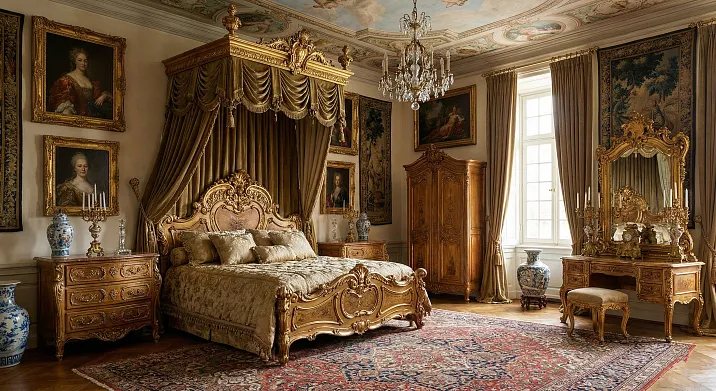
SolutionBuy a baroque bedroom set— is not just buying furniture. It's a step into a world where luxury ceases to be ostentatious and becomes an atmosphere, where every detail works to create a unified image — majestic, thoughtful, captivating. But how to ensure the bedroom doesn't turn into a museum exhibit or a warehouse of expensive items? How to connect the massive carved bed, dressers, nightstands, and vanity into a cohesive composition? The answer lies in understanding that Baroque is a system where furniture and architectural decor exist in inseparable unity.




What's Included in a Bedroom Set: Anatomy of a Baroque Ensemble
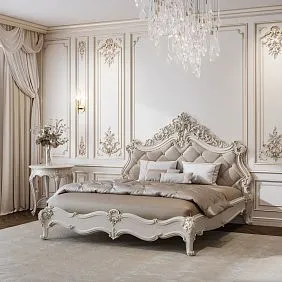
Let's start with the foundation. A Baroque-style bedroom set is not a random collection of items but a curated collection where each element serves its function while supporting the overall stylistic line. The central figure is —baroque bed. A monumental headboard with deep carving, curved forms, a massive base on shaped legs — this is not just a place to sleep, but a throne, an altar of rest. The headboard height can reach two meters, creating a vertical accent that sets the scale for the entire room.
Paired nightstands flank the bed on both sides, creating symmetry — the most important principle of Baroque composition. These nightstands should not be minimalist — carved fronts, curved legs, marble or wooden tops repeat the motifs of the bed. Their surfaces hold table lamps with fabric shades or candelabras — sources of soft, intimate light.
The dresser is the next element of the set. It can be wide, with five or six drawers decorated with carved overlays, bronze handles, inlay. The dresser top serves as a platform for decorative compositions: a mirror in a massive frame, vases, porcelain figurines, boxes. In some sets, the dresser is combined with a mirror into a single structure — a dressing table, which becomes a small architectural element of the bedroom.
A vanity with a mirror — a privilege of the Baroque bedroom. Elegant furniture on curved legs, with small drawers, an oval or rectangular mirror in a carved frame, a soft pouf or chair. This is a feminine territory, a place for beauty rituals, and its decoration requires special delicacy — the carving can be more refined, the ornament finer than on the bed.
A wardrobe or armoire completes the functional part of the set. Massive, with two or three doors, carved fronts, a cornice on top, a balustrade at the bottom. Mirror inserts on the doors visually expand the space, while inside, a well-thought-out system of shelves, rods, and drawers ensures comfortable storage.
But the set is only half the story. The second half is the architectural and decorative context that turns a collection of furniture into a unified space.




How to Choose a Set: Quality and Compliance Criteria
PurchaseBaroque-style furniture— requires knowledge of several critical points. First — material. True Baroque is built on solid wood: oak, beech, walnut, mahogany. MDF with film imitating carving — this is not Baroque, it's its caricature. Solid wood is heavy, dense, and produces a dull, noble sound when tapped. Carving on solid wood is three-dimensional, deep, each curl is felt tactilely. On quality furniture, traces of hand finishing are visible — slight variations in carving depth, the individuality of each detail.
Second — proportions. Baroque furniture is monumental but not shapeless. The ratio of width, height, and depth follows classical rules of harmony. The bed headboard should not be disproportionately wide or narrow relative to the base. The dresser should not look squat or, conversely, too tall. Professional manufacturers calculate proportions based on historical models, adapting them to modern ergonomic requirements.
Third — stylistic unity within the set. Carved motifs should repeat on all pieces. If the bed headboard features acanthus leaves and rocaille, they should also appear on the dresser, nightstands, and vanity. This creates visual connection, rhythm, and recognizability. Hardware — handles, lock plates — should be executed in a unified style: bronze, brass, patinated metal.
Fourth — quality of finish. Varnishing should be smooth, without drips, runs, or bubbles. Patination — if applied — should be evenly distributed, highlighting the carving, creating an effect of noble aging, but not looking artificial. Toning preserves the visibility of the wood grain, rather than turning the wood into a homogeneous mass.
Fifth — ergonomics. Beauty should not come at the expense of function. Dresser and nightstand drawers should open smoothly, on high-quality guides with soft-close mechanisms. The height of the vanity should be comfortable for use. The depth of the wardrobe should be sufficient to accommodate clothes on hangers. This seems obvious, but many manufacturers sacrifice function for decorativeness.
Our factory also produces:




Walls: From Flat Surface to Architecture
Walls in a bedroom with a Baroque suite cannot remain simply painted flat surfaces. Baroque requires volume, articulation, play of light and shadow. The most powerful tool is moldings. Wooden or polyurethane, they create a system of frames, panels, and raised panels on the wall. The classic scheme is high paneling on the lower third of the wall, the middle section divided by vertical and horizontal moldings into rectangular sections, and an upper frieze under the ceiling.
Bedroom Interior Decor begins with the choice of molding profile. Baroque is characterized by complex, multi-step profiles with rounded projections, flutes, and decorative grooves. The width of the molding is 5-10 centimeters, creating a sufficiently expressive line visible from a distance. Installing moldings requires precision: corners must be mitered at 45 degrees, joints should be invisible, lines strictly horizontal and vertical.
Inside the frames created by moldings, contrasting techniques can be used. One traditional method is fabric upholstery. Silk, damask, velvet are stretched over a panel, creating a soft, tactilely pleasant surface. The fabric color can be deep — burgundy, emerald, sapphire — or pastel — cream, pink, peach. The pattern is important: classic damasks with floral motifs, stripes, monograms.
An alternative approach is painting or wallpaper inside the frames. Frescoes with mythological subjects, pastoral scenes, images of angels — this is an authentic Baroque technique, but in a modern interpretation, wallpaper with classic patterns can be used. The main thing is that the pattern does not compete with the furniture carving but complements it.
Get Consultation
Wall Color: The Baroque Palette
Baroque loves rich, noble colors but uses them in doses. If the entire bedroom is painted dark burgundy, the space will become oppressive and gloomy. It's better to combine: the main wall — light (cream, beige, light gray), the accent wall behind the bed headboard — a saturated color or with rich decor. Golden accents — patinated moldings, gilded overlays — add warmth, reflect light, create an effect of luxury.
Sheen is important. Matte paint makes the wall flat, absorbing light. A silky, satin finish creates a soft shimmer, emphasizing the volume of moldings. Glossy varnish is already excessive; Baroque does not like garish shine, preferring a subdued glow.
Ceiling: The Fifth Wall of a Baroque Bedroom
The ceiling in Baroque is not an empty space overhead but a full-fledged part of the interior, requiring attention and decoration. The simplest option is a white or light cream ceiling with a massive cornice around the perimeter. A cornice made of wood or polyurethane, 15-25 centimeters wide, with a rich profile — modillions, dentils, acanthus leaves — creates a powerful frame, visually separating the ceiling from the walls, giving it significance.
A more complex option is a coffered ceiling. A system of beams divides the ceiling into square or rectangular cells, inside which there can be rosettes, painting, gilding. This requires a room height of at least 3.5 meters, otherwise the coffers will make the ceiling oppressive. But if the height allows, the effect is grand — the bedroom turns into a palace hall.
A central rosette is another Baroque technique. A round or oval applied rosette made of plasterwork or carved wood, 60-100 centimeters in diameter, is mounted in the center of the ceiling, from where a crystal chandelier descends. The rosette can be decorated with floral ornamentation, angels, garlands. This is an architectural accent that draws the eye, creating a sense of compositional completeness.
Ceiling Lighting: Play of Light
Baroque loves multi-level lighting. The central chandelier provides general, formal light. Crystal, bronze, multiple arms, pendants creating a play of highlights — such a chandelier is a work of art in itself. But for a bedroom, this is not enough. Hidden cornice lighting — an LED strip installed behind the cornice — creates a soft, diffused glow that emphasizes the volume of the ceiling, making it appear to float.
Wall sconces around the perimeter of the room or by the bed headboard provide local, intimate light. Sconces in the Baroque style are forged or cast bronze constructions with textile shades, crystal pendants, imitation candles. They should echo the style of the chandelier, creating a unified lighting ensemble.
Floor: The Foundation of Luxury
The floor is the platform on which the entire composition is built. For Baroque, parquet is ideal — solid or artistic. Classic patterns — 'herringbone', 'French herringbone', 'squares', 'basketweave'. Wood species — oak, walnut, ash — with pronounced grain, toned in warm or cool tones depending on the overall interior palette.
Artistic parquet is the highest level of craftsmanship. Inlay with different wood species creates complex geometric or floral patterns. A parquet rosette in the center of the room, a border around the perimeter framing the main field — such details turn the floor into a work of art. This is expensive, but the effect is worth it: the eye glides from the carved furniture to the pattern on the floor and finds a visual echo, rhythm, harmony.
An alternative to parquet is marble or ceramic flooring imitating marble. Large-format tiles with noble veining, laid in diamonds or squares, creates a solemn, slightly cool atmosphere. This is appropriate in southern latitudes or in rooms with underfloor heating. It's important to use a rug — large, with thick pile, classic pattern. The rug softens the cold of the stone, adds coziness, outlines the bed area.
Baseboards: The Finishing Touch
Classic Furniture requires appropriate framing of the floor. A baseboard 10-15 centimeters high, made of solid wood, with a profiled top part repeating the motifs of the ceiling cornice. The color of the baseboard can match the floor — creating a unified plane — or match the doors and casings — creating an architectural outline. A white baseboard on a dark floor is a contrasting technique that emphasizes the geometry of the room, making it more graphic.
The corners of the baseboard must be neatly mitered and joined. Carelessness here is unacceptable — Baroque is built on precision of details. The baseboard attachment is hidden, without visible nail or screw heads. After installation, all joints are filled, sanded, painted or varnished to a perfect state.
Textiles: The Soft Luxury of Baroque
Textiles in a Baroque bedroom are not a functional addition but a full-fledged decorative element creating atmosphere. Let's start with bed linen. Natural silk, jacquard, high-density satin — materials that look luxurious and are pleasant to the touch. The color can be saturated — deep blue, emerald, burgundy — or neutral — cream, champagne, pearl gray. Details are important: embroidery, lace, satin edging.
The bedspread is the central textile element. Quilted, velvet, with gold thread embroidery, with tassels and fringe — it drapes over the bed, falls to the floor, creating vertical folds. The color of the bedspread echoes the color of the curtains or upholstery of armchairs, linking different interior elements into a unified palette.
A canopy is an optional but impressive element. Light fabric — organza, veil, tulle — is suspended from the ceiling above the bed or attached to a frame. The canopy can be functional — protecting from light, creating a sense of seclusion — or purely decorative — adding romance, theatricality. The color of the canopy is usually light, translucent, so as not to darken the space.
Curtains: Framing the Windows
Windows in a Baroque bedroom require complex textile treatment. Layering is the key principle. The first layer is lightweight tulle or voile, which diffuses daylight. The second layer consists of heavy drapes made of velvet, jacquard, or brocade, which completely block light and create nighttime darkness. The third layer is a lambrequin, a decorative horizontal drapery at the top of the window, adorned with tassels, fringe, or cords.
Drape mounting is not a simple curtain rod but a carved wooden pole with decorative finials or a concealed cornice from which the fabric descends as if from nowhere, creating a floating effect. The drapes are gathered at the sides of the window with decorative cords or metal holders, forming luxurious folds.
The color of the drapes is one of the key color accents in the bedroom. If the walls are light, the drapes can be rich and saturated—this adds depth and contrast. If the walls already have an active color or decor, it is better to make the drapes neutral but rich in texture.
Lighting: theater of light and shadow
Lighting in a Baroque bedroom should be layered, controllable, and create different scenarios. The daytime scenario is bright and formal, with the central chandelier on, drapes open, and the space flooded with light. The evening scenario is subdued and intimate, with only bedside sconces and table lamps on the dresser and vanity working. The nighttime scenario is minimal, possibly only concealed cornice lighting or a nightlight.
Each light source should be equipped with a dimmer to adjust brightness. This is critical for a bedroom—too bright light in the evening hinders relaxation, while too dim light in the morning makes waking up difficult. Light temperature also matters: warm light (2700-3000K) creates coziness, while cool light (4000K and above) is invigorating but usually inappropriate in a bedroom.
Decorative accent lighting is directed at works of art, sculptures, or decorative niches. Small LED spotlights, built into the cornice or mounted on a track, create light accents, adding depth and volume. It is important that the accent lighting is unobtrusive—Baroque favors soft, diffused light, not harsh light spots.
Decorative details: filling the space
A Baroque bedroom is unthinkable without decorative objects that fill the space with meaning, history, and beauty. Mirrors are a mandatory element. A large floor mirror in a carved frame, placed against a wall or in a corner, visually doubles the space, reflects light, and creates an illusion of depth. A mirror above a dresser or vanity in a horizontal or vertical frame, adorned with gilding, patina, or carved cartouches, is both functional and decorative.
Paintings in massive frames—portraits, landscapes, still lifes in a classical manner. The size of the painting should match the scale of the wall: small paintings get lost on a large wall, while overly large ones overwhelm. Often, paintings are placed within frames created by moldings, forming a 'picture gallery' on the wall.
Sculptures—busts, figurines on pedestals, decorative compositions—add three-dimensionality and variety of forms. Materials include marble, bronze, or plaster with patina. Placement is on dressers, consoles, niches, or on the floor in room corners.
Vases, boxes, clocks: small decorative items
Decorative small items—vases with or without flowers, porcelain boxes, table clocks in carved cases, candelabras, candlesticks—create a sense of lived-in fullness. These items should be high-quality and styled to the era. Modern mass-produced imitations will ruin the impression, while antique or antique-style items will enhance it.
Books—antique folios in leather bindings, stacked on a dresser top or shelves—add intellectual and cultural context. Even if they are just decorative replicas, they contribute to the overall image.
Symmetry and composition: arrangement rules
Baroque is built on the principle of symmetry. The bed is placed in the center of the wall, along the room's axis. On both sides are identical bedside tables with identical lamps. Windows are draped identically. Paintings on the wall are placed symmetrically relative to the vertical axis. This is not accidental but a deliberate technique: symmetry creates a sense of order, stability, and harmony.
But symmetry does not mean boredom. Within the symmetrical scheme, there is room for variations: different decorative objects on the tables (but of the same size and significance), different paintings on the walls (but in identical frames), different flowers in vases (but in identical vases). This creates liveliness and interest, avoiding mechanical repetition.
The height of decorative placement matters. Paintings are hung at eye level for a standing person—usually the center of the painting at a height of 150-160 centimeters from the floor. Mirrors above dressers are placed to reflect the face of a person standing in front of it. Sconces are placed at a height of 160-180 centimeters from the floor so that the light falls softly and does not glare.
First mistake - unstructured mixing. A classic chair, loft table, Scandinavian chest, and minimalist cabinet in one room is not eclecticism, but visual chaos. Each item draws attention to itself, not creating cohesion. A system, logic, unifying idea is needed. Choose one dominant style, add a second as an addition, and possibly a third as an accent. But no more than three, and all should have something in common - color, material, era, or functionality.
The first mistake is overloading. Baroque is luxurious but not chaotic. If every surface is cluttered with decor, every wall is covered with carvings, every corner is occupied by a statue—the space becomes oppressive and uncomfortable. Pauses are needed—areas of calm, neutral surfaces where the eye can rest.
The second mistake is cheap materials. Plastic imitating wood, polystyrene moldings, painted MDF imitating carvings—these materials ruin Baroque. It is better to have fewer elements made of genuine materials than an abundance of imitations. Natural wood, plaster moldings, genuine bronze or brass—these are the foundations of authentic Baroque.
The third mistake is scale mismatch. A small room with a three-meter-high bed headboard looks absurd. A huge bedroom with miniature furniture feels empty and cold. The scale of the furniture must match the size of the room. If the room is small, it is better to choose a more restrained, intimate interpretation of Baroque—less gilding, more concise carving, lighter tones.
The fourth mistake is ignoring function. Beauty should not interfere with living. If a wardrobe is inconvenient, if dusting is impossible due to an abundance of decor, if drapes are so heavy they cannot be moved—this is poor design, no matter how luxurious it looks.
How to work with a manufacturer: selection and ordering
When you have decidedBuy a baroque bedroom set, it is important to choose the right manufacturer. Criteria include: experience in classical styles, a portfolio of completed projects, the possibility of custom orders, the use of natural materials, and transparent pricing.
The first stage is consultation. Describe your wishes, show examples of interiors you like, discuss the budget. A good manufacturer will not impose ready-made solutions but will listen, ask questions, offer options, and explain the pros and cons of each.
The second stage is the project. Based on your wishes, a 3D visualization or sketches of the future interior are created. You see how the bedroom will look, can make adjustments—change dimensions, add or remove elements, alter colors, or carving types. This is a critically important stage: it is better to redo it ten times on paper than to redo it later in reality.
The third stage is production. Timelines depend on complexity: a simple set may be ready in two to three months, while a complex one with custom carving, gilding, or inlay may take six months. Do not rush—quality requires time.
The fourth stage is delivery and installation. The furniture must be carefully packed to avoid damage during transportation. Installation is performed by professionals familiar with the specifics of classical furniture. After installation, a final inspection is conducted, and minor defects, if any, are corrected.
Frequently asked questions
How much does a Baroque bedroom set made of natural wood cost?
The price depends on many factors: wood species, complexity of carving, type of finish, and the number of pieces in the set. A basic set made of beech or oak (bed, two bedside tables, dresser) starts from 500-700 thousand rubles. A set with hand carving, gilding, and made of valuable wood species can cost several million. It is important to understand that this is an investment for decades—quality furniture lasts for generations.
Can a Baroque bedroom set be combined with modern appliances?
Yes, but integration needs to be carefully considered. A TV can be placed in a carved frame that mimics a painting or hidden behind sliding wardrobe panels. Choose stylized sockets and switches, in brass or bronze. Mask air conditioning and ventilation with grilles featuring classic ornamentation. Make appliances as inconspicuous as possible so they don't compete with the decor.
What ceiling height is needed for a Baroque bedroom?
A minimum of 3 meters. At this height, Baroque furniture and decor can be used without a feeling of pressure. Ideally, 3.5-4 meters: this allows for the use of tall headboards, complex ceiling structures, and large chandeliers. With 2.7-meter ceilings, Baroque will look overwhelming—it's better to choose a lighter style, such as Neoclassicism.
How to care for carved wooden furniture?
Regular dry cleaning with a soft cloth or a special brush to remove dust from the carving. Once a month—damp cleaning with a slightly damp cloth and a mild soap solution. Every six months—treatment with a special wood product (wax, oil) that nourishes the wood and protects it from drying out. Avoid harsh chemicals, abrasives, and excess moisture.
Can a Baroque bedroom be created in a small room?
Yes, but with caveats. Choose a more restrained version of Baroque—less gilding, simpler carving. Use light colors—they visually expand the space. Opt out of a massive wardrobe in favor of a built-in storage system. Use mirrors—they double the space. Limit the number of decorative objects—it's better to have a few high-quality pieces than many small ones.
What is more important—furniture or wall decor?
They are equally important. Luxurious furniture in a bare room looks like exhibits in a warehouse. Richly decorated walls with cheap furniture are like beautiful packaging without contents. Baroque is an integral system where furniture and architectural decor exist in an inseparable unity, supporting and enhancing each other.
Is a designer needed to create a Baroque bedroom?
It is advisable, especially if you have no experience working with classical styles. A designer will help choose the right proportions, color combinations, scale of decor, and avoid mistakes. They will unite furniture, architectural decor, textiles, and lighting into a harmonious space. This is an investment that pays off—a professional project looks completely different from amateur attempts.
How to choose a color for a Baroque bedroom?
Start from the color of the furniture. If the furniture is dark—the walls can be light for contrast. If the furniture is light—the walls can be rich, creating a background. Classic Baroque colors: golden, cream, burgundy, emerald, sapphire, purple. Avoid pure, bright shades—Baroque prefers complex, noble tones with a hint of gray or brown.
Can wallpaper be used instead of moldings?
Yes, but the effect will be different. Wallpaper creates flat decor, moldings create three-dimensional decor. Baroque requires volume, play of light and shadow. A compromise—wallpaper with a relief texture inside molding frames. This way you get both color and volume. A purely wallpaper solution is possible, but it will be more of an imitation of Baroque than its true embodiment.
How long does it take to create a turnkey Baroque bedroom?
From project to full implementation—6-12 months. Design—1-2 months. Furniture production—3-6 months. Finishing work (walls, ceiling, floor)—2-3 months. Installation of decor and furniture—2-4 weeks. Final placement of decorative objects, textiles—1-2 weeks. Don't rush—quality takes time, and Baroque does not tolerate carelessness.
Conclusion: Creating a unified ensemble with STAVROS
A Baroque bedroom is not a collection of expensive items, but a symphony where each element plays its part, subordinated to a single melody.baroque bedThe bed sets the theme, the chest of drawers and nightstands develop it, architectural decor creates the context, textiles add softness, lighting adds drama. When all these elements are chosen correctly, when they resonate with each other, that very feeling of harmony arises, for which the interior is created.
The path to such a bedroom begins with an understanding of the style, continues with a careful selection of each element, and ends with professional implementation. This requires time, knowledge, and investment. But the result is a space that is not just beautiful, but also deep, meaningful, inspiring, calming, giving a sense of touching genuine beauty.
For over two decades, the company STAVROS has been creating furniture and architectural decor for classical interiors, including Baroque bedrooms. Working with natural solid oak and beech, traditional techniques of carving, gilding, patination, modern high-precision equipment, and, most importantly, a deep understanding of classical styles—all this allows STAVROS to create pieces that can proudly be called works of furniture art. The STAVROS catalog features ready-made models of furniture, moldings, cornices, carved overlays, as well as the possibility of custom orders tailored to the specifics of your project. Professional consultants will help you choose elements, create a harmonious composition, and calculate material quantities. With STAVROS, creating a Baroque bedroom is not a painful experiment, but a thoughtful, predictable process leading to a guaranteed result—an interior fit for kings.


