Article Contents:
- Why lines shape the perception of space
- Psychology of horizontals
- Dynamics of verticals
- Scale and human perception
- How moldings, baseboards, and cornices create composition
- Basic triad
- Multi-level systems
- Vertical rhythm
- Examples of combinations by style - classic, neoclassic, modern
- Classic - majestic proportionality
- Neoclassic - light elegance
- Modern - organic fluidity
- Role of material and color
- Materials - wood and alternatives
- Color Strategies
- Techniques for unifying by height and ceiling level
- Low ceilings 2.4-2.6 meters
- Standard ceilings 2.7-3.0 meters
- High ceilings 3.2-4.5 meters
- How to avoid visual conflicts
- Violation of proportions
- Stylistic Incompatibilities
- Scaling errors
- Color conflicts
- Conclusion: time-tested rules of proportion
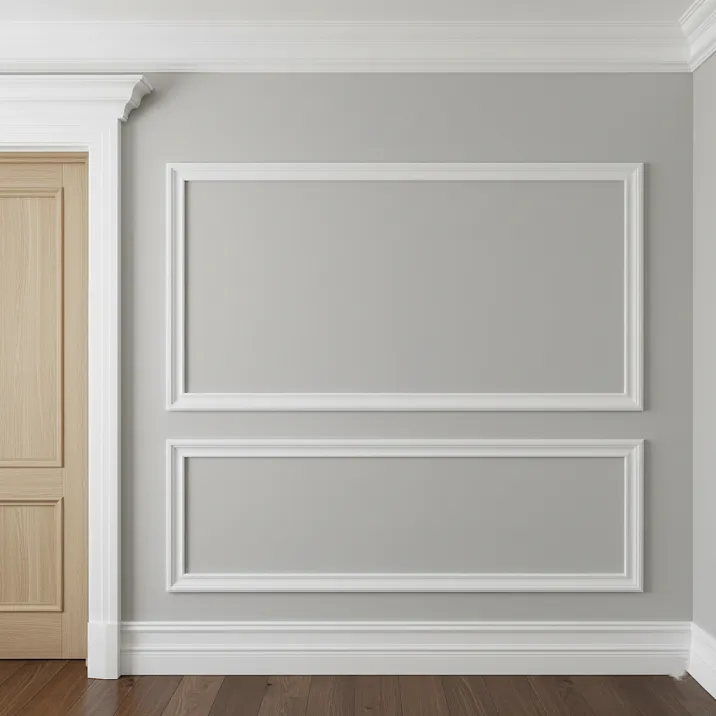
Architectural lines - invisible threads organizing visual perception of space, guiding the gaze, creating rhythm, structuring the chaos of planes into an ordered composition.moldings, cornices, baseboardsThese are not merely decorative elements covering joints and technological gaps. They are tools of architectural expressiveness capable of visually altering room proportions, correcting layout shortcomings, creating an illusion of height where it is lacking, and adding solidity where emptiness dominates.
The history of architectural decoration demonstrates how different eras used profiled elements to create harmony. Antiquity developed the system of orders, where each profile - the capital, the echinus, the torus, the astragal - had mathematically precise proportions, ratios, and rhythms. The Renaissance revived ancient canons, systematizing them in the treatises of Palladio, Vignola, and Serlio. Classicism perfected the principle of proportionality - each element related to a module, and multiple ratios created visual harmony.
Modern interiors inherited these principles despite the loss of rigid regulation. Designers are free to choose profiles, sizes, and combinations, but the laws of visual perception remain unchanged. Correctly chosen proportions create a sense of harmony at a subconscious level, even if the viewer does not recognize the reason. Incorrect proportions cause a vague discomfort, a feeling that something is wrong, though it is difficult to pinpoint the problem.
Harmony of proportions is the result of careful analysis of room parameters, stylistic requirements, functional tasks, and visual effects. Ceiling height, room area, natural lighting, color palette - all these factors influence the selection of sizes and character of profiled elements. Combinationblock, corner, railsto create a unified composition requires understanding basic principles tested over centuries.


Why lines form the perception of space
Human perception of architecture is based on reading horizontal and vertical lines, their relationships, rhythms, and intervals. The brain automatically analyzes proportions, compares the sizes of elements, establishes a hierarchy of significance. Horizontal lines create a sense of stability, calm, and extension — the gaze glides along them, expanding the visual space. Vertical lines generate dynamism, upward movement, a sense of height — the eye moves vertically, increasing the perceived height of the room.




Psychology of horizontals
Horizontal profiled elements — ceiling cornices, friezes at door height, panel moldings at mid-wall height, baseboards — create a framework for perceiving the room. They divide the wall’s verticality into zones, structure the space, and establish scale. A ceiling cornice visually separates the wall from the ceiling, creating a boundary between vertical and horizontal planes. Without this boundary, the wall and ceiling merge, the space loses clarity and becomes amorphous.
The baseboard performs the opposite function — it separates the wall from the floor, creating a visual foundation for verticality. The space between the baseboard and cornice is perceived as the main wall zone, its active field. Intermediate horizontal divisions — panel moldings, friezes — further structure this field, creating a rhythmic organization.
The number of horizontal divisions determines the character of perception. One horizontal — cornice and baseboard — creates a calm, monolithic wall space. Two additional horizontals divide the wall into three zones — plinth, main, and frieze — the classical triad corresponding to human scale. Multiple horizontals create a complex rhythmic structure, suitable for high grand spaces but overwhelming small spaces.
Our factory also produces:


Dynamics of verticals
Vertical elements — pilasters, vertical moldings, corner profiles — create a counterweight to horizontal calm. They direct the gaze upward, visually increase the room’s height, and add dynamism to static planes. In rooms with low ceilings, vertical divisions are critically important — they compensate for lack of height through the illusion of vertical movement.
The rhythm of verticals determines the character of space. Frequent rhythm — vertical moldings with 60-80 cm intervals — creates graphic quality, structure, and clarity. Sparse rhythm — pilasters with 2-3 meter intervals — preserves wall integrity while indicating structural logic. Absence of vertical divisions makes space monotonous, devoid of visual accents.
Combining verticals and horizontals creates a grid organizing perception. The classical order system demonstrates this interaction — vertical columns or pilasters carry a horizontal entablature, creating visual construction logic. Modern interiors simplify this system while preserving the principle of combining directions.
Get Consultation
Scale and the human being
Architectural lines relate to the human body, creating a sense of comfort or discomfort. A baseboard 10-15 cm high is at foot level, visually marking the contact zone with the floor. A panel molding at 90-100 cm corresponds to waist level, dividing the human figure into upper and lower parts. A frieze at 200-220 cm is slightly above a standing person’s head, creating the upper boundary of human scale.
Elements exceeding human scale — cornices under 4-5 meter ceilings — are perceived as monumental, supra-human, and solemn. They create an impression of space’s grandeur and significance. Elements strictly corresponding to human scale generate comfort, coziness, and intimacy. Choosing scale is a deliberate decision about the emotional character of the interior.
How moldings, baseboards, and cornices create composition
Composition of profiled elements — a system of relationships of sizes, rhythms, and intervals, creating visual unity. Each element — cornice, molding, baseboard — occupies its place in the hierarchy, performs a specific role, relates to other elements through proportional relationships. A random set of multi-scale elements creates chaos, a thoughtfully designed system — harmony.
Basic triad
The fundamental composition of profiled elements includes three mandatory components — ceiling cornice, wall molding, baseboard. This triad creates vertical division of the wall into zones, each with its own visual weight, character, and function.
Ceiling cornice — the crowning element, creating a transition from the wall’s verticality to the ceiling’s horizontality. Its width determines visual mass and degree of prominence. For standard rooms with 2.7-meter ceilings, an optimal cornice width is 5–10 cm. For high ceilings 3–3.5 meters — 10–15 cm. For monumental spaces over 4 meters — 15–25 cm. Classical rule: for every 30 cm of ceiling height, 1 cm of cornice width is appropriate.
Baseboard — the foundation of composition, the visual foundation of wall verticality. Its height traditionally equals 2/3 of the cornice’s width. If the cornice is 9 cm wide, the baseboard should be 6 cm high. This proportion creates visual balance — the cornice is slightly larger than the baseboard, following the logic where the crowning element dominates the foundation. Violating this balance — baseboard taller than cornice — creates visual instability and a sense of inversion.
Wall molding — an intermediate element, creating horizontal division at mid-wall height. Its width is usually less than both cornice and baseboard — 3–5 cm. Positioned at 90–110 cm from the floor, it divides the wall approximately in a 1:2 ratio — lower zone smaller than upper. This proportion is visually stable and corresponds to the perception of architectural proportions.
Multi-level systems
Complex interiors use additional horizontal divisions, creating an advanced composition. The classical system includes five horizontal lines:
First level — baseboard 10–15 cm high, marking the plinth zone.
Second level — panel molding at 90–100 cm, separating the panel zone from the main wall plane.
Third level — frieze molding at 200–220 cm, separating the frieze from the main wall.
Fourth level — subcornice molding 20–30 cm below the ceiling, creating an additional step toward the cornice.
Fifth level — ceiling cornice, crowning the entire composition.
Each level has its own profile width, increasing from bottom to top. Panel molding - 3-4 centimeters, frieze molding - 4-5 centimeters, baseboard molding - 5-7 centimeters, cornice - 12-20 centimeters. This gradation creates visual lightness toward the top, corresponding to the tectonic logic of architecture.
Vertical Rhythm
Vertical elements — corner moldings, pilasters, vertical panels — complement the horizontal system, creating a grid. The width of vertical elements matches the width of horizontal elements. If panel molding has a width of 4 centimeters, vertical panel dividers should be the same width or slightly narrower — 3-4 centimeters. Uniformity of widths creates visual consistency.
Intervals between vertical elements define the composition’s rhythm. Classical proportions assume a panel width to height ratio of 2:3 or 3:4 — panels are vertically elongated, visually increasing room height. Square panels create a static, calm composition. Horizontally elongated panels visually expand space but reduce perceived height.
The number of vertical elements on a wall depends on its length. For a 4-meter wall, 3-4 panels of 80-100 centimeters each are optimal. For a 6-meter wall — 5-6 panels of the same width. Too narrow, frequent panels create graphic, overly structured appearance. Too wide, sparse panels create monotony and lack of rhythm.
Style Combination Examples — Classic, Neoclassic, Modern
Different architectural styles created unique systems of combining profiled elements, reflecting aesthetic ideals, technological capabilities, and cultural codes of their eras. Understanding stylistic canons is critical for creating authentic or stylized interiors.
Classic — Grand Proportional Harmony
Classic interiors are based on strict adherence to proportions, symmetry, and element hierarchy. Ceiling cornices have significant width — 15-25 centimeters for rooms 3.5-4.5 meters high. The cornice profile is complex and multi-level — including a cove, gusset, roll, and shelf, creating rich light and shadow play. Cornices are often supplemented by modillions — brackets imitating cantilever support.
Baseboards 12-18 centimeters high repeat the cornice profile at a reduced scale. The baseboard height to cornice width ratio is 2:3 — if cornice is 18 centimeters, baseboard is 12 centimeters. The baseboard profile includes a base, shaft, and capital — a miniature column in horizontal position.
Panel moldings at 90-100 centimeters height create a plinth zone, traditionally painted darker than the main wall or covered with contrasting wallpaper. Panel molding width is 5-7 centimeters, profile simple — roll with shelves. Panels within frames are formed by vertical moldings of the same width, creating rectangular sections.
Frieze moldings at 200-230 centimeters height separate the frieze — upper wall zone — from the main plane. Width 6-8 centimeters, profile slightly more complex than panel molding but simpler than cornice. Frieze may be decorated with ornament, relief garlands, rosettes — this is a ceremonial zone showcasing decorative richness.
Corner pilasters with capitals and bases structure room corners, creating vertical accents. Pilaster width 12-20 centimeters matches cornice scale. Capitals reproduce classical orders — Doric, Ionic, Corinthian. Pilaster base matches baseboard profile.
Color solution is traditional — white or cream profiled elements on colored walls. Contrast creates line clarity, structures space. Partial gilding — cornice and pilaster capitals — adds luxury.
Neoclassic — Lightened Elegance
Neoclassical interiors preserve classical proportions while simplifying profiles, reducing dimensions, and lightening decoration. Ceiling cornices 8-12 centimeters wide for standard 2.7-3 meter rooms have a minimalist profile — one or two coves instead of multi-level classical composition. Modillions are absent or simplified to geometric brackets.
Baseboards 7-10 centimeters high maintain 2:3 proportion to cornice. Profile simplified — smooth curve instead of complex classical cove system. Flat baseboards with minimal relief — only 2-3 millimeters protrusion — are possible.
Panel moldings are selectively applied — not on all walls, but only on accent walls. Width 3-5 centimeters, profile flat or with one roll. Panels are larger than classical — 100-150 centimeters width creates a calmer rhythm. Placement height may vary — 80-120 centimeters depending on room height.
Frieze moldings are often absent — neoclassicism prefers a clean wall plane between panel zone and cornice. If frieze is present, it is at 210-240 centimeters height with minimal profile, 4-5 centimeters wide.
Vertical divisions are minimal — corner moldings 4-6 centimeters wide without capitals or bases, simply marking corners. Pilasters are rarely used, only in large rooms as accents.
Color palette is monochromatic — various shades of white, gray, beige create tonal transitions instead of contrasts. Moldings are painted to match wall tone or 1-2 tones lighter/darker. Gilding is practically unused, preference given to matte or semi-matte finishes.
Modern — Organic Fluidity
Modern interiors reject classical straight lines in favor of organic curved forms. Ceiling cornices have asymmetrical wave profiles, mimicking natural forms — plant curves, water waves. Width varies 10-15 centimeters, but volume distribution is uneven — maximum projection is offset from center.
Baseboards 8-12 centimeters high also have asymmetrical profiles, but not necessarily mirroring cornices. Modern design values variety of forms, rejection of rigid element correspondence. Baseboard may have smooth S-shaped curve, creating dynamism even in horizontal elements.
Panel moldings in modern style are not horizontal — they curve, creating wavy lines on walls. Placement height is variable — line rises and falls, creating organic rhythm. Molding width 4-7 centimeters, profile rounded, without sharp edges of classical coves.
Vertical elements also curve, imitating plant stems. Instead of straight pilasters — wavy verticals, expanding and narrowing vertically. Instead of geometric capitals — stylized plant forms, flowing into cornice.
Color solution implies natural tones — greens, browns, ochres, blues. Moldings are contrasted against walls, but not white, rather natural shades. Gilding or patination is popular, creating precious metal effect.
Role of Material and Color
Material of profiled elements determines not only aesthetics but also formability, durability, cost, and installation complexity. Color creates visual unity or contrast, affects perception of proportions, emphasizes or neutralizes profiled elements.
Materials - Wood and Alternatives
Woodenmoldings, cornices, baseboardsThey embody the traditions of woodcarvers, creating tactile warmth and visual nobility of natural material. Different species offer different possibilities. Oak with expressive texture creates solidity and suits large profiles for classic interiors. Beech with fine-grained structure is ideal for medium-complexity neoclassical profiles. Lime, soft and uniform, allows creating intricate carved profiles with detailed work.
Wooden elements require quality processing — sanding reveals texture, priming ensures even coloring, lacquering protects against moisture and mechanical damage. Natural wood changes dimensions with humidity fluctuations — it expands in summer and contracts in winter. This requires special installation techniques with compensatory gaps.
Polyurethane profiles reproduce any shape with perfect accuracy and phenomenal lightness. Density of 200-250 kg/m³ is 3-4 times lower than wood, simplifying installation and reducing wall load. Absolute moisture resistance makes polyurethane ideal for humid areas — bathrooms, kitchens. The material does not change dimensions with humidity or temperature fluctuations and does not require complex preparation before painting.
MDF profiles combine affordability with acceptable quality. The material is uniform, easily machined, creating medium-complexity profiles. MDF is heavier than polyurethane but lighter than solid wood. Main drawback — sensitivity to moisture, requiring protective coating and limiting use to dry rooms.
Gypsum profiles are traditional for classic interiors, creating authentic texture of historical moldings. Fragility and heavy weight complicate installation, requiring professional skills. Gypsum absorbs moisture, limiting use to dry heated rooms. Modern interiors rarely use real gypsum, preferring polyurethane imitations.
Color strategies
Contrasting coloring — white profiles on colored walls — is a classic solution, clearly structuring space. White cornices, moldings, skirting boards create an architectural frame, revealing room geometry. Colored walls are perceived as fill between frame lines. Contrast works in rooms of any size, but especially effective in high spaces, where profiles create monumental structure.
Tonal coloring — profiles 1-2 tones lighter or darker than walls — creates subtle accent without sharp contrast. Suitable for modern interiors where visual calm is valued. Light profiles on light walls create airiness and lightness. Dark profiles on dark walls — intimacy, coziness.
Monochromatic solution — profiles in wall tone — minimizes architectural line emphasis. They are present, creating relief, light and shadow play, but do not dominate through color contrast. Solution for minimalist interiors where clean planes are important while preserving subtle structuring.
Accent coloring highlights individual elements with contrasting colors. Gilded cornice with white moldings and skirting boards creates luxurious accent. Dark skirting board on light walls and cornice marks base, visually grounding space. Colored frieze molding highlights upper wall zone as decorative band.
Patina creates aging effect. Light base with dark accents in profile recesses imitates centuries-old grime ingrained in material pores. Technique suits Provence, vintage, eclectic interiors. Patina unifies profiles of different materials — wooden and polyurethane elements after patina look uniformly aged.
Techniques for combining by height and ceiling level
Room height critically affects selection of profile element sizes and character. Correct approach compensates for proportion flaws, enhances strengths, creates visual comfort.
Low ceilings 2.4–2.6 meters
Rooms with low ceilings require delicate approach — large profiles visually reduce already insufficient height. Ceiling cornice must be narrow — 3–5 cm, simple profile without complex cuts. Painting cornice in ceiling color visually integrates it into ceiling plane, not reducing wall height.
Floor skirting board 5–7 cm high corresponds to narrow cornice by 2:3 rule. Profile simple — one bend or straight bevel. Painting in floor color visually expands floor plane, not reducing wall height.
Intermediate horizontal moldings in low rooms are undesirable — they break walls, visually reducing height. If panel zone is needed functionally — wall protection in entryway, bathroom — molding must be narrowest, 2–3 cm, placed low, 70–80 cm from floor.
Vertical elements are critical for visual height increase. Vertical moldings 3–4 cm wide, running from skirting to cornice without interruption, direct gaze upward. Interval between verticals 80–120 cm creates frequent rhythm, enhancing effect.
Standard ceilings 2.7–3.0 meters
Standard height provides maximum freedom in profile selection. Ceiling cornice 5–10 cm wide creates expressive wall finish without overload. Profile may include 2–3 cuts — gusset, bead, shelf — creating classic architectural form.
Floor skirting board 7–10 cm high harmonizes with cornice by 2:3 rule. Profile repeats cornice in reduced scale or has independent character while maintaining overall style.
Panel molding at 90–100 cm height creates classic three-part wall division. Width 4–6 cm sufficient for visual emphasis without dominance. Area below molding traditionally darker than upper wall part, creating visual stability.
Frieze molding at 210–230 cm height further structures high wall. Width 5–7 cm highlights frieze as independent zone, decorated with ornament, moldings, contrasting coloring.
High ceilings 3.2–4.5 meters
High rooms require large-scale profiles matching space’s monumentality. Ceiling cornice 12–20 cm wide with complex multi-level profile creates expressive finish. Modules, denticles, ionic elements enrich cornice, transforming it into architectural artwork.
Floor skirting board 10–15 cm high corresponds to cornice by 2:3 rule. Complex profile with base, shaft, capital creates miniature column. Possible addition of plinth molding 5–7 cm wide at 15–20 cm from floor, creating two-tiered base.
Panel molding at 100–120 cm height creates large plinth zone. Width 6–8 cm sufficient for emphasis. Within panels, rectangular sections formed by vertical moldings of same width.
Frieze molding at 240–280 cm height separates developed frieze zone. Width 8–10 cm emphasizes significance. Between frieze molding and cornice, possible sub-cornice molding 30–40 cm below ceiling, creating multi-step transition.
How to avoid visual conflicts
Visual conflicts arise from proportion violations, style mismatches, incorrect scaling, random element selection. Understanding typical errors allows avoiding them.
Proportion violations
The most common mistake is a skirting board wider than the cornice. Visually, this creates an impression of inversion and instability — the base appears heavier than the crown. The correct proportion: the cornice should be 1.5 times wider than the skirting board. If this is impossible for any reason, at least equal width, but not dominance of the skirting board.
Too large profiles in low rooms visually press down, creating claustrophobia. A cornice 15 centimeters wide against a 2.5-meter ceiling visually reduces the perceived height by 20-30 centimeters. The room appears even lower. Rule: the cornice width should not exceed 1/50 of the room's height — for a 2.5-meter ceiling, maximum 5 centimeters.
Too small profiles in high rooms disappear and fail to perform a structuring function. A 5-centimeter-wide cornice against a 4-meter ceiling is practically invisible from below. Rule: minimum cornice width is 1/30 of the room's height — for a 4-meter ceiling, minimum 13 centimeters.
Stylistic inconsistencies
Mixing profiles of different styles creates eclectic chaos in the absence of a unifying concept. A classical cornice with a complex profile, a modern flat skirting board, a neoclassical panel molding — elements conflict and fail to create unity. Solution: choose a dominant style and subordinate all elements to it.
A classical interior requires classical profiles at all levels. A modern interior — modern profiles. A neoclassical interior — neoclassical profiles. Eclecticism is permissible if there is a unifying principle — for example, all elements are painted in a single color and patinated using one technique. Overall finish neutralizes profile differences.
Scaling errors
Too frequent vertical divisions create visual overload. Vertical moldings spaced 40-50 centimeters apart turn the wall into a striped surface, tiring the eye. Optimal spacing: 80-120 centimeters for standard rooms, 100-150 centimeters for high rooms.
Too sparse rhythm creates monotony and lack of structure. Vertical moldings spaced 200-300 centimeters apart do not create rhythm and are perceived as random elements. The wall remains an amorphous plane.
Multiple horizontal divisions in low rooms fragment the wall, visually reducing height. Cornice, frieze molding, panel molding, base molding, skirting board — five horizontal elements in a 2.6-meter-high room create six zones, each 43 centimeters high. Visual fragmentation is uncomfortable. In low rooms, three levels suffice — cornice, optionally panel molding, skirting board.
Color conflicts
Multiple profile colors create visual clutter. A white cornice, beige frieze molding, gray panel molding, dark skirting board — four colors on one wall overload perception. Optimal: one or two profile colors. All horizontal elements in one color, possibly accenting one level with a contrasting color.
Insufficient contrast makes profiles invisible. Cream moldings on beige walls blend together and fail to create structure. Minimum contrast — 2 tone differences on the shade scale. Optimal — 4-5 tones. Maximum — white on dark or dark on white.
Conclusion: time-tested proportion rules
Harmony of proportions of profiled elements — the result of centuries of experience, systematized in the canons of classical architecture and adapted to modern realities. Basic principles remain unchanged regardless of style, materials, or individual preferences.
Rule 2:3 — the skirting board height equals two-thirds the cornice width. This proportion creates visual balance, where the crowning element dominates the base, aligning with tectonic logic. Violating this rule creates disharmony and a sense of instability.
Rule 1:30 — minimum cornice width equals one-thirtieth of room height. For a 3-meter ceiling, minimum 10 centimeters. Narrower cornices disappear and fail to perform a structuring function.
Rule 1:50 — maximum cornice width in low rooms equals one-fiftieth of room height. For a 2.5-meter ceiling, maximum 5 centimeters. Wider cornices visually reduce perceived height.
Rule of the triad — minimum composition includes three levels: cornice, optionally panel molding, skirting board. This triad creates vertical division, sufficient for structuring space without overload.
Rule of intervals — minimum 10-15 centimeters from skirting board to bottom of panel molding. Minimum 4-5 centimeters between edges of two moldings forming a frame. These intervals ensure visual readability of elements and prevent merging.
Rule of stylistic unity — all profiled elements must belong to one style or be unified by a common finishing principle. Mixing incompatible styles creates chaos without a deliberate eclectic concept.
Rule of color restraint — maximum two profile colors on one wall. Monochromatic or contrasting solutions are preferable to multiple shades.
Rule of human scale — key horizontal divisions relate to human body proportions. Panel molding at waist level — 90-100 centimeters. Frieze molding slightly above head — 210-230 centimeters. These heights create visual comfort and spatial harmony with the human form.
STAVROS offers a full range ofmoldings, cornices, skirting boardsfrom natural wood of various species and profiles.Blockfor creating simple geometric profiles.Anglefor decorating corners and joints.Railfor creating vertical and horizontal divisions. Professional consultations will help select properly proportioned elements for a specific room.
Create interiors where proportions of profiled elements create harmony, where each line has its place, where architectural logic merges with aesthetic perfection. Follow time-tested rules, adapt them to modern realities, find balance between canon and individuality. Choose STAVROS — choose quality materials, variety of profiles, traditions of craftsmanship embodied in every element.