Article Contents:
- Evolution of Scandinavian style: from cold to warm
- From white to natural tones
- From minimalism to sufficiency
- From universality to personalization
- Light wood species: the foundation of Scandinavian aesthetics
- Ash — the leader of modern Scandi
- White oak — the classic of Scandinavian homes
- Birch — accessible beauty of the north
- Spruce — budget-friendly alternative
- Furniture handles: functional simplicity
- Shapes: hooks and buttons
- Finishing: oil instead of lacquer
- Placement: logic and convenience
- Balusters: simplicity instead of ornamentation
- Shapes: geometric purity
- Color: light on light
- Alternatives: glass and metal
- Skirting boards: functional detail
- Height and profile: restrained forms
- Color: matching floor or contrasting
- Installation: hidden fasteners
- Wooden rails: modular rhythm
- Vertical rails: visual elongation
- Horizontal Laths: Expanding Space
- Mixed solutions: geometry and freedom
- Color palette: shades of light
- White and its variations
- Gray nuances
- Pastel accents
- Textiles and Materials: Tactile Richness
- Natural fabrics
- Wood as Texture
- Ceramics and Glass
- Practical Tips: How to Create Scandinavian Minimalism
- Start with the Basics
- Add Wood Sparingly
- Free Up Space
- Let in Light
- Frequently Asked Questions
- Conclusion: The Philosophy of Sufficiency

Scandinavian style is undergoing another rebirth — but not as total white minimalism, but as a warm, tactile, deeply human aesthetic. In 2026, 'Scandi' is no longer about sterile Instagram pictures, but about real life, where every element has meaning, function, soul.Furniture Handlesfrom light ash, minimalistWooden balusterswithout excessive carving, functionalWooden skirting boards, Wooden boards in interior— these are not decorations, but tools for creating a space where you want to breathe deeply, where calm reigns without emptiness, simplicity without primitiveness.
Scandinavian minimalism today is the philosophy of sufficiency: not more than needed, but also not less than required for comfort. It is respect for materials, craftsmanship, and time — one’s own and others’. It is a space that does not shout about itself, but is remembered forever.



Evolution of Scandinavian Style: From Cold to Warm
Classic Scandinavian style at the beginning of the 2000s was associated with snow-white walls, simple IKEA furniture, and minimal decor. It was functional, but often cold — beautiful in photos, but not always cozy in real life. By the end of the 2010s, fatigue from this sterility had accumulated, and a transformation began.




From White to Shades of Nature
Scandinavian minimalism in 2026 allows color — but delicately, like nature. It is not screaming accents, but soft transitions between shades: milk-white flows into cream, light gray neighbors with beige, pale blue meets muted green. Walls can be not only white — beige, gray-blue, even very light terracotta tones are acceptable.
Wooden handlesremain in their natural color — light ash, whitewashed oak, birch. No darkening or painting — Scandinavian style values material honesty. The wood texture should be visible, every growth ring, every irregularity becomes part of the visual narrative.
Our factory also produces:


From Minimalism to Sufficiency
Early Scandinavian style often fell into extremes — empty rooms where it seemed the residents had just moved in or were about to leave. The modern approach is different: the home should have everything necessary, but nothing extra. Shelves are not intentionally empty — they hold favorite books, handmade ceramics, live plants. Walls do not have to be bare — black-and-white photographs, graphics, textile panels are acceptable.
Furniture Handlesbecome not just functional elements, but delicate accents. A simple wooden bracket on a cabinet — this is a point of tactile contact, a moment of connection with natural material, a micro-pleasure repeated several times a day.
Get Consultation
From Universality to Personalization
If Scandinavian interiors used to resemble each other like twins, now individuality is valued. Basic principles remain — lightness, naturalness, functionality — but their interpretation is unique to each home. Some add more textiles, some are obsessed with plants, some collect ceramics.
Wooden elements —Baseboards, balusters, rails— are selected not from catalogs, but by inner feeling. Price and brand are not important, but compatibility with the overall mood of the space.
Light Wood Species: The Foundation of Scandinavian Aesthetics
Wood in Scandinavian interiors — not a decorative option, but a necessity. It creates warmth, tactility, visual depth. But not every wood is suitable — Scandinavian style loves light species, which reflect light, expand space, and do not create visual heaviness.
Ash — the leader of modern Scandi
Ash — a light species with expressive texture, strong (density comparable to oak), but visually more calm. Color varies from cream to light brown with a slight pink or olive undertone. Ash-coloredFurniture HandlesIdeal for Scandinavian style — they are light, textured, pleasant to the touch, and durable.
Ash is easy to work with, allowing clean lines without scratches. It does not require complex finishing — just oil or matte varnish to preserve its natural look. AshWooden baseboardAt the floor, it creates a smooth transition from wall to flooring, without drawing excessive attention.
White oak — the classic of a Scandinavian home
White oak — oak wood treated with special compounds (white oil, white wax, alkaline stains) that lighten it, giving it a silver-gray or milk-white hue. The oak’s texture remains visible, but the color becomes lighter, cooler, and more graphic.
Wooden balustersMade from white oak, staircases create a sense of lightness — the staircase does not appear heavy, yet remains strong and reliable. A simple, polished shape without excessive carving — this is the essence of Scandinavian approach: elegance through simplicity.
Birch — accessible beauty of the north
Birch — the most accessible light-colored wood, traditional in Scandinavian countries. Its wood is fine-grained, uniform, ranging in color from white to light cream with a slight yellowish tint. Birch is softer than oak and ash, so it requires more delicate handling, but its strength is sufficient for interior elements.
BirchWooden boards in interiorOn accent walls, they create rhythm, texture, and play of light and shadow. Vertical planks with 30-50 mm gaps — one of the main trends in modern Scandinavian design. They visually elongate space, adding dynamism without overloading.
Pine — budget alternative
Pine — a coniferous wood, soft, resinous, light yellow or cream-colored with characteristic knots. In classic Scandinavian design, pine was used everywhere — it was abundant, inexpensive, and easy to work with. The modern approach is more selective: pine is suitable for elements not subjected to heavy loads — slats, light shelves, decorative beams.
Forfurniture handlesPine is less preferred (it wears out quickly), but it is suitable forbaseboardsIn bedrooms and living rooms, it is quite suitable. The key is proper drying and protective treatment (oil, wax) to prevent resin leakage.
Handle knobs: functional simplicity
In Scandinavian interiorsFurniture Handles— not decorations, but tools. They must be comfortable, durable, and visually minimalist. No curls, carvings, gilding — only clean geometry and honest material.
Shapes: hooks and buttons
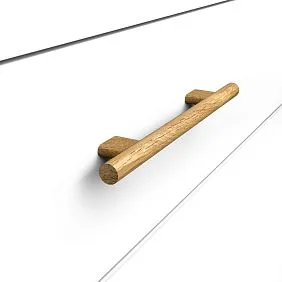
Scandinavian handles feature two main shapes: D-shaped hooks and round buttons. Hooks — for cabinets and drawers, providing secure grip and ease of use. Buttons — for lightweight upper cabinet doors, decorative chests, and furniture where visual delicacy is important.
Wooden handlesHooks have a simple cross-section — round with 18-25 mm diameter or square with rounded edges. No complex profiles, bevels, decorative grooves — only smooth surface, pleasant to the touch. Standard hook length — 96, 128, 160 mm (center-to-center distance), matching standard facades.
Buttons are round or slightly flattened, 30-40 mm in diameter, 20-30 mm in protrusion height. They are mounted on a single central fastener, simplifying installation and replacement. Surface is smooth or minimally textured (concentric circles, radial lines).
Finishing: oil instead of varnish
Scandinavian aesthetics prefer matte surfaces over glossy ones.Wooden handlesThey are coated with oil (linseed, tung) or oil-wax, which penetrate the wood structure, protecting it without forming a film. The wood remains tactilely alive — it is pleasant to hold, feel its texture, and warmth.
Varnish is rarely used in Scandinavian design — it creates artificial gloss, cools the hand, and deprives wood of its naturalness. If varnish is necessary (moist environments, heavy use) — only matte, water-based, applied in the thinnest layer.
Color remains natural — no stains, tinting, or painting. Light ash stays light, birch remains white, oak retains its natural tone. Over time, wood may slightly darken or yellow — this is a natural process that Scandinavians accept as a sign of the material’s life.
Placement: logic and convenience
Handles are placed strictly functionally. On hinged cabinet doors — closer to the free edge, at the natural hand grasp height (90-120 cm from floor for an average-height adult). On drawers — centered on width, slightly above the middle of the facade height.
Symmetry is important, but not fanatic. If a cabinet has doors of different widths, handles can be offset from the center of each door toward a single vertical axis — this creates visual order. On chests with multiple drawers, handles are aligned in strict vertical lines — the eye interprets this as calmness and systematic order.
Balusters: simplicity instead of ornamentation
The staircase in a Scandinavian home is not a decorative element, but a functional structure that must be safe, convenient, and visually light.Wooden balustersHere, they play a constructive role — they support handrails, create a barrier, and ensure safety.
Forms: geometric purity
Scandinavian balusters are simple, precisely turned or milled elements without complex carving. The most common shapes: a cylinder of constant cross-section, a slightly tapering cone, a square beam with rounded edges. Minimal decorative elements are possible — light grooves, slight enlargements at the base and top, but no more than that.
Baluster height is standard — 900 mm (from step to handrail), diameter 40–60 mm for round ones, cross-section 40×40 or 50×50 mm for square ones. Distance between balusters 100–150 mm (along axes) — sufficient to ensure safety (a child cannot squeeze through), and sufficiently sparse to avoid visual clutter.
Color: light on light
Wooden balustersIn Scandinavian style, balusters are often painted rather than left natural — white paint creates lightness, visually lightening the staircase. White balusters on light steps (white oak, beech) with white or light-gray walls — a classic scheme that works reliably.
An alternative — natural light-colored wood without paint, finished with oil. This is warmer, more tactile, but slightly more visually expressive. It is important that the wood species of the balusters matches other wooden interior elements — if skirting boards are beech, balusters should also be beech; if handles are birch, balusters should be birch.
Contrasting solutions (black balusters on light steps) are not used in classic Scandinavian style — this is too graphic, dramatic, and does not align with the philosophy of softness and light. However, in modern interpretations (japandi, Scandinavian with minimalist elements), black is acceptable as a point accent.
Alternatives: glass and metal
Besides wooden balusters, modern Scandinavian style allows glass panels (transparent tempered glass 10–12 mm thick) or thin metal cables/rods (stainless steel, matte finish). These solutions create even greater visual lightness — the staircase seems to float, not cluttering the space.
Glass panels are mounted in a wooden or metal frame, glass is absolutely transparent without tinting. Metal cables are tensioned vertically or horizontally with a 100–120 mm spacing, creating a subtle barrier. These options are more expensive than wooden balusters but more visually impactful.
Skirting boards: functional detail
Wooden baseboardIn Scandinavian interior — not a decorative excess, but a necessary element, concealing the technological gap between floor and wall, protecting the wall from damage during cleaning, and creating visual completeness.
Height and profile: restrained forms
Scandinavian skirting boards are low — 60–100 mm, maximum 120 mm in rooms with high ceilings. High classical skirting boards (150–200 mm) create excessive decoration, not matching the minimalist aesthetic. The profile is simple — a rectangle with a rounded top edge, slight rounding at the base, minimal bevel along the perimeter.
Complex profiled skirting boards with grooves, protrusions, and carving are not used in Scandinavian style. The simpler the form, the more modern and current the interior appears.Wooden baseboardIt should be almost invisible — perform its function, but not draw attention.
Color: matching floor or contrasting
Two approaches to choosing skirting board color. First — matching the floor finish: the skirting board visually continues the floor, extending it. If the floor is light oak, the skirting board should also be oak of the same shade. This creates monolithic unity, calmness, and visual expansion of the floor.
Second — white skirting board regardless of floor color. A white skirting board is perceived as a continuation of the wall, visually lifting it and making the room appear higher. This is a classic Scandinavian technique that works reliably in small rooms.
Intermediate option — skirting board lighter than floor by a few shades. For example, floor made of medium oak, skirting board made of white oak. This creates a smooth transition, delicate contrast without sharpness.
Installation: hidden fasteners
Scandinavian aesthetics require that fasteners be invisible.Wooden baseboardMounted on hidden clips, finish nails (nails without heads) or quality adhesive. If nails are used, their heads are countersunk, spackled, and painted to match.
Corners are mitered at 45° for perfect joints — no plastic corner caps typical of budget solutions. Joints should be invisible — this is a sign of quality work, respect for materials and space.
Wooden planks: modular rhythm
Wooden boards in interiorOne of the main trends of recent years, naturally fitting into Scandinavian aesthetics. They create texture, rhythm, visual depth, without overloading the space.
Vertical Rails: Visual Elongation
Vertical wooden planks 20-40 mm wide, 15-25 mm thick, installed with 30-50 mm gaps on the wall from floor to ceiling — a solution creating an illusion of height. The gaze slides along the lines upward, making the ceiling appear higher and the space more spacious.
Planks are mounted on a frame (metal or wooden), which is attached to the wall. Precise verticality is crucial — even a slight tilt is noticeable and disrupts harmony. Planks can be natural color (light beech, birch) or painted white, gray, or black.
Application: accent wall in the living room (behind the sofa, behind the TV), headboard in the bedroom, entry zone in the hallway. Planks create a focal point, but not aggressive — soft, rhythmic, calming.
Horizontal boards: expanding space
Horizontal planks visually expand the room — the gaze slides along the lines, making the wall appear wider. This technique works in narrow spaces — corridors, elongated rooms, where proportions need compensation.
HorizontalWooden boards in interiorMounted similarly to vertical planks, but require a stronger frame — greater horizontal load. The spacing between planks can be the same (30-50 mm) or larger (up to 100 mm), creating a more sparse rhythm.
Mixed solutions: geometry and freedom
Modern designers experiment with plank orientation: diagonal lines, zigzag, checkered pattern, chaotic arrangement. These solutions are more complex to install but create unique visual dynamics.
Avoid overdoing it: a plank wall should be the only one in the room; others should be calm and smooth. If there are too many planks — visual overload occurs, contradicting minimalism. Scandinavian design values balance: complexity in one zone is offset by simplicity in others.
Color palette: shades of light
Scandinavian minimalism in 2026 — not monochrome white, but a symphony of close light shades, creating depth without contrast.
White and its variations
White remains the base, but not sterile cold — warm: milk, cream, vanilla, ivory. These shades create softness, coziness, not harshness. Walls are painted with matte paint — no gloss, only velvety surface, absorbing light.
Ceiling may be lighter than walls (classic trick, visually lifting it) or the same shade (creating an enveloping atmosphere). Wooden elements —Baseboards, balusters— may be painted the same white or left natural.
Gray nuances
Gray is the second base color in Scandinavian design, but not cold graphite — warm beige-gray (grau), gray-blue, pearl. These shades create calmness, neutrality, serving as ideal background for wood and textiles.
Gray walls with wooden floor and furniture — classic Scandinavian scheme. Wood appears warmer against gray background, creating a light contrast, not irritating the eyes.Wooden handlesNatural color on gray cabinet facade — point accents of natural warmth.
Pastel accents
Scandi 2026 allows color — but delicate, pastel, muted. Pale blue (association with sky, water), soft green (connection with nature), powder pink (coziness, softness), light terracotta (warmth, earthiness).
These colors are used accentually: one wall, textiles (pillows, blankets, curtains), ceramics, small furniture. Base remains light and neutral — white, gray, beige. Wooden elements retain naturalness, linking colorful accents with nature.
Textiles and materials: tactile richness
Scandinavian minimalism compensates for visual simplicity with tactile variety. Touch should be pleasant — this is the philosophy of hygge, permeating the entire style.
Natural fabrics
Linen, cotton, wool, jute — only natural fibers. Synthetic materials are allowed minimally (for practicality of curtains, upholstery in high-use zones), but preference is given to natural materials.
Linen curtains let in light, creating soft diffused lighting. Cotton blankets are pleasant to the touch. Wool rugs are warm, durable, create acoustic comfort (absorb footsteps). Jute storage baskets — practical and aesthetic.
Wood as texture
Wood is present not only in structural elements (Furniture Handles, Baseboards, balusters), but also in decor: wooden trays, cutting boards as wall panels, branches in vases, tree stumps as stands.
Texture of wood is diverse: smooth polished tabletop surface, rough shiplap floor board, rougherrailson the wall. This is a tactile symphony, where each touch is unique.
Ceramics and glass
Handmade ceramics are an essential part of the Scandinavian home. Tableware with imperfect shapes, visible marks of the artisan’s hands, natural tones (white, gray, terracotta). It sits on open shelves, is used daily, and creates a connection with the pottery craft tradition.
Transparent, colorless, and patternless glass — glasses, vases, storage jars. Glass does not hide its contents, creating honesty and openness. Transparent vases with live branches, glass jars with grains on kitchen shelves — practicality as aesthetics.
Practical tips: how to create Scandinavian minimalism
Start with the base
The foundation of Scandinavian interior design — light walls, floor, ceiling. If walls are dark, repaint them white, gray, or beige. If the floor is dark parquet, consider whitening it or laying light laminate or engineered wood.
InstallWooden skirting boardsWhite or matching the floor tone — this immediately refreshes the interior. Replace old doors with simple, smooth white or light gray ones. Remove complex ceiling structures, multi-level gypsum boxes — the ceiling should be flat, white, with minimal lighting fixtures.
Add wood selectively
You don’t need to cover all walls with wood — just accents. One wall withwooden planksin the living room. Woodenbalusterson the staircase.Furniture Handlesmade of light wood on cabinets.
Wooden floor is ideal, but if budget is limited, light-quality laminate with wood texture is sufficient. Mainly — light tone, matte surface, no artificial gloss.
Free up space
Minimalism requires discipline: get rid of the unnecessary. Items unused for a year — sell, donate, discard. Keep only what is necessary and loved. Storage systems must be closed — cabinets, chests, boxes.
Surfaces (tables, chests, shelves) should not be cluttered with small items. Rule: maximum 3–5 items visible on one plane. The rest — inside. This creates visual calm, a sense of order and control.
Let in light
Scandinavians live in conditions of limited sunlight for most of the year — therefore, they value every ray. Windows should be maximally open: light transparent curtains or even without curtains (if privacy allows).
Artificial lighting is multi-level: general overhead lighting (chandelier or recessed lights), local (floor lamps, table lamps, wall sconces), decorative (LED strips under moldings, shelf lighting). Light should be warm (2700–3000 K), dimmable, creating a cozy atmosphere.
Frequently asked questions
Is Scandinavian style suitable for small apartments?
Perfectly suitable. Light colors visually expand space, minimal furniture doesn’t clutter, functionality of each item saves space. Scandinavian minimalism was created for compact spaces — this is its original essence.
Do you need to change all furniture to create a Scandinavian interior?
Not necessarily. Start with the base — walls, floor, lighting. Then gradually replace furniture with more suitable options. Intermediate option — update hardware: replace oldFurniture Handleswith light wooden ones, repaint cabinet fronts white.
Can Scandinavian style be combined with others?
Yes, especially with Japanese minimalism (resulting in 'Japandi' — one of the main trends of 2026). Scandinavian style also pairs well with eco-style, light neoclassicism, modern minimalism. The key — maintain balance of lightness, naturalness, functionality.
Which plants suit Scandinavian interior?
Simple, low-maintenance, with clear silhouette: ficus, monstera, snake plant, succulents, ferns. Pots — simple ceramic, concrete, white or terracotta. Avoid colorful flowering plants — they create visual noise.
How to care for wooden elements?
Wooden skirting boards, rails, balustersWipe with a damp cloth without aggressive chemicals. Once a year, treat with wood oil (if oil-based finish) or polish (if lacquered).Wooden handlesWipe with a dry cloth — they naturally polish with frequent contact.
It depends on the approach. Basic finishing (painting walls, simple flooring, minimal decor) is affordable. Quality wooden furniture and fittings cost more but last for decades. Scandinavian design values quality over quantity: better to buy one good wooden table than three cheap ones made of particle board.
Will it be boring to live in a white interior?
Scandinavian minimalism 2026 — not sterile white, but multi-layered light. Shades, textures, materials create visual depth. Plus, nature outside the window, changing daylight throughout the day, live plants, textiles — all of this makes the interior alive, ever-changing, never boring.
Scandinavian Minimalism 2026 — not sterile white, but multi-layered light. Tones, textures, materials create visual depth. Plus nature outside the window, changing daylight throughout the day, live plants, textiles — all of this makes the interior alive, ever-changing, never boring.
How to add individuality to a minimalist interior?
Through selective accents: handmade ceramics, black-and-white photographs, a collection of favorite books on open shelves, vintage rugs, unusual lamps. The key is to have a little, but with soul. Each item should have meaning, history, and emotional connection to you.
Is Scandinavian style suitable for families with children?
Yes, it is one of the most family-friendly styles. Practicality, functionality, safety (no sharp corners, no unnecessary items), eco-friendly materials — all of this is important for children. Light surfaces require slightly more care for cleanliness, but they foster neatness.
Is a designer needed to create a Scandinavian interior?
Not necessarily — Scandinavian style is quite intuitive. Basic principles (lightness, naturalness, simplicity, functionality) are easy to understand. A designer can help avoid mistakes, find optimal solutions, and save budget, but if you’re willing to study the topic and proceed gradually — you can manage it yourself.
Conclusion: the philosophy of sufficiency
Scandinavian minimalism in 2026 is not a trend, but a worldview. In an era of information overload, consumer excess, and constant rush, Scandinavian style invites you to pause, breathe, and return to basics. LightWooden handles, simplebalusters, functionalBaseboards, Wooden boards in interior— these are not just finishing details, but tools for creating a space where you can breathe, think, and be yourself.
A Scandinavian home does not shout about the owners’ wealth, does not display status, does not try to impress guests. It is simply convenient, honest, beautiful in quiet beauty of natural materials and simple forms. This is a space where there is enough light, air, warmth — physical and emotional.
The company STAVROS offers a full range of wooden elements for creating a Scandinavian interior:Furniture Handlesmade of light beech and oak,Wooden balusterssimple forms,Wooden skirting boardsof different heights,wooden interior railsAll items are made from premium solid wood, undergo quality processing, and are coated with eco-friendly oils and varnishes. By contacting STAVROS, you receive not just materials, but the opportunity to create a home where the Scandinavian philosophy of sufficiency, light, and warmth becomes your everyday reality.