Article Contents:
- The Philosophy of Built-in Storage: The Cabinet as Part of the Wall
- Niche: The Architectural Foundation
- Facades: The Mirror of the Room's Architecture
- Color and Toning: The Cabinet in the Room's Palette
- Solid Wood Furniture Decor: Overlays and Carved Elements
- Corner Overlays: Accentuating the Frame
- Central Rosettes and Medallions: Focal Points
- Vertical Carved Planks: Dividing the Facade
- Cabinet Cornices: The Crown of the Structure
- Cornice as an Extension of the Ceiling Baseboard
- Multi-Level Cornice: Complexity and Luxury
- Color and Toning of the Cornice
- Moldings Around the Cabinet: A Frame on the Wall
- Frame Around the Cabinet: Boundary and Context
- Vertical Pilasters on the Sides of the Cabinet
- Horizontal Moldings: Dividing the Wall
- Baseboard Molding: The Foundation of the Cabinet
- Baseboard as an Extension of the Floor Plinth
- Decorative Baseboard: Carving and Profiles
- Repeating Profiles: The Language of Architecture
- Unified Profile: From Ceiling to Floor
- Scaling Decor: From Large to Small
- The Technique of 'Dissolving' the Cabinet: Practical Methods
- Monochromatic Painting: Cabinet the Color of the Wall
- Mirror Inserts: Reflecting Space
- Glass Doors: Transparency and Lightness
- Hidden Cabinets: Camouflaged as Panels
- Classic Styles and Cabinet Decor
- Baroque: Opulence and Dynamism
- Classicism: strictness and symmetry
- Empire: Imperial Might
- Neoclassicism: Lightened Classic
- Materials: Solid Wood as Standard
- Wood Species: Oak, Beech, Ash, Pine
- Surface Treatment: Oil, Wax, Varnish, Enamel
- Frequently Asked Questions
- Can a Wardrobe Be Built into a Room Without a Niche?
- How High Should the Cornice on a Wardrobe Be?
- Is Gilding Mandatory in a Classic Interior?
- How to Care for a Solid Wood Wardrobe with Carved Decor?
- How Much Does It Cost to Make a Classic Solid Wood Wardrobe with Decor?
- Can a Classic Wardrobe Be Combined with Modern Furniture?
- What's Better: Swinging Doors or Sliding Doors in a Classic Wardrobe?
- Conclusion: Create Architecture, Don't Just Store Things
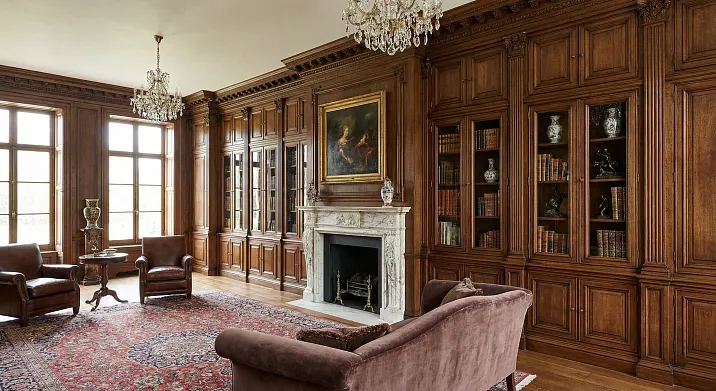
Why do some wardrobes look like randomly placed storage boxes, while others resemble architectural structures, an integral part of the walls? The difference isn't in size or cost, but in understanding the principle of integration.Classic cabinetsSolid wood wardrobes should not protrude in the interior like foreign bodies. They require architectural context, decorative support, and thoughtful integration into the overall style of the room. This is not just furniture—it's an element of architectural composition that either enhances the impression of the interior or ruins it.
A classic interior is a system where each element is connected to others through the repetition of profiles, proportions, and motifs. If there is a cornice with a specific pattern on the ceiling, this pattern should be echoed in the wardrobe's decor. If the doors are adorned with moldings, the wardrobe facades should repeat this language.Classic FurnitureA wardrobe does not exist on its own, but in dialogue with the walls, ceiling, floor, and doors. And the task of the designer or owner handling the interior independently is to create this dialogue.


Philosophy of Built-in Storage: Wardrobe as Part of the Wall
A built-in wardrobe and a freestanding wardrobe are two different entities. A built-in wardrobe is mounted into a niche; its side walls and ceiling are the room's walls. A freestanding wardrobe is an independent structure with its own walls, bottom, top, and back. In classic interiors, the built-in option is preferred, or a freestanding one designed to look built-in.




Niche: Architectural Foundation
If there is a niche (a recess in the wall) in the room, it is the ideal place for a wardrobe. The niche depth should be at least 60 cm for a clothes wardrobe (so that clothing on hangers fits without creasing). The niche width determines the wardrobe width. The height—from floor to ceiling—ensures the wardrobe blends with the architecture, rather than hanging in space as a separate object.
If there is no niche, one can be created: build drywall walls forming a recess. Yes, this will 'eat up' a few centimeters of the room, but the result—a wardrobe that looks like part of the wall—is worth these losses. An alternative is a freestanding wardrobe placed against the wall but decorated so that the boundary between the wardrobe and the wall is blurred.
Our factory also produces:


Facades: Mirror of the Room's Architecture
The facades of a built-in wardrobe are what is visible. And they should speak the same language as the room's doors, windows, and wall panels. If the room's doors are paneled (with a frame and a recessed central part), the wardrobe facades should also be paneled. If there are molding frames on the walls, the wardrobe facades can repeat these frames in scale.
Swinging wardrobe doors are preferable to sliding doors (wardrobe doors) in classic interiors. Sliding doors create horizontal lines and visible tracks—this contradicts the classic aesthetic of verticals and symmetry. Swinging doors with carved or milled panels, with quality hardware (concealed hinges, elegant handles) are the correct choice.
Get Consultation
Color and Toning: Wardrobe in the Room's Palette
A wardrobe that contrasts in color with the walls inevitably stands out and attracts attention. This may be appropriate if the wardrobe is a focal point (e.g., an antique carved wardrobe in a living room). But if the goal is integration, the wardrobe's color should be within the room's overall palette.
Light walls (white, beige, cream)—the wardrobe should also be light. The wood is painted white, ivory, light gray, or toned with a transparent white glaze that preserves the wood texture but lightens it. Dark walls (deep blue, gray, green)—the wardrobe is toned in dark shades: wenge, rosewood, mahogany.
A monochrome interior (walls and wardrobe of the same color) creates a dissolving effect: the wardrobe doesn't catch the eye, becoming an extension of the wall. The decorative relief of the facades is revealed by the play of light and shadow, not by color contrast.
Solid Wood Furniture DecorAppliqués and carved elements
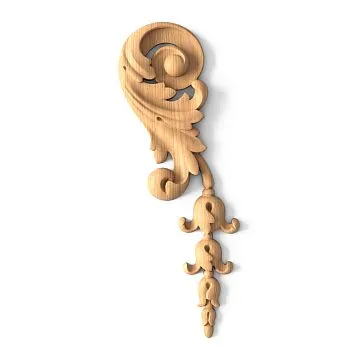
Even a properly designed and painted cabinet front can appear flat and dull without decoration.Solid Wood ItemsAppliqués, rosettes, carved corners, and central medallions transform a simple door into a work of applied art.
Corner appliqués: accentuating the frame
The corners of front panels are natural points for decorative placement. Carved appliqués, echoing motifs of classical ornamentation (acanthus leaves, rosettes, volutes), are mounted with glue and micro-screws in each of the four corners of the panel. Appliqué size: 8–15 cm per side, thickness 10–20 mm. The appliqué protrudes above the front plane, creating volume.
The appliqué motif should echo the decor of other interior elements. If the cabinet cornice (discussed below) features floral carving, the corner appliqués can replicate the same motif in miniature. If the room has a carved fireplace, the cabinet appliqués can quote its decor.
Central rosettes and medallions: focal points
The center of a front panel is the place for a rosette or medallion. Round, oval, or square shapes, sized 10–20 cm, with a relief pattern (floral, geometric, zoomorphic) create a visual center of attraction. There can be one rosette per entire door (if the door is large) or several (if the door is divided into two or three panels vertically).
Installing the rosette: it is mounted precisely in the geometric center of the panel, aligned along the axes of symmetry. Asymmetric placement disrupts classical harmony. The rosette's color can match the front color (monochrome relief) or be contrasting (gilded rosette on a white front, dark on light).
Vertical carved strips: dividing the front
If a cabinet front is wide (door width over 60 cm), it can appear bulky. A vertical carved strip, installed at the center of the door, visually divides it into two parts, easing perception. The strip can be flat with a milled pattern or a three-dimensional carving (half-column, pilaster).
Strip width: 5–10 cm, height—full height of the panel or door. The strip profile—straight with flutes (vertical grooves), wavy, twisted (like rope). The strip is attached with glue, additionally secured with micro-screws at the top and bottom (fasteners are hidden under the cornice and base molding).
Cabinet cornices: the crown of the structure
The upper part of a cabinet is a critical zone. If the cabinet ends with a flat top, it looks unfinished, like a box. A cornice (a decorative profiled element crowning the cabinet) creates completeness, connects the cabinet to the ceiling, and adds monumentality.
Cornice as an extension of the ceiling skirting
Ideal integration of a cabinet into an interior—when the cabinet cornice replicates the profile of the room's ceiling skirting (cove molding). If the room has a wooden ceiling skirting of a specific profile, the same profile is used for the cabinet cornice. This creates a visual connection: the ceiling and cabinet speak the same language.
Cornice height: 10–20 cm depending on ceiling height and cabinet scale. For a standard room with a 2.7 m ceiling—cornice 12–15 cm. For a room with high ceilings 3.5 m and above—cornice 18–25 cm. The cornice is mounted on the cabinet's top lid, protrudes forward by 3–8 cm, creating a visor.
Multi-level cornice: complexity and luxury
A simple cornice—one profile. A complex (multi-level) cornice—a combination of several profiles installed in steps. Lower level—wide, smooth or with light milling. Middle—carved with floral ornamentation. Upper—thin accent (cove, shelf).
A multi-level cornice is appropriate in spacious rooms with high ceilings, where the cabinet is large and requires corresponding crowning. In small rooms, a complex cornice will feel oppressive, reducing perceived height. Rule: the higher the ceiling and larger the cabinet, the more complex and taller the cornice can be.
Color and toning of the cornice
The cornice can match the cabinet front color (monochrome solution, accent on relief) or be contrasting. A contrasting cornice (white on a dark cabinet, dark on light, gilded on any) stands out, becoming a decorative crown. Gilding the cornice—a technique for luxurious interiors in Baroque, Empire styles. Imitation gold (Dutch metal) or real gold leaf is applied to the cornice's carved elements, creating a palace furniture effect.
Moldings around the cabinet: a frame on the wall
A cabinet, even perfectly designed and decorated, can appear freestanding if the wall around it is empty. Moldings, installed on the wall around the cabinet perimeter or creating frames on the sides, integrate the cabinet into the room's architecture.
Frame around the cabinet: boundary and context
Molding is mounted on the wall at a distance of 5–15 cm from the cabinet edge, forming a frame. If the cabinet is built-in (in a niche), the molding frames the niche opening, making it resemble a portal or doorway. If the cabinet is freestanding, the molding on the wall creates the illusion of a niche into which the cabinet is 'built-in'.
Molding width: 5–10 cm, relief—classical (beads, egg-and-dart, ovolo, ribbons). The molding profile should echo the profile of the cabinet cornice and ceiling skirting. If the cabinet cornice has a specific curve, the frame molding can replicate this curve in a simplified form.
Vertical pilasters on the sides of the cabinet
A pilaster—a flat imitation of a column, projecting from the wall. Installed on the sides of the cabinet, pilasters transform the storage area into an architectural portal.interior wall decorPilasters create a vertical structure, emphasize height, and add monumentality.
Pilaster height: from floor to ceiling or from floor to the top of the cabinet (if the cabinet does not reach the ceiling). Pilaster width: 10–20 cm, projection from the wall: 2–5 cm. A pilaster consists of three parts: base (lower, expanded), shaft (central, vertical, can be smooth, fluted, carved), capital (upper, decorative).
Installation of pilasters: they are mounted on the wall strictly vertically, at a distance equal to the width of the cabinet plus 10–30 cm on each side. Pilasters create a 'frame' for the cabinet, making it part of the architectural composition. Pilaster color — matching the wall or contrasting (white pilasters on a colored wall).
Horizontal moldings: wall division
If the wall is high and the cabinet does not reach the ceiling, the space above the cabinet may look empty. A horizontal molding installed at the level of the cabinet top divides the wall into two zones: lower (with the cabinet) and upper (above the cabinet). This creates proportion and order.
The molding runs along the entire length of the wall (or along the length of the zone with the cabinet), at the height of the cabinet's top lid or slightly higher (at the cornice level). Molding width: 3–8 cm, classic relief. The wall above the molding can be painted the same color as below or in contrast (e.g., lower part dark, upper part light).
Baseboard molding: cabinet base
The lower part of the cabinet also requires attention. A cabinet standing directly on the floor looks heavy and squat. A baseboard molding (an elevated baseboard installed along the bottom of the cabinet) visually lifts the cabinet, creating a foundation.
Baseboard as an extension of the floor baseboard
If a high wooden baseboard (10–15 cm) is installed in the room, the cabinet baseboard should be of the same height and profile. This creates visual unity: the baseboard runs along the perimeter of the room, wrapping around the cabinet, and it seems as if the cabinet 'grows' out of the baseboard, becoming part of the wall.
The baseboard can be slightly higher than the floor baseboard (by 2–5 cm), creating a stepped effect: floor baseboard, then cabinet baseboard, then cabinet facade. This adds architectural complexity. The baseboard molding is mounted on the lower frame of the cabinet, protruding forward by 1–3 cm, forming a small overhang.
Decorative baseboard: carving and profiles
The baseboard can be not just a smooth board but a decorative element. Carved ornament, milled profiles (ovolos, beads, flutes) along the lower edge of the baseboard add sophistication. Corner overlays (like on facades) can be installed on the corners of the baseboard if the cabinet is freestanding and its sides are visible.
Baseboard color: matching the cabinet facade or contrasting (like the cornice). A dark baseboard on a light cabinet creates solidity, 'grounding' the structure. A light baseboard on a dark cabinet — lightness, airiness.
Repeating profiles: the language of architecture
The secret to fully integrating a cabinet into the interior is repeating profiles. If a certain profile (curve, sequence of convexities and concavities) is used in the ceiling molding, it should be repeated in the cabinet cornice. If door trims have a certain decorative element, this element should appear on the cabinet facade.
Unified profile: from ceiling to floor
The maximum degree of integration is when the same profile (or profile motif) is used in all architectural elements of the room. Ceiling molding, cabinet cornice, wall frames, door trims, floor baseboard, cabinet baseboard — all are executed with repetition of one profile or its variations.
This does not mean absolute identity (which would be boring), but variations on a theme. For example, the ceiling molding has a profile with a scotia and a fillet. The cabinet cornice repeats the scotia and fillet but adds a carved frieze. The floor baseboard simplifies the profile, leaving only the scotia. Thus, the profile 'travels' around the room, creating a visual connection.
Scaling decoration: from large to small
A decorative motif (e.g., an acanthus leaf) can be present in different scales. A large acanthus leaf — on pilaster capitals (if they are present in the room or on the cabinet). Medium — on the cabinet cornice. Small — on corner overlays of the facades. This creates hierarchy but preserves stylistic unity.
Important: do not overload. If an acanthus leaf is already used in three places, a fourth is excessive. Balance between repetition (creating connection) and variety (preventing monotony) is the key to success.
Technique of 'dissolving' the cabinet: practical techniques
How to make a massive cabinet not dominate the interior but fit into it harmoniously, almost disappearing? There are several proven techniques.
Monochromatic painting: cabinet the color of the wall
The most effective dissolving technique is to paint the cabinet the color of the wall. If the walls are cream, the cabinet is also cream. If the walls are gray, the cabinet is gray. The difference in tone can be minimal (1–2 shades darker or lighter), but the overall palette is the same.
Decorative relief of facades, cornices, overlays remains visible due to the play of light and shadow. Directed lighting (spotlights, sconces) enhances the relief, revealing details. A monochromatic cabinet does not stand out, becomes a background, but a high-quality, noble background.
Mirror inserts: reflection of space
A mirror on the cabinet facade is a classic technique. The mirror reflects the room, and the cabinet seems to disappear, replaced by the reflection. A fully mirrored facade (from floor to ceiling, across the entire width of the door) is a bold solution that visually doubles the space.
Mirror inserts in frames — a more restrained option. The central part of the panel — a mirror, framed by a wooden frame with molding. The mirror can be clear, tinted (bronze, graphite), aged (with patina, like antique). An aged mirror adds vintage charm but does not provide such a bright reflection.
Glass doors: transparency and lightness
If the cabinet is a display case (for dishes, books, collections), glass doors are a functional and aesthetic solution. The glass is transparent or lightly tinted, with a wooden frame featuring classic profiles. Inside the cabinet, there is lighting (LED strips along the perimeter of the shelves) highlighting the displayed items.
Glass doors make the cabinet visually lighter but require order inside. Chaos behind glass is a disaster. The glass can be frosted, engraved, or have a beveled edge (an angled, polished edge creating a play of light).
Hidden cabinets: disguised as panels
A radical technique is to completely disguise the cabinet as wall panels. The cabinet fronts are decorated with the same moldings used on the walls. Handles are hidden (push-to-open) or absent (the door opens by pressing a hidden point). The front finish is strictly matched to the wall color.
Result: the cabinet is indistinguishable from a wall with decorative panels. Only by knowing where the doors are can they be opened. This solution is for those who want maximum visual cleanliness and no visible storage systems.
Classical styles and cabinet decor
Different classical styles (Baroque, Rococo, Classicism, Empire, Neoclassical) require different cabinet decor.
Baroque: opulence and dynamism
Baroque-style cabinets are about the luxury of carving, an abundance of decor, and curvilinear forms. The cornice is complex, multi-level, with large plant motifs (acanthus, grapes, garlands). Fronts have carved overlays, gilding, possibly inlay. Handles are large, ornate, bronze with gilding.
Color: dark noble woods (walnut, mahogany) or light with gilding (white with gold, cream with gold). Cabinet legs (if not a built-in version) are curved cabriole. A Baroque cabinet does not blend into the interior but dominates, becoming the center of attention.
Classicism: strictness and symmetry
Classicism loves order, symmetry, restraint. Cabinets are rectangular, with strict proportions. There is decor, but it is measured: straight fluted pilasters on the sides of the fronts, rosettes in the center, a cornice with Ionic motifs (egg-and-dart, beads, dentils). Color: light (white, ivory) or natural (light oak, ash).
Handles are small, rings or stylized classical forms (lyres, small columns). A Classicism cabinet does not shout but quietly asserts nobility and taste.
Empire: imperial power
Empire — the style of Napoleon's empire — is monumental, heroic, saturated with symbols of power. Cabinets are massive, with columns (real round ones, not pilasters) on the sides. Decor: laurel wreaths, eagles, swords, shields, sphinxes. The cornice is heavy, with large elements. Color: dark (mahogany, ebony) with gilded bronze overlays.
An Empire cabinet is a throne for clothes, a symbol of status. It is appropriate in spacious rooms with high ceilings, where its power will not overwhelm the space.
Neoclassical: lightened classicism
Neoclassicism is Classicism adapted to modern life. Proportions are classical, but forms are simpler, decor is minimal. Cabinets have clean lines, laconic profiles, restrained carving. The cornice is not bulky but elegant. Fronts are smooth or with shallow panels.
Color: neutral (gray, beige, white, light wood). Handles are thin, metal (brass, chrome, matte black). A Neoclassical cabinet integrates easily into modern spaces and does not look like a museum piece.
Materials: solid wood as the standard
Classic cabinetsshould be made of solid wood. This is not a whim but a necessity. Solid wood has density, the ability to hold carving and milling, and a texture that shows through under varnish or oil. Chipboard, MDF can imitate wood (veneer, film) but do not possess its tactile and visual qualities.
Wood species: oak, beech, ash, pine
Oak — a classic, hard, dense species with a pronounced texture. Ideal for carving, takes stains well (from light to black), durable. Oak cabinets are heavy, substantial.
Beech — slightly softer than oak, lighter, with a less pronounced texture. Suitable for painted cabinets (enamel), as its smooth structure provides an even surface. Beech cabinets are warmer in tone.
Ash — lightweight, strong, with a beautiful texture (similar to oak but lighter). Good for natural stains that emphasize the grain pattern. Ash cabinets are elegant, not bulky.
Pine — soft, budget-friendly, easy to work with. Suitable for painted cabinets (enamel, patina), but not for carving (soft wood does not hold fine details). Pine cabinets are a compromise between price and quality.
Surface treatment: oil, wax, varnish, enamel
Oil — penetrates the wood, emphasizes the texture, gives a matte or semi-matte surface. The wood breathes, feels pleasant to the touch. Requires periodic renewal (re-oiled every 1–2 years).
Wax — applied over oil or on its own, gives a slight sheen, protection from moisture. A waxed surface is warm, natural.
Varnish — creates a protective film on the surface, can be matte, semi-matte, glossy. Glossy varnish gives shine, emphasizes color, but shows fingerprints. Matte varnish is more practical, creates a noble surface.
Enamel — opaque paint, hides the wood grain. Used when a specific color is needed (white, gray, colored). Enamel can be matte, semi-matte, glossy. High-quality enamel (polyurethane, acrylic) does not yellow or crack.
Frequently asked questions
Can a cabinet be built into a room where there is no niche?
Yes. Create a niche using drywall walls or install a cabinet against the wall and decorate it (moldings, pilasters) to create the illusion of a niche. A floor-to-ceiling cabinet painted to match the wall color will look built-in.
How high should the cornice on a cabinet be?
Depends on the ceiling height and cabinet size. For a standard room (2.7 m) — 12–15 cm. For high ceilings (3.5 m and above) — 18–25 cm. Rule: the cornice should be proportional to the cabinet, not too small (it will get lost) and not too large (it will overwhelm).
Is gilding mandatory in a classic interior?
No. Gilding is for Baroque, Empire styles where luxury is important. In Classicism, Neoclassicism, gilding is minimal or absent. Natural wood with oil or restrained painting (white, gray) is quite classic.
How to care for a solid wood cabinet with carved decor?
Dust is removed with a soft brush or vacuum with an attachment (low power to avoid damaging the carving). The surface is wiped with a slightly damp cloth, then dried. Oil finishes are renewed every 1–2 years by applying oil. Lacquered finishes do not require renewal, only regular cleaning.
How much does it cost to make a classic solid wood cabinet with decor?
Depends on size, wood species, complexity of decor. A simple two-door wardrobe from solid pine with basic milling — from 80–120 thousand rubles. A cabinet from oak with carved decor, complex cornice, gilding — from 300–500 thousand and above. Individual design increases the cost.
Can a classic cabinet be combined with modern furniture?
Yes, if balance is maintained. A classic cabinet can become an accent in a modern interior if it is high-quality, with beautiful decor, but not overloaded. Painting the cabinet in a neutral color (white, gray) facilitates integration. Avoid bright gilded Baroque cabinets in minimalism — this is a style conflict.
What is better: hinged doors or sliding doors in a classic cabinet?
Hinged. Sliding doors with visible tracks, recessed handles contradict classical aesthetics. Hinged doors with elegant hinges (hidden or decorative), handles, carved fronts — the classic standard.
Conclusion: create architecture, not just store things
Classic cabinets— these are not just storage systems. They are architectural elements that shape the character of the interior, create rhythm, proportions, decorative richness.Classic Furniturerequires context: decorative cornices, moldings on walls, repetition of profiles, thoughtful color harmony. A cabinet integrated into the room's architecture throughSolid Wood Furniture DecorandSolid Wood Items, ceases to be furniture and becomes part of the walls, an extension of the space.
The technique of dissolving the cabinet — monochrome painting, repetition of profiles, framing with moldings, use of mirrors and glass — allows integrating even a large cabinet so that it does not dominate, but harmoniously coexists with other elements. Classic styles (Baroque, Classicism, Empire, Neoclassicism) dictate different degrees of decorativeness, but all require one thing: quality of execution, natural materials, adherence to proportions.
STAVROS company has specialized in the production ofclassic furnitureandof solid woodfor interior decor.Classic cabinetsfrom the STAVROS catalog are made from solid oak, beech, ash using traditional joinery techniques with modern equipment. Each cabinet can be adapted to specific room dimensions, chosen style, individual preferences for tinting and decor.
Assortmentfurniture decor from solid woodSTAVROS includes carved overlays, rosettes, corner elements, cornices, moldings, pilasters, plinth profiles — everything needed to create a full-fledged architectural composition. The possibility of individual tinting (from light Scandinavian shades to rich dark tones of wenge and mahogany) allows fitting the cabinet into any color palette of the interior.
STAVROS professional consultants will help select decor, calculate the number of elements, compose a composition that will turn your cabinet from a piece of furniture into an architectural masterpiece. STAVROS workshops execute individual projects — from sketch to installation — creating cabinets that perfectly fit into a specific space, considering all the features of the room and the customer's wishes.
Create interiors where every element is thought out, where furniture and architecture speak the same language, where storing things becomes an art. With STAVROS, this is not a dream, but a reality, accessible to those who value quality, traditions, attention to detail.