Article Contents:
- Philosophy of scale: why more does not mean worse
- Historical perspective
- Wide wooden skirting board: architectural frame of space
- Height and proportions: selection based on room
- Profiles: from minimalism to classic
- Material: solid wood versus veneer and MDF
- Color and finish
- Large furniture handles: hinges as architectural elements
- Hinge length: from standard to extra
- Cross-Section and Shape
- Material of handle-hinges
- Unity of scale: skirting boards and handles in dialogue
- Principle of proportional scaling
- Material unity
- Stylistic consistency
- Stylistic solutions: from classic to avant-garde
- Neoclassicism: monumentality with elegance
- Scandinavian minimalism: large and simple
- Loft and industrial: brutality of scale
- Modern classic: proportions without ornament
- Maximalism and eclecticism: play of contrasts
- Practical aspects: selection, installation, care
- How to choose skirting board height
- Installing Wide Wooden Skirting Boards
- Installation of large handle-hinges
- Care for Wide Baseboards
- Care for large handles
- Psychology of perception: how scale affects sensations
- Common mistakes
- Frequently Asked Questions
- Conclusion: scale as a statement

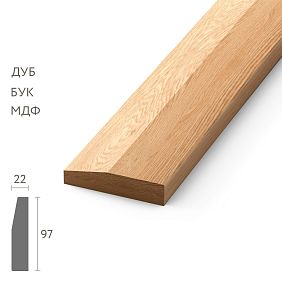
At 100-150 mm, it replaces modest 50-mm strips, creating a powerful horizontal frame of space.wide wooden baseboardAt 100-150 mm, it replaces modest 50-mm strips, creating a powerful horizontal frame of space.Furniture Handlesenlarge —Furniture hinge handleLengths of 192-320 mm and more have become the norm where previously 96-128 mm were used. This is not a random increase in size — it is a deliberate move toward scale, architecture, expressiveness. Large elements create visual anchors, structure space, make interiors more cohesive, substantial, significant. They restore tactility — a wide skirting board feels tangible as an architectural element, a large handle comfortably fits in the palm. This is a countermeasure against dematerialization, a desire to return interiors to physical reality, presence that can be not only seen but also felt.




Philosophy of Scale: Why More Does Not Mean Worse
The decade of minimalism has conditioned us to think: the smaller and less noticeable the detail, the better. Baseboards were hidden behind shadow lines, made microscopic at 30-40 mm. Handles were replaced with integrated profiles, recessed into facades, made as inconspicuous as possible. Result? Interiors devoid of tactility, physicality, character. Spaces that look beautiful in photographs but feel cold, disembodied, alienating in reality.
This is also a question of architectural honesty. A narrow 40-millimeter skirting board in a room with 3-meter ceilings looks disproportionate and insecure, as if trying to hide. A wide 120-millimeter skirting board honestly declares itself, creating proportional scale and harmonizing with the room’s volume. The same applies to furniture — a tiny 64-millimeter handle on a massive 60 cm wide cabinet door looks pitiful. A 192 mm handle creates proper proportions.
Wide skirting boards — not an invention of 2026. It’s a return to classical architectural tradition. In palace interiors of the 17th–19th centuries, skirting boards reached heights of 200–300 mm, creating monumental frames. They often had complex profiles, sometimes adorned with carving or gilding. This was a full-fledged architectural element, part of the overall decorative system.




Historical Perspective
In the 20th century, with the arrival of functionalism and modernism, skirting boards diminished. Bauhaus preached minimal decoration; the skirting board became a utilitarian detail, concealing the junction between floor and wall. By the end of the 20th — beginning of the 21st century, skirting boards reached their minimum — 40–50 mm, almost invisible.
Now the pendulum has swung back. Not to the excessive opulence of the 18th century palaces, but to sensible proportionality, where the skirting board is a full-fledged compositional element, not a shamefully hidden technical necessity.
Wide wooden skirting board: architectural frame of space
Our factory also produces:
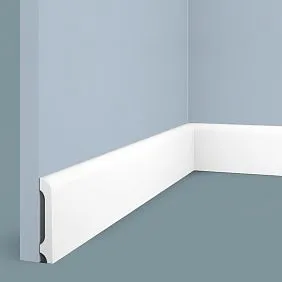
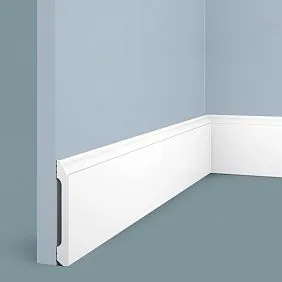
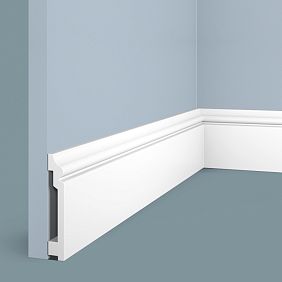
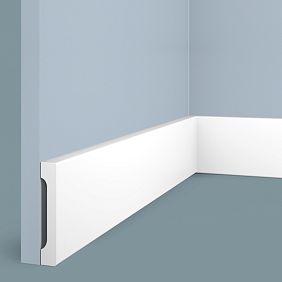
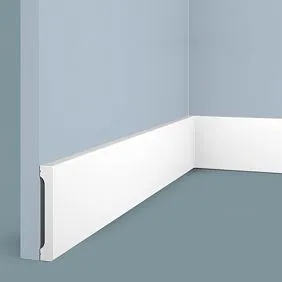
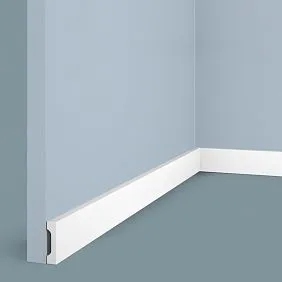
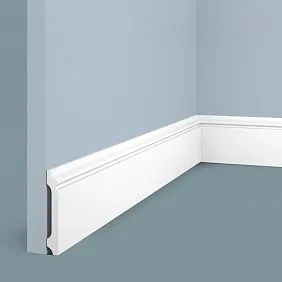

— key trend of 2026. Height of 100–150 mm becomes a new standard for modern and neoclassical interiors, replacing traditional 60–70 mm.
wide wooden baseboardHeight and proportions: choice based on the room
Get Consultation
100–120 mm — universal height for most rooms. Suitable for standard ceilings of 2.7–3.0 meters. Creates an expressive horizontal line without visually overloading. This is the optimal balance between visibility and subtlety.
A wooden skirting board of this height visually expands the floor, creating the impression of a more spacious room. A dark skirting board on light walls creates a contrasting frame, clearly separating the floor from the wall. A skirting board matching the floor color creates an effect as if the floor rises 10–12 cm up the wall — grounding, stabilizing effect.
A wooden baseboard of such height visually expands the floor, creating the impression of a more spacious room. A dark baseboard on light walls creates a contrasting frame, clearly separating the floor from the wall. A baseboard matching the floor color creates an effect as if the floor rises up the wall by 10-12 cm — grounding, stabilizing effect.
120–150 mm — height for rooms with ceilings 3 meters and higher. Creates palace-like monumentality, grandeur, characteristic of classical interiors. Such a skirting board is a standalone architectural element, drawing attention.
A high skirting board may have a complex profile — multiple relief tiers, grooves, protrusions, creating play of light and shadow. This is not just a plank, but a full-fledged architectural module. In historical interiors, such skirting boards were often combined with wall panels, creating a lower protective and decorative tier.
150 mm and above — extreme height for special cases. Rooms with 4–5 meter ceilings, grand halls, commercial spaces. Skirting boards of this height create a dramatic effect, emphasizing scale, transforming detail into a dominant element.
Profiles: from minimalism to classicism
Flat straight profile — minimalist solution without relief. Simply a wide vertical plane connecting floor and wall. Relevant for modern, Scandinavian, Japanese interiors, where clean lines are valued.
A flat wide skirting board may have a bevel on the top edge — a chamfered corner creating subtle light play. A bevel of 10–20 mm adds graphic quality, making the skirting board slightly more visually complex without destroying minimalist aesthetics.
Profiled classic — skirting board with relief created by milling. Bulges and hollows, ridges and grooves create a classic profile, characteristic of neoclassical and traditional interiors.
The profile can be simple — one or two relief elements — for restrained neoclassicism. Or complex multi-tiered — five to seven elements with deep relief — for grand classical interiors. Profiled wide skirting boards create expressive play of light and shadow, especially under side lighting.
With grooves — vertical grooves cut into the skirting board surface. Classic architectural motif borrowed from order columns. Grooves create vertical rhythm, visually increase height, add refinement.
Grooved skirting boards are characteristic of neoclassical and Empire interiors. They require careful manufacturing — grooves must be straight, of equal depth, parallel. Handwork is unacceptable here — only CNC milling ensures the required precision.
Material: solid wood versus veneer and MDF
Solid wood — premium choice. Oak, ash, beech — hardwoods resistant to impacts and abrasion. Solid wood has natural texture, visible even under paint, creating depth. Solid wood skirting boards are heavy, strong, long-lasting — serving for decades.
Advantages of solid wood: material nobility, possibility of multiple repairs (sanding, repainting), eco-friendliness, tactile comfort. Disadvantages: high cost, susceptibility to deformation from humidity fluctuations (requires quality wood drying), greater weight.
Veneered MDF — compromise between quality and price. Base — MDF (pressed wood fiber board), surface — thin veneer of natural wood (0.6–1 mm). Veneer provides natural wood texture, MDF — stable shape and acceptable price.
Veneered skirting boards deform less from humidity than solid wood. They are lighter, easier to install. But upon damage — chips, deep scratches — the MDF base becomes visible, and repair is more difficult than with solid wood.
MDF for painting — budget solution for interiors where skirting boards will be painted. Primed MDF base is perfectly smooth, without texture, enabling flawless paint application. Paint lays evenly, resulting in rich, uniform color.
MDF skirting boards are lighter than solid wood, cheaper, more stable in shape. But less resistant to impacts, afraid of water (swell when wet), lack natural wood texture. Choice for painted interiors with limited budget.
Color and finish
Natural wood — transparent finish (oil, lacquer, wax), preserving and emphasizing texture. Relevant for eco-style, Scandinavian, rustic interiors. Color — from light ash to dark walnut.
Light natural skirting board (birch, ash, light oak) creates lightness, airiness, visually expands space. Medium (natural oak, beech) — versatility, warmth. Dark (walnut, stained oak, wenge) — drama, contrast, solidity.
Stained wood — stains and tinting oils change color while preserving texture visibility. Can make an inexpensive species resemble an expensive one — stain pine to look like oak, birch to look like walnut. Or create non-standard shades — gray oak, bleached ash.
Tinted gray skirting board — trend of 2026. Gray is a modern, neutral, universal color suitable for most interiors. Tinting in gray creates a noble restraint, Scandinavian aesthetics.
Painted — covering paints hide texture, creating a uniform colored surface. White — classic for many styles. Black — modernity, graphic design. Colored — individuality, boldness.
PaintedWide wooden skirting boardCan be matte (trend of 2026), satin (compromise), or glossy (classic). Matte paint creates modernity, does not reflect light, hides minor defects. Glossy — solemnity, but requires perfect surface preparation.
Large furniture handles: brackets as architectural elements
If skirting board is a horizontal frame of space, thenFurniture Handles— tactile contact points with objects. In 2026, handles are enlarged, especiallyFurniture hinge handle— L-shaped form, grasped by the entire palm.
Bracket length: from standard to extra
96–128 mm — traditional length used over the last decade. Suitable for standard facades 40–60 cm wide. But in 2026, this is considered 'small' scale, relevant only for compact furniture.
160–192 mm — new standard. Brackets of this length visually weigh, are convenient to grasp, proportionate to modern facades 60–90 cm wide. They create expressive horizontal lines on facades, structuring them.
A 192 mm handle on an 80 cm wide facade creates proper proportions — the handle occupies about a quarter of the facade width, visually balanced. It is sufficiently large to be noticeable, but not dominating.
224–320 mm — large brackets for wide facades and island kitchens. A 320 mm bracket on a 120 cm wide facade looks powerful, modern, architectural. This is no longer just a handle, but part of the facade composition.
Large brackets are often used horizontally at the top or bottom of a facade, creating an integrated profile. The handle becomes part of the design, not just a functional element.
400 mm and above — extreme sizes for special projects. A bracket spanning the entire facade width, from edge to edge. Such handles make furniture sculptural, monumental. Relevant for kitchens in loft, minimalism, hi-tech styles.
Cross-section and shape
Round section — classic bracket shape. Diameter 10–16 mm is convenient for gripping. Round brackets can be smooth or ribbed (with grooves for better grip with the palm).
Round brackets are universal, suitable for most styles. They are tactilely pleasant — the hand naturally wraps around the tube. A large round bracket with 16 mm diameter looks substantial, solid.
Square section — modern geometry. A square-sectioned bracket 10x10, 12x12, 15x15 mm creates graphicness, clear lines. Characteristic of minimalism, loft, Scandinavian style.
Square brackets can have sharp or rounded edges. Rounded (radius 1–2 mm) are more pleasant to the touch, sharp edges are more graphic but may be uncomfortable.
Rectangular section — flat bracket, where width is greater than thickness. For example, 8x30 mm — thin in depth, but wide in vertical plane. Creates visual lightness even at large sizes — an 8x30 mm section 320 mm bracket looks like a thin line but remains functional.
Flat brackets are relevant for minimalist kitchens, where visual purity of facades is valued. They almost merge with the surface, becoming part of the geometry.
Figured brackets — complex shape, where cross-section changes along length or has decorative elements. Bracket may thicken toward center, have beveled edges, decorative bands. Characteristic of classic, vintage, eclectic interiors.
Handle bracket material
Wood — warm, natural, tactilely pleasant. Woodenfurniture handles bracketscreate unity with wooden furniture, skirting boards, other elements. Solid oak, ash, walnut are finished with oil, varnish, or painted.
Advantage of wooden brackets — tactile comfort. Wood feels warm to the touch, does not chill the hand like metal. Wooden handle is pleasant even in winter, when metal feels icy.
Metal — strength, durability, modernity. Stainless steel, brass, aluminum, black steel — each metal creates its own character.
Stainless steel — universality, hygiene (relevant for kitchens). Can be polished (glossy sheen), satin (soft sheen), or matte.
Brass — warm golden metal, nobility, classic elegance. Matte brass without shine is trending for 2026.
Black matte steel — modernity, graphic design, industrial aesthetics. The most current choice for modern kitchens and furniture.
Leather — an exotic choice. A leather loop instead of a traditional hook creates softness, tactility, Scandinavian or ethnic aesthetics. Leather can be natural (brown, black, white) or colored.
Leather handles are less durable than metal or wooden ones and require careful handling. But they create a unique character, especially in interiors that value hand-made aesthetics.
Scale Unity: Skirting Boards and Handles in Dialogue
Wide skirting boards and large handles must work within a unified scale system, creating visual harmony.
Principle of Proportional Scaling
Ifwide wooden baseboard120 mm creates a large architectural scale; furniture handles must match. A tiny 64 mm handle against a massive skirting board creates disproportion.
Rule: A 100-120 mm skirting board requires handles at least 128-160 mm long. A 120-150 mm skirting board requires 160-192 mm handles and more. This creates visual balance, where elements of different types (horizontal skirting boards, vertical/horizontal handles) have comparable weight.
Material Unity
A wide wooden skirting board and wooden handles from the same wood species create natural unity. An oak skirting board with oak hooks, a beech skirting board with beech handles — the material links elements of different scales.
If the skirting board is painted, handles can be painted the same color. A white skirting board with white wooden or painted metal handles. A black skirting board with black matte handles. Color unity works even with different materials.
Contrasting combinations are also possible: a natural oak skirting board with black metal handles. Warm wood balances cold metal, creating dynamism. But it’s important that the contrast is intentional, not random.
Stylistic Consistency
A classic profiled skirting board requires classic handles — brass with decorative elements or carved/engraved wooden handles. A minimalist flat skirting board — simple geometric hooks without decoration.
Mixing styles is possible in eclectic interiors, but requires virtuoso sense of proportion. If the skirting board is modern minimalist and the handles are vintage brass — a unifying element is needed: for example, brass elements in lighting fixtures or door hardware.
Stylistic Solutions: From Classic to Avant-Garde
Neoclassicism: Monumentality with Elegance
A neoclassical interior requires tall skirting boards 120-150 mm with a classic profile. Oak or beech, painted white, cream, or left natural with varnish. The profile is moderately complex — three to four relief elements without excess.
Furniture Handles— brass or bronze hooks 160-192 mm, satin or matte finish. Classic shape, but restrained, without excessive ornamentation. Hooks may have a slight curve, creating elegance.
Color palette: white skirting board and golden brass create a classic combination. Natural oak skirting board and bronze handles — nobility and warmth.
Scandinavian Minimalism: Large and Simple
Scandinavian style uses wide skirting boards 100-120 mm with a simple flat profile or minimal bevel. Material — light wood (birch, beech) with transparent oil or painted white.
Handles — wooden hooks with round cross-section from light wood, 128-160 mm long. Or black matte metal — a contrasting accent. Simplicity of form, honesty of material, functionality — Scandinavian values.
Color palette: light natural tones with black accents. A white skirting board on white walls creates a delicate relief, black handles — graphic accents.
Loft and Industrial: Brutality of Scale
Loft values roughness, industrial style, expressed materiality. Wide skirting board 100-150 mm from rough wood with brushing, knots, cracks. Color — dark (worn oak, graphite), emphasizing drama.
Handles — black matte steel, large hooks 192-320 mm square or rectangular cross-section. Massive, utilitarian, without decorative excess. Or brown leather loops — soft contrast to industrial rigidity.
Contrast of materials — the key to loft. Wooden skirting board and metal handles, concrete walls and warm wood. Rough and elegant in one space.
Modern Classicism: Proportions without Ornament
Modern classicism takes proportions and scale from classic interiors, but removes ornamentation. Skirting board 120-150 mm, but without complex profile — simple flat surface or light profiling. Color — neutral (white, gray, black).
Handles — large hooks 192-224 mm simple shape from matte brass, stainless steel, or painted metal. No scrolls, rosettes, classical motifs — only pure geometry and material nobility.
Elegance through restraint, luxury through quality, not through decoration. Wide elements create scale, but simplicity of form preserves modernity.
Maximalism and eclecticism: play of contrasts
Maximalist interiors of 2026 use large elements to create drama. Very wide skirting boards 150-200 mm, painted in deep saturated colors — emerald, sapphire, burgundy. Profile complex or, conversely, extremely simple — contrast at the level of form.
Handles — diverse, but all large. On one kitchen, brass brackets, wooden leather hinges, vintage rings may coexist — if this is intentional eclecticism, not chaos. Unifying factor — scale (all large) and quality (all expensive, well-made).
Color combinations are bold: dark green skirting and gold handles, black skirting and red leather hinges. Maximalism — is boldness, individuality, rejection of the blandness of minimalism.
Practical aspects: selection, installation, care
How to choose skirting board height
Main criterion — ceiling height:
-
2.4–2.7 m — skirting 80–100 mm
-
2.7–3.0 m — skirting 100–120 mm
-
3.0–3.5 m — skirting 120–150 mm
-
Above 3.5 m — skirting 150 mm and more
Also consider room area. In small rooms, a very wide skirting board may visually reduce space. In spacious rooms — conversely, it will create the desired scale.
Interior style: minimalism allows wide skirting boards, but simple profile. Classic — tall and profiled. Loft — rough, massive.
Installation of wide wooden skirting boards
Wide skirting is heavier than narrow, requires more secure mounting. Methods:
Adhesive — liquid nails or construction adhesive is applied in a zigzag pattern to the back of the skirting, which is pressed against the wall. Suitable for perfectly flat walls. Pros: invisible mounting, aesthetically pleasing. Cons: difficult to remove if needed.
Self-tapping screws — the skirting is screwed to the wall with self-tapping screws. Screw heads are countersunk and filled with putty in matching tone, then sanded. More reliable than adhesive, but labor-intensive. Suitable for skirting boards to be painted — putty is covered by paint.
C-clips — hidden mounting, where metal or plastic clips are attached to the wall, and the skirting clicks into them. Convenient for removal, but requires perfectly flat walls and a special profiled skirting board.
Corners of wide skirting boards are cut at 45 degrees for neat joining. Use a circular saw or a miter gauge for precise cutting. Wide skirting boards require more precise cutting than narrow ones — errors are more noticeable.
Installation of large bracket handles
Large brackets require precise marking — a 1–2 mm error is visually noticeable on a long handle.
Use a template: a strip with holes spaced at your bracket’s center-to-center distance (160, 192, 224 mm, etc.). Attach to the facade, drill through the template — guarantee of accuracy.
Large metal brackets are heavier than small ones. Ensure screws are long and thick enough to securely hold the weight. For heavy brackets, use 5–6 mm screws instead of standard 4 mm screws.
If the facade is thin (16 mm), install a reinforcing strip inside, to which the screws will be attached. This prevents screw pull-out under the weight of heavy brackets.
Care for wide skirting boards
Wooden skirting boards accumulate dust, especially if profiled. Regular vacuuming with a soft brush. Wet wiping — once a month, avoiding excessive moisture.
Skirting boards with oil finish require renewal every 3–5 years. Surface is sanded with fine grit (240), cleaned, and a new layer of oil is applied. Lacquered boards last 10–15 years without renewal.
Damage (scratches, dents) on wide skirting boards is more noticeable than on narrow ones. Local repair: scratches are filled with matching wax pencil, deep dents — with furniture putty, then sanded and finished with varnish or oil.
Care for large handles
Wooden — like skirting boards, regular wiping, and periodic finish renewal as needed.
Metallic matte — soft damp cloth, no abrasives. Fingerprints are removed with slightly damp microfiber. Brass develops patina over time — if patina is undesirable, polish with special agents every 2-3 months.
Leather handles — wipe with a damp (not wet!) cloth; every half-year, treat with a skin care product (cream, wax) to prevent drying and cracking.
Perception Psychology: How Scale Affects Feelings
Large elements create a psychological sense of reliability, stability, and solidity. A wide skirting visually grounds the room, making it appear more stable. This subconsciously calms — the space seems safer.
Large handles are tactilely comfortable — no need to strain fingers to grasp a tiny button. A wide bracket naturally fits in the palm. This creates a sense of physical comfort that influences the overall perception of furniture and interior design.
Scale elements also create a sense of luxury, thoughtfulness, and individuality. A wide wooden skirting is more expensive than a narrow one, and a large brass bracket is more expensive than a small one. This signals that money, time, and attention to detail have been invested in the interior.
Common Mistakes
Error 1: Wide skirting in rooms with low ceilings (2.4 m and below). A 120 mm skirting visually 'eats' height, making the room appear low. Solution: for low ceilings, maximum 80-100 mm.
Error 2: Mixing scales. A wide 120 mm skirting and small 64 mm handles create disproportion. Solution: harmonize the scale of all elements.
Error 3: Ignoring color. Skirting is painted in cool gray, handles in warm beige. Visual conflict. Solution: harmonize color temperature.
Error 4: Poor installation. A wide skirting on an uneven wall creates noticeable gaps. Solution: level walls before installation or use flexible skirting for uneven surfaces.
Error 5: Cutting costs on material. A wide skirting made of cheap MDF with wood veneer looks cheap and ruins the impression. Solution: better to choose a narrow skirting made of solid wood than a wide one from cheap material.
Frequently asked questions
Will a wide skirting make the room visually smaller?
It depends on color. A dark wide skirting on light walls creates a contrasting frame visually separating floor from wall, which may slightly reduce space. But a skirting in the same tone as walls or floor visually expands the floor, making the room appear larger. For small rooms — match the tone, for large rooms — use contrasting colors.
What is the minimum ceiling height required for a 120 mm skirting?
Minimum 2.7 meters. At lower heights, a 120 mm skirting creates disproportion and makes the room appear low.
Can wooden skirting and metal handles be combined?
Yes, this is a classic combination. Natural oak skirting and brass handles create warmth and elegance. Or black skirting and black metal handles — modern monochrome.
How much does installation of a wide wooden skirting cost?
Wide wooden skirting boardSolid oak skirting 100-120 mm high costs from 1500-3000 rubles per linear meter. Installation — from 300-500 rubles per linear meter. For an 80 sq.m apartment (perimeter around 40 linear meters) — from 72,000 to 140,000 rubles for material + labor.
How to choose the length of the handle-clip?
Rule: bracket length should be approximately 1/4–1/3 of facade width. For a 60 cm facade — bracket 128–160 mm. For an 80 cm facade — 160–192 mm. For a 120 cm facade — 224–320 mm.
Can a wide skirting be repainted in another color?
Yes, wooden skirting can be repainted multiple times. The surface is sanded, primed, and painted with new paint. This allows updating the interior without replacing elements.
Are very large handles (320 mm and above) practical?
From a functional standpoint — yes, they are easy to grasp. But they require appropriate scale of furniture and interior design. On compact furniture in a small room, they will look disproportionate.
Should skirting and door casings be coordinated?
Desirable. They should be made of the same material, color, and profile. Skirting and casings — architectural framing of space; their unity creates cohesion.
Conclusion: Scale as a Statement
Choosing wide skirting and large handles — this is not merely following a trend. It is a statement of values: quality matters more than quantity, scale matters more than miniaturization, physical presence matters more than dematerialization.
wide wooden baseboardHeight of 100–150 mm — this is an architectural element creating a substantial horizontal frame for the space. It protects walls, visually grounds the room, and is the final touch completing the interior.Furniture hinge handleLength of 160–320 mm — this is not merely a way to open a door, but a tactile point of contact, a compositional element of the facade, a tool for defining the character of an object.
Together, they create a system of scales where details do not hide, do not shy away from being minimal, but honestly declare themselves, creating visual and tactile significance. This is an interior that does not strive to disappear or dissolve into the air, but confidently asserts itself, evoking a sense of materiality, reality, and solidity.
In the era of life’s virtualization, when most of our existence takes place in the digital space of screens, physical objects acquire special value. A wide wooden skirting board, which you can run your hand along, feeling its texture. A heavy brass bracket that lies solidly in your palm. These are islands of reality, tactility, materiality. And choosing large-scale elements — this is choosing the physical world over the virtual.
For more than twenty years, the company STAVROS has offered elements that create this weight and significance.Wide wooden skirting boardsHeight from 80 to 200 mm — from minimalist flat to classic profiled — made from solid oak, ash, beech.Furniture HandlesLarge-scale — brackets, knobs, appliqués — made of wood and metal, coordinated in style with the skirting boards.
The possibility of custom manufacturing to your dimensions and sketches means you are not limited by standards — you can create skirting boards exactly the height, profile, and color needed for your project. You can order handles exactly the length and shape that will create the correct proportions on your furniture.
STAVROS professional consultants will help you choose the right scales — they will advise on the optimal skirting board height for your ceilings, the correct handle length for your facades, coordinate colors and materials. They will help you avoid errors of disproportion, creating a harmonious system where all elements work together.
Material quality — solid noble wood species, durable finishes, precise profiling. Craftsmanship — traditional joinery techniques combined with modern CNC technologies. Variety of choices — from simple to complex, from light to dark, from minimalist to classic. All of this is STAVROS — a company that understands: details create interiors, and the scale of details creates character.
Choosing STAVROS, you choose weight over weightlessness, presence over disappearance, materiality over virtuality. You choose an interior that confidently asserts itself, where wide skirting boards create an architectural frame, and large handles provide tactile comfort. Create spaces that are scaled, expressive, materially significant. Because in a world striving toward dematerialization, the physical weight of quality, large, expressive elements —wide skirting boardsandlarge handles— becomes luxury, a statement, a philosophy of life.