Article Contents:
- History and Philosophy: From Palace Halls to Modern Living Rooms
- Wide Skirting Board in the Architecture of the Past
- Revival in Modern Interiors
- Advantages: Why Height Matters
- Visual Monumentality and Status
- Maximum Wall Protection
- Concealing Utilities: High-Capacity Cable Ducts
- Correcting Room Proportions
- Sizes: From Moderate Width to Plinth Panels
- 100-120 mm: Entry into the Wide Category
- 140-160 mm: Classic Monumentality
- 180-200 mm: Plinth Panels and Palace Scale
- Profiles and Styling: From Strict Geometry to Carved Splendor
- Straight Profile: Modern Restraint
- Beveled Profile: Elegant Transition
- Classical Figurative: Play of Volumes
- Multi-Level Complex: Architectural Luxury
- Wood Species: What Can Withstand Monumentality
- Oak: Unrivaled Strength
- Beech: Light Uniformity
- Ash: Northern Contrast
- Installation: Weight, Precision, Patience
- Wall Requirements: Evenness and Strength
- Fastening: Pitch and Reliability
- Corner Processing: Millimeter Precision
- Working in Pairs: The Physics of Wide Planks
- Cost: An Investment in Architecture
- Pricing: What Determines the Price
- Price Comparison: Wide vs. Standard
- Calculation for a specific room
- Stylistic combinations: where wide baseboards reign supreme
- Classical interiors: Empire, Baroque, English classic
- Neoclassicism: balance of tradition and modernity
- Scandinavian interiors in country houses
- American classic: tall white baseboards
- Frequently asked questions about wide baseboards
- STAVROS: technologies for monumental details

Why does wood whisper in some interiors and thunder in others? Why does a classic St. Petersburg mansion convey monumentality even when empty? The secret isn't in gilding or square footage. The secret is in proportions. And hereWide Wooden Skirting Boardplays the role of the foundation of visual hierarchy. A height of 100-200 millimeters isn't a technical detail. It's an architectural statement that fundamentally changes the perception of space.
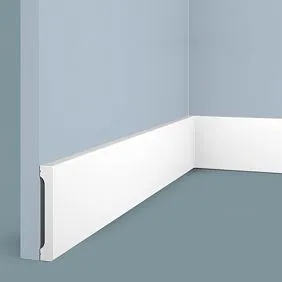
A standard 60-80 mm baseboard serves a function: it covers the joint between floor and wall, hides gaps, protects wallpaper from vacuum cleaners. That's it. It's modest, inconspicuous, neutral.Wide wooden floor skirting boardwith a height of 120-160 mm is a completely different story. It doesn't hide. It shapes the architecture of the room, creates visual mass at the base of walls, sets the rhythm of the space. A room with such a baseboard is perceived as more expensive, more solid, more thoughtful—even if the rest of the finish is modest.
But a wide baseboard requires understanding. Installing a 140 mm high plank in an apartment with 2.5-meter ceilings is a proportion disaster. The room will become squat, oppressive, absurd. However, in a living room with 3.2-meter ceilings, the same baseboard will create a balance unattainable with a narrow profile. Height, profile, wood species, installation method—every aspect is critical. A mistake will cost dearly both in money and in a ruined interior.
This article is a practical guide for those building an interior with high ambitions. For whom wood isn't just a material, but a carrier of aesthetics. For owners of country houses with high ceilings, apartments in Stalin-era buildings, lofts with three-meter windows. We'll analyze sizes, profiles, wood species. Discuss installation—because attaching a plank weighing 3-4 kilograms per meter is completely different from a lightweight 70 mm baseboard. Calculate costs so you know real prices, not sellers' fantasies. And show how to choose correctly—without overpaying and without compromising on quality.




History and philosophy: from palace halls to modern living rooms




Wide baseboards in the architecture of the past
St. Petersburg mansions of the 18th-19th centuries, Moscow estates, European palaces—everywhere wide baseboards 150-250 mm high. Not because they didn't know how to make narrow ones. But because they understood: baseboard height must correspond to ceiling height. Halls with 4-5 meter ceilings required massive framing at the base of walls. A narrow baseboard got lost, made the space disproportionate.
Classicism, Empire, Baroque—styles where architectural elements work systematically. A high ceiling cornice at the top, a wide floor baseboard at the bottom, with vertical pilasters or moldings in between. Symmetry, balance, the mathematics of beauty. A 15-20 cm high baseboard in this system isn't excess, but a necessity.
The material of baseboards in historical interiors—solid oak, walnut, mahogany. Hard, expensive species capable of holding complex profiles with beads, rolls, carved ornaments. A plank width of 16-20 mm ensured the strength of a large-scale element. Hand processing—planing, carving, sanding—required skill and time. Such a baseboard was expensive, a sign of status.
The revolution and Soviet mass housing killed the tradition of wide baseboards. Ceilings dropped to 2.5 meters, rooms shrank to 12-18 m². A wide baseboard in a Khrushchev-era apartment looks absurd. Narrow 50-70 mm profiles from cheap materials became standard. Wood was replaced by plastic and MDF. Aesthetics gave way to utilitarianism.
Our factory also produces:


Revival in modern interiors
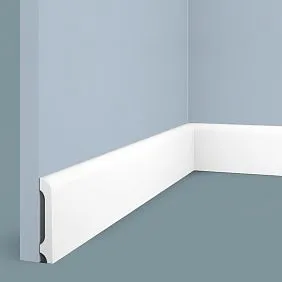
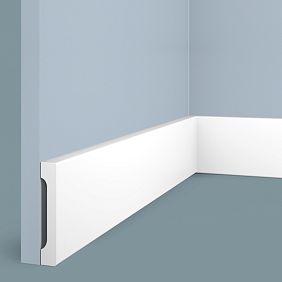
The 2010s—a return of interest in classical proportions in design. New business-class buildings are constructed with 3-3.2 meter ceilings. Country house construction prefers 3.5-4 meter heights in living rooms. Space requires appropriate framing.with a classic profile creates a sense of solidity, reliability.with a height of 120-160 mm returns as a necessary element of a harmonious interior.
Neoclassicism—the style dominating premium interiors in the 2020s. Classical proportions, but without excessive decorativeness. A wide baseboard with a laconic profile—a chamfer or simple roll. Without carving or gilding, but with the noble texture of natural oak or ash. A modern interpretation of historical examples.
Scandinavian style in country houses also uses wide baseboards. But here the preference is for a straight profile without decoration, light ash wood or whitewashed oak, matte oils instead of glossy varnishes. A width of 100-120 mm creates visual mass while maintaining the laconicism characteristic of northern aesthetics.
American classic in cottages uses 140-180 mm baseboards with multi-level profiles. Often white—painted with enamel. A tall white baseboard against colored walls—a hallmark of American interiors. Creates contrast, structures space, makes the finish visually more expensive.
Modern minimalist architecture sometimes uses wide baseboards as a contrasting element. Smooth walls without decoration, minimal furniture, open space—and a powerful 150 mm high baseboard of dark oak, creating a horizontal line that grounds the interior. An unexpected but effective solution.
Get Consultation
Advantages: why height matters
Visual monumentality and status
The psychology of space perception works predictably. Massive elements at the base of walls create a sense of stability, solidity. A thin baseboard reads as a temporary solution, a budget option. A wide 120-150 mm baseboard made of solid oak signals: they didn't skimp here, they built seriously.
Status isn't achieved with gold and marble. Status is in correct proportions and quality materials. A wide wooden baseboard combined with high ceilings, parquet from valuable species, floor-to-ceiling doors creates a sense of respectability. Even if the furniture is simple, the architectural foundation sets the tone.
Compare two rooms with the same floor area and ceiling height of 3.2 meters. In the first, the baseboard is 70 mm. In the second, it's 140 mm. The second room looks visually more expensive, more thoughtful, more architectural. The baseboard creates a visual "plinth" on which the walls stand. The first room looks unfinished, as if they forgot to add the final touch.
Hotel lobbies, restaurants, and offices of premium companies intentionally use wide baseboards to create an impression of solidity. A client entering the room subconsciously reads these signals. A massive wooden baseboard is one of the markers that shape the impression of quality and reliability.
Maximum wall protection
The practical function of a baseboard is to protect the lower part of walls from mechanical damage. Impacts from vacuum cleaners, mops, furniture legs during rearrangement, water splashes when washing the floor. The baseboard absorbs these impacts, preserving the wall.
A baseboard 60-70 mm high protects 6-7 centimeters from the floor. This is sufficient for minimal protection of wallpaper or paint. A baseboard 120-160 mm protects 12-16 centimeters. This is the zone where most accidental impacts, touches, and splashes occur. The wall stays clean longer and doesn't require touch-ups or re-pasting.
Families with children and pets will especially appreciate a tall baseboard. Children touch walls with their hands, roll toy cars, throw toys. Dogs and cats rub against walls, scratch with their claws. A baseboard 140 mm high takes the brunt of the damage. Scuffs and scratches on the baseboard are less noticeable than on wallpaper. And wood can be sanded and refinished — you can't restore wallpaper like that.
Wet rooms — kitchens, bathrooms, hallways — require enhanced protection from water. A narrow baseboard doesn't save from splashes; water hits the wall above. A wide baseboard 100-120 mm, coated with moisture-resistant varnish or oil, creates a barrier. Treated wood withstands humidity better than paint or wallpaper on the wall.
Concealing utilities: high-capacity cable channels
A modern apartment has dozens of meters of wires. Internet, telephone, TV cable, speaker wires, chargers. Running everything in the wall is expensive and not always possible in a finished renovation. A cable channel in the baseboard is a practical solution.
A standard 70 mm baseboard with a cable channel holds 2-4 wires. If there are more wires — they don't fit, bulge out, interfere with installation. A wide baseboard 120-140 mm has an enlarged cable channel, holding 8-12 wires of different cross-sections. Everything is neatly laid inside, nothing is visible.
A smart home with automation for lighting, climate, and security requires laying dozens of cables to sensors, switches, and sockets. A wide baseboard becomes a trunk line along which utilities run around the perimeter of the room. Access to wires through a removable panel allows adding or changing cables without dismantling the entire baseboard.
Office spaces with many computers, printers, and phones traditionally use wide baseboards with cable channels. This is a standard for commercial interiors. Transferring this solution to residential spaces is logical and practical — especially for home offices, media zones, children's rooms with computers and gadgets.
Correction of room proportions
High ceilings are many people's dream. But a room with ceilings 3.5-4 meters and a narrow 60 mm baseboard looks disproportionate. The walls seem too high, the space — empty, cold. A wide baseboard visually "lowers" the walls, creating a horizontal line that divides the vertical and gives the space a human scale.
An architectural technique — using horizontal divisions to adjust proportions. A baseboard at the bottom, a cornice at the top, sometimes a molding at one-third of the wall height. These elements divide the vertical into parts, create a rhythm comfortable for the eye. The higher the ceiling, the more pronounced the horizontal divisions should be.
Narrow rooms — corridors, galleries — visually expand when using a light, wide baseboard that contrasts with darker walls. A light horizontal strip at the floor creates an illusion of greater width. A dark baseboard in a narrow room enhances the feeling of confinement.
Asymmetric rooms with different ceiling heights in different zones benefit from a single wide baseboard around the entire perimeter. The baseboard creates visual unity, connects the zones. Different ceiling heights are perceived as a conscious architectural decision, not a planning accident.
Sizes: from moderate width to plinth panels
100-120 mm: entry into the wide category
This is the lower threshold of the wide baseboard category. A height of 100-120 millimeters is noticeably larger than the standard but doesn't cross into the monumental range. A universal choice for rooms with ceilings 2.9-3.2 meters — typical height in business-class new builds and cottages.
Suitable for which interiors: neoclassical with moderate decorativeness, contemporary interiors with classical elements, Scandinavian spaces in country houses, simplified American classic. A 100-120 mm baseboard creates visual solidity but doesn't dominate the space.
Rooms with an area of 20-40 m² with such ceilings are optimally balanced with a baseboard of this height. Living rooms, bedrooms, studies, dining rooms. Not for miniature rooms 12-15 m² — there a 100 mm baseboard would be excessive. Not for huge halls 80-100 m² — there a height of 140-160 mm is required.
Profiles for this height are diverse. Simple rectangular with a chamfer for contemporary styles. Classic with one bead for neoclassical. Multi-level with two projections for English classic. Carved with geometric ornament for historical interiors. A height of 100-120 mm allows implementing a complex profile without the risk of fragility.
The weight per linear meter of a 100 mm oak baseboard is 1.2-1.5 kg. For a height of 120 mm — 1.5-1.8 kg. This is significantly heavier than standard 70 mm baseboards weighing 0.7-0.9 kg. Mounting requires more frequent screw spacing — every 50-60 cm instead of 70-80 cm for light profiles.
140-160 mm: classic monumentality
A height of 140-160 millimeters — the territory of pronounced classicism. These are baseboards for rooms with ceilings 3.2-3.5 meters, area from 35 m² and above. Country living rooms, halls in cottages, formal rooms in historical buildings. Powerful visual presence, forming the architectural framework of the space.
Such height requires appropriate context. Tall doors — preferably floor-to-ceiling or at least 2.4-2.5 meters. Ceiling cornice 120-200 mm high for balance. Moldings on walls or decorative panels. A 150 mm baseboard in a room with 2-meter doors and no ceiling cornice looks alien.
Profiles at this height are most often complex. Classic with two-three beads, recesses, coves. Multi-level with pronounced relief. Carved with floral or geometric ornaments. Simple rectangular profile at 150 mm height is rare — such height implies classical styling, and it requires decorativeness.
Wood species for baseboards of this height — predominantly oak. The hardness and density of oak allow carving a complex profile without the risk of chipping. Beech is used less often — its uniform grain is less expressive on large elements. Ash suits Scandinavian and contemporary interiors where light wood with contrasting grain is needed.
The weight per linear meter of a 140 mm oak baseboard is 2.2-2.7 kg. For a height of 160 mm — 2.5-3.2 kg. This is a serious load on the mounts. Screws are placed every 40-50 cm. On drywall walls, reinforced butterfly anchors or mounting to the metal frame is required. On weak plasters — chemical anchors.
180-200 mm: plinth panels and palatial scale
A height of 180-200 millimeters is no longer a baseboard in the conventional sense, but a plinth panel. An architectural element that forms a powerful horizontal foundation for walls. Used in rooms with ceilings of 3.5 meters and higher. Palace halls, museum spaces, vestibules of historical buildings, modern mansions with ambitious architecture.
A plinth panel of this height is often painted in a contrasting color relative to the walls. A white panel against gray or beige walls. A dark panel against light ones. Or it is clad with wooden panels—boiserie—creating a plinth belt around the perimeter of the room. This is no longer just a floor trim, but an independent decorative element.
Profiles at this height can be either complex classical or deliberately simple. In historical interiors—multi-level with carving, panels, gilding. In a modern interpretation—a concise rectangular profile with a chamfer, but due to its 200 mm height, creating a powerful visual impression.
Structurally, skirting boards of this height are sometimes made not as solid pieces but as assembled ones. The base is made of MDF or plywood, topped with veneer or solid wood of valuable species. Or two to three elements—a lower strip, a middle section, and an upper profile element—assembled into a single structure. A solid piece 200 mm high is expensive and prone to deformation with changes in humidity.
The weight per linear meter of a solid oak baseboard 200 mm high is 3.5-4.5 kg. Installation requires two people—holding such a plank alone while cutting corners and installing is impossible. Fastening every 40 cm is mandatory. On historical walls made of brick and rubble masonry, long self-tapping screws 120-150 mm are used, reaching a solid base behind the plaster layer.
Profiles and styles: from strict geometry to carved splendor
Straight profile: modern restraint
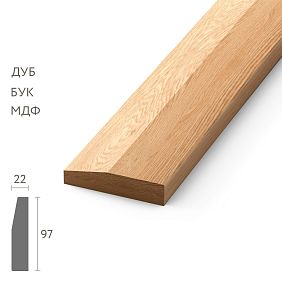
A rectangular profile without decorative elements—minimalism in a wide baseboard. Height 100-150 mm, width 16-20 mm, upper and lower edges strictly parallel. No beads, recesses, or bevels. Pure geometry, emphasizing the wood texture.
Where it works: modern interiors with an emphasis on material, not form. Lofts with concrete walls and wooden elements. Scandinavian spaces where conciseness is valued. Japanese minimalism with its philosophy of simplicity. A wide straight baseboard made of light ash in such interiors is a powerful architectural accent without decorative excesses.
Surface treatment defines the character. A smooth sanded surface under clear oil—restrained elegance. Brushed texture with emphasized relief of annual rings—a more expressive option. Bleached wood—Scandinavian aesthetics. Dark wenge oil—modern drama.
Installing a straight profile is easier than a shaped one. There are no complex joints of relief elements in the corners. A 45° cut—and two planks join evenly. But any inaccuracy is clearly visible—straight lines do not forgive mistakes. A 1 mm gap on a shaped profile gets lost in the relief. On a straight one—it catches the eye.
Profile with a chamfer: elegant transition
The upper edge of the baseboard is beveled at a 30-45° angle with a width of 10-15 mm. Creates a soft transition from the plane of the baseboard to the wall. Visually lightens the massive element, makes it more elegant. The chamfer can be straight or slightly concave—a cavetto.
The versatility of the chamfered profile makes it a popular choice. Suitable for both modern and classical interiors of moderate decorativeness. A 120 mm baseboard with a chamfer in a neoclassical living room—a harmonious solution. The same profile in a modern bedroom with classical elements—also appropriate.
A wide skirting board with a chamfer appears visually thinner than a straight one of the same height. The beveled edge creates a play of light and shadow, breaking up the monolithic look. A 140 mm skirting board with a chamfer looks more elegant than a straight 120 mm skirting board, even though it is actually taller.
Joining in corners requires precision. The chamfer on both planks must meet perfectly in the corner. A half-degree inaccuracy gives a visible gap on the chamfer with a chamfer width of 15 mm. A professional miter saw with a laser guide and precise angle adjustment is a necessity for quality installation.
Classical shaped: play of volumes
One or two beads, separated by recesses. Lower bead diameter 15-20 mm, upper 10-15 mm. Between them—a concave cavetto. On top—a chamfer or cornice. A classic profile scheme, originating from 18th-19th century architecture.
For wide baseboards 140-160 mm, the classical shaped profile is most characteristic. The height allows placing several levels of relief without making them too fine. Light glides over the beads, creates shadows in the recesses—the baseboard ceases to be flat, gains volume.
Wood species with pronounced texture—oak, ash—enhance the effect. Oak texture with large pores and medullary rays on a relief profile creates a rich visual texture. Beech with a uniform texture on a shaped profile looks simpler—here the play of light and shadow on the form is more important than the wood grain.
Painting a shaped profile emphasizes the relief. White paint in the recesses and on the beads creates clear graphics. Dark oil in the recesses with lighter beads—a patina effect, artificial aging. Glossy varnish enhances the chiaroscuro play. Matte oil gives a calm, noble appearance.
Installing a shaped profile is more difficult than a simple one. Joining in corners requires not only an accurate 45° cut but also alignment of all relief elements. The bead on one plank must meet the bead on the other exactly. Even a millimeter offset ruins the joint. Experience and patience are required.
Multi-level complex: architectural luxury
Three or four levels of relief. Lower projection—a flat base. Then a concave cavetto. Middle bead. Another recess. Upper cornice with a chamfer or carving. Complex architecture in the cross-section of the baseboard. Such profiles are manufactured on high-precision CNC milling machines or by hand by master carvers.
Where appropriate: luxurious classical interiors in country mansions, restoration of historical buildings with recreation of original elements, representative premises—hotel vestibules, restaurant halls, offices of premium companies. A multi-level baseboard 160-180 mm high made of oak with a walnut or mahogany tint—a sign of an expensive interior.
The price of such profiles is 2-3 times higher than simple ones. Complexity of milling, number of passes with different cutters, precision of equipment setup, percentage of defects—all this increases the cost. A linear meter of a multi-level oak baseboard 150 mm high—from 3500 to 6000 rubles depending on complexity.
STAVROS performs custom manufacturing of complex profiles according to customer drawings or samples. Bring a photograph of the historical baseboard that needs to be reproduced. The technologist will digitize the profile, create a program for the CNC machine, and produce a test sample. After approval—production of the required footage. Lead time 3-4 weeks, minimum batch 30 meters.
Wood species: what can withstand monumentality
Oak: unparalleled strength
For wide baseboards 120 mm high and more, oak is the optimal choice. Density 680-750 kg/m³, hardness 3.7-4.0 on the Brinell scale. The wood holds a complex profile without chipping on thin elements. A bead 10 mm in diameter on an oak baseboard will remain intact during installation and use. On a beech one, it may chip.
Oops, I hit it carelessly.
Oak texture is an expressive foundation for wide baseboards. Large pores, medullary rays, and contrasting annual rings create a pattern that fully reveals itself at a height of 140-160 mm. A narrow 60 mm baseboard shows a fragment of the texture. A wide 150 mm one displays the full pattern, like a painting in a frame.
The moisture resistance of oak is critical for wide baseboards, which are often used in damp areas—kitchens, hallways. Tannins in oak wood protect against moisture and rot. An oak baseboard coated with water-resistant varnish or oil lasts for decades even with regular contact with water during cleaning.
The color palette of oak is wide. The natural color ranges from light honey to brown depending on the growing region. Tinting with oils expands the palette: whitewashed oak for Scandinavian interiors, gray oak for modern aesthetics, dark wenge for dramatic spaces, golden walnut for classic styles. The same profile in different shades looks completely different.
Beech: light uniformity
Beech is slightly less hard than oak—3.2-3.6 on the Brinell scale versus 3.7-4.0. But the texture is radically different. Fine-pored, uniform, without bright stripes or contrasts. The color is pinkish-cream, calm, neutral.
For wide baseboards, beech is chosen when precisely this light uniformity is needed. Interiors in pastel tones, where the contrasting texture of oak would be overly active. Children's rooms, bedrooms, studies in soft color schemes. A 120 mm beech baseboard coated with clear oil provides a light frame without visual noise.
Painting is a strong suit of beech. The uniform structure absorbs paint evenly, without blotchiness. A wide beech baseboard painted white, gray, or any RAL color is an ideal base for interiors where the baseboard should be colored, not wood-like in appearance. English classic with white baseboards, French Provence with gray, American colonial style with dark blue—beech under paint is optimal everywhere.
The drawback of beech is low moisture resistance. Beech wood is hygroscopic, actively absorbing and releasing moisture. In rooms with unstable humidity, a beech baseboard may deform more than an oak one. For damp zones—kitchens, bathrooms, hallways—beech is not the best choice unless coated with several layers of water-repellent varnish.
The price of a beech baseboard is 25-35% lower than an oak one for the same height and profile. A 120 mm baseboard with a classic profile in beech costs 1200-1800 rubles per meter versus 1600-2400 rubles for oak. The savings are substantial for 70-80 meters in an apartment or house.
Ash: northern contrast
Ash is close to oak in hardness—3.5-4.0 on the Brinell scale. The texture is contrasting: dark stripes on a light background. Color ranges from whitish to creamy. The aesthetic of northern forests, Scandinavian in spirit.
Wide ash baseboards 120-150 mm high are the choice for modern interiors with natural aesthetics. Country houses in Scandinavian style, lofts with wooden elements, eco-interiors. The contrasting texture of ash on a wide baseboard creates an expressive pattern without overwhelming the space.
Ash responds well to brushing. Soft fibers are removed, hard ones remain, creating a relief texture. A brushed 140 mm ash baseboard with clear oil is a tactile and visual pleasure. The relief emphasizes the natural beauty of the wood.
Tinting ash is popular for enhancing contrast. Dark oil fills pores and stripes, light areas remain creamy—contrast is intensified. Or conversely—bleaching the wood with special oils yields an almost white baseboard with a slight grayish tint, popular in Scandinavian interiors.
The moisture resistance of ash is average—better than beech, worse than oak. Quality impregnation with moisture-resistant compounds is required for use in damp areas. Service life with proper treatment is 30-50 years.
The price of an ash baseboard falls between oak and beech. A 120 mm ash baseboard with a bevel costs 1400-2000 rubles per meter. Slightly more expensive than beech, slightly cheaper than oak. A balance of price and aesthetics.
Installation: weight, precision, patience
Requirements for walls: evenness and strength
A wide baseboard 120 mm or taller is intolerant of wall unevenness. A narrow 60-70 mm baseboard, due to its low height, bends, partially following the wall's curvature. A rigid 150 mm baseboard does not bend—it either adheres to the wall or hangs in the air with gaps.
Permissible wall unevenness for a 100-120 mm baseboard is 3-5 mm per meter of length. For a 140-160 mm baseboard—2-3 mm per meter. Check with a long straightedge or laser level. If the wall is more uneven—leveling with putty is mandatory. Local bumps are cut down, depressions are filled, and the surface is sanded.
Base strength is critical due to the weight of the baseboard. A 150 mm high oak plank weighs 2.5-3 kg per meter. On a 5-meter wall—12-15 kg. Old crumbling plaster, weak un-reinforced drywall will not hold. Anchors will spin, screws will pull out, and the baseboard will fall.
Strengthening weak bases with deep-penetration primer is a mandatory step. The primer impregnates the plaster to a depth of 5-10 mm, binds loose particles, and creates a solid base. For critical cases—two or three coats of primer with drying between each.
Drywall walls require attaching the baseboard to the metal frame, not the drywall itself. Locate vertical frame studs with a magnet or detector. Mark the attachment line so screws hit the metal. Alternatively, reinforce the drywall with a horizontal profile at a height of 10-15 cm from the floor during the framing stage—specifically for the baseboard.
Attachment: spacing and reliability
Screw spacing for a wide baseboard is 40-50 cm versus 60-80 cm for standard. The taller and heavier the baseboard, the closer the fastenings. Baseboard 100-120 mm—every 50 cm. Baseboard 140-160 mm—every 40 cm. Baseboard 180-200 mm—every 35-40 cm.
Screws 60-80 mm long for concrete and brick walls. A 6 mm anchor goes into the wall 50-60 mm, the screw is tightened firmly. For drywall—10 mm butterfly anchors or metal Molly anchors that open behind the sheet and distribute the load.
Pre-drilling holes in the baseboard is mandatory. Without pre-drilling, the screw can split oak or ash. A 3-4 mm drill bit goes through the baseboard, then a 6 mm bit for the anchor enters the wall. The hole in the baseboard is countersunk—widened under the screw head so it sits flush.
Adhesive attachment of wide baseboards is rarely used. The weight of the element requires very strong adhesive and a perfectly even wall. A combined method—adhesive plus screws—is most reliable. Adhesive is applied to the back of the baseboard, the plank is pressed to the wall, and additionally secured with screws. After the adhesive dries, screws can be removed if reversibility of installation is important.
Adhesive mounting for wide skirting boards is rarely used. The weight of the element requires very strong adhesive and a perfectly flat wall. The combined method—adhesive plus screws—is the most reliable. Adhesive is applied to the back of the skirting board, the strip is pressed against the wall, and additionally secured with screws. After the adhesive dries, the screws can be removed if reversibility of installation is important.
Concealing fastening points is the final operation. Holes for screw heads are filled with wood putty matching the skirting board tone or with wax pencils. After drying, they are sanded with fine sandpaper and coated with the same finish as the entire skirting board. Quality concealment makes fastenings invisible from a distance of 1-1.5 meters.
Corner processing: millimeter precision
Internal corners of wide skirting boards are cut at 45° on a miter saw with precise angle setting. A 0.5° error on a 150 mm high skirting board results in a 1.5-2 mm gap at the joint — noticeable and unacceptable. A professional saw with a laser guide and micrometer angle adjustment is essential.
Checking the room angle before cutting is mandatory. Construction angles are rarely exactly 90°. A deviation of 2-3° is normal. Measure the actual angle with a protractor or angle finder, divide it in half, and set the saw accordingly. An 88° angle requires cutting each plank at 44°, not the standard 45°.
Ornate profiles complicate joining. All relief elements — beads, coves, protrusions — must align on both planks at the corner. Even with a precise cut angle, a 1 mm vertical shift of the planks ruins the joint. Careful marking, precise fastening, and level checks — every step is critical.
External corners demand even greater precision. The joint on an external corner is visible from all sides; any gap is glaring. Cut at 45°, dry-fit without fastening, adjust if necessary, and only then proceed with final installation. Rushing on external corners guarantees defects.
Fine-tuning joints with micro-sanding is the final touch. If a joint isn't perfectly aligned, fine sandpaper P220-P320 allows adjusting the end by fractions of a millimeter. A few strokes — and the gap disappears. But this only works for minor discrepancies of 0.5-1 mm. Larger gaps require recutting.
Working in pairs: the physics of wide planks
A 150 mm high, 2.5-meter-long oak skirting board weighs 6-7 kg. It's a bulky and heavy component. For one person to hold it during marking, cutting, and installation is inconvenient and unsafe. The plank can slip, fall, or split.
Cutting corners on a miter saw requires supporting the long end of the plank. The saw cuts one end, while the other 2-meter end must rest on a support at the same height as the saw table. Without support, the plank sags, altering the angle, and the cut becomes inaccurate. An assistant holds it, or sawhorses with rollers are used.
Installing wide skirting boards: one person holds the plank, presses it against the wall and floor, and checks levelness with a spirit level. The second person drills holes, inserts wall plugs, and drives screws. Attempting this alone results in a skewed skirting board or a strained back.
Transporting skirting boards to the site also requires care. 2.5-meter planks are transported horizontally in a van or on a roof rack. Vertical transport in a passenger car is risky — the plank may break. Carrying up stairs requires two people, especially for wide, heavy skirting boards.
Cost: an investment in architecture
Pricing: what determines the price
Skirting board height is directly proportional to material consumption and price. A 120 mm skirting board requires one and a half times more wood than an 80 mm one. Accordingly, the cost is 1.4-1.6 times higher for the same wood species and profile. A 160 mm skirting board is twice as expensive as an 80 mm one.
Profile complexity adds 30-100% to the price. A simple straight profile is the base price. A profile with a chamfer adds 15-20%. A classic ornate profile with beads adds 40-60%. A multi-level complex profile adds 80-100%. Carved with ornamentation adds 150-200% or more. CNC machining is cheaper than hand carving but still requires time and tool wear.
Wood species is a key factor. Oak is 30-40% more expensive than beech; ash is 15-20% more expensive than beech. Rare species — walnut, cherry, exotic woods — cost 2-3 times more than oak. For wide skirting boards, wood consumption is high, making the price difference between species significant.
Finish treatment has a lesser impact but also adds cost. Oil adds 200-300 rubles to the price of an unfinished skirting board. Varnish adds 300-400 rubles. Painting adds 400-500 rubles. Brushing adds 250 rubles. Custom tinting to match a sample adds 300-500 rubles.
Order volume through a discount system reduces the price per meter. An order of 30-50 meters is at retail price. 50-100 meters gets a 7% discount. 100-200 meters gets 12%. Over 200 meters gets 18%. For large projects, savings are substantial — a 300-400 m² cottage requires 150-200 meters of skirting board, with a 12-18% discount saving 20,000-35,000 rubles.
Price comparison: wide vs. standard
Oak skirting board, 80 mm high, simple profile, oil finish — 1400-1700 rubles per meter from STAVROS. The same skirting board, 120 mm high — 2100-2500 rubles per meter. A difference of 700-800 rubles per meter. For an apartment with a 70-meter perimeter, that's an additional 49,000-56,000 rubles for the increased height.
Seems expensive? Consider it in the context of the overall renovation budget. Renovating a three-room, 80 m² apartment costs 2.5-4 million rubles in the average price segment. An extra 50,000 rubles for wide skirting boards instead of standard ones is 1.25-2% of the renovation budget. Meanwhile, the visual impact is colossal — the interior looks significantly more expensive.
The alternative is to save on skirting boards and install narrow, budget ones at 800 rubles per meter. Saving 100,000 rubles on 70 meters. But the interior will look unfinished, cheap, despite expensive furniture and appliances. Skirting boards are a detail where savings are noticeable and spoil the overall impression.
Comparison with premium salons shows STAVROS's advantage. A wide 140 mm oak skirting board with an ornate profile in a Moscow salon on Ostozhenka costs 4500-6000 rubles per meter. A similar one from STAVROS costs 2800-3500 rubles. Saving 1700-2500 rubles per meter. For 70 meters, that's 119,000-175,000 rubles. Almost the price of a car.
Construction markets offer wide skirting boards for 1200-1800 rubles per meter. But quality is questionable — under-dried wood, poor geometry, cheap finishes. Within a year, the skirting board may warp, joints may separate, and the finish may peel. You'll have to redo it, spending again. False economy leads to double expenses.
Calculation for a specific room
Living room 30 m², rectangular shape 5×6 meters, with one 1-meter door opening. Perimeter 22 meters minus 1 meter for the door = 21 meters of skirting board. Add 10% for cutting waste — 2.1 meters. Total 23.3 meters, rounded up to 24 meters.
Oak skirting board, 120 mm high, classic ornate profile, oil finish — 2400 rubles per meter. 24 meters × 2400 = 57,600 rubles. Delivery within Moscow for orders under 50,000 rubles — 1,000 rubles. Total 58,600 rubles for materials with delivery.
Installation by a professional installer — 400-600 rubles per meter for wide skirting boards due to complexity. 24 meters × 500 = 12,000 rubles. Consumables — screws, wall plugs, putty for concealment — 1,500 rubles. Total turnkey cost — 72,100 rubles.
Same calculation for a 160 mm skirting board with a multi-level profile: 3500 rubles per meter × 24 = 84,000 rubles for materials. Installation 600 rubles per meter × 24 = 14,400 rubles. Consumables 1,500 rubles. Total 99,900 rubles. Difference from the 120 mm skirting board — 27,800 rubles for a 40 mm height increase and more complex profile.
Country house with an area of 250 m²: the perimeter of the first-floor rooms is 120 meters. Plus a staircase of 15 meters. Total 135 meters of baseboard. 10% reserve — 13.5 meters. Rounded to 150 meters. This falls within the 12% discount range.
Oak baseboard 140 mm with bevel and varnish coating — base price 2600 rubles per meter. With a 12% discount — 2288 rubles per meter. 150 meters × 2288 = 343200 rubles for materials. Delivery is free for orders over 50000 rubles. Installation 500 rubles per meter × 150 = 75000 rubles. Consumables 5000 rubles. Total turnkey 423200 rubles. A serious amount, but for a house worth 30-50 million — an adequate investment in details.
Stylistic combinations: where wide baseboard is king
Classical interiors: Empire, Baroque, English classic
Palace styles with high ceilings, stucco, gilding, heavy drapes require a powerful architectural framework. A wide baseboard 160-180 mm is a mandatory element. Multi-level profile with carving, dark stained oak or painted white with gilding on the relief.
Symmetry of elements: baseboard height correlates with ceiling cornice height. If the cornice is 200 mm, the baseboard should preferably be 150-180 mm. Disproportion — a narrow baseboard with a massive cornice — destroys the balance. In classicism, the mathematics of beauty is strict.
Combination with artistic parquet, rosettes, borders. Wide carved baseboard frames the floor, continuing the lines of the parquet pattern. Baseboard color is often contrasting to the floor — dark baseboard on light parquet or vice versa. Contrast emphasizes the boundary, creates graphics.
Doors in such interiors are high, often reaching the ceiling, with carved casings 120-150 mm wide. The baseboard joins with the casing, creating a unified framing system. A narrow 70 mm baseboard next to a 140 mm casing looks pitiful. A wide 150 mm one — harmoniously.
Neoclassicism: balance of tradition and modernity
Neoclassicism of the 2020s — the most in-demand style in premium interiors. Classical proportions without Baroque excess. Laconic profiles, restrained color palette, natural materials.wide wooden baseboard120-140 mm high baseboard perfectly matches this aesthetic.
Profile — classic with one or two beads, but without carving and excessive decor. Wood species — oak or ash in natural color or with light staining. Coating — matte oil, emphasizing the texture, or semi-matte varnish. No gloss or gilding.
Combination with modern furniture of minimalist forms. Wide classic baseboard and a modern sofa of simple geometry — unexpected, but it works. The baseboard introduces a classical foundation, the furniture — modern purity. Balance of eras.
Walls in neoclassicism are often monochromatic — painted in gray, beige, white. Wide wooden baseboard against a smooth painted wall — a bright accent. Wood texture contrasts with the smoothness of the paint, creating visual interest without excessive decor.
Scandinavian interiors in country houses
Scandinavia loves wood, space, light. Country houses with high ceilings 3-3.5 meters, panoramic windows, open layouts. Wide baseboard 100-120 mm made of light ash or bleached oak — an organic part of the northern aesthetic.
Profile—simple straight or with a clean chamfer. No beads or threading. Geometry that emphasizes the texture. Finish—white oil or clear matte, preserving the naturalness of the wood. Sometimes—gray tinting, fashionable in Scandinavian design of the 2020s.
Combination with wide-format parquet boards 200-240 mm from the same wood species. Floor and baseboard in a unified color and texture create visual unity. The room seems carved from a solid piece of wood — the philosophy of Scandinavian naturalness.
Contrast with white walls is mandatory. Light, but not white, baseboard against snow-white walls creates a subtle boundary. The baseboard reads as a wooden element, not as a painted detail. The naturalness of the material is emphasized.
American classic: white high baseboard
American interiors traditionally use high baseboards 140-180 mm, painted white. Enamel paint creates a smooth surface, contrasting with colored walls — gray, beige, blue, green.
Profiles — multi-level with several protrusions and recesses. Complex profile architecture under white paint creates a play of light and shadow. Glossy enamel enhances the chiaroscuro effect. Matte — gives noble restraint.
Combination with white casings, cornices, ceiling moldings. All architectural trim of the room — white, walls and floor — colored. Clear graphics structuring the space. Wide white baseboard — the lower boundary of this system.
Doors are often paneled, white, high. The baseboard joins with the white casing into a unified system. Visually, the door grows from the floor — baseboard, casing, door — a continuous white vertical, increasing the height of the room.
Frequently asked questions about wide skirting boards
How to determine the correct baseboard height for my room?
Basic rule: baseboard height is 3-5% of the ceiling height. Ceiling 3 meters — baseboard 90-150 mm. Ceiling 3.5 meters — baseboard 105-175 mm. Ceiling 4 meters — baseboard 120-200 mm. This is a guideline, adjusted by interior style and personal preferences.
Room area also influences. A small room of 15 m² with a 3-meter ceiling can handle a baseboard of 100-110 mm maximum. A spacious living room of 50 m² with the same ceiling is harmonious with a baseboard of 130-140 mm. A wide baseboard requires space so as not to feel oppressive.
Stylistics dictates the choice. Classical interiors gravitate towards the maximum height within proportions. Contemporary ones — towards restraint. If in doubt — order several samples of different heights, place them against the wall, evaluate in person. Perception in photos and in reality differs.
Is it possible to install a wide baseboard in an apartment with 2.7-meter ceilings?
Technically possible, but the height is limited to 80-100 mm maximum. A 120 mm baseboard with a 2.7-meter ceiling will make the room squat, disrupting proportions. If you really want a wide baseboard, consider other ways to visually increase height: vertical stripes on walls, floor-to-ceiling doors, minimal horizontal divisions.
Alternative — use a wide baseboard only in one room with the largest area, and standard in the others. But this creates stylistic heterogeneity. It's better to accept the ceiling height limitations and choose a baseboard adequate to the proportions.
How does a wide baseboard affect the visual perception of a room's size?
A wide dark baseboard visually reduces the space, making it more intimate and cozy. Suitable for large areas where intimacy needs to be created. A wide light baseboard, contrasting with darker walls, visually expands the space due to the horizontal light strip near the floor.
A wide baseboard matching the floor color — the wall visually starts higher, the room appears lower. A wide baseboard matching the wall color — the floor smoothly transitions into the wall, the room appears higher. Playing with baseboard color is a tool for correcting the perception of proportions.
How much more difficult is the installation of a wide baseboard compared to a standard one?
Complexity increases proportionally to height. Baseboard 100-120 mm — moderate complication, an experienced DIYer can handle it. Baseboard 140-160 mm — professional installation is desirable due to weight, demanding precision for corners, and the need for two-person work. Baseboard 180-200 mm — only professional installation.
Main difficulties: weight of elements requires an assistant, precision of miter cuts is critical due to large profile height, more frequent and secure fastening, higher requirements for wall flatness. If walls are uneven and you lack experience — it's better to hire an installer. A damaged wide oak baseboard is expensive.
Does a wide baseboard require special care?
Care is no different from a standard baseboard. Wet cleaning with a soft cloth without aggressive chemicals. Oil finish is renewed every 2-3 years by rubbing in a fresh layer of oil. Lacquer finish — lasts 5-7 years without renewal, then can be re-lacquered.
A wide baseboard collects more dust on the top edge due to increased surface area. Regular dry cleaning with a vacuum cleaner attachment or microfiber cloth solves the problem. Brushing creates texture where more dust accumulates — cleaned with a soft brush.
Scratches on a wide baseboard are more noticeable due to the large area. But wood allows for local repair: sand the scratch with fine sandpaper, reapply oil or lacquer. Plastic or MDF baseboards cannot be repaired this way — only replacement.
Which wood species are unsuitable for wide baseboards?
Soft species — pine, spruce, cedar — are not recommended for wide baseboards with figured profiles. Soft wood chips on thin relief elements, scratches easily, dents from impacts remain. For simple straight profiles, pine is acceptable, but for complex shapes — only hardwoods.
Exotic species with unstable geometry in the Russian climate — teak, iroko, merbau — are risky for wide baseboards. Humidity changes cause deformations, and a wide baseboard deforms more than a narrow one due to the larger volume of wood. Oak, beech, ash are adapted to our climate, stable.
Species with pronounced resin pockets — larch, some types of pine — are problematic. Resin seeps out over time, stains, ruins the finish. For interior baseboards, species with minimal resin content are needed — oak, beech, ash, walnut.
STAVROS: technologies for monumental details
Wide wooden baseboard — a product requiring high production precision. A plank 150 mm high, warped even 2-3 mm along its length, cannot be installed. A profile deviation of 1 mm ruins corner joints. STAVROS produces wide baseboards on equipment ensuring accuracy up to 0.1 mm.
CNC milling machines Weinig Unimat — German machines costing from 8 million rubles each. Program control guides the cutter along a set path with micron precision. A 160 mm high profile with three beads and two coves is formed in one pass. Plank identity is absolute — the difference between the first and thousandth does not exceed 0.05 mm.
Nardi drying chambers with 50 m³ capacity process wood according to programs developed for each species. Oak is dried on one temperature-humidity curve, beech on another, ash on a third. Final moisture content of 8±1% guarantees stability of the wide baseboard in rooms with central heating and 40-50% humidity.
Cefla painting lines apply oil and lacquer in an even layer over the entire plank surface, including profile elements. Beads and coves are coated as well as flat surfaces. Manual application on a complex profile causes drips and missed spots. Automatic — perfect result.
Geometry control at production output is a mandatory step. Each plank is checked for curvature with a long straightedge. Deviation over 1.5 mm on a 2.5-meter length — defect, the plank is not sold. For wide baseboards, the rejection rate is higher than for narrow ones — 7-10% vs. 3-5%. But only perfect material goes on sale.
Packaging for wide baseboards is reinforced. Planks 140-180 mm high are packed in 5-7 pieces in shrink wrap with cardboard spacers between them. Ends are protected with foam plugs. Corner profile elements — the most fragile — are additionally padded with foam polyethylene. The cargo reaches the customer without chips.
Custom production of wide skirting boards with unique profiles—a direction in which STAVROS has extensive experience. Restoration of historical mansions in St. Petersburg, recreating original 18th-19th century skirting boards from preserved samples. Technicians digitize the profile, programmers create the control program for the CNC machine, and production manufactures an exact copy.
The STAVROS archive profile collection includes over 50 samples of wide baseboards from historical interiors. St. Petersburg classicism, Moscow Empire style, early 20th-century Art Nouveau. If you need a historical profile — it's likely already in the archive. If not — it will be created to order.
Consultations on choosing the height and profile of a wide baseboard — a service STAVROS provides to all clients. Send photos of the room, indicate ceiling height, area, style. A specialist will recommend the optimal height and profile, explain why this choice is right for your proportions.
Samples for home trial — an opportunity to evaluate a wide baseboard in your interior before purchase. Order 30-40 cm pieces of several profiles of different heights. Place them against the wall, see them under your lighting, with your floor and walls. Perception in reality differs from catalog photos. Trial prevents mistakes.
Partnership with architects and designers — a special focus of STAVROS. For interior designers, drawings of all profiles in CAD format, 3D models for visualization, samples for material libraries are provided. Fixed 20% discount and priority service. Wide baseboards from the STAVROS catalog are used in projects by leading St. Petersburg and Moscow bureaus.
Warranty on wide baseboards for 24 months covers all manufacturing defects. If a 150 mm high baseboard warps, cracks, the profile changes geometry due to production fault — free replacement. Condition — compliance with 5-7 day acclimatization before installation, proper fastening, operation at 40-60% humidity.
Delivery of wide baseboards in Moscow and St. Petersburg by STAVROS courier service with unloading at the entrance. Planks 2.5 meters long and weighing 15-20 kg in packaging require careful transport. Professional couriers deliver cargo intact. Floor carry-up is paid separately — 400 rubles per floor for wide baseboards due to increased weight.
Regional delivery by transport companies in reinforced packaging. Wide baseboards are packed in wooden crates for protection against damage during handling. Cargo insurance for full value is recommended — baseboards 160-180 mm high are expensive, and their damage is a serious loss.
Wide wooden baseboard — the choice of those who build interiors with an understanding of architectural proportions and respect for material. It's not just a technical element covering the gap between floor and wall. It's the foundation of the visual hierarchy of space, creating monumentality, status, harmony. STAVROS produces wide baseboards from 100 to 200 mm high from solid oak, beech, ash with profiles of any complexity. Own production, European equipment, quality control, direct prices without intermediary markups. Visit the showroom, evaluate samples, consult with specialists. Or order online — catalog on the website, delivery across Russia. Create interiors that speak of your taste and status. Choose details that last decades. Trust manufacturers who invest professionalism and responsibility into every meter. STAVROS — wide wooden baseboards for those who understand the value of correct proportions.