












































































Article Contents:
- Revival of traditions: from wooden architecture to modern technologies
- Cultural code in every product
- Production facilities: scale and equipment
- Woodworking production
- Polyurethane stucco production
- Quality Control System
- Designer furniture factory: when craft becomes art
- Design department: from idea to implementation
- Individual approach: custom-made furniture
- Mass production: affordability without loss of quality
- World-class quality: what lies behind it
- Materials: the foundation of durability
- Technologies: precision and repeatability
- Finish: protection and aesthetics
- Control and guarantees
- Twenty-four years on the market: from startup to industry leader
- First steps: enthusiasm and belief in the idea
- Growth: expanding range and geography
- Maturity: recognition and expansion
- Today: stability and development
- Advantages of choosing a Russian manufacturer
- Price: honesty without markups
- Timing: efficiency and predictability
- Service: accessibility and responsibility
- Adaptation: considering Russian realities
- Patriotism: supporting the domestic economy
- Frequently Asked Questions
- How does Russian furniture differ from European in quality?
- What guarantees do Russian manufacturers provide?
- How long does it take to produce custom furniture?
- Do Russian factories deliver to the regions?
- Can furniture be ordered to custom sizes and designs?
- Is Russian furniture and molding environmentally friendly?
- How to care for solid wood furniture?
- What should I do if furniture is damaged during delivery?
- Conclusion: Choosing quality and responsibility
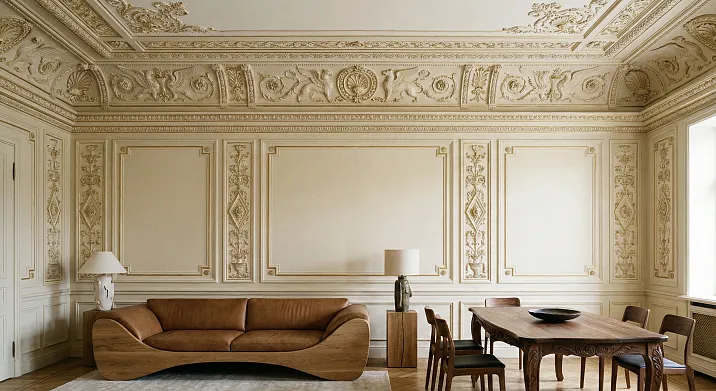
Why buy European furniture at triple the price ifRussian Stuccoand domestic solid wood furniture are not inferior, and sometimes even surpass foreign counterparts in quality of craftsmanship? For decades, we've been led to believe that true luxury only comes from the West. But times are changing.Russian designer furniturehas proven that Russian craftsmen can work with wood in a way that delights even sophisticated European buyers. And the molded decor created at domestic factories adorns interiors from St. Petersburg to Vladivostok, from private mansions to presidential residences. What lies behind the phenomenon of the revival of Russian premium decor and furniture production? Let's examine it in detail.




Revival of traditions: from wooden architecture to modern technologies
Russia is a country with centuries-old woodworking culture. Wooden architecture, carved window frames, church iconostases, royal furniture — all this is part of our cultural code. In Soviet times, many craft traditions were lost or went underground. Furniture production became mass-produced, standardized, losing individuality and artistry.
A new era began in the 1990s, when the first private workshops emerged, reviving traditions of working with solid wood. Enthusiasts studied museum pieces, ancient technologies, and learned from the last bearers of the craft. Simultaneously, modern Western wood processing technologies, CNC machines, and finishing methods were mastered.
By the 2000s, Russian production of solid wood furniture and decor reached a qualitatively new level. Factories emerged capable of creating premium-class products that rival European ones. Moreover, Russian manufacturers gained a competitive advantage: access to quality timber from their own forests, lower production costs, and flexibility in handling custom orders.
TodayRussian designer furnitureis exported to Europe, the USA, and Asian countries. Russian molding decorates objects abroad. This is not just an economic success — it is recognition by the global community of the quality and craftsmanship of Russian producers.




Cultural code in every product
What distinguishes Russian furniture and molding from European counterparts? A special combination of monumentality and elegance of details. Russian classicism tends toward more monumental forms compared to French or Italian. Furniture is solid, substantial, demonstrating sturdiness and durability. At the same time, decorative elements are executed with filigree precision — delicate carving, elegant profiles, expressive ornaments.
The ornamentation of Russian furniture and decor has absorbed influences from various eras and cultures. Byzantine motifs came with Orthodoxy. Baroque and classicism were adapted under Peter I and Catherine II. Art Nouveau of the late 19th-early 20th centuries acquired a special, northern resonance in Russia. All these layers have woven together into a unique aesthetic system, recognizable and distinctive.
Modern Russian producers do not blindly copy historical models. They reinterpret traditions, adapt them to contemporary lifestyles, and create new forms based on cultural memory. The result is furniture and decor that are simultaneously modern and carry a connection to tradition.
Our factory also produces:


Production capabilities: scale and equipment
and furniture at a modern Russian factory.custom molding productionWoodworking production
Get Consultation
The solid wood processing workshop is the heart of any furniture factory. It houses:
Drying chambers — large rooms with temperature and humidity control systems, where wood is brought to operational moisture content of 8-10%. The process takes from two weeks to several months depending on the species and thickness of the material. Proper drying is the foundation of the quality of future products. Over-dried wood becomes brittle, under-dried wood deforms during use.
CNC machines — modern processing centers of German, Italian, Japanese production. Milling machines create complex three-dimensional forms from digital models with precision to tenths of a millimeter. Lathes turn legs, balusters, columns with perfect geometry. Panel saws cut boards into blanks with minimal waste.
Manual processing area — here wood carvers work, creating unique decorative elements that cannot be made on machines. Hand carving is still valued higher than machine carving for its liveliness, individuality, and detail finesse.
Sanding area — here products undergo multi-stage sanding on belt, drum, and orbital sanders of various power. Final sanding is done by hand with fine-grit abrasive to achieve perfect smoothness.
Finishing area — painting booths with exhaust and filtration systems, where oils, varnishes, enamels, and waxes are applied. Water-based compositions from European manufacturers are used — eco-friendly, safe, creating durable and beautiful coatings.
Assembly workshop — here parts are assembled into finished products. Traditional joinery techniques are used — mortise and tenon, dovetail, dowel — reinforced with modern polyurethane adhesives. Hardware — hinges, guides, locks — is installed from European premium brands.
Production of polyurethane molding
The polyurethane decor production workshop is a separate direction requiring specific equipment and technologies.
Modeling area — here master models of future products are created. Sculptors model from clay or carve from foam prototypes of cornices, moldings, overlays. The model is repeatedly refined, sanded, and perfected. The quality of the master model determines the quality of all future products.
The modeling section is where master models of future products are created. Sculptors mold prototypes of cornices, moldings, and overlays from plasticine or carve them from foam. The model is repeatedly refined, polished, and perfected. The quality of the master model determines the quality of all future products.
Molding area — a silicone mold is taken from the master model. Silicone is poured onto the model in layers, reinforced, and removed after curing. This results in a negative mold with an exact imprint of all model details. The mold is reinforced with a rigid frame to maintain geometry during repeated use.
Casting area — this is where the actual production takes place. Two-component polyurethane is mixed in precise proportions and poured into the mold. A chemical reaction occurs with foaming and curing. After a few minutes, the product is ready for extraction. Modern high-density polyurethane creates a surface indistinguishable from plaster, while being many times lighter and stronger.
Finishing area — products extracted from molds undergo inspection, sprues are removed, irregularities are sanded, and if necessary, products are assembled from several parts to create large elements.
Painting area — molding is primed and painted. The base color is matte white, but any shades, patination, and gilding are possible. Water-based acrylic paints are used — safe, odorless, and fast-drying.
Quality Control System
At each production stage, a multi-level quality control system operates. Incoming inspection checks the quality of incoming raw materials — wood moisture content, absence of defects, compliance with grade standards. Operational inspection checks quality at intermediate stages — geometry after sawing, milling quality, joint strength. Final inspection checks finished products — appearance, mechanism functionality, dimensional compliance, packaging quality.
Products with the slightest defects are rejected or downgraded to second-grade category with a corresponding discount. Only products that have passed all control stages and meet premium quality standards are released for sale.
Design furniture factory: where craftsmanship becomes art
designer furniture factory— is not just a production site. It is a creative laboratory where unique objects are born, existing at the intersection of functionality and art.
Design department: from idea to realization
Furniture designers work in close contact with clients, architects, and decorators. The process of creating a custom piece begins with a brief — a detailed description of the task. What interior style? What are the room dimensions? What functional requirements? What colors, materials, and decorative elements are preferred?
Based on the brief, the designer creates sketches — hand drawings or computer graphics showing the overall concept. Sketches are discussed with the client, revisions are made, and details are clarified. After concept approval, detailed development begins.
A 3D model of the product is created in specialized software. The model shows the item from all sides, allows examination of details, assessment of proportions, and verification of functionality. Furniture can be virtually placed in an interior to see how it complements the surroundings, how light and shadow play on carved elements.
After 3D model approval, technical documentation is created — drawings of each part with dimensions, material specifications, assembly diagrams. Documentation is transferred to production, where the item is manufactured in exact accordance with the project.
Individual approach: custom-made furniture
Mass production stamps out identical items in millions of copies. A design factory creates individual pieces that consider the specific needs of a specific person.
Dimensions are adapted to the space. Need a wardrobe not of standard 2 meters, but 2.35 meters to fit precisely into a niche? No problem — we'll make any size. Need a table not for 6, but for 14 people? We'll develop a structure ensuring strength at larger dimensions.
Style is coordinated with the interior. Love Baroque but dislike gilding? We'll create Baroque furniture without gilding — with expressive carving, curved lines, but in natural wood tones. Want Classicism but lighter, more airy? We'll develop simplified profiles, lighter proportions, while preserving classical logic.
Materials are chosen according to preference. Prefer light oak or dark walnut? Want to combine several wood species in one piece? Desire inlay with rare woods — rosewood, ebony, Karelian birch burl? All is possible given material availability and corresponding budget.
Unique decor is developed. Want your family crest on a chest of drawers front? Masters will carve it according to your sketch. Desire a monogram on a chair back? We'll execute it in any technique — carving, inlay, marquetry.
Series production: affordability without quality loss
In addition to custom orders, the design factory produces series collections — carefully thought-out furniture lines in specific styles. Series furniture is cheaper than custom, as it doesn't require new project development, but doesn't lose execution quality.
Collections are developed by factory designers considering current trends and market demands. Each collection is a set of coordinated items: bed, nightstands, chest of drawers, wardrobe, dressing table for a bedroom; table, chairs, sideboard for a dining room; sofa, armchairs, coffee table, display cabinet for a living room.
The advantage of a collection — guaranteed stylistic compatibility of all pieces. No need to guess if a chest of drawers will match a bed — they are designed together, use identical decorative elements, proportions, and color solutions.
Series furniture is manufactured in batches, allowing optimization of the production process and cost reduction. However, each item undergoes the same processing stages as custom pieces — same wood drying, same machinery, same manual finishing, same final finishing.
World-class quality: what lies behind it
The phrase 'world-class quality' has become a cliché abused by everyone. But when it comes to Russian premium-segment factories, these are not empty words, but reality confirmed by specific characteristics.
Materials: the foundation of durability
Quality furniture begins with quality wood. Russian factories work with select wood species purchased from verified suppliers.
Oak — the primary wood for premium furniture. Oak aged 80-120 years from environmentally clean regions is used. Density of 700 kg/m³ ensures strength and wear resistance. Expressive grain with large annual rings and medullary rays creates a noble appearance. High tannin content provides natural resistance to moisture and biological damage.
Beech — wood for furniture where smoothness and uniformity are important. Density 650 kg/m³, fine-pored structure, light warm shade. Beech is ideal for painted furniture, as its uniform structure doesn't distort the coating color.
Ash is an alternative to oak with a lighter tone and a pronounced striped grain. Density 690 kg/m³, high impact toughness. Ash is used for furniture subjected to intensive loads — chairs, tables.
Walnut is a premium species with a deep chocolate-brown color and exquisite grain. Density 640 kg/m³, dimensional stability, excellent workability. Walnut is used for exclusive furniture where status display is important.
Exotic species — rosewood, ebony, macassar, zebrawood — are used for inlays, decorative overlays, and premium countertops. Their use is limited by conventions for the protection of tropical forests, but legal certified batches are available for premium production.
Polyurethane for molding is sourced from European manufacturers — German, French, Italian. Density 180-220 kg/m³ ensures relief detail and strength. The material is chemically stable, does not emit harmful substances, and is non-combustible.
Technologies: Precision and Repeatability
Modern CNC equipment ensures machining precision unattainable by manual methods. Milling centers create complex three-dimensional surfaces from a digital model with a deviation of no more than 0.1 mm. This is critical for part fitting — joints must be tight, without gaps.
Repeatability is a key advantage of machine processing. If 50 identical chair legs need to be made, the machine will produce them absolutely identical. Manual work always yields variations, which is unacceptable in serial production.
However, machines do not completely replace humans. Complex carving, fine details, and final finishing require a master's hand. The correct approach is a symbiosis of machine and human, where each does what they do best.
Finishing: protection and aesthetics
Finishing determines not only the appearance but also the durability of furniture. Russian premium-segment factories use professional formulations from European manufacturers.
Oil deeply penetrates the wood structure, highlights the grain, and preserves the tactile feel of wood. Natural-based oils — linseed, tung — are eco-friendly, safe, and create a breathable coating. Oil-wax combines the penetrating properties of oil with the protective properties of wax, yielding a silky surface with a slight sheen.
Lacquer creates a durable protective film resistant to moisture, dirt, and mechanical impact. Water-based polyurethane lacquers are eco-friendly, do not yellow over time, and provide a transparent coating that preserves the natural color of the wood. Lacquer is applied in several layers with intermediate sanding to achieve perfect smoothness.
Enamels are used for colored furniture. Pigmented compositions completely cover the wood grain, creating a smooth painted surface in any color. Water-based enamels are safe and provide a durable coating resistant to fading.
Patination is an artificial aging technique that gives furniture a noble antique appearance. The recesses of the carving are darkened with a dark pigment, while the protruding parts are lightened or gilded. The effect — the furniture looks as if it is a hundred years old, even though it was just made.
Control and Guarantees
Quality without control is an empty phrase. Russian premium-class factories implement multi-level quality control systems at all stages of production.
Each finished product undergoes a final inspection before packaging. Appearance is checked — absence of scratches, chips, uneven coloring. Functionality is checked — smoothness of door and drawer opening, reliability of hardware fastening. Geometry is checked — conformity of dimensions to drawings, perpendicularity of angles, flatness of surfaces.
Products with the slightest defects are not allowed for sale as first grade. This is a strict standard guaranteeing that the customer receives a flawless product.
A warranty is a material confirmation of the manufacturer's confidence in its product. Premium-class factories provide a 2-5 year warranty on furniture construction, 1-2 years on hardware and mechanisms, and 5-10 years on polyurethane molding. The warranty covers all manufacturing defects and deformations under proper use.
Twenty-four years in the market: from startup to industry leader
Success stories are not written in a year. To become a recognized leader, decades of hard work, constant improvement, and accumulated experience are needed. Russian factories operating for over two decades have come a long way from small workshops to large-scale productions known far beyond the country's borders.
First steps: enthusiasm and belief in the idea
In the early 2000s, the market for solid wood decor and furniture in Russia was virtually non-existent. Mass production released standardized furniture from chipboard and MDF. Quality wooden decor was only available through imports at exorbitant prices.
The founders of future successful factories were enthusiasts, in love with wood, who believed that world-class products could be created in Russia. They started small — small workshops on city outskirts, several universal machines, literally manual labor.
The first orders were from private clients needing custom furniture or decor. Building a reputation — each order was executed with maximum care, as reviews from satisfied customers were the only advertisement.
Gradually, market understanding came, a production culture formed, and connections with suppliers of quality materials were established. Initial successes allowed reinvesting profits into development — purchasing new equipment, expanding production space, hiring qualified craftsmen.
Growth: expanding assortment and geography
By the end of the 2000s, successful factories had become noticeable players on the Russian market. The assortment grew from several dozen items to hundreds and thousands of products. The supply geography expanded from one city to the entire country.
Investments in marketing and sales allowed entry into new customer segments. In addition to private individuals, factories began working with designers, architects, construction companies, and furniture manufacturers. Wholesale sales enabled scaling up volumes, optimizing production, and reducing costs.
Developing proprietary collections became an important direction. Design departments created product lines in current styles, formed catalogs, and developed visual presentation. Buyers gained the ability to choose from ready-made solutions, not just order custom items.
Implementing modern technologies — CNC machines, automated painting lines, production management systems — increased productivity and quality. Factories reached a level where they could execute large, complex orders — complete interior design, supplies for hotels, restaurants, and public buildings.
Maturity: Recognition and Expansion
In the 2010s-2020s, leading Russian factories gained recognition not only in the domestic but also in the international market. Products began to be exported to Europe, the USA, and Asian countries. Russian furniture and decor appeared in projects by renowned foreign designers.
Participation in international exhibitions — Milan, Cologne, Paris, Las Vegas — demonstrated that Russian products are competitive on the global market. Foreign buyers appreciated the price-quality ratio: with comparable or superior quality, Russian products were 30-50% cheaper than European counterparts.
Awards and certifications confirmed the high level. The title 'Industry Leader of Russia', exhibition diplomas, acknowledgments from major clients — all this built a reputation as a reliable world-class manufacturer.
Social responsibility became part of the corporate culture. Factories create jobs, pay taxes, invest in the development of the regions where they operate, participate in charitable programs, restore churches, and support educational institutions.
Today: Stability and Development
Today, leading Russian decor and furniture factories are stable enterprises with long-standing reputations, extensive client bases, and streamlined production processes. They continue to develop, implement new technologies, master new materials, and design new collections.
Crises — sanctions, the pandemic, economic turbulence — did not break them but tempered them. Factories learned to quickly adapt to changes, find alternative suppliers, reorient production, and operate under uncertainty.
Import substitution has become a reality. Many items previously purchased abroad are now produced in Russia. Hardware, paints and varnishes, tools — Russian production is actively mastering these segments, reducing dependence on imports.
Digitalization is changing production processes. Systems for automated design, 3D visualization for clients, electronic document management, and warehouse inventory management are being implemented. Buyers gain the ability to order products online, track order status, and receive consultations remotely.
Advantages of Choosing a Russian Manufacturer
Why choose Russian-made furniture and decor over imported ones? There are many arguments — from economic to patriotic.
Price: Honesty Without Markups
Imported furniture carries not only production costs but also many additional expenses. Cross-border logistics, customs duties, currency risks, markups by importers and distributors — all this is factored into the final price paid by the buyer.
A Russian manufacturer operates within the country. No customs, no currency risks, logistics are simpler and cheaper. Often, the manufacturer sells directly or through a minimal number of intermediaries. The result — a price 30-50% lower with comparable quality.
This is not dumping or cutting corners on quality. It is an objective competitive advantage related to a shorter supply chain and lower overhead costs. The buyer pays for the product, not for bureaucracy and logistics.
Timing: Speed and Predictability
Ordering imported furniture means waiting from several weeks to several months. Production abroad, delivery by sea or air, customs clearance, transportation to the client. Delays are possible at every stage — weather, strikes, bureaucratic red tape.
A Russian manufacturer works faster. Mass-produced items are often in stock — they can be picked up on the day of order. Custom items are produced in 4-8 weeks. Delivery within Russia — from a few days to a week depending on the region.
Timelines are predictable. The factory controls the entire process from production to delivery and can accurately estimate the order completion time. The client plans renovations knowing when the furniture will arrive, without the risk of multi-month delays.
Service: Accessibility and Responsibility
It's difficult to resolve issues with an import supplier. Need a part replaced? Write a request, wait for a response from abroad, then wait for delivery. A defect arose? Prove the warranty case, correspond through intermediaries who are not always interested in a quick solution.
A Russian manufacturer is accessible. Calling the office, writing an email, visiting the factory — all this is real and works. Warranty issues are resolved promptly because the manufacturer is invested in its reputation.
Service includes not only warranty but also consultations, help with selection, care recommendations, and the ability to order additional elements years after the initial purchase. The manufacturer maintains project archives and can reproduce an item after time has passed.
Adaptation: Accounting for Russian Realities
Imported furniture is designed for European or American standards, which do not always match Russian ones. Doorway sizes, ceiling heights, layout specifics, climatic conditions — all these differ.
A Russian manufacturer knows local realities. Furniture is designed considering typical layouts of Russian apartments. Climate is taken into account — humidity and temperature fluctuations, which are absent in stable Europe. Preferences of Russian buyers are considered — more substantial forms, certain decorative solutions.
The possibility for individual adaptation is higher. Need a wardrobe that fits exactly into a niche in a Khrushchyovka apartment? A Russian factory will make it without a problem. Need to account for non-standard ceiling heights or door widths? This is the norm, not an exception, when working with custom orders.
Patriotism: Supporting the Domestic Economy
By buying Russian products, you support the domestic economy. Your money stays in the country, goes to the salaries of Russian workers, to taxes in the Russian budget, and to the development of Russian production.
This creates jobs. A furniture factory provides hundreds of jobs for carpenters, carvers, assemblers, designers, logisticians, and managers. By buying Russian-made products, you support employment in your country.
This drives technological development. Successful factories invest in new equipment, personnel training, research, and development. This elevates the entire industry, making Russian manufacturing more competitive in the global market.
This preserves crafts. Working with wood, carving, and finishing are part of our cultural heritage that must be preserved and passed on to future generations. By supporting manufacturers, you support a living tradition of craftsmanship.
Frequently asked questions
How does Russian furniture differ from European furniture in terms of quality?
When using similar materials and technologies, premium-class Russian furniture is not inferior to European furniture in quality. Modern Russian factories use the same equipment—German and Italian machines—the same materials—European varnishes and hardware—and similar processing technologies. The difference often lies in price: Russian products are 30-50% cheaper with comparable quality due to the absence of customs duties and shorter logistics chains.
What guarantees do Russian manufacturers provide?
Serious Russian factories provide a 2-5 year warranty on solid wood furniture construction, 1-2 years on hardware and mechanisms, and 5-10 years on polyurethane moldings. The warranty covers manufacturing defects and deformations when operating conditions are observed. Warranty cases are resolved promptly—inspection, repair, or replacement within reasonable timeframes.
How long does it take to produce custom furniture?
Timelines depend on the complexity of the item. Simple pieces from serial collections can be manufactured in 2-3 weeks. Standard individual orders are produced in 4-8 weeks. Complex exclusive items with hand carving, inlay, or special materials may require 10-16 weeks. Exact timelines are agreed upon when the contract is signed.
Do Russian factories deliver to the regions?
Yes, leading Russian manufacturers deliver throughout the entire territory of Russia, from Kaliningrad to Vladivostok. They use transport companies specializing in furniture delivery. Large-sized items are packed in sturdy protective packaging. Self-pickup from the manufacturer's warehouse or delivery to the client's apartment with floor lifting is possible. Delivery cost depends on the region and cargo volume.
Can I order furniture to my own dimensions and design?
Yes, premium-class Russian factories actively work with individual orders. The process includes: describing the client's task and preferences, creating sketches and a 3D model by a designer, approval and making revisions, and production in exact accordance with the approved project. You can choose the wood species, type of finish, decorative elements, and hardware. Individual items are more expensive than serial ones but allow you to get furniture perfectly suited to a specific interior and needs.
Is Russian furniture and molding environmentally friendly?
Quality Russian manufacturers use eco-friendly materials. Solid wood is a natural, renewable material. Adhesives are water-based, without formaldehyde or toxic solvents. Varnishes and paints are water-based, complying with European environmental standards. Polyurethane for molding is a chemically stable material that does not emit harmful substances under normal operating conditions. Products have certificates of conformity and sanitary-epidemiological conclusions.
How to care for solid wood furniture?
Solid wood furniture requires simple care. Regularly remove dust with a soft, dry cloth. Avoid direct sunlight, which can cause fading. Maintain stable humidity of 40-60% and temperature of 18-24°C—sharp fluctuations can lead to deformations. Protect surfaces from hot objects, liquids, and sharp items. Re-oil oiled surfaces once a year. Varnished surfaces are sufficient to wipe with a slightly damp cloth. Do not use aggressive cleaning agents or abrasives.
What should I do if the furniture is damaged during delivery?
Upon receipt, carefully inspect the item in the presence of a representative of the transport company. If damage is found, be sure to record it in the acceptance-transfer act and take photographs. Immediately contact the manufacturer, describe the problem, and provide photos and the act. Serious manufacturers insure their shipments and promptly resolve such situations—repair, replacement of the damaged part, or complete replacement of the item at their own expense.
Conclusion: A choice in favor of quality and responsibility
Russian furniture and molding have come a long way from artisanal workshops to world-class production. Today, this is high-quality products that are not inferior to European counterparts in materials, technologies, and design, while being more affordable in price and adapted to Russian realities.
By choosing a domestic manufacturer, you get not only a quality product but also prompt service, predictable timelines, and the possibility of individual solutions. You support the Russian economy, job creation, technological development, and the preservation of craft traditions.
Don't overpay for imported furniture just because of the stereotype that 'everything is better abroad.' Russian premium-class factories have proven—we can work at a world-class level. It's time to value our own production, our own masters, our own achievements.
The company STAVROS is a prime example of a successful Russian manufacturer embodying the best traditions of working with wood and modern technologies. Over 24 years of operation, STAVROS has transformed from a small workshop into a recognized industry leader with production facilities of 6000 m², its own sculptural department, modern CNC machines, and a team of experienced craftsmen and designers.
The STAVROS range includes over 5900 models of carved decor made from solid wood, European polyurethane, and MDF in 39 product groups. This includes cornices, moldings, overlays, balusters, columns, rosettes, furniture legs, handles, facades, doors, boiserie panels—everything for comprehensive interior design in a unified style.
Full-cycle production ensures quality control at every stage—from wood selection to final packaging. Chamber drying to 8-10% moisture content, processing on high-precision machines, manual finishing by carvers, multi-stage sanding, final coating with eco-friendly compounds from European manufacturers—each operation is performed with maximum care.
The STAVROS design department develops original collections, creates individual projects based on client sketches, and performs 3D visualizations of future interiors. You see the result before production begins, can make revisions, and experiment with options without additional costs.
The quality of STAVROS products is confirmed by the title 'Industry Leader of Russia 2020,' certificates of conformity, sanitary-epidemiological conclusions, and thousands of positive reviews from clients. STAVROS products adorn private homes, hotels, and public buildings in Russia, the USA, Canada, the UK, France, Italy, and other countries.
Over 2000 partners—furniture manufacturers, designers, architects, and construction companies—have been working with STAVROS for many years, considering the factory's products their competitive advantage. This is the best confirmation of quality and reliability.
STAVROS guarantees quality without complaints, adherence to production timelines, a large warehouse program for prompt deliveries, and delivery from 1 piece throughout Russia and the CIS. We work transparently, honestly, and with respect for every client—from private customers to large corporations.
By choosing STAVROS, you choose 24 years of experience, a time-tested reputation, quality that meets world standards, an individual approach, and honesty in pricing and commitments. Choose Russian production, choose quality, choose STAVROS—and your interior will gain beauty, durability, and uniqueness that will stay with you for decades.


