Article Contents:
- The Philosophy of Handmade: Why Handcrafted Work Has Become Mainstream
- Tired of Identity
- The Value of Imperfection
- Connection with the Craftsman and Tradition
- Ecology and Conscious Consumption
- Carved Furniture Handles: Sculpture in Miniature
- Carving Techniques
- Motifs and Images
- Wood Species for Carving
- Finishing Carved Handles
- Sculptural Balusters: Vertical Poetry
- From Turned to Carved
- Style Solutions
- Composite Materials
- Handcrafted Molded Decoration: Wall Plasticity
- Hand Molding Techniques
- Elements of Hand Molded Decoration
- Modern interpretation
- Decorative Elements: Personality Accents
- Carved Furniture Inlays
- Ceramic Tiles
- Wrought Iron Elements
- Textile Panels
- Craftsmen and Clients: New Relationships
- Finding a Craftsman
- Ordering Process
- Cost of Handcrafted Work
- Integration into Interior: Balance and Measure
- Do Not Overload
- Coordinate Styles
- Light and Shadow
- Frequently Asked Questions
- Conclusion: The Return of the Soul to Space

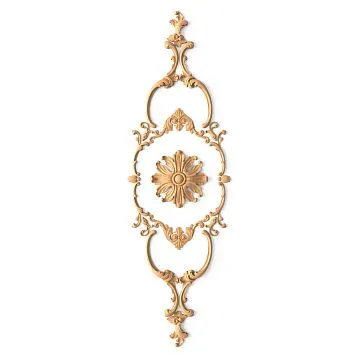
carved by a craftsman individually for a specific itemFurniture Handlessculpturalwooden balusterswhere each one is a work of artRelief Decorationhand-molded, not cast in a molddecorative elementsbearing the imprint of the creator's hand
This is not nostalgia for the past, but a new understanding of luxury. Luxury today is not the number of square meters or the price of a chandelier, but uniqueness, irreplaceability, the history of each item. When you touch a carved handle, you feel the craftsman’s work, his movements, his attention to the wood. When you ascend the stairs with sculptural balusters, you see not a factory stamp, but a creative expression. This is the return of the soul to the interior, the humanization of space, a connection with the tradition of craftsmanship.




Philosophy of Handmade: Why Handcrafted Work Became Mainstream




Tiredness of Uniformity
The last twenty years of interior design have moved along the path of standardization. Global brands imposed a single aesthetic language: minimalism, Scandinavian style, industrial loft. These styles are beautiful, functional, and accessible—but soulless. An apartment in Moscow, Berlin, or Tokyo looks the same: white walls, light flooring, IKEA furniture, minimal decor. Instagram is filled with thousands of identical interiors, where you cannot determine either the country or the owner.
By the mid-2020s, a critical mass of people realized: their home does not reflect their personality. It looks beautiful in photos, but is soulless in reality. There is no history, no character, no individuality. A craving for uniqueness emerged—but not through expensive designer furniture (accessible only to a few), but through handcrafted details accessible to many.
Our factory also produces:


The Value of Imperfection
carvedfurniture handlehas slight variations in carving depth, imperfectly symmetrical elements, tool marks. This is not a defect, but evidence of human labor. A factory-made handle is perfect—like a clone among thousands of clones. A handcrafted one is unique—like a fingerprint.
The Japanese concept of wabi-sabi has valued imperfection for centuries, seeing in it the beauty of authenticity. The unevenness of a clay bowl, the asymmetry of a wooden sculpture, a crack in ceramic—this is not a defect, but character, soul, history. The Western world, fixated on industrial perfection, finally understood this. In 2026, the imperfection of handcrafted work is valued above the soulless perfection of machine production.
Get Consultation
Connection with the Craftsman and Tradition
carvedbalusterWhen you buy a carved baluster from a craftsman, you are not buying just a wooden post. You are buying a part of a specific person’s work, their skill, accumulated over years of training, their attention to the material, their dialogue with the wood. The craftsman feels the texture, sees where the wood cuts easily, where it resists, where the movement of the chisel must change. This is a living process, opposite to mass production.
Handcrafted work connects you with the tradition of craftsmanship, stretching back centuries. The woodworking techniques used by today’s craftsman are the same as those used by medieval cathedral carvers. The tools have changed minimally—chisels, gouges, mallets. This is a direct thread connecting the past and present, making you part of a continuous cultural tradition.
Ecology and Conscious Consumption
Handmade is more ecological than mass production. A workshop consumes minimal energy (unlike a factory), does not produce industrial waste, uses local materials (no transportation footprint). The item is made to order or in small batches—no overproduction, stockpiling, or waste of unsold products.
The quality of handcrafted work is higher—the craftsman is invested in their reputation, pays attention to every item.Carved ElementsThey serve for decades, are passed down through generations, and are restored. This is the opposite of the culture of disposability, where an item is used for a couple of years and then discarded. By purchasing handmade, you make a choice in favor of durability, responsibility, and respect for resources.
Carved Furniture Handles: Sculpture in Miniature
Furniture Handlesare points of daily contact with furniture. Dozens of times a day, a hand reaches for the cabinet handle, opens a drawer, closes a door. A carved handle transforms this utilitarian gesture into a micro-experience of touching art.
Wood Carving Techniques
Wood carving is the oldest craft, encompassing many techniques. Geometric carving is the simplest, based on combinations of triangles, rhombuses, squares, cut at different depths. Geometric patterns create rhythm, graphic quality, play of light and shadow. This is a good choice for modern interiors, where clean lines are important.
Relief carving — lines of different depths creating a pattern on the surface of wood. Plant ornaments, winding vines, stylized flowers are cut with a fine chisel, forming elegant compositions. Relief carving suits classic interiors where decorative value is important.
Relief carving — volumetric elements protruding above or recessed into the background. Leaves, flowers, fruits are carved with realistic detail, creating an illusion of three-dimensionality. This is the highest skill of a carver, requiring deep understanding of form, light, and composition.
Through (openwork) carving — wood is cut through, creating a lace-like pattern. Such handles are fragile and require careful handling, but visually incredibly striking. This is sculpture that can be viewed from different sides, seeing how light passes through the openings.
Motifs and Images
Traditional carving motifs come from nature. Plant ornaments — grapevine with leaves and clusters, oak leaves with acorns, acanthus leaves (classic ancient motif), roses, lilies, tulips. Each plant has symbolic meaning: grape — abundance, oak — strength, rose — beauty.
Zoomorphic images — birds, animals, fish, mythological creatures. Owl symbolizes wisdom, lion — power, dolphin — luck, dragon — strength. A carved handle in the shape of a lion’s head or dragon’s body turns opening a cabinet into a dramatic act.
Geometric and abstract patterns — interlacing, labyrinths, Celtic knots, Slavic solar symbols, Scandinavian runes. These patterns carry ancient symbolism, connect with cultural roots, and create visual complexity.
Modern abstraction — asymmetrical organic forms, waves, spirals, structures resembling natural patterns (honeycombs, crystals, shells). This is a new language of carving, not bound to traditional motifs, yet equally expressive.
Wood Species for Carving
Not every wood is suitable for carving. Lime — classic material for carvers. Soft, uniform, easy to cut in any direction, does not splinter. Lime handles are stained or toned after carving, as the natural color is pale.
Ash — slightly harder than lime, holds details well, has a pleasant pinkish-brown tone. Ash carved handles can be left natural or slightly toned to emphasize the relief.
Oak — hard wood, difficult to carve, but the result is incredibly durable. Oak carved handles are practically eternal, resistant to mechanical damage, have expressive texture that complements the carving.
Walnut — medium hardness, carves beautifully, holds fine details. Walnut wood has noble dark color with rich tones — from light brown to nearly black. Carved walnut handles look expensive, premium.
Beech — hard, uniform, carves well with sharp tools. Beech handles are strong, with a gentle pinkish tone, suitable for classic interiors.
Finishing Carved Handles
Carving is beautiful on its own, but the finish determines the final effect. Natural oil or wax coating preserves the wood’s color, highlights the carving through play of light in recesses. Oil is rubbed in, penetrates the structure, darkens recesses more than raised parts — the carving gains volume and readability.
Staining with stains changes color while preserving visibility of the carving. Dark tones (walnut, wenge, ebony) create drama and contrast. Light tones (white oak, beech) — lightness, modernity. Colored (green, blue, red) — creativity, playfulness.
Patination — technique of artificial aging. Dark paint or wax is rubbed into the recesses of the carving, then excess is removed from raised parts. This creates an effect of accumulated centuries of dust, antiquity, depth. Patinated handles look as if they are a hundred years old.
Gilding or silvering — luxurious finish for classic interiors. Ultra-thin sheets of gold leaf are glued with special glue (polyment), polished with agate to mirror shine. Gilded carving shines, attracts attention, creates a sense of palace luxury.
Sculptural Balusters: Vertical Poetry
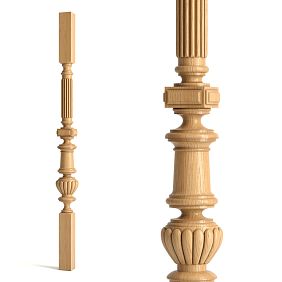
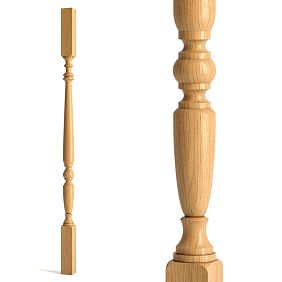
wooden balusters— vertical supports of stair railings, connecting steps with handrails. Functionally, they ensure safety, visually — they create rhythm and architectural expressiveness. A hand-carved sculptural baluster turns a staircase into a gallery of vertical sculptures.
From Turned to Carved
The simplest baluster — turned on a lathe. The craftsman mounts the blank on the lathe, rotates it, brings chisels close, creating a profile — alternating expansions and contractions, spheres, rings, cones. This is a semi-automated process allowing to produce dozens of identical balusters.
But sculptural balusters go further. After turning, the craftsman takes chisels and manually refines details: cuts leaves, flowers, volutes, decorative elements. Each baluster becomes unique — even if the craftsman repeats one pattern on all, variations in carving depth, positioning of elements, expressiveness are inevitable.
Fully carved baluster (without turning) — rarity, handmade work. The craftsman carves the shape from a square block, creating an asymmetrical sculpture. This may be a stylized tree, anthropomorphic figure, abstract form. Such balusters are expensive, require the highest craftsmanship, but create interiors where every detail is a work of art.
Style Solutions
Classic balusters include ancient motifs: Ionic volutes, Corinthian acanthus leaves, Doric fluting. This is heritage of Greek-Roman architecture, reinterpreted in wooden sculpture. Classic balusters suit palace interiors, neoclassicism, English style.
Baroque balusters — lavish, dynamic, overloaded with decoration. Grapevines with clusters, roses in full bloom, cherubs, angels, putti (infants), shells, scrolls. This is theatricality, excess, luxury. Baroque knows no measure — and this is its strength.
Gothic balusters — vertical, reaching upward, with sharp forms. Pointed arches, trifoliate (three-leaf), quadrifoliate (four-leaf), rosettes, wimpergs. Gothic is mystical, spiritual, creates a sense of vertical movement toward heaven.
Modern balusters — smooth organic lines, plant motifs, stylized to abstraction. Climbing stems, irises, water lilies, female figures with flowing hair. Modern style is sensual, elegant, avoids sharp angles.
Ethnic balusters — motifs of folk culture. Slavic solar symbols, Scandinavian interlacing and runes, Asian dragons and characters, Celtic knots. This is a connection to roots, cultural identity, respect for ancestral traditions.
Modern abstract balusters — asymmetrical organic forms resembling natural objects (twigs, bones, shells) or pure geometric abstractions. This is a new language, not bound to historical styles, yet equally expressive.
Combined materials
Modern trend — combination of wood with other materials. Carved wooden baluster with metal inlays — brass rings, copper spirals, iron rivets. Wood with stone — marble or granite inlays in wood carving. Wood with glass — stained glass elements in openwork carving.
Inlay — an ancient technique where pieces of other materials are embedded into wood: mother-of-pearl, ivory (banned, replaced by animal bone or synthetic materials), metal, colored wood species. An inlaid baluster becomes a jewelry piece on an architectural scale.
Handcrafted relief decoration: plastic wall elements
Relief DecorationTraditionally made by hand from plaster — the sculptor applied plaster mass to the base, shaped the volume with fingers and tools, created details. Today, most stucco is cast in molds (plaster or polyurethane) — fast, cheap, identical. But handcrafted stucco is returning as a premium option for those who value uniqueness.
Hand sculpting techniques
Free sculpting — the artist creates form without a pre-defined shape, relying on sight, hand, and experience. Plaster or clay mass is applied to the base (wall, ceiling, frame), shaped with fingers, trowels, spatulas. This is like sculpture — the artist sees the form within the material and extracts it.
Assembled sculpting — the artist creates individual elements (leaves, flowers, scrolls), then mounts them into a unified composition on the wall or ceiling. Each element is unique, the overall composition is one-of-a-kind. Assembled sculpting allows creating complex, multi-layered scenes.
Stucco (stucco) — Venetian technique where marble dust is added to plaster, creating a mass that imitates marble. Stucco is polished to a shine, can be painted or patinated, creating the illusion of stone carving while retaining the lightness of plaster.
Sgraffito — a multi-layer technique where layers of different colors are applied to the wall, then the upper layers are scratched away, revealing the lower ones. This creates a graphic image where lines are the color of the lower layer. This is a painting technique allowing creation of panels, ornaments, narrative compositions.
Elements of handcrafted stucco
Rosettes — round or oval medallions on ceilings around chandeliers or on walls as accents. A handcrafted rosette is not perfectly symmetrical; each petal slightly differs from its neighbor, creating liveliness and movement. Factory-made rosettes are dead symmetrical — beautiful, but lifeless.
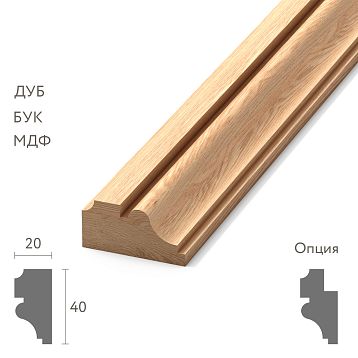
Cornices and moldings — handcrafted by extrusion: the artist makes a metal profile template, guides it over fresh plaster, forming the molding. Small irregularities and gentle waves add handmade character, evoking vintage interiors where perfect geometry was unattainable.
Capitals — crowning parts of columns and pilasters. A handcrafted capital is a sculpture where each acanthus leaf is individually shaped, each volute has a unique curve. This is the opposite of cast capitals, where all leaves are identical.
Panels and bas-reliefs — narrative or ornamental compositions on walls. Handmade panels are unique, created from the artist’s sketch, may include portraits, scenes, landscapes. This is essentially sculpture on the wall, three-dimensional painting.
Brackets and consoles — supporting elements under shelves, balconies, cornices. Handcrafted brackets can be asymmetrical, organic, resembling natural forms — branches, roots, shells. This is functional sculpture.
Modern Interpretation
Handcrafted stucco in 2026 does not have to copy historical styles. Modern masters create abstract forms, organic textures, minimalist reliefs. This may be a wavy wall surface resembling sand dunes. Or a geometric 3D pattern with protruding and recessed elements. Or biomorphic forms resembling coral, mushrooms, moss.
Such stucco does not shout about its historicity, but emphasizes its handmade nature. It is modern in form, yet traditional in technique. This is a bridge between past and future, where ancient craftsmanship serves contemporary aesthetics.
Decorative elements: accents of character
decorative elementsHandmade — these are details creating the interior’s individuality. Small in size, but huge in their impact on the overall impression.
Carved wood appliqués for furniture
Carved wooden appliqués are glued onto furniture facades, transforming a simple chest into a work of art. These may be corner elements, central medallions, vertical ornamental stripes, cartouches with initials.
The artist cuts the appliqué from a thin board (10–20 mm), refines the relief, sands it, and finishes it. The appliqué is mounted with glue and thin nails. A simple operation, but transformative — the furniture acquires status, history, character.
Ceramic tiles
Tiles — ceramic tiles with relief patterns, glazed. Each tile is hand-formed, painted (if multicolored), and fired. Tiles traditionally decorated fireplaces and chimneys, but in modern interiors they are used as decorative wall panels, kitchen backsplashes, and bathroom accents.
Handmade tiles are not identical — each slightly differs in glaze tone, relief depth, pattern nuances. When assembled, they create a living surface vibrating with color and light.
Wrought iron elements
Artistic blacksmithing — the oldest craft, where iron is heated in a forge, hammered on an anvil, taking the desired shape. Wrought iron elements — handles, hinges, grilles, railings, lamps — individually crafted.
Each hammer blow leaves a mark, each curve is unique. Wrought iron details are rough, brutal, but it is precisely this roughness that creates contrast with the smoothness of modern materials, adding masculinity, strength, and connection to the tradition of blacksmithing.
Textile wall hangings
Handwoven, embroidery, tapestries — textile techniques that create decorative wall hangings. The artisan works on a loom or manually embroiders onto fabric, creating images with threads. The process is slow — a large hanging may take months to complete — but the result is unique.
Textile wall hangings add softness, warmth, and tactile quality. They are visually and physically warm surfaces that absorb sound and create coziness. In an age of cold, smooth materials, handmade textiles bring humanity back into space.
Artisans and clients: new relationships
Find an artisan
Where to find artisans creating handmade interior elements? Social networks — Instagram, VK, Facebook — where artisans post portfolios. Search hashtags: #woodcarving, #stucco, #handmade, #handmadedecor.
Craft fairs and artisan markets regularly take place in major cities. Here you can see works in person, talk to the artisan, understand their style, and discuss projects.
Specialized platforms — Artisan Market, Etsy (for international search), local handmade platforms. Here it’s convenient to compare portfolios, read reviews, and place orders.
Workshops and studios — professional workshops specializing in carving, stucco, and metalwork. For example, the company STAVROS offers not only mass-producedSolid Wood Items, but also custom-order services, where experienced artisans bring your idea to life.
Order process
Custom orders begin with a consultation. You describe your desired outcome: interior style, function of the element, preferred motifs, budget. The artisan asks clarifying questions, shows portfolio examples, explains technical capabilities and limitations.
Then comes the sketch — the artisan draws or models the future item. This may be a pencil sketch, watercolor, or 3D model. You discuss, make adjustments, and approve the final version. Important: the sketch is an agreement on what will be created.
Production takes from weeks to months depending on complexity. A carved baluster — one week of work. A stucco panel covering an entire wall — two months. A set of carved handles for a chest — three weeks. The artisan may send photos of the process, showing progress.
Delivery and installation — fragile elements require careful packaging. The artisan may offer installation themselves or recommend a specialist. Stucco requires professional installation — it is not a DIY project.
Cost of handmade work
Handmade is more expensive than factory-made — this is a fact. Carvedfurniture handle— from 3,000 to 15,000 rubles per piece (factory-made — 500–2,000). SculpturalBaluster— from 5,000 to 30,000 (precision mass-produced — 1,000–3,000).
But this is not just a price difference — it’s a difference in value. A factory-made detail is one among thousands. Handmade is unique. Factory-made has no history. Handmade is the result of a specific person’s labor, skill, and time. It’s an investment not in mass timber, but in talent, skill, and individuality.
Integration into interior: balance and measure
Don’t overload
The main mistake of handmade enthusiasts — overloading. If every surface is carved, every wall is stuccoed, every item is original, visual chaos arises. The eye doesn’t know where to look, the brain tires from excess information.
Rule: handmade elements should be accents against calm surfaces. One wall with hand-stuccoed detail, the rest smooth. Carved handles on one piece of furniture, the rest simple. Sculptural balusters on a grand staircase, on secondary ones — minimalist.
Coordinate styles
Handmade elements should resonate with the interior style. Baroque carved handles on minimalist furniture create dissonance (unless this is an intentional contrast). Gothic balusters in a Scandinavian interior would be out of place.
But eclecticism is possible — mixing styles through handmade. Modern furniture with ethnic carved elements. Classical architecture with abstract hand-stuccoed details. The key is to find a unifying element (color, material, scale) that creates unity amid diversity.
Light and shadow
Relief handmade elements reveal themselves through lighting. Side lighting creates deep shadows, emphasizing carving. A carved baluster by the window during the day creates a play of light and shadow. Stucco on the ceiling reveals itself with proper lighting direction.
Plan lighting according to relief. Underlighting for stucco cornices. Side lighting for carved panels. Directional spotlights for sculptural balusters. Light is an instrument that makes handmade work visible, readable, and dramatic.
Frequently asked questions
How to distinguish handmade work from factory-made?
Examine the details carefully. Handmade work has micro-irregularities, slight variations in thread depth, tool marks. Factory-made is perfectly smooth, all elements are identical. If you have ten balusters and they are absolutely identical — it's factory-made. If there are variations — handmade.
Is handmade work durable?
Yes, with proper execution — often more durable than factory-made. The craftsman is invested in reputation, uses the best materials, quality joints. Carved elements of medieval cathedrals have survived centuries — the same technologies.
Can I order a copy of a historical element?
Yes, many masters specialize in historical reconstruction. Provide a photo of the original, describe the era and style. The master will create a copy as close to the original as possible, using authentic techniques.
Does handmade require special care?
No more than factory-made elements. Wooden carved details should be wiped with dry or slightly damp cloth, avoid aggressive chemicals. Moldings — dry cleaning with soft brush or vacuum cleaner with attachment. Restoration — repainting, repairing chips — may be needed every few years.
Does handmade increase property value?
Quality handmade elements — yes. They create uniqueness, premium quality, history. An apartment with original moldings and carved balusters stands out on the market, memorable to buyers, justifies a higher price.
Where to store handmade elements before installation?
In a dry room at room temperature, protected from impacts. Wooden elements should not be stored in a damp basement (deformation) or hot attic (cracking). Moldings are fragile — store in boxes with soft padding.
Can I learn carving on my own?
Yes, but it will take years of practice to reach a professional level. Start with woodworking carving courses, learn the tools, practice on simple patterns. But if you need results immediately — consult a master.
Is handmade more eco-friendly?
Yes, if the master uses local materials, does not produce industrial waste, works with minimal energy consumption. The longevity of handmade items is also eco-friendly — the item serves for decades, without requiring replacement.
How to check a master's qualifications?
Request a portfolio — photos of real works, preferably with client contacts for reviews. Visit the workshop — see the process, tools, unfinished works. Order a small element first (one handle) — evaluate quality before placing a large order.
Does handmade combine with smart home technology?
Absolutely. Technology and craftsmanship do not contradict each other — they complement. Behind a carved wooden panel may be touch-sensitive lighting control. Molded cornice hides LED lighting and climate control sensors. Carvedfurniture handlemay be equipped with an integrated touch sensor for unlocking — touching a specific point unlocks a drawer.
The main principle of integration: technology should be invisible, while handmade — visible. Wires are hidden insidedecorative elements, sensors are concealed behind carving, speakers are integrated into moldings. People see the beauty of handmade work, but benefit from automation convenience.
Modern designers call this 'invisible technology' — when a smart home does not show itself through screens and panels, but dissolves into traditional aesthetics. Carvedbalusterswith built-in step lighting. Molded socket with integrated surround sound speakers. Wooden panel hiding a pull-out TV.
Can I combine handmade elements from different eras in one interior?
Yes, eclecticism — one of the main trends of 2026. Gothic carved baluster can coexist with modern molding, and Baroque handle — on minimalist contemporary furniture. The key is to find a unifying element: color, material, scale, or conceptual idea.
But you need a sense of measure. Three different styles in one room — eclecticism. Ten — chaos. Plan hierarchy: one style dominates (60-70% of elements), second complements (20-30%), third — accent points (5-10%).
Does the energy of the craftsman transfer through handmade?
It's a matter of belief, but many notice: handmade items create a special atmosphere. Perhaps it's due to micro-irregularities that the eye subconsciously interprets, creating a sense of living presence. Perhaps it's in knowing that a specific person invested time, attention, and skill into creating the item.
Scientific research shows: people feel more comfortable in environments with objects that have "history" and traces of human labor. This activates social areas of the brain, creating a sense of connection and belonging to human tradition.
Conclusion: Returning the soul to space
The trend for handcrafted work in interior design in 2026 is not a fashion, but a cultural shift. After decades of dominance of mass production, standardization, and uniformity, people have realized: they lack uniqueness, individuality, soul. CarvedFurniture Handles, created by the hands of a master, sculpturalwooden balusterswith individual carving,Relief Decorationhand-molded,decorative elementsbearing the imprint of the creator's personality — all this returns to the interior what was lost in the pursuit of efficiency and cheapness.
Handmade is not a rejection of modernity. It is its enrichment through tradition. It is a synthesis of ancient craftsmanship and modern aesthetics, where carving techniques, perfected over hundreds of years, serve contemporary design. It is a bridge between the past and the future, where respect for ancestral craftsmanship merges with the needs of today.
Each handcrafted item tells a story. The story of the wood from which it was made — where it grew, how old it was, what tree rings preserve memories of droughts and rainy years. The story of the craftsman — his years of training, his hands holding the chisel for thousands of hours, his attention to the material, his dialogue with the wood. The story of the owner — why exactly this pattern, this form, this object was chosen. All of this creates narrative depth, transforming the interior from mere decoration into a space rich with meaning.
The aesthetic of imperfection, characteristic of handmade, teaches acceptance, tolerance for variations, respect for the process. A carved handle is not perfectly symmetrical — and that is wonderful.BalusterIt bears light traces of the chisel — and this adds character. Moldings slightly differ from the sketch — and this is evidence of a living creative process. In an era obsessed with perfectionism, handmade reminds us: perfection lies not in mechanical uniformity, but in sincerity, authenticity, humanity.
The handmade economy supports local artisans, preserves vanishing crafts, and creates a direct link between creator and consumer. Buying a carved handle from a craftsman means you not only acquire a unique item, but also invest in preserving tradition, support a person who has dedicated their life to craftsmanship, and become part of a chain connecting generations of artisans.
Company STAVROS understands the value of handcrafted work and offers both series-producedSolid wood productsof high quality, as well as custom order services. The company's experienced masters are skilled in traditional woodworking techniques, turning, and creatingdecorative elements. They can bring your sketch to life, recreate a historical sample, or develop a unique design specifically for your interior.
at STAVROSFurniture Handlesin various styles and levels of complexity — from simple, minimalist to intricately carved exclusive pieces.wooden balusters— precisely crafted, carved, and combined — for staircases of any style.Decorative Inserts— rosettes, garlands, corner elements, cartouches — for customizing furniture and interiors.Polyurethane moldings— an affordable alternative to plaster with the possibility of individual finishing and painting.
All items are made from carefully selected solid wood — oak, beech, walnut, birch — species optimal for carving and durability. The wood undergoes kiln drying to a moisture content of 8–12%, is processed using modern equipment, followed by manual finishing of details. Protection and enhancement of the wood’s natural beauty are provided by eco-friendly oils, waxes, and water-based lacquers.
Create interiors where every detail matters. Where touching a carved handle is a tactile pleasure and a connection to the craft tradition. Where a glance along sculptural balusters of a staircase sees not a factory stamp, but the artisan’s creative expression. Where molded ceiling decor creates a play of light and shadow, transforming a flat surface into a three-dimensional composition. Where eacha decorative elementtells a story — of the wood, the craftsman, your choice.
In the era of mass production, handmade becomes not a luxury, but a necessity — for those who wish to live in a space reflecting their individuality, values, taste. For those who understand: home is not merely a place of residence, but an extension of one’s personality, a materialized history, a space where every detail contributes to creating a unique atmosphere.
Handcrafted work returns the soul to the interior — the soul that was lost in the age of conveyor belts and standardized solutions. And in 2026, this trend is not merely a fashion — it is a conscious choice made by millions of people around the world, a choice in favor of uniqueness, authenticity, humanity of the space in which we live.