Article Contents:
- Types of wooden handle coatings: varnish, oil, patina, gilding
- Why a wooden handle needs a coating at all
- Varnish coating: transparency and durability
- Oil and wax coating: a living surface
- Stain and tinting: color in depth
- Patina: the art of imitating time
- Gilding: a handle as a piece of jewelry
- Comparative table of coatings
- Wooden pull handle — a classic for kitchen fronts
- What is a pull handle and why it remains relevant
- Pull handle with coating: how finish changes the character of the product
- Center-to-center distance and dimensions of a kitchen pull handle
- Pull handle on fronts of different formats
- Wooden interior door handles — requirements and differences from furniture handles
- What is the fundamental difference
- Types of wooden interior door handles
- Wood for interior door handles: material requirements
- How to choose a handle for a wooden interior door
- The door style determines the handle style
- Handle size and door proportions
- Handle coating and door coating: combination rules
- Handle and trim: system or chaos
- Care and restoration of wooden handle coatings
- Routine care: daily maintenance rules
- Restoring varnish coating
- Restoring oil coating
- Restoring patinated handles
- Extending coating life: prevention
- How to choose a wooden handle with a finish for a specific interior
- Selection matrix: style + wood species + finish
- Mistakes when choosing a finish
- FAQ: Answers to Popular Questions
- About the Company STAVROS

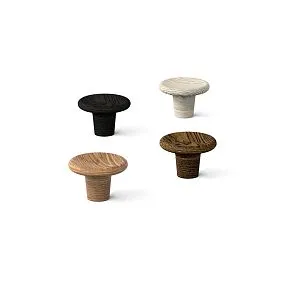
The finish is the last word the wood speaks before becoming a part of the interior. Everything before it—the wood species, shape, milling—is merely preparation for this final decision. It is the finish that turns solid wood into an antique or modern minimalism, makes a handle invisible against the cabinet front or, conversely, brings it into the spotlight. Wooden handles with finishes—patina, varnish, stain, gilding—are a separate story about how the material becomes artistic.
If you are selectinga wooden pull handlefor a kitchen set, looking for wooden interior door handles for an entryway, or want to understand how patina differs from stain and which is more durable—this article will give you a comprehensive answer. No fluff, with precise technical details and real-life examples from practice.



Types of finishes for wooden handles: varnish, oil, patina, gilding




Why a wooden handle needs a finish at all
Before breaking down the types of finishes, it's worth understanding their purpose. Wood is a living material with an open, porous structure. Moisture, grease, and bacteria accumulate in the pores. An unprotected surface darkens from touch within a few months, absorbs stains, and loses its shape due to humidity fluctuations. A finish solves all these problems simultaneously: it creates a barrier between the wood and the external environment, fixes the shape, stabilizes the color, and defines the tactile qualities of the surface.
But a finish also has a second role—an aesthetic one. The same oak handle with clear varnish, dark stain, and silver patina are three completely different products. Each is organic in its own interior style and completely out of place in another. That's why choosing a finish is not a technical task, but a design one.
Our factory also produces:



Varnish finish: transparency and durability
Varnish is the most common type of finish for wooden furniture handles. It is applied in 2–4 layers with intermediate sanding and creates a hard, transparent or semi-transparent film on the wood surface.
Acrylic varnish—water-soluble, minimal odor, fast-drying. The film is elastic, tolerates temperature fluctuations well without cracking. Gloss can be adjusted from glossy to deep matte. Acrylic varnish is most often used on kitchen furniture handles: it does not yellow over time and does not react with household chemicals during cleaning.
Polyurethane varnish—a harder and more wear-resistant finish. The polyurethane film is resistant to mechanical abrasion, point impacts, and exposure to alcohol-containing liquids. This is the choice for handles opened hundreds of times a day: kitchen cabinets, hallways, office furniture. The downside is a higher price and the need for industrial application to achieve a perfect result.
Nitrocellulose lacquer—fast-drying, with a high solvent content. Gives a beautiful gloss but yellows and cracks over time. Today, it is practically not used in the production of quality furniture handles.
Varnish preserves the natural color and texture of the wood, only slightly enhancing it. A glossy varnish finish 'enlivens' the oak grain, making it contrast-rich and deep. A matte varnish finish, on the contrary, mutes the shine, creating the effect of a silky, untreated surface—while providing full protection.
Get Consultation
Oil and wax finish: a living surface
Oil is a finish that does not create a film on the surface but penetrates the wood pores and polymerizes inside. The result is fundamentally different from varnish: the surface remains 'alive'—tactilely warm, matte, with an open texture.
Oil finish on wooden handles has its specifics. On one hand, it is ecologically impeccable: no film, no solvents, no risk of peeling. On the other—it requires regular renewal: one or two times a year, a fresh layer of oil needs to be applied to restore the protective barrier.
Hard oil with added wax—a compromise between pure oil and varnish. Wax fills the pores after oil, creating a light hydrophobic barrier. The surface gets a low-gloss 'silky' finish, more resistant to moisture and grease stains than pure oil. This type of finish is traditionally used for handles in Scandinavian style and on furniture made from light wood species: ash, birch, maple.
Wax as a standalone finish is used less often—it gives a beautiful shine but does not sufficiently protect against moisture. It is usually used as a top coat over oil.
Stain and tinting: color in depth
Stain is not a finish in the strict sense. It is a coloring composition that penetrates the wood structure and dyes the fibers from within. After staining, the surface must be coated with varnish or oil—stain does not protect, it only colors.
Why is it needed? First, to even out the color: different parts of the same board can have noticeable shade variations. Stain evens out this difference, creating a uniform background. Second, for a radical color change: light beech under dark walnut or espresso—this is precisely the work of stain. Third, to emphasize the texture: stain penetrates deeper into the pores than into the fibers, making the wood grain contrast-rich and graphically expressive.
Water-based stain—the most eco-friendly option. It raises the wood grain when applied, so after drying, the surface is sanded with fine sandpaper (grit 240–280), and then a top coat is applied. Alcohol-based stain dries faster and does not raise the grain but requires application skill: it easily creates streaks with uneven brush strokes.
For wooden furniture handles, tinting to walnut, wenge, espresso, or natural oak are the most popular colors. They ensure neutrality in a wide variety of interior contexts.
Patina: the art of imitating time
Patina is one of the most complex and yet most impressive ways to finish wooden handles. It is an imitation of noble aging: the surface acquires the appearance of an item that is 50–100 years old—with darkened recesses, light raised areas, and a 'lived-in' patina on the details.
Technologically, patination is a multi-stage process. First, a base color is applied to the item—usually golden, silver, or dark brown. Then a darker or lighter layer of patina is applied. While it is still wet, the raised parts are wiped, and the contrasting base shows through the top layer. The recesses and grooves retain the dark tone, creating an effect of accumulated shadow.
Gold and silver patina — for classic and baroque interiors. White patina on a dark base — for Provence and shabby chic. Dark patina on a light background — for modern neoclassicism and art deco.
Forwooden handles with apatina finish play a special role in the interior: they don't just open a cabinet, they tell a story. This is the only type of finish that adds narrative to a product — a sense of value that has passed through time.
Gilding: a handle as a piece of jewelry
Gilding in modern interiors is not so much about luxury as it is a tool for creating an accent. Gilded handles on white matte fronts are a canonical technique of modern neoclassicism, which over the past ten years has moved from the category of 'expensive and complex' to 'affordable and in demand'.
Real gold foil is rarely used in the production of wooden handles — mainly in handmade authorial works. In mass production, acrylic gilding paint or metallic pigment spraying is used. The visual effect is preserved, while the cost is significantly lower.
Gilding requires special care: aggressive chemicals destroy the metallic layer. Only a soft, damp cloth without abrasives and without alcohol.
Comparative table of finishes
| Finish type | Protection | Aesthetics | Style | Care |
|---|---|---|---|---|
| Gloss varnish | High | Rich shine | Classic, art deco | Lightweight |
| Matte varnish | High | Silky matte | Minimalism, Modern | Lightweight |
| Oil + wax | Medium | Natural, warm | Eco, Scandinavian, Rustic | Requires renewal |
| Stain + varnish | High | Tinted texture | Universal | Lightweight |
| Patina | Medium | Antique, 'lived-in' | Classic, Provence, Baroque | Delicate |
| Gilding | Low | Metallic shine | Neoclassicism, art deco | Very delicate |
Wooden bracket handle — a classic for kitchen fronts
What is a bracket handle and why it remains relevant
A bracket handle is a furniture handle in the shape of an arc or crossbar, fixed on two support points. A simple, reliable, ergonomically flawless design. Fingers grasp the crossbar from above or below, the hand makes a natural pulling motion — and the door opens effortlessly.
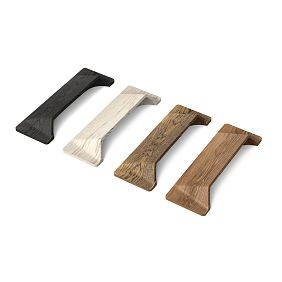
Wooden bracket handlehas remained relevant for several decades precisely because its form is absolutely organic. It does not mimic other materials or imitate metal. A bracket in wood form is an honest construction where the material and form are completely aligned in character.
Coated bracket: how finishing changes the character of the product
The same bracket shape under different coatings becomes a different product. Let's examine specifically.
Oak bracket with matte varnish — strict, neutral, universal. The natural color of oak with characteristic large pores is visible through the transparent coating. Suitable for light veneer cabinets, facades in 'wheat' and 'natural oak' colors. This is the most popular option for kitchens in Scandinavian style.
Beech bracket under dark stain — espresso or wenge color, uniform, deep. Creates strong contrast on light facades and works in unison with dark ones. Appropriate in kitchens with walnut imitation or in classic cabinets in 'chocolate' color.
Bracket with patina — the most characteristic option for a classic kitchen. The bracket body is covered with a dark base layer, protruding parts are rubbed to light — and the handle instantly acquires an 'Italian' or 'French' accent. Looks excellent on facades with milling and on kitchens with decor in neoclassical style.
Bracket under gilding — for kitchens with white matte facades and classic profiles. A gilded wooden bracket looks richer than a metal one, since the natural texture 'shines through' the metallic, adding a sense of craftsmanship.
Center-to-center distance and bracket dimensions for the kitchen
Bracket handles are mounted on two attachment points, the distance between which is called center-to-center. This is a key parameter when ordering: if you are replacing old handles with new brackets, the center-to-center distance must match exactly — otherwise you will have to drill new holes.
Standard center-to-center distances for kitchen brackets: 64 mm, 96 mm, 128 mm, 160 mm. Most cabinets are drilled for 96 or 128 mm — this is the European standard. Before ordering, always measure the actual distance with a tape measure, do not estimate by eye.
The overall length of the bracket is always 20–30 mm greater than the center-to-center distance on each side. Thus, a bracket with a 96 mm center-to-center has an overall length of 130–160 mm — these 'ears' cover the base of the attachment and create a neat visual transition from the handle to the facade.
Bracket on facades of different formats
For kitchen wall cabinets 300–400 mm wide: brackets with center-to-center 64–96 mm, located in the center of the lower part of the facade. For base cabinets: brackets 96–128 mm, located in the center of the upper part of the facade. For drawers: bracket in the center of the facade horizontally and vertically. For tall cabinets 200+ cm high: two brackets at different heights or a long bracket with center-to-center 160–200 mm.
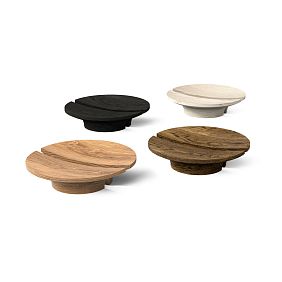
Details from the serieshandles with coatingin the STAVROS catalog are presented in several versions — from compact knobs to long brackets with center-to-center up to 320 mm, which allows selecting a solution for facades of any format.
Wooden interior door handles — requirements and differences from furniture handles
What is the fundamental difference
At first glance it may seem thatwooden interior door handlesare simply a larger version of furniture handles. In fact, the difference between them is much deeper than size.
Load. A door handle withstands fundamentally different loads than a furniture handle. It bears the force of opening a door weighing 15–40 kg, it takes impacts from slamming, it often serves as a support point when entering a room. A furniture handle on a cabinet never experiences anything like this.
Mounting construction. Furniture handles are attached with bolts through a thin facade 16–22 mm. Door handles are mounted through a door leaf 35–45 mm thick, often paired with a rosette or plate that conceals the attachment points. Many door handles are installed with a matching handle on the opposite side of the door — on a long spindle.
Grip ergonomics. A furniture handle is opened with two or three fingers. A door handle — with the entire hand. Therefore, a door handle must have a body diameter or width of at least 25–35 mm — sufficient for a full grip.
Length and scale. Door bracket handles have a length of 120–200 mm, lever handles — 100–130 mm. This is significantly larger than standard furniture handles.
Types of wooden interior door handles
Press handle (lever) — the most common type for interior doors. The lever is pressed down, activating the latch or lock. A wooden lever looks fundamentally different than a metal one: it is warmer to the touch, more organic in a wooden interior, does not create a cold contrast.
Bracket handle — for doors without locks: pantries, utility rooms, double doors. The bracket is mounted stationary, without a moving mechanism. A wooden bracket with patina or varnish coating is an appropriate element in classic and country interiors.
Knob handle (ball) — a traditional door handle in the shape of a ball or egg. In wood, this shape looks especially organic: a turned wooden ball with oil coating is a detail appropriate in interiors in country, Provence, rustic, and country house styles.
Button handle — a decorative option for light doors without locks or for double cabinets built into a doorway. A wooden button with gold or silver coating is a detail for classic studies and libraries.
Wood for interior door handles: material requirements
Requirements for wood in door handles are stricter than for furniture. Here, not only the hardness of the wood species matters but also geometric stability: a handle that warps due to temperature fluctuations stops functioning properly.
Oak is the optimal wood species for interior wooden handles. Its density ensures resistance to mechanical loads, and its relatively low expansion with humidity changes (compared to coniferous species) guarantees geometric stability.
Beech is similar in hardness to oak but more sensitive to humidity changes—if insufficiently dried, it warps more. For rooms with a constant microclimate (heated city apartments), beech works excellently. For country houses with seasonal humidity fluctuations, oak is preferable.
Walnut and cherry are wood species used in premium door handles. They provide an exquisite color (walnut—dark chocolate, cherry—warm reddish-brown) and a velvety texture that doesn't require staining with wood stain—a clear varnish is sufficient.
How to choose a wooden handle for an interior door
The door style determines the handle style
Choosing a wooden handle for an interior door doesn't start with the handle but with the door. Its style, wood species, type of finish, and door casing profile—all of this sets the context in which the handle should exist harmoniously.
Solid oak doors in a classic profile—with wooden handles in a matching color or a shade darker. A handle with a patina on an oak door with a dark oil finish creates the effect of a solid wooden object where every detail tells the same story.
MDF doors with enamel finish—here, a wooden handle works as a contrasting accent. A white door with a walnut wooden handle and a matte varnish is a strong and modern combination.
Solid pine doors in a country house—a wooden bracket handle made from the same pine with an oil finish. Or a contrast: light pine with a dark-stained beech bracket. Both options are organic.
Doors with glass inserts—in doors with square or arched glass inserts, a wooden handle is perceived as an extension of the wooden frame. Here, it's important that the wood species of the handle matches the door's wood species.
Handle size and door proportions
A door bracket handle should be approximately 1/10–1/8 of the door leaf height. For a standard 2000 mm door, the handle length is 200–250 mm. For tall doors of 2200–2400 mm—250–300 mm.
Handle height placement: the center of the handle—at a height of 1000–1050 mm from the floor. This is an ergonomic standard for an average-height adult. For children's rooms: the center of the handle at 800–850 mm—children should be able to open their room independently.
Handle finish and door finish: combination rules
Here, the principle of 'unity or contrast' applies—there is no in-between.
Unity: a handle made from the same wood species as the door, with an identical finish. The visual effect—monolithic, noble, high-quality finishing. This solution requires precision in color and texture matching.
Contrast: a handle in a fundamentally different color than the door. A dark handle on a light door, a gilded one on a white door. This is a technique that 'elevates' the handle into an independent decorative element.
Forbidden zone: 'almost matching' tones. A handle slightly darker than the door of the same wood species—this looks not like an intended contrast but like a mistake. Either a perfect match or an obvious contrast.
Handle and door casing: system or chaos
A competent design approach requires that a wooden door handle be part of a unified system with the door casing and, if present, the baseboard. If the casing is oak with a dark oil finish—the handle should also be oak with a dark oil finish or a patina in a dark tone. This creates the feeling that the door and its framing were made by the same craftsman from the same material.
Violating this principle is one of the most common mistakes in DIY renovations. An oak door with a pine casing and a beech handle stained to look like walnut—these are three different stories in one place, and none of them sound convincing.
Care and restoration of wooden handle finishes
Routine care: daily maintenance rules
Proper care for wooden handles with a finish is not a labor-intensive procedure but a set of simple rules that are easy to follow.
Damp cloth without abrasives. The main tool—a soft microfiber cloth, slightly damp. Movement—along the grain. No sponges with a rough side, no powdered cleaning agents.
Neutral chemicals. For handles with a varnish finish—neutral liquid detergents without chlorine or alcohol. Chlorine discolors varnish, alcohol leaches wax components from the finish.
Immediate moisture removal. After wiping with a damp cloth—dry immediately. Especially important for handles with an oil finish: standing water on oil gradually forms white spots.
Patina and gilding are delicate areas. For patinated handles, use only a dry or slightly damp cloth. No chemicals. Active cleaning agents remove the top layer of patina, disrupting the carefully created aging effect.
Restoring varnish coating
Over time, the varnish coating on frequently used handles loses its shine, and small scratches and wear marks appear. Complete restoration takes several hours and does not require professional tools.
Step 1. Remove the handle from the furniture. Working while it's attached yields poor results.
Step 2. Using a fine-grit sanding sponge (grit 320–400), go over the surface with light circular motions. The goal is to remove wear marks and create roughness for the new layer of varnish. Don't overdo it: you need to refresh the surface, not remove the varnish down to the wood.
Step 3. Remove sanding dust with a dry cloth. Degrease the surface with isopropyl alcohol (only for handles without patina and gilding).
Step 4. Apply a thin layer of acrylic varnish with a soft-bristled brush or an aerosol can. For aerosol: distance 25–30 cm, smooth motion. For brush: move along the grain, without crosswise strokes.
Step 5. Let dry for 4–6 hours, apply a second thin layer. After complete drying (24 hours), polish with a soft cloth.
Restoring oil coating
Oil coating is restored much more easily than varnish. No sanding is required—only degreasing and applying fresh oil.
Wipe the handle dry. Apply a thin layer of oil (hard oil, Danish oil, or special furniture oil for oak). After 15–20 minutes, remove excess with a dry rag—do not leave oil to polymerize on the surface, otherwise a sticky layer will form. Let dry for 24 hours at room temperature.
If the surface has deep scratches—first go over it with a 240-grit sanding sponge along the grain, remove dust, and only then apply oil.
Restoring patinated handles
Patinated handles require the most delicate approach. Patina is a two-layer coating, and mechanical impact on the top layer disrupts the balance between dark and light.
For light refreshment: apply a thin layer of furniture wax matching the top color of the patina, let dry, polish with a soft cloth. This restores shine without altering the character of the finish.
For serious damage—chipping or wear down to the base—professional restoration is performed as follows: the damaged area is painted with the base color (dark), after drying—a light patina tone is applied spot-wise, then everything is covered with a thin layer of matte varnish.
Extending coating life: prevention
Proper prevention extends the coating's lifespan many times over. Several specific tips:
-
Do not open furniture and doors with wet hands after washing dishes or cooking—water with detergents is aggressive to any coating.
-
Install soft stoppers on doors that are often opened abruptly—impacts against the frame gradually damage the handle and coating.
-
Every six months, perform light polishing: soft cloth + a drop of silicone-free furniture polish.
-
When installing handles with coating, avoid direct contact of metal fastening elements with the finished surface—use soft washers as spacers.
How to choose a wooden handle with coating for a specific interior
Selection matrix: style + wood species + coating
Choosing a wooden handle with coating is simultaneously a stylistic, technical, and spatial decision. Below is a practical matrix for different interior contexts.
| Interior style | Recommended Wood Species | Finish | Handle shape |
|---|---|---|---|
| Scandinavian | Ash, birch | Matte oil, light varnish | Pull, knob |
| Neoclassical | Oak | Patina, gilding | Bracket, lever |
| Minimalism | Oak, beech | Matte varnish, stain | Bracket, mortise |
| Provence | Pine, linden | White patina, wax | Knob, bracket |
| Rustic / country | Pine, larch | Oil, dark stain | Pull, knob |
| Art Deco | Walnut, beech | Gloss varnish, gilding | Long bracket |
| Eco / organic | Oak, ash | Natural oil | Bracket, mortise |
Mistakes when choosing a finish
The most common mistake is choosing a finish from a catalog without considering the room's lighting. A patinated handle in a dark hallway without natural light loses all its play of light and shadow. A gilded handle in a brightly lit kitchen produces blinding glare. A matte oil finish in a glossy interior looks untidy.
The second frequent miscalculation is the incorrect combination of the handle's sheen and the cabinet front. A glossy handle on a matte front is either a deliberate contrast or a mistake. To become a deliberate contrast, this technique needs to be supported by other interior details.
The third mistake is a mismatch in the color of metal hardware. If the interior features hinges, locks, and other metal elements in bronze, a wooden handle with a gold patina will 'sound' in unison. If all the hardware is chrome-plated, a handle with gilding will create dissonance.
FAQ: Answers to popular questions
How does patina differ from stain?
Stain colors the wood itself from within and does not create a visible layer on the surface. Patina is a decorative coating applied over the wood (or over another finish), imitating an aging effect with contrast between dark recesses and light raised areas. After staining, the wood looks uniformly tinted. After patination, it looks 'lived-in' and layered.
Can patina be applied over an already varnished handle?
Yes, but only over matte varnish—gloss does not accept patina. The surface of the matte varnish is first degreased, then a dark or light patinating composition is applied. The raised parts are then carefully wiped with a cloth until the contrast appears, and everything is coated with a final matte varnish.
What is the most durable finish for a wooden kitchen handle?
Polyurethane varnish in a matte finish. It is resistant to moisture, grease stains, alcohol-based cleaning agents, and mechanical abrasion. It lasts 8–12 years without needing renewal with proper care.
Can wooden handles with a finish be used in the bathroom?
Yes, provided the finish is polyurethane and applied in 3–4 layers without gaps. After each wet cleaning, the handles must be wiped dry. Handles with an oil finish are not recommended for bathrooms—constant high humidity breaks down the oil layer.
How to tell if a handle needs its finish renewed?
Signs: loss of sheen (for varnished finishes), appearance of whitish water spots, a feeling of roughness to the touch, darkening of the wood in the area of contact with the palm. For oiled handles—drop water on the surface: if the droplet absorbs instead of beading up, it's time to renew the oil.
Is a wooden bracket handle suitable for a built-in sliding wardrobe?
Yes, in a vertical orientation and 300–400 mm in length. For a sliding wardrobe in a niche, a wooden bracket creates an architectural accent while remaining practical: it does not snag clothing when passing by, does not trap dust, and is easy to clean.
How does a wooden interior door handle differ from a furniture pull?
In size, mounting design, and strength. A door handle is installed with longer bolts through a thick door leaf, has a reinforced body to withstand the load when opening a heavy door, and typically includes a corresponding part on the opposite side of the door leaf.
How to choose a handle finish if the kitchen fronts are painted white?
Three foolproof options: 1) dark walnut stain + matte varnish — a classic contrast, 2) gilding — modern neoclassicism, 3) gray-graphite tone stain + matte varnish — a modern neutral accent.
About the company STAVROS
If in fifty years of working with wood and interiors I've learned one absolute rule — it's that the right detail costs more than any redone renovation. That's why, when it comes to wooden handles with finishes — for the kitchen, for interior doors, for bedroom cabinets — it's worth turning to a manufacturer where quality is built into the production process, not added as a marketing claim.
STAVROS company produces wooden furniture handles with finishes from solid oak and beech. Each model is manufactured using 3D milling with an accuracy of up to tenths of a millimeter, ensuring geometric uniformity across the entire batch. Finishes — varnish, stain, patina, oil — are applied under controlled conditions in the production workshop, not in makeshift settings, which fundamentally affects the uniformity and durability of the finish.
The STAVROS catalog features over 30 models of handles with finishes — from compact knobs to long architectural pulls, from minimalist lacquered to luxurious gilded. Price range: from 660 to 11,680 rubles per item depending on the model, size, and type of finish. Delivery — throughout Russia and to neighboring countries. Orders from one piece, shipping from the warehouse within one business day.
STAVROS is not just a handle supplier. It is a manufacturer that understands that a wooden detail with the right finish is not hardware, but the final chord of an interior, which either sounds impeccable or doesn't sound at all.