












































































Article Contents:
- Philosophy of Touch: Psychology of Interaction with Wood
- Material Science: Secrets of Wood Species for Handles
- Technological Innovations in the Production of Wooden Handles
- Design Solutions: Styles and Forms of Wooden Handles
- Ergonomics and Functionality: The Science of Comfort
- Raw Material Preparation and Forming
- Finishing and Protective Coatings: Preserving Beauty
- Installation and Setup: Professional Approach
- Care and Maintenance of Wooden Handles
- Integration into various interior styles
- Frequently Asked Questions
- Conclusion: STAVROS — traditions of quality in the modern world
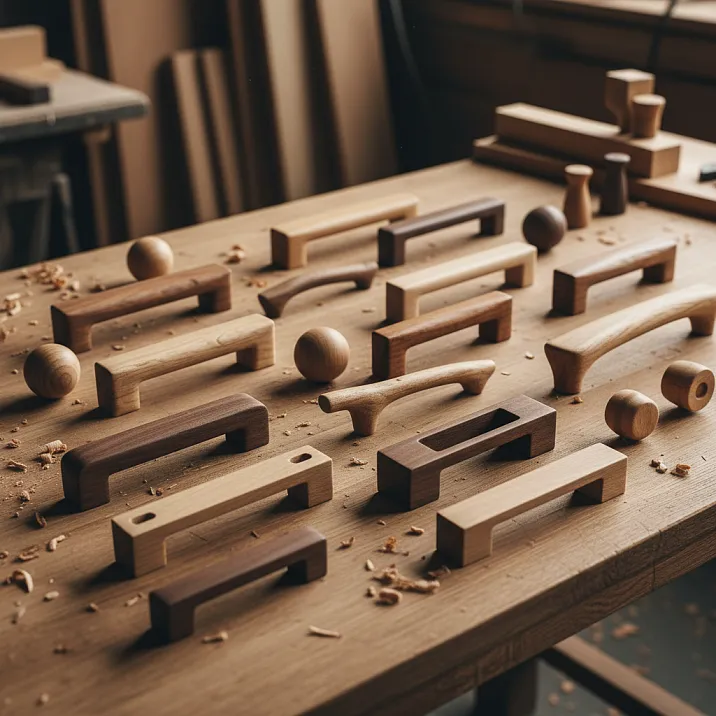
In the world of interior design, there is a paradox: the most inconspicuous details often have the greatest impact on our perception of space. Have you ever wondered why you want to stay in one house for a long time, while in another you want to leave as quickly as possible? The answer may lie in the most unexpected places.Wooden handles— it’s those details we touch hundreds of times a day, without realizing their influence on our mood and comfort.
Imagine morning: you wake up, go to the kitchen, and the first thing your hand touches is a cold metallic cabinet handle. An unpleasant sensation immediately spoils your mood. Now imagine the warm touch of a smooth wooden surface, the pleasant tactile sensation of natural material that seems to come alive under your fingers. Do you feel the difference?
This is not just a designer’s romantic fantasy — it’s a scientifically proven fact. Neuropsychologists claim: tactile sensations directly affect our emotional state and stress levels. Wooden handles create a special energy in the home, forming an atmosphere of coziness and harmony with nature. But how to choose the ideal wooden handles? What secrets does the production of quality items hide? And why is it worth investing in natural materials?


Philosophy of Touch: Psychology of Interaction with Wood
Humans and wood are connected by millennia of evolution. Our ancestors lived among trees, built homes from them, created tools and household items. This genetic memory still lives within us, explaining our special attraction to natural materials. Modern science confirms: contact with wood reduces cortisol levels — the stress hormone, normalizes blood pressure, and improves overall well-being.
The tactile receptors in our hands are incredibly sensitive. They can distinguish surface temperature down to fractions of a degree, detect roughness at a microscopic level, and sense material moisture.Furniture Handlesmade from natural wood provide ideal touch temperature — they do not burn in summer and do not freeze in winter, unlike metallic counterparts.
The texture of wood plays a special role in forming the tactile experience. Each wood species has a unique grain pattern that creates incomparable sensations under the fingers. Smooth birch offers a sensation of softness, textured oak conveys strength and reliability, warm linden evokes home coziness. These differences are not random — they were shaped over millions of years of evolution for each species.
The aromatherapeutic effect of wooden handles — another little-known but important aspect. Natural wood retains its natural aroma for a long time, positively affecting the nervous system. Coniferous species calm and relax, while deciduous species invigorate and energize. This effect is especially noticeable in the first months of use, when the wood still retains the maximum of its natural properties.
The energetic compatibility between humans and wood — a concept that may seem esoteric, but has scientific justification. Wood has the ability to absorb and release moisture, creating a microclimate around itself. It is a living, breathing material that responds to changes in the surrounding environment. Touching a wooden handle, we interact with this living system, becoming part of the natural energy exchange.
The psychological comfort of using natural materials is also linked to a sense of ecological responsibility. Choosing wooden handles means making a conscious choice in favor of sustainable development, rejecting plastic and synthetic materials. This sense of making the right choice subconsciously influences our attitude toward home and adds additional comfort.




Material Science: Secrets of Wood Species for Handles
Choosing a wood species for making handles is an art requiring deep knowledge of the properties of various types of wood. Each species has unique characteristics that determine not only the appearance of the finished product but also its performance, durability, and cost.
Oak is the aristocrat among wood species for handles. Its dense structure provides exceptional strength and wear resistance. Oak handles serve for decades, practically maintaining their shape and size. The characteristic pattern of annual rings creates a noble texture that becomes more pronounced with age. Tannins contained in oak have antiseptic properties, making such handles hygienic and safe.
Birch offers an ideal balance between beauty and functionality. Its light, uniform wood is easy to process, allowing the creation of handles of the most complex shapes. Birch products are distinguished by a pleasant silk-like surface sheen and neutral color, which harmoniously blends into any interior. High density of birch ensures longevity, while its relative softness provides comfort in use.
Ash is renowned for its strength and elasticity. This species can withstand significant loads without deformation, making ash handles an ideal choice for heavily used furniture. The expressive texture of ash with clearly defined annual rings creates a dynamic pattern, especially effective when stained.
Beech is distinguished by its exceptionally uniform structure and pleasant pinkish hue. Beech handles have a fine-grained surface that becomes perfectly smooth after sanding. This species is excellent for staining, allowing it to imitate more expensive exotic species. High hardness of beech guarantees the longevity of products.
Maple is a species with unique decorative properties. Some maple varieties have a swirling grain — a special fiber pattern that creates a shimmering surface effect. Maple handles are distinguished by exceptional elegance and are often used in premium interiors. Light color of maple allows creating contrasting color schemes.
Linden is a classic material for carved items. Its soft, pliable wood allows creating handles with delicate decorative elements and complex profiles. Linden handles are especially popular in traditional-style interiors, where mechanical strength is less important than the beauty of execution.
Coniferous species — pine, spruce, larch — offer interesting opportunities for creating handles in eco-style. Resinous wood of coniferous species has natural resistance to biological damage. Contrasting texture with clear distinction between early and late wood creates an expressive natural pattern.
Our factory also produces:


Technological innovations in the production of wooden handles
Modern production of wooden handles is a complex technological process where traditional carpentry methods are combined with the latest achievements of the woodworking industry. Each stage of production affects the quality of the finished product and requires a professional approach.
Raw material preparation begins with careful selection of wood. For producing high-quality handles, only healthy sections of the trunk free from defects — knots, cracks, rot — are used. The wood moisture content must be stabilized to 8-10%, achieved through specialized kiln drying with controlled temperature and humidity parameters.
CNC machining on modern machines allows creating handles of any complexity with precision down to hundredths of a millimeter. Programmable centers ensure ideal repeatability of geometric parameters, which is critically important for mass production. At the same time, manual finishing of each item remains possible to impart individuality.
Turning remains the primary method for creating handles with classic shapes. Modern turning machines allow processing blanks from the hardest wood species, creating complex profiles with smooth transitions. An experienced turner can give each handle a unique character by varying profile details.
Polishing is a critically important stage determining the surface quality of the finished product. Multi-stage polishing with gradually decreasing abrasive grit allows achieving mirror-smooth surface finish. Modern polishing systems ensure uniform processing of all areas of complex-profile items.
Innovative surface treatment methods include thermal treatment, which alters the structure of the wood surface layer, increasing its hardness and wear resistance. Plasma treatment allows creating micro-relief on handle surfaces, improving grip and preventing slipping.
Laser engraving opens new possibilities for personalizing wooden handles. A fine laser beam can create intricate patterns, logos, and text with jewel-like precision. This is especially in demand when manufacturing exclusive items for premium interiors.
Quality control is performed at every production stage using modern measuring equipment. Coordinate measuring machines check the geometric parameters of items, optical systems detect the slightest surface defects. This approach guarantees consistently high product quality.
Get Consultation
Design solutions: styles and forms of wooden handles
Design of wooden handles is the art of creating functional objects that are simultaneously decorative interior elements. Properly selected handles can dramatically change the perception of furniture and the entire space, emphasize a style or become striking accents.
Classic style in handle design is characterized by strict proportions and noble forms.Wooden HandleIn classic execution, it has clear geometric outlines, smooth transitions between profile elements, perfect symmetry. Traditional decorative elements — reeding, volutes, plant motifs — are often used, executed with jewel-like precision.
Minimalist approach to handle design implies maximum simplicity of forms and absence of decorative elements. The beauty of such items lies in perfect proportions, surface quality, and expressiveness of natural wood texture. Minimalist handles emphasize the architectural quality of furniture and create a sense of modernity.
Scandinavian style brought to handle design a particular philosophy of simplicity and functionality. Characteristic features of Scandinavian handles — light wood species, natural colors, ergonomic shapes, absence of excessive decoration. Such handles create an atmosphere of northern coziness and eco-friendliness.
Rustic style allows maximum use of the natural beauty of wood. Handles in this style may retain natural irregularities, tool marks, even small knots, which would be considered defects in other styles. Intentional roughness of processing creates a sense of closeness to nature and handcrafted authenticity.
Modern handles in the Art Deco style are characterized by smooth, organic forms inspired by natural motifs. Handles in the Art Deco style often have asymmetrical shapes resembling plants, flowers, or ocean waves. Creating such items requires high craftsmanship and artistic taste.
Modern avant-garde solutions in wooden handle design can combine traditional materials with unexpected forms and functions. These may include handles with unusual geometry, composite items made from different wood species, handles with built-in lighting or sensor elements.
Ethnic motifs in handle design allow creating items with a distinctly national character. Russian traditions of wood carving, Scandinavian runes, Eastern ornaments — each culture offers unique decorative solutions that can be adapted for modern interiors.
Ergonomics and functionality: the science of comfort
Creating an ergonomic wooden handle is a complex task requiring deep understanding of human hand anatomy and biomechanics of movement. A properly designed handle is not only beautiful but also ensures maximum comfort during use, reduces fatigue, and prevents injuries.
Anatomical features of the human hand determine optimal handle parameters. Handle length should correspond to palm width — typically 120-160 mm for an adult. Handle thickness is critically important for comfortable grip — optimal diameter is 25-35 mm, allowing fingers to naturally wrap around the handle without strain.
Surface profiling of the handle affects grip quality and tactile sensations. A slight convexity in the central part of the handle ensures natural hand positioning. Small finger indentations increase grip reliability, especially important when opening heavy doors or pulling out loaded drawers.
The angle of handle installation relative to furniture facade should correspond to the natural position of the hand. Too vertical or horizontal installation causes discomfort and may lead to pain during intensive use. Optimal angle is 15-20 degrees from vertical.
Surface material of the handle plays an important role in ergonomics. Natural wood provides ideal grip with skin, does not slip even with wet hands. Different types of finish — oil, wax, varnish — affect tactile properties differently. Oil finish creates the most pleasant sensations, wax provides silkiness, varnish — smoothness.
Thermal properties of wooden handles make them ideal for any climate conditions. Wood conducts heat slowly, so handles remain warm in winter and cool in summer. This is especially important for handles located near heat sources or on sunny sides of rooms.
Handle weight affects the perception of quality and reliability. Light handles may seem fragile, overly heavy ones — create a sense of bulkiness. Optimal weight of a wooden handle is 50-150 grams depending on size and wood species.
Dynamic characteristics determine handle behavior during use. A properly balanced handle does not create vibrations during sharp movements and does not transmit impacts from closing doors. This is achieved through correct mass distribution along the handle length and quality mounting.
Manufacturing technologies: from raw material to finished product
Modern production of high-quality wooden handles is a high-tech process combining advanced processing methods with traditional craftsmanship. Each production stage requires strict adherence to technological parameters and continuous quality control.
Preparation of blanks begins with wood selection. For manufacturingOnly the best sections of the trunk with uniform structure, free of defects and flaws, are selected. The wood is sawn taking into account the direction of the fibers — for maximum strength, the fibers should be aligned along the main axis of the product.Wood drying is a critically important stage determining the dimensional stability of finished products. Modern drying chambers allow precise control of the moisture removal process, preventing cracking and deformation of blanks. The drying process may take from several weeks to several months depending on the wood species and blank thickness.
Mechanical processing includes several sequential operations. Initial milling gives the blank an approximate shape of the future handle. Turning creates the exact geometry of the product, taking into account all structural features. Modern CNC machines ensure ideal repeatability of parameters in mass production.
Polishing is performed in several stages with gradually decreasing abrasive grain size. Preliminary polishing removes traces of mechanical processing, intermediate polishing levels the surface, and final polishing creates a perfectly smooth surface ready for coating application.
Wood moisture control is performed at every stage of production. Special moisture meters allow precise determination of moisture content in the wood. The optimal moisture level for finished handles is 8-12%, ensuring dimensional stability under operating conditions.
Finishing operations include applying protective-decorative coatings. Priming prepares the surface for the main coating, fills wood pores, and creates an even base. Sanding between coating layers ensures a perfectly smooth final layer surface.
Packaging of finished products requires special attention to prevent damage during transportation. Each handle is individually packaged using protective materials. Group packaging provides additional protection and convenience for warehouse operations.
Finishing and protective coatings: preserving beauty
Finishing and Protective Coatings: Preserving Beauty
Final finishing of wooden handles is not merely a decorative operation, but also an important stage of protecting wood from external influences. Properly selected and correctly applied coating extends the service life of products and preserves their attractive appearance for many years.
Oil finishing is considered the most natural way to protect wood.Wooden itemsHandles with oil finish retain the natural wood texture and tactile properties. Oil penetrates deeply into wood pores, creating reliable protection from within. Such a coating can be easily renewed without completely removing the previous layer.
Varnish coatings provide maximum protection of wood against moisture, contamination, and mechanical damage. Modern polyurethane varnishes create a strong, elastic film that does not crack when wood expands or contracts. Different types of varnish allow achieving surfaces ranging from deep matte to mirror gloss finish.
Wood staining allows changing its natural color, emphasizing texture, or imitating more expensive species. Water-based stains are safe and eco-friendly, alcohol-based stains dry quickly, and oil-based stains penetrate deeply into wood. Proper staining requires professional skills to achieve even color.
Patination is a special technique creating an aged wood effect. Using various compositions and processing methods, one can imitate natural aging, create a worn effect, or highlight specific relief elements. Patinated handles are especially popular in classic and vintage interior styles.
Innovative coatings include nanocomposites providing unique protective properties. Such coatings may be self-cleaning, antibacterial, or UV-resistant. Development of nanotechnology opens new opportunities for protecting and functionalizing wooden surfaces.
Coating quality control includes checking adhesion, layer thickness, uniformity of application, and surface gloss. Modern instruments allow objective assessment of coating quality and prediction of its durability under operating conditions.
Correct installation of wooden handles is the final stage determining not only the appearance of furniture but also its usability. Quality mounting requires special tools, precise measurements, and adherence to technological requirements.
Installation and mounting: professional approach
Marking locations for handle installation is the first and critically important mounting stage. Even minor misalignments in handle placement will be visually noticeable and create an impression of carelessness. For precise marking, special templates are used, ensuring uniform handle placement on all furniture elements.
Drilling holes requires proper selection of tools and processing modes. For wooden facades, special wood drill bits with centering tips are used. Drilling speed must match the density of the facade material — excessive speed may cause burning or delamination of the material.
Preventing chipping during drilling is an important task, especially for facades with coatings. Using a dense material backing, drilling from the front side, and using sharp drill bits — all these measures help obtain clean holes without damaging the surface.
Fasteners must match the weight of the handle and the loads during operation. Standard M4 or M5 screws are suitable for most wooden handles. Screw length must ensure secure fastening in the facade material, but should not be excessive to avoid damaging internal furniture components.
Adjusting the handle position is performed after preliminary installation. The handle must be installed strictly horizontally or at the specified angle, depending on the design. Using a construction level helps achieve perfectly accurate positioning.
Final tightening of fasteners must ensure secure fixation of the handle without excessive force that could damage the wood or threaded connections. A properly installed handle should have no play or movement.
Protection against damage during installation includes using soft pads, careful handling of tools, and protecting facade surfaces from scratches and contamination. Professional installers always use protective materials and special tools minimizing the risk of damage.
Care and maintenance of wooden handles
Care and Maintenance of Wooden Handles
Proper care of wooden handles not only extends their service life but also maintains their attractive appearance for many years. Regular maintenance prevents serious damage and allows timely correction of minor defects.
Daily care involves maintaining the cleanliness of handle surfaces. To remove dust and light dirt, it is sufficient to wipe handles with a dry soft cloth. If necessary, a slightly damp cloth can be used, but excessive moisture must be avoided as it may damage the coating or wood.
Weekly cleaning may include using special wood care products. Such products clean the surface from dirt, nourish the wood, and maintain the protective properties of the coating. When selecting products, it is important to consider the type of handle coating — different formulations are suitable for different types of finishes.
Preventive maintenance includes checking the condition of fasteners. Screws may loosen over time due to natural wood movement or heavy use. Timely tightening of fasteners prevents more serious problems and ensures safe operation.
Coating renewal is a periodic procedure necessary to maintain the protective and decorative properties of the finish. The frequency of renewal depends on the type of coating, intensity of use, and operating conditions. Oil-based coatings require more frequent renewal than others, but they are easier to restore independently.
Minor damage should be addressed immediately upon detection. Small scratches can be filled with color-matched wax pencils. More serious damage requires professional repair with partial or full coating renewal.
Seasonal maintenance is especially important for rooms with variable heating. Sudden changes in temperature and humidity can cause wood movement and cracking. Regular inspection and timely maintenance help prevent serious damage.
Professional restoration may be required after several years of intensive use. Specialists can perform full coating renewal, repair serious damage, and replace worn fasteners. Properly executed restoration can practically fully restore the original appearance of handles.
Integration into various interior styles
Wooden handles are a universal element capable of harmoniously fitting into interiors of various stylistic directions. The secret to successful integration lies in correctly selecting the shape, size, wood species, and finish type to match a specific style.
Classic interiors require handles with noble proportions and restrained decoration.decor for furnitureIn the classic style, traditional forms and materials are used. Oak or beech handles with a light patina, strict geometric profiles, possibly with minimal carved elements — all of this will emphasize the elegance of a classic interior.
Modern minimalism dictates completely different requirements for wooden handles. Here, clean lines, absence of decorative excesses, and perfect proportions are important. Handles made of light-colored woods — birch, maple, ash — with natural or slightly tinted finishes perfectly complement minimalist furniture.
Scandinavian style implies a special relationship with natural materials. Wooden handles in a Scandinavian interior should emphasize the connection with nature, eco-friendliness, and functionality. Light-colored woods, simple shapes, natural finishes — all of this creates an atmosphere of northern coziness.
Loft interiors allow experimenting with contrasts and textures. Wooden handles in a loft can be intentionally rough, with emphasized wood grain, possibly with metal elements. Dark wood species, brushed surfaces, industrial accents — all of this harmoniously fits into a loft interior.
Provençal style requires a special approach to selecting wooden handles. Here, the patina of age, wear, and natural imperfections are important. Artificially aged handles, pastel tones, soft shapes — all of this will create an authentic atmosphere of French countryside.
Ethnic interiors offer wide opportunities for incorporating national motifs into handle design. Russian traditions of wood carving, Scandinavian runes, Eastern ornaments — each culture offers its unique decorative solutions.
Modern eclectic interiors allow bold combinations of various styles and materials.buy wooden handlesCombining different styles and combining them in one interior — an interesting design approach that creates a dynamic and individual space.
Frequently asked questions
Which wood species is best suited for kitchen handles?
Hardwood species with dense structure — oak, ash, beech — are best suited for kitchen handles. These species are resistant to moisture and temperature fluctuations typical of kitchen environments. It is also important to use a quality protective coating — lacquer or special kitchen furniture oil.
How often should the coating of wooden handles be renewed?
The frequency of coating renewal depends on its type and intensity of use. Lacquer coatings typically last 5-7 years, oil-based coatings require renewal every 2-3 years, and wax coatings — annually. In rooms with high humidity or intensive use, renewal may be required more frequently.
Can wooden handles be made to order?
Yes, manufacturing wooden handles according to individual sketches is one of the specializations of modern producers. This allows creating unique items perfectly suited to a specific interior. Custom production includes selecting the wood species, shape, size, finish type, and decorative elements.
Are wooden handles suitable for children's rooms?
Wooden handles are ideal for children's rooms due to their eco-friendliness and safety. Natural wood does not emit harmful substances, feels pleasant to the touch, and has no sharp edges when properly processed. It is important to choose handles with safe water-based finishes.
How to fix minor damage on wooden handles?
Minor scratches can be removed with light sanding using fine-grit sandpaper, followed by applying the appropriate finish. For local repair, color-matched wax pencils are suitable. More serious damage requires professional repair.
What tools are needed to install wooden handles?
To install wooden handles, you will need: a drill with a set of wood drill bits, a screwdriver or electric screwdriver, a ruler, a pencil for marking, and a construction level. It is advisable to have a template for accurate hole marking and a backing material to prevent chipping during drilling.
Conclusion: STAVROS — traditions of quality in the modern world
In a world of mass production and synthetic materials, STAVROS remains true to the traditions of creating high-quality authentic wooden products. Our long experience working with natural wood, use of advanced technologies, and careful respect for craftsmanship traditions allow us to produce products that meet the highest international standards.
STAVROS offers a full range of wooden handles — from classic solutions to avant-garde designer pieces. Each handle undergoes careful quality control at every stage of production, from raw material selection to final packaging. We use only premium wood from leading European suppliers, modern high-precision equipment, and eco-friendly finishing materials.
STAVROS's production facilities are equipped with state-of-the-art equipment, enabling us to fulfill orders of any complexity in the shortest possible time. At the same time, we do not neglect the human factor — our workshops are staffed by experienced craftsmen capable of giving each item a unique character and individuality.
Classic FurnitureIt requires appropriate accessories, and STAVROS is ready to offer solutions for the most demanding clients. Our designers constantly work on creating new collections, keeping track of global trends and taking into account client preferences.
Environmental responsibility is one of the main principles of STAVROS's operations. We use only legally sourced wood, minimize production waste, and apply environmentally safe technologies. Our products are certified according to international environmental standards and are completely safe for health.
STAVROS's service support includes consultations on choosing optimal solutions, assistance in design, professional installation, and after-sales service. Our specialists are always ready to share their experience and help you create your dream interior.
Choosing STAVROS wooden handles means investing in quality, beauty, and durability. Our products will become an indispensable part of your home, delighting you every day and being passed down from generation to generation as a true example of craftsmanship and impeccable taste.


