Article Contents:
- The role of the handle in furniture design
- Functional aspect
- Visual aspect
- Psychological aspect
- Materials for wooden furniture handles
- Coniferous species - accessibility and functionality
- Hardwood species - investment in quality
- Handle shapes - from classic to modern
- Scalloped handles
- Straight handles - modern minimalism
- Carved handles - detail and luxury
- Handles with protrusion
- Flat handles
- Sizes and proportions
- Handle length
- Diameter and thickness
- Distance from the front edge
- Handle mounting - reliability and durability
- Through-screw mounting
- Inlaid mounting
- Adhesive Application
- Combined mounting
- Combining handles with fronts - design harmony
- Handle contrasting with the front
- Monolithic combination
- Handles complementing the front
- Handle as a color accent
- Interior styles and handles
- Classic style
- Minimalism
- Scandinavian Style
- Loft and Industrial Style
- Rustic and ethnic styles
- Finishing and painting of handles
- Natural wood without finishing
- Oil and wax
- Matte lacquer
- Glossy lacquer
- Painting
- Stain and toning
- Gilding and silvering
- Practical Recommendations for Selection
- Step 1: Determine the style
- Step 2: Choose the shape
- Step 3: Consider furniture size
- Step 4: Choose the material
- Step 5: Agree on color
- Step 6: Choose the finish
- Step 7: Check dimensions
- FAQ
- Conclusion

Wooden furniture handle - a detail seen and touched thousands of times in life, but rarely noticed. Its value becomes apparent only in its absence. Imagine a kitchen cabinet without a handle - a completely non-functional object requiring heroic efforts to open. Or a chest with a poorly chosen handle - a beautiful piece of furniture that cuts the eye with dissonance against the rest of the finish.
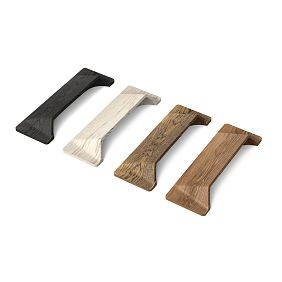
Wooden furniture handleIt is not just a functional element, but a visual accent defining the style of furniture, its character, its place in the interior. A wooden handle in a classic interior creates a sense of historical authenticity, organic nature, naturalness. A modern minimalist handle in the same interior would look out of place, destroying harmony.
Choosing the right handle for furniture is a task requiring understanding not only of aesthetics but also practical aspects. Which shape suits your front? Which mounting method guarantees reliability for decades? How to choose size, material, finish so that the handle works both practically and visually? All these questions are addressed in this article.


The role of the handle in furniture design
The handle is a detail often overlooked in furniture design, but it determines the first impression upon interacting with the object. It is the point of contact between the user and the object, a physical and emotional interaction.




Functional aspect
The handle serves a practical purpose - helps open a door, pull out a drawer. But a quality handle makes this easy, with a sense of smoothness and confidence. A poor handle creates frustration with every use.
Handle size affects comfort. A small handle requires precise finger movements, tires with frequent use. A large handle allows gripping with the palm, reducing the effort required to open. Handle thickness affects grip comfort - too thin cuts the skin, too thick does not allow fingers to wrap around it.
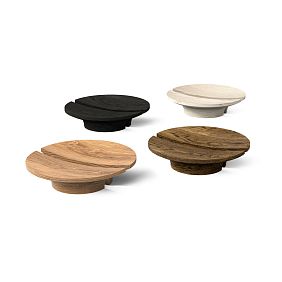
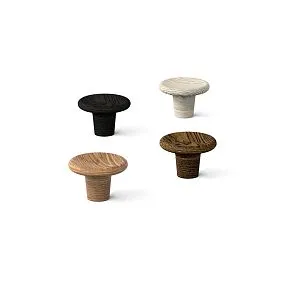
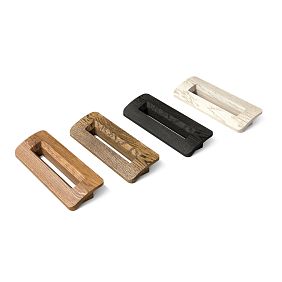
Our factory also produces:



Visual aspect
The handle occupies a central position on the furniture front. Its shape, color, texture are visible from a distance, influencing the perception of the entire object. An elegant handle decorates a simple front. An incorrect handle spoils a beautiful design.
The handle color can contrast with the front, emphasizing its color, or be monolithic, blending with it. Both approaches work, the question is only the design concept.
Handle texture - polished, matte, carved - adds visual interest. A simple smooth handle looks modern. A carved handle - historically, classically.
Get Consultation
Psychological aspect
Natural wood evokes positive emotions - a sense of warmth, reliability, naturalness. A wooden handle held in your hand creates psychological comfort, unlike the coldness of plastic or metal.
Materials for wooden furniture handles
Material selection - the first decision when designing a handle. The chosen wood determines durability, appearance, price, and feel during use.
Coniferous species - accessibility and functionality
Spruce - the most accessible material for furniture handles. The cost of a spruce handle set is 100-300 rubles. Spruce is easy to process, paint, and tone. Spruce handles look light, warm, and naturally fit into most interiors.
The drawback of spruce - softness. With intensive use, the handle surface may become scratched, and finger marks may appear. Requires protective coating with lacquer or oil for longevity.
Larch is more uniform than spruce, with less pronounced texture. Costs approximately the same, 100-300 rubles per set. Suitable for minimalist interiors where clean lines and absence of excessive ornamentation are valued.
Larch is harder than spruce, with a beautiful golden hue. Costs 200-400 rubles per set. Besides beauty, larch has good moisture resistance, which is valuable for kitchen furniture.
Hardwood species - investment in quality
Oak is a classic material for premium furniture handles. The density of oak ensures exceptional durability. An oak handle installed 30 years ago still looks as good as on the day of installation, without deformation, scratches, or dents.
The price of oak handles is 400-900 rubles per set. The oak texture is expressive, with clear growth rings and large pores. The color varies from light golden to rich brown. Dark-stained oak with nearly black color is a material for exclusive projects.
Beech is uniform with a fine structure, ideal for carved handles. The density of beech is comparable to oak, but processing is easier due to its uniformity. Price: 300-700 rubles per set. Color varies from cream-pink to reddish-brown.
Ash is a light-colored wood with a beautiful striped texture. The hardness of ash is close to oak, but ash is more elastic and does not crack with seasonal humidity changes. Price: 350-800 rubles per set. Suitable for interiors where lightness and airiness are valued.
Merbau, wenge, and padauk are exotic species rarely used for handles due to high cost (1500-5000 rubles per set). Used for premium projects, antiques, and historical restorations.
Handle shapes - from classic to modern
The shape of the handle is determined by its purpose, interior style, and personal preferences. Each shape has its own features, advantages, and limitations.
Scalloped handles
Classic shape - a slightly curved arc that fits the palm. Universally suitable for most styles. Easy to grip - the finger naturally rests in the arc.
Scalloped handles vary by the radius of curvature. A shallow curve is for small furniture (commodes, boxes). A pronounced curve is for heavy furniture (kitchen cabinets, sets).
The length of a scalloped handle is usually 80-150 millimeters. Short handles are for furniture where the handle is near the edge. Long handles are for the center of the facade.
Straight handles - modern minimalism
Simple cylindrical or prismatic handle without curves. Modern, minimalist, functional. Gripped by fingers, requires precise grip.
The diameter of a straight handle is 25-40 millimeters. Length is 100-200 millimeters. The larger the handle, the easier it is to grip, but the more visually it occupies space.
Straight handles are often made with a square cross-section - they look graphic and fit organically into modern interiors with straight lines.
Carved handles - detail and luxury
Wooden furniture handleWith carving, they become works of art. Geometric carving creates clear patterns. Floral carving reproduces leaves, flowers, grapevines.
Carved handles require handwork or special CNC equipment. The cost is significantly higher than simple handles - 800-3000 rubles per set depending on complexity.
Used for classic, baroque, and neoclassical interiors where detail and luxury are valued.
Handles with protrusion
Shape with a central protrusion, gripped by fingers. Convenient to grip due to the protrusion, which serves as a finger support. The protrusion may be round, oval, or have a carved pattern.
Such handles are often used in traditional Russian furniture, Slavic styles, and ethnic interiors.
Flat handles
Minimal thickness, maximum simplicity. Gripped from the top by fingers. Modern, functional, economical in material.
Flat handles often have milled edges - rounded, decorative, adding visual interest to a simple shape.
Dimensions and Proportions
The correct handle size is critical for ease of use and harmony with the facade. A handle that is too small is inconvenient, while one that is too large dominates the composition.
Handle length
For small furniture (boxes, small commodes) handles 50-80 millimeters are suitable. For standard kitchen furniture - 100-150 millimeters. For large furniture - 150-200 millimeters and more.
Proportion rule: handle length should be approximately 1/10 - 1/8 of the facade width. For an 800 mm facade, a 80-100 mm handle is suitable.
Diameter and thickness
For comfortable grip, the handle diameter should be 28-35 millimeters (distance between fingers when arm is bent). Too thin handles (less than 20 millimeters) cut into the palm and cause fatigue. Too thick handles (more than 40 millimeters) do not allow full grip.
For children's furniture, handles are made thinner - 18-25 millimeters, so that a child can grip them with a small hand.
Distance from the edge of the facade
The handle should be positioned at the optimal distance from the edge of the facade. Too close to the edge - inconvenient to grip. Too far in the center - disrupts proportions.
Standard distance from the top edge of the facade - 50-100 millimeters. From the side edge - 30-50 millimeters.
Handle mounting - reliability and durability
The way of mounting determines whether the handle will last 10 years or fall apart within a year. Incorrect mounting is a common cause of failure and disappointment.
Through-screw mounting
The most common method - the handle is mounted with two screws through the facade. The screws pass through the facade, securing the handle from the back side.
Advantages: secure mounting, possibility of disassembly and reinstallation, tension adjustment. Disadvantage: holes are visible from the back side of the facade.
Screw diameter is usually 3-4 millimeters. Distance between screws depends on handle size - for standard handles, 100-150 millimeters.
Inset mounting
The handle is inserted into a rectangular hole cut into the facade. Screws also pass through the facade, but are recessed into it and not visible from the outside.
Requires precise fitting of the handle shape to the hole. Looks more aesthetically pleasing since holes are not visible. Disassembly is more difficult than with through mounting.
Adhesion
A wooden handle can be glued to the facade with carpentry glue. Requires precise matching of the handle shape and facade surface.
Advantage: no visible holes or screws, clean appearance. Disadvantage: practically impossible to remove the handle without damage if it needs to be replaced.
Used rarely, mainly in premium exclusive projects.
Combined mounting
The handle is mounted with screws and additionally glued. Provides maximum reliability, eliminates play, increases durability.
Used for heavy furniture, kitchen sets, where handles experience significant loads.
Handle and facade combination - design harmony
Handle selection should consider the style, color, and texture of the facade. Correct combination creates harmony, incorrect combination creates dissonance.
Handle contrasting with facade
A dark handle on a light facade (or vice versa) creates a visual accent. Attention is drawn to the handle, making it a design detail.
Effective in minimalist interiors, where the handle is the only decorative element. A contrasting handle emphasizes the facade's geometry.
Example: white smooth MDF facade with a black wooden handle - looks modern, graphic.
Monolithic combination
The handle blends with the facade, creating a single visual line. Achieved when the handle is made of the same material and similar color as the facade.
Effective in classic interiors, where unity and absence of contrasts are valued. The room is perceived as a harmonious whole without standout details.
Example: oak facade with a slightly darker oak handle - looks historic, solid, traditional.
Handle and facade complement each other
Handle made of one type of wood, facade from another, but both materials harmonize. For example, light beech and darker oak.
This approach works if the handle and facade not only contrast in color but are also united by a common style. Requires a sense of proportion and style.
Handle as a color accent
If the interior is designed in a specific color palette, the handle can support this palette. For example, in interiors dominated by warm tones (beige, brown, gold), choose warm wood tones.
In interiors with cool tones (gray, white, black), choose cool wood tones (ash, silver).
Interior styles and handles
Each interior style imposes specific requirements on handles, their shape, material, and finish.
Classic style
Requires handles with carving, patina, and gilding. Material - oak, beech, beech. Shape - bracket-like with a protrusion, often with floral carving.
Color - warm, dark wood tones. The handle should not be overly modern or minimalist - this would disrupt classical harmony.
Minimalism
Straight, simple handles without decoration. Cylindrical or square-sectioned. Material can be any, the key is simplicity of shape.
Color can be contrasting, creating a graphic accent. The handle is a functional element, not decorative.
Scandinavian style
Simple, light handles made of light wood (birch, beech, larch). Without carving or decoration. The handle should appear natural, light, airy.
Often use oil or transparent lacquer, highlighting the wood texture.
Loft and industrial style
Contrasting, graphic handles. Dark wood on light facade (or vice versa). Possible combinations of wood with metal.
The handle should appear rough, brutal, without excessive finishing.
Rustic and ethnic styles
Carved handles with traditional patterns. Natural wood, often not fully processed. The handle is part of the interior's historical authenticity.
Material - oak, beech, pine with natural texture. Finish - oil, beeswax, creating a sense of age.
Handle finish and coloring
The handle's finish determines its appearance, durability, and maintenance requirements.
Natural wood without finish
Highlights the wood's texture and color. Over time, wood darkens and develops patina, which may be desirable (sense of age) or undesirable.
Without protective coating, the handle absorbs moisture, may deform, and get dirty. Requires regular maintenance.
Oil and wax
Linseed oil, teak oil, or beeswax highlight the texture, create a soft sheen, and protect against moisture and dirt.
The handle remains 'alive', continues to breathe, and develops patina. Requires periodic oil renewal - every 1-2 years.
Matte lacquer
Water-based transparent lacquer or polyurethane. Highlights the wood texture, creates a matte surface. Protects against moisture, dirt, and mechanical damage.
With quality lacquer, the handle retains its appearance for 5-10 years without renewal.
Glossy lacquer
Creates shine, looks more "fancy". Fingerprints and dust are more visible on glossy surfaces. Requires more frequent cleaning.
Suitable for premium furniture where special shine and expressiveness are required.
Painting
Opaque paint hides the wood texture, allows any color. White handles look light and fresh. Black - strictly, modern. Colored - creatively, individually.
Paint fully protects wood from moisture and damage, but hides the beauty of the natural material.
Stain and toning
Semi-transparent finish that changes the color of the wood, emphasizing its texture. Allows various shades - from light honey-brown to dark wenge-black.
Often applied under lacquer to protect color and enhance effect.
Gilding and silvering
Thin layer of gold or silver on protruding carved elements. Creates a luxurious, prestigious look. Used rarely, for premium projects.
Requires careful maintenance - gilding may wear off with intensive use.
Practical Recommendations for Selection
Choosing the right handle requires considering many factors. Here is the selection algorithm:
Step 1: Determine the style
Classic, minimalism, Scandinavian, loft, rustic - the choice of style determines the main characteristics of the handle.
Step 2: Choose the shape
Bracket-like, straight, carved, with a protrusion - shape depends on style and personal preferences.
Step 3: Consider the furniture size
Small furniture - small handles. Large furniture - larger handles. Ratio 1/10 - 1/8 of the facade width.
Step 4: Choose the material
Availability (pine, spruce) vs. quality (oak, beech). Consider usage conditions - humidity, intensity of use.
Step 5: Coordinate the color
Contrasting or monolithic with the facade? Consider the interior color palette and facade texture.
Step 6: Choose the finish
Natural, oil, lacquer, paint - depending on style, usage conditions, desired appearance.
Step 7: Check the dimensions
Ensure the distance between screws matches the holes in the facade. Handle length is convenient for gripping.
FAQ
Which wood is better for furniture handles?
Oak and beech - best choice for durability and appearance. Pine and spruce - affordable, suitable for most interiors. Ash - light, beautiful, hard. Choice depends on budget and required quality.
What size handle to choose for a kitchen cabinet?
For standard kitchens, handles 100-150 mm long, 30-35 mm in diameter are suitable. Screw spacing is usually 100-128 mm.
Can a handle be replaced on existing furniture?
Yes, if the new handle has the same screw holes or they match the holes in the front panel. If the holes do not match, the holes in the front panel need to be modified.
Which finish is better - lacquer or oil?
Lacquer is more durable and does not require frequent reapplication. Oil highlights the natural wood, but requires periodic reapplication. The choice depends on style and required maintenance.
How often should the handle finish be renewed?
With oil - every 1-2 years. With lacquer - every 5-10 years depending on usage intensity. With paint - every 3-5 years.
Is the handle considered hardware or part of the front panel?
The handle is furniture hardware, an accessory mounted on a finished front panel. However, during furniture design, the handle is considered an integral part of the design.
Can a wooden handle get wet and swell?
Yes, without protective coating, wood absorbs moisture, swells, and may deform. Therefore, protective finishing - lacquer, oil, or paint - is essential.
Which handles to choose for a bathroom with high humidity?
Hardwood species (oak, beech) with quality lacquer or oil. Combined solutions are possible - wood with metal. Avoid softwoods without protection.
Conclusion
A wooden furniture handle is more than a functional element. It is a detail that defines the character of the furniture, its integration into the interior, and ease of use. The right choice of handle - material, shape, size, finish - creates harmony, comfort, and confidence when using the furniture.
Wooden furniture handleProduced from selected wood, processed with the care required for long-term use. Each handle undergoes quality control, tested for fastening strength, surface smoothness, and perfect proportions.
STAVROS professional consultants will help you choose the optimal handle for your furniture, considering all aspects - from practical to aesthetic.Wooden furniture handlesSTAVROS - the choice of designers, carpenters, and furniture manufacturers who understand the value of every detail.
Create furniture with STAVROS - invest in quality, beauty, and durability that are visible and felt every day. Your furniture handle should be comfortable, beautiful, and reliable. STAVROS provides all three simultaneously.