Article Contents:
- Hand carving: the soul of wood in the hands of a master
- Hand carving process: from sketch to final touch
- Advantages of hand carving
- Limitations of hand carving
- CNC carving: precision technology in service of art
- CNC carving process: from 3D model to finished product
- Advantages of CNC carving
- Limitations of CNC carving
- Hybrid technology: the best of both worlds
- Types of ornaments: from geometry to figurative compositions
- Geometric ornament: order and rhythm
- Floral ornament: life, growth, abundance
- Figurative ornament: stories and characters
- Abstract and authorial ornament: freedom of form
- Depth and detailing of relief: how to choose the right balance
- Shallow relief (2-5 mm): engraving and fine carving
- Medium relief (5-15 mm): classic carved decor
- Deep relief (15-40 mm): baroque and high relief
- Three-dimensional (full-round) carving: wood sculpture
- Application of carved decor on furniture: focal points
- Center of the facade: focal point of a cabinet or dresser
- Corners: framing composition
- Edges and perimeter: border carving
- Legs and supports: sculptural foundation
- Cornices and pediments: horizontal finishing
- Application of carved decor on walls and in interiors
- Wall panels: boiserie and carved frames
- Door framing: architraves and cornices
- Ceiling Cornices: Completing the Vertical Line
- Fireplaces: The Focal Point of Interior Design
- Staircases: Balusters and Railings
- Choosing Wood Species: Material Determines Possibilities
- Linden: The Ideal Wood for Hand Carving
- Walnut: warm luxury
- Beech: balance of price and quality
- Walnut: Dark Nobility
- Birch: A Light-Colored Alternative
- Frequently Asked Questions
- What is the Visual Difference Between Hand Carving and CNC?
- Can Carved Decor Be Painted After Installation?
- What is the Best Glue for Attaching Carved Overlays?
- How to Care for Carved Furniture?
- Is Carved Decor Suitable for Modern Interiors?
- Can Hand Carving and CNC Be Combined in One Piece?
- What Should the Relief Depth Be for Furniture Overlays?
- How Much Does Carved Decor Cost?
- How to Order Custom Carved Decor from Your Own Sketch?
- Can Carved Overlays Be Installed on Old Furniture?
- Conclusion: Carving as a Philosophy of Space

Wood speaks. Not with words, but with forms, lines, volume.Carved furniture decor— it is the language in which the master conducts a dialogue with space, transforming a functional object into a work that catches the eye, invites touch, and evokes emotion. It is not decoration for decoration's sake, but a conscious enhancement of meaning, adding depth, creating character. Wood carving is an ancient craft experiencing a renaissance today, thanks to the combination of traditional techniques and modern technologies.
In an era of mass production, where furniture is stamped out in thousands of identical copies,Carved furniture decorbecomes a manifesto of individuality. Handcrafted work stands against impersonality, CNC carving democratizes access to complex ornaments without losing quality. How to choose between hand carving and machine carving? What ornaments are possible, what should the relief depth be, how to apply carved decor to furniture and walls? In this article, we will cover the entire journey—from creation technologies to specific examples of use.


Hand Carving: The Soul of Wood in the Master's Hands
Hand wood carving is a meditation, a dialogue between a person and the material. The carver does not fight the wood; they listen to it, follow the grain, feel where the wood is pliable and where it resists. Each chisel leaves a mark that carries the energy of the hand, the individuality of the master. Therefore, two carved overlays, made by hand from the same sketch, will never be absolutely identical—and that is their value.




The Hand Carving Process: From Sketch to Final Touch
The work begins with selecting the blank. The master studies the board, sees the grain, the arrangement of annual rings, the presence of knots, and irregularities. They mentally inscribe the future ornament into the structure of the wood, considering that the carving must go across the grain in some places and along it in others to avoid chipping. An experienced carver sees the future piece in the raw wood, just as a sculptor sees a statue in a marble block.
The sketch is transferred onto the blank with a pencil or carbon paper. If the ornament is symmetrical (acanthus leaves, rosettes, volutes), a stencil is used to ensure mirror symmetry of the right and left parts. For asymmetrical compositions (scenes with figures, floral garlands, landscapes), the drawing is applied freely, allowing for improvisation during the carving process.
The first stage of carving is rough shaping. Using large chisels (skew knives, wide-profile gouges), the master removes the bulk of the wood, forming the general volumes of the ornament. This is fast, energetic work where a confident hand is crucial. Mistakes at this stage can be corrected, as there is still enough wood to adjust the shape.
The second stage is detailing. The chisels become smaller, the movements more precise. The veins of leaves, folds of clothing on figures, bird feathers, and flower petals are worked out. Each line is applied consciously; the carver constantly evaluates the composition as a whole, monitoring the balance between detailed and simplified areas. Excessive detailing turns the carving into visual noise; insufficient detailing makes it primitive.
The third stage is final refinement. With fine chisels (gravers, bent gouges, scorpers), the master adds the smallest details that bring the carving to life: animal eyes, flower stamens, bark texture, hair curls. This is jewelry work requiring absolute concentration. After carving, the surface is sanded (if smoothness is required) or left with the chisel's texture (if an antique carving effect is desired).
Our factory also produces:


Advantages of Hand Carving
Uniqueness. Each piece is one-of-a-kind; even when repeating an ornament, the details differ. This is important for collectors, connoisseurs of exclusivity, and people creating manifesto-style interiors.
Artistic freedom. The master can deviate from the sketch, add details, or change proportions if they feel it will improve the composition. Hand carving is a living process that allows for improvisation.
Working with complex wood species. Hand carving allows working with wood that is difficult to machine process: with swirling grain, interwoven fibers, or inclusions. The carver adapts their technique to the material.
Deep relief. Hand carving creates volume up to 50-80 mm (and in some cases more), unattainable for most CNC machines. This is important for large decorative panels, fireplace portals, and monumental elements.
Get Consultation
Limitations of hand carving
Cost. Handwork requires time—from several days to several weeks for one piece. Accordingly, the price is high, making hand carving not accessible to everyone.
Reproducibility. If ten identical overlays for a furniture set are needed, hand carving does not guarantee absolute similarity. Differences will exist, and this can be a problem for projects requiring strict element identity.
Dependence on the master. The quality of hand carving is entirely determined by the carver's skill. There are few top-class masters, and their schedules are booked months in advance. An average carver can execute simple ornaments, but complex compositions require years of experience.
CNC carving: technological precision in the service of art
CNC carving (Computer Numerical Control) is a technology where a machine, controlled by a computer program, cuts an ornament into wood using various shaped cutters. It is not the opposite of hand carving but a complement, opening new possibilities. Modern multi-axis CNC machines (3-axis, 4-axis, 5-axis) create carvings visually indistinguishable from handwork but possess mathematical precision, repeatability, and production speed.
CNC carving process: from 3D model to finished product
The work begins with creating a 3D model of the ornament in specialized software (ArtCAM, ZBrush, Rhino, Blender). The designer models each element of the composition—leaves, flowers, figures, geometric shapes—defining their volume, relief, and mutual arrangement. This is a creative stage requiring artistic taste, knowledge of ornamentation, and an understanding of the capabilities and limitations of CNC equipment.
The 3D model is converted into a control program (G-code), which contains instructions for the machine: cutter movement paths, cutting depth, feed rate, processing sequence. This stage requires engineering knowledge—the program must account for workpiece rigidity, wood grain direction, cutter geometry to avoid vibrations, chipping, and tool overheating.
A workpiece made of solid wood is secured on the machine's worktable. It is important to ensure reliable fixation—any shift during carving will lead to defects. The machine is equipped with a set of cutters: end mills (for vertical walls), ball-nose mills (for smooth curves), V-bits (for V-shaped grooves), engraving bits (for fine lines).
The machine sequentially executes the program. First, roughing with large cutters (10-20 mm diameter), quickly removing the bulk of the wood, forming general volumes. Then semi-finishing with medium-sized cutters (6-10 mm), refining the shape. Finally, finishing with small cutters (2-6 mm), creating the final relief with all details. Processing time—from 20 minutes to several hours depending on the complexity and size of the product.
After carving, the product is removed from the machine, wood residue is cleared, and areas where cutters left characteristic tool marks are sanded (if a smooth surface is required). For some styles (rustic, country, vintage), cutter marks are intentionally left to create texture.
Advantages of CNC carving
Reproducibility. The machine will cut a hundred identical overlays with precision to tenths of a millimeter. This is critical for furniture sets, serial production, and projects with a large number of identical elements.
Speed. A CNC machine cuts a complex ornament in a few hours, whereas hand carving would take several days. This reduces the cost of the product, making carved decor more accessible.
Geometric complexity. Multi-axis CNC machines create ornaments with undercuts, interweavings, and three-dimensional figures that are extremely difficult or impossible to carve by hand. Mathematical precision allows realizing any shape that can be modeled in 3D.
Economics. CNC carving is 3-8 times cheaper than hand carving with a comparable visual result. This opens carved decor to the mid-price segment and expands the audience.
Limitations of CNC carving
Minimum cutter size. The finest cutter has a diameter of 1-2 mm; it cannot cut details smaller than that (thin leaf veins, hairs, eyelashes). Such details require manual refinement.
Relief depth. Standard 3-axis machines are limited to a carving depth of 30-40 mm. For deeper reliefs, 4-5-axis machines are needed, which are more expensive and complex to program.
Lack of improvisation. The machine executes the program without deviation. If during carving it becomes apparent that a detail would look better differently—the machine will not change its trajectory. A hand carver can adapt; a machine cannot.
Hybrid technology: the best of both worlds
The modern approach is a combination of CNC and hand carving. The machine performs the main work: forms general volumes, creates repeating elements, ensures geometric precision. The master carver refines the product by hand: adds fine details the machine cannot cut, removes cutter marks, imparts individuality to each element. The result is carving that combines technological precision and the soulfulness of handwork.
Hybrid technology is optimal forof solid woodthe mid and high price segments. It is cheaper than purely hand carving (the machine saves 60-70% of the time), but more expensive than purely machine carving (manual refinement requires skill). Visually, hybrid carving is perceived as handwork—traces of the master's individuality are present, although the main form is created by the machine.
Types of ornaments: from geometry to figurative compositions
Ornament is the language spoken by carving. Each type of ornament has its own grammar, its own rules, its own emotional connotations. The choice of ornament determines the character ofof furniture decor, interior style, cultural context.
Geometric Ornament: Order and Rhythm
Geometric shapes — circles, squares, rhombuses, triangles, meanders, stars — create a sense of order, rationality, and mathematical beauty. Geometric ornament is characteristic of Neoclassicism, Empire style, Art Deco, and Scandinavian style. It is universal, not tied to a specific culture or era, easily scalable, and compatible with modern aesthetics.
The simplest geometric ornament is repeating grooves (fluting), vertical or horizontal, creating rhythm on a surface. More complex are interwoven ribbons forming an endless knot, symbolizing eternity. Even more complex are three-dimensional geometric compositions: stars protruding from the plane, cubes with facets of varying depth, spheres, hemispheres.
Geometric ornament is good forinterior decor contemporary spaces where classical vegetation would look archaic. It adds texture without visual overload, maintains conciseness, and emphasizes architectural lines.
Vegetal Ornament: Life, Growth, Abundance
Vegetal motifs — leaves (acanthus, oak, grape, laurel), flowers (roses, lilies, tulips, poppies), fruits (grape clusters, apples, pomegranates), branches, garlands — are the most common type of carved ornament. Vegetation symbolizes life, growth, fertility, and connection with nature. It is organic, plastic, easily fills any forms, and adapts to any size.
The acanthus leaf is an icon of carved decor. Its lush curls, deep incisions, and dynamic curves make it ideal for Baroque, Rococo, and Classicism. Acanthus is easily recognizable, noble, and associated with antiquity, palaces, and high art.
The grapevine is a symbol of abundance, celebration, and the joy of life. Carved grape clusters with leaves are used in the decor of dining rooms, kitchens, and wine cellars. Oak leaves and acorns symbolize strength, durability, and connection to the native land. Roses symbolize love, beauty, and refinement, characteristic of romantic interiors.
Vegetal ornament is universal but requires meticulous detailing. A poorly carved leaf looks like an amorphous blob. A well-carved one looks alive, as if swaying in the wind.
Figurative Ornament: Stories and Characters
Figures of people, animals, mythological creatures, angels, mascaron faces — this is narrative ornament. It doesn't just decorate; it tells a story, creates a mood, and evokes associations. Figurative ornament is complex to execute, requiring knowledge of anatomy, proportions, and artistic flair.
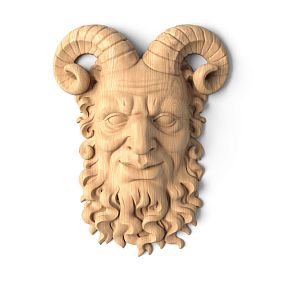
Putti (cherubs) are a characteristic element of Baroque and Rococo. They play, hold garlands, blow horns, symbolizing joy, lightness, and the celestial. Mascarons — faces (human, animal, fantastic) placed at the centers of compositions, above doors, on arch keystones. They ward off evil spirits, attract luck, and add drama.
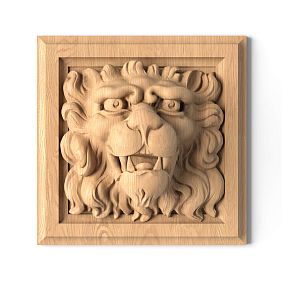
Animals — lions (strength, royalty), eagles (majesty, power), dolphins (sea, travel), deer (nobility, speed), snakes (wisdom, transformation) — each carries symbolic meaning. Mythological creatures — griffins, dragons, sphinxes, chimeras — add fantasy, mystery, and a connection to legends.
Figurative ornament is used sparingly, in key points of a composition. An excess of figures creates chaos and visual overload. One or two figurative elements on a piece are enough to create an accent.
Abstract and Authorial Ornament: Freedom of Form
Abstraction — ornament without a specific object reference, a free play of forms, lines, volumes. This can be a wavelike movement, an interweaving of smooth lines, asymmetrical swirls, organic forms reminiscent of natural ones (shells, corals, clouds) but not copying them exactly.
Abstract ornament is characteristic of Art Nouveau (smooth, flowing lines, lack of symmetry, vegetal motifs transformed into abstraction) and modern art (geometric abstractions, deconstruction of forms). It gives the carver maximum freedom, is not bound by canons, and allows for experimentation.
Authorial ornament is a unique composition created by a specific master for a specific project. It can be a combination of elements from different styles, a reinterpretation of traditional motifs, or a completely original form. Authorial ornament makes a piece exclusive, turning it into an art object.
Depth and Detail of Relief: How to Choose the Right Balance
Relief depth is the distance between the highest and lowest points of the carving. Detail is the quantity and complexity of small elements. Both parameters affect the perception of the carving, its expressiveness, style, and cost.
Shallow Relief (2-5 mm): Engraving and Fine Carving
Shallow relief creates a subtle texture, discernible from a close distance. This is a technique for intimate objects — boxes, photo frames, decorative panels viewed up close. Fine carving requires high detail — every line is important, mistakes cannot be hidden.
Engraving is the ultimate case of shallow relief, where lines are cut into the surface to a depth of 0.5-2 mm. It is a drawing with a chisel, close to graphics. Engraving is good for text (inscriptions, dates, monograms), fine ornaments (arabesques, Celtic knots), and miniature images.
Medium Relief (5-15 mm): Classic Carved Decor
Medium relief is the golden mean, optimal for most furniture decors. It is expressive enough to be noticeable from a distance of 1-3 meters, not too deep to be fragile or visually heavy. Medium relief allows for creating both vegetal ornaments (leaves with veins, flowers with voluminous petals) and geometric ones (relief frames, protruding rhombuses), as well as figurative ones (faces with detailed features, animal figures).
Classical carving forclassic furniture— this is precisely medium relief. It adds volume, play of light, and nobility, but does not turn furniture into sculpture. Medium relief is easier to produce (suitable for both hand carving and CNC), stronger (less risk of chipping thin protruding elements), and more versatile (suits most styles).
Deep relief (15-40 mm): Baroque and high relief
Deep relief is a three-dimensional sculpture, almost separating from the background. Figures protrude by half or more of their thickness, creating dramatic shadows and a strong spatial effect. Deep carving is characteristic of Baroque (opulent compositions, intertwining elements, theatricality) and Rococo (lightness, airiness, complex scrolls).
Deep relief is used for large elements: fireplace portals, door casings, wall panels, furniture pediments. It is designed for viewing from a distance of 3-5 meters, where the volume is fully revealed. Up close, deep carving may appear somewhat rough—small details give way to large forms.
Deep carving is expensive (requires more time, material, and skill), fragile (thin protruding elements break easily), and visually heavy (not suitable for miniature items). But when applied correctly, it creates an impression of luxury, monumentality, and high-level artistry.
Three-dimensional (full-round) carving: wood sculpture
Full-round carving is a three-dimensional sculpture, discernible from all sides. It is not an overlay on a surface, but a freestanding object: a figure, statuette, decorative furniture leg, baluster, column. Full-round carving is the pinnacle of carving art, requiring a complete understanding of volume, anatomy, and composition.
Full-round carving is used for furniture legs (cabriole legs with scrolls, animal paw feet, turned balusters with carving), bed posts, armchair armrests, sculptural finials (finials on posts, spires, cabinet corners). It transforms a functional element into an artistic one, making furniture sculptural.
Application of carved decor on furniture: focal points
Carved furniture decoris not placed randomly, but in compositionally significant points that attract the eye and shape the character of the piece. Knowing these points allows for measured use of decor, avoiding both excess and stinginess.
Center of the facade: focal point of a cabinet or dresser
The center of the facade is the natural focal point of any piece of furniture. The eye automatically goes to the center, seeking visual interest there. A central carved overlay turns a flat facade into a structured one, organized around an axis.
For cabinets, dressers, and chests, the central overlay is placed at a height of 50-60% of the facade's height (slightly above the geometric center, as the visual center is shifted upward). The overlay size is 40-60% of the facade's width to dominate but not overwhelm. The ornament is symmetrical relative to the vertical axis (acanthus leaves, rocaille, geometric rosette), creating balance.
For wide facades (sliding door wardrobes, sideboards), three overlays are possible: a large central one and two smaller side ones, creating rhythm. The ornament of the side overlays is a simplified version of the central one or a complementary motif (center—rosette, sides—leaves).
Corners: framing composition
Corner carved overlays create a frame, bordering the facade. This is a visual technique that makes a plane structured and complete. Four corner overlays (identical or mirror-symmetrical) are placed at the corners of a door, panel, or tabletop.
Corner ornament is most often floral (leaves curving toward the center, flowers growing from the corners) or geometric (volutes, scrolls, corner rosettes). Corner overlays are smaller than the central one (if present) to avoid competition, but noticeable enough to perform the framing function.
Corner decor is characteristic of Classicism and Empire style, where structure, symmetry, and architectural quality are valued. For Baroque and Rococo, corners are often left free, concentrating decor in the center or on the edges (but not in the corners).
Edges and perimeter: border carving
A border is a continuous ornament running along the perimeter of a facade, tabletop, or panel. It can be a floral garland (intertwined leaves and flowers), a geometric pattern (meander, braid, a row of ovals), a wavy line, or a chain. A border creates a frame, unifies the plane, and adds rhythm.
Border carving is good for tabletops (dining tables, consoles, bureaus), where it creates an elegant frame. For vertical facades, borders are used less frequently—they visually reduce the surface, making it appear smaller. But in combination with a central overlay, a border creates a finished composition.
Legs and supports: sculptural foundation
Furniture legs are a functional element that carving turns into a sculptural one. Carved legs transform a simple table or dresser into a work of art. Types of carved legs:
Turned with carving—cylindrical or conical legs, processed on a lathe, with added carved decor (flutes, rings, balusters). Versatile, suitable for most styles.
Cabriole—curved legs of an S-shape, characteristic of Baroque and Rococo. Often ending in a carved animal paw (lion, eagle) or a scroll. Elegant, dynamic, visually lighten the furniture.
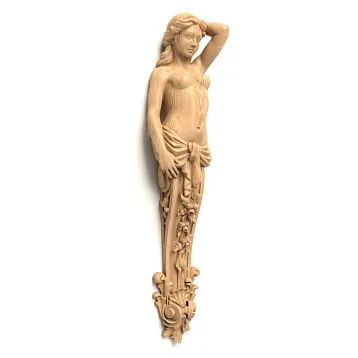
Sculptural—legs in the shape of figures (atlases, caryatids, lions), columns with capitals, stylized trees. Monumental, suitable for large formal furniture.
Square with carving—rectangular cross-section legs with carved elements on the faces (vertical flutes, geometric patterns, stylized leaves). Strict, suitable for minimalist classicism, neoclassicism.
Cornices and pediments: horizontal completion
A cornice is a horizontal projection at the top of a cabinet, sideboard, or secretary. A pediment is a triangular or arched completion above the cornice. Both elements are architectural, giving furniture monumentality and a connection to classical architecture.
Carving on cornices is a border (floral, geometric) running along the projection. Carving on pediments is a central composition (coat of arms, rosette, mascaron), emphasizing the axis of symmetry. Cornices and pediments transform utilitarian furniture into an architectural object, making it formal and solemn.
Application of carved decor on walls and in interiors
interior decoration— this includes not only furniture but also walls, doors, ceilings, and architectural elements. Carving on walls creates architectural structure, transforms a flat surface into a three-dimensional composition, and establishes rhythm, style, and the atmosphere of a space.
Wall panels: boiserie and carved frames
Boiserie is a traditional French technique of wall cladding with wooden panels featuring carved elements. The wall is divided into sections by moldings, with each section containing a carved overlay framed by a border. Boiserie creates rhythm, structure, and depth, transforming the wall into an architectural element.
Carved overlays for boiserie — central compositions (rosettes, garlands, geometric patterns), corner elements, borders. The ornament is coordinated with the furniture ornament, creating a unified decorative line. The relief depth is medium (5-15 mm) to avoid overwhelming the space while creating a play of light.
Door framings: architraves and cornices
A door is a vertical element requiring architectural emphasis. Architraves (strips framing the opening) and the cornice above the door create a frame that turns a utilitarian opening into a compositional accent.
Carved architraves — vertical elements with border ornamentation (floral garlands, geometric patterns). The cornice above the door — a horizontal element with a central overlay (mascaron, rosette, coat of arms) and side volutes. Carving makes the door noticeable, emphasizing its significance, especially for main entrances and passages between rooms.
Ceiling cornices: finishing the vertical
Ceiling cornice — a horizontal element at the junction of the wall and ceiling. It completes the wall's vertical line, creates a transition to the ceiling, and visually increases the room's height (if the cornice is wide with ornamentation). A carved cornice is a classic technique that adds nobility and architectural character to an interior.
Ornament of ceiling cornices — border patterns (meander, acanthus leaves, egg-and-dart pattern, beads) running along the entire length. The relief depth is medium or shallow (the cornice is viewed from a distance, small details will blend). The carved cornice complements carved furniture and wall panels, creating a unified decorative program.
Fireplaces: the focal point of the interior
A fireplace is the traditional focal point of a classic interior, the place where all eyes are drawn. The fireplace portal (the framing of the firebox) is an architectural composition where carving plays the main role. Columns or pilasters on the sides, a horizontal shelf (mantel) on top, a pediment or frieze above the shelf — all these are surfaces for carved decor.
Fireplace ornamentation — floral (garlands, wreaths, acanthus capitals on columns), figurative (caryatids instead of columns, mascaron in the center of the pediment, putti along the edges of the shelf), geometric (meander on the shelf, fluting on columns). The relief depth is medium and deep (the fireplace is large, viewed from a distance, requiring expressive volume).
Staircases: balusters and railings
A staircase is a functional and decorative interior element. Carved balusters (vertical posts between steps and railings) turn a staircase into a work of art. Balusters can be turned (cylindrical with relief rings, balusters, fluting) and carved (with ornaments, figures, floral motifs).
Carved balusters — this is round carving, visible from all sides. The ornament repeats on each baluster (creating rhythm) or varies (creating diversity). Railings can also be carved — with a border, central overlays, sculptural finials on posts.
A carved staircase sets the tone for the entire interior, especially in the hall or foyer, where it is the first thing seen upon entering. The carving style of the balusters is coordinated with the furniture and wall panels, creating integrity.
Choice of wood species: the material determines the possibilities
The wood species affects the quality of carving, its durability, visual perception, and cost. Not all species are equally good for carving — some are ideal, some are acceptable, some are unsuitable.
Linden: ideal for hand carving
Linden is a soft, homogeneous, light-colored wood that is easy to carve. Linden does not split or chip, allowing for the finest details. It is the favorite material of traditional carvers creating icons, wooden sculptures, and miniatures.
Disadvantages of linden: low density (easily damaged by impacts, scratches), light color (requires staining for a noble appearance), low durability outdoors (suitable only for interiors). Linden is ideal forof solid wood, where detailing is important and mechanical loads are minimal — overlays, panels, boxes, frames.
Oak: strength and nobility
Oak — hard, dense, durable wood with expressive grain. Oak is ideal for furniture under load — tabletops, legs, door architraves. Carving oak requires effort (hardness is high), but the result is durable, noble, and associated with quality.
Oak carving has a characteristic texture — large pores and contrasting growth rings are visible. This creates a rugged, masculine character suitable for classic, rustic, and castle styles. For delicate, fine ornaments (rococo, floral miniatures), oak is excessive — the grain overwhelms the details.
Beech: balance of price and quality
Beech — medium-hard wood with a homogeneous texture, similar to oak in strength but lighter and less expressive. Beech is good for CNC carving — it does not split, holds fine details, and is cheaper than oak. Beech carving, after staining, is visually indistinguishable from oak but is lighter and brighter.
Beech is used for serial furniture where cost is important but quality is needed — overlays, balusters, moldings, cornices. Beech takes stains, patinas, and accepts any finish.
Walnut: dark nobility
Walnut — hard wood of dark color (from brown to almost black) with beautiful grain. Walnut is expensive, used for elite furniture where a noble dark tone without painting is desired. Carving walnut requires skill (hardness is high), but it holds the finest details and creates a contrasting play of light on the dark surface.
Walnut is used for study furniture (desks, library cabinets), parquet with carved rosettes, exclusive carved panels. Walnut carving is a sign of a status interior and expensive taste.
Birch: a light-colored alternative
Birch is a medium-hard, light-colored wood with a silky texture. Birch is cheaper than linden and beech, easily stained to imitate more expensive species. For carving, birch is acceptable but not ideal—it can chip on thin elements, and its texture is uneven.
Birch is used for budget carved items where price is important—baseboards with simple profiles, moldings, frames. After staining, birch carving looks decent, but experts can distinguish it by its lightness and less expressive texture.
Frequently asked questions
How does hand carving differ visually from CNC carving?
Hand carving has barely noticeable irregularities—lines are slightly uneven, depth varies in places, details are asymmetrical. CNC carving is mathematically precise—lines are perfectly straight, repeating elements are identical, symmetry is absolute. Up close (from less than 30 cm away), an expert can tell the difference, but from a normal viewing distance (1-3 meters), high-quality CNC carving is indistinguishable from hand carving, especially after manual finishing.
Can carved decor be painted after installation?
Yes, this is standard practice. Carved overlays are installed on furniture or walls, then painted together with the base. This ensures color unity and no visible boundaries between the overlay and the surface. Use brushes to work into the recesses of the carving, and sponges or sprayers for flat areas.
What is the best glue for attaching carved overlays?
For wooden overlays on wooden or MDF bases—carpenter's PVA glue class D3 or D4. For overlays on laminated, varnished, or painted surfaces—contact adhesive, polyurethane, or epoxy. For additional fixation of large overlays, use headless finishing nails driven into the recesses of the carving where they are invisible.
How to care for carved furniture?
Wipe with a dry or slightly damp soft cloth to remove dust. Use a soft brush or vacuum with an attachment to clean the recesses of the carving where dust accumulates. Treat with wood polish or wax every few months. Protect from direct sunlight (wood fades), excessive humidity (swells), and sharp temperature changes (cracks).
Is carved decor suitable for modern interiors?
Yes, with the right choice of ornament and finish. Geometric carving (grooves, diamonds, modern abstract shapes) fits perfectly into minimalism, Scandinavian style, and loft. Carving painted in monochrome (white, gray, black) loses its palatial feel and becomes modern. Use carving in moderation, as an accent, not as total decoration.
Can hand carving and CNC be combined in one item?
Not only is it possible, but it is also recommended for the optimal balance of price, quality, and uniqueness. CNC forms the main volumes and repeating elements. A master then refines it by hand: adding the finest details, removing milling marks, and introducing individuality. The result is an item that looks handcrafted but is reasonably priced.
What depth should the relief be for furniture overlays?
For small furniture (nightstands, bedside tables, dressers)—5-10 mm. For medium furniture (cabinets, buffets, secretaries)—10-20 mm. For large formal furniture (display cabinets, dining tables, fireplaces)—20-40 mm. More than 40 mm—for monumental elements (fireplace portals, door pediments, wall panels).
How much does carved decor cost?
Hand carving: from 5000 to 50000 rubles for a medium-sized overlay (200x150 mm) depending on the complexity of the ornament and wood species. CNC carving: from 1000 to 10000 rubles for a similar overlay. Hybrid (CNC + hand finishing): from 3000 to 20000 rubles. Round carving (balusters, furniture legs): from 2000 to 30000 rubles per piece.
How to order custom carved decor based on your own sketch?
Provide a sketch (drawing, photo of a similar item, description of the idea) to the manufacturer. A designer will create a 3D model and coordinate it with you. After approval, a prototype is made (for complex orders) or the final product is produced immediately. The production time for custom decor ranges from 2 weeks to 3 months depending on complexity.
Can carved overlays be installed on old furniture?
Yes, this is an excellent way to restore and update. Carved overlays hide defects in old furniture (scratches, chips, faded areas) and turn simple furniture into decorative pieces. The main thing is that the base is sufficiently strong, not dried out, and capable of holding the fastening.
Conclusion: carving as a philosophy of space
Carved furniture decorCarving is not just decoration; it is a philosophy of how we relate to the space we live in. In an era of mass production, identical apartments, and standard furniture, carving becomes an act of resistance against depersonalization. It is a statement: I value individuality, quality, craftsmanship, beauty, and history. Every carved line is a trace of a human hand or a computer program, but in any case, it is a conscious choice of form over emptiness.
Modern technology has made carved decor more accessible. CNC carving has democratized an art that for centuries was the privilege of the aristocracy. Today, carved overlays can be afforded not only by palace owners but also by city apartment dwellers. At the same time, hand carving has not died—it has found its niche in exclusive, one-of-a-kind items for connoisseurs. Hybrid technology combines the best of both worlds: machine precision and the soulfulness of hands.
Choosing an ornament is a dialogue with history. Acanthus leaves carry the memory of antiquity, rococo—the playfulness of the 18th century, geometry—the rationality of modernism. By using traditional ornaments, we do not copy the past but reinterpret it, adapting it to modern life. Original ornamentation is a step into the future, creating new forms that will become classics for future generations.
Relief depth, detailing, wood species—these are technical parameters that determine the character of an item. Fine carving is intimate, deep carving is monumental, oak is brutal, linden is elegant. Understanding these parameters allows for precise expression of the concept, creating exactly the effect needed.
Applying carved decor to furniture and interiors is the art of dosage. Excess carving turns a space into a museum; lack of it leaves it empty. The right balance—carving in key points (center of facades, corners, cornices, doors) alternating with clean surfaces—creates harmony where the eye has a place to rest and something to linger on.
Furniture decorandinterior decorationFurniture, walls, doors, ceilings are connected by a single line of ornaments. When carving on furniture echoes carving on walls, doors, and ceilings—the space gains integrity, architectural logic, and visual harmony. This is not a random coincidence but a thoughtful composition where each element is coordinated with the others.
Classic FurnitureFurniture with carved decor is not just furnishings; it is the heir to palace culture, where every element carried semantic and aesthetic weight. Carving on furniture was a sign of status, education, and belonging to a certain cultural stratum. Today, this symbolism has transformed, but the essence remains: carved furniture speaks to the fact that the owner values quality, craftsmanship, beauty, and history.
Solid Wood Itemswith carved decor are durable. Wood is a living material that does not lose but gains nobility over the years. The patina of time on the carving is not a defect but a value. Carved furniture is passed down through generations, becomes a family heirloom, and preserves the stories of generations.
In a modern home, carved decor serves not only an aesthetic but also a psychological function. It slows down time, creates a sense of rootedness, and counteracts haste, chaos, and information noise. Touching a carved surface is tactile pleasure, meditation. Contemplating the ornament is a rest for eyes tired of gadget screens. Carved decor returns us to nature, to manual labor, to a conscious attitude toward things.
STAVROS is one of the leading manufacturers of carved decor from solid wood in Russia. More than 400 models of decorative overlays in various styles, sizes, and shapes are presented in the catalog. Central and corner elements, symmetrical and asymmetrical compositions, modular constructor overlays, luxurious ornamental panels—everything needed to create a unique interior.
STAVROS works with oak and beech wood—hardwoods ideal for carving. Each product undergoes strict quality control: proper drying (moisture content 8-12%), absence of defects, carving precision, ornament detailing. Both traditional hand-carving methods and modern CNC technologies are used, ensuring reproducibility and affordable prices.
STAVROS's assortment includes not only classic ornaments (acanthus leaves, rocaille, cartouches, floral patterns) but also the author's collection "Summer Garden." This is a modern interpretation of Baroque carving: lively, sensual forms, elegant lines, refined silhouettes of plants, birds, and leaves. The "Summer Garden" collection opens new possibilities for decorating kitchen furniture, cabinets, stair posts, doors, wall panels—both independently and in combination with traditional elements.
STAVROS offers not just individual overlays but also ready-made decor kits where elements are coordinated in style, scale, and ornament. This simplifies creating compositions for those unsure of their design skills. The kit includes a central overlay, corner elements, borders, modular parts—everything needed to decorate a furniture facade or wall panel.
Purchase is possible from a single piece, which is convenient for spot furniture updates, restoration of individual items, and decor experiments. Delivery across all of Russia, pickup from warehouses in Moscow and St. Petersburg. Professional consultations on element selection, ornament matching, and installation technology—STAVROS accompanies the client at all stages from idea to implementation.
STAVROS prices range from affordable (simple overlays from 880 rubles) to premium (complex decor kits up to 30,000 rubles and above). This allows finding a solution for any budget without sacrificing quality. Carved decor from solid wood becomes accessible not only for elite projects but also for ordinary apartments and country houses where people want to create atmosphere, individuality, and beauty.
Wood carving is an art that has survived millennia. From ancient Egyptian sarcophagi to Russian izbas, from Byzantine iconostases to French palaces—carving has accompanied humanity, capturing the aesthetic ideals of eras. Today, this art is not archaic but relevant. It has adapted to modern technologies, materials, and styles but has retained the main thing—the ability to turn the functional into the beautiful, to create meaning through form.
ChoosingCarved furniture decor, you are choosing not just decoration but a means of self-expression. You are saying: my home is not a random set of items but a thoughtful space where details matter, where craftsmanship is valued, where there is room for beauty. Carving does not shout; it speaks calmly, confidently, and with dignity. It does not demand attention but receives it because quality is always noticeable.
Create an interior that will delight you and your loved ones for decades. Start with one carved overlay—on a chest of drawers, on a door, on a wall—and feel how the atmosphere changes. Carving adds depth, warmth, and individuality. It makes a house a home, not just a dwelling. With carved decor from STAVROS, your space will gain a soul, character, and a story that you will write yourself.