












































































Article Contents:
- History of Carved Icons in Russian Church Art
- Wood as a Sacred Material
- Flourishing: XIV–XVII Centuries
- Synod Ban and Underground
- Soviet Period and Revival
- Wooden Icon Carving Techniques: From Simple to Complex
- Bas-relief Carving: Canon in Wood
- Three-dimensional (Sculptural) Carving: From Image to Sculpture
- Bas-relief and High Relief: Volume Gradation
- Contour and Openwork Carving: Lightness of Line
- Combined Techniques
- Wood Species for Carved Icons: What Masters Choose
- Linden: The Icon Painter's First Choice
- Oak: eternity in wood
- Cypress: Aroma and Meaning
- Pear and Walnut: Rarity and Elegance
- Difference Between Carved and Painted Icons: Theology and Aesthetics
- Theological Aspect
- Aesthetic aspect
- Tactile Dimension
- Durability and 'Age'
- Assortment: What Church Decor STAVROS Offers
- Carved Crosses
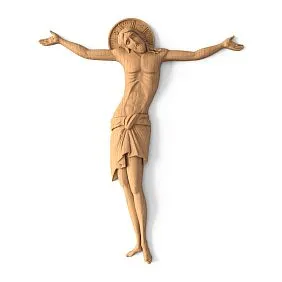
- Crucifix IKN-023
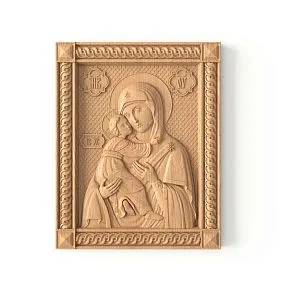
- Icon of the Mother of God IKN-001
- Church Utensils: Crosses, Overlays, Decor
- Carved Capitals and Columns for Church
- Carved Gates IKN-010
- Decorative Overlays for Iconostasis
- How to Choose a Carved Icon: A Practical Guide
- Criterion 1: Purpose
- Criterion 2: technique and quality of execution
- Criterion 3: wood species and finish
- Criterion 4: iconographic correctness
- Caring for a Wooden Carved Icon: A Guide for Decades
- Storage conditions
- Surface cleaning
- Restoration in Case of Damage
- FAQ: Answers to Key Questions About Carved Icons
- STAVROS: Church Decor and Solid Wood Carvings

There are things whose value needs no explanation. A carved wooden icon is one of them. It is an object that exists at the intersection of several dimensions of human experience simultaneously: spiritual, artistic, artisanal, and historical. When a woodcarver works on an image of the Mother of God or the Savior, he is not merely carving a form—he is entering into a dialogue with a tradition a thousand years old. And every strike of the chisel on wood is a continuation of that conversation.
Carved iconmade of wood is experiencing a quiet revival today. Not a booming, commercial one, but a quiet one—the kind that happens when people grow tired of synthetics and return to a living material. This article offers a complete immersion into the topic: history, techniques, wood species, differences from painted icons, selection advice, and practical care recommendations.

History of the Carved Icon in Russian Church Art
To understand a carved icon, one must know where it came from. This history is longer than it seems and richer than is commonly thought in an era when anything can be called an icon.




Wood as a Sacred Material
Long before the adoption of Christianity in Rus', wood held a special place in the sacred life of the Eastern Slavs. Wooden idols, carved images at shrines, sacred oak groves—this is not paganism as an obsolete superstition, but a deep cultural memory that wood lives, breathes, and dies, just as a human lives and dies. When Christianity came to Rus' in 988, it did not destroy this memory—it reinterpreted it.
The first wooden sacred images in Rus' appeared practically simultaneously with the adoption of Christianity. These were relief images—not painted icons in the strict theological sense, but sculptural images carved from linden, oak, and cypress. Novgorod, Pskov, and Suzdal became the first centers of wooden church sculpture.
Our factory also produces:


Flourishing: 14th–17th Centuries
The golden age of wooden church carving in Rus' falls in the 14th–17th centuries. It was then that the main iconographic and technical traditions were formed: relief carving with a kovcheg (a recessed central part of the board), semi-volumetric and volumetric images, carved crosses with crucifixion. The Suzdal, Novgorod, and Moscow schools created canons that are alive to this day.
Carved iconsfrom this period can be seen in the country's largest museums: the Tretyakov Gallery, the Russian Museum, and the Novgorod Historical Museum. These are not just artifacts—they are working models for contemporary masters.
Get Consultation
Synod Ban and Underground
In 1722, the Holy Synod of the Russian Orthodox Church issued a circular restricting the use of 'carved and cast' icons in Orthodox churches. The reason was the influence of the Catholic and Western European tradition of volumetric sculpture, which was perceived as alien to the Orthodox liturgical experience.
This decree did not destroy the tradition—it drove it underground. Wooden carved images continued to be carved and kept in homes, chapels, and small monasteries. The folk tradition proved stronger than the Synod's ban.
The official rehabilitation of the wooden carved icon in Orthodox practice occurred only in the 20th century: the Local Council of 1917–1918 lifted most restrictions. Since then, the carved wooden icon has been legally present both in churches and in home iconostases.
Soviet Period and Revival
The Soviet decades dealt a blow to church art as a whole, but it was during this period that folk woodcarvers preserved the tradition in the form of 'folk crafts'—officially decorative, in fact spiritual craftsmanship. Bogorodskoye, Khokhloma, Abramtsevo—these woodworking centers continued to train masters who, after 1991, found application for their art in the revival of churches and monasteries.
Todaychurch decormade of wood is a rapidly developing field. Demand is formed not only from churches and monasteries but also from private individuals: people want to have an object at home created by human hands from a living natural material.
Wooden Icon Carving Techniques: From Simple to Complex
Woodcarving technique is learned over years. But understanding the fundamental differences between the main techniques is possible without special education—it is useful when selecting and evaluating a piece.
Bas-relief Carving: Canon in Wood
Bas-relief carving is the basic and most common technique for icon images. Its essence: the image is executed in a single relief level, which is slightly raised above the background (2–8 mm). The background is then 'chosen' (recessed) with chisels, creating a contrast between the 'dark' background and the 'light' relief of the image.
Most historical wooden icons from the 14th–17th centuries were executed in the technique of low-relief carving. This technique is akin to painted icons in principle: a single plane, a single viewpoint, and strict adherence to the iconographic canon.
Key tools: straight chisels (width 3–30 mm), gouges (keycarzes), V-tools (gravers). For a low-relief icon measuring 30×40 cm, an experienced master spends from 40 to 80 working hours.
Three-dimensional (sculptural) carving: from image to sculpture
Three-dimensional, or sculptural carving, implies a full-fledged three-dimensional image perceived from different viewpoints. In the Russian church tradition, these are primarily depictions of 'Nikola Mozhaisky' — Saint Nicholas with a sword and a model of a city in his hands — as well as 'Paraskeva Pyatnitsa,' 'Christ in Prison,' and others.
Three-dimensional wooden icons are the most labor-intensive type. Figure height 30–60 cm, full volumetric detailing on the reverse side. Material — solid timber or laminated wood. Work time — from 100 to 300 hours per figure.
Theological status of the three-dimensional carved icon in the Orthodox tradition: strictly speaking, it is not an icon in the classical sense (an icon is a two-dimensional image), but a wooden sculpture of religious content. However, in popular practice, both types — flat relief and three-dimensional figure — are called carved icons, and this usage is established.
Bas-relief and high relief: gradation of volume
Between flat relief and full sculpture lies a gradation:
-
Bas-relief — a relief projecting from the background by no more than half its depth. This is the most common variant for icon images in a frame-kiot. Projection 10–30 mm.
-
High relief — a relief projecting more than half, sometimes almost detached from the background. The head, hands, and halo are separated from the plane and carved almost in full volume. Projection 30–80 mm or more.
High-relief carved icons are the most complex type. Each element of the image is worked on all visible facets, the background is carved out to a great depth. A wooden image of the Vladimir Mother of God in high-relief technique is a piece that occupies a master carver for several months of continuous work.
Contour and openwork carving: lightness of line
Contour carving — technically the simplest: the image is 'outlined' with lines without removing the background. Used for small icon images, pectoral crosses, decorative overlays with religious symbolism.
Openwork (pierced) carving in icons is rare. Used in framing: an icon frame with openwork ornamentation, an openwork kiot, a carved canopy over the image.
It is precisely openwork carving that formsCarved Doors— the Royal Doors of the iconostasis and the deacon's doors. This is a multi-layered structure of several planes of openwork ornamentation, creating an illusion of air and depth with minimal thickness of the wooden base.
Combined techniques
Modern carved icons often combine several techniques in one piece:
-
Relief image in the center + openwork frame-surround
-
High-relief face + low-relief garments
-
Three-dimensional figure + carved background with ornamentation
-
Carving + painting with colors + gilding
This is a synthetic approach with deep historical roots: medieval Russian carved icons were often painted with colors over the carving and covered with gilding.
Wood species for carved icons: what masters choose
The choice of species is not a technological detail, but a substantive decision. Different species give the piece a different character: some — softness and prayerfulness, others — hardness and eternity.
Linden: the icon painter's first choice
Linden is the traditional icon wood species. Its density is not high (350–480 kg/m³), but this is precisely what makes it ideal for carving: the chisel goes into linden easily, cuts cleanly, and does not chip the edges of the relief. Linden fibers are homogeneous — there is no sharp transition between early and late wood, as in coniferous species.
The color of freshly cut linden is almost white with a slight yellowish tint. Over time, especially under a varnish coating, linden acquires a golden hue — this 'aging' gives the icon visual warmth.
Limitation of linden: the softness, which is an advantage during carving, becomes a disadvantage under mechanical load. A carved icon made of linden is for storage and prayer, not for intensive use.
Oak: eternity in wood
Oak — a species chosen for images intended to last for centuries. Density 650–750 kg/m³, Brinell hardness 3.7–4.0 HB — an oakCarved iconicon is resistant to mechanical loads, not afraid of moisture with proper treatment, and does not deform with temperature changes.
Historical wooden icons preserved in museums are mostly made of oak and linden. Oak is found in large altar images, doors,carved doors— where the strength of the load-bearing structure is required.
The difficulty of working with oak: the wood is hard, it cuts significantly harder than linden. This requires a sharper tool, greater physical strength, and experience. That is why carved oak icons are a sign of the master's high qualification.
STAVROSchurch decorand decorative items are made from solid oak and beech — two species with comparable strength and durability characteristics.
Cypress: aroma and meaning
Cypress is a species with exceptional spiritual symbolism in the Orthodox tradition. This evergreen coniferous shrub grows in the Holy Land, Cyprus, and Greece. The cypress tree in the Bible is a symbol of the righteous, aspiring to heaven.
Technical properties of cypress: medium density (450–600 kg/m³), exceptional resistance to rot and insects due to natural resins, a characteristic persistent aroma that remains in the product for decades.
Pectoral crosses, small icons, prayer ropes, reliquaries — the traditional domain of cypress products. Large cypress icons are rarer — due to the limited size of cypress logs and the high cost of the material.
Pear and walnut: rarity and sophistication
Pear wood is one of the densest (600–800 kg/m³) and most homogeneous hardwood species. The fine-pored structure of pear allows for exceptional line clarity in fine carving. Pear was chosen precisely for miniature icons — images sized 5×7 or 7×9 cm with the finest detailing.
Walnut (Juglans regia) — a species with rich texture and expressive grain pattern. Icons made of walnut are rarely left uncoated: the wood's texture itself becomes part of the image's aesthetics. The dark brown tone of walnut without additional tinting is close to the 'antique' tinting used when aging linden and oak icons.
The difference between a carved icon and a painted one: theology and aesthetics
A question often asked and rarely answered exhaustively: how does a carved wooden icon differ from one painted with colors? The difference is not only in technique.
Theological aspect
In the strict iconographic tradition, an icon is a two-dimensional image created by an 'iconographer' according to the canon: consecrated pigments, egg tempera, gesso on a wooden base, priestly blessing. From a theological point of view, a three-dimensional wooden figure is a religious sculpture, not an icon in the technical sense.
However, in the broad practice of Orthodox piety — and this is confirmed by the Local Council of 1917–1918 — carved wooden images, relief depictions, and three-dimensional figures are venerated on par with painted icons. A priest blesses them for liturgical use, they are placed in home iconostases, and prayers are said before them.
Aesthetic aspect
A painted icon speaks through color and line. It is a flat image perceived by the eye as a surface. A carved icon speaks through volume and shadow. Even a bas-relief image creates a play of shadows as the lighting angle changes — the image 'comes to life' throughout the day as the light moves.
This is a fundamental difference in aesthetic experience. Before a painted icon, you stand and look. Before a carved one — you sometimes want to touch it. Not out of curiosity — but from a need for contact with the living material, with the hands of the master who created this image.
Tactile dimension
WoodenCarved icon— an object that can be held in the hands. For a pectoral or small home image, this is not just permissible but natural. The warmth of the wood, which heats up from the touch of a hand, the texture of the carving under the fingers — this is an experience fundamentally unavailable to a painted icon under glass.
In this sense, a carved icon is closer to prayer ropes, to the sign of the cross, to physical liturgical action — it exists in the space of the body, not just in the space of the gaze.
Durability and 'age'
A well-executed painted icon on wood with proper gesso lasts for centuries. But paint is a layer that ages, cracks, darkens. A wooden relief does not darken with time (only the coating darkens), does not crack if the right wood species is chosen, and does not flake. In this sense, a carved icon is potentially more durable than a painted one under identical storage conditions.
Assortment: what the church decor STAVROS offers
Before discussing how to choose, let's look at what is specifically presented in the catalog ofchurch decor STAVROS.
Carved crosses
The most accessible items in the catalog are pectoral and wall crosses made of solid wood. Cross IKN-007 (from 2,080 rub.) and IKN-008 (from 2,460 rub.) — laconic forms without additional carving, pure geometry. Carved cross IKN-003 (from 2,280 rub.) — with decorative carving on the body. Carved cross IKN-002 (from 5,180 rub.) — complex form with relief elements.
Crosses made of solid wood are a traditional element of home iconostases, blessings for journeys, and baptisms. Size — from small wall-mounted to altar altar crosses.
Crucifix IKN-023
Crucifix with a three-dimensional figure of Christ (from 9,000 rub.) — a combination of a relief or three-dimensional image of the Savior with a flat cross base. A traditional element of home and church decoration.
Icon of the Mother of God IKN-001
Carved icon of the Mother of God (from 19,960 rub.) — the main item in the icon section. A product made of solid wood with a relief image, intended both for a home iconostasis and for a small icon case in a church.
Church utensils: crosses, overlays, decor
Church utensils M-013 (from 2,930 rub.), M-016 (from 5,850 rub.), NC-457-1 (from 9,420 rub.), IKN-004 (from 10,040 rub.), N-457 (from 27,350 rub.) — various decorative elements for decorating church space: overlays, frame elements, decor for furniture and walls.
Carved capitals and columns for the church
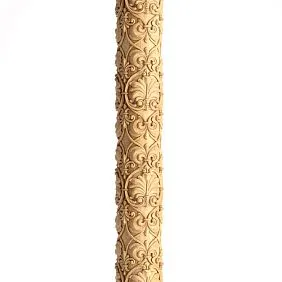
carved capitalsIKN-020 (from 8,180 rub.) and IKN-022 (from 14,430 rub.), carved columns IKN-015 (from 29,180 rub.), IKN-018 (from 40,850 rub.) and IKN-019 (from 21,340 rub.) — architectural elements for church decoration. Used in the design of iconostases, altar spaces, icon cases, narthexes.
Carved gates IKN-010
Royal or deacon's gates (from 50,340 rub.) — the pinnacle of church wood carving. A multi-layered openwork structure with ornamental or iconographic carved decoration. A custom-made product, executed to specific opening dimensions.
Decorative overlays for the iconostasis
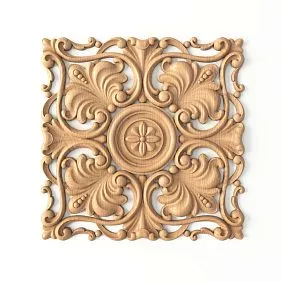
STAVROS also offers a wide rangedecorative insertsfor decorating iconostasis structures: rosettes, capitals, brackets,pilasters and columns— everything for creating a complete iconostasis ensemble from solid wood.
How to choose a carved icon: a practical guide
Choosing a carved icon is not buying a product. It is choosing an item that will be present in life's important moments. Several criteria to help you do it right.
Criterion 1: purpose
Home iconostasis. For daily prayer, a medium-sized icon — 20×30 or 25×35 cm — is suitable. Flat-relief or bas-relief technique. Material — linden or oak.
Gift for baptism, wedding, birth of a child. A small icon 15×20 or 18×24 cm in a carved icon case. Cypress or linden. The theme of the icon is selected according to the name of the heavenly patron.
Altar or iconostasis decoration. Large format — from 40×60 cm. Oak. High relief or three-dimensional sculpture. Requires consecration by a priest.
Collector's item. A unique author's work. Material — any, including walnut and pear. Form and iconography — according to the customer's choice.
Criterion 2: technique and quality of execution
Signs of quality hand carving:
-
Clarity of lines without steps and 'torn' edges
-
Depth of relief with gradual transitions (not a 'staircase', but a smooth descent to the background)
-
Uniformity of background removal (without traces of rough tools)
-
Detailing: halo, garments, inscriptions — all should be clearly readable
-
Symmetry (where it is implied by the iconography)
Signs of machine-made or low-quality work: mechanically even (too even) lines without the 'live' movement of the tool, cuts of the same depth without plasticity, unclear inscriptions, chips on the edges of the relief.
Criterion 3: wood species and finish
-
Cypress: recognized by its characteristic aroma even several years after production
-
Oak: expressive texture with a characteristic pattern, hard to the touch
-
Linden: light, lightweight, soft to the touch
Coating: natural beeswax — traditional. Acrylic varnish — modern, durable. Oil with wax — intermediate option. No coating — acceptable for cypress (natural resins) and undesirable for linden (gets dirty quickly).
Criterion 4: iconographic correctness
The image must correspond to the iconographic canon: traditional figure pose, attributes (halo, omophorion, gospel, sword, cross — each image has its own), inscriptions — the name of the image, monogram of Christ (IC) or the Mother of God (MP), characteristic gestures.
Violation of the canon is not a manufacturing defect from a technical point of view, but it reduces the liturgical significance of the image.
Care for a wooden carved icon: instructions for decades
A carved wooden icon, with proper care, lasts for centuries — this is no exaggeration. Monasteries in Russia preserve wooden images from the 14th–15th centuries in excellent condition.
Storage conditions
Humidity. The optimal air humidity for a wooden image is 45–60%. At humidity below 30%, wood dries out and cracks. At constant high humidity above 75% — risk of mold. Avoid placing the icon near heating radiators and near open windows with damp air.
Temperature. Sudden temperature changes are the enemy of any wooden product. If you brought the icon from the cold — let it warm up in a bag or a closed box: this will prevent condensation of moisture on the surface.
Direct sunlight. UV radiation fades the coating and pigments within a few years. The icon should not be exposed to direct sunlight for more than 2–3 hours a day. Ideally — diffused light or a directed lamp.
Surface cleaning
Dust is the main enemy of a carved icon: it clogs into the recesses of the relief. Removed with a soft brush with natural bristles (a flat brush or artist's flat brush 30–50 mm wide). Movements — light, without pressure, along the relief.
Wet cleaning — only for heavy soiling, with a slightly damp (almost dry) soft microfiber cloth. No chemical agents with solvents, ammonia, chlorine.
If the icon is varnished — once every 1–2 years apply special furniture wax or polish on a natural basis (beeswax with solvent). Apply a thin layer, polish with a soft cloth.
Restoration for damage
Small chip on the edge of the relief: wood filler, matched to the color of the coating. Light sanding after drying. Retouching with tinting.
Crack: if the crack does not go through — treat with liquid PVA wood glue (introduced with a pipette into the gap, the surface is clamped by hand until completely dry). If the crack is through — a job for a restorer.
Darkened coating: removal of old wax with a soft cloth and white spirit (only for wax coatings), then application of fresh wax.
FAQ: answers to the main questions about carved icons
Can a carved wooden icon be consecrated in an Orthodox church?
Yes. The priest consecrates the image according to the rite of icon consecration regardless of the technique — painting, carving, mosaic. The main condition: the image must correspond to the iconographic canon and have inscriptions with the name of the image.
Is a carved icon a living image or a decorative item?
It depends on the owner's attitude. A consecrated image is an object of religious veneration. An unconsecrated one is a religious-artistic work. One does not contradict or exclude the other.
What size icon to choose for a home iconostasis?
Central image (Savior or Mother of God) — 25×35 or 30×40 cm. Side images — 20×30 cm. This ratio creates a visual hierarchy corresponding to the canonical tradition of the iconostasis.
What is the difference between an oak icon and a linden icon?
Oak is heavier, stronger, with an expressive texture. Suitable for large images and altar decoration. Linden is lighter, softer, with a more neutral texture — a traditional material for home images and pectoral crosses.
How to check if an icon is made of solid wood?
On the end or back side, the natural wood grain should be visible. MDF and plywood do not have a characteristic cut grain. Weight: an oak icon 25×35×3 cm weighs about 300–400 g — significantly more than an MDF equivalent.
Can I order a carved icon with a specific image?
STAVROS produces items from the catalog and accepts custom orders. For a custom carved icon order, it is necessary to specify the image (saint's name), carving technique, size, and material.
Should the icon be taken off the wall during renovation?
Recommended: construction dust, paint aerosols, and solvents damage the finish and wood. Mandatory: if wet plastering or masonry using cement mortar is being done in the room.
STAVROS: church decor and solid wood carved products
church decor— this is a special field that requires from the manufacturer not only technical qualification but also an understanding of what is being produced. An iconostasis, gates, a carved cross, or an image of the Mother of God — is not a furniture component or an interior overlay. It is an object connected to a person's profound spiritual experience.
STAVROS creates church decor from solid oak and beech with an understanding of this responsibility. The catalog ranges from small wall crosses (from 2,080 rub.) tocarved gates(from 50,340 rub.) and carved columns for temple adornment. High detail, hand sanding, two quality levels — Standard and Prestige.
STAVROS's production program is not limited to church decor. For comprehensive interior design —Wooden moldings, Capitalsandpilasters, Mirror Frames, Decorative Insertsandbalusters for staircases— all from one production system, with a unified approach to quality.
Wood remembers the hands that worked it. A carved wooden icon remembers them longer than most things created by man. STAVROS makes what will be remembered.


