












































































Article Contents:
- Universality of wooden linear elements
- Minimalist solutions: strict geometry
- Neoclassical solutions: architectural logic
- Wood species: texture and character
- Baseboards and profiles: wall finishing
- Linear logic: unity of language
- Installation: precision and invisibility
- Creating a cohesive interior
- Conclusion: universal set from STAVROS
- Frequently Asked Questions

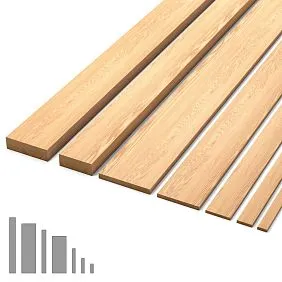
When starting renovation, you first think about tiles, wallpaper, flooring — large surfaces that catch the eye. But it is precisely the details that define perception: how corners are finished, how openings are framed, what lines structure the space.Oak wooden planks for walls, Wood TrimProfiled strips — this is a universal language spoken by minimalist interiors with their clean lines, and neoclassical spaces with their architectural logic.Thin wooden lathsThey draw walls with a graphic rhythm.Wooden profileThey frame panels and doors.Wooden skirting boardsThey complete the composition at the bottom, connecting walls with the floor. Let’s figure out how to build a cohesive system of linear elements, where each detail contributes to the overall concept.




Universality of wooden linear elements
Wood trim elements are a constructor, whose components can be combined in infinite variations.oak lumberA 30 mm wide strip can become the basis for a vertical accent wall in the living room. The same strip, installed horizontally with an 80 mm interval, becomes a rhythmic ceiling structure in the bedroom. AddProfile made of woodto frame a door opening,buy wooden flooringto divide wall panels,Buy wooden cleatto fix glass — and you get a complete set for comprehensive finishing.
Universality lies in modularity. All elements have standardized dimensions and profiles, allowing them to be combined freely. A 20x40 mm strip combines with a 30x40 mm strip — the combined thickness creates visual continuity. A profile with a 5 mm radius round corner harmonizes with a baseboard having a similar round corner. This consistency is not coincidence, but the result of a thoughtfully designed system, where each element is part of the whole.
Functional universality is equally important. The same strip can serve as a structural element — a joist for drywall — and as a decorative element — a surface-mounted strip on an accent wall.Wooden profileIt works as part of a door frame and as framing for a wall panel. Baseboards protect the lower part of the wall from mechanical damage and simultaneously serve as a decorative finish for vertical surfaces.
Stylistic flexibility expands application. In a minimalist interiorThin wooden lathsare painted white or gray, creating a graphic structure. In neoclassicism, the same strips under transparent lacquer reveal oak texture, supporting the idea of naturalness and material nobility. In Scandinavian interiors, lightBeech parquetcreates a cozy, warm atmosphere. In lofts, dark strips with preserved natural texture emphasize the industrial character of the space.
Scalability of solutions allows using the same principles in rooms of different sizes. In a compact studio of 25 m², vertical strips 20 mm wide create elegant graphics without overcrowding the space. In a spacious 60 m² living room, you can use more substantial 40-50 mm strips, forming a solid, expressive structure. The principle is the same — vertical lines create rhythm and visually increase height, but implementation adapts to specific conditions.
Economic versatility lies in budget flexibility. Basic solution — pine boards ready for painting — available for minimal budget. Average solution — beech or ash planks with factory finish — balance of price and quality. Premium solution —Wooden planks for wall decorationradially sawn boards with transparent oil finish — for interiors where status and durability matter.Interior oak plankMinimalist solutions: strict geometry




Minimalism does not tolerate excess. Every element must be functionally justified and visually clean.
Planks 15-25 mm wide and 10-15 mm thick — ideal tools for creating minimalist compositions. They create structure without dominating, organize space without cluttering it.Thin wooden lathsWidth 15-25 mm and thickness 10-15 mm — ideal for creating minimalist compositions. They create structure without dominating, organize space without cluttering it.
Vertical plank wall — a characteristic minimalist technique.Oak wooden planks for wallsMounted with even 50-100 mm spacing, creating rhythmic structure. Color — monochromatic: white, gray, black, rarely beige. Perfect geometry is essential: all planks are strictly vertical, intervals are identical to the millimeter, ends are aligned along a single line. Any carelessness destroys the effect — minimalism demands absolute precision.
Horizontal planks in minimalism are used less often but create no less expressive effect. Wide planks 40-60 mm, installed horizontally with 100-150 mm spacing, divide the wall into horizontal bands, creating a calming, meditative rhythm. This technique works well in bedrooms, where atmosphere of calm, relaxation, and detachment from bustle is important.
Plain planks without profiling — foundation of minimalist aesthetics. Rectangular cross-section with sharp edges or minimal bevel 1-2 mm creates a clean, geometric form. No rounding, grooves, decorative protrusions — only a clean line dividing the plane into segments. Surface is perfectly smooth after multi-stage sanding — no tool marks, fuzz, or unevenness.
Painting in dense matte colors hides wood texture, transforming planks into purely geometric elements. White color creates a sense of purity, light, and spaciousness. Gray color — neutrality, calmness, modernity. Black color — graphic quality, contrast, drama. Glossy finishes are not used — gloss contradicts minimalist philosophy of restraint and tactile natural surfaces.
Hidden mounting is critical for minimalist solutions. Any visible fastening — nails, screws, clips — destroys line purity. Planks are mounted on hidden framing via slots on ends or with adhesive and temporary clamping. The finished structure appears monolithic, devoid of visible technical elements, as if planks grew out of the wall rather than being attached to it.
Monochromatic space enhances the effect of plank structure. When wall, planks, ceiling, and floor are in the same tone, attention focuses on geometry, line rhythm, and play of light and shadow between planks. Contrasting solutions are also possible — white planks on black wall or vice versa — but this requires flawless execution and precise understanding of proportions.
Our factory also produces:


Neo-classical solutions: architectural logic
Neo-classicism — reinterpretation of classical canons in modern context. Architectural logic, tiered division, use of profiled elements are preserved, but without excessive baroque or empire ornamentation.Wood TrimIn neo-classicism — not just decoration, but a system organizing space according to time-tested proportions.
Wall panels with profiled frames — classic neo-classical technique. Wall is divided into rectangular sections, each framed bywooden profile40-70 mm wide. Profile has shaped cross-section with rounding or bevel, creating volume and play of light and shadow. Inner part of panel is filled with stained MDF, embossed wallpaper, fabric upholstery — material with different texture than frame.
Three-tiered horizontal division — another characteristic technique. Lower tier (panel) 80-120 cm high, framed and painted in darker tone than main wall. Middle tier (main field) occupies most of wall height. Upper tier (frieze) 30-50 cm high completes composition, often has decorative framing or differs in color. HorizontalWooden profilesseparate tiers from each other, creating clear structure.
Buy wooden trimUsed for creating small divisions within large panels. Rectangular panel 100x150 cm divided by layout into 4-6 small sections, each perceived as separate panel. Layout width 20-35 mm — sufficient to be noticeable but not dominant. Layout profile matches main frame profile — if frame has 8 mm radius rounding, layout should have 5 mm (proportional but smaller) rounding.
Door and window openings framed by wide profiled casings 80-120 mm wide with expressive relief. Profile may include multiple tiers: base plane, protruding bead, recessed bevel, capping ledge. Such complexity creates depth, volume, transforming opening into architectural element. Casings match wall panel profiles in style and proportions.
Baseboards in neo-classicism are always high — 100-150 mm — with multi-tiered profile repeating motifs of casings and wall panels.Wooden baseboardCreates visual base on which the entire architectural composition of the wall "stands". Baseboard color is often darker than wall — emphasizing its role as foundation, base upon which vertical structure is built.
Crown molding under ceiling completes composition from above. Ceiling molding 80-120 mm wide with profile similar to baseboard creates symmetrical frame for space. Wall appears enclosed between two horizontal boundaries — baseboard below and crown molding above — giving interior completeness, classical proportionality, architectural logic.
Get Consultation
— choice for those who value expressive texture and maximum durability. Oak density 700-800 kg/m³ and hardness 3.7-4.2 units by Brinell ensure resistance to mechanical impacts, dimensional stability under humidity fluctuations, service life over 50 years. Oak texture is active: pronounced annual rings, radial heartwood rays, natural color variations create lively, dynamic surface.
oak lumberUnder transparent lacquer or oil becomes main decorative element, requiring no additional ornamentation.Interior oak plankFeatures more uniform texture without sharp contrasts. Density 650-680 kg/m³ and hardness 3.2-3.5 units slightly lower than oak, but still ensure high strength. Beech color — warm rose-beige — creates cozy atmosphere.
Solid beech parquetFeatures a more uniform texture without sharp contrasts. Density 650-680 kg/m³ and hardness 3.2-3.5 units slightly lower than oak, yet still provide high strength. The color of beech — warm rose-beige — creates a cozy atmosphere.Beech parquetIdeal for Scandinavian interiors, where softness, warmth, and naturalness are valued. Beech texture is less pronounced than oak, making it a universal background that does not compete with other interior elements.
Ash is the third most popular wood species for interior trim. Ash has a light texture with smooth lines and no sharp contrasts. Color ranges from whitewashed to light straw. Ash visually expands space, making it brighter and airier. Ash planks are popular in minimalist and Scandinavian interiors, where purity, lightness, and subtlety of decorative elements are important.
Walnut is used less often — in premium interiors where status and luxury matter. Walnut color — from dark brown to chocolate with a purple tint — creates a rich, noble image. Texture is complex, with interwoven fibers creating a unique pattern on each plank. Walnut requires a corresponding environment — expensive furniture, quality finishing, and thoughtful lighting.
Staining expands the color palette while preserving texture visibility. Popular stains: gray oak (modern, urban tone), whitewashed oak (light, Scandinavian variant), wenge (dark, contrasting color), walnut (noble brown tone). Water- or alcohol-based stains penetrate wood structure, coloring fibers and emphasizing texture, making it more contrasting and expressive.
Painting in dense, opaque colors turns wooden planks into graphic elements. White, black, gray, or colored (blue, green, terracotta) — color choice depends on interior concept. Painted wood is cheaper than natural wood, as it allows second-grade material with small knots and defects, which paint hides. However, the main advantage of wood — its living, tactile warmth — is lost.
Baseboards and profiles: finishing the wall
Wooden baseboard— mandatory element of any interior, finishing the wall at the bottom and creating a transition to the floor. Baseboard height determines visual perception of room proportions. Low baseboards 40-60 mm are typical for minimalist interiors, where minimalism is important. Medium baseboards 70-90 mm — universal solution for most living spaces. High baseboards 100-150 mm create a formal, classic look, emphasize ceiling height, and form a solid visual base.
Baseboard profile matches the overall interior style. Rectangular baseboard with minimal rounding radius 1-2 mm — for minimalism. Baseboard with one rounded corner or bevel — for modern and Scandinavian interiors. Multi-level baseboard with complex profile — for neoclassicism and classicism. Baseboard profile should harmonize with door casing, wall panel, and ceiling cornice profiles.
Wooden profileFor door frames, it forms the opening geometry and ensures door functionality. Profile has L-shaped or П-shaped cross-section with grooves for seals, stop strips, hinges. Profile width 70-120 mm is chosen based on wall thickness. Thickness 30-40 mm ensures structural strength and rigidity. Profile is made from the same wood species as casing for visual unity.
Corner profile protects exterior wall corners from mechanical damage and creates a decorative element. Г-shaped cross-section with rounded edge or bevel makes the corner safe to touch and visually interesting. Width of corner profile’s flanges 20-40 mm. Profile is attached with glue and additional fixation using finish nails; attachment points are spackled and painted to match.
Buy wooden cleatUsed for fixing glass in doors, windows, and furniture facades. Stop strip is a thin strip 10-20 mm wide with a groove for glass. It presses glass against frame, ensuring secure fixation without rattling. Stop strip profile can be flat or shaped with rounding. Stop strip is painted to match frame color for visual unity.
Connecting baseboard to casing — technically complex joint requiring precision. Possible options: baseboard fits casing at right angle, its end is mitered perpendicular; baseboard is mitered at 45 degrees, creating a bevel; decorative corner element is used to hide the joint. Choice of option depends on baseboard and casing profiles, overall interior style, and installer skill level.
Color coordination of baseboards, casings, and profiles is critical for interior cohesion. Classic approach — all elements in one color, creating a monochromatic system. Contrast approach — baseboards and casings in door color, different from wall color. Baseboards under floor — in floor covering color, visually expanding the floor. Any solution must be thoughtfully planned and executed precisely, without random color spots.
Linear logic: unity of language
Creating a cohesive interior requires aligning all linear elements into a unified system. One room — one wood language means all wooden elements are made from one species, have coordinated profiles, and are in one color palette.Oak wooden planks for walls, Wood TrimFor doors,Wooden skirting boards— all elements are perceived as parts of a whole, not as a random assortment of disparate details.
Basic principle — unity of species. If oak is chosen, all wooden trim must be oak. Mixing oak and beech creates different textures that the eye perceives and disrupts cohesion. Exception — intentional contrast, for example, light ash vertical planks combined with dark oak baseboards and casings. But this must be a deliberate design technique, not a coincidence.
Second principle — profile consistency. IfWooden planks for wall decorationhave sharp edges with 1 mm rounding radius, then baseboards and casings must have similar sharpness. If planks have soft rounded edges with 5 mm radius, other elements must contain similar motifs. Profile unity creates visual connection and a sense of thoughtfulness.
Third principle — color unity. All elements are painted in one color or controlled palette. Monochromatic solution — most reliable: all wooden elements in one shade. Tonal solution — elements in one color with varying saturation (light gray, gray, dark gray). Contrast solution — two or three coordinated colors, each with its role (vertical elements one color, horizontal another).
Fourth principle — scale hierarchy. Largest elements (baseboards, casings) form the main structure. Medium elements (30-40 mm wide planks) create secondary divisions. Small elements (thin 15-20 mm planks, moldings) refine details. Violating this hierarchy — using thin moldings for large divisions — creates disproportion.
Fifth principle — functional logic. Vertical elements organize height, create rhythm, direct gaze upward. Horizontal elements divide walls into tiers, slow vertical movement, expand space. Framing elements (profiles, cornices) create frames, separating zones. Each element performs its role, and together they create a logical, readable composition.
System design begins with concept: minimalism, neoclassicism, Scandinavian style, or eclecticism. Concept determines selection of wood species, profiles, color palette, and principles of element combination. Sketches, computer visualizations, material samples are created. Upon concept approval, full specification of all elements is prepared, including dimensions, profiles, wood species, and finish type.
Installation: precision and invisibility
Professional installationMounting wooden planks on wallStarts with preparing the base. Wall must be flat — deviation no more than 3 mm per 2 meters. If wall is curved, install leveling subframe from 30x40 mm beams with 400-600 mm spacing. Beams are attached to wall with dowels or anchors, leveled, and form a single plane to which finish planks will be attached.
Hidden mounting ensures clean lines without visible fasteners. Several methods exist. First — mounting with finish nails, sinking nail heads and filling grooves with spackle. Nails 40-50 mm long are driven with 400-500 mm spacing, heads sunk 2 mm, grooves filled with wood-tone spackle, then sanded after drying. Second method — mounting with hidden clips, inserted into grooves on back of planks and fixed to subframe. Plank simply clicks into clip, fastening remains completely hidden.
The third method — adhesive mounting with temporary fixation. The rail is coated with adhesive (liquid nails, polyurethane adhesive), pressed against the wall, and secured with clamps or supports for 24 hours until the adhesive fully cures. This method provides a completely clean surface without any fastener marks, but future dismantling is difficult. The fourth method — mounting on a hidden magnetic system, where metal plates are attached to the wall, and the rails have built-in magnets. This is an expensive but technologically advanced solution for premium projects.
Color selection is critical when using natural wood. Even within the same species and batch, individual planks may differ in tone by 1-2 shades. Before installation, all rails are laid out, sorted by shade, and an installation plan is created, where the lightest and darkest planks are distributed evenly. This ensures visual uniformity without abrupt color transitions.
Ends of rails are milled on a miter saw with precise angle setting. Vertical rails are milled at 90 degrees, diagonal rails at the calculated angle. Milling accuracy is critical: a 0.5-degree deviation results in gaps at joints. After milling, ends are sanded with fine abrasive to remove fuzz and chips.
Gaps between rails are maintained with precision to 1 mm. Calibrated spacers — plywood or plastic strips of the required thickness — are used. The spacer is inserted between installed rails, the next rail is pressed against the spacer and secured. This ensures absolute uniformity of intervals across the entire surface. Any deviation is noticeable to the eye and perceived as a defect.
Final finishing includes sanding mounting areas, dust removal, and applying protective coating (if rails were not pre-finished). Lacquer or oil is applied in a thin layer with a brush or spray gun, carefully rubbed in to avoid streaks or uneven coverage. After drying, final cleaning is performed, removing protective films and painter’s tape.
Creating a cohesive interior
A cohesive interior is a space where every element supports a unified concept.Oak wooden planks for wallsThey create vertical rhythm in the living room.Profile made of woodThey frame door and window openings.Wooden skirting boardsThey finish walls at the bottom.Buy wooden trimThey define panel divisions. All elements are made from the same wood species, same color, with matching profiles.
Design begins with selecting a style. Minimalism — thin rails, strict geometry, monochromatic colors. Neoclassicism — profiled molding, panel systems, classical proportions. Scandinavian style — light woods, natural finishes, simple forms. Loft — rough textures, contrasting combinations, industrial aesthetics. The style determines all subsequent decisions.
Choosing wood species. Oak for maximum strength and expressive texture. Beech for balanced quality and price. Ash for light interiors. Walnut for premium spaces. The species is chosen once and used for all wooden elements in the room.
Defining color palette. Natural color under transparent lacquer or oil showcases the beauty of wood. Staining creates the desired shade while preserving texture visibility. Painting in solid colors turns wood into graphic elements. The color solution must be consistent across all wooden elements.
Profile coordination. All elements must have similar motifs — roundness radii, profile characteristics, proportions. Samples of all profiles are ordered, assembled into a mockup, and visually evaluated. Profiles are approved for production based on results.
Calculating quantities and ordering materials. A detailed specification of all elements is prepared, indicating type, dimensions, and quantity. An additional 10-15% allowance is added to the calculated quantity. Orders are placed with a single manufacturer to ensure compatibility of all elements.
Professional installation. Installation team with experience in wooden molding, portfolio of similar projects, understanding of the concept. Adherence to technology, use of quality fasteners, finishing touches, cleanup after completion.
Result — an interior where wooden linear elements create a unified, logical, visually harmonious system. The space acquires structure, rhythm, character. Every detail contributes to the overall concept. The interior becomes not just a collection of finishing materials, but a thoughtfully designed architectural environment.
Conclusion: Universal set from STAVROS
STAVROS company offers a full range of wooden molding for modern and classic renovations.Wooden planks for wall decoration, Wood Trim, Wooden profiles, Wooden skirting boards, layouts, trim— all elements made from solid oak, beech, ash with factory-quality finishing.
All products are manufactured on modern equipment using carefully selected wood, dried in a kiln to 8±2% moisture. Strict quality control at all stages, professional finishes, precise geometry — STAVROS standards for premium products.
Thin wooden laths, oak lumber, Beech parquetavailable from stock in Saint Petersburg and Moscow with delivery across Russia. Custom manufacturing is possible.
Frequently asked questions
Which wood species is better for rails — oak or beech? Oak is stronger, has expressive texture, more expensive. Beech is more uniform, cheaper. For natural color — oak, for painting — beech.
Can different wood species be combined in one room? Technically yes, but visual differences in texture are noticeable. It’s better to use one species or paint everything in a solid color.
How to calculate the number of rails for a wall? (Wall height / (rail width + gap)) × wall length. Add 15% allowance for trimming and defects.
Do rails need additional treatment? If rails have factory finish — no. Untreated rails require sanding, priming, and coating with lacquer or oil.
How much does a rail wall cost? Depends on area, wood species, and installation complexity. On average, 4000–8000 rubles per square meter including materials and labor.
How to care for wooden rails? Regular dry cleaning, periodic wiping with a damp microfiber cloth. Reapply finish every 5–7 years.
Can rails be installed by oneself? Technically possible with tools and skills. For optimal results, it’s better to hire professionals.


