Article Contents:
- Slatted wall finishes: the philosophy of contemporary decor
- What are decorative slats: construction and parameters
- Vertical or horizontal layout: visual effects
- Accent wall or full coverage
- Frame moldings: polyurethane framing for slatted panels
- Why frame slats with moldings
- Options for positioning moldings around slatted panels
- Molding profile: simple or classic
- MDF skirting as the finishing touch for eclectic compositions
- Why choose MDF skirting
- Height and profile of MDF skirting for eclectic interiors
- Skirting color: harmony with moldings
- Contemporary furniture in eclectic interiors: minimalism supports decor
- Principles for selecting furniture for eclectic styles
- Examples of Successful Combinations
- Slat decor: geometric patterns and 3D effects
- Diagonal herringbone
- Square grid
- 3D effect: volumetric slatted panels
- Asymmetrical compositions
- Installation of slatted finishes and moldings: step-by-step technology
- Step 1: Planning and material calculation
- Step 2: Wall preparation
- Step 3: Installing battens (for vertical slats)
- Step 4: Installing slats
- Step 5: Sanding and finishing slats
- Step 6: Installing moldings
- Step 7: Installing skirting
- Frequently asked questions: eclectic interiors without mistakes
- Conclusion: create a unique space with STAVROS

How to combine the incompatible? How to make minimalist wooden slats — a symbol of modern Scandinavian design — work together with classic polyurethane moldings that originated from 18th-century palace interiors? How to create a space where the geometry of slat cladding coexists with the ornamentality of stucco, whereModern Furnitureit does not conflict with architectural frames, where each element enhances the other? The answer lies in eclecticism — a conscious blending of styles, eras, and materials, based on a deep understanding of proportions, color, and compositional laws. Today, we'll discuss howbuy wooden planks for wall decorationandMoldings made of polyurethanehow to install them, how to create a set of materials for an eclectic interior that you won't be ashamed to show to guests and professional designers.
Eclecticism is not chaos. It is a thoughtful system where elements of different styles are united by a common idea, color palette, and scale. Imagine a living room: one wall is clad with verticalwooden planks for decorationmade of light oak with a 7 cm spacing — pure modernity, geometry, rhythm. The opposite wall is framed with white polyurethane moldings forming rectangular panels — a classic structure. At the bottom of both walls — a white— is a horizontal element that frames the room at the bottom of the walls where the wall meets the floor. Skirting boards perform several functions: they hide the technological gap between the wall and floor covering (necessary for thermal expansion), protect the lower part of the wall from mechanical damage, create visual completion, and may conceal wiring.tying the composition together. In the center — a minimalist legless sofa, a light wood coffee table on metal supports. Everything works because the rules are followed: a unified color palette (white + light wood + gray), coordinated proportions (wide 100 mm baseboard + 70 mm moldings + 50 mm slats), a balance of smooth and textured surfaces.



Slat wall cladding: the philosophy of modern decor
Whywooden slat wall decorhas become one of the main trends in recent years? The answer lies in several factors: visual lightness (slats create volume without bulkiness), tactility (wood is pleasant to the touch, warm, alive), eco-friendliness (natural material without synthetics), versatility (slats fit into Scandinavian, loft, minimalist, eco-styles).




What are decorative slats: construction and parameters
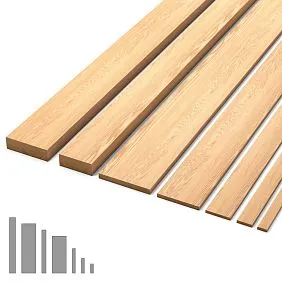
Decorative slats are solid wood planks of rectangular cross-section, mounted on a wall vertically, horizontally, or at an angle with a specific spacing. Typical cross-section sizes:
-
20×40 mm — thin slats for delicate decor, mounting spacing 3-5 cm
-
30×50 mm — medium slats, the most common size, spacing 5-8 cm
-
40×60 mm — thick slats for large rooms, spacing 8-12 cm
Slat length is typically 2000-2600 mm (to match standard ceiling heights). Wood species — oak (strength, expressive texture, warm color), ash (cool light shade, high hardness), pine (budget option, requires protective coating).
Our factory also produces:


Vertical or horizontal layout: visual effects
Vertical slats — the classic scheme. They visually raise the ceiling, create a sense of height, and slenderize the space. Vertical rhythm calms, organizes, and is suitable for rooms with low ceilings (2.5-2.7 m). Spacing between vertical slats — 5-10 cm. If the spacing is less than 5 cm, the wall looks too dense, heavy. If more than 10 cm, the rhythm is lost, and the slats appear disjointed.
Horizontal slats — a modern alternative. They visually widen the space, make the room feel more spacious, and are suitable for narrow rooms and corridors. Horizontal rhythm is more dynamic than vertical, creating movement of the eye along the wall. Spacing between horizontal slats — 10-20 cm (more than for vertical, otherwise the visual density is excessive).
Diagonal slats — an experimental option. Slats are mounted at a 30-45 degree angle, creating a diagonal pattern (herringbone, diagonal stripes, geometric patterns). Diagonal creates dynamism, visual interest, but requires precise calculation — angles must be identical, joints must be perfect.
Combined layout — vertical and horizontal slats on one wall, forming a grid or asymmetrical pattern. This is the highest level of skill, requiring design flair. An incorrect combination turns into chaos, a correct one — into a work of art.
Get Consultation
Accent wall or full coverage
Accent wall — slat cladding on one wall (behind the bed headboard, behind the sofa, behind the TV, in the wall section between windows). The other walls are smooth (painted or wallpapered). An accent wall draws attention, creates a focal point, without overloading the space. This is the optimal option for small rooms (15-20 m²).
Full coverage — slat cladding on all walls or on three walls (the fourth remains smooth). This creates the effect of a wooden box, total naturalness, characteristic of eco-style, Scandinavian saunas, log houses. Full coverage is suitable for spacious rooms (from 25 m²) with good lighting.
Partial coverage — slats only on the lower or middle part of the wall (a panel 100-150 cm high from the floor). The upper part of the wall is smooth. This is a compromise between an accent wall and full coverage, creating a horizontal structure that visually divides the wall into tiers.
Molding frames: polyurethane framing for slat panels
How to connect modern slats with classical tradition? How to transform slat cladding from a fashionable trend into an architectural element with weight, history, and context? The answer — polyurethane moldings framing the slat panels.
Why frame slats with moldings
Structuring — the first function. Moldings create boundaries for the slat panel, separate it from the rest of the wall, turning it into an independent element. Without framing, slats on a wall can look unfinished, random. With framing, they become a deliberate composition.
Connection with classicism — the second function. Moldings are a classic architectural element used for centuries. By framing modern slats with classic moldings, you create a dialogue between eras, styles, and approaches. This is eclecticism — when old and new work together.
Visual completeness — the third function. Moldings create a clear frame, a sense of completion, like a picture frame. Inside the frame — wooden slats (texture, rhythm, naturalness). Outside — a smooth wall (calmness, background). The contrast enhances the perception of both zones.
Options for positioning moldings around a slatted panel
Rectangular frame — the basic option. The slatted panel occupies a rectangular area (e.g., 200×150 cm). It is surrounded by a frame made of polyurethane molding, 60-80 mm wide. The molding is painted white or another contrasting color (if the slats are natural light wood, the molding is white; if the slats are dark stained, the molding can be gray). The frame corners are joined at 45 degrees (the classic method) or using corner rosette elements.
Double frame — a more complex option. Around the slatted panel are two frames: an inner narrow one (40-50 mm) and an outer wide one (70-80 mm). Between the frames is a 5-10 cm gap filled with a background of a different color or texture. The double frame creates depth and visual complexity.
Asymmetric frame — a contemporary technique. Moldings are placed not around the entire perimeter of the slatted panel, but only on two or three sides. For example: vertical moldings on the sides of the panel, a horizontal molding only at the bottom, the top of the panel remains unframed. Asymmetry creates dynamism and lightness, characteristic of modern interiors.
Moldings as an extension of the slats — an experimental option. The slatted panel is not framed with a separate frame; instead, the slats in the outermost rows are replaced with polyurethane moldings of the same cross-section, painted in a contrasting color. This creates a smooth transition from slats to moldings, without a sharp boundary.
Molding profile: simple or classic
For framing slatted panels, it is better to use simple molding profiles — rectangular or with one or two grooves. Complex classic profiles (with curves, scrolls, ornaments) will clash with the geometric nature of the slats. A simple profile creates a neutral frame that does not distract from the wood texture.
Molding width — 60-80 mm (medium). A molding that is too narrow (30-40 mm) will get lost against the background of the slats. One that is too wide (100-120 mm) will dominate, drawing attention. The golden mean is 60-80 mm.
MDF skirting board as the finishing touch for an eclectic composition
Any vertical composition needs a base — a floor skirting board that connects the floor with the walls, creates a transition, and sets the scale. In an eclectic interior, where slats and moldings are combined, MDF Skirting Board — is the optimal solution.
Why specifically an MDF skirting board
Paintability — the main advantage. MDF can be perfectly painted any color. In an eclectic interior, the skirting board is usually painted the same color as the moldings (white, gray, beige), creating unity among the framing elements. A wooden skirting board requires opaque paint to hide the grain, or it remains natural (then unity with the painted moldings is broken). An MDF skirting board is simpler — prime, paint, done.
Stability — the second advantage. MDF does not shrink or swell with humidity fluctuations. In winter, when humidity drops, a wooden skirting board may pull away from the wall, creating gaps. An MDF skirting board remains stable.
Price — the third factor. An MDF skirting board costs 2-3 times less than one made of oak or beech wood. When finishing an apartment of 60-80 m², the savings will be 10-20 thousand rubles.
Height and profile of the MDF skirting board for an eclectic interior
For an eclectic interior, a medium-height skirting board is recommended — 80-100 mm. It creates a stable base without dominating. A taller skirting board (120-150 mm) is characteristic of classic interiors with rich moldings; in eclecticism, it would be excessive. A lower one (60-70 mm) would get lost against the background of the slatted finish and moldings.
Skirting board profile — straight or slightly profiled. A straight profile (rectangular cross-section) suits the minimalist part of eclecticism (modern slats, minimalist furniture). A slightly profiled one (with one groove or a rounded top) suits the classic part (moldings, frames).
Skirting board color: unity with the moldings
In an eclectic interior, the skirting board is painted the same color as the moldings around the slatted panels. If the moldings are white, the skirting board is white. If the moldings are gray, the skirting board is gray. This creates a unified system of frames — skirting board at the bottom, moldings around the panels, ceiling cornice at the top (if present) — all in one color. Against this neutral background, the wooden slats (natural color or stained) and modern furniture stand out.
Modern furniture in an eclectic interior: minimalism supports the decor
What furniture to choose for an interior where modern wooden slats and classic polyurethane moldings coexist on the walls? The answer is minimalist modern furniture, which does not compete with the wall decor but serves as a calm, functional background.
Principles for choosing furniture for eclecticism
Simple shapes — the main principle. Sofas and armchairs of rectangular forms, without curved backs and plush armrests. Tables on simple legs (tapered, cylindrical, metal hairpin legs), without carving or decoration. Cabinets with smooth fronts, without overlays or milling. The simplicity of the furniture balances the complexity of the walls.
Low seating — the second principle. Sofas and armchairs on low legs (10-15 cm from the floor) or without legs at all (platform). Low furniture visually expands the space, makes ceilings appear higher, and does not block the wall decor.
Neutral colors — the third principle. Upholstery — gray, beige, white, muted blue, muted green. No bright, loud shades (red, orange, purple) that would compete with the wooden slats. Neutral furniture is the background; the accents are on the walls.
Materials — wood, metal, textile, glass. Wooden elements of the furniture (tabletops, legs, shelves) should be made from the same wood species as the slats on the walls, or a similar color. If the slats are light oak, the tabletops should also be light oak. This creates unity, linking the furniture and decor.
Examples of successful combinations
Living room: The accent wall behind the sofa is finished with vertical oak slats, framed by white polyurethane moldings. Sofa — gray, low, rectangular, on wooden oak legs. Coffee table — light oak tabletop on metal hairpin legs. Shelving unit — open oak shelves on a metal frame. Skirting board — white MDF, 100 mm high. Everything is coordinated: oak wood in the slats, table, and shelving; white color in the moldings and skirting board; gray sofa as a neutral background.
Bedroom: The wall behind the bed headboard is finished with horizontal ash slats (cool light shade), framed by gray moldings. Bed — low, without legs (platform), with a soft gray headboard. Bedside tables — made of light ash on metal legs. Wardrobe — smooth ash fronts. Skirting board — gray MDF, 80 mm high. Unity: ash in the slats, tables, and wardrobe; gray in the moldings, skirting board, and headboard.
Office: The wall behind the desk is finished with vertical slats of stained oak (dark gray), framed by white moldings. The desk features a dark oak tabletop on a metal frame. The chair has a modern design, made of metal and gray textile. The open shelving unit has shelves made of dark oak. The baseboard is white MDF, 100 mm high. The contrast between the dark wood and white framing creates a graphic, strict look suitable for a workspace.
Slat decor: geometric patterns and 3D effects
Slat finishing is not just about vertical or horizontal stripes. It offers the possibility to create geometric patterns, three-dimensional effects, and visual illusions. Let's explore several advanced techniques.
Diagonal herringbone
Slats are mounted diagonally at a 45-degree angle, alternating direction with each row to create a herringbone pattern. This adds dynamism and visual complexity, characteristic of parquet flooring. Diagonal herringbone is suitable for accent walls of small area (2-3 m²), as it can be overwhelming on larger surfaces.
Installing diagonal herringbone is more complex than standard vertical layout—each slat must be cut at an angle on both ends, and joints must be perfect. It requires a miter saw with precise angle settings and carpentry skills. But the result is impressive—the wall transforms into a three-dimensional pattern that plays with light and shadow.
Square grid
Slats are mounted vertically and horizontally to form a grid of squares (square sizes: 30×30 cm, 40×40 cm, 50×50 cm). Inside the squares, there can be a smooth surface (painted in a contrasting color) or smaller slats (creating additional texture). Square grid is suitable for modern interiors that value geometry, order, and rhythm.
Installing a grid requires precise calculation—square sizes must be consistent across the entire wall, and joints must be perfect. A hidden batten framework is used (horizontal battens are mounted on the wall, vertical slats are attached to them, followed by horizontal slats).
3D effect: volumetric slat panels
Slats are mounted at varying distances from the wall—some slats lie flush against the wall, others are set back 2-3 cm (using spacers), and some are set back 5-7 cm. This creates a three-dimensional relief, a volumetric panel that changes perception depending on viewing angle and lighting. The 3D effect adds visual depth, making the wall feel alive and dynamic.
Installing a 3D panel requires planning—determining which slats go at which level and how to secure the protruding slats (using metal brackets or wooden spacers). But the effect is worth the effort—the wall transforms from flat to sculptural.
Asymmetric compositions
Slats of different lengths, cross-sections, and colors are mounted asymmetrically—without strict rhythm, creating an abstract composition. This is the highest level of craftsmanship, requiring design intuition. Asymmetry can be chaotic (scattered slats without a system) or ordered (slats grouped into zones, creating balance). Ordered asymmetry is an art form, the result of many trials and errors.
Installing slat finishing and moldings: step-by-step technology
How to implement an eclectic interior in practice? A step-by-step guide from preparation to final painting.
Step 1: Planning and material calculation
Draw a scaled sketch of the wall. Indicate:
-
The slat finishing area (size, placement)
-
Spacing between slats (5 cm, 7 cm, 10 cm)
-
Framing with moldings (molding width, placement)
-
Baseboard at the bottom (height, color)
Calculate the number of slats: wall height divided by (slat width + spacing). For example: wall height 260 cm, slats 50 mm, spacing 70 mm. Number of slats: 260 / (5+7) = 21.6 ≈ 22 slats. Each slat length is 260 cm. If slats are supplied in 250 cm lengths, you'll need to add a 10 cm piece (joined in an inconspicuous place).
Calculate the amount of molding: perimeter of the slat finishing area plus 10% for cuts and joints.
Step 2: Wall preparation
The wall must be level (deviation no more than 5 mm over 2 meters), dry, and clean. If the wall is uneven, level it with filler or drywall. Paint the wall in the final color (the one that will be visible between the slats). Usually, this is a neutral shade—white, light gray, beige.
Step 3: Installing battens (for vertical slats)
For vertical slats, horizontal battens are needed—wooden blocks 30×40 mm, screwed horizontally to the wall with 50-70 cm spacing (3-4 blocks for a wall height of 260 cm). The blocks are leveled and secured with anchors. The battens create an air gap between the wall and slats (2-3 cm), improve sound insulation, and allow for hiding wiring.
For horizontal slats, vertical battens are needed. For diagonal slats—diagonal battens or a grid (horizontal + vertical).
Step 4: Installing slats
Slats are attached to the battens with finishing nails (30-40 mm) or countersunk screws. The first slat is installed level (vertical or horizontal) and secured. The second slat is placed at the specified spacing (measured with a template—a piece of plywood of the required width) and secured. Continue this process across the entire wall.
Fasteners are screwed into the middle of the batten (at the intersections with the lathing battens). The heads of finish nails are countersunk with a nail set, the holes are filled with wood putty and sanded. After finishing, the fastening points are invisible.
Step 5: Sanding and finishing the battens
After installation, the battens are sanded with 180-220 grit sandpaper (removing roughness, burrs, tool marks). Then they are coated with a protective finish:
-
Oil (Osmo, Biofa) — preserves the wood texture, enhances the natural color. Applied with a brush or cloth, rubbed in, excess is removed. Two to three coats with intermediate drying of 8-12 hours.
-
Varnish (polyurethane, acrylic) — creates a protective film, can be matte, semi-matte, or glossy. Applied with a brush or sprayer, two to three coats with intermediate sanding using 320 grit sandpaper.
-
Paint (opaque) — conceals the wood texture, colors to any shade. Used if tinted battens are desired (gray, black, colored). Primer, two coats of paint.
Step 6: Installing moldings
After completing the batten installation, polyurethane moldings are mounted. Mark the molding placement lines with a pencil (using a level). Cut the moldings to length with a miter saw, corners at 45 degrees. Apply polyurethane adhesive to the back of the molding, press it against the wall, hold for 30-60 seconds. Fill the joints with acrylic putty, sand. Paint the moldings with acrylic paint (two coats).
Step 7: Installing the baseboard
MDF baseboard is mounted with adhesive (liquid nails) or a combination method (adhesive + finish nails). Corners are joined at 45 degrees. After installation, fill the joints and holes with putty, sand, and paint the baseboard the same color as the moldings (two coats of paint).
Frequently Asked Questions: Eclectic interior without mistakes
Can battens be installed without lathing, directly on the wall?
Yes, if the wall is perfectly flat (deviation no more than 2 mm over 2 meters). Battens are glued with polyurethane adhesive or liquid nails. However, lathing is more reliable — it creates an air gap, compensates for wall unevenness, and allows battens to be removed without damaging the wall.
What spacing between battens should I choose?
For vertical battens — 5-10 cm. A 5 cm spacing creates a dense texture, almost a solid wall. A 10 cm spacing — a sparse, light texture. For horizontal battens — 10-20 cm (more than for vertical). For diagonal battens — calculated individually.
Do battens need to be treated with a protective finish if they will be indoors?
Yes, absolutely. Even indoors, wood collects dust, grease, and changes color from UV light. Minimum — two coats of oil. Maximum — three coats of varnish. Without protection, battens will darken and lose their aesthetic appeal within a year or two.
Can different wood species be combined on one wall?
Yes, but this is advanced work. For example: alternating light oak and dark walnut battens. But the colors must be coordinated, proportions precise. It's easier to use one species, varying the finish (natural oil, tinting, painting).
How much does it cost to implement an eclectic interior in a 20 m² room?
Approximately:
-
Wooden battens (1 accent wall 8 m²) — 50 battens at 2.5 m, 300 rub/piece = 15000 rub
-
Lathing (battens, fasteners) — 2000 rub
-
Oil for battens — 2000 rub
-
Polyurethane moldings (perimeter of the area 10 m) — 250 rub/m = 2500 rub
-
MDF baseboard (room perimeter 18 m) — 200 rub/m = 3600 rub
-
Adhesive, fasteners, putty, paint — 3000 rub
-
Total materials: 28100 rub
-
Labor (if hiring professionals): 20000-30000 rub
-
Total: 48000-58000 rub
How to care for lath paneling?
Wipe with a dry or slightly damp cloth once a week. Do not use aggressive cleaning agents. Renew the oil finish every 2-3 years (wipe down, apply a thin coat of oil).
Can an eclectic approach be used in classic interiors?
Yes, but with caution. Eclecticism is a mixing of styles. In a classic interior, slatted wall cladding can look alien if not framed by classic elements (moldings, cornices). Framing creates a bridge between the modernity of the slats and the classicism of the rest of the decor.
Where can I order custom-sized slats?
Many manufacturers offer custom-made slats (cross-section, length). The minimum order is usually 10-50 linear meters.
Conclusion: Create a unique space with STAVROS
An eclectic interior is the art of balance. Balance between modernity and classicism, between simplicity and decorativeness, between geometry and ornament. It is a space whereWooden planks for decorationcreate rhythm and texture, whereMoldings made of polyurethaneframe and structure, whereModern Furnitureserves as a functional background, where each element enhances the other. Such an interior is not created by chance — it is designed, calibrated, and realized with an understanding of the laws of composition, color, and proportion.
STAVROS is a leading Russian manufacturer of wooden products and polyurethane moldings with over twenty years of history. STAVROS creates materials for those who are not afraid to experiment, who value quality, who understand that a true interior is a fusion of tradition and innovation.
Wooden strips for wall decorationfrom STAVROS are made of grade A solid oak, ash, or pine, with precise cross-section (deviation no more than 0.3 mm), smooth sanding (180 grit), and straightness (deflection no more than 1 mm over 2 meters). The range includes slats with cross-sections of 20×40 mm, 30×50 mm, 40×60 mm, and lengths from 2000 to 2600 mm. Custom-sized slats can be manufactured to order.
Moldings made of polyurethanefrom STAVROS — over 150 profiles with widths from 30 to 200 mm, white factory primer, perfect geometry. Simple rectangular profiles for framing slatted panels, classic profiled ones for traditional decor — any task will find a solution.
MDF skirting boards for paintingfrom STAVROS — height from 60 to 150 mm, profiles from straight to classic, MDF density 760-850 kg/m³, emission class E1. Ready for priming and painting in any color.
Modern solid wood furniturefrom STAVROS — tables, chairs, shelves, executed in a minimalist style with clean lines, simple forms, and natural finishes. Furniture that does not compete with wall decor but supports it.
STAVROS professional consultants will help you select a set of materials for your eclectic interior: calculate the quantity of slats and moldings, recommend optimal sizes and profiles, and advise on installation and finishing technology. The company's website features detailed catalogs, examples of completed projects, and instructional articles. Delivery is available throughout Russia.
By choosing STAVROS, you choose creative freedom. You choose materials that allow you to realize any idea — from the strict geometry of vertical slats to complex three-dimensional compositions. You choose quality, tested by time, and a partner who understands your tasks.
Create interiors that tell stories. Where every wall is a canvas, where slats create rhythm, moldings create structure, and furniture creates function. Where modernity and classicism work together, enhancing each other. Trust the masters at STAVROS — and your home will acquire a unique, professional, inspiring appearance.