Article Contents:
- Planks and beams: where decoration, and where structure?
- Wooden planks on walls and in interiors: types and applications
- Types of planks: by thickness, width, and finish
- Wood species: oak and beech in planks and beams
- Regional demand and logistics
- Facade solutions: planks on the exterior
- Price and area calculation: optimizing purchase
- Conclusion: STAVROS company — planks for modern interiors

Wooden plankIt is not just a narrow wooden strip. It is an element that, over the past ten years, has transformed from a construction trifle into one of the main tools of modern interior design.wooden planks on the wallThey create relief where there was a flat surface, add rhythm where there was monotony, zone space without load-bearing partitions, improve acoustics without special panels. Planks work both as decoration and as structure simultaneously. Behind them, wires, wall irregularities, radiators are hidden. From them, partitions, screens, panels are assembled.Wooden boards in interiorIt is a universal material that works in any style: from Scandinavian minimalism to Japanese wabi-sabi, from loft to eco-style. But only if planks are chosen correctly: correct cross-section, correct wood species, correct finish, correct installation. An error in any of these parameters — and planks turn from an elegant solution into a crude DIY project.


Planks and beams: where decoration, and where structure?
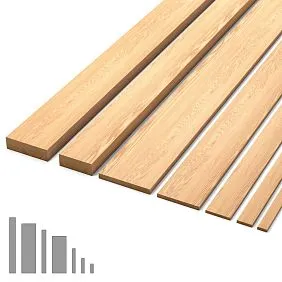
The difference between decorative planks and structural beams — lies in their purpose and requirements.Decorative wooden stripIt is intended for visual decoration: creating relief on the wall, dividing planes, zoning space. It does not bear load, works only on aesthetics. Requirements for decorative planks: precise geometry (straightness along the entire length, uniform cross-section), smooth surface (without scratches, without fuzz, ready for painting or transparent coating), high grade (minimum knots and defects, uniform texture). Cross-section is usually 20×10 mm, 40×20 mm, 60×30 mm — rectangular, where width is greater than thickness.
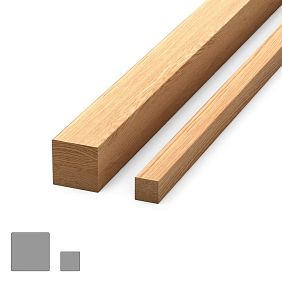
Structural beam is intended for load-bearing functions: frame for cladding, substructure, support, anchor for fasteners. It bears load, works under compression, bending, and holds fasteners. Requirements for structural beams: strength (wood species with high density, absence of critical defects such as through cracks), stability (low moisture to prevent drying and deformation after installation), sufficient cross-section (the thicker the beam, the greater the load). Grade is not critical (beam is hidden under cladding, it is not visible), surface does not necessarily need to be smooth (can be sawn, not planed). Cross-section is usually square or close to square: 40×40 mm, 50×50 mm, 60×60 mm.
wooden strips, beamsIt is an intermediate category, where the element performs both functions. For example, substructure for a plank screen: beams are mounted horizontally to the wall, forming a frame to which vertical decorative planks are attached. Beams work structurally (supporting planks), but partially visible (between planks, through gaps), therefore require decent finishing. For such tasks, beams with cross-section 40×20 mm, 50×30 mm — rectangular, where one side is wider (the wider side is attached to the wall, the narrower side — to the planks). Surface is planed, grade is medium (small knots are allowed, but not rotten or falling out).
They transform the wall into a dynamic surface that changes throughout the day.Wooden planks for decorationThey transform the wall into a dynamic surface that changes throughout the day.
Second function — zoning space without load-bearing partitions. A studio, where kitchen, living room, and bedroom are in one room, needs visual zoning. A load-bearing wall will consume area, block light, make the space cramped. A plank partition (frame of beams, clad with planks with gaps) visually divides space, but not physically: light, air, and view pass through gaps. Zones are separated, but not isolated.Wooden planks on walls and in interiorsThey work as a semi-transparent curtain that divides but does not isolate.
They improve acoustics. A smooth hard wall (concrete, plaster, tile) reflects sound, creates echo, reverberation, making the room echoey. Plank cladding with gaps partially absorbs sound (sound waves penetrate between planks, scatter), partially scatters (reflects off the textured surface at different angles, not creating a clear echo). The room becomes acoustically more comfortable: voices are not echoey, music does not resonate. Especially relevant for kitchen-living rooms, where there are many hard surfaces (tile, glass, metal) that amplify noise.Wooden planks for wall decorationIt is a budget alternative to acoustic panels.
They mask defects and utilities. A wall with irregularities, cracks, stains — it can be plastered, spackled, leveled. Or it can be clad with planks, which will hide all defects. Behind planks, wires, cables, pipes are hidden, which spoil the view. Behind planks, radiators are hidden, creating a decorative screen that allows heat to pass (through gaps), but hides the ugly radiator.Buy wooden planks for decorationClad and clad problematic walls — it is faster and cheaper than major renovation.




Wooden planks on walls and in interiors: types and applications
wooden planks on the wallThey are mounted in three ways. First — vertically, with gaps. Planks are attached to a horizontal substructure (beams attached to the wall), arranged vertically from floor to ceiling, with gaps between planks of 20-50 mm. This is a classic variant that visually raises the ceiling (vertical lines draw the eye upward), creates a clear rhythm, works in Scandinavian, Japanese, eco styles. Plank width is usually 40-60 mm, thickness 20-30 mm, gap equals plank width or slightly less (ratio 1:1 or 1.5:1).
Second method — horizontally, with gaps. Planks are attached to a vertical substructure, arranged horizontally, with gaps between planks. This variant visually expands the wall (horizontal lines draw the eye sideways), makes the room wider and lower. Suitable for narrow, high rooms where proportions need to be balanced. Plank width 20-40 mm, thickness 10-20 mm, gap 20-40 mm. Horizontal planks are used less frequently than vertical ones, but in loft styles, marine interiors, and rooms with low ceilings they are relevant.
The third way — diagonally, like a fir tree, in patterns. The boards are mounted at a 45-degree angle, forming rhombuses, zigzags, geometric patterns. This is more complex to install (more cutting, more joints, requires precise marking), but visually more impactful: it creates dynamism, movement, an accent wall. Suitable for one wall in a room (accent wall behind the bed, behind the sofa, behind the TV), not for the entire space (too many patterns will overload).Wooden planks on walls and in interiorsDiagonally — this is about creativity, boldness, non-standard solutions.
Wooden planks for wall decorationThey work not only on flat walls. From boards, you can make 3D structures: headboards (boards mounted on a frame behind the bed, creating a relief background), partitions (frame with boards dividing the room into zones), radiator screens (a box with a slatted facade hiding the radiator), projector screens (boards on the wall hiding the projector screen when rolled up).form the architecture of walls and ceilings, creating a play of light and shadow.In 3D structures — this is a transition from flat decoration to architectural elements.
Wall panels made of boards — a ready-made solution for quick installation. A panel is a 600×2400 mm or 1200×2400 mm sheet with boards already mounted with gaps. The panel is mounted on the wall as a whole; several panels next to each other form a continuous board covering. Advantage — speed of installation (one panel is mounted in 10-15 minutes), factory quality (boards are identical, gaps are even, processing is identical). Disadvantage — limited choice (board width, gap, color are set by the manufacturer), more expensive than installing individual boards (premium price for a ready-made product). Panels are suitable for standard tasks where speed is important.Wooden railsFor individual installation — for non-standard projects.
3D walls made of boards — a trend of the last few years. Boards are mounted not in one plane, but at different depths: some boards are closer to the main wall, others protrude further, creating a multi-layered relief. This is achieved using frames of different thicknesses or additional spacers between the board and the frame. Result — a wall with pronounced volume, which plays with light and shadow even more actively than a flat board covering. 3D walls are more complex to install (requires precise marking of the depth of each board), more expensive (more material, more work), but more impactful. Suitable for accent walls in living rooms, bedrooms, hallways.buy wooden lumberFor 3D walls, you need to allow for experimentation.
Our factory also produces:
Types of boards: by thickness, width, and finish
Planed wooden strip— a board processed on a planer, with smooth surfaces and precise dimensions. A planed board is ready for installation and painting, does not require additional processing (unless you plan for perfect smoothness for varnishing — then sanding is needed). A sawn board (after cutting, without planing) has a rough surface, saw marks, imprecise dimensions. It is 20-30% cheaper than planed boards, but requires additional processing (planing or sanding), which ultimately does not save time but adds work.Buy wooden skirting boardBetter than planed — this saves time and guarantees quality.
Thin wooden lathsThin boards — thickness 10-15 mm, width 20-40 mm. They create a light, graphic relief, do not overload the wall, suitable for small rooms where visual lightness is important. Thin boards are mounted with a frequent spacing (gap 20-30 mm), creating a dense texture. Disadvantage — less rigidity (thin boards may bend if longer than 2 meters), requires more frequent framing (boards with spacing 40-50 cm, not 60-80 cm as for thick boards). Advantage — less material consumption (thin boards are lighter, cheaper), less load on the wall.
Thick boards — thickness 20-40 mm, width 40-100 mm. They create a pronounced, large-scale relief, suitable for large rooms with high ceilings, where a strong visual accent is needed. Thick boards are mounted with a sparse spacing (gap 40-100 mm), creating a sparse but expressive texture. Advantage — high rigidity (thick boards do not bend even at 3 meters), requires sparse framing (boards with spacing 80-100 cm). Disadvantage — higher material consumption, greater weight, greater load on the wall.Oak wooden planks for wallsThickness 20-30 mm — optimal balance for most projects.
Board width affects the visual perception of rhythm. Narrow boards (width 20-30 mm) create a frequent, fragmented rhythm — many lines, high texture density. Suitable for Scandinavian style, where lightness and airiness are important. Medium boards (width 40-60 mm) create a moderate rhythm — noticeable but not dominant lines. Universal option for most styles. Wide boards (width 80-100 mm) create a sparse, strong rhythm — each line stands out, creates an accent. Suitable for loft, industrial style, where brutality and scale are important. Gap is usually chosen in proportion to board width: gap = width (ratio 1:1) or gap = 0.5 × width (ratio 2:1).
Surface finish of the board: un-sanded (after planing, smooth, but with small knife marks), machine-sanded (smooth, no marks, ready for painting or varnishing), hand-sanded (perfectly smooth, premium finish). For boards that will be painted with opaque paint, un-sanded or machine-sanded finish is suitable. For boards with transparent finish (oil, varnish), where wood texture is important to show, machine or hand sanding is needed.Price of wooden stripThe price increases with the quality of finish: un-sanded is 20-30% cheaper than sanded.
Get Consultation
— premium choice for board structures where natural wood texture is important to show. Oak has a clearly visible texture with large pores, contrasting growth rings, transitions between early and late wood. This texture is visible even on a narrow board 40 mm wide, especially with transparent finish (oil, varnish). Oak is hard (hardness 3.7-4.0 on Brinell scale), does not fear moisture (with proper treatment), does not deform, lasts for decades.
oak lumberPremium choice for lath construction, where showcasing natural wood texture is important. Oak has a distinctly visible grain with large pores, contrasting growth rings, and transitions between early and late wood. This texture is visible even on narrow 40 mm laths, especially with transparent finishes (oil, varnish). Oak is hard (Brinell hardness 3.7–4.0), resistant to humidity (when properly treated), does not warp, and lasts for decades.Decorative oak plank— 2-3 times more expensive than boards from other species, but this premium is justified by aesthetics and longevity.
Interior oak plank— used in interiors where oak is the main species: oak doors, oak parquet, oak furniture. Oak boards on the wall connect all these elements, creating visual unity. If a room has an oak floor, it makes sense to make one wall with oak boards — this emphasizes naturalness, eco-friendliness, material consistency. Oak boards are painted less often than beech or pine boards — oak texture is too beautiful to hide under paint. Usually covered with oil (emphasizes texture, protects from moisture) or matte varnish (protects, preserves natural appearance).
Beech parquet— a balance of price and quality. Beech is hard (hardness 3.8), almost does not fall short of oak in strength, but significantly cheaper (30-50% less). Beech texture is fine-grained, uniform, without clearly visible growth rings. Wood is light, pink-beige, calm. Beech is easy to process, gives a smooth surface, does not splinter, does not give chips. But beech is more sensitive to moisture than oak — it may swell when wet, and crack when drying. Therefore, beech boards are not suitable for humid rooms (bathrooms, saunas), but work excellently in living rooms, bedrooms, offices.
Solid beech parquet— popular for board screens in modern interiors. Beech is light, uniform, does not distract with texture, creates a calm background.Oak parquet— often painted (white, gray, black paint) — uniform beech texture accepts paint well, does not show contrasting spots, gives an even finish. For Scandinavian style, where light wood or white paint is preferred, beech is the optimal choice.Beech parquet for sale— 30-40% cheaper than oak, which, for large volumes (board covering a wall requires 50-100 linear meters), gives significant savings.
Oak beam— a premium-class structural element. Oak beams are used where not only strength but also visual value is important: visible beams on the ceiling, support columns in loft interiors, furniture frames where wood is not covered by cladding. Oak holds load better than pine, does not sag, does not crack under weight.Buy oak beams— expensive (price 3-4 times higher than pine beam of the same cross-section), but for visible structures, the premium is justified. An oak beam with cross-section 60×60 mm or 80×80 mm, covered with oil or varnish, looks like an element of high-end architecture.
Oak timber beam— an alternative to oak, 30-40% cheaper, but almost as strong. Beech beams are used as framing for board screens (if the framing is partially visible through gaps between boards, pine framing looks cheap, beech framing looks decent), as furniture frames, as supports under countertops.Beech beam for lathing— can be from 30×30 mm (for light structures, framing) to 80×80 mm (for support elements, beams). Beech beams hold screws more reliably than pine, do not split, do not give chips when drilling.
Comparison of species for boards and beams: pine — budget option, soft, easy to process, but has knots, resin pockets, non-uniform texture. Suitable for opaque paint. Price 150-250 rubles per linear meter for 40×20 mm boards. Beech — mid-range, hard, uniform, light. Suitable for painting or transparent finish. Price 250-400 rubles per linear meter. Oak — premium, hard, with pronounced texture, status. Suitable for transparent finish to show texture. Price 400-600 rubles per linear meter. Species choice depends on budget and whether texture will be visible (transparent finish) or hidden (opaque paint).
Regional requests and logistics
Wooden planks SPBSaint Petersburg is traditionally the center of wood processing, where dozens of manufacturers of boards and beams operate. Competition is high, prices are 10-20% lower than in Moscow, and the assortment is wider.buying wooden planks in St. PetersburgYou can order directly from the manufacturer, avoiding intermediaries. Many manufacturers have showrooms where you can see samples of boards of different cross-sections, different species, compare processing, and choose what suits the project. Manufacturers in St. Petersburg mainly work with northern timber (pine, spruce), oak and beech are imported, therefore more expensive. However, the quality of processing is high — traditions, skilled craftsmen, modern equipment.
Logistics of boards and beams from St. Petersburg to regions: boards are long-length (standard length 2-2.5 meters, up to 3 meters by order), requiring careful packaging and transportation. Large manufacturers package boards in stretch film in bundles of 10-20 pieces, place them on pallets, and deliver by truck. Delivery cost within St. Petersburg is 1500-3000 rubles (depending on volume), within Leningrad Oblast 2000-5000 rubles, to Moscow 5000-10000 rubles (depending on volume and urgency). For large volumes (over 200 linear meters), delivery is included in the price or offered with a discount. For small volumes (up to 50 linear meters), you can pick up yourself if you have transport.
Buy oak wooden planks for wallsOnline — a modern way to order that saves time. On the manufacturer's website, you choose the board cross-section (width × thickness), wood species (pine, beech, oak), processing (planed, sanded), length (standard or non-standard), quantity (linear meters or pieces). The website automatically calculates the material cost, delivery, and total amount. Payment is online or upon receipt, delivery to the site at an agreed time. The advantage of online purchasing — transparent pricing, time savings from traveling to warehouses, ability to compare offers from different manufacturers. The disadvantage — you can't see the material in person before purchase (but reputable manufacturers guarantee quality).
From a federal manufacturer with delivery to the region — this is a guarantee of quality and fair price.Buy wooden skirting boardFrom a federal manufacturer with regional delivery — this is a guarantee of quality and fair pricing.
Facade solutions: boards for the exterior
Facade strips imitation woodAdvantages of solid wood on facades: natural texture and color, warmth of natural material, eco-friendliness, possibility of repair (a darkened board can be sanded and re-coated with oil). Limitations: requires regular maintenance (re-coating with oil every 3-5 years), afraid of humid climates (in coastal regions where humidity is high year-round, wood deteriorates faster), more expensive than composite or metal alternatives (solid wood + processing + installation is 30-50% more expensive than composite). Solid wood facade boards made of oak or larch (species especially resistant to moisture), thermally treated ash, last 15-20 years with proper care.
Advantages of solid wood facade: natural texture and color, warmth of natural material, eco-friendliness, repairability (darkened laths can be sanded and re-oiled). Limitations: requires regular maintenance (re-oiling every 3–5 years), sensitive to humid climates (in coastal regions with year-round high humidity, wood deteriorates faster), more expensive than composite or metal alternatives (solid wood + treatment + installation cost 30–50% more than OSB). Solid oak, larch (a species especially resistant to moisture), and thermally treated beech facade laths last 15–20 years with proper care.
Combining facade boards with baseboards and window casings inside the building: if the facade is clad with wooden boards (solid oak or larch), it is logical to use the same species for interior elements — baseboards, window casings, slatted screens. This creates visual continuity between exterior and interior, demonstrates thoughtful project design, material unity. If outside is oak boards, inside is oak baseboards and window casings — this is coherence. If outside is oak, inside is plastic baseboards — this is a break, inconsistency. For private homes, where architecture and interior are designed as a single whole, combining facade and interior boards of the same species is a sign of high-quality project design.
Combining facade laths with baseboards and door casings inside the building: if the facade is clad with wooden laths (oak or larch), it is logical to use the same species for interior elements — baseboards, door casings, lath screens. This creates visual continuity between exterior and interior, demonstrates thoughtful design and material unity. If the exterior has oak laths, the interior should have oak baseboards and door casings — this is coherence. If the exterior is oak but the interior has plastic baseboards — this is a break, inconsistency. For private homes, where architecture and interior are designed as a single whole, combining facade and interior laths of the same species is a sign of high-quality design.
Price and calculation of linear meters: purchase optimization
Price of wooden stripHow to calculate linear meters for board cladding of a wall: the formula depends on the board width and gap width. Example: wall 4 meters wide, vertical boards, board width 40 mm, gap 40 mm (ratio 1:1). Width of one module (board + gap) = 40 + 40 = 80 mm. Number of modules on the wall = 4000 mm / 80 mm = 50 modules. Number of boards = 50 pieces. Wall height (board height) = 2.7 meters. Total linear meters = 50 boards × 2.7 meters = 135 linear meters. With allowances for waste and reserve (10-15%) = 135 × 1.15 = 155 linear meters. This is the number of boards for one 4×2.7 meter wall.
Waste from cutting boards: boards are sold as 2.5-meter planks. If wall height is 2.7 meters, each plank is cut to 2.7 meters, leaving a 0.8-meter offcut, which is unusable (too short for wall height). This means actual consumption is 20-30% higher than calculated. Solution: order non-standard 3-meter boards (cut to 2.7 meters, leaving a 0.3-meter offcut, part of which can be used for short sections). Or order 2.7-meter boards (custom order, minimum order 50 linear meters) — then offcuts are almost nonexistent, consumption is minimal. For large volumes (over 100 linear meters), ordering non-standard length pays off through material savings.
Waste from cutting laths: laths are sold in 2.5-meter planks. If wall height is 2.7 meters, each plank is cut to 2.7 meters, leaving a 0.8-meter offcut, which is unusable (too short for wall height). This means actual material consumption is 20–30% higher than calculated. Solution: order non-standard 3-meter laths (cut to 2.7 meters, leaving a 0.3-meter offcut, part of which can be used for short sections). Or order 2.7-meter laths (custom order, minimum 50 linear meters) — then offcuts are nearly nonexistent, material waste is minimal. For large volumes (over 100 linear meters), ordering non-standard lengths pays off through material savings.
Example budget calculation for board cladding of an accent wall: wall 4×2.7 meters, beech boards 40×20 mm, vertical, gap 40 mm. Board linear meters: 155 linear meters. Price of beech 40×20 mm: 320 rubles per linear meter. Board cost: 155 × 320 = 49,600 rubles. Lathing (pine 40×20 mm beams, horizontal, 60 cm spacing): 5 beams × 4 meters = 20 linear meters, price 150 rubles per meter = 3,000 rubles. Fasteners (self-tapping screws, dowels): 1,500 rubles. Finish (wood oil, 2 coats): 3 liters × 800 rubles = 2,400 rubles. Installation (if hired): 155 meters × 200 rubles per meter = 31,000 rubles. Total: 49,600 + 3,000 + 1,500 + 2,400 + 31,000 = 87,500 rubles. This is the full budget for board cladding of one 4×2.7 meter wall with beech.
Budget calculation example for lath cladding of an accent wall: wall 4×2.7 meters, beech laths 40×20 mm, vertical, 40 mm gap. Lath length: 155 linear meters. Price of beech 40×20 mm: 320 rubles per linear meter. Lath cost: 155 × 320 = 49,600 rubles. Framing (pine 40×20 mm beams, horizontal, 60 cm spacing): 5 beams × 4 meters = 20 linear meters, price 150 rubles per meter = 3,000 rubles. Fasteners (self-tapping screws, anchors): 1,500 rubles. Finish (wood oil, 2 coats): 3 liters × 800 rubles = 2,400 rubles. Installation (if hired): 155 meters × 200 rubles per meter = 31,000 rubles. Total: 49,600 + 3,000 + 1,500 + 2,400 + 31,000 = 87,500 rubles. This is the full budget for lath cladding of one 4×2.7-meter wall using beech.
STAVROS — boards for modern interiors
Wooden plank, wooden planks on the wall, Wooden railsThey work in any style, from Scandinavian to Japanese, from loft to eco-style. But only if the boards are of high quality: precise geometry (straight, uniform cross-section along the entire length), smooth surface (planed or sanded), low moisture content (8-12%, to prevent drying after installation), correct species (for the task: pine for painting, beech universal, oak for transparent finish).Wooden boards in interiorWork in any style, from Scandinavian to Japanese, from loft to eco-style. But only if the laths are quality: precise geometry (straight, uniform cross-section along the entire length), smooth surface (planed or sanded), low moisture content (8–12%, to prevent drying after installation), correct species (suitable for the task: pine for painting, beech universal, oak for transparent finishes).
Available in various cross-sections: from thin 20×10 mm to thick 100×40 mm, from different species (pine, beech, ash, oak), different processing (planed, machine-sanded, hand-sanded), different lengths (standard 2.5 meters, custom up to 3 meters).Wooden planks for decorationSTAVROS boards have geometry with tolerance ±0.3 mm — this guarantees that all boards are identical, gaps during installation are even, visually perfect. Wood moisture content 8-12% (kiln-dried) — guarantees that boards will not dry out or deform after installation.Wooden planks for wall decorationSTAVROS boards are available in three variants: untreated (for painting or lacquering on-site), with oil finish (emphasizes texture, protects, ready for installation), painted (white, gray, black paint, ready for installation).
form the architecture of walls and ceilings, creating a play of light and shadow.Premium species that showcase natural texture under transparent finish.oak lumber, Beech parquetStructural elements for lathing, frames, supports, where strength and visual value are important.Oak beam, Oak timber beamProduction on modern equipment (four-sided planers, multi-blade saws for cutting boards, sanding lines) guarantees precise cross-section, straight boards, smooth surface. Quality control at every stage eliminates defects, guarantees uniformity of the batch. Packaging in stretch film in bundles protects boards from damage during transport. Delivery to St. Petersburg, Moscow, all of Russia — by truck, on pallets, with guarantee of preservation.
Available from warehouses in St. Petersburg and Moscow (standard cross-sections in stock, dispatch within the day of order) or ordered directly from the factory (non-standard cross-sections, non-standard length, special processing, minimum order 50 linear meters).
Buy wooden planks for decorationWith linear meter calculation: STAVROS consultants will help calculate the number of boards for your project, account for waste, select optimal length to minimize waste.Buy oak wooden planks for wallsSTAVROS — boards for modern interiorsbuying wooden planks in St. PetersburgYou can see samples of all sections and species in the showroom, touch, compare, and choose.
For designers and architects, STAVROS offers a loyalty program: wholesale prices for orders over 100 linear meters, consultation on how to use planks in projects, 3D visualization of how planks will look in interiors, samples for client approval. For developers: supply of planks for standard apartments, agreed delivery times, payment deferral. For private customers: retail sales, assistance with calculations, installation recommendations, addresses of verified installers.
Contacts: phone 8 (800) 555-46-75, websitestavros.ruVisit our showrooms and warehouses listed on the website. Call, come by, order — STAVROS creates planks that transform flat walls into architectural reliefs, monotonous spaces into rhythmic ones, random interiors into thoughtfully designed ones.Lamellae, Planks, Wall PanelsMade from solid wood — an investment in quality, naturalness, and longevity of interior. STAVROS — planks that deliver results.