Article Contents:
- Mathematics of Beauty: Why Exactly 2700×16×40
- Length 2700 mm as an Architectural Standard
- Thickness 16 mm: Balance of Strength and Elegance
- Width 40 mm: Optimum Perception
- Technical Specifications and Engineering Calculations
- Mechanical Properties of the Structure
- Thermal Deformations and Their Compensation
- Load-Bearing Capacity of Fastening Systems
- Modern Methods of Oak Wood Processing
- Precision Dimensional Processing
- Geometry Control of Finished Products
- Packaging and Marking
- Application areas and design solutions
- Residential Interior Spaces
- Commercial interiors
- Special Applications
- Mounting and fastening technologies
- Foundation Preparation
- Mounting systems
- Features of Working with Long Elements
- Finishing and Protective Coatings
- MDF Base Priming
- Coating systems
- Decorative Effects
- Economic aspects of application
- Cost analysis
- Comparison with alternative materials
- Innovative technologies and prospects for development
- Digital Production Technologies
- Ecological innovations
- Functional additives
- Conclusion
Accuracy in dimensions determines the quality of the result. MDF Rail 2700x16x40 represents an ideal combination of optimal proportions and universal applicability. These specific dimensions — 2700 millimeters in length, 16 in thickness, and 40 in width — are not random; they have been refined through years of practice by architects and interior designers.
When every millimeter counts, when the accuracy of dimensions determines the harmony of the entire space, professionals choose materials with flawless geometry. These parameters have become a de facto industry standard due to their functionality and aesthetic appeal.


Mathematics of Beauty: Why Exactly 2700×16×40




Length 2700 mm as an Architectural Standard
The dimension of 2700 millimeters did not appear by chance. It is the result of the evolution of building standards and understanding of optimal proportions for living space. The standard ceiling height in modern construction is 2700–2800 mm, taking into account the thickness of flooring and suspended structures.
Usage MDF material Only at this length can you create seamless vertical compositions without joint seams. This is critically important for perception — the human eye instantly notices any breaks in vertical lines, which disrupts the integrity of the design.
When mounted horizontally, the length of 2700 mm ensures optimal coverage of standard openings. A typical room width of 3–4 meters is covered by one or two elements with minimal joints, simplifying installation and improving appearance.
Our factory also produces:


Thickness 16 mm: Balance of Strength and Elegance
A thickness of 16 millimeters represents the golden mean between visual lightness and structural strength. Thinner elements are prone to warping and deformation, especially at significant lengths. Thicknesses less than 12 mm create a risk of sagging under their own weight.
On the other hand, elements thicker than 20 mm begin to visually 'press down,' creating a sense of massiveness that is not always appropriate in modern interiors. A thickness of 16 mm provides sufficient depth of shadow line to create an expressive surface relief.
The section resistance moment of 16×40 mm is 4267 mm³, providing sufficient bending strength for most interior applications. Under a uniformly distributed load of 2 kg/m, deflection does not exceed 2 mm over a length of 2700 mm.
Get Consultation
Width 40 mm: Optimum Perception
A width of 40 millimeters corresponds to the psychological optimum for perceiving architectural elements. Studies show that elements with widths of 35–45 mm are perceived as harmonious and proportionate to the human form.
Narrower rails disappear into the interior, not creating sufficient visual impact. Elements wider than 50 mm begin to dominate, overpowering other interior details. A width of 40 mm provides the ideal balance between expressiveness and delicacy.
Technical specifications and engineering calculations
Mechanical properties of the structure
MDF Rail 2700x16x40 It possesses calculated characteristics that allow for its use in various design solutions. The bending strength limit is 22-28 MPa, depending on the material density.
The modulus of elasticity 2800-3200 MPa provides sufficient stiffness with minimal mass. The weight per meter is approximately 0.43 kg, creating a load on fasteners of 1.16 kg per element 2700 mm long.
The critical load for longitudinal bending is calculated using Euler's formula and amounts to 28.5 N for a simply supported element. In real mounting conditions with intermediate fasteners, this value is significantly higher.
Thermal deformations and their compensation
The linear expansion coefficient of MDF is 8-15×10⁻⁶ 1/°C. For an element 2700 mm long, with a temperature difference of 25°C, linear elongation will be 0.54-1.01 mm. These values are considered when designing fastening systems.
At locations of rigid fixation, compensatory gaps of 1-2 mm are provided. When using elastic fasteners, deformations are compensated by the natural flexibility of the system.
Humidity deformations are more significant and amount to 0.2-0.4% of linear dimensions for a 10% change in relative humidity. To control this parameter, it is recommended to maintain a stable microclimate in the room.
Fastening system load capacity
The calculation of the number of fastening points is based on load distribution and characteristics of the fasteners used. For MDF planks size 2700×16×40, it is recommended to use 4-5 fastening points when mounted horizontally.
A 3.5×35 mm self-tapping screw withstands a pull-out load of 350-450 N depending on the base density. A 6×40 mm anchor in concrete provides a load capacity up to 600 N. This creates a significant safety margin for interior applications.
For vertical mounting, 3 fastening points are sufficient, spaced 900 mm apart. The upper and lower points are located 200-300 mm from the ends of the element.
Production technologies and quality control
Precision dimensional processing
Achieving precise dimensions of 2700×16×40 mm requires the use of high-precision equipment and strict adherence to technological processes. CNC calibration-grinding machines ensure thickness tolerance of ±0.1 mm along the entire length of the blank.
Longitudinal cutting is performed on multi-blade saws with discs of 350-450 mm diameter. Material feed speed is 15-25 m/min at saw blade rotation speeds of 4000-6000 rpm. This ensures cut quality without chipping or gouging.
End cutting to size 2700 mm is performed on end-cutting machines with accuracy ±0.5 mm. The cutting angle is controlled with accuracy ±5', which is critically important for subsequent element joining.
Control of geometry of finished products
Each batch MDF rail for interior use undergoes selective geometric parameter inspection. Measurements are taken in three sections — 200 mm from each end and at the center of the element.
Deviations from nominal dimensions must not exceed ±0.3 mm in thickness, ±0.5 mm in width, and ±1.0 mm in length. Straightness is controlled using a string — deviation must not exceed 1 mm over the entire length of the element.
Material moisture is measured using a pin-type hygrometer at five points. Readings should not vary by more than 1%, and the average moisture content should be within the 6-9% range.
Packaging and labeling
Finished rails are packaged in packs of 10-20 pieces depending on the finish type. Each pack is marked with information on dimensions, production date, and batch number. This ensures product traceability and simplifies logistics.
Protective sheets are placed between elements to prevent damage during transportation. Ends are protected by special foam-polyethylene caps.
Areas of application and design solutions
Residential interiors
In apartments and houses Decorative MDF rails of size 2700×16×40 are used to create accent walls, space zoning, niche and opening decoration. Universal dimensions allow creating both solid surfaces and rhythmic compositions.
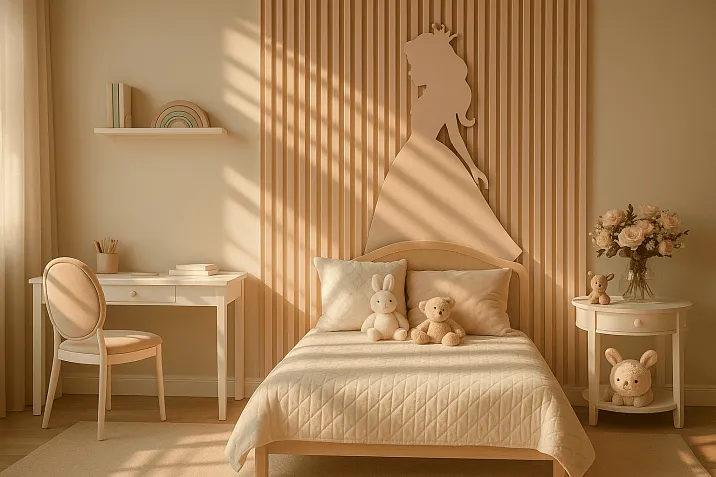
In bedrooms, it is popular to decorate the wall behind the headboard. Vertical rails create a sense of height, while horizontal rails expand the space. Integrated lighting adds intimacy and coziness.
Living rooms use slat structures to highlight media zones or fireplaces. The contrast between smooth walls and textured surfaces creates visual interest without overloading the interior.
Commercial interiors
Office spaces value slats for their ability to structure open areas. MDF laths for interior They create psychological boundaries between work zones without compromising the overall sense of openness.
Restaurants and cafes use slat structures to create a cozy atmosphere. The wooden texture adds warmth to the interior, and the ability to integrate lighting creates a unique ambiance.
Hotels use slats in corridor and public area finishes. Standard sizes simplify design and reduce project implementation costs.
Special Applications
Exhibition stands use the modularity of slat systems for quick assembly and disassembly. Standard length of 2700 mm corresponds to the height of most exhibition pavilions.
Acoustic solutions use perforated slats with sound-absorbing fill. Dimensions 16×40 mm provide optimal balance between decorative effect and acoustic properties.
The furniture industry uses slats to manufacture facades, shelves, decorative elements. Standardization of dimensions simplifies design and production.
Installation and Mounting Technologies
Foundation preparation
Quality installation of slats sized 2700×16×40 begins with careful preparation of the base. The surface must be cleaned of dust, grease stains, and remnants of old coatings. Base moisture is checked with an electronic moisture meter.
Irregularities exceeding 3 mm per meter require leveling. For mineral bases, gypsum or cement putty is used. Wooden bases are leveled with a hand plane or sander.
Marking is done with a laser level with ±1 mm accuracy. Base lines are marked with a chalk line and checked with a metal ruler. Deviations are corrected during the preparation stage.
Mounting systems
Clamp mounting ensures an ideal appearance of the finished surface. Clamps are milled into the end of the slat to a depth of 8-12 mm with ±0.2 mm accuracy. Guide profiles are mounted at intervals of 600-800 mm.
Countersunk-head screws are used when the surface is subsequently painted. Holes are drilled with a 2.5 mm diameter drill to a depth of 8-10 mm. Screw heads are countersunk 1-2 mm below the surface.
Adhesive bonding is used on perfectly flat bases. Polyurethane adhesive is applied in a zigzag pattern with a 200-300 mm spacing. Consumption is 200-300 g/m² depending on surface roughness.
Features of Working with Long Elements
Installation MDF plank finishing Elements 2700 mm long require at least two workers. Elements are supported at three points to prevent sagging under their own weight.
Temporary fasteners are installed at intervals no more than 1000 mm. Final fixation is performed only after checking the geometry of the entire structure. Position adjustment is possible within 15-20 minutes after installation.
Element joints are made with a 0.5-1.0 mm gap to compensate for thermal deformations. Gaps are filled with elastic sealant in the finish color after installation is complete.
Finishing and Protective Coatings
MDF Base Priming
The MDF surface has uneven absorption capacity, requiring mandatory priming before applying finish coatings. Acrylic deep-penetration primers are applied with a roller or brush in one to two coats.
Primer consumption is 100-150 g/m² per coat depending on material porosity. Drying time between coats is 4-6 hours at 20°C and 60% humidity. Intermediate sanding with P240 grit sandpaper improves adhesion.
Alkyd primers provide deeper penetration and better base isolation. They are especially effective when followed by oil-based paints and enamels. Full drying time is 12-24 hours.
Coating systems
Water-dispersible paints ensure environmental friendliness and ease of application. Acrylic formulations form an elastic film compensating for minor base movements. Consumption is 150-200 g/m² depending on coverage.
Alkyd enamels create a stronger, glossier finish. They are better suited for high-humidity or high-traffic areas. Drying time between coats increases to 8-12 hours.
Polyurethane paints provide maximum durability and chemical resistance. Two-component formulations form a coating hardness of up to 2H on the pencil scale. They are used in commercial interiors with high wear resistance requirements.
Decorative Effects
Patination creates an aged finish effect. A light base coat is covered with dark patina, which is partially removed from raised areas. This highlights surface relief and adds depth to the color.
Texture coatings imitate various materials – stone, fabric, leather. Structural pastes are applied with a trowel or roller, creating a relief surface. Subsequent painting highlights the texture.
Metallic coatings contain aluminum or bronze powder, creating a metallic sheen. They are especially effective under directional lighting and are often used in modern interiors.
Economic Aspects of Application
Cost analysis
Cost MDF strips 2700x16x40 Varies from 180 to 450 rubles per linear meter depending on material quality, finish type, and manufacturer. Standardization of dimensions reduces production cost by 15-20% compared to custom orders.
Installation costs account for 40-60% of material cost when using clip systems. Simple screw mounting reduces these costs by 30-40%, but requires additional expenses for finishing.
Operational costs are minimal due to the stability of MDF and quality coatings. Periodic repainting is required no more than once every 7-10 years for interior use.
Comparison with alternative materials
Natural wood of similar cross-section costs 3-4 times more and requires significantly higher maintenance and care. Risk of deformation and cracking creates additional operational costs.
Plastic profiles are 20-30% cheaper but lag behind in aesthetic qualities and durability. Limited finishing options reduce design potential.
Metallic profiles are comparable in cost to quality MDF, but require special anti-corrosion protection and create integration issues with fastening systems.
Innovative technologies and development prospects
Digital Manufacturing Technologies
Implementation of automatic quality control systems based on machine vision ensures 100% control of geometric parameters. Deviations from specified dimensions are detected in real time with accuracy ±0.05 mm.
RFID tags in packaging contain information about production date, batch number, and quality control results. This ensures full product traceability and simplifies logistics processes.
Predictive maintenance systems based on IoT sensors prevent failures and maintain consistent product quality. Machine learning algorithms optimize technological processes.
Ecological Innovations
Biodegradable binders based on soy protein and other plant components gradually replace synthetic resins. Full decomposition cycle under composting conditions is 18-36 months.
Use of recycled materials in MDF production reaches 40-60% of total raw material volume. Paper waste, textile scraps, sawdust create a closed production cycle.
Energy-independent production uses wood waste to generate steam and electricity. Modern boilers achieve up to 85% efficiency with minimal atmospheric emissions.
Functional Additives
Antibacterial additives based on nano-silver create surfaces that suppress growth of pathogenic microorganisms. Effectiveness is maintained throughout the material’s service life.
Fire-resistant compositions increase fire safety class to G1-G2. Special fillers release non-flammable gases upon heating, preventing flame spread.
Moisture-resistant additives reduce water absorption to 3-5%, enabling use in high-humidity areas without additional protection.
Conclusion
The evolution of interior design is inseparably linked to the development of technologies for producing decorative materials. MDF Rail 2700x16x40 It has become a symbol of this progress, combining the precision of industrial production with the aesthetic requirements of modern design.
Standardization of dimensions created the foundation for widespread use of quality decorative materials. Unification simplified design, reduced costs, improved installation quality. At the same time, design possibilities expanded further due to the variety of coatings and finishing methods.
Technological excellence in production processes guarantees stability of characteristics and predictable behavior of the material under various operating conditions. Automation of quality control eliminates human factors and ensures compliance with the strictest standards.
Environmental responsibility of modern production is reflected in the use of renewable raw materials, energy-efficient technologies, and closed recycling cycles. The future belongs to materials that are not only beautiful and functional, but also safe for the environment.
Economic efficiency of applying standardized solutions is evident at all levels – from production to operation. Optimization of logistics, simplified warehouse accounting, reduced installation costs create a synergistic effect of cost savings.
Future prospects are linked to integration of digital technologies, creation of smart materials, and expansion of functional capabilities. Materials of the future will become not just decorative elements, but active participants in creating a comfortable living environment.
The professional community of designers and architects highly values the quality of modern MDF strips and their alignment with current requirements. Predictability of properties, technological applicability, and wide creative possibilities make this material an indispensable tool in modern interior design.
STAVROS Company, with its long-standing experience and deep understanding of market needs, continues to set quality standards in MDF strip production. Every STAVROS product embodies the best traditions of industrial manufacturing, enhanced by innovative technological solutions, creating materials that serve as the foundation for implementing the most ambitious design projects and become a source of inspiration for creating spaces where technical excellence harmoniously combines with flawless aesthetics.