Article Contents:
- Magic of Proportions in Design
- Width 40 mm: The Golden Middle
- Length 2800 mm: Universality of Application
- Technological Superiority of MDF in Rail Production
- Microstructure and Physical Properties
- Advantages Over Alternative Materials
- Application Areas: From Conceptual Design to Mass Construction
- Implementation of Design Concepts
- Architectural expressiveness
- Production Technologies: From Raw Material to Finished Product
- Functional Solutions
- Raw Material Preparation and Forming
- Pressing and Thermal Treatment
- Mechanical Processing and Profiling
- Decorative Possibilities and Finishing Technologies
- Veneering and Laminating
- Coating systems
- Special Coatings
- Engineering Aspects of Application
- Load and Deformation Calculations
- Thermal Deformations
- Mounting Technologies: Professional Solutions
- Hidden Mounting Systems
- Comparative Economic Analysis
- Adhesive joints
- Mechanical connections
- Economic aspects of application
- Lifecycle Cost Analysis
- Standards and Technical Requirements
- Regional pricing characteristics
- Quality control and certification
- Functional Materials
- Testing methods
- Innovative solutions and development prospects
- Intelligent systems
- Regional Adaptation and Climatic Features
- Ecological innovations
- Humid Regions
- Northern Regions
- Southern Regions
- Architecture of Details Determines the Character of the Entire Space. In Modern Interior Design, There Is No Room for Accidents – Every Millimeter Matters, Every Line Is Thoughtfully Designed. That’s Why Professionals Choose
- Conclusion
rail 16 40 2800 MDF MDF Rail 16x40x2800 – an element that embodies the philosophy of precision in creating flawless interior solutions.
What lies behind these numbers? Why exactly these proportions have become a standard among leading design studios worldwide? The answer lies in a deep understanding of perceptual ergonomics and mathematical principles of harmony embedded in modern design.


Geometry of perfection: anatomy of size 16×40×2800




Magic of proportions in design
The size series 16×40×2800 mm is not random. The thickness-to-width ratio of 1:2.5 creates a visually balanced element that does not overload the space while still possessing sufficient expressiveness to form architectural accents.
Thickness of 16 mm ensures structural integrity without creating bulkiness. This parameter allows MDF slat to harmoniously integrate into various interior concepts – from minimalist Scandinavian to luxurious classical.
Our factory also produces:


Width of 40 mm: the golden middle
A width of 40 millimeters represents an optimal compromise between visual impact and practical application. This size is sufficient to create expressive shadow lines that structure the space, but not so large as to dominate the interior.
Perception psychology confirms: elements with a width of 35–45 mm are perceived by the eye as harmonious and proportionate to the human form. They create a sense of stability and order, without causing visual discomfort or a feeling of confinement.
Get Consultation
Length of 2800 mm: universality of application
The standard length of 2800 millimeters corresponds to the height of ceilings in most modern buildings, making MDF slat interior a universal solution for vertical compositions. This length minimizes the number of joints during installation, ensuring visual continuity of the structure.
Horizontal use of 2800 mm long slats allows covering standard openings without additional connections. This is critically important for creating continuous lines that visually expand the space and create a sense of monolithic finish.
Technological superiority of MDF in slat production
Microstructure and physical properties
MDF production is based on the principles of high-temperature pressing of wood fibers using natural and synthetic binders. The process temperature reaches 220°C, pressure – 45 MPa, creating a material with unique characteristics.
The density of the finished product is 720–780 kg/m³, ensuring an optimal balance of strength and workability. Uniformity of structure guarantees dimensional stability under varying temperature and humidity conditions during operation.
Advantages over alternative materials
MDF panel rail outperform natural wood in dimensional stability. The swelling coefficient is only 6–8%, which is three times less than that of solid wood.
Isotropy of properties – uniformity of characteristics in all directions – eliminates warping and cracking. The bending strength reaches 28–32 MPa, comparable to characteristics of coniferous wood species.
Application areas: from conceptual design to mass construction
Architectural expressiveness
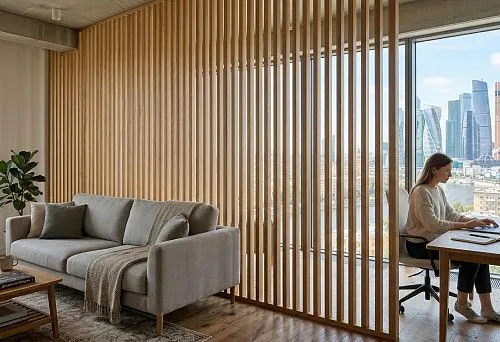
In the hands of a talented architect, the 16×40×2800 MDF slat becomes a tool for creating spatial compositions. Vertical installations form a rhythmic structure that sets the pace of interior perception and guides the viewer’s gaze.
Horizontal compositions create an effect of spatial stratification, dividing the space into functional zones without using load-bearing partitions. This approach is especially in demand in modern open-plan offices.
Implementation of design concepts
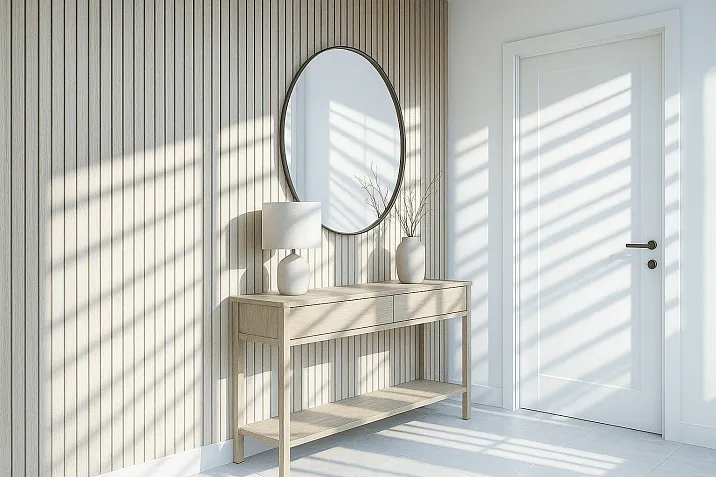
Scandinavian minimalism finds in finishing with MDF slats The ideal embodiment of its principles. Light tones and simple geometric shapes create an atmosphere of calm and functional beauty.
Industrial style uses contrasting combinations – dark slats against concrete surfaces or metal structures. Clear geometry emphasizes the technological nature of the space.
Eco-design values the natural texture of veneered slats, which imitate various wood species. Modern technologies allow achieving photographic-quality imitation at significantly lower cost.
Functional solutions
The acoustic properties of MDF make slats an effective tool for sound regulation. Perforated elements with a sound-absorbing backing layer create an acoustically comfortable environment in offices, restaurants, and concert halls.
Integration of LED systems transforms decorative slats into architectural lighting elements. RGB backlighting allows creating dynamic lighting scenarios adapted to various room functions.
Production technologies: from raw material to finished product
Raw material preparation and molding
Quality slats 16 40 2800 MDF is determined already at the stage of preparing wood raw material. Shavings undergo multi-stage cleaning from bark, metallic inclusions, and decay. Particle size is standardized within the range of 5–40 mm.
Defibration occurs in an atmosphere saturated with steam at a temperature of 175–185°C. This process activates natural lignin, which becomes an additional binding component, increasing the strength of the finished material.
Pressing and thermo-treatment
Panel molding occurs in multi-story presses with programmable temperature-time regimes. Pressure gradually increases from 15 MPa to maximum 45 MPa, eliminating delamination and internal stresses.
Cooling of panels occurs over 6–8 hours in special chambers with controlled convection. This process is critically important for forming a stable crystalline structure of the polymer binder.
Mechanical processing and profiling
Stock calibration is performed on grinding-calibration machines with accuracy ±0.05 mm. Such precision ensures ideal geometry of finished slats and minimizes gaps during installation.
Longitudinal sawing is performed using disk saws with hard-metal inserts. The cut quality is characterized by surface roughness Ra not exceeding 6.3 micrometers, ensuring ideal adhesion of finish coatings.
Decorative possibilities and finishing technologies
Coating systems
Modern painting technologies allow creating coatings with unique properties. Polyurethane enamels provide hardness up to 2H on the pencil scale, guaranteeing resistance to mechanical damage under intensive use conditions.
Powder coatings create an especially strong protective-decorative layer. Electrostatic application ensures uniform coating thickness ±5 micrometers, and polymerization at 180°C forms a super-strong surface.
Veneering and laminating
Natural veneer of 0.6–1.2 mm thickness provides MDF slat for interior an elegant look of premium wood species. Oak, beech, walnut, wenge – each species has a characteristic texture and color palette.
Vacuum pressing technology ensures perfect adhesion of veneer to the base. Absence of air inclusions guarantees long-term durability of the joint and resistance to delamination.
Special coatings
Antibacterial coatings with silver nanoparticles create surfaces that suppress the growth of pathogenic microorganisms. The effectiveness of action is maintained throughout the entire service life of the product.
Self-cleaning coatings based on photocatalytic additives break down organic contaminants under light exposure. Such surfaces are especially relevant in public spaces with high usage intensity.
Engineering Aspects of Application
Load and Deformation Calculations
When designing structures from Decorative MDF rails all active loads must be considered. The self-weight of a 16×40×2800 rail is approximately 1.45 kg, creating a uniformly distributed load of 5.2 N/m.
The modulus of elasticity of MDF is 3200-3800 MPa, allowing calculation of deflections using classical formulas of structural mechanics. The maximum deflection of a freely supported beam 2800 mm long under its own weight is 0.3 mm.
Thermal Deformations
The linear expansion coefficient of MDF is 9×10⁻⁶ 1/°C. A 2800 mm long rail under a 30°C temperature difference will elongate by 0.75 mm. Such deformation is accounted for in the design of fastening systems.
Humidity deformations are more significant. A 10% change in relative air humidity causes a linear dimension change of 0.8–1.2 mm per meter of length. Compensation devices are installed every 5–6 meters.
Installation Technologies: Professional Solutions
Hidden Fastening Systems
Modern clip systems provide invisible attachment of rails to load-bearing structures. Stainless steel clips withstand a load of up to 150 N per fastening point, ensuring reliable fixation.
Magnetic fastening systems are used for quick-disconnect structures. Neodymium magnets provide a holding force of up to 25 kg per square decimeter of contact area. Such systems are indispensable for exhibition stands and temporary installations.
Adhesive Joints
Structural polyurethane adhesives create joints stronger than the material itself. The shear strength of the adhesive joint reaches 12–15 MPa, exceeding the tensile strength of MDF perpendicular to the panel plane.
The thixotropic properties of modern adhesives prevent sagging on vertical surfaces. A 15–20 minute setting time allows adjustment of element positions during installation.
Mechanical Connections
Self-tapping screws with partial thread provide optimal connection of rails to wooden structures. The pre-drilled hole diameter is 70–80% of the screw diameter to prevent cracking of MDF.
Conformers are used for detachable joints in furniture structures. The special thread geometry provides high load-bearing capacity — up to 800 N for pulling out from the end of a 16 mm thick MDF.
Economic Aspects of Application
Life Cycle Cost Analysis
Initial costs for MDF rail 2700 account for only 20–25% of total costs for interior creation. Main expenses are allocated to design, preparatory work, installation, and finishing.
The service life of quality MDF rails in interior conditions is 18–25 years when operating recommendations are followed. The depreciation rate is 4–5% per year, significantly lower than many alternative finishing materials.
Comparative Economic Analysis
Natural wood of similar quality costs 3–5 times more than MDF rails. Additionally, maintenance and care requirements are significantly higher, and dimensional stability is lower.
Plastic rails are 15–20% cheaper, but they are inferior in aesthetic qualities and tactile feel. Their service life is 2–2.5 times shorter, which negates the initial cost savings.
Regional Pricing Characteristics
Material costs vary depending on the region. In central Russia, prices are 15–20% higher than the average Russian level due to high demand concentration. In regions distant from production centers, transportation costs are added.
Seasonal demand affects pricing. Peak demand occurs during spring-summer, when prices may increase by 8–12%. Planning purchases for the autumn-winter period can save up to 10% of the project budget.
Quality Control and Certification
Standards and technical requirements
The production of MDF is regulated by GOST 32289-2013, establishing requirements for physical and mechanical properties, dimensional accuracy, and formaldehyde emissions. The European standard EN 622 additionally regulates moisture resistance and resistance to cyclic loads.
E1 emission class limits formaldehyde emission to 0.124 mg/m³ of air. Modern moldings are produced with E0 emission class – less than 0.05 mg/m³.
Testing Methods
Flexural strength is determined on samples measuring 50×300 mm at a loading speed of 10 mm/min. Tests are conducted under normal climatic conditions – temperature 20±2°C, relative humidity 65±5%.
Thickness swelling is determined after 24-hour immersion of samples in distilled water at a temperature of 20±1°C. Quality MDF shows swelling not exceeding 8% for a sample thickness of 16 mm.
Innovative Solutions and Development Prospects
Intelligent Systems
Integrating humidity and temperature sensors into the rail structure enables the creation of adaptive interior systems. Data is transmitted to the building’s central control system via wireless Zigbee or LoRaWAN protocols.
LED strips integrated into the rail grooves create uniform architectural lighting. Color and intensity control is performed via mobile applications or smart home systems.
Functional Materials
MDF composites with carbon nanofibers exhibit enhanced strength and electrical conductivity. Such materials can be used to create anti-static surfaces in rooms with sensitive electronic equipment.
Incorporating microcapsules with fragrances creates surfaces with prolonged pleasant scent release. Activation occurs upon mechanical impact or temperature change.
Ecological Innovations
Biodegradable binders based on soy protein and other plant components gradually replace synthetic resins. Such materials fully degrade under composting conditions within 18–24 months.
Using fast-growing plant species – bamboo, hemp, flax – as fibrous fillers reduces pressure on forest resources. The raw material regeneration cycle shortens from 25–30 years to 1–3 years.
Regional Adaptation and Climatic Features
Northern Regions
In conditions of low temperatures and high humidity, MDF rails with enhanced moisture resistance are used. Paraffin emulsions reduce water absorption to 3–5%, preventing deformation under humidity fluctuations.
Frost resistance is achieved by modifying the binder system with special plasticizers. Such materials retain elasticity down to -45°C without cracking or delamination.
Southern Regions
High temperatures and intense UV radiation require the use of special stabilizers. Titanium dioxide and organic UV absorbers prevent polymer binder degradation and coating discoloration.
Thermally resistant coatings based on silicon-organic polymers withstand heating up to 120°C without color or mechanical property changes. Such coatings are especially important for elements located near heat sources.
Humid Regions
Hydrophobic impregnations create a water-repellent barrier on the MDF surface. Silicone emulsions penetrate to a depth of 2–3 mm without altering the material’s vapor permeability. The water contact angle increases to 110–120°.
Biocidal additives prevent mold and fungal growth under high humidity. Active components slowly migrate to the surface, providing long-term protection for 8–10 years.
Conclusion
The path from conceptual idea to realized project passes through numerous technical solutions and creative compromises. MDF Rail 16x40x2800 Represents the evolution of building materials, embodying the achievements of modern technology and a deep understanding of interior design needs.
Accuracy of geometric parameters opens up boundless possibilities for architectural creativity. Dimensions 16×40×2800 mm are not random – they reflect years of application experience and understanding of visual space perception laws.
Technological excellence in MDF production ensures material quality stability and predictable properties. Modern control and certification methods guarantee compliance with the strictest international safety and ecological standards.
Economic efficiency is manifested not only in affordable cost but also in long-term operational prospects. Minimal maintenance requirements and high durability ensure rapid investment payback.
Innovative development directions open new application horizons. Integration of intelligent systems, use of functional additives, development of eco-friendly technologies define the future of the decorative materials industry.
Regional adaptation of technologies enables successful application of MDF rails in any climatic conditions. Special material modifications account for operational specifics and ensure reliability under extreme conditions.
Professional approach to design and installation guarantees realization of the most daring design concepts. Proper selection of fastening systems, adherence to technical requirements, and high-quality execution of work – the foundation for creating interiors that become a source of inspiration and pride for their owners.
Company STAVROS, with its rich experience and continuous pursuit of perfection, remains a leader in producing high-quality decorative materials. The combination of traditional craftsmanship with modern technologies, strict quality control at all production stages, and individual approach to each project make STAVROS a reliable partner for architects, designers, and builders creating interiors of tomorrow.